
Chapter 3 of Nelson Goodman’s influential book Languages of Art begins with a quote from art critic Aline Saarinen:
The most tantalizing question of all: If a fake is so expert that even after the most thorough and trustworthy examination its authenticity is still open to doubt, is it or is it not as satisfactory a work of art as if it were unequivocally genuine?139
This issue has been a challenge for art scholars since the Renaissance, and particularly over the last half-century philosophers have wrestled with it. The shorthand term that has been adopted for the type of artwork Saarinen describes is “perfect fake.” Her way of putting it invites discussion of two related yet distinct concerns: whether there can be such a thing as a perfect fake, and if so, what its value is, with that value conceived as a matter of aesthetics rather than economics.
The possibility of a perfect fake has drawn attention in theoretical and practical terms. Are there fakes so excellent that they are impervious to detection? Both yes and no have been confidently asserted. Is it possible for there to be an artwork that mimics another work, or a particular artist’s style, in every way? Here, the issue of a work’s form versus its context is important, with answers differing about what factors count in assessing it. Do those factors extend beyond physical features that can be perceived to also include information regarding the artist’s intention and observers’ knowledge and insights? What is the aesthetic worth of a fake so good that it fools many people, including experts, with its falsity known only to the artist who made it and perhaps the party who sells or displays it? This point pertains not only in the immediate circumstance of viewing the work but also to its function in art history.
In the seventeenth and eighteenth centuries, as connoisseurship became popular and its practitioners developed expertise, speculation arose about the possibility of a perfect copy. Several authors made significant statements about whether such a work existed or could exist, and about what its aesthetic significance would be. Much of the discussion addresses duplicates of existing works, but the points made often could be applied to stylistic copying as well. Giulio Mancini’s treatise on painting asserts that each artist has a unique style that is evident especially in features such as hair, beards, and eyes, and he compares the individuality found there to the distinctive movements found in each person’s handwriting. Good connoisseurs are able to apply their knowledge of styles to spot copies, although on occasion they may be fooled, and viewers with less expertise are more susceptible. Mancini shows admiration for excellent reproductions done by master painters that go unnoticed while masquerading as originals, and for support he cites the opinion of the Grand Duke Cosimo de’ Medici that copyists are doubly skilled:
And for myself, I certainly wish to be deluded by such eminent men, and of such copies I truly believe what the Grand Duke of Tuscany said about them: that there are two arts in them, the one belonging to the author and the other to the copyist, and that they really are gems among paintings.140
Among theorists more skeptical of connoisseurs’ capabilities to detect copies is Jean-Baptiste Du Bos, who disputed the comparison of artists’ styles to individuals’ handwriting. Painters, he noted, can rework their strokes, whereas written words are not adaptable in this way, so painters hold a great advantage in mimicking someone else’s stylistic peculiarities. On the other hand, he emphasized that artists often copy their own works without being entirely faithful to the original, a factor pointing to the difficulty of copying imperceptibly.141 Roger de Piles expressed confidence that connoisseurs are often able to distinguish copies from originals, but specified that skillful copies made in the same time period as an original are puzzling even to the best experts. In his book about the idea of a perfect painter, he recites Vasari’s story about Del Sarto copying a Raphael painting that was verified by Giulio Romano. When Romano later learned of the duplicity, he announced that given the excellence of the painting, he valued it as much as if it had been done by Raphael himself.142 Here, again, is respect for the quality of a well-executed copy that estimates its aesthetic worth to be on par with an original.
Lengthier discussions of copying are found in the writings of Abraham Bosse and Jonathan Richardson. Bosse’s treatise on connoisseurship declares against the possibility of a perfect copy: “As the painter who imitates nature never comes to its same perfection, so the copyist never makes his copy to the perfection of the original.”143 Given the status of a copy as secondary, coming after an original, it is bound to lose out in the process of imitation. A second statement from the same writing hedges just a bit by suggesting that there may be a few copies that escape detection: “I am aware that there are few copies and not at all that may be preferable to their original, to pass through the eyes of connoisseurs for other than what they are.”144 As with Mancini, Bosse likens the analysis of artists’ styles to the process scribes use to recognize handwriting styles. When copyists imitate originals, they are unable to overcome limitations that include the way they depict various bodily features such as eyes, ears, hands, and feet. Brushstrokes are different on copies, and there is an overall stiffness and flatness. Other obstacles are the use of materials different than those used by the artist being imitated and colors that age into tones that do not match what is found on originals.145
Bosse did not claim that all copies are in fact recognized, and he believed that the necessary expertise to spot copies consistently is held only by a few people who understand the techniques of painting and also are knowledgeable about the works and styles of various painters. However, in his view, experts do hold the capacity to assess any work in question to determine its status as an original or a copy. This is also the position of Jonathan Richardson. His Essay on the Whole Art of Criticism as It Relates to Painting and An Argument in Behalf of the Science of a Connoisseur offer a detailed examination of copying and the role of connoisseurs in attribution and authentication. He holds that even if there were indistinguishable copies, an existence he does not believe in, they would be so rare as to be insignificant. Skilled connoisseurs hold the upper hand over copyists.
The best counterfeiter of hands cannot do it so well as to deceive a good connoisseur; the handling, the colouring, the drawing of the airs of heads, some, nay, all of these discover the author. . . . Tis impossible for any one to transform himself immediately, and become exactly another man.146
Richardson notes that no two people in the world think and act alike since each comes from a unique set of causal circumstances, and regarding physical performance, he says painting styles are like voices (as well as handwriting) in distinguishing one person from another. The constant features in a copyist’s style cannot be fully overcome, and “if he attempts to follow his original servilely, and exactly, that cannot but have a stiffness which will easily distinguish what is so done from what is performed naturally, easily, and without restraint.”147 And going further than Bosse regarding a copy as secondary to nature, he states that “an original is the echo of the voice of nature, a copy is the echo of that echo.”148 This is not only because human hands are incapable of executing perfectly in copies what is in their minds, but also because the model in their minds is a lesser, defective version of nature from which it is taken. Richardson invokes God in the background as the sole source of perfection in suggesting an ontological difference in a copy in contrast with an original, in addition to the less-than-perfect level of skill involved in making it. In other words, a copy is lacking not only in the way it is made but also in the metaphysical category to which it belongs. Finally, in keeping with his thinking about levels of perfection, Richardson introduces two ideas that show respect for copies despite his insistence on their inferiority. A copy done by an artist of talent superior to that of the artist who made the original may be better than the original. So although in theory copies are subordinate to originals, in practical terms it makes sense to recognize some that surpass the quality of what they imitate. And regarding the few cases of superior copies Richardson is willing to say may exist, he contends,
If ‘tis doubtful whether a picture, or a drawing is a copy, or an original, ‘tis of little consequence which it is; and more, or less in proportion as ‘tis doubtful: if the case be exceeding difficult, or impossible to be determined ‘tis no matter whether ‘tis determined or no; the picture supposing to be a copy must be in a manner as good as the original.149
In accordance with the notion of degrees of perfection, an indiscernible copy achieves aesthetic value equal to that of the work it imitates.
The ideas from art history summarized here regarding the concept of the perfect fake carry through in the writings of more recent theorists where they take on variations and complexity. What was said before about copies, often conceived of as legitimate productions, is now applied to forgeries. In two important points of focus for connoisseurs, we are told that forgers are betrayed by a lack of freedom in their execution as well as by personal mannerisms in their own individual styles, neither of which can be avoided. For these reasons, as well as one added in recent times, fakes are said to always be subject to detection even if some manage to avoid the scrutiny that would reveal them. The principle that is added introduces the factor of time: fakes inalterably bear the aesthetics of the era when they were made, which, if not recognizable during that time, will be a giveaway in the future. All three of these ideas are open to criticism, but they have been spoken for by noted art historians and other art experts. Likewise with perspectives on the quality and aesthetic value of fakes, as views range from their worthlessness to equivalence or near equivalence to originals.
In the mid-twentieth century, the assertion that time will reveal fakes was supported by noted art historians. Hans Tietze was a proponent of this view: “Seen from a safe distance, all productions of a given period fall in line . . . not only the style of the period, but also the personal style of gifted forgers cannot be suppressed in the long run and history will betray their productions.”150 There is something about the look of any fake from a given era that will reveal it as being from that era, although neither artists nor viewers during the era will recognize what constitutes that look. Recognition comes only later on. Max Friedländer, in Art and Connoisseurship, sums up:
Since every epoch acquires fresh eyes, Donatello in 1930 looks different from what he did in 1870. That which is worthy of imitation appears different to each generation. Hence, whoever in 1879 successfully produced works by Donatello, will find his performance no longer passing muster with the experts in 1930. We laugh at the mistakes of our fathers, as our descendants will laugh at us.151
And to capitalize on the public relations value of a catchy metaphor, Friedländer coined an expression that is quoted occasionally in the literature of art forgery: “Forgeries must be served hot, as they come out of the oven.”152
What Friedländer declares assertively, philosopher Nelson Goodman expresses in a nuanced view. Rather than stating outright that forgeries will be spotted over time, he notes that it cannot be proven that this will not happen. What sort of proof could be given, he asks? Considering hypothetically an original artwork and a forgery (direct copy) of it, “I can never ascertain merely by looking at the picture that even I shall never be able to see any difference between them.”153 Another statement, which would be applicable for stylistic forgeries as well, holds that “distinctions not visible to the expert up to a given time may later become manifest even to the most observant layman.”154 Again, “When van Meegeren sold his pictures as Vermeers, he deceived most of the best-qualified experts. . . . Nowadays even the fairly knowing layman is astonished that any competent judge could have taken a van Meegeren for a Vermeer.”155 With Goodman’s formulation of the point, as well as with Friedländer’s, the notion of a perfect fake is challenged. Over time, a different way of seeing artworks that comes with a new era overrides the status of indistinguishability. If the temporal factor does not assure that fakes will always be discovered, there is at least the potential for that to happen with any fakes, and the notion of perfection in forgery is nullified.
The confidence that time reveals forgeries—that the fresh perspective of knowledgeable viewers in the future will see what is not seen in the present—faces objections. One is that it fails to account for forgeries done of artists who live in the same era as their forgers. A forger of a twentieth-century artist will be influenced by the same general twentieth-century perspective in artistic understanding as that of the artist. There will not be inappropriate features unconsciously incorporated in the forger’s product based on a lack of understanding of the norms of the time in which the artist lived. This point is supported by considerable evidence. There is a large output of fakes by twentieth-century forgers who have simulated artists of the same era. Picasso, Dalí, Chagall, Giacometti, Dufy, and other masters of that time were favorites among some of recent history’s most notorious forgers: De Hory, Stein, Tetro, Ribes, Jansen. Whatever tripped them up to reveal their deception, it was not a lack of understanding of the time in which the artists they faked lived and worked. And what holds for twentieth-century forgers holds also for those of earlier times whose target artists were their contemporaries. Seventeenth-century forgers were not out of sync with the artists of their own era, and so on. The march of history continues an accumulation of fakes made by contemporaries of the artists they targeted, which, because they were made in accordance with an understanding of the aesthetics of their day, are not subject to the pitfall of anachronism.
A second problem with the temporal argument is that time not only reveals fakes but also strengthens their deception. When a fake is accepted as an original, it influences the understanding experts have of the target artist’s manner. They build what they see in the false work into their conception of what constitutes originality, and with more fakes by the same forger that bear the same characteristics unnatural to the artist, the look of an original by that artist becomes permanently distorted. Future generations of experts will see the faulty reading of what constitutes originality for the artist and accept it. For instance, consider a forger who regularly places atypical fingernails on portraits attributed to a master. If the forgeries are accepted as genuine, in the future that characteristic will be recognized as a legitimate variation for the master. Or perhaps the variation is not a matter of technique but of a color. A shade of green not used by an artist may become accepted once a forger uses it successfully. Subject matter, too, may be affected by forgers. If a fake painting of a yacht is discovered bearing the signature of a famous marine artist known for military vessels and clipper ships but never pleasure craft, and it gets past experts because it is well executed in the style of that artist, the subject will be accepted in the future as within the artist’s range. Once that happens, more fakes of yachts by the artist may turn up. A variation on this sort of strategy was employed by Van Meegeren with his Supper at Emmaus, which fooled many experts until he revealed himself as the painter. Had he not confessed, he may have convinced the art world that Vermeer’s works not only included a period during which he made religious paintings, but that they were stylistically different than was known for Vermeer. Among other factors, the faces of the figures were unlike any painted by Vermeer and instead bore a pale, ethereal cast. The odd appearance of Van Meegeren’s Vermeers that Goodman and others have said is so obvious had already been explained away by the forger’s ruse. The oddity was easy to point out, not only later but also when the painting was first viewed, and some observers at the time declared it a fake. But without the forger’s confession, inertia from experts who believed the work was genuine may have held the upper hand and carried through time. An obvious anomaly, then, could become accepted as mainstream and be passed along through generations as having the endorsement of past experts, with the likelihood of discovering the truth less probable rather than more probable as time moves on.
Besides the temporal argument, the other main points of confidence about detecting fake artworks are that those works display an awkward and unnatural execution and that their makers cannot escape incorporating some of their own individual mannerisms into what they create. Friedländer tells us about copyists (saying that what holds for them holds for forgers as well, with the added factor of deceit) that they are necessarily different than artists making original works: “The servitude and duty of the copyist’s task stamp his performance with the character of subordination and lack of freedom; that his mental attitude . . . is essentially different from that of the creative artist.”156 Restricted by attitude, “the copyist draws warily . . . incapable of achieving the boldly flowing sweep of the archetype,”157 and “deliberation and consciousness reveal themselves in artistic form as a lack of life or else hesitation.”158 Here is the stiffness in execution referred to by Bosse and Richardson. And their emphasis on the individuality of each artist’s style, including copyists, is echoed as well in the twentieth century. According to Otto Kurz, “Even the most adaptable talent, the most perfect imitator, has his own personality, however slight it may be, he has his own distinctive inflection.”159 In his handbook on art forgeries, art and antiques expert George Savage relates the recognition of forgeries through individual artists’ styles to fingerprint analysis:
The manner in which the paint was applied, however, and the handling of small details, is never the same from one individual to another, and these are, in fact, almost as idiosyncratic as a fingerprint. Experts have large collections of photographs and micro-photographs of small details, which help to establish the hand of the artist. These methods can equally well be applied to the detection of modern forgeries of old paintings and to those of contemporary work.160
Although stiffness in execution and the personal idiosyncrasies of forgers may be helpful in spotting fakes, the comprehensiveness of these means is questionable. Eric Hebborn makes this point in his memoir, and includes the temporal argument as well, saying, “An artist working in the style of draughts-men of the past may sometimes, even often, reveal his authorship by personal mannerisms, lack of freedom, poor quality, and the sign of his times, but not always, and if he is sufficiently able, never.”161 Hebborn offers himself as an example of a forger who has made works that are wholly indistinguishable from the real thing and cites various fakes he claims to have made that have passed the scrutiny of experts.
There is, for instance, no mannerism linking the Pierpont Morgan’s “Cossa” to the British Museum’s “Van Dyck,” there is no lack of freedom in the National Gallery of Denmark’s “Piranesi,” some of my own “Johns” are better than many of the artist’s own drawings, and I defy anyone to find anything particularly twentieth-century about the National Gallery of Washington’s “Sperandino” or the Metropolitan Museum of New York’s “Brueghel.”162
He also says that after he was exposed for twenty-five fakes of the five hundred he made in his first large initiative, he not only improved his technique and made five hundred better ones, but he also created a series of red herrings meant to be spotted and mislead experts who were trying to identify his mannerisms.163 Given Hebborn’s large-scale activity, along with the successes he points to that have fooled museum experts as well as his deliberate program to throw authenticators off his trail, even when factoring in the expectation that as a con man he exaggerated some of his claims, the likelihood seems strong that there are many Hebborn fakes in the art world that are beyond discovery.
Hebborn is only a single source of forgeries, although an especially talented one. There are others—part I names a number of them. Is it not likely that any of them, or another talented forger, will, when having a good day, produce a fake that is good enough to be taken for an original when examined by experts in the present and in the future? How many times has this happened and how many more times will it happen? And this refers only to the forgers who have been caught. How many are there who completed their careers of deception without being discovered? In False Impressions, noted fakebuster Thomas Hoving tells of Frank X. Kelly, a paintings restorer and forger of French Impressionist and Post-Impressionist paintings he stumbled on in 1951 while a college student on a summer job. In exchange for a vow of silence until after his death, Kelly showed Hoving his secrets. His output was five to ten fakes per month, a few pieces of which came to hang on the walls in “the better museums.” Kelly made pastiches and was careful to achieve a flow and tempo with his brush that would seem natural and fairly rapid, a process he practiced to avoid the stiffness said to be a giveaway for forgers. Hoving, while claiming he was able to spot Kelly’s fakes and that he encountered some of them on occasion, did not identify the works as false, although he sometimes pointed out odd characteristics in them. To his knowledge, most of Kelly’s output went undetected.164 It is likely that Frank X. Kelly would be unknown today were it not for Hoving’s uninvited peek at the bins in the back of his studio where his fakes were hidden.
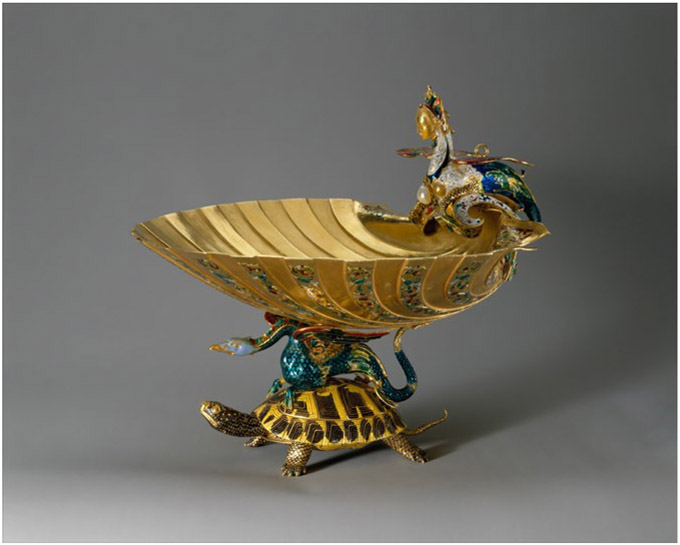
Figure 3.5. Rospigliosi Cup by Reinhold Vasters, gold, enamel, and pearls, 19.7 × 21.6 × 22.9 cm. Attributed to Renaissance master Benvenuto Cellini until the 1980s, when Vasters’s nineteenth-century forgery activity came to light. Courtesy of the Metropolitan Museum, New York
Reinhold Vasters is another prolific forger whose discovery was by accident. Nearly a century after his illicit career, a look through his archived records revealed more than one thousand designs for Renaissance metalworks and other art objects he had created, including those of noted masters. Some were of works held as originals in museum collections (see Figure 3.5), and an uncomfortable reassessment began that resulted in the exposure of fakes. The passage of time, manner of execution, and idiosyncrasies of the artist had not given them away. Indirectly, Vasters turned himself in by not destroying his files, with a question remaining as to why. Other forgers have confessed directly. Bastianini in the nineteenth century and Dossena and Malskat in the early and mid-twentieth century revealed their illicit activities out of anger for being underpaid and unappreciated. Van Meegeren disclosed his forgeries to avoid capital punishment for the crime of collaboration with Nazi Germany. Perhaps their secret careers would have been discovered without their confessions, but that possibility cannot be assumed. The presence of these figures in art history, all of whom except for unusual circumstances unrelated to scrutiny by art experts may never have been found out as art forgers, suggests that there are others who have not been discovered and will not be. This does not mean their fakes cannot be unmasked one by one without knowing who made them, but as with those forgers who are caught, if only a few fakes by some of them pass for originals each time experts view them, the prospect of the perfect fake looms large.
It is reasonable to accept that there are fakes in the art world that have not been discovered and will not be, and would not be even with careful inspection. This is so especially because the features they bear have or will become identified as those of the artists being faked. These false works, so well done that they continually pass scrutiny by experts, are for all practical purposes “perfect.” What, then, is their value in aesthetic terms? Are they, as Richardson said in the eighteenth century, as good as an original? In the twentieth century, Arthur Koestler has spoken for the worth of a well-done nonoriginal with an example that challenges dissenters. Catherine hangs a work on her staircase that she believes to be a reproduction of a Picasso drawing, and then on finding out that it is an original Picasso, moves it to a prominent place in her drawing room. Koestler labels this a case of snobbery.165 Nothing about the artwork itself changed when it was promoted to the status of an original. It looked exactly the same: the colors, form, and lines remained without alteration. That is, there was no change to the intrinsic makeup of the physical object. All that changed was in Catherine’s mind, and what occurs there should not, Koestler says, be confused with aesthetic properties, which are the proper measure for making judgments.
Other examples cited to make this point usually move in the reverse direction, with a supposedly authentic work being demoted to inauthentic. This is what occurred with Van Meegeren’s Supper at Emmaus. When the painting was declared to be a fake, its aesthetic value plummeted. What hung on a museum wall for seven years and was admired by many viewers as a unique demonstration of Vermeer’s genius was suddenly looked on as a poor substitute for the master’s work. Again, nothing about the physical object changed, but its moral status—its known fraudulence—was different. Alfred Lessing argues that this factor should not be thought to alter the aesthetic status of the painting, nor should historical, biographical, legal, or financial factors.166 This perspective does not deny that extrinsic considerations are significant in assessing an artwork, but excludes them from the category of aesthetic properties.
The label given to the way of thinking Koestler and Lessing represent is “formalism.” It emphasizes that the formal properties of an artwork—its physical characteristics—have not changed when its status switches from copy to original, or, in the case of forgery, from original to fake. Given the sameness of the object, why should its designation as a fake trigger a loss of aesthetic value so that it becomes a mere second-rate curiosity? When it comes to direct copies, it has been argued that they can be as valuable aesthetically as an original, at least under certain conditions. In Clive Bell’s view, if a work “were an absolutely exact copy, clearly it would be as moving as the original.”167 Even if not absolutely exact, a copy has aesthetic value when an original has been destroyed. Its effect on viewers is significant in reminding them of what the original looked like and giving them enjoyment vicariously. And when a damaged or faded original remains in existence, the aesthetic value of a copy may be greater than the value of the original since the copy presents a more credible rendering of the prototype.168 These claims about copies are not thoroughgoing endorsements of formalism and are not directed to stylistic forgeries, although it is possible that in the unlikely event of the destruction of all known works by a particular artist, a work in the artist’s style done by someone else could be instructive and have aesthetic value pertaining to the artist’s production. The main point of formalism, however, does apply to stylistic forgeries. Supper at Emmaus is a prime example. It is not a direct copy but a new subject claimed to be by Vermeer, with its formal properties remaining unchanged when it went from its status as an original to being a contemptible fake.
When an art lover has a moving experience in viewing an artwork by a master, impressed by its beauty and technique, and during a later viewing of the same work is told it is a fake, prompting a different response, what accounts for the difference? Is the viewer a snob or a misguided moralist? Has the forgery been given its fair due? The challenge of formalism is that because the formal properties of an artwork remain the same when the status of its authenticity changes, there is no reason for there to be a dramatic reassessment of its aesthetic quality. Opposition thinking sees this view as a misinterpretation of the nature of artworks and of what occurs in the experience of viewing them. The perspective of “contextualism” recognizes the background beyond what formalism takes note of in understanding works and determining their aesthetic value.
Formalism fails to recognize that a viewer’s perception and interpretation are inextricably related. An important dimension is left out when they are separated. Goodman, with sarcastic humor and a biting explanation, dubs the formalist perspective the “Tingle-Immersion theory,” attributed to Immanuel Tingle and Joseph Immersion,
which tells us that the proper behavior on encountering a work of art is to strip ourselves of all vestments of knowledge and experience (since they might blunt the immediacy of our enjoyment), then submerge ourselves completely and gauge the aesthetic potency of the work by the intensity and duration of the resulting tingle. The theory is absurd on the face of it . . . but it has become part of the fabric of our common nonsense.169
Denis Dutton is equally critical:
Yet who is it who ever has these curious “aesthetic experiences”? In fact, I would suppose they are never had, except by infants perhaps—surely never by serious lovers of paintings. . . . the encounter with a work of art does not consist in merely hearing a succession of pretty sounds or seeing an assemblage of pleasing shapes and colors.170
Something beyond the lines, shapes, and colors of the physical object is essential when experiencing art. Viewers do not simply absorb signals and process them mechanically. Prior knowledge and beliefs are brought to the situation and make a difference in how a work is understood—a difference in aesthetic response. Knowing that an artist used a particular technique, or was in a certain frame of mind, or following (or creating) a trend in style affects how a viewer carrying this background reacts. Likewise with holding a belief that the artist’s later works are inferior, or that the artist is an underappreciated genius, or that all works of a certain genre are uninteresting. How one actually sees a piece of art, including the value assessment made about the piece, depends on the mindset from which it is approached. Since this is the case, should not knowledge that the piece is inauthentic be factored in as well? This, too, is a part of context, an especially informative part. Considered in that light, Catherine’s accused snobbery over her Picasso, and the dramatic change of heart Vermeer admirers had about the aesthetic worth of Supper at Emmaus when it was exposed as a fraud, do not deserve criticism and are reasonable responses.
The symbolism of Tingle-Immersion highlights the weakness of formalism, while the full force of contextualism in addressing the aesthetics of authenticity versus inauthenticity has been worked out in terms that often emphasize history as the frame of reference. Goodman defines a forged artwork as “an object falsely purporting to have a history of production requisite for the (or an) original of the work,”171 a factor he sees as key when assessing aesthetic properties. Arthur Danto says the nature of a forgery “has something to do with its history, with the way in which it arrived in the world.”172 Dutton posits that “the concept of art is constituted a priori of certain essential properties. . . . reference to origins and achievement must be included among these properties,” and “we cannot understand a work of art without some notion of its origins, who created it, the context in which the creator worked, and so forth.”173 A proper aesthetic assessment of an artwork, then, would not exclude such an essential consideration as its beginning. Dutton connects that beginning with the work’s achievement. With a forgery not only is the origin misrepresented but so is what it has accomplished. In the case of Supper at Emmaus, the achievement of Van Meegeren was falsely portrayed as the achievement of Vermeer. The former may deserve recognition as an achievement, but not of the same sort and not worthy of the same respect as the latter.174 M. W. Rowe elaborates on this point through the example of Shaun Greenhalgh’s fake sculpture Faun, sold at Sotheby’s in 1994 as an original by Gauguin and later acquired by the Art Institute of Chicago, where it was displayed prominently for ten years. Noting that Gauguin labored for decades to develop his primitivist style, going through mistakes, dead ends, and personal sacrifices, Rowe states,
In contrast, Shaun Greenhalgh did not spend years of disappointment and self-sacrifice discovering a personal style; he was not responsible for Western art’s turn toward the primitive, and he did not influence Picasso and Matisse. The work he produced represents a faun just as Gauguin’s might have done; and it follows the conventions of sculpture in just the way Gauguin might have done. But what Greenhalgh cannot put into his work is the originality, insight, discovery, and innovation Gauguin put into his; and consequently Greenhalgh’s achievement cannot approach Gauguin’s.175
Few artists are innovators like Gauguin, but the point Rowe is making holds for artists in general. Although only a few are known for developing prototypical styles, each one making original works does have a personal style. Even if it is simply one more of numerous renditions of, say, Impressionism, individual touches are added that make for uniqueness. When a forger simulates that style, it means following what someone else has formulated, trying to assume a mindset that belongs to another. If, for instance, the original artist intends to paint trees and unconsciously uses a particular broad (or choppy or wispy) stroke, a forger trying to simulate those trees works from a different intention. Whereas the original artist is painting trees, the forger is painting trees meant to look like those of the originator. The resulting achievement, coming from different intentions, is also different: a better or lesser simulation of what someone else would have created, contrasted with such a creation in itself. There is a distinction in kind between the process occurring from intention to achievement by an artist producing originals and the process from intention to achievement of a forger.
A forgery, then, is of lesser aesthetic worth than an original, and historical context is instrumental in making this determination. But there is more to be said about forgery and context in the grand scheme of understanding and appreciating art. Not only is context informative regarding forgery, but it is also liable to corruption from being seeded with falsity. Fakes affect the historical record, and this occurs in several ways: misinformation regarding an artist’s production stands to alter the artist’s reputation for style, quality, and quantity. When Gauguin’s achievement is misunderstood because a forger’s work is accepted as genuine, he is made to appear to be more prolific than he truly was, or to have sometimes borrowed content or technique from somewhere that was not the case, or to have produced a set of works of lesser caliber than usual. Still, a further damage to history lies beyond the reputations of individuals. Wrong information about an artist that is singly accepted from forgeries as genuine affects not only our view of that artist but also where the artist stands relative to other artists. Art history does not consist merely of autonomous agents pursuing personal agendas, but it is more like a tapestry of interconnected elements where a pull on one of the threads results in a reaction among other threads. And beyond the history of art, history in a broader scope may be affected by falsity in art when we rely on visual images of the past to provide information about how people lived.
Johann Winckelmann in the eighteenth century may have been the first to critique the corruption forgery causes in historical terms when he explained the threat of fake frescoes by Giuseppe Guerra, who claimed they were ancient originals excavated from Herculaneum.
Guerra painted his hero with an armor of complete iron, which soldiers of the Middle Ages used to wear in tournaments. In another painting . . . the praetor or emperor who presides is seen with his arm resting on the hilt of a drawn sword—just like those used during the Thirty Years War.176
Winckelmann’s takeaway is not simply that Guerra failed as a forger, although clearly he did when the process he used for artificial aging was discovered, but that “if even one of the pictures had been antique, the entire system of knowledge . . . about Antiquity would have been toppled.”177 Which artist(s) made the frescoes is not in question here. No individual artist’s reputation is on the line, nor an artist’s style, but the content of the works bears the potential to mislead historians about military customs, designs, and technology in the ancient world.
The problem cited by Winckelmann that false art history causes is sometimes equated with a similar liability in scientific findings.178 Fake fossil remains identified as those of a formerly unknown human ancestor, “Piltdown Man,” found in England in the early twentieth century, contrived a misleading picture of human evolution until it was discovered that they consisted of a human skull combined with the mandible of an ape. Similarly in 1999, the “archaeoraptor” fossil discovered in China that misled many experts about the evolution of dinosaurs turned out to be a pastiche of fossil pieces from different species.179 In cases like these, as with Guerra’s frescoes, we see how anomalies corrupted the historical record, although eventually they were discovered and the record was corrected. Forming another example, particularly ominous because of its scope, are the fake Pre-Columbian sculptures of Brigido Lara, who gave away his scam only when he was jailed for selling what appeared to be genuine artifacts protected by the Mexican government. Over several decades, Lara fashioned tens of thousands of clay figures identified by museum experts as Mayan, Aztec, and in an exceptionally large quantity, Totonac. It has been said that the number of Totonac pieces he created may exceed the number of authentic works in existence. The sheer volume of his fakes bears the potential to mislead examiners into thinking they must be the real thing.
Lara’s forgeries present a threat to both archaeology and art history. His special expertise is in materials: in knowing just which of an assortment of native clays to use for each of his various creations and how to administer an appropriate patina. He was not a student of iconography, and his works are adaptations rather than faithful depictions of what would have been made fifteen hundred years ago. Because there is considerably less expert information available for the culture his works simulate than for other long-past cultures such as Greece and Rome, his eccentric imagery has been easily accepted as authentic. The statue he claims to be his of the wind god Ehecatl (see Figure 3.6), on view for years at the Metropolitan Museum of Art in New York, was written about by various experts. On seeing a picture of it, Lara responded, “this one I invented completely. A piece like this never has been excavated, and all those in existence are mine.”180 Two female figures and a male figure prominently displayed in the collection of the Dallas Museum of Art also were identified by Lara as his productions. The Los Angeles Museum of Natural History and the Saint Louis Art Museum, too, among other major institutions, have presented sculptures of Lara’s as originals, which have served as models for study. These, along with others of his work, hold the potential to mislead us today and in the future about clothing, headgear, and other features, as well as the religious practices, of the people and period he portrayed. Social and cultural history are burdened with misinformation that has to be sorted out by comparison with additional findings. As for the historical study of art, the problem looms larger.
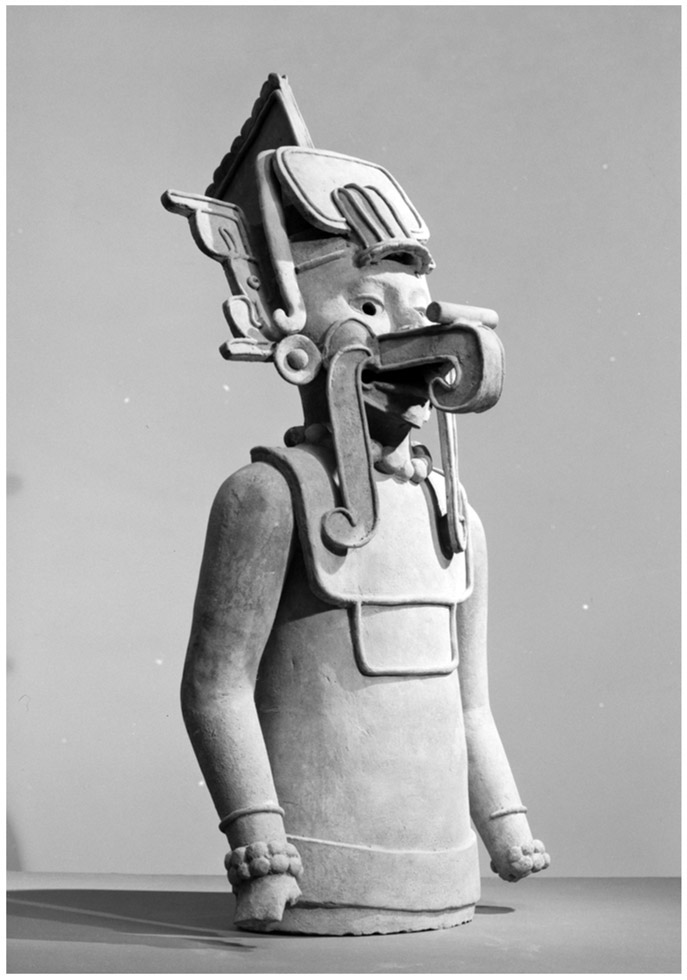
Figure 3.6. Ehecatl (Mesoamerican wind god), seventh to ninth centuries AD, ceramic, 85.7 × 32.2 × 45.1 cm. Claimed by former forger Brigido Lara as his twentieth-century creation in an image devised by himself. Courtesy of the Metropolitan Museum, New York
Mimi Crossley and E. Logan Wagner, museum experts who are knowledgeable about Lara’s fakes and have written about them, state that
Because of the inventiveness with which he executed his figures, it is possible that Lara has singlehandedly skewed our perceptions of a prominent period and style of pre-Columbian art. In other words, this one man has managed to invent much of what up to now scholars have considered to be the Classic Veracruz style.181
Consider other examples with potential to muddy the historical record. What if Paul Jordan-Smith had not exposed his Pavel Jerdanowitch hoax, and the paintings he made, perhaps with additional output, became a permanent chapter in the annals of art history? The story of primitivism would be different than it is, and aesthetic judgments based on that account would be altered. With the fictitious school of Disadumbrationism as one of its branches, early twentieth-century primitivist art would be measured against a purposely nonsensical hoax that was thought to be genuine, and the art that followed would be seen in that context. And turning once more to Van Meegeren not only would his forgeries of religious works have caused a distortion in the understanding of the breadth of Vermeer’s works but the effect also could have extended to Pieter de Hooch and Frans Hals as well. Van Meegeren also forged these artists, and his stylistic idiosyncrasies would be present in the paintings and affect how these artists stand relative to one another and to Vermeer as well as to others. All of this flawed understanding would come to play in making aesthetic judgments.
Van Meegeren’s and Jordan-Smith’s deceptive works caused damage to art history that was short-lived because the forgers revealed their creations. In Lara’s case, the damage will be long-standing and undone only partially through revelations the forger chooses to make. And it can be reasonably assumed that undiscovered forgeries by the likes of Hebborn, Beltracchi, and Greenhalgh have altered our historical understanding and will do so in the future. The phenomenon extends broadly through the schemes of many forgers who lack celebrity status and whose targets are lesser-known artists working in various mediums and genres. To reiterate an assertion made at the outset of this book, forgery is not everywhere, but it may be anywhere. Misinformation from fakes stands to have a profound effect on art history. The full extent of it cumulatively can only be a matter of conjecture. But more can be said about the role specific forged works play. Those on exhibition in museums, which are seen by many people and infuse the opinions of experts who are fooled by them, are much more influential than the ones held in private collections where they are seldom seen. A counterfeit work ascribed to a famous artist would, in the latter case, be less of a force against the historical record than one of a minor artist that is displayed publicly.
A more provocative perspective, however, on the relative harm done by fakes addresses their quality. Among the ones that are executed well enough to avoid detection—perfect fakes in a practical sense—we may consider that there will still be degrees of perfection. Some of those works will be closer than others to simulating the style and technique of their target artists. A key ramification is that the more they are like originals, the less damage they do to historical understanding. This point extends Richardson’s contention three centuries ago when he said that as difficulty increases in telling a copy apart from an original, concern about making that determination decreases proportionally. A contemporary and more detailed statement comes from philosopher Sherri Irvin:
A highly competent forgery has great potential to cause harm, yet at the limit its very competence may mitigate the harm’s severity. The better a forger is at avoiding detection, the longer the forger’s products are likely to remain in place and to subtly corrupt our aesthetic understanding. But if a forgery is successful largely because it has been purged of anachronistic elements and imbued with the style of the forged artist, then for the same reason the magnitude of damage may be relatively slight.182
Irvin describes the irony in which a fake’s high degree of faithfulness to the manner of an original, as opposed to a fake with lesser excellence, both increases its potential harm to art history and decreases it. Although it is likely to remain undetected longer, there is less in its composition that is misleading.
Despite noting the mitigating factor of excellence, Irvin strongly opposes forgery. She specifies how it acts as a deceptive force not only in regard to a particular artist but also in regard to the connections of that artist with others, and cites Goodman’s temporal argument as potentially offsetting the effect of high-quality forgeries. That argument has liabilities, as described previously, but there is another concern that challenges mitigation as a correlate of perfection. A single fake that bears only a small inconsistency in capturing the style of a master can be said to cause relatively little harm to historical understanding, but if more fakes are produced by the same especially talented forger, the size of the master’s output is distorted. An artist who made five hundred works may now be thought to have totaled six or seven hundred, perhaps introducing subject matter the master never attempted. So the greater the excellence of the forger’s renderings the greater the harm done to art history. Rather than mitigation, perfection leads in this way to escalation.
This argument about volume, while countering the mitigation brought about by excellence, does not pertain to individual forgeries. A single piece that is truly excellent in copying its target still can be said to do relatively little damage to art history: viewers are subjected to much that tells them accurately what the target artist’s work is like and to little that is inaccurate so as to mislead them. How does this circumstance relate to the aesthetic worth of a perfect fake? As a fake reaches proportionally toward equivalence with works by the artist being copied, creating proportionally less mistaken understanding of that artist, does its aesthetic value, then, increase, aspiring to that of an original? In a sense, the mitigation drawn from excellence acts in this way, but at the same time, the achievement of the forger is diminished. The more the forger’s work looks like that of the target artist, or in other words, as the performance of a copyist reaches toward absolute perfection, less and less originality is present. Judgment of aesthetic worth, when including the factor of originality and the achievement connected with it, sees even the best forgery as the work of a copyist and lacking in the worth of an original. What makes a fake the best among inauthentic objects isolates it from an authentic work. To put it in terms of formalism and contextualism as they were discussed previously, to the extent that aesthetic judgment moves beyond the formal characteristics of a work to consider contextual factors, the claim for mitigation loses, and a fake that is so excellent that it is virtually harmless to the historical record is still aesthetically inferior to an original.