
Foundation Quarter Horse Registry
P.O. Box 230
Sterling, Colorado 80751
www.fqhr.net
The Quarter cow horse has been known in song, legend, and fact as the hard-working partner most frequently used to tame the American West. It has earned its place in history. Would there have been a cowboy or a rancher without the Quarter Horse? How would the history of the cattle industry read without it? There are many things that define the United States and that are especially American, one being the Foundation Quarter Horse.
The breed’s origin now is more than two hundred years old, coming from oriental, Chickasaw, Quarter Running stock, mustang, and Thoroughbred blood. After two centuries of breeding, the result today is the Foundation Quarter Horse—the cowboy’s horse on the ranch and show, and the rodeo horse in the arena. This breed has proven to be the quintessential working horse, excelling in performance as well as riding enjoyment for all the family. As America’s all-around horse, the Foundation Quarter Horse has paid its dues, earning the accolade, “The greatest cow horse to ever look through a bridle.”
The term “quarter horse” originated in colonial times, with such names as the Celebrated American Running Quarter Horse, the Quarter Mile Running Horse, or simply the Quarter Horse. They were a product of the times in early American history, when short-speed match racing was popular and breeding for this was in style.

Built low to the ground, the Foundation Quarter Horse packs more horse for its height than other breeds. Every part of his body is adorned in muscle. Ritz Ranch
They were first called Quarter Horses because of their speed. J. F. D. Smith, who toured America in 1773, wrote, “In the southern part of the colony ‘Virginia’ they are much attached to quarter racing; they have a breed that performs it with astonishing velocity, beating every other for that distance at ease.” He also wrote, “I’m confident that there is not a horse in England, nor perhaps in the whole world, that can excel them in rapid speed.” Smith noted at that time that “the Quarter Horse was a breed.” Other writers used the term Quarter Horse several years before him.
Down through the centuries, quarter-mile running horses continued to be popular. In the first book published on Quarter Horses entitled The Quarter Horse by H. T. Fletcher (published in 1941 and edited by Bob Denhardt), he wrote:
To this good day no county fair or Fourth of July celebration is complete without the quarter-of-a-mile race; every community in Southwest Texas has a ‘Billy’ [quarter-mile-running] horse that is worth its money. The Billy horses became popular over Texas and even spread to other states. Mr. Fleming bred Billy horses for more than 40 years. In 1875 he and John King, a neighbor, started a Billy Stud book. As Fleming and King have been dead many years, I can learn nothing of its whereabouts. (Denhardt, “He Was Called Billy,” The Quarter Horse, vol. 1 [Fort Worth: The American Quarter Horse Association, 1941])
What was needed then, possibly more than today, was the all-around horse. The early colonists desired short speed for sport and respectability, but their lifestyle and vocation required a horse that could race, work, drive, and ride—a truly versatile family horse.
Foundation Traits
Match racing not only required speed and ability, but also the foundation of a docile disposition and an abundance of intelligence. The original Quarter Horses were built upon what most true breeders and experienced horsemen today consider priorities in a breeding program: first, intelligence; second, disposition; third, ability; and fourth, conformation.
Besides intelligence, disposition, and ability, early Quarter Horses had to have the body type to work cattle. Colonial history records describe early Quarter Horses as being 14 to 15 hands in height, stout, and heavily muscled when compared to other horses of that day.
When the Quarter Horse was first used, it was recognized that at least half the area of the entire nation could produce beef on its natural forage. To manage cattle, there was no better means than the Quarter Horse, which was qualified and endowed naturally with the necessary endurance, agility, substance, and cow sense.
The largest contributing reason for the popularity and growth of the Foundation Quarter Horse Registry is its return to these roots, unlike the modern breeders who have other priorities in their breeding programs. These more modern breeders strive for a different type of Quarter Horse, citing that now the need, expectation, and use of the Quarter Horse has changed since colonial times.
Registry
Breeder Bill Anson desired to establish a Quarter Horse studbook in the early 1900s. He stated in The Quarter Horse that he felt the Quarter Horse was a definite breed prior to the English Thoroughbred. The English Thoroughbred Studbook was established in 1827 to register purebreds, while the American Thoroughbred Studbook was not established until 1868. That was nearly one hundred years after the Quarter Horse was called a breed.
It was long overdue for the Quarter Horse to have a registry when the American Quarter Horse Association (AQHA) was established in 1940. Horses were registered by a threefold standard: bloodlines (pedigree), conformation (inspection and produce), and performance (ability and versatility); these were, and still are, worthy requirements. This was the desire of the first directors of the AQHA.
If the cowboys and ranchers wanted to run short horses as they had always done, this was accepted, but the intent of the registry at the beginning was to register and preserve the “bulldog or ranch type” Quarter Horse. This did include some Thoroughbreds of worthy type and ability; however the Thoroughbreds of the early foundation horses are not the same as Thoroughbred horses of today.

With a beautiful head, clean legs, and an athlete’s body, this chestnut stallion is an outstanding example of the King family of working Foundation Quarter Horses. Black River Quarter Horse Ranch
Bill Anson described the Quarter Horse in these terms: “The immense breast and chest, enormous forearm, loin and thighs, the heavy layers of muscle are not found in the same proportion in any other breed.”
Many of the Thoroughbreds entered in the Quarter Horse shows were rejects from the racetracks. The height of these horses was much greater than that of the original Quarter Horse. The difference in conformation was easy to recognize.
The first Western Pleasure classes with these racetrack Thoroughbreds turned into runaway classes. The lucky winner was the one who could hold on long enough to be the last one still in the saddle. Something had to be done about this, so the horses were trained to alter their natural free movement and head carriage, until the end result was a horse that could not run away because it had its nose lower to the ground.
The old-time master Quarter Horse breeders had an eye for good horses. This, plus the fact that the horses were used on a daily ranch routine, gave breeders a chance to see the results of their program. The Quarter Horse as it was known then was the ranch horse that did everything, being used in whatever task needed to be done. It was medium sized, neither too big or too small for the many everyday ranch jobs. It could pull the light wagon or buggy, drive cows, rope calves and drag them to the branding crew, go to town for supplies, or take the kids safely to school.
This type of horse must have a certain kind of mind. It could not be flighty, nervous, short tempered, or sulky. The big, wide-set, soft eyes showed trust and intelligence. The short foxy ears displayed interest and alertness. The nicely refined muzzle and large jaw showed good Quarter Horse breeding. The quiet, willing disposition was another defining quality, but this was quickly lost with the addition of too much Thoroughbred blood or by abusive, quick training.
The disagreement over type and the addition of Thoroughbred blood were bitterly fought. The old National Quarter Horse Breeders Association at Hockley, Texas, was founded in 1945, but lasted only four or five years before it merged with AQHA. By 1949, there were many requests from members to close the books and keep the breed intact. This was contested, and the struggle went on through the 1950s. The elected officials favored growth over preservation, and by 1960 it was clear the conservative breeders were outnumbered.
Yet there were many articles written in defense of keeping the original Quarter Horse by great old-time breeders who knew the true value of their horses. These conservative foundation breeders were a quieter type who could not see the need for lots of high-priced advertising, and they continued to breed and use their own horses in the cattle business.
In 1961, Bob Denhardt, the first secretary of AQHA, put forth a motion for a compromise to unify the association. He wanted to form a group within the AQHA that would list and preserve the foundation blood and close that group to any further addition of Thoroughbred blood. It was not approved.
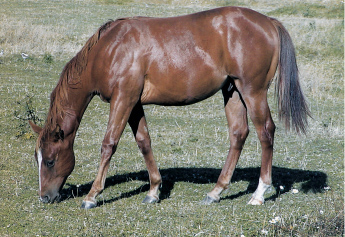
This sorrel gelding’s compact body style is typical of the working lines of his lineage used for ranch and cattle work as well as the show pen. Black River Quarter Horse Ranch
Many years passed in which no foundation stallion was advertised, because the majority of people now preferred the new type and considered it as the real Quarter Horse. By now there were only a few breeders who doggedly preserved their own breeding programs and refused to add Thoroughbred blood. In working ranch situations, the cattle had to carry horse expenses so the ranch could have usable working cow horses. These hard-headed breeders sacrificed financial gain and popularity to retain the type of horses that was best suited for daily ranch work.
Finally, but slowly, a few people became interested in the foundation horses and began to appreciate their dispositions and ability. Foundation-bred Quarter Horses were excelling in rodeo and other athletic events, and people were beginning to notice. By the early 1990s, a few of the “old-timers” began talking once again about recording and preserving these foundation families, thinking there would be at least a small amount of interest. Instead, they found that interest in foundation horses had skyrocketed. This was the last chance to save the foundation lines.
In 1994, the Foundation Quarter Horse Registry was incorporated in Colorado. Its purpose was to perpetuate and continue the hopes and dreams of Billy Fleming, Billy Anson, Bob Denhardt, Dan Casement, Coke Roberds, and so many other Quarter Horse people.
Purpose of Foundation Breeding
When the Quarter Horse came into its own, it had to work for a living, thus the term “the working horse” was born. Over time, the Quarter Horse built and established a reputation that was true to this term. Its owner depended on it for a living, as did the cowboy, rancher, farmer, circuit-riding preacher, and short match-race folks. Since so much was expected from those early working Quarter cow horses, it was necessary and expedient to breed not only for physical ability, but also for that quiet, unique disposition and intelligence that had given these horses the reputation of dependability.
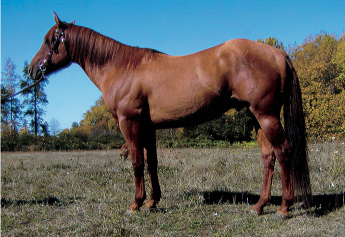
Red dun stallion with prominent Quarter Horse features carries the wonderful family oriented disposition of the Poco Bueno/King foundation breeding. Black River Quarter Horse Ranch
The modern horse show arena has affected much change in so many aspects of today’s horse world. It has thrust the refinement of the horses into the spotlight, accepting the judge’s concept of what is considered pretty, and has made specialization the norm, rather than the all-around horse type. Most show horses are limited, specializing only in their events and having only certain abilities.
Since many top breeders are so focused on the traits necessary to win, they can fail to add athletic ability and the mindset to work. Without this, the non-winners are a waste and an overload to the market. For example, when the race Quarter Horse breeders fail to include disposition and structure in their programs, these kinds of horses benefit neither the breeder nor the breed. There is more to performance than the ability to run. Many horses have more than enough speed, but there is danger in losing that elite foundation disposition that is the throttle and steering of their versatility.
Once in a while, breeders can produce a top show horse, top roping horse, or some super event winner. Truthfully, however, the all-around breeder is the one who can supply a horse that will satisfy first-time horse owners, or those who simply need a horse that is safe for all the family to ride. The breeder who produces all-around versatile horses has a 100 percent saleable crop and does not have to worry about his or her non-winners.
The Foundation Quarter Horse was bred to work and does this work better than any other breed. It has proven and made its mark as the most usable, dependable, versatile athlete of the equine world. This horse will satisfy the need of the young novice rider, or the professional by being the best roping or cutting horse one could hope for. A horse that is gentle and safe for everyone to handle is an asset to the breed. The Foundation Quarter Horse is the all-around horse. No other breed fits in so many places.
Foundation of the Foundation
The AQHA was originally organized with the intent of preserving and perpetuating the working cow horse bloodlines. Therefore, the Foundation Quarter Horse Registry recognizes those horses listed in the first five studbooks of AQHA as Foundation bred.
The Foundation Quarter Horse is not promoted as the modern Halter or Western Pleasure horse. It is a breed that returns to the concept and purpose of the “do it all” horse. Many are owner bred, owner raised, owner trained, and owner shown Foundation Quarter Horses.
This breed can display and present not only what the Quarter Horse is, but also what it can do. There is no specialization in the breed for one particular aspect of showing; rather, it is a “do everything” working horse.
The Foundation Quarter Horse is bred for soundness and a level-headed disposition. It is trained to fit the needs of the corporate cattleman or weekend rider quite nicely. Proclaimed and known to be the most versatile horse of the century, this is the horse that has won the hearts and loyalty of many.
To the great breeders of the past, and now to the Foundation Quarter Horse Registry, the priority is usability and versatility found in the foundation blood.
Criteria for Registration
The Foundation Quarter Horse Registry recognizes the first twenty-seven thousand horses registered in the Quarter Horse registry as foundation bred. Most individuals carrying 75 percent foundation blood are eligible for registration. The fourth generation is critical (great grandsires and great grand dams); of that generation 75 percent should descend from, or run to, foundation blood.
No registered Thoroughbred may be closer than the fourth generation. The 75-percent foundation percentage program encourages the perpetuation of foundation blood, while limiting or eliminating Thoroughbred blood. There is also a limit to white on the horse, rather than a promotion toward white coloring.
Those families known to carry hyperkalemic periodic paralysis (HYPP) disease are not eligible for registration, regardless of generation or testing. The Foundation Quarter Horse Registry has taken a stand against it since 1994.
Sharon J. Spier, DVM, PhD, from the University of California, Davis School of Veterinary Medicine, states of HYPP:
This is a hereditary muscular disease that produces unpredictable attacks of paralysis which can lead to collapse and sudden death. A horse carrying the defective gene but showing minimal signs has the same chance of passing the gene to future generations as does the affected horse with severe signs. It became widespread when breeders sought to produce horses with heavy musculature, but not necessarily all those with heavy musculature [inherit it]. It is more inherited from a specific Quarter Horse line whose descendents are so numerous that the genetic mutation in the bloodline is widespread. It is inherited from generation to generation with equal frequency; it does not get “diluted” out. Breeding an affected heterozygous horse to a normal horse will result in about 50 percent normal offspring, while 50 percent will carry the defective gene. Breeding an affected homozygote horse will result in all offspring carrying the gene regardless of the status of the other parent.
Selective breeding to normal horses could entirely eliminate the disease. As it is inherited as a dominant condition, it can and is being spread to other breeds. It is to everyone’s benefit to take the necessary steps to selectively breed HYPP out of existence before it becomes so widespread that this is impossible. This can be done with DNA testing, which is accurate and reliable.
Characteristics
The Foundation Quarter Horse is easily recognized by the body shape and unique conformation. It is more horse for the height than is found in any other breed. Built low to the ground, much of the time it does not exceed 15 hands but, due to the build, will often weigh 1,200 pounds or more. The pattern of the muscle adorns nearly every part of the body.

Ever the athlete, Foundation Quarter Horses are up to anything needing quick movement and a steady mind. Daniel Johnson
The horse has small alert ears and wide-set, honest, bright eyes that window its great intelligence and kindness. It has a bulging jaw and a neck of moderate length that is joined low into the sloping shoulder and topped by a well-defined wither. The back is short with strong loins, a deep barrel with long underline, and well sprung ribs with great heart girth.
The space between the forelegs is ample to supply a wide, well-developed chest. The forearms, gaskins, and hindquarters carry the type of muscle that separates the Foundation Quarter Horse from all others. Seen from the rear, the power-filled stifles are wider than the croup.
The bones of the Foundation Quarter Horse are trim, dense, and sturdy. A rugged frame is necessary to support the bulk that provides the horse’s strength. The cannon bones are short and flat, set above strong pasterns. The foot is deep with an open heel and well rounded with sufficient size.
This is the horse to ride, enjoy, and be proud of. To ride and use this horse is to love it. The Foundation Quarter Horse is the best all-around horse known to humans. It has proven itself in rodeos, roping, team penning, cutting, reining, barrels, trail riding, and more. Its gentle disposition makes it the ideal horse for the entire family. It is an easy keeper, thrifty, surefooted, balanced, and intelligent. Adding these up, the Foundation Quarter Horse is the greatest equine athlete in the world. It can do more things better than any breed known, and still be a delight to all the family.
Of no other breed can it be said that it is “the greatest cow horse to ever look through a bridle.”
Credit: Foundation Quarter Horse Registry