
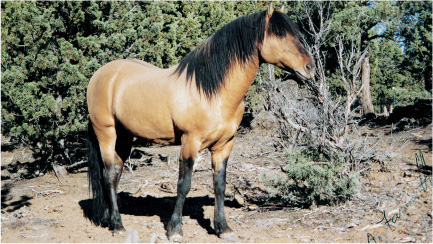
Kiger Mesteño stallion. Dorsal stripe is mandatory and leg stripes are desirable as well as a noticeable neck crest. Dave and Annette Farnsworth
Kiger Mesteño Association
11124 NE Halsey, Suite 591
Portland, Oregon 97220
www.kigermustangs.org
No other horse today is quite like the Kiger Mesteño in legend or reality. Stunning beauty and spirit, primitive markings, beautiful dun factor coloring, dense bone, compact hooves, and a well-crested neck round out this unique and tough horse. The Kiger Mesteños are agile, remarkably intelligent, courageous, and bold; renowned for their athletic ability, stamina, endurance, and surefootedness. These traits are combined with their gentleness, calm temperament, and willingness to please. Truly standing out in a crowd, they have a regal carriage and a high step fit for royalty. Pleasure, trail, performance, endurance, driving, packing, cutting—they can do it all!
The Kiger Mesteños were discovered in Kiger Gorge in Oregon’s Steens Mountain. After a roundup in 1971, it was first noticed they were a particular kind of horse. Their striking beauty and similar color and conformation made a great impression. Since then, they have been separated from other wild mustangs and valued for their unique characteristics.
Their exact history is unknown prior to 1971, when the Wild Free-Roaming Horse and Burro Act was passed by the U.S. Congress to protect, manage, and control the wild equine populations. In order to keep the herds at manageable levels, roundups or gatherings were, and still are, held periodically, during which the horses are counted, branded, and examined. Excess animals are offered for adoption to the public, and the rest are returned to the range.
Kiger Mesteños were first separated in 1977 after one of these gatherings in the remote area of Beatty’s Butte, Oregon. Bureau of Land Management (BLM) Wild Horse Specialist E. Ron Harding noticed them while inspecting the herd. A number of the horses were unusually similar both in type and quality. Upon closer observation, he determined that they carried the primitive markings of the Spanish mustangs. Harding arranged for these horses to be separated from the rest and held at the Burns District facility in Oregon. Then, a suitable area was chosen to release them. To prevent losing all the horses to a natural catastrophe, two Herd Management Areas (HMA) were selected in southeastern Oregon. Twenty of the horses were released in the Kiger HMA and seven in the Riddle HMA.
It was soon decided that these Kiger Mesteños should become an established, registered breed. Spanish markers were found in their blood during genetic testing by the University of Kentucky. Thus, the Kiger Mesteños were set aside and saved for future concerns. With growing interest in this exceptional breed, their continued survival is assured.
The Kiger Mesteño Association was founded in 1988 to help protect and preserve these rare remaining wild mustangs and their captive counterparts. A registry and standard of perfection were established for Kiger and half-Kiger horses. To be eligible for registration today, a horse needs to have been rounded up from either the Kiger or Riddle HMA in southeast Oregon or have parents that traced back to one of these areas.
The association took its name from the famous stallion, Mesteño. A legendary foundation stallion captured along with his mares in the original roundup of Beatty’s Butte, many of today’s Kigers are descended from Mesteño. The name means “wild” or “unclaimed” horse in Spanish. Upon seeing this stallion, BLM officials knew he should never be put up for adoption, but instead become the lead sire for the Kiger Mustangs. They named him Mesteño and released him into the Kiger HMA. He was last seen alive in 1996 at the approximate age of twenty-seven. To this day, Mesteño’s fate is unknown, but for all who know the Kigers, Mesteño will always roam free and watch over the herds on Steens Mountain.

The Iberian features on this Kiger Mesteño leave no doubt about its Spanish forebears. Canyon Creek Kigers L.L.C.
Famous Kigers
The life of Mesteño, the outstanding Kiger foundation stallion, is captured in a Breyer Horse Series. The series depicts the life of Mesteño from a colt to his older years, and marked the first time Breyer introduced a series depicting the life of one horse.
Another famous Kiger is Cougar. His story begins with Bobby Ingersoll, a professional horse trainer who became interested in the idea of training a wild horse for reining and cow horse competition. In 1990, while he was judging the Bell A Ranch cutting competition in Burns, Oregon, he met two BLM employees. They introduced him to a small local band of wild horses running in the Kiger Gorge in Steens Mountain. The horses exhibited similar characteristics to Spanish Barb horses, including the dun factor coloring, black points, and zebra stripes on their legs.

Striking Kiger Mesteño stallion with excellent conformation and beautiful head. Canyon Creek Kigers L.L.C.
Ingersoll accepted the invitation to visit the BLM corrals just outside of town. It was there where he first saw Cougar, a two-year-old colt. Cougar was turned out in a large corral with two other mustangs about the same age. He captured Ingersoll’s interest by the way he began to herd one of the other colts by putting that colt through the same type of controlled movements found in the performance arena. Just like in a cow horse contest or cutting exhibition, Cougar boxed the black colt on the end of the corral and then ran him down the fence, turning several times in each direction. He ended his play by circling up the colt in the middle of the pen.
At this point, Ingersoll was impressed with Cougar because of his obvious natural herding instinct (cowboys call it “cow instinct”) and became interested in training this real, born-on-the-mountain wild horse to be a show horse in reining competition. He adopted him and called him Kiger Cougar.
Cougar’s training began under Ingersoll, who used a program to which the mustang could relate. Time, patience, and understanding of the natural habits, instincts, and ways of the horse were the disciplines used. Cougar showed Ingersoll from the beginning that he was an individual that liked to please and, most importantly, had the ability to accept training. After Cougar had been handled for a time, he became gentle and everyone loved the kind and bright little stallion. He was a joy to be around and would lick salt off anyone’s hand if it was offered.
Cougar was brought along slowly in the beginning, but soon he reached the pace of any other horse. He was ridden only sixty days in preparation for the reining work. Next, he was put on cattle to expand his natural ability to herd and match the action of the cow. His training lasted until near the end of his third year.
When he was two and three years old, Cougar performed in several exhibitions in California, Oregon, and Nevada. There was a great amount of interest in the Kiger Mustang stallion that year.
It was Ingersoll’s intent to train and show Cougar in the 1992 Snaffle Bit Futurities. In August 1992, Cougar was shown at the Paso Robles County Fair. He won first place over all the other breeds in the Snaffle Bit Class. The following month, Cougar was shown at the World Championship Snaffle Bit Futurity in Reno, Nevada. He placed twenty-first out of 150 horses of mostly registered American Quarter Horses. In 1993, he was retired to stud, breeding a limited number of Kiger mares.
In 1994, Ingersoll was asked to consider sending Cougar to the Kentucky Horse Park in Lexington, Kentucky. Although it was hard to let him go, Ingersoll did and Couger lives there today. He is in a beautiful spot where he is on permanent display representing his Kiger Mesteño heritage. Every day he is carefully groomed and shown under saddle to the delight of hundreds of park visitors.*
Standards
Kiger Mesteños carry the dominant genes that code for the primitive dun factor coloration and markings. Dun factor horses are most commonly identified as duns and grullas. Kigers have variations of the dun color factor, which include dun, red dun, grulla, bay, black, claybank (diluted pale cream color), and roan. Dun factor markings include dorsal stripe, jack (shoulder) stripe, zebra stripes on legs, arm bars, bi-colored mane and tail, ears with dark outline and fawn-colored interior, facial mask, and cobwebbing (distinctive line markings).
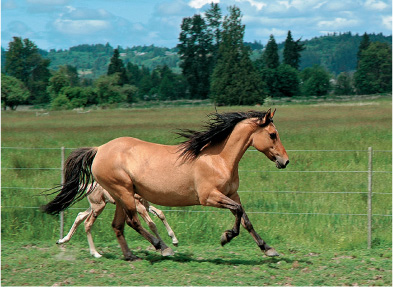
When Kigers are born, their legs are cream in color. As they mature, they shed out to their dark leg color and leg bars. Canyon Creek Kigers L.L.C.
On Kiger Mesteños, the dorsal stripe is mandatory, with herringbone stripes being desirable. Stripes on the lower legs are highly desirable.
The Kiger Mesteño should have good saddle conformation. In general, it should be compact, light to moderately muscled, smooth and stylish in appearance. It should have clean, dense bone with sufficient substance, well-developed joints and tendons, and exhibit a fine coat. It averages about 13.2 to 15.2 hands in height.
The head should be medium in size, clean cut, and should taper slightly from jaw to muzzle. The profile side view can be straight, concave, or slightly bulged, like the Tarpan. The lower jaw is wide and clean cut, with medium fine muzzle and small, firm lips with medium nostrils. Ears should be medium in length, finely pointed, slightly hooked at the tips on the inside, set wide apart, and carried alertly. Eyes are prominent. Cobwebbing and masking are highly desirable.
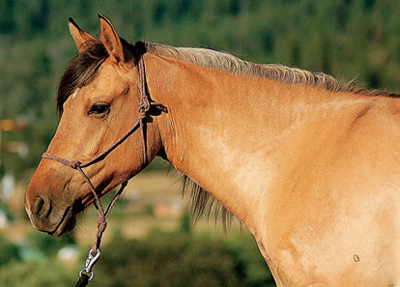
An elegant Kiger Mesteño. Joan Gross
Neck is medium length, well crested, clean cut at the throatlatch, smoothly joined to the shoulder, and deep at the point of the shoulder. Mane and foretop are full and bi-colored. Some may tend to have upright manes of Tarpan type.
The body conformation of the Kiger Mesteño is distinctive, with chest of good depth and a short back that is broad and moderately muscled. The barrel should be oval, with well-sprung ribs and full flank. The sternum should not protrude.
Shoulders should be long in length and at 45- to 50-degree slope, blending into smooth, well-defined, but not too high withers. The withers should be slightly higher than the point of the hip and well defined, but not prominent. Wither stripes, crosses, shadows, bars, and stripes on chest and legs are highly desirable.
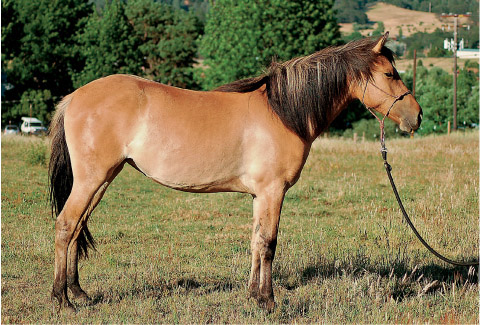
Note the bi-colored mane and tail, leg barring, short level back, and slope to the croup. Joan Gross
When viewed from the front, forelegs should be moderately spaced with an inverted “V” appearance where they connect to the chest, and the legs should be thin and must be straight. Legs should be wide and sinewy when viewed from the side. Cannons are short to medium, wide, flat, and free from muscling. Fetlock joint should not be round, but rather wide. Pasterns should be clean, strong, and of medium length, with the slope to correlate with the slope of the shoulder. The hoof should be of medium size, round to oblong, with thick walls. Kiger horses tend to be mule footed.
The hind legs should be squarely set and placed so that the horse turns on its hindquarters with the legs under it. The hips should be well rounded. Croup should be rounded gently, with medium- to low-set tail, and well carried. The tail is to be full with light-colored guard hair. Muscles in the hip and thigh should be long and sinewy, not heavy as characterized in draft horses. The rear hocks should be wide, deep, and clean. Viewed from the rear, the hind legs are usually closer at the hocks than at the fetlocks. Hind cannons are short to medium, wide, and flat, with tendons standing well out from the bone and being well defined.
The hind feet should resemble the forefeet and should be medium in size, smooth, and dense. The feet are compact with recessed sole and frog, tending to be oblong or mule footed.
The Kiger should be tractable, but with good spirit. The horse should be lively and light, tending toward higher-than-average front leg action.
Credit: Randy Billinger, Tornado Alley Kigers, and Kiger Mesteño Association.
*“The Kiger Cougar Story,” originally published in the April 2000 Kiger Focus, written by Jeanne Daly and Bobby Ingersoll