
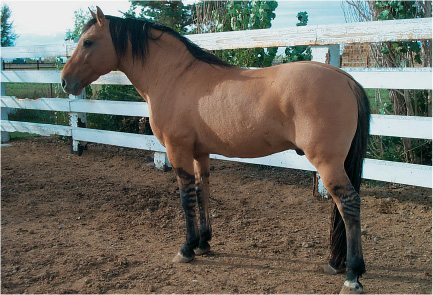
Pryor Mountain stallion with distinctive leg barring and back lining. Pryors have short, hooked ears, short backs, low tail sets, depth of neck and body, and overall balance. The sloped hip here is rounded off with muscle. Daphne Hartman
Pryor Mountain Mustang Breeders Association
P.O. Box 884
Lovell, Wyoming 82431
www.pryorhorses.com
The Pryor Mountains border Montana and Wyoming and are extremely rugged with high terrain elevations from 3,900 to 8,000 feet. The landscape includes arid desert, high grass meadows, and timberland. The climate is cold in winter, and hot and dry in the summer. Ranging on this contrasting wilderness is a small herd of wild horses known as the Pryor Mountain Mustangs. They are colorful horses that often have barring on their shoulders and legs—primitive markings handed down from their Spanish ancestors. People from all over the world have come to study, photograph, and write about these unique equines.
History
Spanish horses in North America were hardy animals, prized for their capabilities to endure adverse conditions and remain tractable. They could carry heavy loads and were surefooted. They remained entrenched in American history, helping to establish the new nation.
Their ancestors were brought by Spanish explorers in the sixteenth century and used extensively to establish colonies in the unpopulated areas of the New World. Some of these early Spanish horses retained characteristics from ancient breeds, such as Barbs, Tarpans, Arabians, Andalusians, and Sorraias. The combination of these breeds produced certain definable traits. Barbs were quick, could carry heavy loads, boasted great endurance, and were easy keepers. Tarpans were small primitive horses from Eastern Europe that were mostly grullo with a dorsal strip and had black manes and tails. Arabians were renowned for their stamina and refined beauty. Andalusians were agile with great riding compatibility and strength. Sorraias were small, hardy Portuguese horses that could thrive in poor environments. They had a dorsal stripe and leg stripes, and were always either grullo or dun in color.
Eventually America’s Spanish horses were replaced with the more popular draft or racing horses brought to the East Coast. Some managed to escape before being bred with the new European horses that were pressing westward. These wild Spanish horses, referred to as mustangs, thrived on the western plains for which they were especially adapted. Eventually, there were millions of Spanish mustangs roaming America.
Their numbers, however, began to dwindle over the centuries due to competition with cattle and sheep for food and water, as the West became more populated. Mustangs were hunted and killed to remove them from valuable grazing land. By the middle of the twentieth century, there only remained pockets of horses that managed to escape and thrive in the more inaccessible places, which included the remote area of the Pryor Mountain. It is possible that the Crow Indians had a hand in the initial introduction of horses to that area. Regardless of how they got there, some Spanish horses managed to survive in this mountain range for more than two hundred years.
Nature took over from the initial Spanish breeding that produced such beautiful and useful horses. The Pryor Mountain Mustangs were isolated from outside influences, preventing little deviation from the original type. They remained small and compact animals, with heavy manes and tails, and were hardy enough to survive on their own.
Spanish Ancestry
Evidence of the Pryor Mountain horses’ Spanish ancestry has been proven by genetic studies and blood type tests. Dr. Gus Cothran, an invaluable authority on equine genetics, tested them and concluded they were “primarily derived from horses with Spanish ancestry.”
D. Phillip Sponenberg, DVM, PhD, stated in his article, “North American Colonial Spanish Horse,” that most Pryor Mountain Mustangs “have Spanish conformation. They are found along a major Crow and Shoshone migration route, and they probably have an origin in tribal horses. . . . They are an interesting group since colors include bay, black, roan, chestnut, dun, grullo, and a few buckskins and minimally expressed calico paints. This array of colors, especially the relatively high proportion of black and black based colors, is also consistent with a Spanish origin.”
In 1968, Secretary of the Interior Stewart Udall announced the creation of the Wild Horse Refuge in the Pryor Mountains to preserve this unique breed of Colonial Spanish Mustang. The refuge was the first of its kind in the country, as it was land set aside specifically for the preservation of mustangs.
Dr. Sponenberg emphasized that the Pryor Mountain Mustangs are an important resource for Spanish horse conservation in North America:
The Pryor Mountain Mustangs are fortunate in inhabiting the first wild horse refuge that is specifically set up to conserve mustangs. That they are Spanish is an added bonus and private individuals are now becoming interested in conserving this type. The Bureau of Land Management (BLM) has recently been acknowledging the uniqueness of this herd and is working to preserve the Spanish type on this range. This herd is one of the most accessible feral horse herds and seeing these horses in their home environment is well worth the trip to this range.
The Tillett Ranch was another source that was instrumental in saving the Pryor Mountain horses. When the Pryor Mountain Mustang range was started, a fence was put up between the horse range and the Tillett Ranch, and there were Pryor horses on each side of the fence. The Tilletts kept their Pryor horses separate from the rest of their horses and began adopting them out.
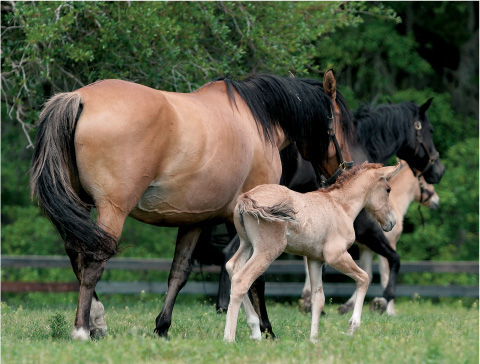
Barring on this filly will be similar to her dam’s. Darlene Wohlart/equinephotography.com
Today, tourists can still observe the Pryor Mountain Mustang in its natural surroundings on the range. Mustangs have also been put up for adoption, which is held every two to four years, depending on the condition of the range and number of adult horses. To ensure the viability of the herd, between 120 and 150 horses need to be maintained on the range to protect the gene pool. Until recent years, the “pretty” horses were adopted out; this left the majority of the horses on the range to be blacks or bays. Around 1994, the theory changed to adopt out horses of various colors to maintain a diversity of colors of horses on the range. Now there are plenty of duns and grullos, as well as blacks, bays, and others.
Registry
The Pryor Mountain Mustang Breeders Association (PMMBA) was founded in 1992 to preserve the gene pool of Colonial Spanish horses, as found in the wild herd of the Pryor Mountain Mustangs, and to establish a registry for their progeny. It cooperates with the BLM to protect, preserve, promote, and enhance the wild herd of mustangs that currently inhabit the Pryor Mountain Wild Horse Refuge.
To be eligible for registration, a horse born in captivity must have a dam and sire already registered. An adopted horse must have a copy of the BLM adoption certificate, or a statement from the Tillett Ranch stating it is a Pryor horse, and a certificate of blood typing from the University of Kentucky. The first three horses that were registered with the PMMBA came from the Tillett Ranch.
As of April 2008, the PMMBA had registered 209 horses. Pryors now are located in sixteen states: California, Florida, Idaho, Illinois, Indiana, Maryland, Massachusetts, Missouri, Montana, Oregon, South Dakota, Texas, Utah, Washington, Virginia, and Wyoming, plus one in Canada. This is quite an accomplishment considering there are so few Pryor horses.
Characteristics
Pryor horses can be any color, but the majority are dun or grullo and include red or blue roan. Most carry the markings of ancient primitive horses. These markings include the dorsal stripe down the back, stripes on the withers, and distinctive tiger stripes on the legs. The colors of the horses are usually vibrant and clear.
Their average size is about 14 hands high, and they weigh 700 to 800 pounds when maturing under feral conditions. Horses raised by people can grow larger. Due to their size, Pryor horses make great mountain horses and are easy to mount and dismount. Though small, they are durable, intelligent, and surefooted with great stamina.
They have fairly heavy bodies with good bones and medium-length necks. Their manes and tails are usually quite long, and they have thick, sometimes curly winter coats.
Pryors have fine, neat heads with wide-set, intelligent eyes and small hooked ears. The head profile is either convex or straight. The broad forehead tapers to the muzzle. The teeth meet evenly, but the upper lip is usually longer than the bottom, which helps when grazing on short grass. The nostrils are usually small and crescent shaped when the horses are at rest, but flare open when alert or during exertion.
Sloped croups and low tailsets are common. The shoulders are sloping and long. Withers are prominent. Chests are a medium to narrow width.
Leg chestnuts are either small or nonexistent: sometimes this happens on only two legs, while other times it happens on all four. They have hard hooves and rarely do they need to be shod; hooves are an ample size to accommodate their weight.
Some have a distinctive five-lumbar vertebrae, or the fifth and sixth vertebrae are fused, characteristics atypical of other horses, which have six and no fused vertebrae.
Many exhibit paso gaits, and genetic testing has proven they are closely related to the Puerto Rican Paso Fino, a definite Spanish breed. Pryors are intelligent, strong, and exhibit true Colonial Spanish type.
The disposition of the Pryor horse is quite different than domestic horses. Once the horse gets to know and depend on a person, it becomes social, wanting to be around people, much like a dog, and to be petted. Most Pryor horses are calm, having an easygoing temperament, as well as smart and willing to learn. When trail riding, they are extremely alert to their surroundings and make great trail horses, because of their stamina and surefootedness.
The PMMBA recognizes the unique genetics of this important breed and attempts to preserve it by selectively breeding adopted Pryor Mountain Mustangs. The number of PMMBA horses has been recognized by the American Livestock Breeds Conservancy as critical, with fewer than two hundred registrations each year in the United States and an estimated global population of less than two thousand. The Pryor horses are on the critical list along with nine other Colonial Spanish strains.
There currently are four PMMBA members, located in Wyoming, Missouri, and Massachusetts, who are raising registered Pryor horses to preserve the bloodlines of the Pryor Mountain Mustang. Since the establishment of the PMMBA, the members have promoted the horses by riding them in parades, horse shows, endurance riding, trail riding, herding cattle, and roping. The Pryor Mountain Mustangs can be trained to do anything other domestic horses can do.
Credit: Dale Hartman, Pryor Mountaiin Mustang Breeders Association; and Dr. D. Phillip Sponenberg, DVM, PhD