
Spanish Barb Breeders Association
P.O. Box 1628
Silver City, New Mexico 88062
www.spanishbarb.com
Spanish Barbs are historic horses with an aura of legend surrounding them. They are an ageless and world-renowned breed. Paintings from the old masters depict Spanish kings and nobility mounted on what appear to be large, full-bodied, Barb-type horses of exceptional beauty.
Barbs were the first horses to populate the New World, predating all other breeds. These graceful, agile, and fleet horses were undeniably rugged, surefooted, willing, and enduring—all much-needed and sought-after traits in frontier times. Throughout the five centuries the Spanish Barb has survived in North America, valuable characteristics and abilities first established in the breed long ago in Spain by the Moors have remained intact today.
History
The Spanish Barb’s unusual history begins, not in Spain, but in the scrub-brush mountains and the dry plains of North Africa. There, the Zenata, an extraordinary horse-warrior tribe of Berbers, joined with the Muslims, and in 711 AD, seven thousand of these superb horsemen made up the initial force that first invaded Iberia. The seven-hundred-year occupation of Spain by the Moors brought about monumental changes in the lives of the people and, especially, in the breeding of horses.
The agile, desert-bred African Barb was crossed with the existing stock of Spain, creating a new horse type that was bred throughout the entire southern half of Spain. Spanish horses had already received an infusion of Barb blood during the earlier rule of Carthage. The superior horses of Al-Andalus (Iberian Peninsula) developed from this cross and became world famous by the Middle Ages. They were much sought after by the royal stud farms of all Europe.
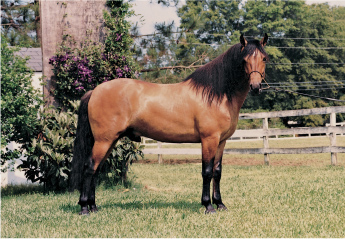
An elegant Spanish Barb stallion: refined head, short, level back, and wonderful shoulder layback. Spanish Barb Breeders Association

An exquisite Spanish Barb mare. Joe Cardinal
In the year 1492, the Spanish had regained possession of their country and began their own invasion force—the conquistadors. The Spanish exploration and settlement in the Americas depended, in large part, on the livestock initially brought over from Spain, and none proved more necessary than their horses. By royal edict, horses were transported to the New World, and breeding farms were established.
Thus, the Spanish Barb was introduced into North America by Spanish adventurers who brought the breed first to the Caribbean Islands. Later, the horses were brought into Mexico, Central and South America, and eventually to the vast southwest of what is now the United States.
During the sixteenth and seventeenth centuries, the Spaniards established settlements in northern Florida and the areas along the Gulf of Mexico and the southeastern Atlantic. The Chickasaw and Choctaw Indians, as well as the Creeks, acquired many Spanish horses. It was mainly from trading with these eastern Native American tribes and capturing strays that the English colonists acquired Spanish horses.
The English, for the most part, appeared unaware that the horse of the Spaniards had been the first of such animals on the continent. They apparently believed the finely bred horses they purchased from, or traded with, the Indians, or caught running in wild herds to be “native” horses. The English utilized these horses under saddle or for plowing, as well as raced them at every available opportunity.
The eventual importation of English racers, which at the time were line-bred Oriental Barbs with a liberal dash of Irish blood, led to the crossing of the Spanish/Indian horses to the English imports—basically Spanish Barb to Oriental Barb. This union created the Colonial Short Horse, later known as the celebrated American Quarter-of-a-Mile Running Horse. All of those deep-bodied horses averaging 14 hands carried the same pre-potent genes of the Spanish Barb.
Spanish horses were later raised on the lands granted to the missions and ranches in the vast territory between the Arkansas River and Mexico. They not only populated the entire western area of North America, but were transferred east, providing most of the broodmares for the imported English stallions of the eastern colonists. Whether they were called Spanish, Chickasaw, Colonial, Western, or Plantation horses, their heritage remained Spanish Barb.
The blood of Spanish horses can be found in the foundation stock of the early Thoroughbred, Standardbred, Morgan, Quarter Horse, and Plantation horse (known today as the Tennessee Walking Horse) of the early southern states. Many of the color registries in the United States today (Palomino, Buckskin/Dun, Paint, and Appaloosa) can thank the horses bred by the early Spaniards in North America for the outstanding coat-color inheritance of their horses.
Until the time of the U.S. acquisition of the Spanish-held western territories in 1803, the blood of the Spanish Barb flowed in the veins of more early American horses than anyone had imagined—and with good reason. These horses had the courage and sturdiness especially suited for exploration and ranching. Yet the ancient bloodlines of the Spanish Barb were nearly annihilated during the nineteenth century.
Americans at that time knew little to nothing of the long history of the ancient Spanish breed, nor of its contributions in creating the early English “thoroughly bred” horse, or the Lipizzan, Andalusian, Lusitano, and various European crossbred horses. Even so, the new settlers heading west appreciated these horses’ unequalled working ability, stamina, versatility, and temperament.
Outcrosses
Despite the many attributes retained by the breed during their two hundred rugged years of existence in western America, harsh environments and careless breeding practices had diminished the remaining Spanish Barb in size and beauty. As a result, the descendants of the once-renowned Spanish breed were considered much too small to suit the rugged Westerners’ tastes of that day and age.
Wanting to create an exclusively American breed, yet one that would incorporate all of the abilities genetically carried by the pure Spanish Barb, western ranches brought about a flurry of experimental crossbreeding. Larger eastern stallions of a variety of types and breeds were brought to the West and crossed with mares from the old, disbanded Spanish ranches of the southwest, as well as on mares purchased cheaply and brought up from Mexico. The Steeldust and Copperbottom bloodlines that are still found in the Quarter Horse were created at that time when the predominantly Oriental Barb bloodlines—carried by the Thoroughbred stallion Sir Archy—were crossed on Spanish mares.
The contribution made by the Spanish horse to both history and other breeds of the world will never be diminished. At one time in America’s past, the Spanish horse could be found from the Atlantic Seaboard to the Pacific Coast, and from the borders of Canada to the tip of Mexico, but time, humans, and circumstances brought many changes, including the culling of this once plenteous breed.

This proud Spanish Barb stallion is solid with good straight legs. Dragoon Mountain Spanish Barbs
Foundation Breeders
Slaughter and extensive crossbreeding nearly destroyed the pure old-time Spanish Barb by the latter part of the nineteenth century. Had it not been for the regard and foresight of a few western ranchers who valued and admired the traits and unmatched abilities of the pure Spanish Barb, this historic breed would have remained only a legend in North America.
At the beginning of the twentieth century, when Bob and Ferdinand Brislawn acquired several Spanish Barb horses from the remote Book Cliffs area of Utah, the few survivors of this all-but-forgotten breed appeared on the brink of extinction. During this same time, IIo Belsky searched out individual horses and began raising a small herd of dun and grullo Spanish Barbs on his Sand Hills ranch in Nebraska.
These were the only Spanish Barb horses known to exist in North America until the McKinley family purchased the thirty-thousand-acre D. D. Romero ranch west of Los Lunas, New Mexico. This was an original Spanish land grant awarded to the Romero family and later purchased by their descendants when New Mexico became a state in 1848. Señor Romero was in his eighties at the time of the sale to the McKinleys, and part of the purchase agreement was the condition that the McKinleys would look after and protect the remaining Romero horses. Romero was extremely proud of his heritage and that of his horses, and boasted of the fact that no gringo horses had ever been crossed on any of his stock.

These Spanish Barb geldings show the convex Iberian profile and great depth of body and neck. Prominent bone structure above the eye is typical. Don MacCarter
Selected horses from these three small groups—descendants of a few Book Cliffs horses, several of the Belsky horses, and a number of the Romero/McKinley horses, in addition to one medicine hat Paint stallion whose sire came from San Domingo pueblo in northern New Mexico—became the foundation for the restoration of the Spanish Barb in North America.
Registry
Undertaking the challenge of restoring and preserving a nearly decimated, but valuable and historic, breed of horse is an unusual and difficult endeavor, and one that had never been successfully achieved by American horse breeders before. The genetic and historic research involved was painstaking and time consuming. Only the most serious and dedicated individuals would commit. Breeding had to be approached with extreme care, as the surviving bloodlines represented a small gene pool. If prudent, knowledgeable methods were not utilized, there would be serious genetic problems.
In 1972, the Spanish Barb Breeders Association (SBBA) began with some thirty breeding horses. In order to ensure the continuation of the breed whose nucleus was so small, elective, intelligent line-breeding and inbreeding played a vital part in the early years. The successful use of close breeding programs became evident in the quality of the resulting foals and the stabilization of the desired attributes of the breed.
In 1996, the registry created a separate division to track a strain of the Colonial Spanish horse, known as the Wilbur-Cruce Mission horse, as a possible addition to the registry. Wilbur-Cruce horses trace their descent from horses bred by Father Eusebio Kino of Mission Dolores in Mexico. The reintroduction of some of the original blood that created the Spanish Barb served to strengthen the gene pool and, at the same time, ensured the complete restoration of the breed. In 2005, the Wilbur-Cruce strain was added to the registry. A nearly ten-year trial proved this strain could produce type and conformation that conformed to the SBBA standard.
The registry contains three separate divisions: Permanent, General, and Appendix. The Permanent registry is reserved for only the finest representatives of the breed. This system of registration has been undertaken to encourage breeders to upgrade their stock by breeding to a Permanent-registered stallion or mare. It also is meant to promote breeding the best to the best in order to restore the breed to the full beauty and conformation that belonged to the original horses of Spain.
Each application for advancement in registration includes the recording of fifteen different measurements on the horse. These measurements are utilized not only in the review process for acceptance into the Permanent registry and for overall statistics maintained on the horses, but also in the ongoing research carried out by the association since its inception.
The Spanish Barb remains a rare breed in the United States at this time and will be so for some time to come. Each generation, however, has produced better quality offspring than the previous one, thus the original goal of complete and accurate restoration of the breed is successfully achieving its objective. Part of the proof of this achievement rests not only with the inherited abilities displayed by the breed in all areas of performance, but also in its direct link with the past.
Related Breeds
Nearly five centuries have passed since the landing of the first Spanish horses in the New World, and presently there are several breeds descending from those original Spanish Barb horses residing in South America that are rarely seen outside of their respective countries. The Argentine Criollo, Brazilian Criollo, and Chilean Criollo are among some of those descendants. Specialized breeding for purely gaited horses in South America and the Caribbean has resulted in the beautiful Peruvian Paso and the Paso Fino, both of which are now bred in the United States. These attractive horses were conceived and raised exclusively for the smoothness of their gaits and the comfort of their ride. Due to that selectivity, they are no longer suited to the wide diversity of performance for which the original Spanish Barb horses were developed by the Moors eleven centuries ago.
The remaining descendants of Spanish Barb horses in North America have been purposely bred by the SBBA to retain all of the characteristics of their ancestors. Occasionally, a pacer has occurred among these descendants of the originals, a genetic reminder of their close relationship to the Spanish/Moorish horses of the ancient past, as well as to their more specialized relatives in the present.
Standards
The breed standard for the Spanish Barb horse serves as a criterion by which the individuals are judged. It also provides a basis of comparison by which horses are measured for acceptance, placement, or rejection, in relation to being numbered within the registry. Every aspect of the breed standard has been designed to promote the ideal for the breed, with the goal of attaining complete restoration in quality and excellence.
The overall appearance of the Spanish Barb is one of balance and smoothness, with depth of neck and body, roundness of hip, short, clean legs and a well-set, distinctively refined head.
Spanish Barbs stand at 13.3 to 14.3 hands in height. A few individuals may mature slightly under or over, but they do not represent the norm. The ancient horses of Spain were deceptively portrayed to be larger than their actual size due to their erect carriage and great depth of body. The Spanish Barb of today continues to give the impression of being a larger horse than it actually is. The breed is also slow to mature.
All colors are found within the breed. Due to the heritage of the African Barb, a variety of unusual coat colors are found, such paints—overo, tobiano, and sabino, and blanket roans. The traditional chestnut, bay, and black, in addition to the predominant colors endowed by the various phases of dun, are inherited from the ancient Iberian horses.
The head is distinctly Iberian Barb in type: lean and refined with a straight or slightly convex profile. The ears are short to medium, curved inward, and slightly back at the tips. The eyes are set well forward on the head and are primarily brown; blue eyes occur occasionally. A prominent bone structure above the eye is characteristic. The muzzle is refined, short, and tapered, being set off by a shallow mouth and firm lips. The nostrils are crescent shaped and of ample size for air intake when enlarged during exertion.
There is great depth of both neck and body. The chest is strong, medium in width, and sufficiently muscled inside the forearm to form an arch. The ribs are well sprung, never slab-sided, and the heart girth is deep, depending on the height and overall size of the horse. The shoulder is well angled and in balance with the back and heart girth.
The back is short and strong, in proportion to the length of the shoulder, forelegs, and depth of girth. The loin is powerful. The croup is round and sufficiently full in width and length to be in balance with the body. The hindquarters are not heavily muscled, and the flank is deep. The tailset is medium to low.
The legs are straight, strong, and well formed with long muscling in the forearms and thighs, and short, clean cannons. The bone is dense, with the circumference of the front cannons averaging 7.5 to 7.875 inches. The joints are well developed, strong, and free of excess flesh. The pasterns are strong, medium in length and slope, and have good flexibility that contributes to the smoothness of the gaits. The hooves are ample and well shaped, with an excellent frog formation and thick walls that are extremely hard. During the summer, the feathering is either lacking or curled tightly against the lower leg.
Chestnuts on the front legs should be small, smooth, and non-protruding. When they appear on the hind legs, they should be extremely small and flush with the leg. Ergots are either lacking, small, or appear to be more like a callous.
Under normal conditions the mane, forelock, and tail are quite long and full. An exceptionally full mane will sometimes fall naturally on both sides of the neck.
The classical-style characteristic to the Spanish Barb and all Iberian Barb descended breeds is displayed by their natural carriage, action, intelligence, and temperament under saddle. These somewhat elusive traits remain an important part of their heritage and appeal, and are basic to the breed’s successful restoration.
Their large, deep girth houses the heart and lungs, and it is the size of these organs of circulation and respiration in relationship to the overall size of the horses that endows them with the stamina and weight-carrying abilities. For this reason, the Spanish Barb is a natural when it comes to endurance and competitive trail events. With proper conditioning, this breed may be the endurance horse of the future, exactly as its ancestors were centuries ago. The well-proportioned skeletal structure of the breed, the long, smooth muscling, and the natural movement may be adapted to the graceful, controlled actions required by dressage. It could also be trained for the quick, darting moves of the cutting horse, or the efficient strides of strenuous cross-country eventing. The skeletal strucure and the accompanying muscle formation are made for optimum performance, and the deep heart girth is part of the engine that provides the power.
The well-balanced body, stamina, and range for extension and hock action of the Spanish Barb allow the horse to perform such movements as quick turns off the hind quarters and sliding stops.
While their natural physical ability is unquestionably among the best to be found, ability alone does not always produce a winner. Disposition and intelligence are also required in order to achieve responsive handling and peak performance. In this area, the Spanish Barb again proves to be exceptional, displaying a cooperative willingness in response to correct handling and schooling, which blends horse and rider into an unbeatable team. The Spanish Barb’s conformation, ability, and exceptional temperament combine to produce an attractive horse suited to whatever area of performance a rider desires to pursue.

Spanish Barb in mounted shooting competition. Most Spanish Barbs are less than 15 hands. The breed’s cooperative temperament blends this horse with its rider to make an unbeatable team. Dragoon Mountain Spanish Barbs
While these horses are hot-bloods, displaying all of the brio under saddle for which the Spanish breeds have always been noted, their body metabolism is extremely efficient. They recover quickly from physical exertion when properly conditioned, and their pulse and respiration rates are normally lower than those of other breeds. They are easy keepers, needing smaller portions of a nutritional diet in order to maintain a high level of energy and a proper body weight.
During the early years of the SBBA’s existence, only geldings and non-breeding stock were sold (unless a buyer had both the means and the land necessary to become a breeder). There were simply not enough breeding horses available to allow any of them to be lost to the restoration program. Now that the breed has been safely brought back to a sufficient population to ensure its survival, owners in various sections of the country have gradually begun to train for a wide range of performance: endurance, reining, jumping, timed events, gymkhana, dressage, combined eventing, mounted shooting, and pleasure.
Many individuals from any number of breeds can attain performance greatness, but the Spanish Barbs have the added dimension of temperament and personality that makes them very special indeed.
Credit: Silke Schneider, Spanish Barb Breeders Association