
American Azteca Horse International Association
P.O. Box 1577
Rapid City, South Dakota 57709
www.americanazteca.com
The American Azteca breed inherits beauty, temperament, pride, and spirit from their Andalusian blood, and its strength, heart, and speed from the Quarter Horse. The possibility of paint coloring also brings added flashiness to an already spectacular horse. This combination creates a horse many are proud to own.
The Azteca breed originated in 1972 when the Mexican charros (cowboys) began a quest to produce a horse to represent Mexico as their contribution to the equine world. They required a horse with agility, quickness, and cow sense to work on their cattle ranches, yet it needed to retain the elegance needed for exhibition, rodeos, and parades. For this, they chose the Andalusian to cross with their Quarter Horses and Criollo mares.
The results were astounding. The horse that emerged was gifted with athleticism, a willing attitude, speed, heart, stamina, grace, riveting beauty, harmony of form, outstanding disposition, and a great talent to learn. Not only did it possess the ability to work on cattle ranches, but it also had the versatility for many other uses. The Azteca was born and, in the years following, acquired so much recognition it earned the title as the National Horse of Mexico.
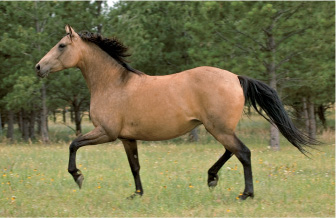
American Azteca D mare. Diana Allison/courtesy Rita Greslin Ricard
It became such a popular horse that inevitably it was noticed by other countries. Horse lovers in the United States were among the first to appreciate the Azteca. It was here that the breed took an interesting turn and developed in a slightly different manner. Although its bloodlines continued to be based on the original Azteca of Mexico—a combination of Quarter Horse and Andalusian—the American Azteca breeders also allowed “Quarter Horses with color”—Paint Horses—in their breeding program. Since the Paint Horse is derived from the Quarter Horse, it is essentially a Quarter Horse with color. Thus it could be used to produce American Aztecas, provided their bloodlines are Quarter Horse and don’t have more than 25 percent Thoroughbred blood.
Foundation Breeds
Quarter Horses and Paint Horses are popular breeds originating in the United States and known for their great athletic ability. Most are used as pleasure horses, but both breeds are especially renowned as working ranch horses. They are quick, maneuverable, and even tempered, having natural cow sense and often working cattle without much guidance from the rider. Attractive and compactly built, they feature large powerful hindquarters, strong shoulders, and short muscular backs. Quarter Horses were named for their quick burst of speed at quarter-mile races, while Paint Horses were named for their colorful markings.
Andalusians are an ancient and rare breed with great strength, long sloping shoulders, natural collection, and sturdy legs and hooves. Sought after for their quiet temperament and extreme intelligence, they are easily handled, yet have a reserve of energy available when called upon. Throughout history, Andalusians were revered for their abilities as warhorses. These same skills were used in Spain and Portugal to work cattle and the notorious fighting bulls. Andalusians are still used in those capacities today, carrying their riders in the bullring with unimaginable grace and speed.
The Andalusian is the working ranch horse of Spain and Portugal, just as the Quarter Horse is in the United States. Today, 80 percent of all modern breeds trace back to Spain and Portugal’s illustrious Andalusian, including the Quarter Horse and Paint Horse. Thus utilizing Andalusian blood is not something new, but a reintroduction of a bloodline that is already present in the Quarter Horse.
The Registry
Although the Azteca began as a breed in Mexico, the culture and tastes in the United States called for a little different type of horse to fit its needs. The American Azteca Horse International Association (AAHIA) takes into consideration the demands, requirements, market, and abilities of breeders and owners of Aztecas in the United States and throughout the world.
With a respectful non-interference attitude toward Mexico’s national breed, the AAHIA registry has named Aztecas outside of Mexico as American Aztecas. This signifies that they are the American version of the fabulous Azteca originally created in Mexico.
The AAHIA horses, however, are modeled closely after their Mexican cousins in type. The organization still bases the breed on the combination of Quarter Horse and Andalusian blood and promotes a high quality horse. It does not allow more than 25 percent Thoroughbred blood in any Quarter or Paint Horse used to produce an Azteca. The AAHIA traces back four generations, not including the horse itself, for Thoroughbred blood. If any of those generations have more than 25 percent Thoroughbred blood, that horse is not allowed for breeding an Azteca. The registry reserves the right to research further generations if more Thoroughbred blood is suspected.
Additionally, horses applying for registration have to be tested for hyperkalemic periodic paralysis (HYPP) disease if they have the Quarter Horse “Impressive” bloodline, and they won’t qualify unless the test is negative. Tests results may be: (a) positive, meaning the horse has it; (b) negative, meaning the horse does not have it; or (c) negative/positive, meaning the horse may or may not develop it, but may be a carrier, in which case the horse won’t qualify for registration either.
Standards
The American Azteca combines characteristics of the Old World breed type in the Andalusian and New World breed type with the Quarter Horse, resulting in a noble, docile, agile, proud, and spectacular horse. It should have a good balance between the two breeds and possess qualities of both. The intention is to create a new type of horse, a new breed that exhibits the best of both ancestor breeds.
With some allowance for variations, the recommended characteristics of the American Azteca are as follows:
Size: The size ranges from 14.2 to 16.0 hands.
Color: Both Quarter Horse and Paint Horse markings and colors are acceptable.
Head: The head is of medium size with a straight, slightly convex or slightly concave profile. It has a broad forehead, expressive eyes, and medium ears, which are mobile and well placed.
Neck: The neck is well muscled, shapely, and slightly arched with a medium crest. It is broad at its base, where it joins onto a long, sloping shoulder.
Body: The withers are broad and slightly muscled, yet defined. The haunches are strong and well muscled, leading to a medium- to low-set tail. A long flowing mane and tail are often present.
Legs: The legs are well muscled with dense bone, good joints, and strong hooves.
Movement: Retained from the Andalusian are free and mobile shoulders and hips, which allow the Azteca to be incredibly athletic and smooth to ride. The movement is naturally collected with a variance of knee action from high and brilliant, to long and flowing.
The American Azteca responds exceptionally well to the different equine High School disciplines requiring suspended and elevated gaits. Qualities passed on from both parent breeds also make it a skillful working cow horse or western horse. It excels at many events, making it an extremely versatile horse. The breed is very easy to train and once taught, never forgets.
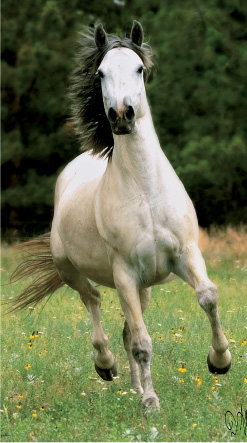
American Azteca D mare. Diana Allison/courtesy Rita Greslin Ricard
Breeding Basics
The goal of breeding American Aztecas is to arrive at a point where a new breed is created. To achieve this, several generations must be bred. The first generation of an American Azteca is an Andalusian bred to a Quarter Horse or Paint Horse; that offspring is given the notation of an American Azteca D. When the American Azteca D is then crossed back to an Andalusian, the offspring is labeled as an American Azteca B, or second generation. If an Azteca D is bred to a Quarter Horse, that foal is an American Azteca C offspring. When both an American Azteca D and B are bred, the offspring is an American Azteca A. This generation then has been produced by breeding American Azteca to American Azteca and is not a cross of the two ancestor breeds—thus a new breed has begun. Since the breed comes in A, B, C, or D, the A is significant because it is the third generation or a result of breeding Azteca to Azteca.
There are other combinations that can be used to arrive at an American Azteca A, but this method is the fastest and can still take twelve to fifteen years to achieve. It also gives a great blood percentage to the A, that being five-eighths Andalusian and three-eighths Quarter Horse. A breeding chart is available to show the different letters of an American Azteca and how to get them, or in other words, what crosses are allowed. The letters of A, B, C, and D are not indicative of quality, as there are quality horses at all levels, which are all considered American Aztecas.
It took noted American Azteca breeder, Rita Ricard, about fifteen years of breeding American Aztecas to produce a level A Azteca. This level of Aztecas are very rare, with probably less than fifteen of them of any sex in the United States, and of those, less than five are American Azteca A stallions. Ricard counts it as a real privilege to be one of the first to have bred and raised her American Azteca A stallion, Primero Viento, which is registered as number one in the registry. Primero Viento was produced from an American Azteca B stallion and a D mare, so he has the coveted five-eighths Andalusian, three-eighths Quarter Horse percentage.
Azteca Excellence
Ricard has been an Andalusian breeder since 1980 and has tried many Andalusian crosses with other breeds. She states, “I can honestly say that I have yet to find an Andalusian cross that I don’t like, but the American Azteca definitely stood out to me. They are just the perfect type of horse for any purpose. They are wonderful to be around, kind, sensitive, talented, and willing are words that come to mind. They’re easy to own.”
She believes the future of the breed is promising. “They have everything that anyone could desire. The Quarter Horse started from crossing different breeds. It also started out small and blossomed into the huge influence it is today because of its talents. I believe that the American Azteca has even more talents. I expect to see great things with this breed in the future.”
Ricard’s American Azteca stallion, Vaquero, which is the sire of Primero Viento, was the National Champion Western Pleasure and Reserve National Champion Hunt Seat, and was in the top five for the Dressage Suitability category at the Andalusian National Show. In classes where he competed against both Andalusians and part-bred Andalusians, he won first place in both Doma Vaquera (Spanish reining, which is a combination of reining and dressage) and Trail Class. He also won several West Coast championships and a bronze medal in dressage at a U.S. Dressage Federation show. Another American Azteca, Oro Blanco S.E.R., won Grand National Champion, Reserve Half-Andalusian Senior Stallion, Amateur. “That tells just how versatile and talented this breed is,” Ricard says. “You can do it all with one horse!”
So whether the need is for English or western, graceful dancer or working ranch horse, jumper, dressage competitor, western cutting, reining, penning, or just a great companion for trail riding, the American Azteca is a wonderful choice. This horse can do it all and do it well!
Credit: American Azteca Horse International Association