

Curls of the Bashkir Curly are especially evident in the winter. Greg Oakes
American Bashkir Curly Registry
857 Beaver Road
Walton, Kentucky 41094
www.abcregistry.org
The Bashkir Curly is a rare breed of horse that is totally different from all others because it’s covered with curls, drawing attention wherever it goes. Crowds are amazed by the horse with curls all over its body. People want to touch the unusual coat, which feels like lamb’s wool, and sink their fingers into it instead of petting like they would on a regular horse. Some put their faces up to the curly coated neck to feel it better. The horses seem to understand and are patient with all the attention.
The coat ranges from a crushed velvet look or gentle wave, to tight corkscrew curls. Manes are thick and often wavy, appearing like they had been braided.
A side effect of the Bashkir’s unique hair coat is that the hair is hypoallergenic. Most people with horse allergies find that Bashkir Curly horses don’t cause an allergic reaction because their hair’s genetic design is different from other horse breeds. For people who have allergies to horses, the Bashkir Curly with its special hair coat resolves that problem. According to one breeder, there is nothing more heartwarming than to see the smile on the face of someone with horse allergies who suddenly realizes that their dream of owning a horse can actually come true when introduced to a Curly.
Others appreciate the breed not only because it’s different, but because they have found more in these marvelous horses than their curls. Besides their hypoallergenic coat, other exceptional features of the Curly include versatility, soundness, and a docile temperament which endears them to their owners. The curls are unique and draw attention, yet it’s their personality and diversity that sustains their continuing popularity.
History
No one knows for sure the origin of curly horses. Throughout history, there have been various sightings of curly coated horses worldwide. When Napoleon conquered Austria in 1805, he found what he described as “poodle hair horses” at the Vienna Zoo and had some transported back to Paris for his personal enjoyment. In his famous book about evolution, Charles Darwin mentioned curly haired horses in South America in the early 1800s. Various early European horse books mention crisp-haired horses that were also curly.
The celebrated exhibitor of curiosities, P. T. Barnum, purchased a curly coated horse in 1847 from an agent in Cincinnati. Barnum waited for the perfect opportunity to introduce the horse to the public. When noted explorer Colonel John Fremont was lost in the Rocky Mountains and America waited for news of his survival, Barnum took advantage of the situation. As soon as Fremont emerged from the wilderness, Barnum promoted his curly horse as a strange new breed Fremont discovered there. Barnum initially made a small fortune, but his returns became even greater after Fremont sued Barnum for his chicanery. The litigation made national headlines and the free publicity further promoted Barnum’s woolly horse exhibit. A few years later when Fremont ran for president, he was lauded as “the Woolly Horse” candidate.
There are many theories as to the Bashkir’s origins in North America. Pioneers recorded various sightings of curly haired horses among wild horse herds in the western parts of both Canada and the United States. Canadian pioneer sightings include such diverse places as the Cypress Hills and Aishihik Lake in the Yukon. In America, they were found wild in Nevada and Oregon.
Perhaps the Russians imported the horses when they explored the Pacific Coast of North America, as there is a curly breed of horse in Russia today. The Russians set up various settlements from Sitka in the Aleutian Islands to Fort Ross in California in the late 1700s and early 1800s. This theory was strengthened early in the history of the registry when it was initially believed that the Russian Bashkir horse was curly coated; thus it probably was an ancestor of the American Curly. “Bashkir” refers to a region in Russia, hence the name American Bashkir Curly.
After the fact, it was discovered that it wasn’t the Bashkir Russian horse that had a curly coat. It was actually the Lokai, which is a breed in the central and southern regions of Tajikistan. Members of the American Bashkir Curly Registry considered dropping the word “Bashkir” from the name, but after lengthy discussions, they left the name as it was for the sake of public recognition. Many breeders have chosen to refer to their horses as simply American Curlies.
Some people claim that a prominent wealthy Nevada rancher named Tom Dixon imported Curly horses in the 1870s. Research has proven that Dixon purchased a Curly stud and two Curly mares in northern India and imported them to Nevada. He settled in Eureka, Nevada, and used feral herds in his breeding program, which would certainly account for the Curly horses’ presence in Nevada.
This theory, however, does not account for their presence in the northwest in the early 1800s when the Crow and Lakota people were capturing and riding Curly horses on the plains of Montana and South Dakota. Proof of this has been found in Native American drawings. Most Indian tribes kept records of important events that occurred during each year with drawings, usually on animal hides, called “winter counts.” The Sioux winter count of 1801 drawn by High Dog, a Lakota Indian, depicts the Sioux stealing Curly horses from Crow Indians. There have been several winter counts found that contain the same information.

Bashkir Curly manes can look like they have been braided. Sonja Oakes
In 1881, Chief Red Horse, a Minneconjou, was persuaded to create some drawings of the Battle of the Little Bighorn. One of those pictures depicts an Indian riding a curly coated horse.
Descendants of Indian horses are considered to be the Native American line.
Initially, few cowboys bothered with the strange breed; then rough cold weather and temperatures wiped out many wild horses. Only Curlies with their thick winter coats survived, though they were gaunt. Given no choice, ranchers brought in several of these horses for work and quickly discovered their marvelous characteristics. Some were used as ranch saddle horses, while others were crossed with draft horses for heavy farm work.
Peter Damele and his family from Nevada had a history of breeding Curlies after one extremely harsh winter hit the area in 1932. Among the few surviving horses were the Curlies, who were soon discovered to have gentle natures and a certain ease with working cattle. From then on, the Dameles made a concerted effort to capture and breed the Curly horses. Descendents of these horses have come to be known as the Damele line.
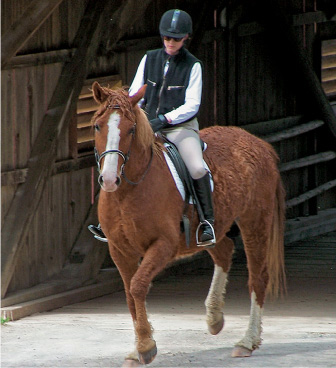
Curlies are versatile performance horses, both in English and western classes. Greg Oakes
Breed Foundation
In 1971, Benny Damele, the son of Peter Damele, joined with a fellow Curly enthusiast, Sunny Martin, and organized the American Bashkir Curly Registry in hopes of preserving the remarkable horse. Due to the small number of horses with which they had to work, inbreeding was a major concern. In an effort to introduce new blood, they chose to cross their Curlies with the following four breeds:
Arabian: This breed shares the same short back as the Curly, indicative of a five-vertebra spine, and is also known for its endurance.
Morgan: Horses whose conformation is similar to that of the Curlies.
Appaloosa: Native American horses bred for endurance that share the unusual Curly trait of shedding mane and tail hair.
Missouri Fox Trotter: A breed that Martin thought shared the smooth gait of the Curly. Today, some people feel that the only “gait” exhibited by the original Curly is actually a running walk, or “Indian shuffle,” not the full gait of the Missouri Fox Trotter. This issue has never been proven one way or the other, but the cross produced some beautiful gaited Curly horses. Many breeders today breed specifically for the “Gaited Curly.”
Some of the most notable of these “outside” studs were: Nevada Red (Arabian); Ruby Red King (Morgan); Chocolate Chip D (Appaloosa); and Walkers Prince T (Missouri Fox Trotter).
By the late 1990s, the number of registered Curlies was approaching 3,000. The American Bashkir Curly Registry closed its books in 2000, as many feared that continued crossbreeding would dilute the gene pool to the point where the Curlies unique characteristics would be lost. As a result of that decision, the American Bashkir Curly Registry is now a blood registry as opposed to a coat registry.
Knowing that there were many fine curly coated horses that could no longer be registered, a second registry, the International Curly Horse Organization (ICHO) was founded. ICHO continues to register all horses with a curly coat, regardless of pedigree, which allows the Bureau of Land Management’s feral range horses and crossbreds to be tracked. This provides a valuable service to all Curly breeders.
The American Bashkir Curly is now prospering in both North America and Europe. Though used in many disciplines worldwide, the Curly is still a rare breed.
Characteristics
Other than the obvious curly coat, the Bashkir Curly is valued for its gentle disposition, high intelligence, strong bone, soundness, performance versatility, strength, and endurance. As a result of the years of crossbreeding, the Curly can be found in every size and color: mini to draft, solid colored, pinto or appaloosa colored. Only mules are not allowed in the registry.
Among its best traits is the low maintenance for upkeep and it would definitely be classified as an easy keeper, doing well on hay alone. However, it still needs all the care and comforts given to any other horse: to be wormed, vaccinated, and have its feet cared for.
Curlies are famous for their ability to endure hardship. They are able to withstand cold winters and can stay outside year round, which is important to people who get tired of mucking out stalls. Nature has provided Curlies with a unique heating and cooling system. Their thick, curly, winter coat repels rain and snow, and underneath it, air is trapped near the short hair coat next to the body, keeping them warm.
In the spring, they shed their curly coats, which then become straight, wavy, velvety, or turn to marcel or micro curls. Yet they remain hypoallergenic even if their summer coat is straight. Sometimes only portions of their summer coat are straight while other portions remain curly.
As a former feral horse, the Curly has extremely tough hooves, and unlike other breeds, doesn’t usually need shoes. The Curly is endowed with tremendous stamina, having a surprising ability to pull and carry.
Naturally gentle, many Curly horses do not have the same flight reaction other breeds have. They don’t frighten easily and, in a bad situation, will wait patiently until someone comes to help. They tend to assess, not flee, thus making them safer mounts.
“Curlies seem to bond with people and learn quickly, making them good for children and novice riders,” says longtime breeder Sonja Oakes. “Today, when so many people with little or no horse experience are buying horses, it is all the more important that a horse have a well-balanced and gentle nature—qualities Curlies possess. My husband learned to ride as an adult. He was skeptical at first, but the horse seemed to sense he was learning and would stop when he was off balance and wait for him.”
Oakes taught her preschool daughters to ride on her Curly horses. “I would be worried about them on any other horse but a Curly.” She also trains Curlies for therapeutic riding.
Curlies are suitable for most disciplines, both English and Western. They have performed well in national level dressage, jumping, vaulting, sidesaddle, and endurance riding. Recently there were two Curly horses in the United States that reached high levels in dressage. Curlies excel at anything, including being family-oriented pleasure mounts.
Coat
As for that curly coat—it is not typical horsehair, but more closely resembles mohair; it can even be spun and woven or knit into garments. It is hypoallergenic, so people who are allergic to straight-haired breeds usually will not have a reaction to Curlies.
The winter coat expresses itself in a variety of patterns commonly described as marcel wave, crushed velvet, curl, or micro curl. The summer coat also offers varieties ranging from smooth to wavy. Some horses shed their manes and tail hair every summer, only to grow them back in the winter.
Not all Curlies have curls over their entire body, as some may only have curls over portions of it. A lot depends on the temperature: the colder the weather, the longer the hair and heavier the curl. Genetics no doubt plays a part in this, also.
Standards
The official breed identity standards are as follows:
Size and Weight
Average size is 14 to 16 hands. Average weight is 800 to 1,000 pounds. Some Curlies can weigh up to 1,200 pounds.
Body Conformation
They have a medium-sized head with well-defined jaw and throatlatch, and wide-set eyes with eyelashes that curl up. Ears are short to medium in length with curls inside; the ear hairs do not totally shed out in the summer.
The neck is medium in length and deep at the base of the neck where it joins the shoulder.
The back is noticeably short and Curlies are deep through the girth with a long underline and belly cut high in the flank. They have heavy-boned legs and short cannon bones compared to the forearms.
Forequarters and hindquarters should be supple, yet well muscled. Withers are medium. The croup should be flat or with a shallow slope to the base of the tail.
Curlies should travel easily and smoothly.
• Types of curls on body:
Fine, soft hair
Ringlet: can be several inches long
Marcel wave: deep soft wave in the body coat
Crushed velvet: soft dense pile of curls in body coat
Micro curl: really small tight curls that tend to stay all year
Round: tends to be in the Fox Trotter lines
• Types of curls on mane:
Extra fine hair
Kinky: (is preferable)
Wavy
Ringlets
• Types of curls on tail:
Ringlets
Wavy
• Types of curls on fetlocks:
Curly (is preferable).
Wavy
• Mane: Should all or partially be shed in the summer; split mane that hangs on both sides of neck
• Tail: Should shed partially at the head of the tail in the summer; some may shed tail hair completely
• Fetlock hair: Should shed in summer but still retain some long hairs
• Hooves: Almost perfectly round in shape; hard and dense; proportioned to the size of the horse.
Unique Characteristics
Curlies are distinctive in their even-tempered disposition. They also have quick pulse and respiration recovery and very dense bone in the legs. Their noticeably short, strong back indicates a five-lumbar vertebrae. They can completely shed the mane and tail hair in the summer, but their hair will grow back in the fall with the winter coat.
The Curly coat is hypoallergenic. The hairs are round instead of flat, appear barbed or feathered underneath a microscope, and can be spun and woven. Testing has proven the hair to be closely related to mohair instead of horsehair.

Curlies may not show much of a curly coat in the summer. Creekside Curlies
Due to the years of outcrossing, Curlies can be found with differing conformation, sizes, and weights. This influence will probably continue for the next five to ten generations of Curly-to-Curly breeding. However these horses will be registered as long as they meet American Bashkir Curly Registry criteria.
Curly horses have excelled in all disciplines—working cattle, trail riding, endurance, and showing in both English and Western. Therapeutic riding schools have been searching out Curly horses for their programs, as they appreciate their gentleness. Curlies are always a favorite in parades and at equine fairs; every year the Classic Curly Riders can be seen in the Rose Parade in Pasadena, California.
Knowledge of the Curlies now extends beyond the American and Canadian borders, with several having been exported to European countries. Their popularity in Europe is growing by leaps and bounds.
If they sound too good to be true, the only way to truly appreciate Curlies is to see one up close and personal.
Credit: Marni Malet, Bearpaw Ranch