
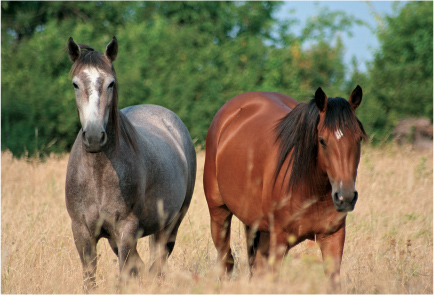
American Indian Horses have a variety of colors. Chris Hurd
The American Indian Horse Registry
9028 State Park Road
Lockhart, Texas 78644
www.indianhorse.com
It is difficult to describe how different and special American Indian Horses are. First impressions of them are of beauty and elegance, then gentleness and love for attention. Most of all, they transmit an underlying current of pervasive and mysterious energy. It is in their stance, the tilt of their head, or flick of an ear, but mostly it’s in their eyes. It’s a look that misses nothing and gauges everything.
Indian Horses emit a certain sense of knowing that goes beyond the ordinary. They size up a situation, discerning between friend and foe. More than anything, they think and make sensible deductions. Their trust must be won. Once that is established, they are the most loyal, brave, and wonderful creatures that ever befriended humans.
It is this survival attitude and perception that has enabled American Indian Horses to retain their intelligence and common-sense nature and allowed them to continue for so long under such extreme and diverse conditions that would have destroyed other animals. And it is what attracts and endears them to their owners.
America’s Living Legend
The ancestry of the American Indian Horse traces all the way back to fleet Arabian horses that were brought to Spain, where they were bred with Barb and Andalusian stock, resulting in what was widely known as the best horse in the world of that time. Magnificent Spanish riding horses were used as a mighty force in various military campaigns.
In the late 1400s and early 1500s, Columbus, and then Spanish conquistadors, brought these horses to the New World. For the next five hundred years, Spanish horses influenced both North and South America. They helped establish modern development of both these continents in multiple ways, and in the process they became precursors to American Indian Horses.
In the decades after the Spanish conquered Mexico and the southern and western parts of what is now the United States, some horses escaped, multiplied, and migrated north. They thrived on the North American plains, and were used extensively by the Plains Indians, who retain their tribal names today—Apache, Comanche, Lakota, Kiowa, Nez Perce, Omaha, Ute, and many more. Due to their association with the various tribes, wild Spanish horses eventually became known as American Indian Horses.

Buckskin overo American Indian Horse. This is a well balanced horse with clean legs, nicely angled shoulder and pleasant head. Excessive muscling is not desirable. Chris Hurd
They became an integral part of tribal life, transforming the Plains Indians from nomads surviving on foot to effective hunters and warriors. Most tribes counted their wealth in horses, using them extensively for barter and gifts and even paid for their brides with them. Tribal shamans often kept unusually colored horses as “great medicine” and used them for ceremonies. Those who owned buffalo and hunting horses prized them so much that the horses were tethered to their owner’s wrist at night to prevent theft by other tribes.
For more than two centuries, Native Americans with horses kept their territory free from the greater numbers and technology of European intruders. This was due primarily to their horses, which were far better than anything the U. S. Calvary had. Indian Horses proved their superiority and toughness by continually outmaneuvering and outrunning the cavalry’s European warmbloods.
Eventually, the U.S. Army attempted to conquer Native Americans the only way possible—by depriving them of their quick, hardy horses. The army repeatedly massacred complete Indian Horse herds because they were such a threat. This fact more than anything else proves the superiority of Indian Horses over other horses of the time.
The toughness of the Indian Horse was also appreciated by cowboys. One of the most colorful episodes in the history of Indian Horses was when they were used to gather millions of wild longhorn cattle off the Texas range after the War Between the States. To do this, Indian Horses swam every river from Texas to Canada and endured stampedes, tornadoes, hailstorms, and freezing blizzards. They did it all while foraging on grass and brush without grain, and they came through it ready for more. Most of them were not much larger than the long-horns they drove. A lesser breed would never have survived such adversities.
Since that time, the American Indian Horse has been owned and admired by every culture of the Americas. They have been called a multitude of names: cow pony, buffalo horse, mustang, Indian Horse, Cayuse, Chickasaw, or Spanish pony, but they are all the same animal with the same roots.
American Indian Horses and Colonial Spanish Horses
The American Indian Horse Registry also accepts Colonial Spanish Horses, not to be confused with wild Indian Horses. Colonial Spanish Horses are often selectively bred and were never wild, although their foundation goes back to wild herds from the North American plains.
Colonial Spanish Horses that are accepted in the registry retain some of the same attributes that separates wild mustangs from other horses, but not to the same extent as the mustangs.
About one-fourth of today’s American Indian Horses were once wild mustangs taken off Bureau of Land Management (BLM) ranges and adopted by new owners.
After five hundred years of concentrated and exclusive living on western American open ranges, the original Indian Horse types show definite, proven traits. They existed under the most exacting and unrelenting breeding criteria—only the strongest survived. They lived by their wits, instincts, and sturdy physiques.
Today, wild mustangs remain on the same plains, living a tough existence in wild herds without outside influences. Government roundups and adoptions always leave some on the plains, where they continue to be naturally honed by nature.
American Indian Horses are athletic and attractive horses that come in virtually every equine color; they can be appaloosa spotted, paint spotted, or solid colored with every variation imaginable occurring. They are known for their common sense, savvy on the trail, intelligence, and ability to size up a situation. Some have been known to save their owners’ lives on more than one occasion. Their loyalty is as legendary as their beauty and toughness. They exude a noble presence, these magnificent, strong, and trainable horses. Anyone fortunate enough to share their life with an Indian Horse knows how truly special it is.
Unique Character
Mustang Indian Horses captured from the BLM plains areas are much more expressive than domestic horses. One owner, Karen Nowak, tells of an Indian Horse Mustang she worked with, saying that he “was one of the coolest horses I have ever seen and has taught me more about horse behavior than any other horse I have been around.”
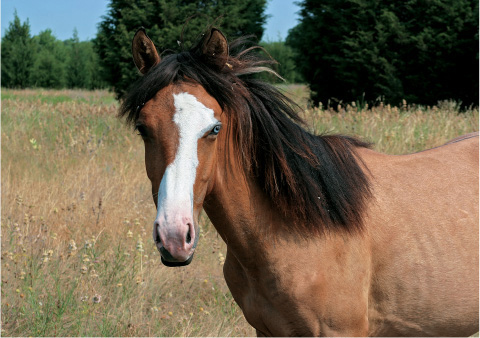
This buckskin youngster’s head is wide between the eyes and tapers to a fine muzzle. Ears are nicely set and the mane is coarse. Blue eyes are acceptable. Chris Hurd
Without a doubt, Indian Horses read body language better than the average horse because their safety depended on such judgments when in the wild. For them, instantly responding to the small and silent nuances of herd warnings is a necessity for survival. Few people are aware of this kind of language that Indian Horses know and speak so well. The horses are so in tune to the world around them, they can pick up on the most minute thing—not only subtle body language, but also hidden emotions in others.
“I have no doubts about this,” states Lona Patton, long-time Indian Horse owner and trainer. “I also think that is part of the reason people either hate and distrust them, or totally love them. People tend to fear what they cannot control, and you can’t control a Mustang, not like you can a domestic [horse]. But you can use their innate instincts to gain their undying trust and [establish a] loyal bond that goes above and beyond any domestic I’ve ever known. Most people tend to fear and dislike animals that prove to be smarter than them, calling them stupid and bullheaded, when in reality it is merely a lack of trust and partnership.”
Patton experienced that kind of closeness when she got her Indian Horse, Metawa. On his first ride out of the pasture, she took him down the road, but he refused to go any farther. Knowing about and trusting the instincts of Indian Horses, Patton turned back. She found out the next day there were two mountain lions in the area that killed her neighbor’s two llamas. Metawa also saved her another time when Patton was suddenly attacked by a horse that had been abused by a previous owner. Metawa raced from two pastures away to drive away the attacking horse. This goes far beyond the typical relationship most people have with their horses.
Patton laughs at the suggestion that her horse might run away if she released him in a park. “I’d have to really work hard to do that! I have 110 percent trust in him, and I know he loves me. Even in wide open spaces, he comes to me instead of running off. I couldn’t lose him if I tried!”
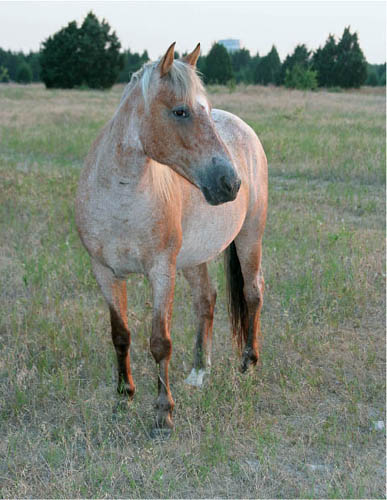
A varnish roan American Indian Horse with white eye sclera common to appaloosa colored horses. Chris Hurd
Comments about bonding with Indian Horses are numerous from owners: “The connection between my horse and me is so strong that it goes beyond words.” “When an Indian Horse accepts you, there is a closeness that’s not equal to anything else.” “They take you into their heart. It’s a forever thing.” “I learned more from them than they did from me. They caused me to believe in God.” “I am truly one with my horse, and that feeling can’t be described unless you experience it yourself.”
“Not just anyone can partner with an Indian Horse,” says Nanci Falley, president of the American Indian Horse Registry, “[and] those who do, have that rarest of combinations, which is unlike anything else I’ve ever seen in the horse world. I call it respectful tolerance and an innate joy in the relationship. The horses are simply amazing!”
Once accepted, an owner has the complete and unique trust of the Indian Horse. Such acceptance is unparalleled with most other horses. It means an absolute and total giving of themselves.
The American Indian Horse Legacy
Indian Horses have contributed to the making of a number of American breeds—the Morgan, Quarter Horse, American Saddlebred, and the Tennessee Walking Horse are only a few. Most of the color breeds can trace their ancestry back to Indian Horses—the Paint, Palomino, Appaloosa, and Buckskin to name some. All horse breeds native to America began with at least a little Indian Horse ancestry, which has been on the North and South American continents for two centuries.
Modern-day American Indian Horses are as beautiful and useful now as they were to the Plains people. These are not scrubby individuals with scraggly coats and wild eyes. It should be remembered what the conditions under which Native Americans and their horses were forced to exist. The lifestyle and hazardous terrain took its toll on human and animal in equal measure. With outside forces pushing into their territories, Native nations and their herds existed on whatever meager rations were available. The horses decreased in size, but this was not deterioration; it was the efficiency of survival. They became stronger and hardier and learned to exist on what nature provided, often having to travel long distances to find enough food and water to sustain them. Their very existence depended upon their intelligence and cunning, and they became masters at the art of eluding those who pursued them.
When the U. S. Army killed thousands of Indian Horses and forced the Native Americans onto reservations, Indian Horses for the most part disappeared, except for a few bands. Those remaining were preserved by people who had a vision and realized the importance of keeping links to the past alive. Many camps hid their finest Spanish stallions and mares and continued to raise them; consequently, some Indian Horse herds were kept pure over the years.
In the late 1950s, several collectors of these horses formed an organization to preserve what they called Spanish Mustangs. A Native American in California, however, felt that the Native influence was being ignored and founded a separate registry in 1961 named the American Indian Horse Registry, which continues to this day. Its purpose is to preserve the American Indian Horse and its history. The AIHR sustains the original dream of its founder and holds great pride that through its registry, today’s owners of American Indian Horses in the Original Class can point to the various tribal names associated with the pedigrees of their horses.
Standards
As the original mount of the Plains Indians, the American Indian Horse has come far yet has changed little over the years. Better care and herd management may have added a little to its size and general condition, but nothing has altered its great heart and spirit.
The American Indian Horse carries Spanish Barb, Arabian, Mustang, and/or Foundation Appaloosa blood in its veins. It shows the litheness, agility, endurance, and load-carrying capabilities of these bloodlines. It is strongly built, has excellent feet and legs, and possesses as much savvy as any horse that ever lived.
Indian Horses can work cattle, herd sheep, or rock a baby to sleep with their easy gait (many Indian Horses are naturally gaited with what is sometimes called the Indian shuffle). Additionally, they can do all this on less feed and less pampering than most horse people would ever believe.
They are highly intelligent, capable of learning and excelling in nearly every capacity for which the Native Americans valued their mounts: hardiness, stamina, and the fortitude to withstand great odds, along with a willing attitude, love for human companionship, and a desire to please.
It is with this in mind that the American Indian Horse Registry pursues the goal of perpetuating and promoting the original type of horse used by the Native American nations, as well as their hybrid and modern-day descendants. To this end, the American Indian Horse Registry has five classifications of registration:
Class O (Original) includes horses whose ancestry can be traced to Native American herds and that otherwise fit the Original status criteria. Class O horses are not bred to conform to popular modern horse breed standards, but are bred with the objective to preserve original bloodlines of Native American Indian nations. Class O horses registered since 1979 have bloodlines that trace back to various American Indian tribes and families.
Class AA includes horses that have one parent registered in Class O and also may include BLM mustangs, as well as other horses that can claim a line containing American Indian heritage.
Class A horses have unknown bloodlines, but are definitely Indian Horse type. Most horses with combined characteristics of Class M and A qualify for Class A registration as well as many so-called grade or backyard horses.
Class M (Modern) horses include breeding of Modern type. Moderns are considered descendants of the Original Indian Horses and are respected as such. They may have parents registered with the Quarter, Paint, Palomino, Pinto, Appaloosa, and similar associations.
Class P is for ponies of Indian Horse type. Eligible ponies include those with Galiceno or Pony of the Americas (POA) in their pedigrees. Ponies of unknown ancestry may also qualify.
No horse or pony exhibiting draft horse breeding can be registered. By not adhering to cookie-cutter standards, the original American Indian Horse comes in many sizes and types. Emphasis is not placed on modern conformation type (of any breed), but rather on soundness and body types, leaning toward strength and stamina.
The American Indian Horse Registry has no height requirements. The Indian Horse is generally a smaller, compact animal, normally 15 hands or less, although their height can range from 13 to 16 hands, with larger and smaller sizes being common. They weigh 700 to 1,000 pounds, with a few individuals over or under this.
American Indian Horses display virtually every color that can be seen in horses, thus the American Indian Horse Registry has no color requirements. Colored Appaloosas of the Foundation type are common, as are the various paints, pintos, and mixtures of colors. Often there are rare colors, such as lilac roan, peacock spotted leopard, or sabino paint. Unusual markings, such as lightning marks, leg striping, line-backing, or varnish marks, are much more common due to the Spanish Barb influence. Normally the varnish roans are fairly light colored on the body with varnish looking marks in varying stages of darker colors. (Sometimes Appaloosas or their crosses have these varnish markings on their facial bones, knees, hocks, and lower legs.)
No particular head shape is preferred. The dished face of the Arabian, the Roman nose of the Barb, or the more modern straight profile may be found in the Indian Horse, but large, wide-set eyes, full nostrils, and alert ears are desired. Overall, the Indian Horse should have an alert and interested appearance.
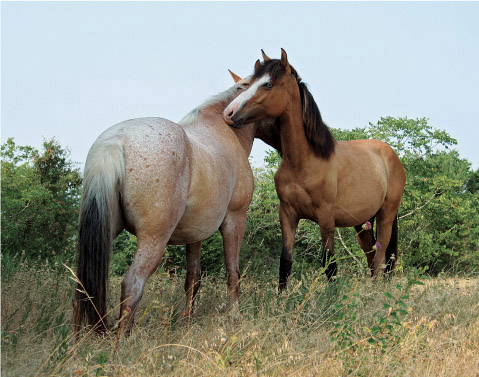
Indian Horses especially enjoy companionship. These two are grooming each other. Chris Hurd
Indian Horses are well made and have excellent feet and legs. Straight legs are not to be placed over serviceably sound legs. Defects causing unsoundness are to be heavily penalized in the breeding pen, as well as the show ring. Modern breed conformation criteria that causes or contributes to soundness problems—such as small feet, heavy, bunchy muscling, excessive fat, and an excessively wide (as opposed to deep) barrel—should be penalized as not desirable in Indian Horses. They don’t have the overly muscled or fat body style of the modern breeds.
Their hooves are hard and healthy. They do not have small feet in comparison to body structure, overly straight legs, or overly defined conformation. They also do not have many of the digestive, nervous, and muscular problems associated with more modern breeds.
Indian Horses often have a lot of fetlock and body hair (if it is allowed to grow out), which protects them from the elements. They are naturally highly prepared to survive hot summers in arid deserts, or frigid cold in bitter winters, and the sloppy conditions in between, doing so on less feed and with less care than other horses. They can be ridden long distances with fewer injuries, perform heavy ranch and range work with more power, and generally provide better “horsepower” than horses much larger.
They are intelligent, independent, flexible, and competent when it comes to taking care of themselves. They still have what could be called a wild streak, which allows them to respond well to danger, yet American Indian Horses are friendly and courageous, and easily trusted around children and pets.
Credit: The American Indian Horse Registry