

Muscling in the Quarter Horse, as on this stallion, is evident over the entire body, but especially on the rear quarters. Caryl Chrisman
American Quarter Horse Association
P.O. Box 200
Amarillo, Texas 79168
www.aqha.com
The American Quarter Horse—there’s nothing else is like it. Durable, quick, willing to please, it is the king of the American West. None can challenge its status as an equine leader. From the backwoods of a new nation, it rose to surpass all others in popularity. It mirrors what the United States is all about. Starting from a mixed foundation, it developed into a determined and reliable breed, a force to be reckoned with, excelling at almost anything put in front of it. From breaking new frontiers to performing dressage, it has proven its right to the title as the very best, earning the status of number one in the world. The American Quarter Horse truly epitomizes the American spirit.
Virtually everyone has heard about, or seen, an American Quarter Horse. It is most familiar in mounted events at rodeos, working on ranches, or being ridden in Western movies. Its reputation for quick speed, agility, trainability, and cow sense has solidly established it among professionals and amateurs alike. It has the widest range of devoted fans and the largest single-breed equine registry in the world. Its popularity continues to soar as its talents are appreciated, whether for ever-expanding competitions or just pleasure riding.
History
The American Quarter Horse is the first breed of horse native to what is now the United States. Former American Quarter Horse Association (AQHA) President J. D. Blondin once wrote, “Since colonial Williamsburg, the American Quarter Horse has served as an icon of the American West. It has secured a place in history as the versatile breed of choice for early Americans who pioneered across this great nation and settled into untamed land. It greatly benefited those who owned it then and it remains just as popular today.”
The history of the Quarter Horse began when early Spanish explorers first brought their horses to Florida. Later, in the 1600s, other various breeds were brought to the English colonies. A distinct strain resulted from crossing the Spanish horses with the colonists’ English breeding stock, which was recorded as early as 1611.
By the time the American Revolutionary War began, the colonists had grown greatly attached to horse racing. In colonial Virginia and the Carolinas, riding horses evolved to fill the colonists’ passion for short-distance racing. Their horses gained fame for running in quarter-mile races, a favorite pastime of the colonists. Any unsown field or thoroughfare served as a racetrack (which probably accounts for the evolution of dirt racetracks in America). One-on-one match races were run down village streets, country lanes, and level pastures. This sprint racing in the early colonies was the earliest known example of horse racing in the United States.
The first recorded American Quarter Horse races were held at Enrico County (now Henrico County), Virginia, in 1674. Reports from that time show that by 1690, substantial purses were being offered at races, proving their popularity. Racing was a serious sport, and it was not uncommon for large plantations to change hands on the outcome of one of those sprints.
The heavily muscled, compact horses could run short distances over a straightaway faster than any other. Thoroughbred stock of similar conformation from England was then introduced, and later during westward expansion, wild mustang broodmares of the American frontier were added to the gene pool. This produced a distinct strain of horses with its own unique conformation, athletic ability, and wonderful disposition.
Word about the versatile new horses soon spread across the country, as respect and appreciation for them grew. Their inherent agility and disposition proved to be ideally suited for both recreation and work on developing western frontiers. They still plowed fields and served as saddle horses, but as westward expansion grew, so did their uses. They explored vast woodlands, broke sod for new farms, and drove cattle up the trails from Texas. This latter duty gained them the greatest fame—that of being natural cow horses.
These horses did not have an official breed name at that time, but the fastest in racing were the first to be recorded as “Celebrated American Quarter Running Horses.” Prior to 1940, American Quarter Horses were most commonly known as Steeldusts, after a famous quarter-mile racing stallion of the century, or less frequently as Billys, after a horse sired by Shiloh that was out of a daughter of Steeldust. Over the years, there were different variations of names. Collectively they were called Quarter Horses by a group of horsemen and ranchers from the southwestern United States who became dedicated to preserving the pedigrees. These ranch horses were selectively bred for both speed in quarter-mile races and cow sense on the open range.
William Anson was the first person to try to define the Quarter Horse as a distinct breed. Anson was from England, but came to the United States when he was twenty-one and established a ranch near Christoval, Texas. He published the first information that linked the Quarter Horse to its colonial beginnings. Horse shows began to appear where horsemen brought their Quarter Horses to be judged. Anson sponsored and judged this type of show in 1908 at the Northside Coliseum in conjunction with the Southwestern Exposition and Fat Stock Show.
Early Quarter Horse Breeding
In the early 1900s, Richard M. Kleberg Sr., Robert J. Kleberg Jr., and Caesar Kleberg began developing a superior ranch horse type that had speed, athletic ability, intelligence, and cow sense. In 1916, they intensified that effort after they purchased a yearling colt from famed American Quarter Horse breeder George Clegg. They found this horse not only possessed all of the desired traits, but more importantly, he also could pass them on to future generations. This stallion, later named Old Sorrel, became the founding sire for the King Ranch American Quarter Horses.
Old Sorrel was sired by Hickory Bill whose sire was Peter McCue. Old Sorrel went on to sire many great stallions, including Little Richard and Tomate Laureles, which were designated AQHA foundation sires based on desirable American Quarter Horse qualities. Old Sorrel also sired other foundation stallions, such as Solis, Macanudo, and Hired Hand. Solis went on to sire Wimpy, the stallion that was later named Grand Champion at the 1941 Southwestern Exposition and Fat Stock Show and given the number “1” in the registry of the newly formed American Quarter Horse Association (AQHA). Old Sorrel and his grandson, Wimpy, stand out as two important foundation sires, not only for the King Ranch type, but for the Quarter Horse breed in general.
Peter McCue was another foundation stallion and one of the greatest sires of the American Quarter Horse breed. Sired by Dan Tucker out of Nora M, he was foaled at Samuel Watkins’ Little Grove Stock Farm in 1895. The 16-hand bay horse had tremendous speed, so Watkins often raced him.
As a sire, Peter McCue was legendary, stamping offspring with his speed and physical characteristics of the early American Quarter Horse breed. His influence as a sire spread west when he was purchased by breeders in Texas, Oklahoma, and Colorado. He sired Chief and Sheik, American Quarter Horse foundation sires, as well as Harmon Baker, Badger, and Hickory Bill, the great grand sire of Wimpy. Peter McCue died in 1923 at age twenty-eight.
Other Foundation Sires
After 1940, the King Ranch American Quarter Horse breeding program continued under the supervision of Richard M. Kleberg Jr. Both he and Robert J. Kleberg Jr. continued to make the King Ranch a leader in the American Quarter Horse industry, establishing a dynasty of champion cutting horses led by its stallions Mr. San Peppy and Peppy San Badger (also known as Little Peppy). Both Richard and Robert Kleberg Jr. are honored in the American Quarter Horse Hall of Fame for their involvement with the breed.
Leo, a 1940 stallion sired by Joe Reed II (who was sired by Joe Reed) was bred by John W. House. Leo’s dam was Little Fanny, who was also sired by Joe Reed. While Leo displayed considerable speed, reportedly winning twenty of his twenty-two starts, it was his reputation as a sire that made him famous. An all-time leading sire of broodmares, Leo’s daughters produced fourteen champions. In addition to speed, Leo’s foals displayed excellent conformation, athletic ability, quiet dispositions, and cow sense. He died in 1967.
Three Bars, the most influential Thoroughbred in American Quarter Horse history, was foaled in 1940 near Lexington, Kentucky. Despite severe circulatory problems in a hind leg, Three Bars won races as a three-, four-, and five-year-old. As a six-year-old in 1946, he set a 0:57 3/5 track record over 5 furlongs at the Phoenix fairgrounds in Arizona. The chestnut stallion possessed not only speed, but also excellent conformation and disposition, which he passed on to 558 American Quarter Horse offspring. A legendary sire of almost transcendental genetics, Three Bars sired champions in all facets of the American Quarter Horse breed, with four AQHA Supreme Champions, twenty-nine AQHA Champions, fourteen racing champions, and sixty-four racing stakes winners. His impact still weighs heavily on the breed today, as even now he figures prominently in the pedigree of virtually every champion, from racing to cutting to showing. He died in 1968 at the age of twenty-eight.
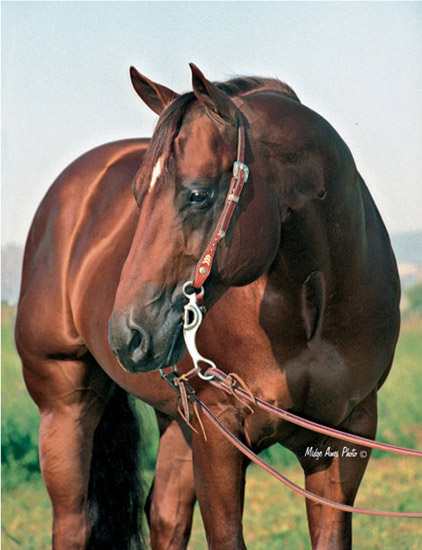
The pleasant head and extensive muscling is apparent in this Quarter Horse stallion. Midge Ames/courtesy Caryl Chrisman
Since 1991, First Down Dash has been one of the leading racing sires. His ability to pass flawless conformation and an exemplary attitude to his offspring has resulted in progeny earnings exceeding $64.3 million.
Quarter Horse Racing
Organized American Quarter Horse racing got its start in Tucson, Arizona, at a racetrack called Hacienda Moltacqua. The track boasted a card of races that included not only American Quarter Horses, but also trotters, Thoroughbreds, and even some steeplechasers. Soon, however, American Quarter Horse racing outgrew its stage-sharing position with the other racing breeds at Hacienda Moltacqua. Thus in 1943, a new racetrack was built and designed especially for the sport of American Quarter Horse racing. That track was Rillito Park Racetrack in Tucson.
Today, horse racing ranks among the top spectator sports in America. American Quarter Horses continue to excel at racing at more than one hundred racetracks throughout North America, with total purses reaching some $95 million. In 2007, the total starters in American Quarter Horse races numbered 16,607. It is interesting to note that the quarter-mile is still the most popular distance for racing, and the best blaze the 440 yards in 21 seconds or less.
American Quarter Horses Today
Throughout its history, the breed has also been known for its calm disposition and cow sense, or the ability to outmaneuver cattle. Today, the heavy muscling and sprinter’s speed remain characteristic traits, but horses within the breed have been bred to specialize in particular events. There are American Quarter Horses competing in every discipline imaginable, from traditional rodeo events such as roping and barrel racing, to the refined English classes of dressage and show jumping. They compete in horse shows around the world.
American Quarter Horses have always been appreciated for their racing ability, ranch work, and rodeo activities, among many other attributes, yet the number one interest of their owners remains riding “America’s Horse” for recreation.
American Quarter Horse Association
Enthusiasts such as William Anson, Dan Casement, and Robert Denhardt recognized that the horses famous for their quarter-mile sprints also had specific physical characteristics that set them apart from other horses. Denhardt wanted to form a breed registry to preserve the bloodlines of these horses, whose ancestry traced back to the English colonies. He held a meeting at the Fort Worth Club in Texas that coincided with the 1940 Southwestern Exposition and Fat Stock Show. This marked the founding of the American Quarter Horse Association (AQHA) and when the breed officially became the American Quarter Horse.
AQHA is now the world’s largest equine single-breed registry. It has 2,700 approved shows and 9,300 sanctioned races held each year, and recognizes a whole slew of outstanding athletes. Competition options are nearly unlimited—pleasure driving, jumping, halter, cutting, reining, and roping. Besides the United States, Canada, and Mexico, American Quarter Horses can be found in eighty-three other countries. The American Quarter Horse Association leads the equine industry with a record 3,500 members and more than 5 million registered horses worldwide. Horses that earn a certain number of points in a particular class are invited to the AQHA World Championship Show. The invitational show draws more than 3,500 open and amateur exhibitors from around the globe. These exhibitors compete for award purses valued at nearly $2.5 million, making it the largest and richest world championship horse show in existence.

This Quarter Horse stallion has a wonderful head with prominent jaws, clean-cut throatlatch, powerful build, and trim legs, all characteristics of a good Quarter Horse. Midyett Ranch
Although the athletic prowess of the American Quarter Horse carries many riders to the winner’s circle, it is the breed’s versatility and gentle nature that have made it the world’s most popular horse. Both a novice rider of any age and a seasoned professional can find an American Quarter Horse that will provide a pleasurable ride.
Standards
Of course, beyond its appearance, a registered American Quarter Horse foal is the product of a registered American Quarter Horse dam and sire. The AQHA also offers an Appendix registry for foals with one American Quarter Horse parent and one Thoroughbred parent registered with the Jockey Club.

Pronounced forearm muscling is clearly seen here, as is rear muscling. This is a solidly built breed. Caryl Chrisman
The American Quarter Horse is characterized by a short, broad head topped by small, active ears, large eyes set wide apart, sensitive nostrils over a shallow muzzle, and a firm mouth. Well-developed jaws imply great strength.
The medium length neck joins the sloping shoulders at a near-45-degree angle with a distinct throatlatch. The chest is deep and broad with wide-set forelegs that blend well into the shoulders.
The powerful, muscled forearm extends to the knee, whether viewed from the front or side. The back is close-coupled, is especially full and powerful across the kidneys, and is full through the thigh, stifle, gaskin, and down the hock.
The rear quarters are broad, deep, and heavy when viewed from either side or rear. The hind leg is muscled inside and out. The hocks are wide, deep, straight, and clean, with the foot that is well-rounded and roomy and has an especially deep, open heel.
The generally acceptable height of the American Quarter Horse ranges from 14.3 to 15.1 hands, with weight ranging from 1,100 to 1,300 pounds.
The AQHA recognizes sixteen colors, with sorrel being the most prominent. Other colors are bay, black, brown, buckskin, chestnut, dun, red dun, gray, grullo, palomino, perlino, cremello, and red, blue, and bay roan. It is interesting to note that the official gray coloring is what newcomers often call white, but there are no white American Quarter Horses. White markings, including white above the knee, are allowed if both parents are registered. Horses with excessive white are now allowed to be registered, but it is considered an undesirable trait.
The parentage requirements for Appendix and regular AQH registration are as follows:
• A numbered registered AQH parent plus a Thoroughbred parent—Appendix registration
• A numbered registered AQH parent plus an Appendix AQH parent—Appendix registration
• A numbered registered AQH parent plus a numbered registered AQH—numbered registered AQH
• An Appendix registered parent plus an Appendix registered parent—not eligible for registration
• An Appendix registered parent plus a Thoroughbred—not eligible for registration
The American Quarter Horse Association strives to keep the American Quarter Horse as the powerful athlete it always has been. American Quarter Horses born after January 1, 2007, that are a descendants of the American Quarter Horse Impressive (AQHA registration number 0767246) must be tested for hyperkalemic periodic paralysis (HYPP) to be eligible for registration. Any horse testing positive (H/H) will not be eligible for registration. HYPP is a muscular disease caused by a hereditary genetic defect leading to uncontrolled muscle twitching and weakness, and in severe cases can lead to death.
Credit: American Quarter Horse Association