
PART 4
From the brawn of spectacular heavy drafts to the muscle and ability of their smaller counterparts, a job is never too big. Herein are the mighty titans that established countries and kingdoms with their devotion and pounding strength. They clashed in tournaments, moved mountains, and shaped nations with a hardiness and steadiness that will never go out of style. Some still perform the same duties they did in their ancient past, while others are showcased as the best in parades or exhibitions. With a surge of power and might, they strike an awesome picture. Beholding them in action is an unforgettable and breathtaking experience.
Other hardworking breeds also extended their robust capabilities to get a job done. Quietly and humbly, they contributed their service and partnership. Their gentle perseverance carrying a precious load or hauling the master’s wagon over difficult terrain required as much courage and deft ability as their bigger cousins.
These are the profound allies of man, without which the progression of civilization could not have happened.

With their calm, gentle demeanor, a team of American Cream Drafts can be driven by anyone.
American Cream Draft Horse Association
193 Crossover Road
Bennington, Vermont 05201
www.acdha.org
The American Cream Draft is a rare cream colored draft horse that most people know little or nothing about. This is amazing since it is the only draft horse native to America. It is built like the original drafts that worked on farms in the breadbasket of America before the age of mechanization. The American Cream is a unique breed, possessing all the beauty and movement of a top athlete, and projecting a graceful power that is easily directed. These gentle giants have come a long way toward being ideal drafts in the horse world of today and are appealing for work, riding, driving, or show.
Blood testing has proven that the American Cream is, in fact, a distinct group among the draft breeds. Though cream colored with white mane and tail, it is not a palomino, albino, or cremello, but has traits and blood type specific to itself. Its cream color is one of three main physical characteristics manifested by the “champagne” gene. The other two traits are obvious in American Creams, which are pink skin and amber eyes. These three defining traits result from the champagne gene and make the breed unique compared to other drafts. It is truly the “cream” of the draft horses.
History
The most frequently asked question by those who see American Creams for the first time refers to where they originated. Like some other breeds, there was one special horse that is credited for starting it all—Old Granny. She was an outstanding cream colored mare born in the early 1900s in central Iowa, but was of unknown draft type ancestry. She left her stamp on the horse world as the founder of a breed which distinctly and consistently resembled her in beautiful color and type. By mating her offspring to other well-known draft breeds, the American Cream type and quality were improved, while the color was maintained.

Cream Drafts have long manes and tails, short coupling, and well-muscled hindquarters.
Many times it has been questioned if the Belgian drafts might have started the Cream breed. There is no evidence to support that theory, only the oral memory of Old Granny. She displayed the type of conformation and color now specified as required traits for American Creams. Belgians were used to further the breed, but so were other drafts.
From the first, American Creams were admired by all who saw them, yet it was not until approximately 1935 that any special effort was put forth to make a distinct breed of them. At that time, a few foresighted breeders began line-breeding and inbreeding with the hopes of establishing a new draft breed. In 1944, a group of breeders in Iowa formed the American Cream Draft Horse Association and was granted a charter for registrations and transfers by the state. In 1950, the association was recognized as standard by the Iowa Department of Agriculture. This gave it all the privileges granted to older established breeds in the state.
Following the untimely death of the association’s president in 1957, registrations and transfers steadily declined. Although bylaws in effect at that time stated that after five years, no animal would be registered unless both sire and dam were registered American Creams, applications for registrations failed to verify whether the ruling ever went into effect.
Then the advent of the internal combustion engine and the popularity of tractors during the 1950s ushered in the slaughter of millions of draft horses. With the demise of so many draft horses that were deemed to no longer have any purpose, the American Cream Draft breed, which was in its infancy, became all but extinct. The registration numbers that had grown to over two hundred were diminished to fewer than twenty-five. It was only due to the efforts of a few headstrong Iowa horsepeople who refused to trade their Creams for tractors that the breed survived at all.
In 1982, the association reorganized and reopened the books, which had become inactive. As of 2008, the number of registered Creams was 402, an increase of 20 from the previous year. With these kinds of numbers, the American Livestock Breeds Conservancy and the Equus Survival Trust placed American Creams on the critically endangered breeds list.
Preservation
As word of American Creams being on the critical breeds list surfaced, owners and breeders accepted the challenge to come together as an association and replenish the numbers to stop the loss of this great draft. Members pledged to develop and improve the breed through careful study, yet maintain the breed as it had existed for the past century, rather than yield to the temptation to breed a more modern or “hitchy” type of animal. In an effort to obtain these goals, a herd book was updated semi-annually and provided free to members. Each American Cream horse owned by a member had first to be registered before being entered in the herd book, and if sold, registration papers had to be transferred to the new owner.
Blood-typing recommended by genetic specialist Dr. Gus Cothran began in 1982. It established that, compared with other draft breeds and based upon gene marker data, the American Cream was a distinct breed within the draft horses.
The association recognized artificial insemination and embryo transfer as a means of breeding registered stock, a service that is now offered by some members. Also, the association has been pro-active in testing its registered animals for junctional epidermolysis bullosa (JEB) ever since the disease was discovered and test procedures were developed. (This disease is an inherited, soft tissue, terminal defect found in some drafts and other horses.)
Though it was found that the champagne gene is dominant, not every breeding resulted in a foal with pink skin, rich cream color, white mane and tail, and amber eyes. Dr. D. Phillip Sponenberg, another reputable geneticist, recommended an appendix registration for foals with Cream breeding that were too dark for full registration.
Today, though numbers of Cream horses are increasing, they are still dangerously low. Creams can be found all over the United States, with the highest concentration still in the Midwest.
Renewed Popularity
Guidelines for showing Creams have been developed, and several shows now hold classes in which they can compete. Youth of member families can attend clinics for training Creams that are not available to them locally. Through patience and quiet training, almost anyone can learn to drive American Creams. They are not so tall that a stepladder is needed to put on a collar and harness, or a stool to mount for riding.
With their calm, willing demeanor, Creams are a good choice for those just starting in draft horse competitions, such as David and Nancy Lively from Vermont. They entered their two-year-old Cream filly team in the Billings Farm Plowing Contest and placed higher than fifth out of a field of forty-plus teams. Their team’s calm behavior toward the crowd, the cows (oxen), and the many other teams and teamsters was flawless.
David commented, “They actually made me look good, for I had never plowed with a team of horses prior to this. They stood dead still when asked and showed no nervousness or uncertainty, listening to quiet commands and cues from [me sitting behind them]. . . . These young horses are built for power. When we measured them for a harness as two year olds, we found their girth was longer than their length! . . . [They have a] thick chest and sturdy legs . . . and they work unshod.”
The American Cream’s temperament is exemplary, as evidenced by the Livelys’ American Cream stallion that follows them around the pen like a puppy.
Registry Requirements
American Creams can be fully registered if both parents are registered.
Cream foals with one registered Cream parent and another registered draft horse qualify for the appendix registry, if they meet certain requirements. From that point there is an upgrade system to ensure the offspring will be mated to fully registered Creams. The association believes this will strengthen, rather than dilute, the genes and enable the breed’s numbers to increase more rapidly.
At some point, it is likely that the books will be closed to outside breeding and only offspring of Cream-to-Cream breeding will qualify for registry. Until that time, a Cream mare with dark skin and light mane and tail is still accepted for foundation stock, yet stallions must have pink skin and white manes and tails to be eligible for registration.
Standards
The American Cream is a draft animal that possesses the cream coat, pink skin, and amber colored eyes. It is strictly of draft breeding and must not be confused with palominos or other light breeds. The association’s records tracing back to the beginning of the twentieth century do not indicate any other than draft breeding.
The American Cream is a medium-heavy draft. Mature (five years) height and weight of mares is 15 to 16 hands and 1,600 to 1,800 pounds, respectively. Mature stallions are 16 to 16.3 hands, and they weigh from 1,800 to 2,000 pounds.
American Creams have light, medium, or dark cream color on pink skin, white manes and tails, and amber or hazel eyes. Foals’ eyes are almost white during the first year, but begin to darken and, by maturity, turn to amber. White markings on the face and legs are also desirable. The association does not allow roaching the manes or docking the tails. All Creams must have long manes and tails to be registered
Through the use of selective and line breeding, the breed has been refined to the standard it is at today. Creams exhibit a refined head that is well proportioned to the body, wide-set, large, intelligent eyes, small expressive ears, and a flat nose profile.
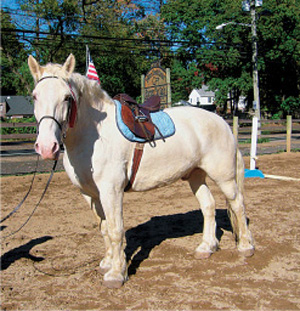
American Cream Draft Horse gelding, 16.2 hands. Suzanne Solieri and Pamela Jerrett
They are short coupled with well muscled hindquarters, a wide chest, good sloping shoulders, and a short, strong back. They are deep throughout the heart girth. Ribs are well sprung, with good strong legs that are in proportion to the body and set wide apart with strong, sure feet.
Their movement is smooth and easy, picking up their feet and setting them squarely on the ground.
A characteristic of the Creams that makes a lasting impression on those who have handled them, and is probably the most important feature, is their excellent disposition. They are best described as amiable, easygoing, willing, ready to please, and trustworthy.
Credit: American Cream Draft Horse Association