
The Belgian Draft Horse Corporation of America
125 Southwood Drive
P.O. Box 335
Wabash, Indiana 46992
www.belgiancorp.com
The Belgian is a spectacular animal and America’s favorite draft horse, outnumbering all other draft breeds combined. It is a big, tall, powerful fellow with lots of action and one that carries its head high and proud. Its confident demeanor and high stepping movement are show stoppers, and yet the Belgian is easily handled. Compared to other major American draft breeds, the Belgian is the most outstanding. It is the best in any pulling field, outnumbering any other breed wherever there are pulling contests because it puts its heart into it and does not give up. For that reason, this horse is the most popular breed with the Amish and farmers who are serious about draft type work. They know the Belgian is the best. Whether the purpose is that of work, show, advertising, or just pleasure, the Belgian fits the need. The Belgian was no overnight success. Its popularity has been hard won over the last century on thousands of farms and ranches, in countless pulling contests and show rings, and on American streets where hitches once pulled freight wagons of food for numerous people. Its staying power proves its worth. This breed did not become America’s favorite draft horse by being second best. It is the “American Draft Horse Supreme.”

The Belgian is tall and powerful, carrying his head high and proud. Belgian Draft Horse Corporation of America
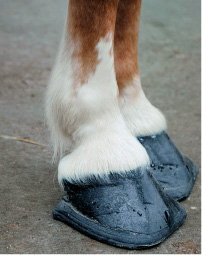
The Belgian foot is important; it should be deep, strong, and have adequate size. Belgian Draft Horse Corporation of America
History
Heavy type horses were known to exist in western Europe during the time of Julius Caesar. Most notable were the large black horses known as Flemish horses, which later carried armored knights into battle during the Middle Ages. With their great strength and size, they could handle the extra weight of armor and were referred to as the “Great Horse” by medieval writers. These horses provided the genetic material from which nearly all modern draft breeds are fashioned, yet the Belgian draft horses of today are the most direct lineal descendants of the Great Horse.
As the ancestral home of the Great Horse, Belgium lies in the heart of Flemish horse country. Although small, Belgium has fertile soil that is perfect for agriculture, and from early times its farmers used native stock to develop a heavy, powerful breed of horse necessary for the area’s abundant farming and commerce.
Stallions from Belgium were exported to many other parts of Europe as the need for larger draft animals rose for industrial and farm use. There was no reason to import other horses into Belgium, which already had the best stock. It only needed to refine and stabilize the type of genetic material it already had at hand. This was accomplished with the Belgium government’s energetic participation in establishing a system of district shows, culminating in the famous National Show in Brussels. At this international showcase for the breed, the prizes were generous, and there were inspection committees in place for stallions standing for public service.
The result was a rapid improvement into a fixed breed type, and the draft horses of Belgium were regarded as a national treasure, as well as part of its heritage. As an example, in 1891 Belgium exported stallions to the government stables of Russia, Italy, Germany, France, and the Austro-Hungary Empire. The movement of horses out of Belgium for breeding purposes was tremendous in scope and financially rewarding for its breeders for decades.
In the United States
The heavy draft stallions of Belgium were imported to the United States as its civilization moved west. Homesteaders needed heavier horses than the mustangs of the West to break the prairie ground for planting and pull large freight wagons. This created a need for a U.S. organization to keep imported animals and their descendants pure and protected. Thus the American Association of Importers and Breeders of Belgian Draft Horses was founded in 1887 in Indiana, with its name changing to the Belgian Draft Horse Corporation of America in 1937.
Progress of the Belgian horse was slow until after the turn of the century. In 1903, the government of Belgium sent an exhibit of horses to the St. Louis World’s Fair and the International Livestock Exposition in Chicago. While this effort created plenty of controversy over which type of horse best suited Americans, it also generated a great deal of interest in the breed.
From that point forward, the breed’s acceptance grew steadily. Nearly every major importer in the country included Belgians in their offering. In terms of importing seed stock and establishing new breeders, this was none too soon, for the onset of World War I in 1914 brought all importations to a halt. Suddenly, American Belgian breeders were on their own, but fortunately they had plenty of stock with which to develop their own style of Belgian horse.
It was during the draft horse decline in the 1920s when the Belgian moved into a very solid number-two position in the United States, just behind the Percheron. Thus it was not surprising that during that decade, there was a resumption of small-scale importations from Belgium. With the dramatic upturn in draft horse fortunes in the mid-1930s, horses imported from Belgium again assumed major proportions for a few years. The last importation was timely, landing in New York four months after World War II had begun and four months before the German invasion of Belgium.
Around that time, a number of events conspired to nearly end draft horse breeding of any kind. The labor shortage of World War II, the introduction of small, rubber-tired row-crop tractors, and the tremendous push for mechanization in the wake of World War II put all draft breeds under severe pressure. The decline of interest in draft horse breeding was precipitous, and the number of annual Belgian registrations dropped under the two hundred mark for a couple of years during the early 1950s.
Slowly, the return of the draft horse proceeded. As the price of horses recovered, so did the breeding. Registrations and transfers made slow but steady gains until, in 1980, they surpassed the all-time high set in 1937. An average for the next five years was over four thousand registrations and close to six thousand transfers—easily the greatest five-year period in the breed’s history.
That is where the Belgian horse is today—way out in front.
Popularity
There are different reasons that fuel the resurgence in draft fortunes, explain its remarkable success, and support its current popularity, particularly of the Belgian. One is the growing ecological awareness that certain tools and methods of modern agriculture farming are destructive, causing many to seek alternatives. The Belgian is also a very different and rewarding source of power for logging, plowing, or hauling.
Another reason more are turning to Belgians is an economic crunch that necessitates better farming methods, such as using homegrown power that can run on natural fuel and can, in turn, enrich the soil in the form of manure. The Belgian reproduces itself, provides surplus foals for sale, and appreciates in value for the first half of its life. Besides being used for the production of a cash crop, it can be bred for sorrel and blonde mules with the size and color so prized today.
Additionally, the Belgian’s beauty is a consideration. Once discontinued at some fairs for being behind the times, it has now been welcomed back as a crowd pleaser. More increasingly big commercial firms are also looking to the Belgian hitch as an advertising vehicle.
Current popularity makes the purchase of Belgians easier than ever. The fact that Belgians are by far the most numerous of all draft breeds in the United States makes them more accessible for those contemplating the thrill of driving a powerful team or single draft horse, or just beginning a breeding program. Since they are mostly a one-color breed, it is easier to breed them, pair them up as a team, and enjoy a much bigger market when it comes time to sell.
Lastly, nostalgia plays a role, albeit a minor one. Increasing numbers of horse-minded people are finding their pleasure horses are in the form of a team of Belgians. Their good disposition and willingness to work make them a favorite for small, part-time “sundowner and weekender” type farms, which continue to increase in number.
Major Breed Changes
Many of the first Belgians imported into the United States were roundly criticized for being too thick, too low headed, straight shouldered, and round boned. There was even an expression for it: the Dutchman’s type. Regardless of their faults, early Belgians made friends because they were easy keepers and willing workers with amiable dispositions. American farmers decided that the breed’s assets far outweighed its faults, and set out to retain what was right and remedy what was wrong.
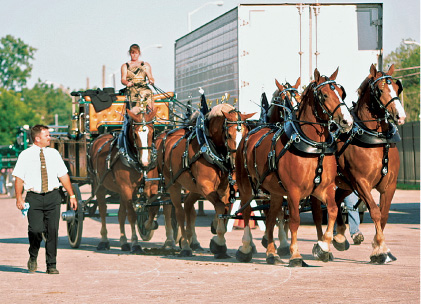
A six-up hitch. Belgians are high stepping, which is a show stopper, yet they are easily handled. Belgian Draft Horse Corporation of America
This concerted effort has been one of the great success stories in animal breeding. American breeders of the Belgian horse achieved more in improvements than breeders of any other species of livestock. Today’s modern Belgian is very different from that of the European type. It is a horse with far more style, particularly in the head and neck, with more slope to both shoulder and pastern, and possessing the good, clean, flat bone that goes hand-in-hand with such qualities. The American Belgian retains the drafty middle, shapely foot, good bone, heavy muscling, and amiable disposition of early Belgians. Its qualities as an easy keeper, a good shipper, and a willing worker are intact. The modern Belgian is still great in harness and has become a great wagon horse. The fact that Belgians are equally effective in pulling competitions as in hitch competitions says it all.
Standards
Color has also changed drastically from the early Belgian. Black, gray, red roan with black points, brown, and bay have given way to the predominant colors of today’s Belgian, which are blonde, sorrel, and roan with light points and chestnut shading. In all of these colors there are different variations. Most all the colors do have light colored legs, though this does not necessarily mean that the horse has white socks. White socks are more desirable to some people than others. The white manes and tails are the most desirable, and the white face strip, which can vary in width, is also sought after.
The Belgian retains the thick middle, heavy muscling, close coupling, and easy-keeping qualities of its earlier ancestors.
It has a pleasing head. It is undesirable to have a large head that is not in proportion with the rest of the horse. The ears should be moderate, not too short or too long. The width between the eyes should coincide with the size of the horse. A Roman nose is frowned upon, but can happen occasionally. The Belgian horse should have large attractive eyes which are pleasant to look at. It is undesirable for a Belgian to have small, or “pig,” eyes.

Neck of good length blends into the sloping shoulder, and the back is level of the ideal Belgian. Belgian Draft Horse Corporation of America
The Belgian horse should have a nice neck with good length that blends into the shoulder. It has sloping shoulders and pasterns and a strong, level back. There is a certain amount of slope to the hip (croup), with the tailset neither too high nor too low. Docked tails are desirable for the sake of safety, especially when working or driving.
Belgians have lots of bone. Hocks should be clean and straight, and hind legs placed properly. The foot should be deep, strong, and adequate for whatever size the horse may be. In judging the Belgian, this is one of the significant characteristics looked for and can be one reason why some horses do not place first in the show ring.
The horse should move well at both the walk and trot. Some important considerations for judging are: draft type, soundness, size, conformation, quality, and action at both the walk and trot.
The height of the Belgian can range from 16 to 19 hands, with a few individuals more than this.
As for the temperament of the Belgian, the horse is generally gentle, but this depends on the individual horse. There is no one set pattern for any breed when it comes to temperament.
The Belgian horse is quite diversified. It is used as a source of farm power and for showing in both Halter and Hitch classes, as well as pulling competitions and Pleasure class. Show classes include unicorn (three horses, one in the lead) and four-, six- and eight-horse hitches. Other classes that can be offered are for Tallest Horse and Draft Under Saddle, both western and English.
Junctional Epidermolysis Bullosa (JEB)
The Belgian Draft Horse Corporation of America has contracted with the Veterinary Genetics Lab at the University of California, Davis, to handle genetic testing for the junctional epidermolysis bullosa (JEB) condition. This is the new name for an old disease originally called epitheliogenesis imperfecto (EI), or hairless foal. JEB is a skin defect that is terminal in certain newborn Belgian foals. It affects the skin protein that holds the skin to the body. Affected foals are typically born alive and well, but soon develop patches of hair and skin loss over points of wear. These patches soon become larger and encompass large areas of the foal’s body. Hoof attachment is also dependent on the protein; with its absence, this leads to the loss of the hoof wall. The foal’s front teeth are in at birth, but many oral ulcers are also present. The foal dies, or is euthanized for severe infection and discomfort, at three to eight days of age.
Belgian breeders have been plagued with this annoying disease for centuries. There are scientific reports of the condition dating back to 1934 in Sweden, 1936 in the Netherlands, and there were twenty-eight cases reported in Germany from 1935 to 1944. JEB is a simple recessive genetic mutation that can be controlled through screened breeding. Breeding two horses that carry the genetic mutation can cause the birth of a JEB foal. The gene site of the mutation was isolated in 2002, so now testing for parentage verification of the disease can be performed.
Belgian owners can submit registration papers to the Belgian Draft Horse Corporation of America office requesting the JEB test. The corporate office then sends back bar-coded paperwork and an envelope to collect mane or tail hairs for testing. When the samples are sent to the lab, it performs the genetic testing to determine the carrier or non-carrier status and parentage verification to confirm it was the animal specified. The results are returned to the corporate office and printed on the registration paper as “carrier of JEB,” or “non-carrier of JEB.” Public access of the horse’s carrier status is allowed to help breeders identify those horses with JEB. Registration papers are then returned to the owner.

Hocks of the Belgian should be clean and straight and hind legs placed properly.
The test is only mandatory for new breeding stallions. If they have been blood-typed for the registration of their offspring, testing is totally voluntary. If they have not been blood-typed, however, it is mandatory for them to be JEB- and DNA-tested before their offspring can be registered. Blood typing is being replaced by DNA testing. Mares are done strictly on a voluntary basis. The purpose of this program is to inhibit two carrier horses from being bred together, so there would never be another JEB foal born.
Credit: The Belgian Draft Horse Corporation of America