

Beautiful Fjord herd on a beautiful landscape. Fjords do well in various climates. Crown Jewel Resort Ranch
Norwegian Fjord Horse Registry
1203 Appian Drive
Webster, New York 14580
www.nfhr.com
The Norwegian Fjord Horse has become known as the little horse with a big heart, whether it is in the competition ring or patiently bearing the first-time horse owner. The sincerity of this breed, which gives unconditionally and trusts generously, has endeared it to people throughout the world. The Norwegian Fjord possesses a charming, gentle disposition and a strong body structure that enables it to perform all types of riding, driving, and draft work. It is a unique, pure, and beautiful horse.
The Fjord has the reputation of being an agile and trusted workhorse with extraordinary power for its small size, as it is proportionally stronger than most horses. It is hardy, long lived, and willing. It learns fast and has an amazing ability to retain what it has learned, even after long periods of inactivity. Its versatility and compactness is enhanced by its extreme surefootedness. Its wonderful temperament and graceful, balanced gaits both under saddle and in harness make it the ideal all-purpose horse.
The Fjord’s rugged and people-loving nature has made it a family favorite for centuries in Norway. It is often used as a schooling horse for the young or inexperienced rider, yet is large and powerful enough for adults to ride and enjoy. Its willingness to please, honest work ethic, and cleverness make it the perfect partner in the show world or in front of a farm implement. Remaining unchanged for centuries, it has become that rare breed of horse that is able to do it all in a world of specialization.
Breed Overview
The Norwegian Fjord Horse is one of the world’s oldest and purest breeds. It is believed that the original Fjord horse migrated to Norway. After the last ice age, herds of wild Fjord horses existed there, which were domesticated over four thousand years ago. The mountainous district of Vestlandet (western Norway) is the breed’s place of origin in Scandinavia. The breed still exhibits strong survival instincts and remains healthy, fertile, and useful well into its long life. Fjords are efficient foragers and thrive equally well in the pasture or stable, adapting easily to the weather conditions of their environment, be it hot and dry, or cold and wet.
One unique characteristic of the Norwegian Fjord Horse is its mane. The center hair of the mane is dark (usually black), while the outer hair is white. The mane is trimmed short, so it will stand erect in a characteristic crescent shape to emphasize the graceful curve of the neck. The white outer hair is trimmed slightly shorter than the dark inner hair to display the dramatic dark stripe. The mane is one of the breed’s trademarks and complements the horse’s frame and structure well.
Without a doubt, the nature of the Norwegian Fjord Horse is one of its greatest qualities. Possessing a mild mannered, sensible, and predictable disposition has earned the Fjord a home with many families. It loves attention, is people-orientated, and is happiest when working. Its eagerness to please makes it very trainable.
With its calm and noble character, the Fjord is often the breed winning in competition. It can be seen in dressage, jumping, reining, cutting, packing, both light and heavy harness work, combined driving events, weight pulling, logging, and farm work. It is now distinctly making its name as a top competitor in sanctioned equine events, such as in U.S. Equestrian Federation (USEF) level dressage, advanced level American Driving Society (ADS) combined driving events, elite carriage driving, and USA Equestrian approved hunter shows.
Norwegian people hold the Fjord in such high esteem that it is regarded as a national treasure and is one of the national symbols. The Norwegian Registry is called Norges Fjordhestlag.
The first Fjord, a colt, brought to the United States was in 1888 by publisher J. B. Lippincott. Warren Delano, uncle of President Franklin Delano Roosevelt, imported the first stallion and six mares in 1906. It was not until the 1950s and early 1960s when most of America’s original foundation stock was imported, many bloodlines of which may be found in the pedigrees of current registrations.
In the 1980s, an evaluation committee began to pen the process for evaluations of Fjord horses in the United States through the training of qualified judges (evaluators). The first qualified evaluators went to the Fjord show in Norway in 1990. The first evaluation using the new U.S. rules was held in Libby, Montana, in 1994. Since then, the Fjord has progressed to the popular breed it is today in North America. The future looks bright for this beautiful, gentle horse.
Colors
In some countries, there is confusion as to which Fjord colors are genuine and accepted and what the correct terms should be. Norway has established fixed names of the different colors, which have been official since 1922.
Approximately 90 percent of all Fjord horses are brown dun in color. The other 10 percent can be red dun, gray (blue dun), white dun, or yellow (gold) dun. The brown dun, red dun (chestnut), and gray are also called “wild colors” because they are the same kind found on Przewalski’s Horse, the wild horse of Central Asia—and the Tarpan, the European wild horse. In addition, yellow dun and white dun are genuine colors of the breed, although yellow dun is a very rare color. It is seldom seen even in Norway.
The white dun was the dominant color among the earliest registered Fjord horses in the Norwegian stud book. It is a diluted color and a variety of the brown dun color caused by a factor that reduces the production of pigment. The color of the body is an off-white or yellowish-white. It came into disrepute because early in the breed’s history, no one knew how the different colors were inherited. Thus white duns were bred to white duns, which sometimes resulted in white and walleyed foals, called kvit.
In 1980, the Norges Fjordhestlag (Norwegian registry) acknowledged these five colors—brown dun, red dun, gray, yellow dun, and white dun—as the genuine and typical colors of the Fjord horse. This decision was supported by scientific fact.
There have been changing opinions on what color is the most fashionable, and for this reason, different kinds of dun colors have fluctuated in number at different times. The brown dun color in particular has increased in popularity recently, especially the lighter shades, and is now the dominating color. At present, there is interest in preserving all five dun colors.
Markings
Fjords also retain primitive markings, which include horizontal zebra stripes on the legs and a dorsal stripe that runs from the forelock, down the neck and back, and into the tail. Dark stripes may also be seen over the withers. Red duns have reddish-brown stripes and body markings. Gray duns have black or very dark gray stripes and markings. Pale or white dun is a very light body color with a black or gray stripe and markings. Yellow dun has a darker yellow stripe and markings, and it may have a completely white forelock, mane, and tail.
The last marking is very seldom seen; some individuals can have small, brown spots on their body, for instance on their thigh or cheek. This marking is called Njals-merke (mark of Njal), after the foundation stallion of the modern Norwegian Fjord Horse, Njal 166, which had such spots on his cheeks.
The color of these markings differs according to the main body color. On a red or yellow dun horse with a monochrome forelock, mane, and tail, the dorsal stripe can be indistinct and zebra stripes may not be present at all. On very light shades of brown dun, zebra stripes can be very weak or lacking.
Zebra stripes have the same color, though often a lighter shade, as the mane and the other markings, and are more noticeable in the horse’s summer coat. The stripes are most prominent and in greatest numbers on the forelegs. Foals lack zebra stripes, but they will appear by the first shedding of their foal-coat. In some cases, the zebra stripes are lacking on the grays and white duns. On these, the legs can be of the same color as the body, or dark up to the knees and hocks. A white star is acceptable only on mares, but not preferred.
Registry
According to the European Convention on domestic animals, the breed’s motherland, Norway, has the responsibility to preserve and develop the Fjord horses’ breed type. Around 1850, breeding and certification of the Fjord was instituted by the Norwegian government. The Norwegian Fjord Horse Registry maintains a stud book in the United States and works in conjunction with Europeans and the Fjord Horse International Association.
In the early 1980s, there were two U.S.-based Norwegian Fjord registries. They merged in 2003 to become the Norwegian Fjord Horse Registry, Inc., the official registry for Fjords based in the United States. It requires that Norwegian foals must have registered parents to be registered and have to be DNA tested to confirm parentage.

The ideal Fjord Horse is short coupled with good body depth and muscling. Sandy North
The Norwegian Fjord Horse Registry has an independent evaluation program in which horses are evaluated in-hand for conformation. Performance evaluations are also offered at Introductory and Advanced levels in three disciplines: Riding (English or western), Driving, and Draft. Although optional, evaluations are strongly encouraged, especially for breeding stock. Evaluation results are published in the Evaluation Record Book.
Standards
The breed standard is difficult to express in precise terminology. Norwegians describe their impression as “got mote,” which means a horse should have a nice and pleasant appearance. Historically, Fjords have had different shapes, models, or body types, according to the particular needs of the time.
Body structure within the breed ranges the entire spectrum, from flatter, lighter muscling to a more round, heavier muscling. This wide genetic pool has produced the versatile Fjord of today, which is not a specialized breed, but has varying types for a wide variety of activities. All horses that meet the set conditions and demands of quality are equally acceptable.
Temperament: Norwegian Fjord Horses have a calm presence and a curious, active character with an obvious display of either masculine or feminine traits.
Size: Fjords generally range in size at maturity from 13.2 to 14.2 hands (54 to 58 inches) and weigh about 900 to 1,200 pounds, with a few individuals ranging outside these measurements.
General conformation: The head and neck should present an appearance of elegance without coarseness. The body is short coupled with good depth, large heart girth, and well developed muscles.
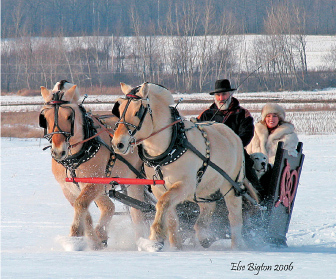
Fjord Horses are naturally adept for harness work in all kinds of conditions. Else Bigton
Conformation should be harmoniously balanced and must always be complemented by substance of body and ample bone. A combination of correct conformation, movement, and breed type is more important than extremes of beauty, elegance, and extravagant movement. What is most important is the ability of the horse to use and develop its inborn qualities.
Head: Medium-sized, with a broad, flat forehead, a straight or slightly dished profile, and good definition. Ears are small and truncated, wideset, and alert. Eyes are large, round, expressive, dark in color, well set on head. Jowls are well rounded and muscular. Jaws are quite large, with a definitive ridge and a good distance between them.
Muzzle: A wide and fleshy muzzle should be present, with large, softly elastic, outlined nostrils. On a mature Fjord Horse, incisors must be properly occluded. A malocclusion of less than or equal to one-quarter of a tooth width should be considered a minor fault, while more than one-quarter tooth width should be considered a major fault, regardless of sex.
Throatlatch: Slightly deeper than most other breeds, but must be sufficiently refined to allow proper flexing at the poll, while still providing for normal respiration. The poll should have sufficient length to allow for proper flexion. The neck bones approach the skull from behind the ears rather than inserted from below.
Neck: Is well muscled and crested. It should be supple, forming a natural arch, and appear rather heavy, but well raised and in proportion to the entire horse. The topline should be longer than the bottom line. Placement of the neck on the shoulder should run smoothly into the withers and chest, creating an upward- and outward-flexing image, giving the balance and carriage necessary to maintain the look of the Fjord horse.
Shoulder: Well muscled with good length and angulation. The shoulder and neck should be viewed as a balanced, functional unit.
Withers: Moderately defined and long, extending into the back.
Chest: Wide, demonstrating muscling proportional to gender and body size. Girth is deep, with an ample spring of rib to provide circulatory and respiratory capacity.
Back: Well muscled and broad; short to moderately long. (The back is considered moderately long when it has the same length as the shoulder.)

The Fjord has a reputation for its agility as well as its power in a compact size. Sandy North
Loins: Well muscled with an even transition to the croup.
Croup: The shape of the hindquarter may vary, and it is important that the back, loins, croup, and quarters are in harmony. The tail should be set moderately high and carried naturally while at rest and in action.
Hips: Long, deep and well-developed; substantial and in proportion to the shoulder.
Thigh and gaskin: Strong and well muscled, carrying plenty of flesh; appear well muscled when viewed from behind.
Stifle: The stifle is located deep in the hindquarter with strength and full range of motion.
Hocks: Well developed, large in proportion to the horse, and positioned with a well-marked point.
Legs: Powerful with substantial bone. Should be correct and sound with a slightly longer forearm than cannon, well-defined joints, clean cannons, flat bone, and an appearance of overall substance and strength. When the legs are viewed from the side, front, and rear, they should be parallel and nearly vertical to the ground, except for the angulation of the pasterns. There is some feathering on the legs, but not profuse.

A lovely Fjord colt with a promising future. Sandy North
Pasterns: Should have moderately proportional length and angulation to provide reasonable flexion and support.
Hooves: Dense, round, large, and black or dark in color. Their attachment at the coronary band should be a continued angle of the pastern with proportional heel length. Fjords have excellent feet.
Movement: The Fjord horse’s athletic action is straight, even, and true with good forward movement. The gaits are well balanced with a regular cadence and a length of stride in which the hind hoof print oversteps the front hoof print at the walk and trot. The Fjord has a ground-covering walk, powerful trot, and free moving canter.
• Walk: The Fjord horse is eager and efficient, moving in a four-beat cadence.
• Trot: It has a true two-beat diagonal gait. Being a powerful gait, the trot demonstrates the characteristic traits of speed, comfort, and athletic ability. The trot comes naturally and is the most favored gait of the horse.
• Canter: It should be balanced and free with good forward movement.
Markings and colors: The most common and/or desirable markings found on Fjords are: Primitive markings, such as small brown marks over the eyes and on the cheeks and thighs. Dark horizontal stripes on the legs, especially the forelegs. One or more dark stripes over the withers (very seldom seen).
Other markings that may occur are dark ear outlines and tips, a darker mid-section in the forelock, mane and tail, and a full-length, darker dorsal stripe. Dark hoof color may be present and may range to amber in red and yellow dun horses. Some striping may occur.

Fjords have extraordinary power for their small size, being proportionally stronger than most horses. Crown Jewel Resort Ranch
Markings that are not typical for the breed should be avoided. A small star is acceptable only on mares, but is not preferred. Other white or flesh-colored markings are not accepted.
It is important to preserve all of the accepted Fjord horse colors and their variations. Coat colors and marking combinations are described as follows:

Fjords are powerful enough for adults to ride, and many do. Sandy North
• Brown dun: coat color is pale yellow-brown and can vary from creamy yellow to nearly brown, with the dorsal stripe (forelock through tail) being black or dark brown
• Gray (blue dun): coat color ranges from light silver gray to dark slate gray; stripe in mane, dorsal stripe, and tail stripe are dark gray to black; muzzle is generally a darker shade of gray than body color
• Red dun: coat color is pale red-yellow in lighter or darker shades; the dorsal stripe is red or red-brown and always darker than the coat color, but never black. On the lighter shades of red duns, the forelock, mane, and tail can be completely white
• White dun: coat color is white or yellow-white; dorsal stripe is black or gray
• Yellow dun: coat color is yellow-white; dorsal stripe is a darker shade of yellow, but may be indistinct; forelock, mane, and tail may be completely white
Undesirable Aspects of Conformation
• Head: long or narrow-shaped head; high-set, or small (pig) eyes; white sclera around the eye; eye discoloration (walleye); extreme convex profile; small, underdeveloped jaws; long ears; narrow placement or poor angulation of ears (lop ears); small, pinched nostrils; improper occlusion (bite); lack of appropriate gender characteristics
• Neck: depression in front of withers (ewe neck); tied in too low on shoulder; thick throatlatch; heavy underside of the neck; insufficient muscling; lack of gender-related crest; length longer or shorter than body proportions; insufficient length of poll
• Legs and hooves: short, straight pasterns; broken-axis pastern; long, weak pasterns; over at the knees (buck knees); back at the knees (calf knees); offset knees; tied in at the knees; base wide or narrow; narrow, flat, or low heels; platter hooves; ringbone; laminitis (founder); spavin; curbs; stringhalt; straight or sickle hocks; cow hocks
• Withers: excessively round (mutton withers)
• Shoulder and forequarters: too straight (lack of angulation); upright shoulder; short arm or forearm; too wide, muscled, or narrow (lacking capacity and muscling)

Fjords possess a charming, gentle disposition, making them a family favorite. Paula Chmura
• Body and hindquarters: long or low back; roach back; long, weak coupling; high hip/croup; too narrow (lacking capacity and muscling); steep croup; rafter hips; wry or low-set tail
• Movement: irregular stride and/or cadence; extravagant action; short stride behind; overreaching; forging; winging; paddling
• Gender: retained testicles (one or both); malformed vulva
Credit: Norwegian Fjord Horse Registry