
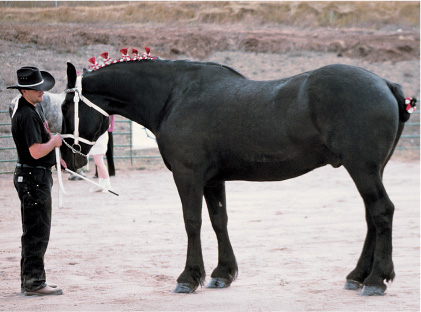
Percheron horse, showing its strong musculature. Daniel Johnson
Percheron Horse Association of America
P.O. Box 141, 10330 Quaker Road
Fredericktown, Ohio 43019
www.percheronhorse.org
The Percheron is an intelligent, hardworking, classic draft that can easily get a job done. It is a versatile athlete that readily adapts to varying climates and conditions. It has the strength to pull heavy loads and the graceful style to pull a fine carriage. The Percheron can be ridden, and some have been known to make fine jumpers. Long before the invention of the motorized truck or tractor, Percherons provided the power to build and feed many nations. Now this noble horse provides the power, substance, beauty, and style as America’s work and recreation horse for the twenty-first century.
History
As with any ancient breed, the origins of the Percheron are shrouded in myth, as the foundations of the breed precede any documentation by several centuries.
The breed derives its name from the area that served as its cradle. Le Perche is an old province about 55 by 66 miles in size and located some 50 miles southwest of Paris. It borders Normandy to the northeast and Beauce to the east. It is a gently rolling, well-watered, and fertile place with a benign climate, pre-eminently suited to the raising of livestock. It was thus ideally suited to capitalize on trade opportunities as they arose following the Middle Ages and well into the modern era.
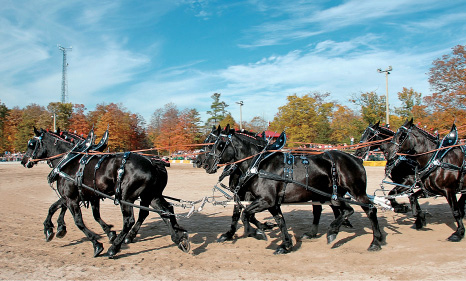
A six-horse team of Percherons displays their power. Shutterstock
From the earliest known times, the people of Le Perche were producers of horses, but not often buyers; they were always free sellers to the adjacent areas and, ultimately, the world. In the matter of breeding horses, they were a world unto themselves. They prized their horses and entire families cared for them, causing the horses to develop docility and affection toward people. This is similar to the Arabian heritage, a breed that also played a role in the development of the Percheron.
By the time of the Crusades, the Percheron was widely recognized as an outstanding horse for its substance and soundness, as well as for its characteristic beauty and style. Traditionally, it has been a breed with a preponderance of grays, confirmed by old paintings and crude drawings from the Middle Ages. French knights were almost always portrayed on gray or white chargers that had considerable substance for that time, yet without coarseness.
By the seventeenth century, horses produced in Le Perche had attained widespread fame and were in demand for many different uses. When the day of the warhorse was over, their color, substance, and style were made to order for heavy stagecoaches in France. There were three turnpikes from Paris to the coastal ports of Normandy that ran through Le Perche, so the French did not have to look far. They needed a horse that could trot from seven to ten miles per hour and had the endurance to do it all day and night. The Percheron of this time showed less scale, usually 15 to 16 hands high, and easily adapted to pulling at a trot, the heavy mail and passenger coaches for the kings of France. The light colored grays and whites were preferred because of their visibility at night. Percherons were called a diligence horse, as the stagecoaches were called diligences.
When rail replaced the diligences, omnibus horses were needed in Paris and other French cities. The job called for a little heavier horse, thus the breeders of the Le Perche altered their local breed enough to do the job. At the same time, faster and stronger horses were replacing oxen in agriculture. An example was the nearby Beauce, known as the granary of France, which needed a bigger horse for farming. Also, as trade and commerce grew, so did the need for horses of heavy draft to move large loads from docks and railheads. These businesses needed an even larger horse than the farmers, so again, the breeders of Le Perche complied. Another change to the Percheon type occurred in the early nineteenth century, when the French government established its own Percheron stud at Le Pin for the development of army mounts.
About 1823, a famous foundation horse named Jean le Blanc was foaled in Le Perche, and all of today’s Percheron bloodlines trace directly to him. He was a white stallion that greatly improved the breed more than any other and was descended from the famous Arabian stallion, Gallipoly. A great number of horses raised in Le Perche over the next fifty years had Jean le Blanc as an ancestor. This influence of the Arabian horse, along with selective breeding, led to the superiority of the Percheron, which surpassed all other draft breeds in excellence.
From warhorse (heavy saddler) to diligence horse (heavy coacher or light draft) to the true heavy draft, the breeders of Le Perche sculpted away on their beloved indigenous breed for hundreds of years, altering the animal to meet the demands of the times and to entice the buyer.
In the United States
The decades of the 1870s and 1880s were years of massive importations from Europe to the United States. Literally thousands of draft-type horses, especially stallions, were imported primarily from France and Great Britain. As the trade grew and importers ventured farther inland into France in search of the best horses, the little province of Le Perche and its superior draft horses were discovered.
The United States was experiencing the same changes as Europe: from stagecoach to rail, from agrarian to industrial, and from sail to steam. Horse stock had been heavily depleted because of the American Civil War in the 1860s. The West was being settled, its cities were growing, and there came the same cry for bigger, stronger horses than before, just as in continental Europe. The only source of draft stock at the time was from western Europe.
Percherons were first imported to the United States in 1839 by Edward Harris of Moorestown, New Jersey. Then the Percheron stallions Normandy and Louis Napoleon were imported to Ohio in 1851. Louis Napoleon was later sold to someone in Illinois and wound up in the hands of the Dillon family, which was instrumental in forming the Percheron Association.
The age of purebred livestock had dawned, with stud books and herd books rapidly spawning on both sides of the Atlantic. In the winter of 1875–1876 in Chicago, Illinois, the National Association of Importers and Breeders of Norman Horses was launched, becoming the first purebred livestock association formed in the United States. By the time the second volume of the stud book was published, the name was altered to the Percheron-Norman Society, and in a matter of just a few years, the hyphenated version disappeared to become simply Percheron.
Percherons quickly became America’s favorite horse. In the decade of the 1880s, almost 5,000 stallions and over 2,500 mares were imported to the United States from France, mostly from Le Perche, which exceeded importations from Great Britain and the rest of continental Europe. This lasted until the financial panic of 1893. There were virtually no importations from 1894 to 1898, and breeding in United States came to a standstill. Much of the seed stock from the earlier period was lost or squandered, as people were either too broke or too cautious to spend the money they had.
Importations resumed in 1898, averaging about seven hundred head annually from that time to 1905. In 1906 they reached the enormous number of thirteen thousand stallions and two hundred mares. In 1905, Percheron breeders again met in Chicago and formed the Percheron Society of America. Annual registrations reached ten thousand per year by the next decade. The Percheron quickly regained its status as the favorite of both the American farmer, and the teamster who moved freight on the nation’s city streets.
With World War I in 1914, the days of large horse importations were forever gone. With the role of tractors and trucks in the cities, the United States equine population crested in 1920. The draft horse was subjected to a losing battle, particularly in the cities. It held its own on the farms in the 1920s, but even there, interest was waning. However, in the 1930s, corn was cheap, and farmers were broke, so drafts were once again in demand. Registrations more than doubled in a few short years.
In 1934, the Percheron Society of America discontinued when the Percheron Horse Association of America was founded. Registrations in 1937 reached 4,611, a figure not seen in over a decade. Percherons were so popular that by 1930, the government census showed that there were three times as many Percherons as the other four draft breeds combined (Belgian, Shire, Clydesdale, and Suffolk).
The tides turned again during the 1940s, with the invention of the modern farm tractor, and the use of drafters declined, leading to the near extinction of the Percheron. After World War II, the greatest liquidation of draft horse stock in history began and kept right on going through the 1950s, until drafts were no longer considered worth counting in the official U.S. agriculture census of the United States. As the country modernized and mechanized, the Percheron was all but forgotten. The low point in Percheron registrations came in 1954, when just eighty-five head were recorded. The term “endangered species” would have been appropriate, though it was not yet in common use.
It was a relatively small handful of farmers dedicated to the breed and unwilling to relinquish its equine heritage who kept the Percheron alive. They were aided by the thousands of Amish farmers throughout the country who stuck with the draft horse as their source of motive power. They kept the breed alive through the next twenty years of the draft horse depression, which lasted through the 1950s and 1960s.
By the late 1960s, a renaissance in the draft horse business began, as Americans rediscovered draft horse usefulness. They enjoyed the pleasure of working with Percherons on non-farm tasks, and the horses proved to be very handy in saving young trees in the smaller woodlot operation while extracting other trees. They did not need a wide road to get to a dense wood site and could work where even the most modern tractors failed. Their independent “four-wheel-drive” conquered mud and snow to the shame of all manmade machines. Additionally, equine shows welcomed them back, and a growing recreation business discovered their attractiveness at ski lodges and similar places. Thus their comeback involved a combination of niche markets.
The Breed Today
At its height, the Percheron Horse Association of America registered in excess of ten thousand head per year and was the largest draft horse association in the world. It set many of the registration standards that are still in widespread use in other livestock breed registries.
Percherons are now back on small farms and working in the forests. Thousands of Percherons are used for recreation, such as hayrides, sleigh rides, and parades. They are shown in competitive hitching, halter, and riding classes at many state and county fairs across the country. They are used in advertising and promotions and are a common sight on streets, as the carriage business has flourished in many of the larger cities.
The resurgence in numbers and values has been nothing short of amazing. Registrations totaled 1,088 in 1988, and in 2006, there were 2,032 registrations from forty-three states and Canada. The Percheron Horse Association of America, whose membership includes all fifty states, has a National Show and sponsors a World Percheron Congress every four years, which had its thirteenth show in 2008.
This is not, as was sometimes true in the old days, a case of a few people importing and recording hundreds of horses. The ownership of the breed is in many hands for many uses.
In the 1930s, the conventional wisdom was that the draft horse’s battle with the truck and tractor was lost completely. So a deliberate effort to downsize the breed was undertaken. The appeal of the big hitches has reversed that trend, and the demand for draft horses now reaches in several directions at the same time. The times call for a versatile horse. At that, the Percheron has had a lot of practice.
Standards
Percherons need to have registered parents to be eligible for registration. Those from foreign countries need to be registered in their country before they can be registered in the Percheron Horse Association of America.
Temperament: The Percheron has a very pleasing disposition. It is proud, alert, intelligent, and a willing worker. It is also expected to be of marked tractability and an easy keeper.
Color: Percherons are usually black or gray, but there are also sorrels, bays, roans, and other various colors. Many Percherons have white markings on the head and feet, but excessive white is undesirable.
Size: Percherons can range in height from 15 to 19 hands, but most are between 16.2 and 17.3 hands. They can weigh up to 2,600 pounds, with the average being around 1,900.
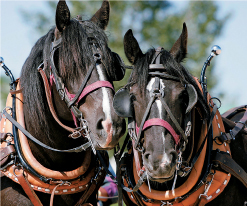
Percherons have a more classic styled head than most drafts. Lincoln Rogers/Shutterstock
Head: The Percheron head and neck are the most attractive of its draft horse characteristics. Good Percherons have large and full prominent eyes, a broad and full forehead, and a straight face. Their strong jaw and refined ears, attractively set and carried with animation, suggests an Arabian ancestry. Stallions should have a ruggedness about the head, and mares should have a feminine look.
Body: The ideal horse should have a fairly long, level croup with a big, round hip. It should be close coupled and wide and deep through the chest, with plenty of back rib. The muscles of the arms, forearms, croup, and gaskins are especially emphasized in a good drafter. The Percherhon is noted for heavy muscling on the lower thighs and for an aspect of unusual ruggedness and power. Also characteristic of the Percheron is the high quality of the feet and legs.
Movement: Ease and balance of gait is essential. A characteristic of the Percheron is its clean action.
Credit: Percheron Horse Association of America