
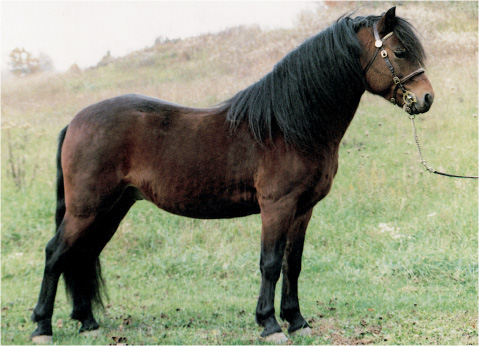
As a hearty moorland breed, the Dartmoor is stalwart and athletic. American Dartmoor Pony Association
American Dartmoor Pony Association
203 Kendall Oaks Drive
Boerne, Texas 78006
Dartmoor Pony Registry of America
295 Upper Ridgeview Road
Columbus, North Carolina 28722
www.dartmoorpony.com
The Dartmoor is an attractive and ancient pony originating from the moors of Devon in southwest England. Through the centuries, the rough, rocky terrain and sparse grazing produced a surefooted, strong, and hardy pony quite capable of excelling in any number of pursuits.
The Dartmoor of today has a wonderfully calm temperament and friendly nature, making it an excellent choice for adults and children alike. The pony provides riders of all ages with wonderful experiences due to its versatility and adaptability. Its well laid-back shoulder and long, low stride provide a smooth and comfortable ride that adults like to sit. With its gentle, calm nature, the Dartmoor is very much in demand as a child’s first riding mount. It is not unusual for the same pony to patiently carry a toddler on lead-line, compete with an older child in 4-H or Pony Club, and then happily take parents for a Sunday drive.
Typically, once a Dartmoor Pony belongs to a family, it is rarely sold. Fondness for Dartmoors is such that when children outgrow one as a riding mount, it continues on with the family as a harness pony or is passed on to relatives to introduce their young ones to the love of riding and caring for a pony.
The Dartmoor is perfect for showing, hunting or trail riding. Its good looks, pleasant manner, and brave nature make it an excellent candidate for both pleasure and competitive driving.
The Dartmoor is the best possible foundation stock for breeding larger children’s ponies. It contributes its substance of bone for a small warmblood type of pony with versatility and strength and, most importantly, that Dartmoor good nature.
History
Ponies on Dartmoor are believed to have been in existence for centuries, surviving unbelievable hardships from both nature and humans. Hoof prints assumed to be from domestic animals—possibly Dartmoor Ponies—were discovered on England’s Shaugh Moor within the boundaries of a Bronze Age settlement dating back to approximately 2000 BC.
The Dartmoor Pony originated on High Willhays, one of the tallest peaks and highest points of southern England located on the southwest coast in the county of Devon. The pony received its name from a wild area of moorland called Dartmoor, which stands over one thousand feet above sea level. Dartmoor is about 365 square miles of almost solid granite highlands, which are very rocky with sparse vegetation. A thin layer of soil covers protruding rocks throughout with little fields, grassy slopes, and wooded valleys along the edges. Dartmoor’s weather can be quite intense, receiving full force gales from the Atlantic Ocean. Being able to survive such bleak conditions, the Dartmoor Pony became known as a race of pony that was surefooted, hardy, and full of stamina, enabling it to survive in almost any terrain or climate in the world.
One of the earliest recorded references to Dartmoor Ponies is in the will of Awifwold of Credition, a Saxon bishop who died in 1012. Another example was during the reign of Henry I (1100–1135), when a stallion was taken from Dartmoor (then a royal forest) to be bred with his royal mares.
Much later, however, there was less need for ponies, as it was necessary to breed a horse of considerable frame to carry soldiers and their heavy armor. The plight of English ponies became even more pronounced in 1535 when Dartmoor Ponies, along with all other ponies of the British Isles, almost became extinct after Henry VIII passed a law to eliminate “nags of small stature.” Fines were imposed on anyone using a stallion under 14 hands. Six years later, another law was passed by Henry VIII prohibiting the use of any “horse under 15 hands” and all “unprofitable beasts.” Smaller ponies were caught and destroyed, but some slipped through the cracks because they were too far away to police. Queen Elizabeth I later annulled these laws.
In the 1820s, Dartmoor Ponies became very popular in the nearby towns for their ability to cross the rough and mountainous roads. King Edward VII valued Dartmoors for his polo teams, and there followed a huge comeback in the breed until World Wars I and II. During the wars, Dartmoors and other ponies once again declined in numbers, as they were more usable for meat instead of work. Since that time, however, the Dartmoor has made steady progress in numbers due to strict breeding practices and demands.
Registration in England
It was not until 1898 when the Polo and Riding Pony Society—later known as the National Pony Society—set up local committees to provide descriptions of native breeds of ponies, giving each a section of the Stud Book for registration. More Dartmoors were initially registered than any other native British breed. With exception of the height, the original description of the Dartmoor is almost identical to today’s standard. The height limit for a stallion at that time was 14 hands and 14.2 hands for mares, but very few ponies came close to that.

Dartmoor herd racing. Dartmoors show consistency in type, size, and color. Bob Langrish
The 1920s were an important time for the Darties. From 1924 to 1927, the Dartmoor Pony Society came into existence and set the height limit at 12.2 hands. It knew there were many other outlets beyond polo in which the Dartmoor could perform for both profit and enjoyment.
Some of the most influential bloodlines still utilized today were first noticed in the 1920s. Ponies of this era include Judy V, a champion mare bred by E. P. Northey, who produced the first breed standard and got the first Dartmoor Stud Book off the ground. The Leat, another champion, was bred by the Prince of Wales at his Ducy Stud at Tor Royal near Princetown. These two champions bred together and produced Juliet IV, yet another champion that in turn produced the outstanding show and stud success, Jude, in 1941.
In the 1940s, very few Dartmoors were registered, partially due to World War II. Registration by inspection was introduced, and prizewinners at selected shows became eligible for registration. By the end of the 1950s, the breed was in much better shape. Registration by inspection finished in 1957. All future registrations in the National Pony Society’s Stud Book were of ponies whose parents were already registered. The Dartmoor Pony Society continued with membership, breeding, inspections, and showing, but did not take over the registration process until 1977.
Preservation of Ponies on Dartmoor
Throughout history, the Dartmoor Pony has been used for a variety of services, including pulling carts to and from market and packing wool, granite, and tin as well as other materials from the mines. At the start of the twentieth century until the 1960s, Dartmoor Prison officials raised unregistered ponies for the warders to ride while escorting inmates to and from their duties outside the prison.

Beautiful Dartmoor stallion with naturally full mane and tail. Pam Norton
When not in service, the ponies were left to roam free on the moor. Over the years, the quality and number of pure Dartmoor Ponies on the moorland declined. Since the moor is common land, there are no restrictions as to what can be turned out. Some farms on Dartmoor have been given grazing rights on the commons for a specific number of cattle, sheep, and ponies. Breeds such as the Shetland, Arabian, and Thoroughbred have been turned out on the moor at various times. Consequently, a pony coming from Dartmoor does not necessarily mean it is a Dartmoor Pony.
The Dartmoor area also reflected what was popular for the current times. In the 1940s, there was a demand for small pit ponies. In the 1950s, pinto ponies were popular and pony classes were on the rise, requiring a warmblood type pony. Ponies on Dartmoor began to decline by the crossbreeding with these less hardy breeds. While the breed was being kept pure by stud farms, it was evident with each trend, a toll was taken on the quality of the pure Dartmoor. A plan had to be formed to preserve the breed.
In 1951, Dartmoor was designated a national park and the pony was chosen to be on its logo. In 1987, the Duchy of Cornwall (of which Prince Charles is the Duke) joined the Dartmoor Pony Society, along with the Dartmoor National Park Authority and the Ministry of Agriculture, to improve the quality of the moor ponies. They developed the Dartmoor Pony Support Scheme, which allowed inspected and approved typey mares to run with a pedigreed stallion on one of several newtakes (an enclosed, controlled part of the moor that is separated from the commons and used for breeding purposes). Newtakes are owned by Prince Charles and maintained for the purpose of producing the type of pure Dartmoor that is as hardy as its ancestors. It was hoped that this scheme would encourage local farmers to breed the true-to-type Dartmoor that is able to survive the highland’s harsh environment.
The Dartmoor Pony Society opened a supplemental register to include the inspected mares as foundation stock, and there was a noticeable improvement of the foals over the years. It was hoped that the majority of the fillies that were upgraded after inspection would return to the scheme and eventually replace the original mares. This would give breeders a new genetic pool, which was important to future breeding. It also provided park visitors a chance to see the Dartmoor Pony in its natural habitat.
One such example of the scheme’s success with mares from the newtakes is Lizwell Gambling Queen, a four-time National Combined Driving Champion that competed successfully in three World Championships in Europe representing the United States. This smart-moving mare finished in the top ten twice and won the silver medal for dressage in Denmark—an amazing feat!
Beneficial Crossbreds
Every breed of equine has a special purpose and is not meant to be good at every discipline. Due to this and to meet the current trend, breed registries have often added outside blood to make their breed come closer to what the market demands. Dartmoors are no different, and as early as the twelfth century, blood from other breeds had been introduced, sometimes to create the perfect replacement pony for children who had outgrown their Dartie. In turn, the pure Dartmoor has remained invaluable for its own unique qualities that have been transmitted to create other breeds worldwide.
The Dartmoor Pony contributes both its kind disposition (a very important quality for a child’s mount) and substance of bone to produce a pony with versatility, strength, and intelligence. Thus the present-day Dartmoor Pony has been beneficially crossbred to create the Dartmoor Sport Pony, an elegant, talented, kind-hearted, riding and driving pony that is also an exceptional jumper.
Initially, there was concern that the Dartmoor would lose its valuable foundation bloodlines and original quality so necessary for preservation, such as other pure breeds have experienced when crossbred. To prevent this from happening, the American Dartmoor Sport Pony registry was created by the American Dartmoor Pony Association. With this addition to the registry, breeders could obtain the special qualities of the Dartmoor in an equine suited to their needs and discipline without depleting the number of pure Dartmoor Ponies.
The Dartmoor Sport Pony has at least 50 percent Dartmoor Pony blood and is created by crossing Dartmoor stallions with mares of other breeds. Sport Ponies come in various builds and sizes suitable for all types of disciplines and can be bred to another American Dartmoor Sport Pony or Dartmoor Pony.
The Dartmoor Sport Ponies have helped purebred Dartmoors as well. Since purebreds are rare and can only come from the limited number of mares available to breed with stallions, the process of increasing numbers is slow. With low worldwide numbers, it is hard to get the publicity needed to increase interest, breeding, and marketing. Since the number of mares of other breeds is endless, the Dartmoor Sport Ponies are being bred at a higher rate. As they enter shows where their talents are being displayed, they increase awareness of the Dartmoor Pony and its contribution to the equine world. With this added exposure, the purebred Dartmoor is on the rise. This pattern of improvement by crossing other breeds to pure Dartmoor stallions has caused the Dartie to become one of the most successful of all British Isle pony breeds.
The Dartmoor Market
Virtually all registered English Dartmoors now reside on private property, and stud farms throughout Great Britain have been breeding and showing their registered Dartmoors. They are constantly striving to keep the breed true to its origins to provide others a chance to own a first class pony. Dartmoors are now being raised throughout Europe, the United States, Australia, and smaller countries. Breeding societies worldwide are working hard at retaining quality and increasing Dartmoor numbers to fill the demand for reliable and sensible ponies.
The increase in Dartmoor demand is due to several reasons: Darties average around 12 hands, making it easy for a child to groom, saddle, and mount them. They move with a low, smooth stride, making their riders feel like they are on a much larger mount. They are not readily excitable like some of their cousins. They are quiet, dependable, easy to train, and possess a gentle and kind heart, not unlike the family Labrador dog. In the show ring, they have competed at Federation Equestre Internationale (FEI) levels and have had outstanding success against other breeds in jumping, cross-country, and dressage, proving that they are a breed to be reckoned with in competition. When used as harness ponies, they can hold their own against much larger equines, displaying toughness and courage allied with their calmness.
By careful selection, breeding through the stud farms, and the preservation efforts of the farmers’ ponies on the moor, Dartmoor numbers have a chance of rising to that of other popular pony breeds. Globally, however, there are very few Dartmoor Ponies compared to their cousins. The breed is listed with the Equus Survival Trust as vulnerable, with five thousand to seven thousand active adult purebred breeding mares.
In the United States
The Dartmoor Pony was first introduced to North America in the 1930s. Although still considered a rare breed, its population has been growing steadily in the United States. Recently, there has been a number of quality imports from England as more people have become interested in breeding and owning Dartmoors. Today, there are about 350 purebreds in the United States.
There are two U.S. registries: American Dart-moor Pony Association (ADPA) and Dartmoor Pony Registry of America (DPRA).
Founded in 1993, ADPA was started by breeders who felt it important to have a registry that preserved and promoted the Dartmoor Pony by the standards of the Dartmoor Pony Society in the United Kingdom. This was first accomplished through blood-typing and parentage verification, and later upgraded to DNA-typing with parentage verification. Ponies that can trace back 100 percent to pure United Kingdom stock are registered as purebreds, while Dartmoor crosses of 50 percent or more are registered as American Dartmoor Sport Ponies.
Founded in 1956, the DPRA was started by Joan Dunning of Virginia who imported her first Dartmoors in 1936. Dunning, as well as her daughter, Hetty Abeles, are still among the leading breeders and supporters of Dartmoor Ponies today.
The DPRA is the organization that maintains the official studbook for Dartmoor Ponies in the United States. It has been registering Dartmoors since 1956 and also maintains a database on DPRA-registered Dartmoors. The DPRA uses its database records and DNA to maintain an accurate account of the breed in the United States.
Standards
Overall impression: The Dartmoor is a very good-looking riding pony, sturdily built yet possessing quality. The mane and tail should be full and natural. As a hearty moorland breed, the Dartmoor is stalwart in conformation, more similar to a warmblood type than the elegant Welsh. Its distinctiveness and consistency of appearance make the Dartmoor easy to pick out in a crowd, as well as easy to match to other ponies for a driving team.
Height: Ranging in height from 11 to 12.2 hands, but is not to exceed 12.2 hands (127 centimeters or 50 inches).
Color: Bay, black, brown, chestnut, gray, and roan. Bay and brown are the most dominant colors, followed by black and gray. White markings on the head and legs should be minimal. Excessive white markings are discouraged, and piebald and skewbald are not allowed.
Head and neck: The head should be small with large kindly eyes and small alert ears. It should be well set on a good neck of medium length. The throat and jaws should be fine and show no signs of coarseness or throatiness. Stallions have a moderate crest.
Shoulders: Good shoulders are most important. They should be well laid back and sloping, but not too fine at the withers.
Body: Of medium length, strong, and well-ribbed up with a good depth of girth giving plenty of heart room.
Loin and hindquarters: Strong and well covered with muscle. The hindquarters should be of medium length and neither level nor steeply sloping. The tail should be well set up.
Limbs: The hocks should be well let down, with plenty of length from hip to hock, and clean-cut with plenty of bone below the hock. There should be a strong second thigh. Legs should not be sickle-hocked or cow-hocked, and the forelegs should not be tied in at the elbows. The forearm should be muscular and relatively long, with the knee fairly large and flat on the front. The cannons should be short with ample good, flat, flinty bone. The pasterns should be sloping, but not too long, and the feet should be hard and well shaped.
Temperament: The Dartmoor makes an excellent choice for a child’s first pony. Its calm, consistent, quiet disposition encourages novice riders both in and out of the show ring. It has an exceptional mental attitude.
Movement: Low and straight coming from the shoulder with good hock action, but without exaggeration.
Abilities: Dartmoors are perfect as children’s riding and show ponies.
Being very brave and possessing powerful rear quarters, they are solid and safe jumpers, thus making them ideal for small children learning to jump. Combining a quiet disposition, inherent hardiness, and a great work ethic, the ponies excel in competition or pleasure driving for both older children and adults. For those not willing to give up the wonderful Dartmoor qualities when they grow too tall for purebreds, the larger Dartmoor Sport Pony is a good choice.
Credit: American Dartmoor Pony Association