
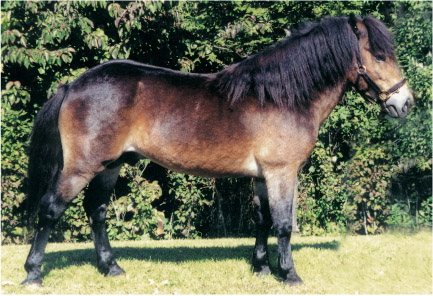
This Exmoor stallion is an excellent example of the breed type. Kathryn A. Lasky
Exmoor Pony Association International
P.O. Box 1517 Litchfield, Connecticut 06759
www.exmoorpony.com
Exmoor Pony Enthusiasts
P.O. Box 155
Ripley, Ontario N0G 2R0
Canada
http://exmoorenthusiasts.fortunecity.com
Canadian Livestock Records Corporation
2417 Holly Lane
Ottawa, Ontario K1V 0M7
Canada
www.clrc.ca
The Exmoor Pony certainly is special. Here is no inanimate relic dug up from the past; here is a living, breathing animal of great antiquity that came to Britain long before humans did. It has seen humans evolve from the Stone Age to the beginning of agriculture, through the Industrial Revolution to the Age of Technology. It is considered the purest of England’s Mountain and Moorland pony breeds and is an enormously important part of British heritage. It still resembles wild ponies that roamed England ten thousand years ago. To this day, it continues to live on one of the most remote moors of England, Exmoor, for which it is named.
The Exmoor is talented and strong, and is a very rare and treasured breed. It is a hardy pony, shaped by nature for survival over many centuries, and as such is an easy keeper. While it is genetically invaluable for its unique history and hardiness, there is the added bonus of its versatility. Its intelligence, robust nature, and natural agility results in a pony ideally suited for riding and driving, whether for pleasure or competition. It is stocky and strong enough to carry an adult fox hunting. Its action is long, low, and more comfortable than many other ponies its size. The mountain and moorland habitat of the Exmoor has bred into the breed balance, agility, and surefootedness.

Identical characteristics are obvious in this Exmoor Pony herd. Ona Kiser
The Exmoor is wonderful to live with, easy to care for, easy to fall in love with, and sensible enough to learn all things equine—and more! It is the Original Off-Roader.
History
The first wild ponies came to Britain between ten thousand and twenty thousand years ago, walking across a swampy plain that was later to become the English Channel. They became widespread throughout Britain, living alongside mammoths and preyed upon by saber-toothed tigers, wolves, and bears. Their presence in Britain ebbed and flowed until drastic climate changes in the Mesolithic period brought a covering of trees in the lowland areas. Open grazing habitats became available only on the mountains and hills of Britain, and consequently the pony populations became restricted to those areas.
When the English Channel formed five thousand to eight thousand years ago, equine populations became isolated on the British Isles with no possible further interference. Some scientists theorize that the British hill pony was hunted to extinction, and then re-introduced by Celts. Other scientists believe they remained in reduced numbers on the isolated uplands.

The Exmoor Pony is a wonderful riding and family pony. Exmoor Ponies of North America
When farmers settled the lowland areas and divided the land into fields and agricultural holdings, British hill ponies became isolated from each other and their destinies followed different paths. This resulted in the nine recognized native breeds of Mountain and Moorland ponies in Britain today. In each area, human interference led to the mixing of different genetic ingredients to produce distinctive breeds. As an example, when Roman mercenaries brought their horses to Northern England, these breeds blended with British hill ponies to produce the Fell Pony.
On Exmoor, a very different story unfolded. In every other part of Britain, outside equine blood was introduced to a degree that drastically altered the appearance of the British hill pony; on Exmoor, this did not happen. Most of the changes to ponies elsewhere in Britain took place in the last few hundred years. These changes can be linked to the influences of major trade routes and ports introducing new ideas and new animals, or to the influences of landowners doing the same.
Exmoor, however, until very recently, was a forgotten place with no such routes across it or large ports nearby, and few landowners feature in its history. It is situated in the southwest of Britain, spanning the borders of Devon and Somerset, its northern boundary being the high cliffs of the Bristol Channel. It is an area of high moorland divided by steep wooded valleys and fragmented by farmland. The moorland provides a varied diet of grasses, rushes, heather, and gorse and is where wild red deer survived as well as the hill ponies and farm stock. The area is subject to very wet winters, cold temperatures, and driving winds. It is, in effect, a social island within the British Isles, and because of this the original type of pony survived.
A few people on Exmoor followed the trend for crossing and “improving” the local pony, but it is significant that these herds died out and left no legacy. Exmoor Ponies of today are descended from stock that was managed on the principle that nature had the best design and introducing outside blood would lead to dilution of hardiness. Thus the Exmoor of today remains the closest surviving breed to the British hill pony.
Until 1818, most of the open expanse of Exmoor was designated a Royal Forest, with “forest” in this sense meaning a hunting ground. A warden worked for the crown and managed Exmoor as an upland grazing expanse where farmers from its fringes could graze their stock (ponies, sheep, and cattle) upon payment of fees. The warden alone ran the stallions that, as it is recorded, were of the original native type.
In 1818, the Royal Forest was sold to John Knight, an industrialist who believed he could tame the Exmoor land and make it a more productive agricultural system. He considered that whatever nature had created, he could improve upon, including the ponies. Knight and a few others experimented, but they produced ponies that could not thrive living out in Exmoor’s harsh winters.
The outgoing warden, Sir Thomas Acland, took thirty of the pure Exmoor Ponies that had lived in the forest to his own estate. Other local farmers who had worked with him bought up small numbers of ponies at the 1818 dispersal sale and began their own breeding herds. Sir Thomas and his colleagues were perhaps some of the first conservationists, breeding the Exmoor ponies true to type.
Most of the significant traits from these outside infusions in the last of the crossed herds, which had lived separately from the true Exmoors, died out early in the twentieth century. The Acland ponies continued and their descendants now form the famous Anchor herd that runs on Winsford Hill. In most cases, those farming families that had saved ponies back in 1818 are still involved today, inbreeding Exmoors.
Having survived the dispersal in 1818 and the fashion for “improvement,” which could have changed them beyond recognition, Exmoor Ponies were nearly exterminated during World War II. They were used for training troops, some of which practiced on live targets, including ponies. Gates were left open and grazing areas were no longer safe for stock. Many ponies were stolen and transported away to cities to feed hungry people. By the end of the war, it is estimated that no more than fifty Exmoor ponies survived.
A breeder on Exmoor named Mary Etherington rallied farmers and landowners to revive Exmoor pony breeding and build up numbers. She even exhibited two Exmoors at the London Zoo to draw attention to their plight. Cattle grids were installed, and stock was returned to the commons and moors. Steadily, the Exmoor Pony population began to recover and grow.
Although numbers increased gradually, even by the mid 1970s just around thirty Exmoor foals a year were being registered. In the late 1970s, attention was once again focused on their zoological importance and rarity. Enthusiasm for breeding Exmoors returned as demand for foals increased, and many new owners bought Exmoors as a commitment to their conservation. While numbers rose away from Exmoor, the population of free-roaming ponies that lived on the moor and were subjected to the laws of nature remained under two hundred.
Today, the majority of Exmoors are bred off the moors. The few remaining herds on the moors have experienced significant inbreeding and are managed by their owners only during yearly roundups, weanling sales, and stallion selections. Otherwise, they fend for themselves on the cold, windy, and wet moor.
Uses
A boost to this free living population came in the 1980s with the recognition that Exmoor Ponies can be a useful conservation tool themselves. The National Trust, English Nature (now part of Natural England), and several county wildlife trusts set up small, free-living herds on sensitive nature reserves to manage the vegetation. This is proving most successful and is benefiting the conservation of the Exmoor Pony alongside the conservation of whole habitats.
Prior to the use of mechanization, which came comparatively late to Exmoor, the local pony was used for a wide variety of tasks on the hill farms. A pony could be used for driving, shepherding, plowing, harrowing, hunting, and carrying the farmer to market, as well as being children’s show ponies. Some were even used for the post (mail) rounds, while others were mounts for the British Home Guard during World War II. Exmoors were also used in crossbreeding programs to improve the soundness of other breeds and tap into their jumping ability. Those that were one-quarter to one-eighth Exmoor crosses (usually crossed with Thoroughbreds) were used as steeplechasers in the United Kingdom.
As well as being able to serve many family members, the Exmoor found favor because it was economical to keep. In fact, one of the most important aspects of caring for an Exmoor is to ensure that it does not get too much food, even if it is pastured.
Today, Exmoor Ponies are seldom used for farm work, but throughout Britain they participate in every sphere of equestrian activity, be it showing, riding, driving, jumping, long-distance riding, or riding and driving for the disabled. Their considerable strength makes them highly suited to driving, but it also means that they require a competent child rider rather than a rank beginner.
Registries
Back in 1921, the owners of herds in the United Kingdom, who believed that the purebred Exmoor should continue to exist and not be lost through crossbreeding, gathered together and formed the Exmoor Pony Society to promote and encourage the breeding of purebred Exmoor Ponies. The Society set in place a system whereby foals from registered Exmoor parents have to be inspected and passed as free from disqualifying faults before they can be registered. A foal with any concentrations of white hairs on the body, or in the mane or tail, or white patches on its feet, fails to qualify for registration.
Each autumn the herds are gathered off the moor to their home farms for inspection and branding. There are many more Exmoors bred in Britain’s domesticated situations, thus the society inspectors travel throughout Britain assessing these foals, as well as the moorland ones. If a foal passes, it is hot branded with the Exmoor Pony Society’s four-pointed star above its left shoulder. Beneath this—except for the Anchor herd—is the mare owner’s herd number, and the left flank is branded with the foal’s individual number. The Anchor herd has no herd number, but instead has an anchor symbol brand over the individual number. Each registered Exmoor therefore carries its individual identity for life, and by checking this in the studbook, its breeding is also known.
In the United States, the Exmoor Pony Association International was founded in 2001 and does registrations based on DNA testing. The goal is to include all Exmoors and be able to assess their genetic status and numbers. It has three levels of registration. Section A is for those that are DNA tested and have a veterinary exam, plus they are presented to a panel of three judges to assess breed type and pass. Section B is for those that are DNA tested plus they have an exam for physical defects. Section C is for those ponies that are DNA tested. The registry also includes Exmoor crosses of 50 percent or more.
Another registry is the Canadian Livestock Records Corporation, which registers Exmoor Ponies under its General Stud and Herd Book and is open to all purebred ponies born in Canada or the United States.
Due to Exmoors being very rare, there is much concern about their low numbers. The Exmoor population on the moor in England is limited to about 150 ponies; there are less than 100 Exmoors in North America and only some 2,000 in the world. The breed is listed in the critical category by the Equus Survival Trust, and the Rare Breeds Survival Trust (United Kingdom) lists it as endangered as of 2007.
Breed Characteristics
All Exmoor Ponies are essentially identical, conforming to a natural blueprint. Variation in color and markings, which are typical in breeds humans have created, is noticeably absent. This suggests that the Exmoor remains more a wild race than a selected breed. Characteristics of Exmoor Ponies are all survival adaptations for avoiding predators as well as coping with hostile elements.
The ponies’ moorland living has given them an efficient digestive system. They have a large girth and stomach capacity and unusual prehensile lips. Whereas they thrive on gorse bushes, they will get fat on too much hay or pasture. They are easy keepers personified; however, as with other breeds, they need to be fed adequately if they are working hard.
Their hooves are unusually tough. Typically, they do not need shoes unless they are driven on pavement, and hoof trimming is needed far less than with most other breeds. They have an almost catlike jumping ability with remarkable agility and can often make a significant jump even from a standstill.

Exmoors are stocky and robust ponies resembling their ancient ancestors. Ona Kiser
Their temperament is intelligent, sensible, and independent, but it usually takes some experience as a rider to get the best work out of them.
Overall appearance: Exmoor Ponies are hardy, vigorous, alert, and symmetrical in appearance. They are stocky and strong with deep chests and large girths. The large capacity of their digestive system is important in winter, as they consume large quantities of coarse plant material that provides them with internal warmth. They have an alert expression and general poise indicating balance and symmetry of movement with fine, clean bone.
Color: At first glance, all Exmoor Ponies look alike. They come in bay, brown, and mouse dun (a dilute of the basic bay gene) and usually have darker legs, although browns may have brown legs. They all have striking mealy (oatmeal) colored markings on the muzzle, around the eyes, and sometimes under the belly, but no white markings anywhere else. The mane and tail are usually a darker brown than the body, sometimes almost black, but occasionally they are lighter and more mousy in color. The shade of brown of the coat ranges from a light rich brown, termed “bay,” through every shade of brown, to just a few individuals that are almost black.
This pattern of coloring/marking, which is uniform throughout the population, is a primitive design and found elsewhere in the horse family (Przewalski’s Horse) and is displayed by many herbivorous prey animals in other animal families, such as cattle, sheep, and antelopes. Exmoors blend in very well against the background of mixed heather, grass, and bracken in their moorland habitat, camouflaging them from predators. Additionally, the mealy muzzle and mealy eye ring perhaps serve to break up the outline of the head, making its movements less obvious to a predator. Exmoor foals are born with the mealy markings set against a much lighter coat color. This changes as they grow their first winter coat, and it may take up to two years for them to match the adults in color.
Size: There is relatively little variation in size between adult Exmoors. They naturally range from 11.1 to 13.1 hands (46 to 53 inches), with the majority being around 12.2 hands (50 inches). Heights of above 12.2 hands occur more frequently in domestication. The preferred height range in stallions and geldings is 11.3 to 12.3 hands at maturity, while mares should be 11.2 to 12.2 hands at maturity.
Exmoors are immensely strong ponies for their size. They have plentiful bone, with 6.5 to 7 inches minimum circumference for cannon bones (6.5 inches minimum for mares and 7 inches minimum for stallions and geldings). They also have three-quarters of an inch more in circumference on their hind cannon bones than their front ones. (It is professionally recommended that all equines have 7 inches per 1,000 pounds of body weight, and Exmoors are well over that.) They have broad loins allowing them to carry relatively more weight for their size, making them an ideal family pony as they can carry adults as well as children.
Temperament: Exmoors are loyal and kind if well treated. They are also intelligent, sensible, and independent.
Bite: The Exmoor Pony presents an example of high efficiency in the business of finding, gathering, chewing, and digesting food. The teeth are well adapted to a coarse diet. The incisors (biting teeth) are curved so that they meet vertically, like a pair of pliers, and therefore cut cleanly and effectively. The efficiency of the bite does not appear to decline so rapidly with age as is seen in many other horses. The molars (chewing teeth) are very large and set into the jaw, so that the maximum chewing pressure can be exerted on tough plants.
Contrary to many publications, Exmoor Ponies do not have an extra seventh molar tooth. This misconception arose from the mistranslation of some German research, which in fact was referring to an extra branch off the blood supply to the lower jaw (this might have been the beginnings of the evolution of an extra tooth). This feature does not seem to be confined to Exmoors and is perhaps simply present in animals with large lower jaws.
Head: The face is clean-cut with a wide forehead. Ears of the Exmoor are short, thick, and pointed. The eyes are large and wide apart, giving them an extra-wide field of vision and a distinctive, appealing expression. The eyes are prominent “toad,” or hooded, eyes, which are often erroneously thought to relate to the mealy colored ring. It refers, however, to the raised fleshy rim above and below the eye that the coloring accentuates. This rim serves to protect the eye from rainwater by diverting it down the length of the head to run off the lower jaw.
Body: The Exmoor has a clean throatlatch and good length of neck. The shoulders are clean, fine at the top, and well laid back. The chest is deep and wide between and behind forelegs. Ribs are long, well-sprung, and wide apart. The back is level, broad and also level across the loins. The tail is neatly set in.
Legs: The legs are clean and short with a strong cannon bone. Forelegs are straight, well apart, and squarely set. Hind legs are well apart and nearly perpendicular from hock to fetlock, with point of hock in line with pelvis bone. There is a wide curve from flank to hock joint, and legs are free in motion with no tendency to sweep or turn. The feet are outstandingly hard and neat, and are slate blue/black in color.
Movement: When moving, the Exmoor is straight and smooth without exaggerated action. The limbs are designed for movement over hilly terrain.
Coat: One of the major forces of natural selection is climate. The Exmoor Pony’s external anatomy is designed to withstand extremes of cold and, most importantly, rain. These are the descendants of a mountain pony prototype that evolved to live in wet upland environments.

A thrilling scene: an Exmoor herd cavorting in a country setting. Ona Kiser
The coat grows in two phases, providing summer and winter coats. The winter hair grows in two layers that, in effect, provides a sort of thermal underwear and a raincoat. The hairs next to the skin forming the undercoat (like thermal underwear) are fine and springy in texture and form an insulating layer. The outer hairs act as a raincoat, being coarse and water-repellent, which water beads off of like a well waxed car or polished furniture. The efficiency of this double layered coat is evident from the phenomenon of snow-thatching—the coat insulates them so well that in cold weather, snow does not melt on them. It collects on the ponies’ backs as insufficient body heat escapes to melt it. Thus the body is not chilled by melting snow, and the collected snow is shaken off periodically.
Body hair is good at channeling rain off so that it never touches the skin. It grows in a surface drainage pattern: it lies in an arrangement of whorls (cowlicks) and vortices, which maximize water dispersal away from the vulnerable parts of the body and body openings.
The tail, mane, forelock, and, in winter, the beard all show water-shedding specialization. The fan of short hairs near the root of the tail is called a snowchute, but its function is to channel rainwater out over the buttocks so that it does not run under the tail. The long, fully haired mane and tail, which contrast with the upright mane and partially haired tail of a Przewalski, are adaptations to this prime need of dispersing water from the body.
The Exmoor Pony sheds its winter coat by late spring, and for a short time, until about late August, sports its summer coat. This retains the drainage properties but consists of just a single, short layer, since insulation is unnecessary. It is a hard, flat, shiny coat. Most Exmoors with good nutrition show extensive dappling. Seasonal dappling is a result of the sooty (smutty like) gene.
Certain bloodlines have a tendency for “sweet itch,” an allergic dermatitis to insect bites, especially gnats.
Credits: Exmoor Pony Association International and Exmoor Pony Enthusiasts