
The American Shetland Pony Club
81 B East Queenwood Road
Morton, Illinois 61550
www.shetlandminature.com
Shetland Ponies have been known for more than a century as “the most remarkable of ponies.” They are the perfect-sized riding pony for children and are hardy and reliable, ready to share in any adventure. They make great, trustworthy companions, suitable for most any youngster to ride and handle. The love and devotion these ponies offer is giant sized, and a bond with them is never outgrown. Shetlands are relaxing and fun to own with an appeal lasting beyond childhood.
With their maximum height of 48 inches, they are an easy fit for lighter adults as well. For those desiring a larger Shetland, the National Show Pony (half Shetland) is now available. Since they have retained an innate driving ability, well trained Shetlands excel in driving classes and can be shown by both adults and older children. Pony hitches have livened up many a parade and are used regularly in a working environment.

Classic Shetland stallion showing ideal breed type. Courtesy Dorie Tennessen/TNT Farm
Shetlands are fine family pets requiring minimal maintenance. They can undertake most any pursuit a standard horse can, only in a smaller, less expensive package. They require the same healthcare as horses, only their feed and stabling is in proportionately smaller amounts. Owning a Shetland does not require expensive equipment. It can range from the barest essentials such as a halter, bridle, saddle, and simple grooming tools, to all the equipment necessary for a hitch of performance ponies pulling an elegant, antique carriage.
A well trained Shetland not only excels at driving, but it also has a multitude of other uses. Lead-line classes for small children are always fun. Shetlands have also been used successfully in therapeutic programs for the physically and mentally challenged. There is an activity suited for anyone with the Shetland.
History
The Shetland Islands on the storm-lashed northern most part of the British Isles is the home of the Shetland Pony. On those islands, its ancestry roamed the hills and moors, developing into hardy little animals well adapted to their environment. It is uncertain from where the ponies came from before then, but they have been on the islands as far back as any knowledge of Britain. Nowadays, the Shetland Pony is raised and kept only on a few of the islands, i.e., the Mainland, Bressay, Fair Isle, Fetlar, Yell, and Unst.
It is said that sometime in the sixteenth century, Spanish Armada ships went ashore there (possibly aground), having had onboard some fine horses belonging to the admiral’s stud (horse farm). Supposedly the cross of these horses imparted much of the beauty and fleetness now evident in the pony.
The islands’ rough terrain obviously had much to do with establishing the characteristics of the ponies. They are renowned for their sound feet and legs, strong symmetrical body, good eyes, wonderful endurance, and good temperament. The ponies generally ran at large on the hills and lived on the heather and the scant grass they found. They were seldom fed a handful of grain or hay during the long, cold winter and were driven to the extremity of eating seaweed. It has been said that they also would, under pressure of great hunger, eat the dead fish that were washed in with the seaweed, but this is questionable. Hence, “survival of the fittest” accounts for their symmetry of form and great constitution.
In the mid 1800s, Shetlands were used for pulling ore carts in coal mines and carried peat from the hills for the family. The peat, which was used for fuel, was packed in “cassies,” each one containing not less than 60 or 70 pounds. Two of these cassies were slung across a pony’s back on a kind of pack saddle in the shape of a sawhorse and were fastened in position by a breast collar, a girth or two, and breeching. The whole load weighed as much as a good-sized man and was often carried for several miles up and down hills, across marshes, through storms, and in washed out paths and gullies without halting. So the Shetland’s feet had to be good, its back strong, and its eyes clear to pick its way. The pony was never used in its native home in harness, but only to ride and pack. Any good Shetland pony could pack half of its own weight and go many miles without halting.
Not all ponies from the Shetland Islands were small. Eli Elliott, an early Shetland Pony historian from Iowa, remarked, “Some years ago they brought larger ponies from the highlands of Scotland and crossed them with little mares. These are not ‘right Shetlands’ as they grew to be 46 to 48 inches. ‘Rights’ are 40 to 43 inches, with some 36 to 38 inches.” As to size, the smaller the better, which the Shetlander was not slow in finding out. When Elliott imported 126 Shetlands in the year of 1888, he had to pay 50 percent more for 8 little mares that were 36 inches and under fully grown. He remarked, “As long as you can get them straight in the legs and round in the body, you can not get them too small. We often hear of marvelously small ponies and I have made it a point to look for them: but the smallest grown pony I have ever seen was 34 inches high and weighed under 200 pounds.”
Elliott imported all the Shetlands he could buy for two years straight and said, “I am fully convinced that we have more and better Shetland Ponies today in America than they have on the whole group of the Shetland Isles. . . . As a rule the [sucklings] and yearlings are straight in their legs. The mares seldom breed oftener than every other year, but keep at it to a great age. I saw one mare thirty years old and about to drop another colt.”
It is a well known fact that on a part of the island of Fetlar, a titled lady of Scotland, Lady Nicholson, had for years crossed small Arabian stallions to Shetland mares. This produced remarkable ponies 46 to 48 inches tall, some of which were extremely fine, and they became known as Fetlar or Lady Nicholson ponies. Iceland’s ponies were also released on the island of Bressay, with which Shetland stallions were then crossed. Consequently, a pony coming from the Shetland Islands does not prove it is a pure Shetland.

Shetland mare with the refinement of the Modern type. Courtesy Dorie Tennessen/TNT Farm
Elliott proclaimed, “I have seen work horses there that would weigh from 1,200 to 1,500 pounds and I saw one colt, the produce of such a mare and a Shetland stallion. Hence [there is] wisdom of having a competent committee to examine each and every applicant for entry in our Stud Book!”
Registry
In 1888, the American Shetland Pony Club (ASPC) was founded, and the first Shetlands were registered in the United States. Over a hundred years later, the American Shetland Pony is still popular and thriving. Now after more than a century of selective breeding, the Shetland has developed refinement, resulting in a sturdy but elegant pony.
Shetlands are divided into four registries: the American Show Pony, the Modern American Shetland Pony, the Classic American Shetland Pony, and the National Show Pony. Each type of American Shetland Pony has its own division for competition and its own criteria.
The newest registry recognized by the American Shetland Pony Club is the National Show Pony, which is required to have only one purebred Shetland or Miniature Horse parent and can measure up to a full 14.2 hands at the withers. National Show Ponies have a division for hunters, western riding, and driving.
Shetlands must be registered with the ASPC, which is also the parent registry of the American Miniature Horse Registry. The ASPC has remained closed since 1955 to imported Shetlands. The exceptions to this rule are ponies that are registered in Canada with American parentage.
American Show Pony
American Show Ponies are similar to the Modern American Shetland Pony with its animated gait and brilliance. These larger, flashy ponies are especially suited to driving and draw a lot of attention in the show ring.
Any pony that is registered with the American Shetland Pony Club, the American Hackney Horse Society, or any offspring of a registered Shetland bred to a registered Hackney pony is eligible to be recorded in the American Show Pony Stud Book. It also must meet the dual height requirements: there must be a maximum overall exhibition height of 48 inches or less as measured from the highest point of the withers to the measuring surface; also the height from the highest point of the withers to the hairline of the coronary band at the heel shall not exceed 46 inches (that is, 47 inches overall height with a 1-inch heel, or 48 inches overall height that would include up to a 2-inch heel).
This breed, like the Modern, is an elegant and stylish show pony. Although it can be slightly larger, its rules and shows are similar to the Modern American Shetland Pony.
Modern American Shetland Pony
This pony is elegance in motion. It combines the historic hardiness of the Classic Shetland Pony with an outcross of an animated and more superior, refined breed. This cross produces a long, shapely necked and fine-boned pony with extreme action and a spirited, but sophisticated, personality that lends itself well to the show ring. Moderns can come in any color, but are not to exceed 46 inches.
The Modern American Shetland Pony is shown in two height divisions: less than 43 inches, and 43 to 46 inches. Besides halter classes, they can be shown in performance classes, which include roadster, harness, and pleasure driving.
A well trained Modern American Shetland makes an agile, intelligent mount for a child and can be used for everything from gymkhana ponies to hunter/jumpers. A good headset, superb carriage, and high action most often define a great Modern Shetland performance pony. This is an elegant animal with all the pomp and sophistication of a carriage horse, yet possessing the sturdiness of a pony.
Modern Shetlands are thrilling to watch, with the fiery energy and style they bring to the show ring, as well as the fun and quick thinking they achieve in event competition. They can also add elegance to a casual carriage ride down the lane. They have high-stepping action and the excitement of the larger breeds, with the handiness of a pony.
Standards for American Show Pony and Modern American Shetland Pony
Conformation should be that of a strong, attractive pony, blending the original Shetland type with refinement and quality resulting from American care and selective breeding. The head should be symmetrical and proportionate to the body with width between prominent eyes. It should have a fine jaw, short, sharp, erect ears, a small muzzle with flaring nostrils, and a refined throatlatch. The head should be carried high on a well arched neck. The barrel should be well rounded, and the back short and level with a flat croup. The pony’s structure should be strong with refinement: high withers, sloping shoulders, flat boned, muscular legs (not cow- or sickle-hocked), strong springy pasterns and good, strong, serviceable feet. The mane and tail should be full.
Ears: Ears should be small, fine, alert, expressive, and set well on head.
Foretop: This should be long and full, but not bushy and wavy.
Eye: Eyes should be large and luminous, placed well on head, wide apart, and prominent on side of head.
Forehead: A wide and smooth forehead is desirable.
Face: The pony should have straight or very slightly concave profile.
Nose: The nose should be broad and flat, carrying width of muzzle.
Muzzle: The muzzle should be small and refined, with large nostrils and firm lips.
Chin: The chin should continue line from upper lip and should not be meaty or flappy.
Mandible: This should have a smooth bottom line and be wide between the branches.
Jaw: The jaw is not as pronounced and massive as on some breeds, but should show some bulge, particularly on stallions to denote masculinity.
Throat: The throat should be fine and pronounced. The previously mentioned parts of the head, when blended together, should be small and fine, and express personality.
Neck: The intersection of the neck into the head should be horizontal to give a fine rounded throatlatch and an arched neck with the head carried high.
Point of shoulder: This is pronounced, setting well forward at approximately a 45-degree angle from the withers.
Breast: The chest should be broad and deep, but not too wide and flat between the front legs.
Arm: This should be muscular, but not too bulgy or massive, and set forward on shoulder. The forearm should be long, smooth, but with pronounced muscles.
Cannon bone: The cannon bone should be short, wide, flat, and dense, with the tendons standing out.
Knee: The knees are smooth, well blended, and in straight line with forearm and cannon bone.
Fetlock joint: Clean and hard. There should be no puffiness, or cocked-over appearance. Fetlocks are light.
Pastern: The pasterns should be long and springy, but not at the expense of strength.
Hooves: The hard, dense hooves should be wider at the base than at the coronary band. The heels are open, and the angle is that of the pastern.
Foot: It should toe straight, not turned in or out.
Tendons: Broad and clearly defined. When felt between the fingers, the tendons should be hard and taut. They should not be overly cut-in below the knee and the hock.
Pisiform: This should be clear cut and clean (one of the signs of quality joints).
Elbow: The elbow should be close to barrel.
Chestnut: They should be heavy and course, as chestnuts seem to go with ponies.
Ribs: To have feed capacity, endurance, and good looks a pony must be well ribbed. There must be a combination of breed character, or quality, and the good spring of rib that the Shetland has been noted to possess for centuries. The ribs should be extended back as close as possible to the point of the hip. In other words, the pony should have a rounded barrel.
Girth: When viewed from the side, the pony should be deep in the heart girth.
Coupling: The back and the loin areas should be short, and the hip or croup long and level. If the pony has these features, then it is said to be short-coupled, which is desirable. From the side, the belly line is longer than the back line. This indicates several things: the heart-girth is deep, the ribs are well sprung, the coupling is short, and the foreleg is set well forward, which it must be to have the angle of shoulder necessary for good shoulder action.
Flank: The flank should not be “cut-up.”
Stifle: The stifle should be round, full, and strong.
Hock joint: When a pony stands with the hind legs squarely under it, a plumb bob should fall from the point of the buttock, straight down the back of the hind leg from the hock to the ankle. From a posterior view, the point of the hock should be the same distance apart as the fetlocks. The joint itself should be large, but neat and clean, with the bones defined, or else the hock will look meaty.
Gaskin: The gaskin should be well rounded, wide, and muscular.
Thigh: The distance from the stifle to the buttock should be deep and full.
Point of buttock: The buttock should be gracefully and symmetrically rounded. When viewed from the rear, it should be wide.
Tail: The tail should spring from the line of the back, not hung down below as though an afterthought. The tail should be long and full.
Dock: This is the portion of the tail arising from the back and should come out boldly.
Croup: There should be a pleasing, gentle curve, but comparatively speaking, it is a horizontal croup. When viewed from behind, the croup should be oval, not broad and flat, and it should not come to a point.
Point of hip: This should be laid in smoothly to give a pleasing appearance. The angle of the line from the points of the buttocks should be low, and the distance should be great.
Loins: The loins should be full, broad, and strong, as well as blend smoothly.
Back: The back should be short and wide, not flat, and in proportion to the neck of the pony.
Withers: These should be clearly defined and narrow, but not pronounced, and should give a pleasing blend to the back and neck.
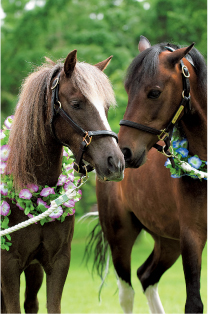
Shetlands are expressive with refined heads and large eyes. Courtesy Johnny Robb
Poll: The poll is horizontal just behind ears.
Quality: The quality of the American Show Pony and the Modern Shetland has a general overall appearance of style, refinement, and beauty, as evidenced by fine-boned legs, well proportioned body, and skin that is soft and pliable, with the pony in good health and flesh (but not too fat).
Performance: Good performance shall consist of the walk (in breeding classes), in which the feet should be lifted well off of the ground and placed down flat. The stride is medium in length, brisk, elastic, and straight. The trot should be a straightforward, diagonal movement, with the forelegs being raised at least to a point where the forearm is extended in a horizontal position. The elbow and the hocks should be flexed, with the feet well under the body and well off the ground. The body at all times should be in perfect balance, with the head carried high.
Manners: Good manners are demonstrated by the pony’s obedience to all commands requested, and in general, the pony should be guided by a light mouth. Pulling on a bit, head tossing, and breaking stride are objectionable. Ladies, amateur, and children’s ponies in harness should stand quietly and back readily.
Presence: Presence refers to the animation, self-assurance, alertness, and personality that stems from good breeding, good grooming, good care, good training, and good handling.
Soundness: As a minimum requirement, all Shetlands must be serviceably sound for show purposes. Any pony showing evidence of lameness, deformity in feet, broken wind, or complete loss of sight in either eye shall be refused an award.
Color: Shetlands may be any color, and either solid or mixed, but not appaloosa. No particular color is preferred. Additionally, no discrimination should be made because of the color of eyes, such as glass, watch, hazel, or blue.
Classic American Shetland Pony
This is a pony that possesses style and substance, being more refined than the original imported Shetland. It is a fun choice for the show ring, driving, trail, or open events. It exhibits a well balanced, strong, sturdy body in a compact package, while also having the willing, easygoing, and gentle disposition to be a suitable companion for all ages. It is a versatile animal, adept at pulling a cart, working in the field, or carrying a child.
To be eligible for registration, the Classic Shetland’s height must not exceed 46 inches at the withers. For the Classic Shetland that is under three years of age, there are two major show ring height divisions and each has additional graduated divisions to accommodate different heights for varying ages.
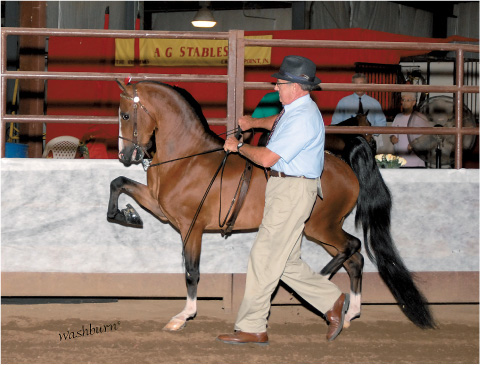
The American Show Pony is flashy with its animated gaits and overall brilliance. Courtesy Dorie Tennessen/TNT Farm
The Over Division is for:
• Three-year-olds that are over 42 inches, but not exceeding 46 inches.
• Two-year-olds that are over 41 inches, but not exceeding 44.5 inches.
• One-year-olds that are over 40 inches, but not exceeding 43 inches.
The Under Division is for:
• Three-year-olds and older that are 42 inches and under.
• Two-year-olds that are 41 inches and under.
• One-year-olds that are 40 inches and under.
• Foals of current year that are 40 inches and under.
There is also a Foundation Class for those on which the breed has been founded. They are required to have a pedigree imprinted with a Foundation Shetland seal. They should be more conservative in type than an entry in Open Classes and should exhibit slightly more bone and substance. The maximum heel (barefoot or shod) for a Foundation pony, including the plate, does not exceed 1½ inches. It is for those Shetlands not exceeding 42 inches and is for exhibition purposes only:
Senior Class is for three-year-olds and older whose height does not exceed 42 inches.
Junior Class is for two-year-olds and under that are 41 inches or less.
Foals of Current Year who are 40 inches or less.
There is a broad diversity of types within the Classic Shetland Pony breed that can vary to a degree from one geographic region to another. The correct Classic American Shetland type should be based on the motto of “form follows function.” The more correct type will be dictated by the discipline in which it is engaged or exhibited, such as halter class, light harness, heavy harness, hunter/jumper, competitive driving, or as a child’s mount or pet.
Standards of Classic American Shetland Pony
The Classic American Shetland has a well-proportioned body that maintains the strong Shetland constitution with substance in the chest, body, and hindquarters. The short head is clean-cut, with a fine muzzle, large nostrils, brilliant eyes, wide forehead, and sharp, small, well-set ears. It possesses fineness of throatlatch, length of neck in proportion to the body, and a sloping shoulder. The legs are set properly under the body on the four corners, and the forearm is well muscled. The knee and cannon bones are broad and well defined and have an ideally shaped pastern with proper size and angle of pastern and foot. Its topline is straight, the back is short, and the loin is short and well muscled. The tail is set high on the croup. The body has plenty of depth, with well-rounded buttocks and well-muscled gaskins. The ribs should be well sprung and have a round barrel. The knees and hocks are well supported from below by strong, short cannons, joints, and hooves. The mane, foretop, and tail are full, and the coast is fine and silky. It has a natural, straight, and springy way of going. Extremes in length of neck, body, legs, and action are undesirable.
General character: Hardy, spirited, and pony-like.
Head: Small, short, and clean-cut; well set on the neck and tapering from wide set eyes to the muzzle.
Ears: Small, alert, and expressive, set well up on head and delicately curving to tip.
Foretop: Long and full.
Eyes: Expressive, large, bold, and luminous, placed well down from base of head, wide apart, and prominent on side of head. Placement of eyes should give the head a diamond shape from the front view.
Forehead: Wide, smooth, and full.
Face: Slightly concave, and dished is preferred, but a straight profile is permissible. Any indication of a convex (Roman) profile shall be severely faulted.
Nose: Narrow but flat nose is desirable, blending into the muzzle with a gentle curve. A Roman nose shall be severely faulted.
Nostrils: Prominent and open on a small and refined muzzle.
Muzzle: Small and refined, with large nostrils and firm lips.
Neck: Must be proportionate to the body, with extreme length of neck to be avoided. It should be well carried and be moderately lean without crestiness, in the case of mares. In the case of mature stallions, it is inclined to be slightly crested. A broken crest shall be faulted.
Angle of neck: The angle of the neck coming out of the shoulder should be from 45 to 60 degrees. The ideal angle of neck on the halter pony should not exceed 60 degrees.
Hock joint: This is the same as the other two registries, except that cow hocks or sickle hocks shall be faulted.
Action: Free, true, and forcibly straightforward. The walk should be a relaxed, flat footed walk and a four-beat straight movement. The trot should be easygoing and square with elasticity, and should have freedom of movement that is open, reaching, and capable of covering ground when asked to do so. Stiff legged extension (pea shooting) or lack of freedom of movement shall be faulted. Up and down motion (piston-like) without extension shall also be faulted.
Color: This is the same as the other two registries. Recognized Shetland colors are albino, bay, black, brown, buckskin, chestnut, cremello, dun, gray, grullo, palomino, perlino, pinto (tobiano, overo, tovero, and sabino) roan (bay, red, and blue), silver dapple, sorrel, and white.
All other parts of the standards are the same as the American Show Pony and Modern American Shetland Pony’s criteria.
Credit: The American Shetland Pony Club