
Personal Ponies Ltd
The Shetland Register
23 Sergio Way
Hot Springs Village, Arkansas 71909
www.personalponies.org
The United Kingdom (UK) Shetland Pony is a very special breed. It is the true Shetland Pony, the one that worked the coal and tin mines in Scotland, England, and Wales, and the peat fields in the Shetland Islands. These ponies are docile, kind, intelligent, sensitive, and capable of doing hard work. They have an amazing temperament, and are steady of mind and great of heart. However, they are definitely not world-class beauties! They are not sleek, slim-legged, high spirited show ponies. Quite the contrary, they mostly look like sturdy little trolls—short and stocky with shaggy coats and thick manes and tails. This is because they have more important work to do than jumping fences and prancing in show rings.
It was discovered that the UK Shetlands are extra sensitive to small children, especially those with special needs. Their job in the United States is to be loved, hugged, petted, and kissed, as they stand quietly and patiently while a child in braces, on crutches, or in a wheelchair brushes and combs, feeds, or caresses them. It is very important work.
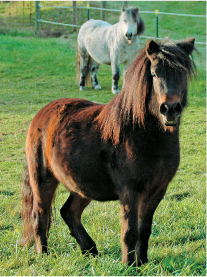
UK Shetlands are not elegant. The most beautiful part of them is their heart. Personal Ponies Ltd.
Breed Origins
No one knows for sure how the UK Shetland Pony became an integral part of the history of the Shetland Islands, but about two thousand years ago there were ponies like today’s UK Shetland living there. The Shetland Islands have severe weather due to their location, approximately one hundred miles south of the Arctic Circle and just north of Great Britain. Grass is scanty, the ground is hard, rocky, and wet, and there is a constant cold wind. Under these conditions, animals that can get by with little to eat are more likely to survive, thus the process of natural selection resulted in smaller ponies. It is important to note that the smallness of UK Shetland Ponies is not the result of stunting due to the lack of food while they are growing; it is solely due to the ruthless action of natural selection in weeding out the genetically larger ponies.
These ponies have a long history of domestication and were best suited to work as draft animals; they were often described as “wide, round, and low to the ground.” They were originally bred to haul peat and do farm work. Later they were used for draft work, when roads were built and carts could be pulled along the roadways. They were not the same type as today’s American Shetland or the American Miniature Horse, for they were far more stocky and rugged.

UK Shetlands are built low to the ground. They are like sturdy little trolls. Personal Ponies Ltd.
In the late nineteenth century, Shetland Ponies were used extensively in the coal mines of Scotland and Wales. Many were exported to the United States to be used in the mines of Pennsylvania, West Virginia, Kentucky, and Tennessee. Their patient, quiet, kind ways were ideal for the demanding work of pulling coal carts in the mines. It was at this time that their history took a dramatic turn, regarding the work in the coal mines.
Troubling History
Previous to the use of the UK Shetlands, from 1809 to 1842, hundreds of women and children were employed as “beasts of burden,” working in the many iron or coal mines across England, Scotland, and Wales. Boys as young as four and girls as young as seven would draw coal out of the narrowest mine shafts by way of girdle and chain. From a belt around their waist, a chain was attached that went between their legs and was attached to a large tub without wheels. On hands and feet they would crawl, pulling the tub filled with ore or coal to the main shaft for fourteen hours a day.
In 1842, the Mines Act was passed, which prohibited women and children under the age of ten from working underground. When the labor law was enacted, UK Shetland Ponies were exported from their homeland by the thousands to replace the women and children who were no longer allowed to do the work. UK Shetlands were small in stature, heavy boned, and surefooted. These qualities, along with their strength and temperament, made them ideal for the grueling labor in the narrow mine shafts.
By the 1850s, only male ponies (stallions) were used. They were lowered down into the mines at age four, where they remained underground the rest of their lives—sometimes as long as thirty years. Tens of thousands of stallions worked together underground, which was certainly a testament to their kind nature and willingness to please their human companions. The ponies traveled more than three thousand miles per year and hauled as many tons of ore and coal.
This was a sad and heart-wrenching time. The ponies received inhumane treatment, as attested by a grandson of a collier in the United States to the founder of the Shetland Register. Not only were the ponies sent into the mines for life, but their eyes were also sometimes hammered out and sewn shut to eliminate coal dust infections! This cruel treatment was done in the coal mines in the United States as well.
The best and stoutest ponies were exported to the colliery (coal mine) owners, as large profits could be made selling them for mine work. This was attractive to farmers on the Shetland Islands, who lived at poverty level and could not afford to keep their best ponies. Only the more slender animals were kept or sold elsewhere, because the strongest were in demand for the heavy work in the mines, thus they were much more valuable. The smallest and strongest ponies had no counterparts for this demanding work.
In 1870, a stud (breeding farm) was established by the Fifth Marquis of Londonderry, a colliery owner. The sole purpose of the stud, located on the islands of Bressay and Noss, was to breed pit ponies. No expense was spared in purchasing UK Shetland stallions and mares from the islands, and the best became the foundation breeding stock for the Londonderry Stud. The formula for success in the development of the Londonderry pony was to produce those with “as much weight as possible and as near to the ground as can be got” without defects of conformation. Temperament was not compromised, as a tractable pony was essential for the work required in the mines.
The Shetland Pony Stud Book Society began in 1890 in England to preserve the breed from the drain of the best stallions being exported to the coal mines. It accepted only ponies less than 42 inches high, which encouraged breeders not to produce bigger Welsh-like ponies.
As the mines became progressively more mechanized, fewer ponies were needed. Ponies bred at the Londonderry Stud were sold to breeders in the United Kingdom as well as to breeders and mine owners in the United States. The Londonderry Stud was finally dispersed in 1899, yet up until the latter part of the 1970s, ponies still worked in isolated underground mines throughout Britain. Today, UK Shetlands are still used on the islands to haul peat as well as do other tasks, and a few still work in tin mines in Wales, but for the most part, pit ponies are no longer used in the mines.
After World War I, the British started breeding UK Shetlands as riding ponies for children, and the demand for riding and driving them became popular. Queen Elizabeth II and her siblings rode UK Shetlands, and the Queen Mother was the patroness of the breed until her death.
In 1956, the Shetland Islands Premium Stallion scheme was put into effect in Britain. The Department of Agriculture provided quality registered stallions to seven of the Shetland Islands to live on the common grazing grounds (scattolds), where UK Shetlands were allowed to roam. It also prohibited the use of inferior studs, ensuring foals of greater value.
In the United States
In 1984, Marianne Alexander of upstate New York bought two registered American Miniature Horses. She was captivated by their exceptionally kind and gentle dispositions, and amazed at the way they responded to her grandchildren and other children who visited her farm. They seemed to have a special sensitivity toward the children, who adored them.
Curious about their lineage, she began to trace their bloodlines and discovered that, although they were registered as American Miniature Horses, they were descendants of UK Shetlands imported to the United States in 1884 from the Londonderry Stud. This discovery piqued her curiosity, so she and her husband made a trip to England, Ireland, and Scotland to see the UK Shetland breed in its homeland hills, meet with Shetland breeders, and study the original studbooks in depth. It was their good fortune that they found some longtime UK Shetland breeders that had adhered to the Londonderry Shetland breed type. They offered the Alexanders firsthand knowledge about the UK Shetland that is barely known in the United States. This is when the Alexanders learned of the ponies’ inhumane treatment in many of the mines. They also found that Shetlands in the United Kingdom are the true breed type—gentle, full-bodied, and good with children.
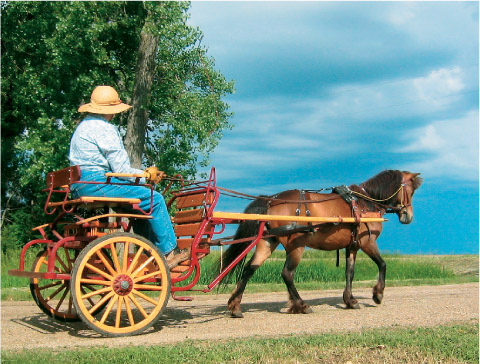
United Kingdom Shetland mare pulling a carriage. Personal Ponies Ltd.
By the end of the trip, Marianne Alexander knew what she had to do; she wanted to give something back. “My personal intent was to make reparation for the inhumane treatment that thousands of Shetland Ponies received when sent into the mines for some thirty years—a life sentence.” The ponies’ incredible sensitivity to children convinced her that they were ideal companions for children with special needs. She wanted to spend her retirement breeding the ponies and offering them to children who needed something to brighten their lives, to love, and to be a loyal friend.
Registry
Alexander began to assemble a breeding herd of UK type Shetlands in the United States and established The Shetland Register (TSR) in 1986. The philosophy of the register was based on the knowledge and interest of individuals who later participated in the development of Alexander’s organization, Personal Ponies Ltd. (PPL), incorporated in New York in 1993. The primary purpose of this organization was to provide Shetland Pony companionship to children who are differently able, to make a difference in their lives, and to bring love and joy to them.
To assure that the true UK Shetland type and temperament would be acquired, the register began securing and importing ponies from the Shetland Islands, Scotland, and England. The majority of American Shetlands could not be used; although some could possibly trace their lineage to the UK Shetland, they did not resemble the breed. Only a few UK type Shetlands in the United States were used for breeding if their pedigrees traced back to the UK Shetlands imported in 1881, but these were infrequently found. TSR’s goal was to develop and preserve this type of pony from the United Kingdom.
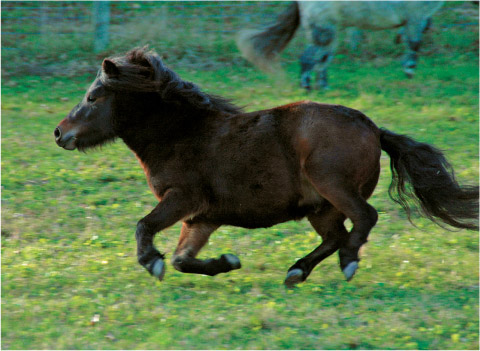
United Kingdom Shetlands have lots of depth. They are robust and sturdy. Personal Ponies Ltd.
PPL’s purpose was to bring a pony to a child with special needs—their pony—to love and care for, completely without charge. In a distinctly unique program, the ponies were placed with sponsors who brought them to the children, which made PPL the only organization of its kind in the world. There are riding centers and organizations dedicated to assisting children to learn to ride or drive a horse or pony in harness. Nothing, however, has been done for the very small child with special needs that requires a smaller mount or an equine companion of small stature.
The ponies were placed strategically with their sponsors to help promote PPL and serve the wider community, such as visits to convalescent homes, daycare centers, therapeutic riding centers, and treatment centers. Ponies were brought anywhere children could benefit from seeing and interacting with them. Volunteers sponsored ponies by maintaining them so that they were available for visiting families unable to keep a pony at their home. These children could visit several times a week to see “their” pony and to care for it in any way they could, whether it be brushing, feeding, walking, or just being with their pony.
Dynamics
Since its humble beginning with only two individuals, PPL has expanded into an international organization. It has placed ponies with hundreds of children with special needs. There are programs in almost every state involving hundreds of volunteers throughout the country. The organization now has fifty-five breeding farms, sixty-five stallions standing at stud, about two hundred breeding mares, and more than one thousand registered ponies. Yet even with all this growth, there are still many children waiting for ponies.
Although small Shetland Ponies are far less expensive to maintain than big horses, building a quality herd of UK Shetlands is hard work and very expensive. The Personal Ponies organization is ever on the lookout for true-to-type Shetlands in the United States, but they are rarely found anymore. Thus importing quality UK Shetland stallions and mares for the breeding program is a priority. Without quality breeding stock, it is impossible to keep up with the requests of families with children who are differently able.
Finding and importing a mature (two-year-old) stallion or broodmare is both an expensive and complex undertaking. Today’s market in the United Kingdom is focused on a riding type Shetland, making it difficult to find the draft Londonderry type pony of yesteryear. Once an individual that is suitable for the organization is located, there is the cost of the pony, the added cost of airfare, trucking, and veterinary approvals, as well as extensive quarantines and testing carried out by both the U.K. and U.S. governments. All of this means that the cost to import a mature individual of breeding quality is about $18,000 to $20,000.
TSR is open to utilizing modern biotechnology, such as artificial insemination, embryo transfer, and the possibility of cloning, as these technologies become available. It is hoped that the use of these and other modern scientific methods will dramatically enhance the number of quality UK Shetlands.
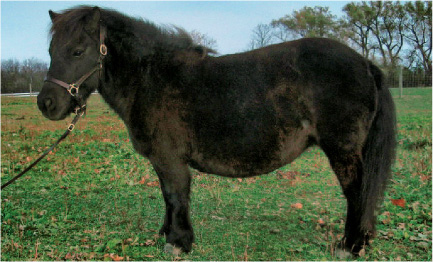
A pregnant United Kingdom Shetland mare. Personal Ponies Ltd.
The organization consists of volunteers who raise, train, sponsor, and promote the ponies, and they assume the cost of maintaining the ponies they are assigned. Families who receive ponies from the program are also responsible for the cost of maintaining and the care of the ponies they receive.
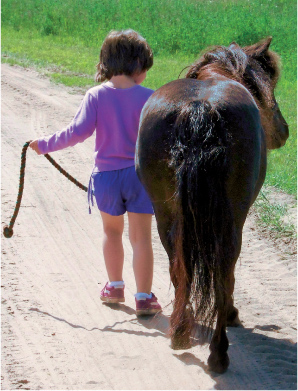
A little girl with her United Kingdom Shetland. Personal Ponies Ltd.
Attributes
UK Shetlands are perfectly suited for their intended new job in the United States of being a friend to a child with special needs. The requirement of a sweet disposition for easy handling is innate in the UK Shetland, giving them the tenderness needed to be lovable little equines. With their robust structure, naturally kind nature, and singular enjoyment of human company, UK Shetlands are uniquely suited in temperament and size for small children.
The ponies are often very small, as small as 30 inches, and seldom taller than 39 inches. Most ponies are too small to be ridden (except minimally by a child of thirty pounds or less), although often they make fine driving ponies. The only requirement in the program, however, is that the ponies are offered as “best friends.” In their average thirty-year lifetime, the ponies may serve many children. PPL’s mission is always to bring joy and smiles into children’s lives, and the UK Shetlands are remarkably suited in temperament and size to excel at this mission.
All the ponies must allow themselves to be bumped or leaned on by children on crutches, braces, or in wheelchairs. They must not be bothered by excited screams, clapping, or laughter as children hug, snuggle, pat, or kiss them. They must tolerate quick, erratic movements, or slow, clumsy fumbling, and stand patiently while a child brushes, combs, feeds, or walks them. They are the ideal pony to be a personal companion of “differently abled” children. “I like to think that being hugged on by little arms and feeling tiny fingers in his mane with a carrot treat or apple core snugged in a small fist is a far better job for a ‘winged’ (angel) pony than hauling coal,” says Alexander.
There have been continuing examples of the lives of children with special needs being immeasurably enriched by having a small equine companion to love and care for. One example is the story of Krista, a little seven–year-old girl diagnosed with a terminal brain tumor, who wanted a white pony because “angels are white in heaven where I am going.” A little white UK Shetland Pony named Sandman was sent to her, but the day before he arrived, Krista was hospitalized. Sandman was taken to the hospital the next day, and Krista was wheeled to the window so she could see her pony for the first time. She was given a photo of her pony to keep with her until she was well enough to come home and be with him. She treasured that photo. Later Krista’s mom wrote that Krista went to heaven while lying in her mom’s lap holding a picture of her “angel horse.” From Krista’s mom come these words, “The last few days of Krista’s young life were greatly enriched by the generosity of your program. The smiles on her face every time her pony was mentioned were worth more than any amount of money in the world.”
Soon after Krista’s death, Sandman was sent to a little boy with the same condition who had heard about Sandman and asked if he was available. The stories go on about the love these little ponies bring to children with special needs.
Besides providing love and companionship to children who are differently able, the ponies are also “roving ambassadors” and are taken wherever people can benefit from interacting with them. They brighten the day of seniors in convalescent homes, lighten up an entire camp of cancer patients, and participate in programs for children who are emotionally disturbed. They go to parades, fairs, daycare centers, therapeutic riding centers; any place where smiles are needed, the ponies are there.
Standard of Excellence
General appearance: An important feature of the UK Shetland Pony is its general air of presence, stamina, and robustness.
Temperament: First and foremost in the standard of excellence for the breeding stock is a kind attitude and the innate ability to relate to children and be a loving companion. The pony must have an attitude and temperament in keeping with the true UK Shetland Pony; this number one requirement is being suitable for use by a child, especially a child who is differently able.
Height: The ideal ponies stay in the mini to midi range of 28 to 38 inches, with the goal of breeding toward the midi-size range of 32 to 38 inches. They must not exceed 42 inches at maturity. Regardless of size, all ponies must maintain the bone, substance, and temperament of the UK Shetland.
Color: Any color known in equines is acceptable, except appaloosa spotting.
Head: The head should be small, carried well, and in proportion. Ears should be small, erect, and wide set, but pointing well forward. The forehead should be broad with bold, dark, intelligent eyes. Blue or wall eyes are not acceptable. The muzzle must be broad with nostrils wide and open. Teeth must be correct with an even bite.
Body: The neck should be properly set onto the shoulders, which should be sloping, not upright. The body should be strong with plenty of heart room and well-sprung ribs; the loin is strong and muscular. The quarters should be broad and long with the tail set well up on it.
Forelegs: Front legs should be well-placed with sufficient good, flat bone, showing a strong forearm. They should have a short, balanced cannon bone and springy pasterns.
Hind legs: Thighs should be strong and muscular with well-shaped strong hocks, nicely let down. The hocks are neither hooky nor too straight. The hind legs should not be set too wide apart, nor should the hocks be turned in when viewing the pony from behind.
Feet: Feet should be tough, round, and well-shaped.
Action: The ponies should have straight, free action, tracking up well and using every joint.
Coat: The ponies carry a double coat in winter, with long guard hairs for shedding rain to keep the pony’s skin protected and dry. Their short summer coat has a silky sheen. The mane, foretop, and tail hair should be long, straight, and profuse in both winter and summer coats. Feathering of the fetlocks must be straight and silky at all times.
Credit: Personal Ponies Ltd.