
WALK 3
At A Glance – the following stories, plays and novels are highlighted in this walk:
The Adventure of the Three Garridebs. The Adventure of the Empty House. The Hound of the Baskervilles. The Adventure of Charles Augustus Milverton. The Adventure of the Blue Carbuncle. The Final Problem. The Disappearance of Lady Frances Carfax. The Resident Patient. The Adventure of the Noble Bachelor. The Adventure of the Three Gables. The Problem of Thor Bridge. His Last Bow. The Adventure of the Illustrious Client. A Scandal in Bohemia. The Red-headed League. A Study in Scarlet. The Greek Interpreter. The Adventure of the Retired Colourman
Distance: About 3.9 kilometres/2.5 miles
Time to allow: A complete day for the walking: at the end in the Haymarket/Leicester Square area there are pubs, clubs, cinemas, theatres and restaurants.
Walking conditions: You will be walking along the busiest shopping streets in London – Oxford Street and Regent Street – and into the tourist hot-spots of Piccadilly Circus and Haymarket. Public seating is very limited but there are dozens of places to buy a drink or meal. The route is mainly flat. As ever, take a camera!
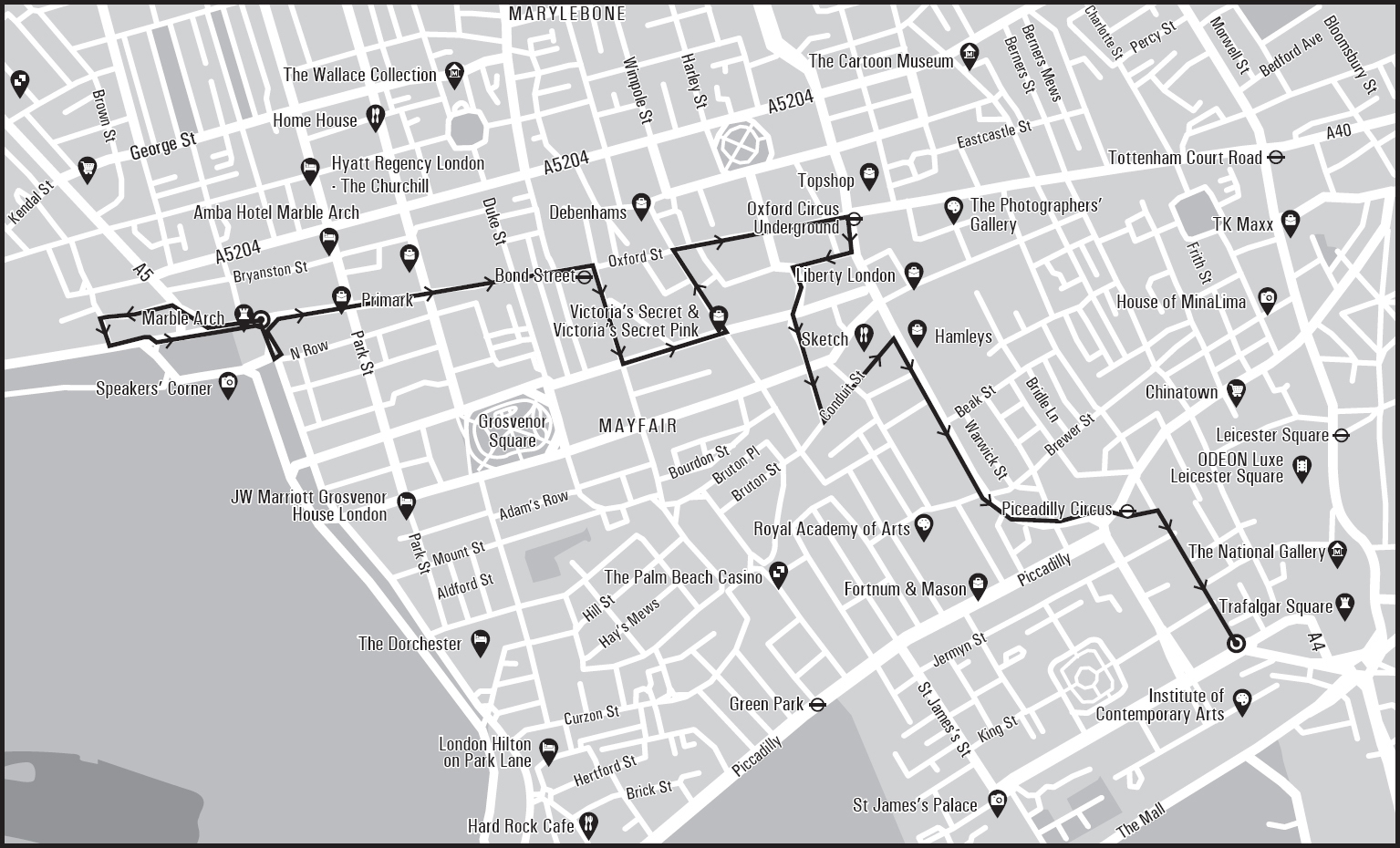
Route
• Marble Arch tube station
• Connaught Place
• Park Lane
• Oxford Street
• Brook Street
• Regent Street
• Hanover Square
• Conduit Street
• Piccadilly Circus
• Haymarket
This walk begins at Marble Arch – Marble Arch tube station is on the Central (red) line. Marble Arch, immediately outside, was designed by John Nash in 1827 and he based it on the Arch of Constantine in Rome. Originally designed as the gateway to Buckingham Palace (only members of the Royal Family could pass through the arches) it was moved – some say ‘relegated’ – to where it is now, in the middle of a roaring roundabout, in 1857. A series of subways will take you from the tube station to the arch and then on to Speakers Corner, Hyde Park and Park Lane.
This specific part of London was where criminals would be hanged. Almost opposite, at the end of North Carriage Drive, was the area where once soldiers would be shot for cowardice. Conan Doyle refers to the Tyburn Tree, a tablet at the location of the hangings which you will see set in the pavement if you visit the home of Nathan Garrideb as given below. The first recorded execution was in 1196, and from 1571 a three-sided gallows was erected here. This enabled mass-hangings such as that in June 1649 when twenty-three men and one woman were hanged simultaneously. Those sentenced to the gallows would often be brought in open carts from St Giles, some drinking heavily if they had been able to bribe their gaolers, along the length of Oxford Street, in front of cheering, leering crowds. Once at Tyburn, they were sometimes allowed a last speech at a place that became known as Speakers’ Corner.
The last public execution, of John Austin, a highwayman, took place at Tyburn on 3 November 1783. Speakers’ Corner, however, still flourishes and on Sunday mornings, anyone can go there (some literally bringing a box to stand on) and talk about anything whatsoever provided it does not lead to a breach of the peace. This is a very entertaining, even sometimes informative but more often a little crazy, spectacle for Londoners and visitors alike.
The first literary stop on this walk is to the home of Nathan Garrideb. We learn that this adventure took place at the latter end of June 1902 – Watson was able to be specific on this point as it was the previous month that Holmes had refused a knighthood, the circumstances of which are kept secret from the reader as Watson does not wish to commit any indiscretion. In this wonderful tale, The Adventure of the Three Garridebs, Nathan Garrideb’s address is given as 136 Little Ryder Street, W. There is no such Street, but Sherlockians point to the house and street details as perfectly fitting Connaught Place, a few minutes stroll from Marble Arch tube station; turn right out of the station, and right again into Edgeware Road. An alleyway leading to Connaught Place leads off the street on your left a short distance along.
The return of Holmes
In The Adventure of the Empty House, the Oxford Street end of Park Lane marks the spot where Watson and Holmes reunite, albeit unbeknown to Watson and only for a few brief seconds. The year is 1894 and Holmes had been gone three years. Watson, now a widower, wanders across Hyde Park and, fascinated by the recent unsolved murder of the young Honourable Ronald Adair in a locked room at 427 Park Lane, finds himself outside the house, trying to apply the methods of Sherlock Holmes to solve the crime. To the reader, his hopelessness, and that of the police when faced with a seemingly impossible crime, brings home just how lost the world is without Sherlock Holmes, who would surely have solved the case. Watson accidentally bumps into an elderly deformed man who drops some books which he is carrying. Watson helps pick them up, mumbles apologies and returns to his home in Kensington. The man reappears there, reveals that he is Holmes and is indeed not dead, and Watson faints for the first and last time in his life.28 Holmes is back.
Oxford Street and the stories
The walk resumes from Marble Arch tube station and down Oxford Street, which claims to be Europe’s busiest shopping street with over half a million visitors daily. Originally a Roman road through the city, the fields in this area started to be bought up by the Earl of Oxford in the eighteenth century. Until this time, it had not been seen as a desirable place for home or business with public hangings at one end and the notorious St Giles slums at the other. It was redesigned in conjunction with Regent Street by John Nash from 1810.
As far as the Holmes stories are concerned, Oxford Street features in part as a road along which people rush to get somewhere else, are tracked or followed, and cabs clatter. In The Hound of the Baskervilles, Holmes and Watson follow Sir Henry Baskerville and Dr Mortimer, unbeknown to them and keeping 200 yards behind, from Baker Street ‘into Oxford Street and so down Regent Street’. During the early stages of The Adventure of Charles Augustus Milverton, Holmes picks up a cab in Oxford Street to drive to Hampstead. At the end of the tale Holmes jumps to his feet. ‘Take your hat! Come with me!’ he says to Watson and rushes ‘at his top speed down Baker Street and along Oxford Street until we almost reached Regent’s Circus’. Here they find a shop, the windows of which are filled with the beauties and celebrities of the day including a stately lady they have recently seen performing an act of vengeance and Holmes, acting as both judge and jury, not for the first time, regards the case as closed. Looking at Watson he puts his finger to his lips and they turn away from the window.
In The Adventure of the Blue Carbuncle, a goose is the central feature and Watson reports that, as they go in search of the said bird’s origin, ‘our footfalls rang crisp and loudly’, and he and Holmes travel through ‘Wimpole Street, Harley Street and so through Wigmore Street into Oxford Street.’ Also, Holmes is certain in The Final Problem that Moriarty is at the root of the affair when: ‘I went out about midday to transact some business in Oxford Street. As I passed the corner which leads from Bentinck Street on to the Welbeck Street crossing a two-horse van furiously driven whizzed round and was on me like a flash…’
There are specific points of interest along Oxford Street. Two relate to where Holmes and Watson shop. Bradley, supplier of Holmes’ ‘strongest shag’ – liable to reduce the air in the front room of 221B to an almost unbreathable fug – is here, as is Latimer’s, where Watson buys his boots. Watson mentions this at the very start of The Disappearance of Lady Frances Carfax. Holmes is then able to deduce, just from the way the laces on his nearly new boots are tied, that Watson has been for a Turkish Bath.
The streets immediately to the south are very well represented also. In Silver Blaze we hear of a milliner’s account for £37 15s made out by Madame Lesurier of Bond Street. On another occasion in The Hound of the Baskervilles, once the bright young lad, Cartwright, has been dispatched around the twenty-three hotels in the immediate vicinity of Charing Cross to search for the centre page of the Times with some parts cut from it with scissors, Holmes proposes that he and Watson pass some time at one of the Bond Street galleries. In The Resident Patient Holmes is informed that Dr Percy Trevelyan lives at 403 Brook Street (this highly fashionable street runs parallel to Oxford Street, from Park Lane to Regent Street). Then, Lord St Simon writes to Holmes from Grosvenor Mansions in The Adventure of the Noble Bachelor; and in The Adventure of the Three Gables, Holmes and Watson take a cab to Grosvenor Square.
Claridge’s Hotel, Brook Street, which once entertained Queen Victoria and was opened in 1856, features in the stories, notably The Problem of Thor Bridge – J. Neil Gibson sends a letter to Holmes from the hotel asking for his help in proving Miss Dunbar’s innocence. It also has the distinction of being the only hotel in central London in which it can be proved from the text (as opposed to what many enthusiasts, when playing the Great Game, surmise) that Holmes ever stayed; at the end of His Last Bow Holmes tells Martha that she can report to him at Claridge’s and confirms he will be returning there. Some readers like to think that Martha is Mrs Hudson from 221B, but the way Holmes addresses the old lady, in a fairly reserved fashion, leaves doubts and surely Watson would have greeted her more effusively had she been his old housekeeper? It is interesting that in the wonderful Russian TV series The Adventures of Sherlock Holmes and Dr Watson, starring Vasily Livanov as Holmes, it is made quite clear that Martha is Mrs Hudson. Did Watson also stay at Claridge’s? Some Sherlockians are convinced that he would have accompanied Holmes for at least a short break before confronting the horrors of the Great War, especially so as Holmes had in his pocket a cheque for £500 that he was eager to cash before it was stopped by the drawer. The story presents some further unanswered questions, in particular, why does it read more like a James Bond spy story than a traditional Holmes adventure? And why is it written in the third person? His Last Bow was published in 1917 and it is possible that Conan Doyle changed his approach in order to better write a story that he considered would raise morale during the hostilities.
As a collection, His Last Bow was banned for a period in 1923 in some Dundee schools after a Highland Minister picked up a copy in a school and reported to the education committee that it was no less than a text book to teach boys to rob and murder.
Regent Street
This walk turns right down Regent Street at Oxford Circus – Oxford Street continues straight on with some interesting Holmes locations nearer the Tottenham Court Road end and these are covered in Walk 4.
Regent Street was designed by John Nash and James Burton from 1811 and redesigned near the end of the century. It was originally to have been straight, to look triumphal, but land ownership issues resulted in its now famous curved shape. No residential accommodation was built above the shops which led a strangely deserted air to it when business was done. One idea at the time was that the street would act as a divide between the upper classes in Mayfair and the lower classes in Soho. Much of it has always been owned by the Crown Estate on behalf of the monarch, although some parts were sold off in the 1970s to finance regeneration.
Hanover Square is a pleasant leafy oasis in which to take a rest or eat a snack – there are seats – and is the first stop as we head down Regent Street, turning right at Princes Street. St George’s Hanover Square church is a short distance to the south of the square and the location of Lord St Simon’s proposed marriage to American Hatty Doran, only to have her run away during the wedding breakfast in The Adventure of the Noble Bachelor. It was built in 1721–5, designed by John James and has an impressive portico supported by six Corinthian columns which extends out over the pavement. Land being very scarce, it was constructed without a graveyard and people in the parish, which included Laurence Sterne (1716–68), author of Tristram Shandy, were buried in the grounds of the nearby workhouse.29 It rapidly became a fashionable wedding church, one of them being that of Theodore Roosevelt, aged 28, and Edith Carrow, aged 25, on 2 December 1886. In popular culture, the church in the song ‘Get me to the church on time’ from My Fair Lady is St George’s.
A few yards south is Conduit Street, the home of Colonel Sebastian Moran, second only to Moriarty in the hierarchy of crime; Conan Doyle gives us his own take on the most dangerous men in the stories but all readers will probably have their own cherished opinion. We learn of his street address (but not the number) in The Adventure of the Empty House. He is, according to Holmes’ index of biographies, the son of Sir Augustus Moran C.B., educated at Eton and Cambridge, a most distinguished soldier, author of two books on hunting and life in the jungle, and ‘the best heavy-game shot that our Eastern Empire ever produced’.
Colonel Sebastian Moran is mentioned in The Adventure of the Illustrious Client and His Last Bow but it is in The Adventure of the Empty House that the reader gains a detailed sense of the man.30 He is someone who has gained high honour in battle and the grateful thanks of his queen and country, and yet cheats at cards. His criminal exploits, including the ‘impossible’ shooting of young Adair and his plans for the death of Holmes are very creative and require an iron nerve, yet he fails to adequately reconnoitre the scene of his most audacious crime to date (the proposed murder of Holmes himself). After being outwitted by Holmes with the help of Watson and Lestrade, all he can mutter is, ‘you cunning, cunning fiend’. Later, Watson expresses surprise that a man so distinguished, should revert to evil ways. ‘There are some trees, Watson,’ says Holmes, ‘which grow to a certain height, and then develop some unsightly eccentricity. You will see it often in humans.’ The story is remarkable for having Mrs Hudson play a key role, unquestionably endangering her own life, only to have Holmes peremptorily thank and dismiss her at the end. Holmes is sometimes accused of being cold and inhuman and Jeremy Brett, many people’s favourite Holmes, once said that he disliked the arrogance of the man.
Conan Doyle and soldiering
The mentions of Moran’s military distinctions apart, there is very little of soldiering in the tales. This is opposed to Conan Doyle’s own life where nothing, not even Sherlock Holmes, had a more profound impact.
Conan Doyle described the routine life of a private soldier as a delightful one – cleaning this and that, keeping his rifle in good order, being led and not leading. One amusing incident involved a new adjutant arriving and reviewing his section. Conan Doyle describes him as a cocky little fellow, who in age could have been his son. Having exchanged a few words with Conan Doyle the adjutant asked the CO who the big fellow was that he had been talking to. ‘That’s Sherlock Holmes,’ he said. ‘Good Lord!’ said the adjutant.
His immediate and extended family suffered terribly in the Great War. The first to die was Malcolm Leckie, his wife’s brother. Then Miss Loder Symonds, who lived with the family, lost three of her brothers and the fourth was wounded before she herself passed on. Two nephews, Alec Forbes and Oscar Hornung, then perished. A sniper killed his brother-in-law, Major Oldham, in the trenches. Finally a double blow: firstly his son Kingsley, ‘one of the grandest boys in body and soul that ever a father was blessed with’, who was badly wounded at the Somme and carried off with pneumonia in London; thereafter Innes, his brother and companion of the youthful days in Southsea, died from the same disease. Conan Doyle subsequently said it was a source of the utmost solace that, of all these, there was only one whose posthumous existence he could not to his satisfaction subsequently establish through his practice of spiritualism.
Conduit Street leads directly back to Regent Street where the walk continues towards Piccadilly. In A Scandal in Bohemia, Godfrey Norton instructs a cabby to ‘drive like the devil’ to Gross and Hankey’s in Regent Street before going on to St Monica’s church in the Edgeware Road (fictional) where he is to marry Irene Adler; we are not told but presumably this is to buy a wedding ring.
On the left-hand side, not far from the Eros statue in Piccadilly, is the Café Royal. In the 1890s this was already a famous meeting place for the great and the good of the day including George Bernard Shaw, Max Beerbohm and Oscar Wilde, who famously met his friend Frank Harris here on 24 March 1895 to discuss what to do about Lord Alfred Douglas’ father, the Marquess of Queensbury, against whom Wilde had issued a charge of criminal libel.31 It is outside the café that Holmes was set upon in The Adventure of the Illustrious Client and escaped through the café into Glasshouse Street; he was, however, injured badly enough to need medical assistance from Charing Cross Hospital before returning to Baker Street.
Between the Quadrant in Regent Street and Piccadilly, Vine Street and George Court lay St James’s Hall; opened in 1858 and capable of sitting, in the main hall (there were two more smaller theatres) over 2,000, it became the most popular concert hall in London. Holmes relaxes here during a quiet lull during the untangling of events in The Red-headed League. Watson paints an unusual picture of this side of Holmes ‘sat in the stalls wrapped in the most perfect happiness’, with ‘his gently smiling face, and languid dreamy eyes’, the opposite of the ‘sleuth-hound’ (the reader may wonder during this very detailed description whether Watson is paying attention to the concert – German music rather than Italian or French, according to Holmes when planning the trip – at all, but the truth is probably that he found his famous friend far more interesting) and concludes that ‘an evil time’ may be coming to those Holmes was engaged in hunting down.
The tale is additionally interesting because it mentions a vegetarian restaurant. ‘There is Mortimer’s, the tobacconist, the little newspaper shop, the Coburg branch of the City and suburban Bank, the Vegetarian Restaurant and McFarlane’s carriage-building depot.’ Although Vegetarian food is associated in part with the Jains in India 2,500 years ago, and ancient Greece to some extent, fashionable vegetarian restaurants in England only came into existence at about this time; thus this one, noticed by Holmes, must have been one of the very first.
In Piccadilly Circus itself is the Criterion Restaurant, opened in 1874. It is here in A Study in Scarlet that Watson met young Stamford and mentioned that he was looking for affordable accommodation, which is really the very first scene in the adventures themselves.
There are a couple more points of interest in this area before this walk ends. The first is Charing Cross which is where Mr Melas, in The Greek Interpreter, starts to become concerned that this route, which carries on up the Shaftesbury Avenue, is an odd way to Kensington and says as much. His fellow traveller responds by pulling down the carriage blinds and producing ‘a formidable-looking bludgeon loaded with lead’. The second is the Haymarket Theatre which is where old Josiah Amberley, in The Adventure of the Retired Colourman, claims to have bought two tickets as a treat for his wife in the upper circle; at the last moment, however, she claimed a headache and could not go. Amberley said he had gone alone. Watson, however, had seen and remembered the number of ‘her’ ticket, from which Holmes is able to prove that Amberley is a liar as neither of the seats either side had been occupied during the performance in question.
You are now in the very centre of one of the prime tourist areas of London – Piccadilly Circus, Trafalgar Square and Leicester Square with, practically speaking, a never-ending array of restaurants, take-away outlets, cinemas, theatres, galleries and pubs. As already mentioned, there is a half-price theatre ticket kiosk in Leicester Square – always worth a try. Trafalgar Square is discussed in detail in Walk 6.