
WALK 4
At A Glance – the following stories, plays and novels are highlighted in this walk:
The Adventure of the Blue Carbuncle. A Case of Identity. The Adventure of the Cardboard Box. The Adventure of the Red Circle. The Musgrave Ritual. The Adventure of the Copper Beeches. The ‘Gloria Scott’. The Adventure of the Dancing Men. The Hound of the Baskervilles. The Adventure of Wisteria Lodge. The Adventure of the Retired Colourman. The Man with the Twisted Lip. The Sign of Four
Distance: About 3.5 kilometres/2.2 miles
Time to allow: A morning, afternoon or evening for the basic walking. However, the route encompasses the British Museum, theatreland and Covent Garden with its restaurants and entertainments – usually there are street performers here – so there is really no upper limit on the amount of time to allow.
Walking conditions: Basically flat but some of the streets, such as behind Tottenham Court Road and beside the British Museum, were not originally laid out according to any grand plan and can be a bit of a jumble, which means they can take extra time to navigate especially if there are lots of people about. There are some wonderful photo opportunities, especially around the British Musuem and in Covent Garden.
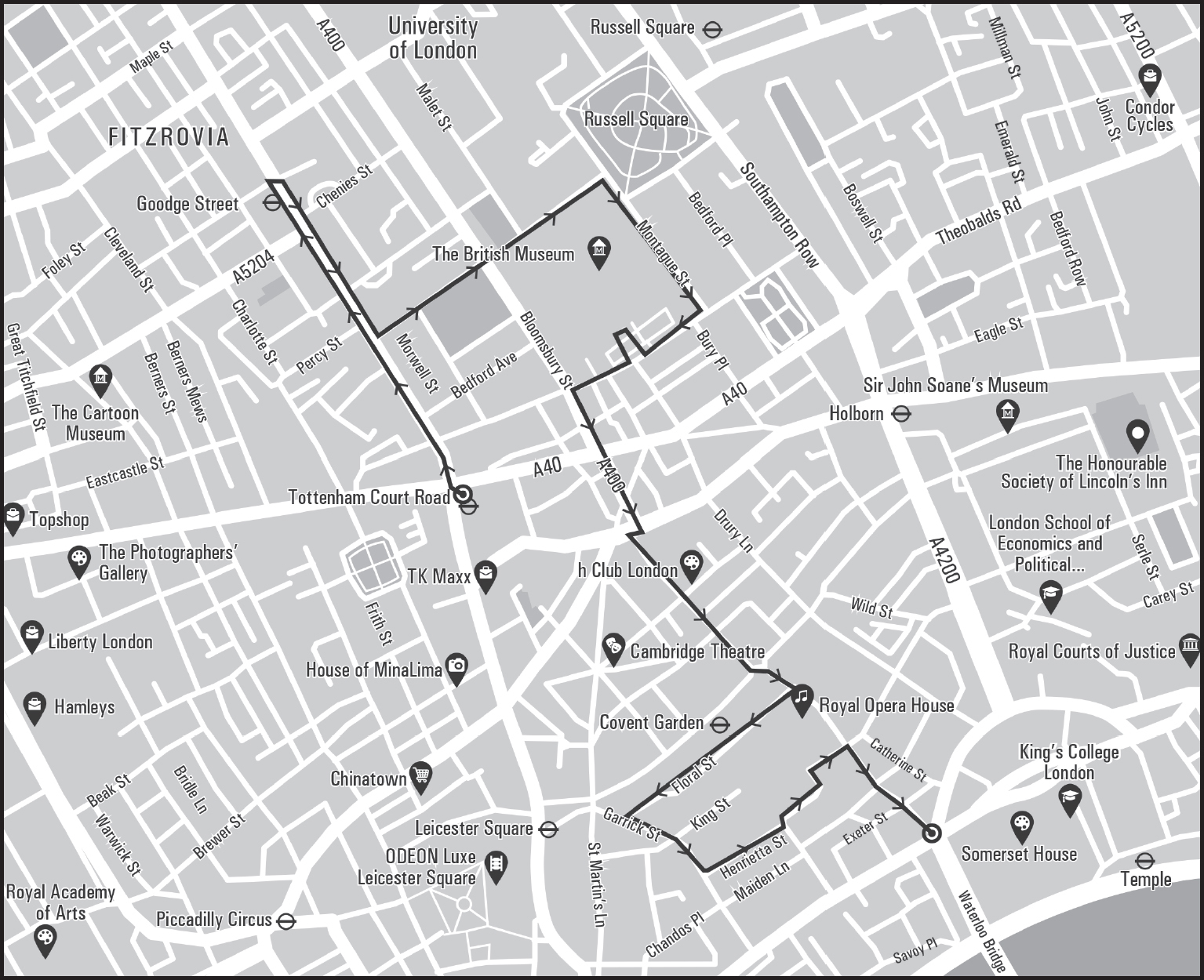
Route
• Tottenham Court Road tube station
• Tottenham Court Road
• Goodge Street
• Bayley Street
• Montague Place
• Russell Square
• Endell Street
• Royal Opera House
• Covent Garden
• Wellington Street
This walk begins at Tottenham Court tube station which is on the Central (red) and Northern (black) lines. Once you could travel from here to the next stop, ‘British Museum’, but that is closed now. In Conan Doyle’s day this was the station for St Giles, a dreadful slum which had been immortalised a few years previously by Charles Dickens in Bell’s Life where he wrote of ‘dirty men, filthy women, squalid children, fluttering shuttlecocks, noisy battledores, reeking pies, bad fruit, more than doubtful oysters, attenuated cats, depressed dogs and anatomical fowls…’ It had been through here in the eighteenth century that the carts full of those destined to be hanged would pass, as mentioned in Walk 3.
On leaving the tube, the immediate area is dominated by Centre Point, a 34-storey skyscraper, completed in 1966 and built using pre-cast panels of crushed Portland stone originating in Dorset. Great controversy ensued as it was left empty for nine years because the owner could not secure a tenant for the whole building and refused to let it out floor by floor. In an area of acute homelessness, it became a symbol for many of uncaring capitalism. Now, after many twists and turns, it appears that its fate is to be residential flats and building work on this is ongoing.
Walk along Tottenham Court Road with Centre Point at your back. It is not difficult to imagine being back in 1892 and walking along this street of plumbers, pawnbrokers, locksmiths, grocers and other small businesses. It is around four on Christmas morning and, about half a kilometre along, as you approach Goodge Street on the left, a tallish man looms out of the gaslight. His name, we later learn, is Henry Baker. He has a white goose slung over his shoulder. Staggering slightly as he is a little too full of liquid Christmas cheer, he is accosted by a ‘knot of roughs’, one of whom knocks off his hat. Raising his stick to defend himself he only succeeds in smashing the shop window behind him. A man dressed in an official-looking commissionaire’s uniform who goes by the name of Peterson, an honest fellow well known to the great detective Sherlock Holmes, is fortuitously passing by and runs forward to assist. Baker, however, scared by Peterson – who in the relative gloom resembles a policeman, and fearing arrest for the damage he has caused – drops the goose. He runs as fast as he can towards Oxford Street and vanishes ‘in the labyrinth of small streets which lie at the back of Tottenham Court Road’. Thus, thrillingly, begins The Adventure of the Blue Carbuncle.
There are three other Holmesian connections to this street:
• In A Case of Identity, we learn that businesses here could be worth a tidy penny. Miss Mary Sutherland tells Holmes that her deceased father had been a plumber on Tottenham Court Road. Her mother had remarried and her new husband made her sell the business (as he ‘was very superior, being a traveller in wines’) which attracted a price of £4,700 for the goodwill and interest, and this was not even as much as her late lamented father could have secured had he lived and put it up for sale himself.
• In The Adventure of the Cardboard Box Holmes regales Watson over dinner with stories about violins including how he had bought a Stradivarius worth at least five hundred guineas for fifty-five shillings from a ‘Jew broker’s in Tottenham Court Road’.
• Then, during The Adventure of the Red Circle Mr Warren, husband of the aggrieved landlady who comes to see Holmes about her unusual tenant, is attacked in the street early in the morning when going to work, and one of the things we learn about him is that he is a timekeeper at Morton and Waylight’s in Tottenham Court Road (fictional but it confirms that this is an industrial, as well as a shopping area: there used also to be a major Post Office sorting establishment close to where the tube station is now).
Goodge Street itself is worth a wander down as it contains some interesting eateries and traditional English pubs. Just beyond, on Tottenham Court Road itself, you get a fine view of what is now called BT Tower, a structure 177 metres in height, completed in 1964, and which was a communications tower with a revolving restaurant at the top (one revolution completes every twenty-three minutes). The restaurant was closed in 1980 for security reasons and plans to reopen it in time for the 2012 Olympics came to nothing. It now has an ‘Information Band’ around the top, the largest of its type in the world with over half a million LEDs.
To continue on this walk, find a point to cross the road and walk back again towards Tottenham Court Road tube. Leading off the main thoroughfare, on your left, you will see Bayley Street which leads straight on to Bedford Square and this becomes Montague Place. As already mentioned in Walk 1, number 23 was where Conan Doyle lived while waiting for non-existent patients in his nearby surgery.
As Conan Doyle knew this area well it is not surprising to find Holmes telling Watson, during the beginning of The Musgrave Ritual, that this is where he had rooms when he first came up to London; ‘in Montague Street, just round the corner from the British Museum’.32 They would certainly not have been expensive as Holmes says he had established a ‘considerable, though not very lucrative, connection’ at this time in his life. Montague Place is also deemed suitable for the lodgings of Violet Hunter, a young lady seeking employment as a governess, and who describes herself as ‘destitute’ in The Adventure of the Copper Beeches; it is from here that she writes to Holmes seeking an appointment as she has been offered a job at an extraordinary salary of £100 a year. In The ‘Gloria Scott’ Holmes talks of going ‘to my London rooms’ before his friend, Victor Trevor, pleads with him to return to Donnithorpe in Norfolk; this was, chronologically, his earliest case and so it seems reasonable to assume that he was at the time based at Montague Street, although some scholars believe he may have occupied more than one address during his time in this part of London.
In this location also, ‘at the northeast side of the British Museum’, is the fictitious Great Orme Street where Conan Doyle placed Mrs Warren’s house in The Adventure of the Red Circle.
Continuing up Montague Place you will come to Russell Square, which is the location of the boarding house in which Mr Hilton Cubitt stayed in The Adventure of the Dancing Men. Here he met and married an American, Elsie Patrick, which led to an intriguing case in the county of Norfolk, further discussed in Chapter 8.
Montague Street leads to a T-junction with Great Russell Street and turning right here will bring you to the main entrance of the British Museum. There are several interesting pubs hereabouts and the pub at which Henry Baker drank and contributed to a goose club in The Adventure of the Blue Carbuncle is in this location – we know it is small, on a corner of one of the streets running down into Holborn and was called the Alpha Inn, but that is all. Trying to locate it can be fun and an excellent reason to try some of the local ales and food.
Henry Baker himself spends his days at the British Museum which was founded in 1753, principally comprising the collections of Sir Hans Sloane. It now has over 8 million works, many acquired during the expansion of the British Empire. The Natural History Museum was formed as a branch institution in 1881, the British Library, which is estimated to have between 170 and 200 million items, moving to its own site in 1998. The ownership of some objects, such as the Parthenon Marbles, especially at the time of writing, is disputed. It is one of the greatest museums in the world, an essential visit for everyone, and is currently free to enter although a donation of £5 is encouraged; some parts and exhibition areas may levy a charge if you wish to include these in your visit. It is open every day 10.00am to 5.30pm with a late night on Fridays until 20.30. (www.britishmuseum.org)
The British Museum is especially important four times in the canon. The first, mentioned above, was when Holmes first acquires lodgings ‘just round the corner’, and we learn that ‘there I waited, filling in my too abundant leisure time by studying all those branches of science which might make me more efficient’. Some scholars say that this sentence does not mean that this knowledge was actually gained in the British Museum but it does seem quite probable. The second is in The Hound of the Baskervilles where Holmes tells Watson that he had established from the Museum that Stapleton, under the name of Vandeleur, was a recognised authority on entomology and that a moth had been named after Vandeleur as he was the first to describe it. The third is in the summing up for Watson’s benefit ‘over an evening pipe’ in The Adventure of Wisteria Lodge, when he says that he spent a morning at the museum reading Eckermann’s Voodooism and the Negroid Religions.33 The fourth is in The Adventure of the Blue Carbuncle when Mr Henry Baker says that he is to be found there during the day and sometimes frequents the Alpha Inn of an evening.
In The Adventure of the Blue Carbuncle Holmes and Watson visit the Alpha Inn, as mentioned above, learn that the goose they are interested in was bought from a salesman in Covent Garden and then ‘passed across Holborn, down Endell Street and so through a zigzag of slums to Covent Garden Market’. This walk takes the same basic route, although there are no longer any slums and the market site now consists of restaurants, high-end shops, bars and a large entertainment space.
This is theatreland; the walk passes the magnificent Royal Opera House, sometimes referred to as ‘Covent Garden’. It is the third theatre on the site as a result of disastrous fires, with the present building being the result of a comprehensive refurbishment in the 1990s. At the end of The Adventure of the Red Circle, Holmes says enthusiastically: ‘By the way, it is not yet eight o’clock, and a Wagner night at the opera, Covent Garden. If we hurry, we might be in time for the second act.’
Just before reaching the Royal Opera House, on the other side of the road, is the site of Bow Street Police Station (identifiable today although it closed for good in 1992). It is here, towards the end of The Man with the Twisted Lip that Holmes arrives, is greeted cordially by the police on duty, and produces a ‘very large bath-sponge’ from a Gladstone bag which he proceeds to wet and wash over a very dirty prisoner, smearing away his disguise… ‘Let me introduce you,’ he exclaimed, ‘to Mr Neville St Clair, of Lee, in the county of Kent.’ One of the great joys of reading the stories is that Holmes can never resist a dramatic flourish.
Covent Garden had been used since the seventh century as arable land but from 1654 a fruit and vegetable market took hold, followed by houses, taverns and brothels. Parliament took steps to control the area by legislation from the 1830s, leading to a huge growth in the market. By the 1970s traffic congestion was so great that the market relocated to Nine Elms and the area was developed as we see it today. Other attractions, such as the London Transport Museum, were added close by. The buildings are controlled by the Covent Garden Area Trust who pay a peppercorn rent for each lease of one red apple and a posy of flowers. Visitors find it an interesting place to linger, maybe for a drink and a bite, with some just sitting along the street curbs and watching the often-incredible street performers.
Covent Garden and writers
Many writers have used the area in their works or found inspiration here. Samuel Pepys mentions Covent Garden in his famous diaries when, in May 1692, he makes the first mention in literature of a Punch and Judy show. Dr Samuel Johnson reputedly met James Boswell for the first time in a book shop in Covent Garden in 1763. Jane Austen stayed at an apartment here in 1813–14. Thomas de Quincy was living at 36 Tavistock Square, Covent Garden, when he wrote Confessions of an English Opium-Eater, published anonymously in 1821. The central figure in George Bernard Shaw’s Pygmalion, Eliza Doolittle, sells flowers at a market stall. This was, of course, later turned into the famous musical My Fair Lady, starring Audrey Hepburn and Sir Rex Harrison.
Charles Dickens has David buy flowers for Dora from the market in David Copperfield, while Tom and Ruth gain some peace after terrible times by wandering around the area early on summer mornings in Martin Chuzzlewit. Dickens himself was known to take rooms in the piazza when, for whatever reason, he could not get home of an evening: the offices of his fabulously successful weekly magazines Household Words (1850–59) and All the Year Round (1859–70) are just a few yards away on Wellington Street (there is a plaque) and he would sometimes work late. Often, he would end his famous night walks in Covent Garden, sometimes accompanied by Charles Frederick Field, a detective and later, private investigator on whom he is said to have based Inspector Bucket in Bleak House. In 1851 Dickens wrote an article On Duty with Inspector Field for Household Words which detailed their wanderings among the poorest underclass of the city at night. It is vintage Dickens as it begins:
How goes the night? Saint Giles’s clock is striking nine. The weather is dull and wet, and the long lines of street lamps are blurred, as if we saw them through tears. A damp wind blows and rakes the pieman’s fire out, when he opens the door of his little furnace, carrying away an eddy of sparks ….
He meets up with Inspector Field and, proceeding to St Giles, New Oxford Street and surroundings, they come across an old outhouse, open the door:
…and let us look! Ten, twenty, thirty – who can count them! Men, women, children, for the most part naked, heaped upon the floor like maggots in a cheese!
All the while Mr Field holds sway and is respected, even though ‘he has collared half the people here, and motioned their brothers, sisters, fathers, mothers, male and female friends, inexorably to New South Wales.’
Field was, according to Dickens, ‘a portly presence with a large, moist knowing eye’, and, like Holmes a few years later, fond of drama, disguises, and unconventional behaviour, sometimes, his police colleagues complained, to the point of embarrassment. He became famous, helped in no small part by his association with the greatest novelist of the age, and was beloved by the press before his death in 1874 – perhaps the first English detective, official or otherwise, real or fictional, to beguile the general public.
From this spot you can wander in all directions and see the great theatres of London and check out what is playing. This walk, though, carries on down Wellington Street in the general direction of the river. At the bottom of the road to your right you will see the impressive portico and six large columns of the Lyceum Theatre and it is ‘by the third pillar from the left … tonight at seven o’clock’ that Miss Mary Morstan is requested to meet a mysterious person in The Sign of Four. She is told she can bring two friends, so Holmes and Watson accompany her and they are soon all transported by clattering cab to Thaddeus Sholto’s unusual house.
This walk ends here; the Strand is off to your right, Aldwych, Fleet Street and St Paul’s to your left and Waterloo Bridge straight ahead.