
WALK 5
At A Glance – the following stories, plays and novels are highlighted in this walk:
The Crooked Man. The Hound of the Baskervilles. The Five Orange Pips. The Adventure of Charles Augustus Milverton. The Adventure of the Blue Carbuncle. The Adventure of the Abbey Grange. The Adventure of the Cardboard Box. A Study in Scarlet. The Adventure of the Engineer’s Thumb. The Disappearance of Lady Frances Carfax. The Sign of Four. The Naval Treaty. The Musgrave Ritual. The Adventure of the Second Stain. The Lost World. Micah Clarke. Silver Blaze. The Final Problem. The Adventure of Wisteria Lodge. The Adventure of the Bruce-Partington Plans. A Case of Identity. The Adventure of the Noble Bachelor. The Adventure of Black Peter. The Adventure of the Empty House. The Adventure of the Priory School. The Greek Interpreter. The ‘Gloria Scott’
Distance: About 6 kilometres/3.7 miles
Time to allow: A complete day for the walking. This is the longest route in the book. If you add on the time to spend exploring the sites on the way – Palace of Westminster, Westminster Abbey, Buckingham Palace and others – it can take several very enjoyable days. One idea is to walk the route first and then return on subsequent days to explore sites that particularly appeal.
Walking conditions: It can be breezy over Hungerford Bridge and Golden Jubilee Foot Bridges; there are steps up and down but also a lift. Thereafter, in the main, flat or very gently sloping but with very heavy traffic in parts, e.g., Parliament Square, around Victoria Station and Trafalgar Square. There are some spectacular views, for example, from Hungerford Bridge and in Parliament Square, so take a camera!
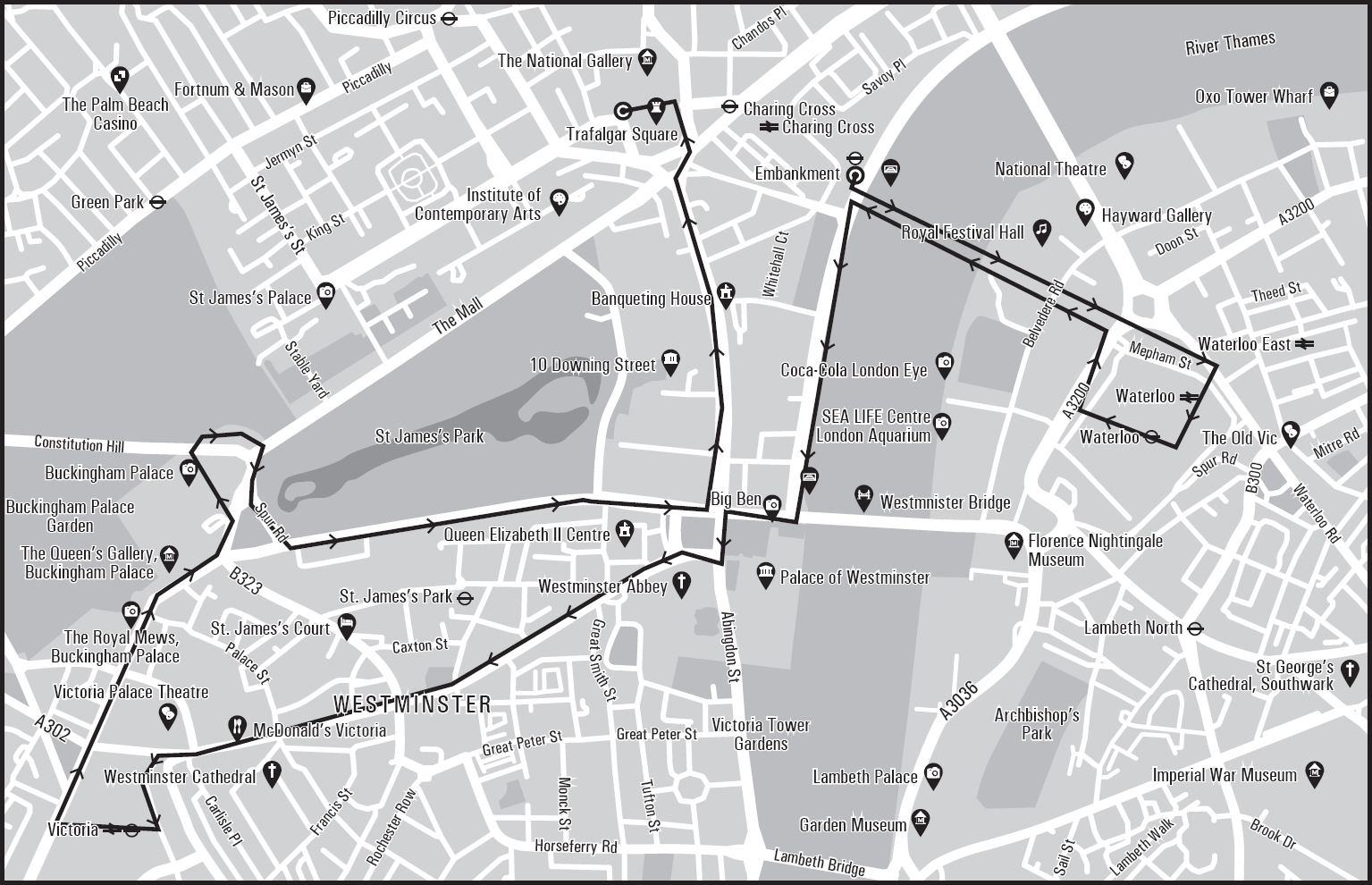
Route
• Embankment tube station
• Hungerford Bridge
• Waterloo station
• Victoria Embankment
• Westminster Bridge
• Parliament Square
• Victoria Street
• Buckingham Palace
• Birdcage Walk
• Whitehall
This is the second walk to begin at Embankment tube – District (green), Circle (yellow), Bakerloo (brown) and Northern (black) lines. This time, though, we are heading across the water to Waterloo and the reason for starting here is to experience the vistas from both sides of the Golden Jubilee Foot Bridges – the east side, to Waterloo and, after a consideration of the Waterloo station in the stories, the west side on the way back. The views of London both down- and up-river are fabulous and make for one of the best free spectacles in the city.
The foot bridges were designed by Lifschutz Davidson Sandilands and won a specialist award from the Royal Fine Art Commission in 2003 in the ‘Building of the Year’ Awards. In 2014 a Garden Bridge was briefly proposed for the river; although the idea has now been dropped, an assessment of the use of the Golden Jubilee Foot Bridges at the time estimated them to be the busiest in London with a footfall of 8.5 million each year.
Leave Embankment tube station by the entrance fronting the river. Take the east Golden Jubilee Foot Bridge and cross the Thames. Waterloo station itself is mentioned in eight of the stories, usually, as in The Crooked Man, when Holmes – ‘I want to start by the 11.10 from Waterloo’ – needs to take a train from there, or, in the same story, catches a bite to eat there on his way home. The ‘new’ Sir Henry Baskerville also arrives at the station in The Hound of the Baskervilles.
A more dramatic event occurs, however, towards the end of The Five Orange Pips, and one which leaves Holmes more depressed and shaken than Watson had ever seen his friend, spurring him on to finally tie up the loose ends in the case. He and Watson are both at breakfast when they see a headline in the morning paper: ‘Tragedy near Waterloo Bridge’. The report goes on to say that young John Openshaw, who had come to Holmes for help, has been accidentally killed when he slipped on one of the small landing places for river steamers when rushing for the last train from Waterloo. Of course, it is no accident and Holmes announces that he is going out. Watson asks if he is going to the police. ‘No, I shall be my own police,’ replies Holmes.
The tales always gain an extra layer of excitement when Holmes takes the law into his own hands, maybe as in The Five Orange Pips because he knows that only he has the abilities to identify the culprits, or occasionally, as in The Adventure of Charles Augustus Milverton, in a blatantly criminal act of breaking and entering, or where he appoints himself both judge and jury as at the end of The Adventure of the Blue Carbuncle when he lets the wretched, terrified miscreant go, uttering the immortal words: ‘I am not retained by the police to supply their deficiencies’. At the end of The Adventure of the Abbey Grange it is Watson who acts as the jury and is asked by Holmes for a verdict on Crocker, who had killed Sir Eustace but has no regrets whatsoever given the circumstances. Watson says ‘Not guilty’ and Holmes lets Crocker go free. The moral aspects of the adventures are clearly affected by Holmes and Watson operating outside the law and fans have strong opinions on this topic as can be seen in the conversations on Sherlock Holmes Facebook pages and online forums.
It is also near Waterloo that John Clayton, the cabbie Holmes was keen to track down – in The Hound of the Baskervilles – kept his horse and cart (he gives the fictional address of 3 Turpey Street, Southwark and he kept his cab in Shipley’s Yard).
London Waterloo station was first opened in 1848 – it was never designed to be a terminus but a through station on the way into the city. Six years later, by special Act of Parliament in response to panic caused by the closure of London graveyards, a route serving Brookwood Cemetery was opened by The London Necropolis and National Mausoleum Company with its own platform, station and ticketing arrangements. The station became a byword for confusion by the end of the nineteenth century as fewer numbers were allocated for platforms than were necessary and some numbers were used twice. Jerome K. Jerome had fun with this as his travellers in the 1899 novel Three Men in a Boat struggle to find their train to Kingston upon Thames with seemingly every official on the station giving them conflicting advice.
The main station has a huge clock in the middle of the concourse, constructed in the 1920s, which you cannot miss and which is known as the lovers’ clock – many romantic meetings, both real and on film, have taken place underneath.
From 1994 to 2007 the station served as the London end of Eurostar, but in 1998 the BBC reported that some travellers from France were upset by arriving at a station named after Napoleon’s final defeat by the British and Prussians; some French councillors requested, to no avail, a change of name from ‘Waterloo’. Since 2007, Eurostar travellers have needed to go to St Pancras, the meaning of which is not universally agreed but at least has not to date caused controversy – it may derive from St Pancratius, a Roman citizen who was executed at the age of 14 for converting to Christianity.
Waterloo station concourse is vast with a fair array of retail shops, including a bookshop. There are plenty of places to eat and drink, and toilets. When you are ready to leave, follow the signs to the Golden Jubilee Foot Bridges. The west footbridge travels from the south to the north bank. When on land, walk along the Victoria Embankment with the river on your left.
The Great Stink
In 1858, as MPs shuddered behind curtains soaked in chloride of lime to minimise the stench of human excrement from the Thames, and Disraeli said that the Thames had become ‘a Stygian pool reeking with ineffable and unbearable horror’, it was at last agreed that something must be done. The problem derived from centuries of pumping human, and every other form, of waste into the River Thames; it was seen as an Imperial issue as well – the British Empire was stinking and rotting from its core.
The solution as envisaged by Joseph Bazelgette, a monument to whom you will pass as you walk on the river’s edge, involved the most ambitious urban engineering project ever undertaken – embanking the Thames to create the Victoria, Albert and Chelsea embankments and the digging of a vast underground sewage system still in use today. Bazalgette is usually seen as one of the great, almost unsung, heroes of London, in large part because his influence on people’s health was profound yet his magnificent ‘cathedral of sewage’ is not visible above ground. It is possible, however, to visit the intricate and colourful Crossness Victorian pumping station. Trips can be made by those who are firm of foot along the sewers themselves.34
The Victoria Embankment along which you are walking was begun in 1865 and finished five years later. It involved narrowing the river by building out into it. Whitehall Gardens, on the other side of the roadway, was also built at this time. In 1878 this stretch became the first street in Britain to be permanently lit with electricity.
On your right you will see, not far from Big Ben, the Norman Shaw Buildings, unmistakeable due to their ‘stripes’ of red brick and white Portland stone. This was the New Scotland Yard known to Sherlock Holmes and used between 1890 and 1967, after which the building became government offices. During construction in 1888 the torso of a woman was discovered by workers – the rest of her was never found. At first seen as possibly a medical prank, the ghastly find was later linked to Jack the Ripper, but again, this theory was dismissed by the police. It became known as The Whitehall Mystery and the case has never been solved – the press at the time, and subsequently, not failing to note the irony of the new London police HQ being built on the scene of an unsolved murder.
Holmes worked with twenty-three Inspectors from New Scotland Yard, the most famous of whom were Lestrade, Tobias Gregson and Stanley Hopkins.35 Lestrade’s initial is stated to be ‘G’ in The Adventure of the Cardboard Box and the family name may derive from a friend of Conan Doyle at Edinburgh University, Joseph Lestrade. In the worldwide hit BBC series Sherlock (2010–17) written by Mark Gatiss, Steven Moffat and Stephen Thompson, a running joke is that Sherlock Holmes, as played by Benedict Cumberbatch, can never remember Lestrade’s first name. He is stated in the canon to be ‘a little sallow rat-faced, dark-eyed fellow’ (A Study in Scarlet), who succeeds largely because of his tenacity rather than his crime-solving skills. He appears thirteen times in the canon and Holmes seems quite fond of him, allowing him to unduly take the credit for some cases. Lestrade and Tobias Gregson are ‘the best of a bad lot’.
More often than not, the detectives join Holmes in Baker Street or at the scene of the crime. As an exception to the rule in The Adventure of the Engineer’s Thumb, Holmes says ‘we shall go down to Scotland Yard at once’, where he, Watson and Victor Hatherley pick up Inspector Bradstreet before taking the train to Eyford. Again, in The Disappearance of Lady Frances Carfax, Holmes tells Watson that in the evening he will walk down to Scotland Yard and have a word with ‘friend Lestrade’. On screen, however, Scotland Yard tends to play a bigger role; in some of the many TV series, such as the excellent but rarely seen 1979 series Sherlock Holmes and Doctor Watson, created by Sheldon Reynolds and starring Geoffrey Whitehead as Holmes, Donald Pickering as Watson and Patrick Newell as Lestrade, for example, key scenes take place in Lestrade’s office in Scotland Yard.36
After the case of the Yorkshire Ripper in 1985, the police developed the Home Office Large Major Enquiry System (HOLMES), an administrative support system for senior officers dealing with major crime in UK police forces. It was named in honour of Sherlock Holmes. An updated version, HOLMES2, is now used by all British forces.
As you approach Westminster Bridge, cast your eyes to the other side of the river to see Westminster Stairs, adjoining the bridge and leading down to the water. In The Sign of Four, as the chase up the Thames is on, Holmes says to Athelney Jones: ‘Well then, in the first place I shall want a fast police boat – a steam launch – to be at the Westminster Stairs at seven o’clock.’ Holmes then suggests that, when the expected treasure is in their hands, Watson should be the one to take it round to its rightful owner who shall be the first to open the chest. Jones thinks the whole thing highly irregular but accedes to the request, adding, ‘…I suppose we must wink at it’.
It is easy to see, in your mind’s eye, a cab containing Holmes and Watson driving swiftly ‘past the Houses of Parliament and over Westminster Bridge’, as they discuss their next moves in The Disappearance of Lady Frances Carfax. The story is one of the more unsettling in the canon with aspects of a horror story (the prospect of being buried alive while chloroformed). It has been adapted and amended several times – for instance in the Granada production (1984–94) starring Jeremy Brett, the adventure takes place in the Lake District and it is also heavily altered in the CBS series Elementary (2012–19) starring Jonny Lee Miller and Lucy Liu where it is called The Ballad of Lady Frances.
Westminster Bridge and the Arts
Westminster Bridge features in many English poems, novels and films. Jane Austen, in Emma (1815) mentions a visit to Astley’s Theatre which was situated just over the far side of the bridge (from where you are standing now) and Wilkie Collins recalled a visit to the same theatre with enormous affection; Pip mentions the bridge in Great Expectations and Charles Dickens sets scenes here in both David Copperfield and Barnaby Rudge; Jim, played by Cillian Murphy, walks across the eerily deserted bridge in the film 28 Days Later (directed by Danny Boyle, 2002) and James Bond finds himself confronting his nemesis on the bridge after Blofeld’s helicopter crashes on it in Spectre (Eon Productions 2015). The most famous poem associated with the bridge, in fact, some claim the most famous poem about London in the English Language, is Composed upon Westminster Bridge, September 3, 1802 by William Wordsworth. He was travelling to Paris with his sister, Dorothy, when his carriage stopped on the bridge.
Earth has not anything to show more fair:
Dull would he be of soul who could pass by
A sight so touching in its majesty:
This City now doth, like a garment, wear
The beauty of the morning; silent, bare,
Ships, towers, domes, theatres, and temples lie
Open unto the fields, and to the sky;
All bright and glittering in the smokeless air.
Never did sun more beautifully steep
In his first splendour, valley, rock, or hill;
Ne’er saw I, never felt, a calm so deep!
The river glideth at his own sweet will:
Dear God! the very houses seem asleep;
And all that mighty heart is lying still!
The poem has delighted, intrigued, and irritated people both at the time and since. As subject matter, it presents London as a romantic idealisation at the moment that Wordsworth sees it, yet this was the same putrid river that was to produce ‘The Great Stink’, just referred to, and it took many lives, providing for some a bare living, fraught with disease, as they scavenged in the mud for anything of value.37
Holmes around Big Ben and the Houses of Parliament
Big Ben looms straight ahead. Officially called Elizabeth Tower it was designed by Augustus Pugin and was his last commission before he succumbed to madness. On finally submitting the plans he is reported to have said about his creation ‘…it is beautiful’. Completed in 1859, it has 334 steps up to the belfry (a lift is being installed at the time of writing). It has developed a tilt – about 20 inches at the top – but it is estimated that this should not be a critical problem for a few thousand years. In The Naval Treaty it is presumably Big Ben that young Phelps hears at his office in Charles Street – we are not told for sure but there are no other striking clocks around here – when he determines it is a quarter to ten, a fact that Holmes says is of enormous importance in ascertaining how the documents which have been stolen, vanished.
Turn right into Parliament Square for a more comprehensive view of the Palace of Westminster, usually known as the Houses of Parliament. Reginald Musgrave becomes an MP following his father’s death in The Musgrave Ritual. The fictitious 16 Godolphin Street, ‘one of the old-fashioned and secluded rows of eighteenth century houses which lie between the river and the Abbey, almost in the shadow of the Great Tower of the Houses of Parliament’, is where Mr Eduardo Lucas was stabbed through the heart with a curved Indian dagger in The Adventure of the Second Stain. Great Peter Street, by contrast, does exist and it was to Holmes’ ‘dirty little lieutenant Wiggins’ that a wire was dispatched from the Post Office here in The Sign of Four. Holmes explains to Watson that the ‘Baker Street division of the detective police force’ might be invaluable for the task in hand – to find the whereabouts of the steam launch Aurora – as they can ‘go everywhere, see everything, overhear everyone’.
Conan Doyle twice stood for Parliament as outlined in Part 1. Why he did so was not clear to him. He certainly had no great desire to sit in Parliament and had also been offered easier seats than those he fought. There was a certain romanticism to fighting Central Edinburgh, which might have been a fine exploit if he were one of his more dashing literary characters, but he came to the conclusion that he did it primarily to have a go, to put himself in the way of life, to give himself an opportunity to win if fate so decreed. He also thought that the hustings were an excellent training ground for standing tall when speaking despite hecklers and all sorts of distractions and that this was to stand him in good stead when he came to promote the ultimate point of his life – his spiritual work.
Westminster Abbey is here. Many poets and writers are commemorated in Poets’ Corner.38 This does not include Sir Arthur Conan Doyle, who is buried in Minstead in the New Forest, having first been laid to rest in the rose garden of his home, Windlesham. He was not a Christian, regarding himself as a Spiritualist. There have been campaigns to have him given at least a plaque in the abbey but this has not happened yet. All his life he knew the abbey very well and there are some records of his activities and visits here – for example, he came at the age of 15 on a visit from his Jesuit Stonyhurst School; he attended the funeral of Sir Henry Irving at the abbey in October 1905; in The Lost World, published in 1912, he writes that the pugnacious Professor Challenger, who liked to assault curious journalists, believed ‘he was destined for Westminster Abbey’; and in 1925, he helped set up the ill-fated Psychic bookshop in nearby Victoria Street. Yet, curiously, Sherlock Holmes does not have adventures here.
This walk continues down Victoria Street. At the beginning of The Adventure of the Engineer’s Thumb, Watson explains that there have been two cases which he has introduced to Sherlock Holmes: that of Colonel Warburton’s madness (the details of which presumably still lie in the tin trunk entrusted to Cox and Co. in Charing Cross) and this one. A young man, Mr Victor Hatherley, has been brought round by a member of railway staff from nearby Paddington station. His card shows that his address is 16A, Victoria Street (3rd floor). He has a horrific injury caused by something like a meat cleaver. Watson says:
‘An accident, I presume?’
‘By no means.’
‘ What! A murderous attack?’
‘Very murderous indeed.’
‘You horrify me.’
At Watson’s suggestion they rush around to Sherlock Holmes, and Conan Doyle must surely have chuckled to himself as he has the young man tell of the loneliness of starting up a business – it sounds very similar to Conan Doyle’s customer-less days in Upper Wimpole Street, referred to in Walk 1. The young man has had his offices for two years, during which he has had three consultations and gross takings which total just £27 10s.
At the end of this wide street, opened in 1851 and named after Queen Victoria, lies Victoria Station. In the summer of 1889 Conan Doyle arrived here and took a cab to the Langham Hotel where he first met Oscar Wilde and he was smitten immediately. They were both the guests of Joseph Stoddart, managing editor of Lippincott’s Monthly, a Philadelphia magazine. He was planning an English edition. Doyle wrote later of this ‘golden evening’ during which Wilde praised Doyle’s just-published novel, Micah Clarke. Conan Doyle wrote of the meeting with Wilde that his conversation left an indelible impression, that he has delicacy and tact, and that he ‘towered above us all’.
The two men left with commissions – Doyle for The Sign of Four and Wilde for The Picture of Dorian Gray, both of which appeared in the new magazine. Conan Doyle wrote in his diary on 30 August 1889, of which a copy exists, that he has been offered ‘£100 for 45,000 words for Lippincott’s’. It has been suggested that Wilde advocated a darker side to Holmes as the next adventure, The Sign of Four, starts with Holmes’ cocaine habit; also, that Thaddeus Sholto in the tale is, in fact, Wilde. Both of these things are incapable of proof unless some further evidence comes to light. In future years Doyle saw Wilde once more and thought he had become mad. He said of his fall from grace that what ruined him was in essence a pathological, not a criminal, issue and that a hospital rather than a police cell was where he should have been sent.
Following Wilde’s death, Doyle was completely convinced that he had contacted Wilde in seances, in particular because of some typical witty opinions, one of which was to the effect that death is the most boring thing there is apart from being married or having dinner with a schoolmaster.
Conan Doyle regarded that, through the meeting with Stoddart and Wilde, he ‘touched the edge of literary society’. There was only one previous time that he considered this had been accomplished. This was at a dinner at the Ship at Greenwich to which he was invited on account of his contributions to Cornhill magazine. Here he met a man he had long esteemed, the author James Payn (1830–98). He was waiting for a statement of significance from the great man but his first words were that the window was cracked and he wondered how this had occurred. He subsequently found that there was no wittier or delightful companion in the world. Here he also met F. Anstey, a pseudonym for Thomas Anstey Guthrie (1856–1934) who was having great success with his comic novel Vice Versa, which detailed how a father and son had swapped bodies after the son discovered a magic stone; the father goes to the boy’s school and the boy runs his father’s business before they swap back again, both much chastened by their experiences. The book has been filmed at least five times. Following this dinner Conan Doyle came home ‘floating on air’.
Victoria Station is used a few times in the stories but much less than Waterloo – one such is when Holmes and Watson return by rail from Silver Blaze: ‘This is Clapham Junction,’ says Holmes. ‘If I am not mistaken, we shall be in Victoria in less than ten minutes.’ A more intricate plan to catch a train here is made by Watson in The Final Problem and discussed in Walk 2.
From Victoria Station take Grosvenor Gardens heading in the direction of Buckingham Palace. Here, in The Adventure of Wisteria Lodge, at the Spanish Embassy (1 Grosvenor Square), Mr Scott Eccles enquires about Garcia only to find that no one at the embassy knows him.
Buckingham Palace is an extended and modified version of Buckingham House, built for the Duke of Buckingham in 1703. It is the London residence of the monarch of the United Kingdom and has 775 rooms and the largest private garden in London.
Sherlock Holmes and Royalty
Holmes was very much at home with royalty and unswervingly patriotic, although nowhere in the canon does he actually meet Queen Victoria. This may have something to do with the fact Conan Doyle remarked that he himself had little acquaintance with kings and queens – although we know that this is not totally true: there is on record a dinner at which he sat at the same table as Edward VII and it is said that the king, who was also a Sherlock Holmes fan, recommended him for his knighthood – because he was so busy and preoccupied. A royal visit may be accurately deduced, however, at the end of The Adventure of the Bruce-Partington Plans, where he spends a day in Windsor and returns with a remarkably fine emerald tie-pin. Watson asks where it came from and Holmes replies that it was a gift from a ‘certain gracious lady in whose interests he had once been fortunate enough to carry out a small commission’. His most notable expression of patriotism, amusingly to Watson’s (and Mrs Hudson’s) fierce disapproval was when, at the start of The Musgrave Ritual, he, ‘in one of his queer humours’, sits in an armchair ‘with his hair-trigger and a hundred boxer cartridges’, and adorns the opposite wall with a ‘V.R.’ (Victoria Regina) in bullet-pocks.
He is also well-acquainted with various other royals. At the start of A Case of Identity, Watson remarks on the splendour of a snuffbox of old gold, with a great amethyst in the centre of the lid and Holmes tells him that this is a gift from the King of Bohemia for his help with the Irene Adler Papers. In a very funny exchange, as The Adventure of the Noble Bachelor gets under way, Lord St Simon is rash enough to imply that, should Holmes take his case, he will be mixing in a higher class of society than he is used to.
‘No. I am descending.’
‘I beg pardon.’
‘My last client was a sort of a king.’
‘Oh. I really had no idea. And which king?’
‘The King of Scandinavia.’
Percy Phelps is talking to Watson in The Naval Treaty, seeking reassurance as to Holmes’ credentials in dealing with crucial matters of state. ‘To my certain knowledge,’ Watson tells him, ‘he has acted on behalf of three of the reigning houses of Europe in very vital matters.’ It is hardly a surprise to learn, also, that when he was ‘dead’ for three years he amused himself by visiting Lhassa and ‘spending some days with the head lama’. Again, we learn, in The Adventure of Black Peter, that Holmes investigated the sudden death of Cardinal Tosca ‘at the express desire of His Holiness the Pope’.
Several of the most memorable cases involve the aristocracy. Charles Augustus Milverton’s unscrupulous and immoral behaviour centres around the marriage of Lady Eva Blackwell. The murdered young Ronald Adair in The Adventure of the Empty House, was the second son of the Earl of Maynooth, ‘governor of one of the Australian colonies’. Generally, the nobility is seen as upright but, in The Adventure of the Priory School, Holmes unmasks the duplicity of the illustrious Duke of Holdernesse, from whom he requests a cheque for six thousand pounds when the case is solved:
‘The Duke fell back in his chair.
‘And whom do you accuse?’
Sherlock Holmes’s answer was an astounding one. He stepped swiftly
forward and touched the Duke upon the shoulder.
‘I accuse you,’ he said. ‘And now, your Grace, I’ll trouble you for that
cheque.’
As we learn that Mycroft, Sherlock’s brother, has a unique position where on occasion he is the British government, it is natural that the Prime Minister himself is directed to Holmes in The Adventure of the Second Stain. On a Tuesday morning in autumn a visitor to Baker Street, ‘austere, high-nosed, eagle-eyed and dominant, was none other than the illustrious Lord Bellinger, twice Premier of Britain’. Billy, the young page, has some sagacious words about these political grandees who come to see Holmes, as we find out at the beginning of The Adventure of the Mazarin Stone. He comically says that he gets along just fine with the Prime Minister and has nothing against the Home Secretary but cannot stand Lord Cantlemere.
In real life, Conan Doyle knew royalty and top brass and their meetings are outlined in various parts of this study. One occasion was in in April 1917 when he was invited to breakfast by Lloyd George, Prime Minister of the United Kingdom 1916–22. Conan Doyle found him relaxed and smiling, clad in a grey suit and, as there were no servants present, the Prime Minister poured out the tea while Conan Doyle brought bacon and eggs for both from a side table. There is scant record of the conversation but it is safe to say it was probably at least partially about soldiering and armaments as Conan Doyle had a habit, found irksome by some in authority, of making many suggestions and had personally written to Lloyd George on these topics.
Following the Boer War Conan Doyle had become convinced that the primary weapon of war was the rifle, or machine gun, which was a ‘modified rifle’. He founded the ‘Undershaw Club’ which was inspected by Lord Roberts and became the model for many more rifle clubs throughout the land. He wrote to The Times suggesting that a law be passed compelling all parish councils to establish a rifle club. In answer to the criticism that such activities were not suitable for the Christian Sabbath, he said that training to help one’s country was, for young men, preferable to standing around on road corners, and in a subsequent letter pointed out that shooting, motoring, golf, boating and cycling were already universal on Sundays.39
Conan Doyle was a great traveller and recounts how he received a message from the Sultan, when visiting Constantinople between the wars, saying that he had read the author’s books and would gladly have seen him had it not been Ramadan. He did, however, award him the Order of the Medjedie (a military and civilian Order instituted in 1851 and often awarded to non-Turkish nationals) and, pleasing Conan Doyle much more, granted his wife the Order of Chevekat (the Order of Compassion).
As regards the British Empire, both Holmes and Conan Doyle were children of their time. When visiting Canada, Conan Doyle saw everywhere a consciousness of the Empire’s glory and was convinced that it had a magnificent future. When this sentiment was added to the material advantages of the arrangement, he saw no reason for Canada to seek independence.
Leave the Buckingham Palace locale by Birdcage Walk. The unusual name derives from the fact that the Royal Aviary and Menagerie were here in the reign of James I. Keep St James’ Park on your left – this was used in the filming of the BBC series Sherlock and is probably the park that Sir Henry Baskerville walked around in The Hound of the Baskervilles when he had some time to kill and went out for some air; he does not specify the park but this would be the nearest to Northumberland Avenue. Turn left into Horse Guards Road and right at King Charles Street. Here you will find the Foreign Office, where Holmes would have briefed the government on his return after three years’ absence. Percy Phelps ran to the side door on Charles Street, which he found unlocked, after he had discovered the missing documents in The Naval Treaty. There was no one outside, although great activity in Whitehall. Turn left into Whitehall. A short distance along on your left is Downing Street, home of the UK Prime Minister. It is also where Holmes and Watson were fortunate, after the theft of the naval treaty, in finding Lord Holdhurst, ‘cabinet minister and future Prime Minister’, still in his chambers as they needed to interview him. Mycroft also has his office here; in The Greek Interpreter, Conan Doyle writes, ‘Mycroft lodges in Pall Mall, and he walks round the corner into Whitehall every morning and back every evening’, and this is the only exercise he ever gets.
Facing Whitehall, nearing Trafalgar Square, you will see Admiralty House which, until 1964, was the official residence of the First Lords of the Admiralty. It is mentioned a few times in the stories, one of which is in The ‘Gloria Scott’, as it was in this government department that the loss of the convict ship would have been registered. Ultimate responsibility for the Bruce-Partington plans rested here. It is also revealed in The Adventure of the Priory School that the Duke of Holdernesse had been Lord of the Admiralty in 1872. In real life, Conan Doyle had a ship named after him and it served more than honourably in the Great War.40
Whitehall leads into Trafalgar Square which is where this walk ends and the next begins.