
Chapter 11

CLEARLY THERE ARE CERTAIN PREREQUISITES FOR PAPERmaking. The Dutch had three of the most important: a population with a need and desire for paper (that is, a growing commercial class, engineers, scientists, mathematicians, and artists); a large enough population to produce enough rags to make paper (Dutch linen was plentiful and famous throughout Europe); and waterways on which to build paper mills (there are few countries with more waterways than Holland; all Dutch live near water).
And yet for a very long time, the Dutch made no paper of their own. Their printers depended on the Germans, French, and Swiss. This was due in part to Holland’s struggle for nationhood. From 1384 until 1581 the Hapsburgs, first from Burgundy and then from Spain, ruled the country, and France and Spain served as their source for paper. The Dutch started one of the earliest printing industries in Europe without ever developing a papermaking industry. The first mention of Dutch-made paper is from 1586, when their printing industry was already more than one hundred years old. It appears in a government decree authorizing Hans van Aelst and Jan Luipart to establish a paper mill near Dordrecht.
The only drawback to making paper in Holland is the fact that, with the exception of a small hook of land in the south, it is completely flat. Its ubiquitous waterways do not generate enough power to drive a waterwheel. But by the time the Dutch finally developed a papermaking industry, they had already solved that problem with an ingenious machine that they used to grind grain and spices—a high-mounted wheel with sails on the tips of its spokes and powered by the wind.
Windmills have become associated more with Holland than with any other country, but they were not a Dutch invention. They date back to ancient Persia and China, and first appeared in northern Europe in the village of Weedley, Yorkshire, England in 1185. Historians believe that the English, who apparently had no knowledge of Persia or China at the time, took the idea from somewhere in continental Europe, but no record of this has been found.
Watermills generated about 20 horsepower of energy, and windmills only 14. Neither was wind power as reliable as waterpower; some days, a mill could not operate at all. But in a flat, windswept area with no downhill rushes of water, wind power was an important alternative. Windmills were introduced to Holland in the thirteenth century, possibly earlier.
Zaanland is a peaty area just north of Amsterdam. Well suited for windmills, it became an important milling center in the fourteenth century. Nearby Amsterdam was becoming an international port, and Zaanland had a water connection for moving bulky products to the city. First, the Zaanland region milled grain, then cut lumber, and finally, became one of the most famous papermaking centers in Europe.
Zaanland papermaking had begun with two men, Jan Simonz Honig and Pieter Janz van der Ley. Their two families intermarried and became wealthy. Their most famous mill was De Bijkorf, which means “beehive” and is a reference to Jan Simonz’s surname, Honig, which means honey.
Some historians believe that De Oude Ganse (the old goose) or DeWitte Ganse (the white goose) was the first paper mill to be established in Zaan, in 1605. Other historians believe that the first was De Kauwer (the chewer), in 1616. Whatever the case, the first mills made gray, blue, and brown paper, most of it very thick, some of it cardboard. Much of the paper was used for wrapping and packaging, though artists also used it. They drew in black and white chalk, sometimes adding gray pastel, on blue-gray paper. Pieter Van der Faes, a seventeenth-century Dutch artist who made his career while living in England, where he was known as Sir Peter Lely, was the first to use this technique, and it became popular.
ONE OF THE few significant changes in the technology of papermaking was developed by the Dutch between 1630 and 1665. Used in Zaanland mills beginning in the early 1670s, it was a device for rendering rags into pulp. Known throughout Europe as “the Hollander beater,” it could produce more pulp in a day than a stamper could produce in a week. Despite its nickname, it used metal blades to chop rags into pulp, whereas the stamper beat rags into pulp.
As so often happens when a cheaper and more efficient technology is introduced, some claimed that the Hollander beater produced an inferior product. Chopping the rags in the beater produced much shorter fibers than those produced by the stampers, and long fibers make for stronger, more flexible paper. The Hollander beater paper required more sizing to make it stronger and this made it less favorable for printing at first. But the Hollander beater could be adjusted, its blades raised to avoid short fibers when desired, and soon the Dutch were producing excellent paper. Within a year of installing the beaters, Holland became a white-paper exporter and a major international competitor.
The Hollander beater was also more efficient at removing dirt from rags, because it utilized continuous washing. One of the first books ever written about papermaking, The Art of Paper Making, published by the French Royal Academy of Sciences in 1761 and written by Jérôme de Lalande, a leading early astronomer who has a moon crater named after him, discussed the advantages of the Hollander beater. De Lalande observed that during the Hollander’s beating and washing process, you could see the pulp gradually becoming whiter.
The Hollander simplified rag sorting as well, because it could beat different grades of rags together. When the stampers mixed different grades together, coarse, inferior paper was produced. Different rags required different beating times. Rag sorting, almost always done by women, was a skilled job. It was also a very unpleasant one. The rags were filthy and often reeked. Sometimes they carried diseases, including a noxious dust that could settle in the lungs. De Lalande wrote that the eighteenth-century French sorters could rapidly divide rags into fine, medium, and coarse grades. Sometimes, he said, they even sorted them into seven grades, the coarsest of which they discarded.
Because the Hollander beater was faster, it produced cheaper paper. The French, British, and other papermakers found it very difficult to compete with Dutch paper until they acquired Hollander beaters too.
As the Dutch gained a reputation for fine paper, their paper workers, including their rag sorters, became in demand. In the eighteenth century, when the Swedish wanted to build up their paper industry by hiring Dutch workers, one of the first that they took was a Dutch rag sorter. The Swedes also used Zaanland papermakers to help them produce higher-quality currency. And in the early eighteenth century, Zaanland papermakers went as far as Russia to help them build their paper industry.
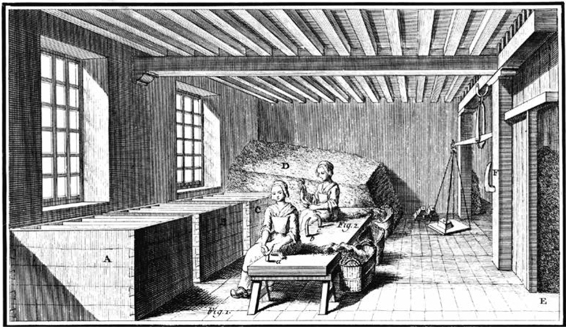
Women sorting rags for paper. Diderot, Trade and Industry, Volume II.
The Dutch also became expert at a process for preparing rags called “souring.” Buttermilk or sour milk was added to the rags; later, fermented bran or rye was used instead. The rags were soaked for five or six days, and then taken out and washed. The process was repeated, and then the rags were left out in a field until dry and fairly white. The process could take six to eight months, and was an important and extremely lucrative industry in Haarlem. Its workers were exclusively women. Not all Dutch paper was made from soured rags, but the finest paper was. Souring ended after 1799 when a Scottish chemist, Charles Tenant, discovered bleach by passing chlorine through lime.
Jérôme de Lalande devoted several pages of his book to comparing French and Dutch paper. He highlighted several points in favor of the French: their paper was thinner and stronger and didn’t tear as easily. But he finally concluded that Dutch paper was superior, for a variety of reasons: the Dutch weren’t as obsessed with whiteness; they were more frugal and less obsessed with money; and they made their paper “more slowly, more carefully, and with more precautions.”
PRINTING IN WHAT was called the Lowlands, now the Netherlands and Belgium, coincided with their Renaissance, which took place somewhat later than the Italian Renaissance and earlier than the English. This is more than a coincidence. The ideas, literature, and art that were being created in the Lowlands required a more efficient writing system than the old one of scribes writing on parchment could provide.
Lowlands books of the fifteenth century, like those in Germany, were heavily illustrated with woodcuts. These early illustrations, with their shaded, draped fabrics and wooded backgrounds, were clearly an attempt to imitate the great painting that was flowering at the time. But they were not great woodcuts—nothing near the standards of Dürer. Some of the first Lowlands books published, by Colard Mansion of Bruges, were in Flemish. A calligrapher and a scribe, Mansion saw how the world was changing. He started printing in 1476, and his first book was Ovid’s Metamorphoses, for which he did the woodcuts himself.
Holland’s woodcutting centers were Delft and Haarlem, the latter being home to the leading printer Jacob Bellaert, who produced seventeen books between 1483 and 1486. His principal illustrator was called the “Master of Jacob Bellaert”; his real name is not known, but his woodcuts are very painterly and he is thought to have been either a master painter or the student of a master painter. The popular books of Delft and Haarlem centered on stories from the Bible or classical mythology, and could have as many as seventy-five woodcuts apiece. One of the most popular of these early books was Dialogus creaturarum moralizatus, on the subject of animals and minerals, published by Gerard Leeu in Gouda in 1480. It had 121 woodcuts.
As in Germany, several of the great Dutch and Flemish painters became book illustrators. In Antwerp, a center for woodcuts, a leading shop was owned by a man named Jerôme Cock, who happened to be both the engraver and father-in-law of the great Flemish painter Pieter Bruegel. Bruegel was an unusual artist for his day in that his subject matter was almost exclusively the lives of peasants. And woodcuts and drawings were not a sideline occupation for Bruegel. He was deeply interested in producing quality art on paper—and not only drawings in their own right, but also drawings designed to be woodcuts.
Christophe Plantin was a French businessman who opened a bindery in Antwerp in 1540. Binderies were good business, as the prolific printing presses sold their books unbound. Six years later, the entrepreneurial Plantin went into the printer/publisher trade and became famous for his so-called Polyglot Bible, commissioned by Philip II of Spain. It was composed of eight volumes in Aramaic, Greek, Hebrew, Latin, and Syriac. He published thirteen sets for the king, printed on vellum, and 1,200 for the public, printed on paper. Vellum was still considered the finest of all writing materials. Plantin liked to have his illustrations done by recognized artists and on copper plates rather than wood. Copper-plate etching involved a different printing process, and in Antwerp, much of it was done by Bruegel’s printer, Jerôme Cock. Plantin used many etchings by the Flemish master painter Peter Paul Rubens, who was considered to be the greatest painter of his age.
Rubens demanded to be paid well for his illustrations, and he may have been somewhat disdainful of the work, since he would do illustrations only on Sundays—as if to say it was not part of his real work. Rubens did his best book illustration early on. By 1637, he was passing it on to others in his studio and allowing them to sign his name to it. Nevertheless, books circulated far more than art, and Rubens’s illustrations greatly enhanced his fame and reputation in much of Europe.
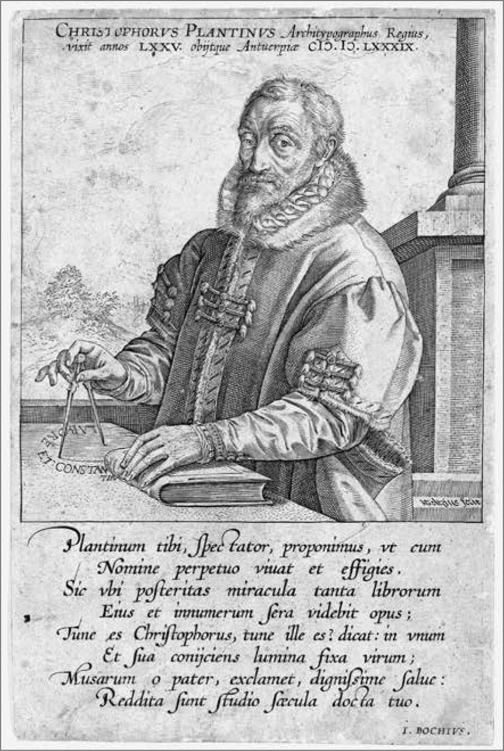
Portrait of Christophe Plantin by Hendrick Goltzius, circa 1590.
Partly due to the influence of Plantin, etching and other copper-plate printing techniques completely took over book publishing, first in the Lowlands but eventually in all of Europe. Woodcuts would almost completely disappear until the nineteenth century, when they would become popular again.
WOODCUTS AND ETCHINGS are essentially black-and-white. Colors can be painted in or created by printing with several blocks in different-colored ink, and drawing techniques such as crosshatching can be used for shadows, but woodcuts and etchings do not have true shading.
The first printmaking technique to make grays, or halftones, possible was called mezzotint, and was invented in 1642 by Ludwig von Siegen, a German. The technique, which spread quickly to Holland and England, involved spiky rollers that “roughed up the plate” to grab ink; those areas could then be smoothed down to varying degrees to achieve the desired lightness.
About ten years after mezzotint was invented, Jan van de Velde in Amsterdam introduced a technique known as aquatint. Aquatint is a method of etching with a heated resin that is applied by a brush, followed by an acid bath, and then more resin painting so that there are different gradations from black to gray to white. The great master of this technique was the eighteenth-century Spanish artist Francisco Goya, who combined aquatint with the crisp lines of conventional etching.
The greatest paper artist of Holland, however, was Rembrandt Harmenszoon van Rijn. He was to etching what Dürer was to woodcut, the master who set the standard for all who followed. But unlike Dürer, who was brilliant in paper but struggled with painting, Rembrandt was good at almost everything. In his lifetime, he produced approximately 600 paintings, 300 etchings, and 1400 drawings, and is best known today as one of the greatest painters of all time.
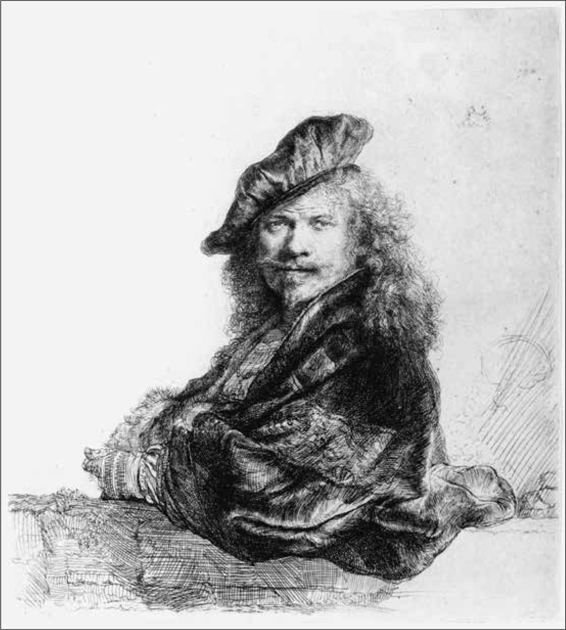
Rembrandt Harmenszoon van Rijn. Self-Portrait Leaning on a Stone Sill. Etching, 1639.
The only thing at which Rembrandt did not excel was book illustration. His etchings were too fine to hold up to constant reproduction, and in some of the books he illustrated, his work was replaced with that of other artists in later editions. Only a few books with Rembrandt’s illustrations have survived, one being La Piedra Gloriosa o de la Estatua de Nebuchadnesar, published in 1654 by his friend Samuel Menasseh Ben Israel, the first to print in Hebrew in Holland. The book, which relates a set of mystical tales, is credited with persuading Oliver Cromwell to let Jews back into England.
Rembrandt had his own press and an important collection of master etchings from around Europe. He did his own printing so that he could control the final image, and sometimes did several acid bitings of different periods of time to create lighter and heavier lines. Sometimes he left ink on part of the plate for a shadowy area. Toward the end of his life, for reasons that remain mysterious, he produced very little. Depression is sometimes cited, but some historians believe that he was simply trying to move on to a new idea that he never found. Because of a lack of work, and an absence of income, he was forced to sell both his press and print collection.
LEARNING TO USE the Chinese compass made the Dutch the great international traders of the seventeenth century. Dutch skill in using maps and nautical charts had also been steadily improving since the sixteenth century, thanks largely to the master works of the Flemish cartographer Gerardus Mercator, who coined the word “atlas.” Mercator is famous for his 1569 world map, printed from twenty-four large copper plates, with ingenious projections that account for the curvature of the Earth while still keeping sailing courses in straight lines. One year later, his friend Abraham Ortelius, noted for the brilliant colors in his wooden engravings, produced Theatrum orbis terrarium, a book of fifty-three maps that is considered to be the first truly modern atlas.
In 1602 the Dutch East India Company was established to enable trade with Asia, and in the years that followed, Amsterdam became the port from which Europe finally began to learn about China and its neighbors. Up until then, most Europeans still knew almost nothing about the Far East and still believed that they—or, as some more generously suggested, the Arabs—had invented paper. Paper was thought to have evolved from Egyptian papyrus, which is why the word for paper in most European languages either stems from the word “papyrus” or the Greek word khartes, which means papyrus.
In the seventeenth century, however, when European traders started frequenting China and Japan, they were surprised to learn that its peoples were using paper. Their immediate assumption was that the Asians had somehow picked up—but not perfected—the European art of papermaking. The Asians wrote with a brush rather than a quill like the Europeans, which meant that Asian paper required a different finish; the quill worked poorly on this finish. The European traders in Asia would resort to using the local paper when their own supplies ran out, but complained about its “inferiority” and pleaded with their home offices to send them more “good paper.”
The traders almost never bothered to ship the Asians’ so-called inferior paper back to Europe—clearly no one there would want it. But the Dutch, who enjoyed a virtual monopoly on trade with Japan from 1639 until 1854, twice brought some Japanese paper to Amsterdam, in 1643 and 1644. Rembrandt, who would scour the city in search of the best paper for his drawings and etchings, found some of this Japanese paper and purchased it. Thin and yet strong and supple with its long fibers, the paper had a way of grabbing the ink. Plates could be inked more lightly, yielding very delicate images. Rembrandt started doing many of his etchings on Japanese paper. He also found good Indian paper and printed etchings on that as well.
In the seventeenth and eighteenth century, Jesuit missionaries went to Asia, where they learned and brought back the legend of Cai Lun, the man whom the Chinese believe invented paper. In the 1730s, Jean-Baptiste du Halde, a Jesuit priest, wrote The General History of China, the definitive book on the subject, by interviewing seventeen Jesuits who had been there—he himself never left Paris. A popular book, it was republished in English in London in 1736. “A great mandarin,” du Halde wrote, “made use of the bark of different trees, and of old worn out pieces of silk and hemp cloth, by constant boiling of which matter he brought it to a liquid consistence and reduced it to a sort of thin paste, of which he made different sorts of thin paper.” Still, Europeans remained convinced that making paper from rags was a thirteenth-century Italian or German invention.
It took centuries for the rest of the art world to catch on to Rembrandt’s discovery about the quality of Japanese paper. But in the nineteenth century, Japanese paper started being shipped to London and Paris, and artists such as J.A.M. Whistler, Edgar Degas, Paul Gauguin, and Édouard Manet all made prints with Japanese paper. And another century later, following the archaeological expeditions of the late 1800s and early 1900s, the Europeans finally came to understand that paper was indeed a Chinese invention.
In seventeenth-century Europe, however, Japanese paper remained Rembrandt’s special material.