
Chapter 12

Thou hast most traitorously corrupted the youth of the realm in erecting a grammar school, and whereas, before, our forefathers had no other books but the score and the tally, thou has caused printing to be used; and contrary to the King, his crown, and dignity, thou has built a paper-mill. It will be proved to thy face that thou hast men about thee that usually talk of a noun and a verb, and such abominable words as no Christian ear can endure to hear.
—WILLIAM SHAKESPEARE,
Henry VI Part 2, ACT 4, SCENE 7
THE BRITISH ISLES DID NOT HAVE A PRINTER UNTIL WILliam Caxton set up shop in Westminster in 1476. More surprising, he printed on paper imported from the Lowlands because there was no British papermaker until John Tate established the Sele Mill in Hertfordshire in 1495. There are a number of countries that have this kind of reverse history—first printing and then papermaking. A printing press was easier to set up than a paper mill. Printing presses needed neither water nor power.
Caxton was born in Kent about 1422 but later spent thirty years in the Lowlands, as a merchant and British consul-general. While he was there, in the 1470s, printing began in the town of Louvain in what is now Belgium. Like many commercial people of his generation, Caxton was a man of letters. In 1469 he began translating Raoul Lefèvre’s Recuyell of the Historyes of Troye, a somewhat fanciful history in which ancient Troy resembles a European walled city with red-tile roofs. Caxton put the project aside, but his patron, Margaret, duchess of Burgundy, sister of Edward IV, urged him to finish. According to the often-repeated, though hard-to-believe story, the English colony in Bruges loved his book and he was wearing himself out writing copies for them—there is a record of him complaining about it—so he went to Cologne in 1471 and learned to print. There he is believed to have studied under Ulrich Zell, the priest from Mainz who started Cologne’s first print shop. In 1473, he returned to Bruges, built a print shop of his own, and in 1474 published his translation of Recuyell of the Historyes of Troye.
In the fall of 1476, Caxton returned to England, rented space in Westminster, and established a press. In 1477 he produced the first book ever printed in England, Dictes and Sayings of the Philosophers, a compendium of passages of wisdom that Anthony Woodville, 2nd Earl Rivers, had translated from the French while on a pilgrimage to Santiago de Compostela in northwest Spain. Woodville was the brother-in-law of King Edward, and after the death of Edward in 1483, the duke of Gloucester had Woodville beheaded—an unseemly ending for England’s first printed author.
Woodville’s book had a complicated origin. It was based on a French translation of a Latin book interpreted by a French aristocrat, Guillaume de Thionville, which itself was derived from an Arab text, Mukhtar al-hikam wa mahasin al-kalim (Choice maxims and finest sayings), written in the eleventh century by al-Mubashshir ibn Fatiq, an Egyptian emir. Caxton’s only revision to the book was to ask Woodville to add some of Socrates’s comments on women; Socrates, at least according to Plato, had argued for equal rights for women and was against ascribing gender roles.
England was the only European country besides Germany to have printing introduced by a native. Caxton printed thirty books in his first three years. None of them are known for their beauty or the quality of the type, but his historic significance is inarguable. He was the first printer of Chaucer. Among the 103 known editions of Chaucer that he printed, twenty are Caxton’s own reworking. The fact that Chaucer wrote in the Midlands dialect, one of four prevailing dialects of English at the time, had an enormous influence on the future of English. One of the consequences of printing is that it tends to standardize language. Caxton and subsequent London printers published in a local variation on Chaucer’s Midlands dialect, and so gave the London way of speaking dominance in England.
By 1480, Caxton already had competition. John Lettou, who is thought to have come from the Baltics, set up a print shop in London. Caxton then sent for a colleague from Bruges, a Dutchman named Wynkyn de Worde, to help him produce more. After Caxton’s death in 1491, Wynkyn de Worde took over his business.
De Worde was a considerably different kind of publisher from the sort that Caxton had been. Caxton started English printing; de Worde popularized it. He published inexpensive books with mass appeal. Caxton had rarely used illustrations, but most of de Worde’s four hundred books were heavily illustrated. He stopped buying expensive foreign paper and purchased his paper from John Tate. In his translation, the first in English, of Bartholomaeus’s De proprietatibus rerum (On the properties of things), a thirteenth-century forerunner of an encyclopedia by a French Franciscan, are the lines:
And John Tate the younger Ioye mote he broke
Whiche late hathe in Englande doo make this paper thynne
That now in our Englysh this book is printed Inne
De Worde’s publications were mostly religious in nature, but he also published romantic novels and poetry, including the work of John Skelton, a popular poet in Tudor England and the favorite teacher of the future Henry VIII. De Worde became wealthier from printing than any other early British printer.
One of 140 European towns that began printing in the last quarter of the fifteenth century, London was considered to be an important printing center by 1500. William de Machlinia from the Lowlands became a major printer in London, while Richard Pynson from Rouen was the first printer in England to use Roman type, later also used by most other British and American printers. Pynson too influenced the standardization of the English language, following Caxton, in the use of what is called Chancery Standard, which is largely London English but also borrows from the Midlands dialect. Pynson published five hundred books and was the official printer for Henry VIII.
The English learned other things from the Protestant Reformation in Germany besides printing. Catherine of Aragon was only twenty-four when she married Henry VIII, but they did not have a suitable heir—that is to say, a son—and once she was in her forties it seemed she never would. Henry asked the pope to sanction a divorce, but since the Roman Catholic Church does not recognize divorce, the pope refused. Henry then asked the leading cleric in England, the archbishop of Canterbury, to recognize a divorce. He agreed, and so Henry decided that England would leave the Roman Catholic Church and establish its own Church of England. This was a delicate public-relations problem. A Church of England would need popular support, and the argument that Rome should not be allowed to dictate English affairs could resonate with the population. But it needed to be sold. Thomas Cromwell, the king’s chief minister, both negotiated the move with Parliament and, like the German Protestants, turned to the printers to garner popular support. Cromwell published a series of tracts arguing the anti-papist cause in vernacular English, and the pamphlets and their ideas were well received. This was the new way of doing things in the sixteenth century.
DESPITE THE EXISTENCE of John Tate’s mill and others, printing developed more rapidly in England than did papermaking, and printers continued to buy their paper from the Continent. Yet, thickly veined with rivers and brooks that swiftly fell through chutes and falls, England was an ideal place for papermaking. Watermills were common, and there were even windmills. The mills were most commonly used to grind grain, but all it took to turn a grain mill into a paper mill was a shaft and wheel driving a few stamping hammers, a vat or tub, and some molds. Mills near London also had easy access to rags and a short shipping time to presses.
Most of the early paper mills failed. Tate’s Sele Mill operated for only a few years. The British papermakers could not get enough rags, and they could not compete with imported French paper, which dominated the British market. And, as so often happened in English history, the French were to blame, or so the British claimed: The French bought up all the rags and shipped them to France. They sold their white paper for less than it cost the British to make it. The French authorities relentlessly harassed French papermakers who attempted to work in England.
German papermakers saw opportunities farther afield than London. They built a mill near Cambridge in 1550, and one in Scotland in 1590 in Darly Near Edinburgh on the Water of Leith River. By the nineteenth century, the Water of Leith would be a major paper center with as many as ninety mills in operation. Some historians believe that Tate’s mill also employed Germans. John Spilman, a goldsmith to the queen, was one of the most successful German papermakers in England. In 1588 the Crown granted him a lease of two grain mills at the royal manor of Bicknores, Dartford, on the River Darent in Kent, and he converted them into paper mills.
Spilman was a man who knew how to use his royal connections. His watermark, for example, was a crown with the letters “E. R.,” for Elizabeth Regina, the queen. One year after opening his mill, he persuaded the Crown to grant him exclusive rights to making white writing paper, control over the manufacture of other types of paper, and most important, a monopoly on rag collection in the kingdom. But paper was also important to Elizabeth personally. No British monarch before her had ever used so much paper. She wrote speeches, translations, prayers, poems, and essays on paper. She also wanted Spilman’s mill to succeed because she was troubled by the extent to which England relied on imports from France. When James I later became king, he visited the mill and awarded Spilman a knighthood.
Historians suspect that Spilman knew nothing about papermaking, though as a German he probably had more general knowledge of the trade than did the average Englishman. He brought papermakers from Germany to work his mills, and it was probably their knowledge that led the mills to produce such high-quality white paper. Mills making lesser-quality paper coveted his German workers, but the Crown forbade them from switching employers. Spilman’s exclusive rights lasted for eight years, and were then renewed for another fourteen.
Over the course of the next one hundred years, papermaking became an established trade near London, especially in Kent, Buckinghamshire, Middlesex, and Worcestershire. Between 1601 and 1650, forty-one paper mills began operations in England, twenty-three of them within thirty miles of London. There were also a few mills farther west in Exeter and farther north in Shropshire, Lancashire, and Yorkshire. Like Spilman’s mill, many of the paper mills were converted grain mills. Others were converted “fulling mills” from a declining textile trade; fulling was a process of cleaning and thickening wool by beating it, similar to felting.
But the British had entered the game late and had not developed enough skilled workers. They could make brown paper that was good enough for wrapping or even taking notes on, but not enough smooth, white paper suitable for printing. The Reformation in France gave England a new source of papermakers, however. On September 10, 1627, royal French troops fired on La Rochelle, the stronghold of the Huguenots, a French Protestant denomination, and the Church’s highest-ranking authority, Cardinal Richelieu, had the city blockaded for fourteen months until it surrendered. Subsequently, the Huguenots were persecuted for many years. Then Louis XIV came to the throne. He expelled three hundred Protestant families from La Rochelle in November 1661, and life for the Huguenots who remained grew even worse. In 1685 Louis XIV revoked the 1598 Edict of Nantes, which had guaranteed rights to French Protestants. A large number of Huguenots fled France, some to found the town of New Rochelle in New York, others to a variety of destinations, including England.
Among the Huguenots who settled in England were many highly skilled papermakers. The French Crown that had tried so rigorously to stop their papermakers from working in England ended up driving them there. Britain received many highly skilled rag-sorting women, vatmen, and businessmen; the latter helped finance and establish a paper industry in Scotland and the Irish Paper Company in Ireland. The French war on Protestants also caused some French paper mills to shut down, reducing their output of the valuable export. Realizing their mistake, the French government attempted to win back some of their papermakers. Numerous French papermakers in England were taken into custody and legal action ensued; others were persuaded to return home, their travel expenses paid for.
PAPERMAKING AND EVEN printing was not always popular in England. As was the case everywhere that paper mills sprang up in Europe, those who lived near the mills complained of the smell and the incessant noise. They also complained that the farmers now had to take their grain farther away to be milled, that the waterwheels were killing the fish, that rags were spreading the plague, and even that they were endangering the royal family, who lived near mills in Windsor. During an attack of plague in 1536, paper mills in Middlesex were closed down, and when the government asked the public to help support the out-of-work papermakers, the locals complained that they had earned better salaries than most artisans and should have saved their money.
The controversy over paper is touched on in Shakespeare’s Henry VI Part 2. Part of Shakespeare’s celebrated War of the Roses cycle, this history play is regarded by many as the worst play Shakespeare ever wrote. However, it is largely remembered among paper and printing history buffs because of Jack Cade and his tirade.
In act 4, scene 7, Jack Cade has come to power and declares that the country will be returning to the old system of oral codes. Henceforth, no laws are to be written down and all existing written laws are to be burned. Saye, from the former regime, is brought before Cade and accused of losing Normandy to the French, undermining English society, corrupting youth by teaching them grammar, and encouraging papermaking and printing. Cade also accuses Saye of surrounding himself with unbearable people who constantly discuss nouns and verbs, and even charges Saye with imprisoning people for illiteracy. Saye meanwhile defends knowledge and proclaims that ignorance is a curse. Cade orders him beheaded, and the next time we see Saye, his head appears on a pike. Shakespeare, like Cervantes a decade later, exposes a contemporary belief that no doubt he did not share. Although theatre is an oral art form, Shakespeare arranged to have both his poetry and his plays printed beginning in 1593, early in his career.
When Cade accuses Saye of erecting a paper mill, it is believed that Shakespeare was referring to Spilman’s mill. The events of the play take place in 1450, when there were no paper mills in England. But in Shakespeare’s time, there were, and not everyone was happy about it. Shakespeare is clearly castigating Cade for his willful ignorance and for standing in the way of progress. As the scribes of old were keenly aware, literacy is empowering and a threat to despotic rule. Saye’s great crime, according to Cade, was not losing Normandy but sending children to school.
Spilman turns up again in English literature in a poem by Thomas Churchyard, an occasional poet and full-time mercenary who fought in Ireland, Scotland, the Lowlands, and France. He fled to Scotland after displeasing Queen Elizabeth, was forgiven in 1583, and returned to England where, in an attempt to stay in the queen’s good graces, he penned a 353-line tribute to Spilman and papermaking. The poem was dedicated to Sir Walter Raleigh, just back from fighting for England in Ireland and a favorite of the queen. Printed in 1584 in a large-format fifteen-page book with a lengthy, unmusical title—“A Description and playne discourse of paper, and the whole benefits that Paper brings, with rehersall, and setting foorth in verse a Paper myll built nere Dartford, by a High Germaine, called Master Spilman, Jeweler to the Queen Majestie”—it shows that the parchment-versus-paper debate was still very much alive. The poem also suggests that Churchyard might have been more skilled as a soldier than a poet:
I prayse the man, that first did Paper make,
The onely thing that set all virtues forth:
It shoes new books, and keeps old works awake,
Much more of price than all the world is worth;
Though parchment duer, a greater time and space,
Yet can it not put paper out of place:
For paper still from man to man doth go,
When parchment comes to few men’s hands you knowe.
FLAX, FROM WHICH linen was made, was the British papermakers’ first choice for making paper. When linen was pounded, the fibers frayed, and the frayed threads, known as febrils, interwove to make strong white paper. Cotton, their second choice, did not fray, but flattened, and this gave paper an opaqueness and a softness that was valued for making copper-plate prints such as etchings. Lime was sometimes added to the cotton pulp for whitening. Hemp from cloth or rope was also used, usually for lower grades of brown paper.
The paper was formed on a mold in a vat that contained a mixture of about 2 percent pulp, called stuff, and 98 percent warm water. The percentage of the pulp varied slightly depending on the thickness of paper desired, and the water was warmed for the comfort of the vatman, the most skilled tradesman in the operation, whose hands were in the vat the entire day. The vatman held to the mold a wooden frame, known as a deckle, from the German or Dutch, which created a slightly uneven edge around the paper sheet as it was formed. After machine-made paper was invented, the deckle edge, as it was called, became a distinguishing and valued characteristic of handmade paper.
The vatman held the mold and deckle firmly but not stiffly, dipped them vertically in the water-pulp mixture, and brought them up again with an easy scooping motion—just as the Chinese papermakers had done more than a millennium earlier. Then he held the mold horizontally and shook it gently until all the water had passed through and an even layer of fiber remained. Next, the vatman handed the mold to the coucher next to him. The coucher, whose job title was taken from the French verb coucher, to lay down, turned the mold over onto a layer of felt and the newly formed sheet of paper dropped out. A sheet of handmade paper (and this is sometimes true of machine-made paper as well) has two distinct sides, a wire side with a pattern and a felt side that is smooth. An artist can chose to work on either side.
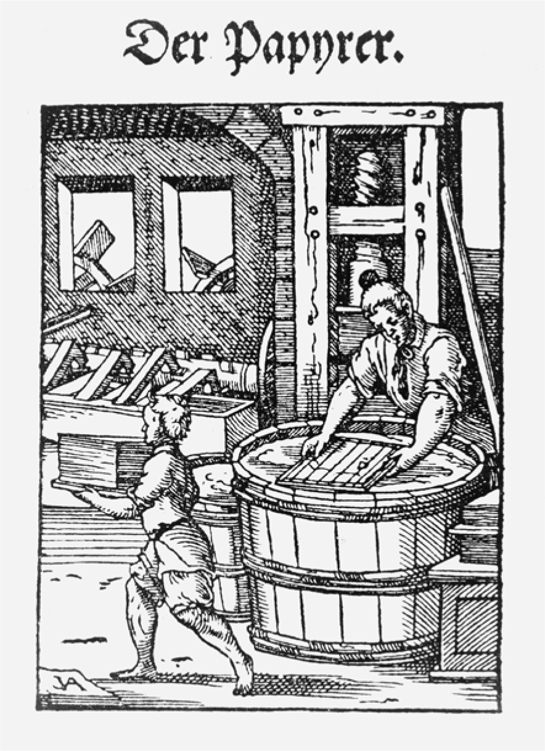
Jost Amman (1539–1591). Der Papyrer (the papermaker). Zürich-born Amman became one of the leading woodcut artists in Nuremberg in that city’s golden age of woodcut book illustration. He usually drew the image and let a Formschneider cut it. Among the 1,500 woodcuts for which he is responsible, some of the most famous, like this one of a vatman, were for the 144 woodcuts he drew from the 1568 Das Ständebuch (the book of trades), featuring poems by Hans Sachs, a Nuremberg native, shoemaker, and celebrated author of both songs and poems.
A vatman and a coucher were expected to make a sheet of paper in thirty seconds, and could make between two and four reams of paper a day. Afterward, there was still pressing, drying, sizing, and finishing—usually hand-rubbing with a polished stone—to be done, but the type and quality of the paper had already been determined by the selection of rags, the making of the pulp, and the thirty critical seconds that had passed between the vatman and coucher.
The wet paper, known as a waterleaf, was pressed in felt and dried, hung over horsehair ropes that left a mark known as the back mark. Various techniques were used to rid the sheets of back marks until the nineteenth century, when the papermakers realized that paper should be dried lying flat—“flat-dried.” As customers, especially artists, became more demanding, the sizing used to make paper became an important issue too. Paper for different tasks needed different types of sizing.
THE ENGLISH MANUFACTURED paper for many purposes. White paper was for printing, and industrial paper, usually brown or blue, for wrapping, packaging, and encasing firearm cartridges. Brown paper was popular with artists, such as the eighteenth-century painter Thomas Gainsborough, for sketches and works done in charcoal, chalk, and pastels.
Until the eighteenth century, England lacked the craftsmen needed to meet the country’s demand for white paper and thus supplemented their small production with imports. Most English paper was brown, though this was more a classification than a color: “brown” paper was just off-color, which sometimes meant gray. Brown wrapping paper was so popular in sixteenth-century England that the British mills couldn’t make enough of it, and some brown wrapping paper was imported as well.
Pasteboard, made of several sheets of paper laminated together, was another popular packaging material; it was also used for making playing cards and, occasionally, book covers. Blue paper was in demand as well, perhaps because there was a lot of blue clothing and hence blue rags. It was used as wrapping paper, most famously for wrapping sugar, and books left the printers wrapped in blue paper to be taken to the bindery. Blue paper was also popular with artists.
Papier-mâché, a craft learned from the Japanese despite its French name, which means “chewed paper,” became an important industry in eighteenth-century England. It was made from scraps of paper mixed with glue. The English learned how to waterproof papier-mâché, and it became an important element in creating architectural details, such as molding. Everything from coach doors to lightweight canoes to snuff boxes was made of it, and papier-mâché was also found to be more effective than paper in stuffing firearm chambers. Gunpowder needs a well-sealed chamber separate from the bullet in order to explode and effectively propel the bullet forward; plugs made of papier-mâché, called sabots, suited this purpose well. Paper was also rolled into tubes to make gun cartridges containing both powder and balls. The paper used for this purpose was coarse and heavily sized.
Wallpaper became extremely popular in seventeenth-century Europe. The Asians had made the first wallpaper, sometimes hand-painting it and sometimes printing it with wood blocks, and the Europeans started producing wallpaper when they, too, started producing wood blocks. In fact, Albrecht Dürer had designed wallpaper; some of the huge pieces commissioned to him by Emperor Maximilian were essentially wallpaper. But paper as wall decoration did not achieve true popularity until the seventeenth century. By the eighteenth century, England was Europe’s leading wallpaper maker, and it was mostly made from English paper. This paper was also used to line boxes and trunks.
By the late eighteenth century, paper of all sorts had become extremely fashionable in England. Decorative paper adorned tea caddies and picture frames, and elaborate paper fans were everywhere. Designing flowers or other objects with colored or gilded paper was a widespread hobby. The English had fallen in love with paper.
Paper was also used as roof covering. Brown paper was coated with rosin, sand, and oil. Later, pitch and tar were used as a coating instead, and both “tar paper” and “rosin paper” are still in use today. In 1776, Henry Cook of the Stoke Holy Cross paper mill in Norfolk developed a paper that was both fireproof and waterproof. Unfortunately, however, he either neglected to use it himself or it didn’t work as promised because he lost his mill in an accidental fire.
In 1788, Charles-Louis Ducrest invented a paperboard for use in the construction of buildings, bridges, and even ships. Ironically, its strength was based on the addition of steel filings, which in time were destroyed by corrosion, causing the paperboard to deteriorate.
MARBLING BECAME A British paper specialty. Marbled paper had first been invented in twelfth-century Turkey or Persia, by mixing dyes into liquids that refused to blend, such as olive oil and turpentine, to create a marble-like pattern. Soon it was discovered that more colors and even more intricate patterns—swirls and zigzags, stripes and crests, drops and tears—could also be created, depending on the elements mixed. The process became a closely guarded secret, yet somehow crossed over to Europe, either through the Persians or the Crusaders who had learned about it in the Middle East.
For centuries, the French, Germans, and Dutch were the great marblers of Europe, and so when the secret finally crossed the Channel, the English imitated the Continental work. Marbled paper was primarily used for books, either for endpapers or, as leather became more scarce and expensive, covers. Then an impressive array of seventeenth-century men of science took an interest in the secret. Francis Bacon mentioned it in his writings, and John Evelyn, whose family had made a fortune in gunpowder, introduced it to the Royal Society in London. The Royal Society had been founded by Robert Boyle, the father of chemistry, in order to enable the discussion of the new scientific approach to learning about the world—experimentation. Boyle also took an interest in the secret of marbling.
But English marbling did not come into its own until the mid-eighteenth century. It is not certain exactly when, because early British marbling is indistinguishable from that of the Germans, French, and Dutch. The first example of marbling that is definitely British-made is in a 1766 pamphlet by Richard Dymott entitled An Examination of the Rights of the Colonies upon Principles of Law.
Benjamin Franklin, who was deeply involved in papermaking and printing most of his life, lived in England from 1757 to 1774, representing the colony of Pennsylvania and enjoying the sophistication of London; in fact, he became somewhat of an Anglophile. He was active in the Royal Society for the Arts and through them tried to promote British marbling. But ultimately, realizing that his efforts to reconcile the American colonies and the British mother country that he admired were in vain, he set sail for America and the American cause.
In 1775, Franklin was involved in the printing of American currency. He believed that marbling would be impossible to duplicate and therefore an ideal safeguard against counterfeiters. The British planned to wreak havoc with the colonial economy by flooding it with counterfeit bills. A 1775 $20 bill of colonial money, called Continental currency, featured a thin band of marbling that could not be duplicated.
Two years later Franklin was in Paris, one of three commissioners attempting to secure French support for the American cause. He settled in Passy, on the route to the court in Versailles, and established a printing press for American publications (by then rebels were printers). He managed to get top-quality British paper, a typeface for his press, and apparently something else. Once loans were secured from the French government, Franklin printed promissory notes that somehow featured British marbling, despite the vaunted secrecy of British marblers. It is not known who did this clearly British marbling.
How many British marblers existed in Franklin’s time cannot be said because they did their work in absolute secrecy. They often worked at night in laboratories at secret locations, toiling behind locked doors and covered windows. Rooms were even examined for peepholes. It was nearly impossible to learn marbling at that time unless you were born into a marbling family. Even apprentices, who were always relatives, were not entrusted with complete formulas until they were older and deemed trustworthy. Marblers had their own secretive guild, and though they worked with book binderies, kept themselves absolutely separate from the bookbinders’ guild. Meanwhile, the bookbinders’ guild frequently sent spies into the marblers’ guild, attempting to discover their secrets.
A CHANCE DISCOVERY in sixteenth-century England had a huge impact on scientists, mathematicians, storekeepers, writers, artists—in fact, on most everyone who wanted to jot something down on paper. In 1565, as the story goes, a large oak tree was uprooted in a storm in Cumberland and an odd black mineral was discovered clinging to its roots. This led to the digging of England’s first graphite mine and the development of the pencil—a cheap, portable, erasable writing tool.
Pencils in Europe are older than paper. The word comes from the Latin name of a type of fine-tipped writing brush, a penicillum. The Greeks and Romans also sometimes used metallic lead to write or draw on papyrus, which is the origin of the modern expression “lead pencil”—despite the fact that a modern pencil contains no lead. But technology is only embraced when it answers a society’s needs, and only after a society began to write constantly and casually did the pencil become a commonplace tool. According to Henry Petroski’s history of the pencil, the first person known to use a graphite pencil was a sixteenth-century Zürich writer named Konrad Gesner. He mentions and even supplies an illustration of a graphite pencil in his 1565 book on fossils.
It was at about this same time that graphite was discovered in Cumberland. Soon afterward, graphite was inserted into a wooden tube and use of the new writing implement spread. By 1600, wooden cases and sticks of graphite were being sold, separately, on the streets of London. Pencils were initially most popular with scientists, but artists and writers used them too. In 1610 one artist recommended that books be marked with a pencil and later the markings erased. Gesner had used his pencil for sketching when researching in the countryside. Others noted that the pencil was a good tool for writing notes when on horseback. By the eighteenth century, artists such as J. M. W. Turner always began a painting by first making a pencil sketch.
AMONG THE EARLIEST books printed in the West were books about science and medicine. In 1483, Herbal, a book written in 400 CE by Apuleius Barbarus, was printed in Rome. In 1485, Gart der Gesundheit (The garden of health), about medieval herbal medicine, was printed by Peter Schöffer, Gutenberg’s former apprentice, in Germany. In seventeenth-century England, the field of modern science was still in its earliest stages, but it was already a pursuit that demanded paper. Scientists took notes and published their findings.
What had previously been thought of as science had been rooted in Aristotle and had dictated a system of debating and reasoning to arrive at what were perceived to be truths. But that method of inquiry was beginning to be questioned. Francis Bacon wrote, “Our present sciences are nothing more than peculiar arrangements of matters already discovered, and not methods for discovery or plans for new operations.” He insisted that ideas had to be tested through experiments—and that this process had to involve careful notations and record keeping at every step. “We cannot, however, approve of any mode of discovery without writing, and when that comes into more general use, we may have further hopes,” he predicted correctly.
A generation later, Robert Boyle, founder of the Royal Society in London, introduced the use of a scientific methodology that would lay the foundation for modern chemistry. And another generation later, Isaac Newton, the first modern theoretical physicist, used mathematical calculation and physical observation to lay the foundation for both physics and calculus. He developed theories on gravity and the laws of motion, and built the first true telescope, from which he could observe his theories at work in space.
When Newton was twenty-three, sequestered in his room to avoid the plague, he started conducting a series of experiments with a prism, bending a beam of sunlight to pierce through a small hole in a window shade. With the prism and mirrors, he studied the color of light and observed that it broke down into red, green, and blue. He called these primary colors. Then he remixed them, to find that together they formed white light. The three primary colors were separated from one another by other colors made from them—yellow, cyan, and magenta. This is not how artists see color or mix paint, but it is how light mixes, and his experiments led the way to color printing and color photography.
The findings of these early scientists became known because their books were published. Much of modern science is based on works by Boyle, such as the Sceptical Chemist and The General History of Air, as well as the ten books that Newton published in the late seventeenth century.
As for Bacon, himself the author of numerous books, he made no significant scientific discoveries. However, he is credited with leading the way for Boyle, Newton, and others. As the man who urged experimentation and the necessity of writing down results, Bacon was also less than perfect in his own methodology. In 1626, he was riding in a coach with a doctor, on their way to visit the king, when snow started to fall. The two men began discussing how snow resembled salt and speculated on whether it might have the same preserving qualities with food. Suddenly, infused with enthusiasm, Bacon wanted to conduct a scientific experiment. Stop the coach! he shouted, or so the story goes. He ran to a peasant woman and bought a chicken, which the woman killed and cleaned for them. Then the two scientists, on their hands and knees in the snow, stuffed the chicken with snow and packed snow all around it. The experiment was a success. It did seem to preserve the chicken. But poor Bacon had no time left in which to discover that freezing and salting preserved food in two completely different ways. He died in a matter of days from pneumonia, the first—perhaps the only—martyr to frozen food.
SCRIBES SURVIVED THE age of printing. But they were forced to endure a major demotion—from revered writer to ordinary calligrapher. Some scribes, hoping to regain their status, became printers; but most continued as scribes. There was always some deluxe item that called for the work of a calligrapher. But in the age of printing, the author and not the scribe became the star of literature.
The sixteenth-century writer Robert Greene is sometimes considered to be the first English author; that is, the first Englishman to earn a living from what he published. Greene wrote numerous book-length romances that enjoyed great popularity in the 1580s, though today he is chiefly remembered by Shakespeare scholars for having berated the Bard for being an upstart actor pretending he could write.
Some literary historians consider Don Quixote to be the first true novel, certainly the first enduring one. Others consider the novel to have been an English art form that did not come to full fruition until Daniel Defoe’s work of the early eighteenth century. But no matter what book was first, such works as Defoe’s Robinson Crusoe in 1719 and Moll Flanders in 1722, along with Jonathan Swift’s Gulliver’s Travels in 1726, firmly established novels as cultural artifacts that could be appreciated by a popular audience—and provide their creators with the means of making a living.
Printing had a similar impact on music. Throughout Europe, composers were at last able to free themselves from the demands of wealthy patrons, who had previously subsidized their art. Composers could now earn a following and their own livelihood by publishing their music. In earlier eras, composers had written their music down any way they pleased. Music was written on four-, five-, or six-line staffs. But once music started to be published, in the seventeenth century, notation became standardized, with a five-line staff, measures of equal beats, and key signatures for a choice of twelve major and twelve minor scales. Compare this with the Middle Ages, when there had been only two keys, C and F. Publishing also preserved the composers’ music. We don’t really know the exact sound of the original Gregorian chants, but, with a few unwritten exceptions, we do know exactly what Bach performed in his church.
____________
IN EIGHTEENTH-CENTURY ENGLAND, papermakers and artists started working together to develop new papers for new art forms. In 1740, England’s most celebrated papermaker, James Whatman, started Turkey Mill, where among the innovations for artists was “wove paper.”
The traditional papermaking mold had horizontal wires braided into the vertical wires every inch or so, which left a ribbed pattern on paper—this was called laid paper. Whatman thought that some art and possibly some printing might look better on paper without this pattern. So in 1754 he bought brass wire cloth, a newly manufactured product, and experimented with this fine mesh, to produce the first wove paper—smooth paper with no mold marks—in 1759.
Wove paper immediately came to the attention of John Baskerville, a leading printer whose work was so admired by Benjamin Franklin that he adopted his type for the first printing done by the US government. Baskerville printed his 1755 edition of Virgil on wove paper. Papermakers began to think that with their new, smooth paper, they could at last dethrone parchment from its perch in the luxury market. Wove paper was sometimes called vellum paper or wove vellum because it was considered to be as fine and smooth as vellum. When the French started producing wove paper in the late 1770s, they too called it papier vélin, vellum paper.
Soon the British began to produce a thicker, hand-sized wove paper that came to be called drawing paper. It was actually designed not so much for drawing as for watercolors. Just enough sizing was used to allow paint to remain on the surface and dry brilliantly before sinking into the paper. The paper was also thick enough for techniques such as scraping, rubbing, and wiping—to remove excess paint—to be used without wearing a hole in the paper.
Watercolors, beloved in East Asia for centuries, had never been regarded as a serious art form in the West before. But suddenly there was a growing public embrace of all forms of paper art, and though the times were not easy—Britain was at war with France for more than twenty years in the late 1700s—there was an expanding market for it in England. With England cut off from French imports because of the war, British papermakers also had an unexpected opportunity. Previously, France had been Britain’s source of art paper; but the native papermakers could now fill the void.
Stationers and other shops that sold etchings, watercolors, papier-mâché objects, paper, and books conducted a brisk business, especially in London. They also became social meeting places, part of the intellectual life that Benjamin Franklin had so loved about London.
One of the most popular stationers was Ackermann’s Repository of Arts. Rudolph Ackermann was a German who had moved to London, where he published books. His first was a book on watercolors, and he gave lessons in the popular new art form in his store. He sold paper and art and his own brand of watercolor in dried, compressed cakes—a new invention from another London art supply company, Thomas Reeves. In 1813 Ackermann added a tearoom and a library. Ackermann claimed, though it has been disputed, to have invented a popular fad of the time, transparencies. These were prints with certain areas varnished so that if held to the light, those parts of the picture were translucent, luminescent, to great dramatic effect.
For the first time artists, like writers and composers, could earn a living from their creative work. How-to books by watercolorists sold well, and such artists were in great demand for watercolor lessons. But the man who established English watercolors as a true art form more than anyone else was Joseph Mallard William Turner. Born in 1775 in London’s Covent Garden, a market district that had fallen into disrepair and was known for prostitution at the time, Turner was the son of a barber and a butcher’s daughter.
Before Turner, watercolorists were not called artists but draftsmen. Yet the power and luminosity of Turner’s work, the richness of the color and freedom of his brushstrokes, raised forever the status of the watercolor. He was called “a painter of light,” although with watercolors you do not so much paint light as paint shadows. But Turner could create the illusion that the light itself was the primary subject of his paintings. He earned a reputation for his oil paintings as well, though art historians point out that his oil paintings exhibit watercolor techniques. The converse could also be argued. His watercolors show an oil painter’s sensibility.
Artist Mary Lloyd once asked Turner’s advice about watercolors, and he said, “First of all, respect your paper.” Turner grew up and developed as an artist at a time when British papermakers were first beginning to develop papers for specific arts—copper-plate paper, watercolor paper . . . Papermakers and artists had a dialogue, and papermakers competed to attract artists. Turner experimented with everything he could find—different surfaces, different sizings—and his work was always shaped by the paper he was working on. He scraped gray paper white in places to create highlights, used colors differently depending on the paper’s sizing, and sometimes washed paper to bring out its nap or texture.
Turner’s interest in working on paper coincided with his discovery of papers specifically made for art, and in 1798, he began a period of great experimentation. For a time, he would paint only on the wire side of paper. Then for a time he would paint only on the felt side. Later he would go back to the wire side. But as papermaking became more sophisticated, he tended to gravitate toward smoother surfaces and hard sizing.
Much of Turner’s paper came from Whatman’s mill, in part because Whatman offered a wide variety of papers and paid careful attention to sizing. But there were other quality British papermakers of interest to Turner as well. From August 1819 to January 1820, he traveled in Italy and filled twenty-three sketchbooks, made of British paper from eight different papermakers. Some of Turner’s most celebrated work was created on blue paper made by George Steart at the Bally, Ellen and Steart paper mill. It specialized in white writing paper, but also made colored wrapping paper, which many artists liked to use, especially the blue.
In 1805, for the first time in history, London held a series of exhibitions devoted exclusively to watercolors—Turner’s work among them—and they changed the British art world. Yet even with Turner at the height of his career, it took some time for other countries to recognize watercolor as a legitimate art. This was partly a result of the war, during which France ruled out any admiration of things British. It was not until an 1824 exhibition of British watercolorists in Paris that the art form gained international acceptance.
Turner was also famous for his etchings and mezzotints of landscapes. While they were a mainstay of East Asian art, landscapes had low standing in Europe at the time. Rembrandt had helped to popularize the genre with his etchings and drawings, but in Europe, high art meant portraits and historic and biblical scenes, done in oils, preferably on large canvases. But because of the genius of Turner, both landscapes and watercolors done on paper, the highest art forms in China for more than a thousand years, started to be taken seriously in Europe.
ANOTHER SIGNIFICANT BRITISH contribution to paper art was wood engraving, a craft similar to woodcuts that had similarly evolved from textile printing. Whereas a woodcut is carved along the grain of the wood, an engraving is carved at the end of a block. The preferred material for engraving is boxwood, a slow-growing evergreen that is more of a shrub than a tree. It is an unusually dense, tight-grained hardwood; its one limitation is that you cannot get a very large block from a boxwood bush. The end of the block is smoothed and then carved with a burin, the metal tool used for etchings, which is pushed away from the carver. Because of the tightness of the wood, very fine-lined images can be carved into it—much more delicate and detailed ones than can be carved on a woodcut. The boxwood block would be cut down to the height of the type, about seven-eighths of an inch, so that it could be set into a page of type.
The great pioneer and undisputed master of wood engraving was Thomas Bewick, born in 1753 in a farming village near Newcastle. His father owned a small coal pit. From an early age, Thomas was a great draftsman, but at that time he had no paper and so his drawings would turn up on the sides of the church, on gravestones, or on the stones of his family’s fireplace. Finally he was given a pen and some paper, and while still a small boy, earned a reputation in the area for his drawings of birds and hunting scenes.
At age fourteen, Bewick was apprenticed to Ralph Beilby, a copper engraver in Newcastle. At first, Beilby had him doing coarse work, such as doorplates and sword blades, and the boy complained that his hands were becoming like “those of a blacksmith.” But then Beilby noticed that the boy excelled at wood carving and tried to give him wood projects. Not long thereafter, Bewick won a medal from the Royal Society for a woodcut illustration for a new edition of Aesop’s Fables. Beilby eventually made him a partner in his firm; and through such famous works as the 1790 A General History of Quadrupeds, for which Beilby wrote the text, Bewick became the most sought-after illustrator in England.
Like Turner, Bewick had the good fortune to live at a time when papermakers were making special paper for different types of work. There was an explosion of printmaking in England—etchings, mezzotints—in the early eighteenth century, and papermakers responded. Whatman’s wove paper was only one example. Another was soft-sized paper for copper printing.
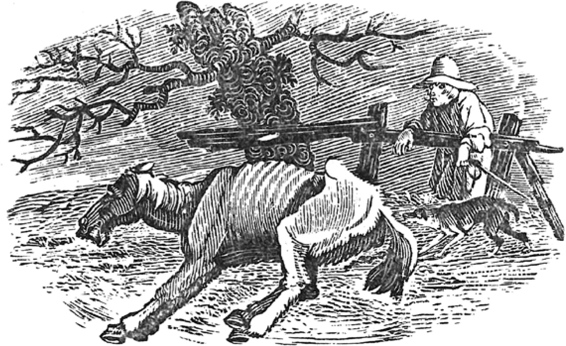
Thomas Bewick, Waiting for Death, 1828. This is the largest wood engraving ever made by Bewick. It is printed from four blocks. Intended as a protest against the mistreatment of old horses, it was Bewick’s last work. He died before completing the final touches.
In an age of printmaking, Bewick did for wood engraving what Turner did for watercolor: he gave it legitimacy and standing as a major art form. Woodcut illustration virtually disappeared and engraving became the leading form of illustration. Bewick had not invented the technique, but he perfected it, drawing by what was called white lines. In this technique, the spaces between the black lines were as fine as the black lines themselves, and light and shadow could be created by the thickness of the white lines instead of by crosshatching. Bewick supervised the printing of his engravings, instructing printers to wipe off ink in those places he wanted to be grayer.
THE TIMES WERE right for Bewick and wood engraving because of two emerging uses of paper. One was children’s books. There had long been books for the education of children, but the modern children’s book for the child’s enjoyment, usually with brightly colored illustrations, was an eighteenth-century English invention. John Newberry is often credited with starting the genre, with a stream of books starting in 1744.
The other was journalism. Journalism came out of pamphleteering, which first became important during the Reformation, but continued to grow in stature in the seventeenth and eighteenth centuries. In France, there were writers such as François-Marie Arouet, who wrote under the name Voltaire—and who once said, “To hold a pen is to be at war”—and Jean-Jacques Rousseau, whose The Social Contract is possibly the most influential political pamphlet ever written. It begins, “Man is born free and everywhere he is in chains.” The ideas of Voltaire and Rousseau were the underpinnings of both the American and French Revolutions, and the echo of The Social Contract is heard in the American Declaration of Independence, itself written in the manner of an eighteenth-century pamphlet.
The English writer Thomas Paine became known for a fifty-page pamphlet he published in January 1776 while visiting America. He called it Common Sense, and the arguments it presented led many Americans and a few British to conclude that America ought to be independent. Paine wrote other pamphlets while in America too, one excoriating the slave trade. Then he returned to England, where he made an industry of pamphleteering. His best-known work, The Rights of Man, has been reported to have sold 100,000 or even 200,000 copies, though historian William St. Clair, who tried to document its sales record, could find evidence for only tens of thousands of sales—still a significant number. The typical successful pamphlet of the time found five hundred readers. The Rights of Man was probably the bestselling pamphlet of the late eighteenth century, at least until the British government banned it.
Among other eighteenth-century pamphleteers whose work is still remembered are Jonathan Swift and Daniel Defoe. The British abolitionist movement was built on pamphlets as well. The British public had no idea, for example, that a British slave ship left for Africa every other day until 1791, when William Fox published a pamphlet entitled “An address to the People of Great Britain on the propriety of abstaining from West India Sugar and Rum.” In 1792, more than 500 petitions with more than 700,000 signatures demanding the abolition of the slave trade were sent to Parliament. By 1823 the Anti-Slavery Society was publishing 200,000 copies of anti-slavery pamphlets a year, a figure that would more than double in the years to come.
It is more difficult to measure the influence of Mary Wollstonecraft’s A Vindication of the Rights of Woman. This pioneering declaration, published first as a pamphlet and then as a book, drew to it a fair number of admirers and a huge number of detractors. As was becoming clear in this new world of print, women were not content with their traditional roles, a fact that many decried. One frequent response to the pamphlets was to suggest, with no intended irony, that it would be best if women did not read.
THE WORLD’S FIRST newspaper, Avisa Relation oder Zeitung, was published in Strasbourg in 1609. Almost a century later, in 1702, the world’s first true daily newspaper, The Daily Courant, was published in England. By 1757, the total circulation of British newspapers grew to eight times the number it had been in 1712. And this despite the efforts of government, starting in 1712, to suppress the growth of newspapers by taxing them.
In 1771, under pressure, Parliament finally granted the press the right to report on parliamentary debate. Newspapers continued to grow, spurred on by the burning debate over American independence. In 1785, a Scot named John Walker started a daily of a different kind from those that had existed before—it would attempt to be independent of all political parties and movements. It was called The Daily Universal Register, but after three years changed its name to The Times. Another Scot, James Perry, started The Morning Chronicle, which supported the Whigs (liberals), while still another Scot, Daniel Stuart, started The Morning Post in support of the Tories (conservatives).
As newspapers grew more numerous and more competitive, they consumed ever-increasing quantities of relatively low-grade paper. In 1760, more than 9 million British newspapers were sold. In 1811, more than 24 million were sold, and by 1820, newspaper circulation exceeded 29 million. Demand for paper was exceeding supply. A small newspaper with a circulation of 3,000 required twelve hours of printing with experienced printers moving as quickly as they could. A large newspaper needed four presses, two for each side of a sheet. New technology was needed.
Newspapers tried to expand their reach to working-class readers by keeping their prices low, while government levied taxes to try to keep those papers out of the hands of the working class. Reading was dangerous. There were important issues at stake, and these issues were being disseminated, consumed, and debated on paper.