
Chapter 1

WHAT DO HUMANS DO THAT OTHER ANIMALS DO NOT (aside from the curious observation by Pliny the Elder in the first century CE that “only man has ears that do not move”)? Much is made of our opposable thumbs, but many animals do quite well without them, carrying, climbing, and otherwise going about their lives with teeth, claws, or tails. Indeed, the skill with which a cat uses its claws to snatch food from an inattentive human’s plate suggests that thumbs may at times be overrated; though it is true that paws are not much good for typing.
The ability to build and change one’s environment is not a uniquely human trait either. Beavers build dams that completely alter rivers and their banks and surrounding life. Neither are humans uniquely violent. Most ants spend their lives at war. Other animals, such as wolves and cats, laugh, joke, and play, just like humans do. Their sense of humor and play may have developed during evolution to hone certain survival skills, but the same may be true of us. Nor is communication uniquely human. A variety of animals—including some insects, wolves, monkeys, porpoises, and whales—communicate with sounds, sometimes even by composing music.
But there is one truly unique human trait: people record. They record their deeds, their emotions, their thoughts, and their ideas . . . they have an impulse to record almost everything that enters their minds and to save it for future generations. And it is this urge that led to the invention of paper. Other recording devices such as stones, clay, boards, barks, and skins existed before paper, but once paper was developed, its advantages made it dominate.
Dard Hunter, the great American paper historian, wrote that human development could be divided into three “stepping stones”: speaking, drawing, and printing. It is curious that he left out writing, but in the long stretch of human development, the few thousand years’ separation between the emergence of writing and the emergence of printing seems like only an instant. Human beings have existed for between 3.5 and 5 million years, depending on what stage is recognized as human, but only started writing about 5,000 years ago. This means that humans spent 99.9 percent of their history without writing; in addition, during most of their brief literate phase, only an elite few actually knew how to read and write.
Using the general definition of technology to mean a practical application of knowledge, humankind’s first technologies—basic tools and speech—seem to have developed at the same time. They came about as a result of a million-year period in the Pleistocene Age 1.8 million years ago when the human brain grew to be more than one-third larger than it had been before. During the same period, facial and throat anatomy evolved to facilitate a greater variety of sounds.
These first technological breakthroughs, just like subsequent ones, did not change society. Rather, humankind’s enlarged brainpower led to a more organized society, which in turn required certain tools for building and hunting and the big breakthrough—speech. There is no way to document this, but in that early society, there were probably a few who used their new ability to warn others that their new habit of communicating through utterances was going to destroy their quality of life: There would be no more silence. People would give constant orders. Humans would lose the ability for true expression and instead rely on this easy and superficial new technology. And perhaps in some way, this was true. There is always some loss associated with a new technology.
Anthropologists suggest that humans could speak before they could draw, but by 50,000 BCE they were drawing lines. They began to make decorative objects from stone, bone, and possibly wood. They learned to grind certain minerals such as manganese to make colors. With apologies to Meng Tian, they may have also known how to bundle together animal hairs to apply colors to stone. The first drawings resembled pictographs, an early form of writing. They were drawings in which a few lines represented an object. Gradually, these drawings grew in sophistication and made more use of perspective and color. The caves at Lascaux, France, have some 2,000 drawings, most of animals, but a few of humans. The drawings date to about 15,000 BCE. More recently, drawings dated at about 13,000 BCE were found in the caves of Altamira, Spain, and even more recently, on the walls of caves in Niaux, France.
What is striking about these paintings, other than their beauty, is that they are dynamic. They depict motion. Wild horses show their delicate prance. Stags leap forcefully. Powerful aurochs charge head-down. In Lascaux, there are whole herds of fauna romping or galloping. How can we not be moved that people from 15,000 years ago made these paintings? True, it is just a moment in the millennia of human time. But for those of us who make huge distinctions between eighteenth-century enlightenment and nineteenth-century industry, this was a very long time ago.
Seeing these paintings prompts many questions: Who were these people? Did they have a fully evolved language or just minimal pragmatic phrases? Was this their only imaginative expression? Did they leave it for us? What were these drawings intended to communicate? Were the authors naturalists, storytellers, perhaps food writers? Some have suggested that the paintings are connected to religion, and others have suggested that they map the constellations.
All we know for certain is that they are beautiful. We look at them and we are moved. Communication is taking place. And all over the world, there are other remnants of communication drawn or carved on rock. The urge to communicate or to record is primal. The urge to draw is unique to humans, and is in every human. Why do people unconsciously doodle? Why do children, as soon as they begin talking, have a desire, with or without instruction, to draw?
Long before actual writing was invented, there was written communication. In the graves of the Moche, a people who lived in Peru before the Inca, pouches have been found containing beans that are carved with dots and lines. Pottery depicting couriers carrying such beans indicates that the beans contained messages. The aborigines of Australia used marked sticks in much the same way. Often, the messenger carrying a stick was instructed on the meaning of the marks, so that the stick was simply a memory aid, which is also what writing often is. The Yoruba of Nigeria sent messages with cowrie shells. To send a single cowrie meant defiance. A string of six meant that you liked someone. If a man sent a string of six shells to a woman, it meant he desired her. If she agreed to his proposition, she sent back a string of eight. In the Pacific Northwest, totem poles were carved as a record of family history.
Knots on strings and slash marks on sticks or poles were also used for counting. The poles could be split in two so that both sides in a transaction had a record. From 1100 to 1826, the British Royal Treasury accepted such notched sticks as proof of payment. Recording transactions with knots on strings dates back to the late Stone Age, but reached its highest refinement with the Incas, who recorded complicated transactions through a variety of strategically positioned knots coded by colors.
Most, but not all, scholars believe that the first writing developed in various spots in the world independently. People had a need for it and so developed a system: the Sumerians in Mesopotamia in 3300 BCE, the Egyptians in 3000 BCE, the people of the Indus valley in 2500 BCE, the people of Crete and Greece in 1400 BCE, the Chinese in 1200 BCE, the Phoenicians in 1000 BCE, the Zapotec/Mixtec of Mexico in 600 BCE, and the Mayans in 250 BCE. Missing from this list are North and South America, Africa except for Egypt, Australia, and Northern Europe except for Scandinavia, where the runic alphabet was developed, a latecomer in the second century CE. Other societies could be missing as well, but these are the earliest written languages we have found; one of the great advantages of writing is that it is left behind to be found.
Some ancient languages were slow to develop writing. Swahili, the most widely spoken of some 250 languages of the Bantu, was first written in the early eighteenth century. The Cherokee alphabet was not invented until 1821—one of numerous North American and African languages to establish alphabets in the nineteenth century. The ancient Basque language, the oldest living European language, was seldom written until the sixteenth century.
The fact that at least nine writing systems developed across the globe independently of one another shows that human development had arrived at a point when writing had become necessary. In the case of the Basque and some African and American languages, the slow development of their writing was due to the fact that other languages came into use, such as numerous European languages for Africans and North Americans, or Spanish and French for the Basques.
It is not completely clear why people started writing at all. In many cultures, people believed that writing was handed down from God. This belief was commonly held until the nineteenth century, and is still believed by fundamentalists of many religions. And consistently, wherever writing first appeared—be it in Mesopotamia, China, Egypt, or Greece—it was developed by a people who had given up the hunting and wandering life and become stationary farmers.
Historians have multiple theories regarding the origin of writing, the leading one being that it originated as an attempt to improve accounting in business transactions. Agriculture generates commerce, which in turn generates numbers. The spoken word is an effective means of communication, but mathematics taxes the memory and requires something more. The Sumerians of Mesopotamia, the first to develop writing, used it for accounting, and their development of writing corresponded with an expansion of their trade and economy. It has been hypothesized that the Inca, advanced in other ways, were slow to develop writing because they had become so efficient with quipas, the knotted, color-coded strings they used for accounting, that they had no need for written language.
Originally, writing was crude line drawing. These drawings then grew increasingly abstract. Some historians believe that writing was invented by an unknown genius, others suggest a group of administrators.
AS FAR AS is known, writing began among the Sumerians in Uruk on the lower Euphrates between Babylon and the Persian Gulf about 3300 BCE, but this is really just an educated guess. Uruk is referred to in the book of Genesis as Erech, and is in present-day Iraq. Sumerian writing consisted of a series of circles and other shapes initially inscribed in stone and later pressed onto clay tablets. The shapes are thought to represent commodities, and the tablets themselves are thought to be records of sales or movements of goods. The writing tool used for clay seems to have been a cut reed. Pressing straight down vertically would produce a circular impression in the soft material. Pressing down at an angle would yield a fingernail-shaped impression. These were the first two characters in written Sumerian and, along with other early characters, evolved into pictograms.
Early cuneiform, as this writing came to be called—originally by the French in the seventeenth century, from the Latin, meaning “made from wedges”—had at least 1,500 pictograms and symbols, and only experts could use them; these scribes became important men in the community. But as time went by, cuneiform was refined, and by 300 BCE, it consisted of about 800 characters. Rather than pictures, these characters were now letters representing phonetic sounds—an important breakthrough in writing because it meant that a limited number of characters in different sequences could have many meanings. For some reason, the Chinese never reached this stage, and even today most of their characters stand for ideas, not sounds.
Most cuneiform was written in wet clay, horizontally from left to right, though there is some evidence that an earlier version of cuneiform was written in columns from top to bottom and that these columns were read right to left. This change in orientation is thought to have occurred early on, when the scribes switched from writing on stone to writing on clay. The blunt reed stylus that formed a circle remained in use for inscribing numbers, but the alphabet was written with a pointed reed. This tool could not draw curves easily, and so the characters became linear and angular. It took study and practice for scribes to learn how to work a reed stylus in wet clay, which probably contributed to the move away from pictographs in the direction of abstract characters. Other, later, languages such as Phoenician were not written in wet clay, yet still adopted the simple strokes of cuneiform as a prototype for their alphabets.
Rapidly, the alphabet became more phonetic, which reduced the number of symbols needed, though the scribes remained powerful and revered experts. The Sumerian language was well suited for phoneticism. It was a monosyllabic, agglutinating language, meaning that most words were one syllable, a single sound, and that prepositions, adjectives, and adverbs could be created by adding sounds onto a root syllable. It was also a language with many homonyms—words that sound alike but have different meanings.
The Sumerians must have been both tough and creative. They tamed the wild Euphrates, a river harsher than the Nile; it changed course without warning, causing unpredictable floods and droughts. They were one of the early inventors of the wheel, used first for pottery and later for transportation. They also learned about irrigation, and developed agriculture and commerce. Constant war, the act of conquering and of being conquered, spread their written culture. The Sumerians were also one of the first societies to have professional soldiers, as opposed to sending all men off to war, and relied on slave labor to develop their agriculture.
The Sumerians were certainly not a literate people, but their scribes read what they wrote out loud to the laypeople. They left behind tablets containing not only accounting records and history but poetry. Sumerian tablets pre-date the book of Genesis by some two thousand years and tell a similar story of creation, that of an Adam-esque founder who ate forbidden food and was punished, a woman made from a rib, a great flood, and two brothers similar to Cain and Abel.
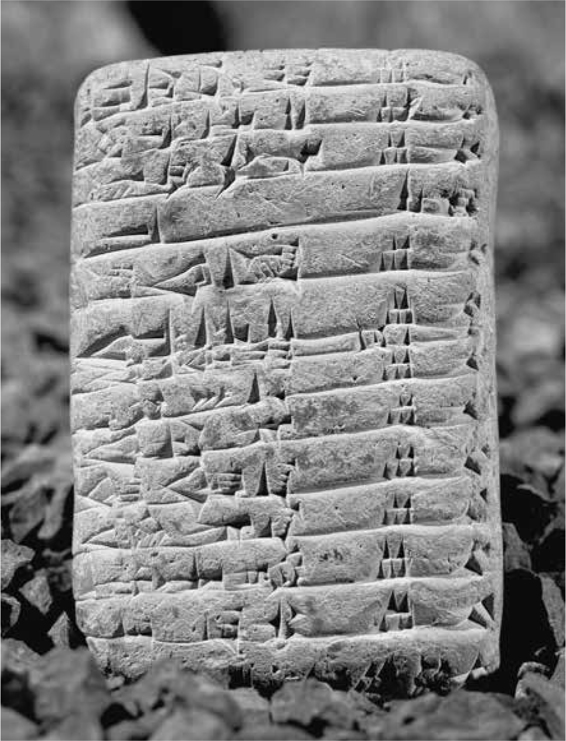
Baked clay tablet with 22 lines in cuneiform writing listing barley rations for 17 gardeners for one month. Third dynasty of Ur, Mesopotamia (Iraq), 2113–2006 BCE. 6.1 x 3.9 cm. From the Dagon Agricultural Collection, Haifa, Israel.
The Sumerians were the world’s first poets, and their poetry, like most poetry until that of the Chinese, was not descriptive. Instead, it related historical events in a manner designed for easy memorization. It was highly repetitive:
In those days, now it was in those days
In those nights now it was in those nights
In those years, now it was in those years
Though this translation by M. I. West of the introduction to a Sumerian poem does not show it, their poetry was also heavily rhymed, another aid to memorization.
The Sumerian language lived for about three thousand years, until the arrival of Alexander the Great in 330 BCE, at which point it began to fade rapidly. For a time, Sumerian had been the language of written diplomacy in the region, and cuneiform’s phoneticism would later influence the writing of the Indus valley and Egypt. Sumerian culture and writing was influential in Syria, Persia, and other parts of the region as well. Their written language, like that of the Romans, lasted longer than their civilization itself.
All this was accomplished with writing inscribed in clay or occasionally carved into stone. Once the clay tablets were fired, they became durable, and have survived until modern times. Clay tablets had the advantages of being cheap, readily available, and easy to write on. Their lack of portability, however, was an obvious drawback. Nonetheless, clay tablets were the world’s primary writing material for three thousand years—a considerably longer period than the reign of paper up until now.
THE BANKS OF the Nile River are softened by thick growths of tall papyrus reeds with feathery tops that bow and sway in the breezes. According to legend, an infant who would be called Moses was found abandoned in a patch of these reeds in about 1500 BCE. At the time, the reeds themselves were already an important Egyptian product, and they would remain valuable for the next fifteen hundred years.
The papyrus plant was tall, with a bushy tuft of leaves and flowers on top. In its most favorable growing conditions, the Nile delta, it grew to sixteen feet high, with stalks as thick as two inches. In the reed’s center was a soft substance that the Egyptians enjoyed eating raw or cooked. Light boats for navigating the shallow pools of the Nile were made from woven papyrus reeds caulked with resin, and the plant was also used for making ropes, sails, and baskets.
But the plants were most valued as writing material. The papyrus reed peels like an onion, and once the green outer layer is removed, there are about twenty inner layers. These would be unrolled and laid out on a hard and smooth table, with each layer slightly overlapping the next. Then a second set, turned at a 90-degree angle from the first so that the fibers were running at right angles, was placed on top. The sheets were moistened, and pressed or hammered together with weights for a few hours. Since the reed was freshly cut, its own sap served as glue; flour paste was also used as an additional adhesive. The sheets were then rubbed with a stone, a piece of ivory, or a shell until they reached the desired smoothness and a stylus could pass over the overlapping joints without hitching up. As with paper, different tasks required different surfaces. The best papyrus was white, though it yellowed with age, which is why it is depicted as yellow on tomb paintings. Individual sheets of papyrus would be joined together to make a scroll, for longer pieces of writing. Typically, a scroll was twenty sheets long, but it could be as long as thirty feet or even more depending on the document.
Using plants to make writing material was not a uniquely Egyptian idea. Incising characters on leaves is thought to be one of the oldest forms of writing—a simple method that required little preparation. Leaves were also far easier to transport than were stone or clay tablets. The practice of writing on palm leaves continued in India and Sri Lanka until almost modern times.
Other civilizations in different climates found other plants to flatten into writing surfaces. One of the most widespread was tapa, a Polynesian word that means “bark paper.” This, and the fact that it was made by beating thin the bark of the mulberry tree, which was also one of the first paper materials, has caused tapa to be confused with paper. But it is beaten thin, not broken down and woven in a random pattern the way true paper is. The bark of other trees, including fig and breadfruit, has also been used to make writing material. A two-inch strip of tapa can be beaten into a ten-inch sheet.
Tapa is a product of tropical countries, and there is evidence of tapa being used in Southeast Asia as early as 4000 BCE and in Peru by 2100 BCE. The Chinese first mention it about 600 BCE. Some of these early dates suggest very early writing systems, perhaps far earlier than those of the Sumerians and Egyptians. Like papyrus, tapa was used for many things, such as clothing and bedding, before it was used for writing material. But unlike papyrus, tapa does not conserve well in its native environment, and only a few fragments have survived from ancient times, none with writing on them. Tapa is still being made in Africa, the Pacific, and Central and South America, but it is now usually used for clothing.
What was unique about Egyptian papyrus, however, was that it became a valuable commercial product that was exported throughout the known world.
The oldest papyrus scroll ever found dates to between 2900 and 2775 BCE, and its quality is so fine that historians believe that the Egyptians had already been making scrolls for some time before that date, probably since about 3000 BCE, only a few centuries after the Sumerians began using clay tablets for writing.
If a writing surface is at all porous, it needs a coating, otherwise known as a sizing, to keep the ink on the surface so that it does not soak in, which would make the lines blurry. In the case of papyrus, the plant’s dried sap acted as a natural sizing that kept the pigments that were used as ink from penetrating the sheet or spreading too much. Later, the Romans would improve on papyrus by coating it with a sizing of flour and vinegar, which created a better writing surface.
The earliest Egyptian writing ever found was already completely developed, so nothing is known of the early stages of its development. It is thought to have been created independently of the Sumerian language and to have later acquired some features of cuneiform, but it is also possible that it was a spinoff of Sumerian writing.
Egyptians wrote both from left to right and from right to left. Their characters, such as the profile of a standing bird, all faced one direction, so it was easy to tell which direction the writing went. Though the Egyptians showed little interest in calligraphy, their alphabet is unusually beautiful—a complex mixture of phonograms, or characters that represent sounds, and logograms, or characters that represent objects or ideas. Some of the Egyptian pictographs faithfully represent the objects that they look like, but this is not always the case.
Papyrus grew in numerous marshes and riverbanks throughout the Middle East, but it was usually spindly. Optimum growing conditions existed only in certain parts of the Nile delta and only there did it grow to be two inches thick, making it suitable for making writing sheets. So while the demand for papyrus for writing spread throughout the Mediterranean world, its manufacture remained an Egyptian monopoly. This meant that the Egyptians controlled the price of this labor-intensive product, so that while papyrus was a more practical writing material than stone or clay, it was also expensive.
The use of papyrus as writing material seems to have existed in other countries and climates, but only a dry climate such as Egypt’s allowed it to survive the millennia until modern times. The only papyrus ever found outside of Egypt was in a desert cave near the Dead Sea, part of a Hebrew collection known as the Dead Sea Scrolls.
PAPYRUS WAS MOSTLY used by scribes, who wrote with reed styluses, the ends chewed off into stiff brushes. Students studying to become scribes would begin with writing boards that were covered with a soft plaster that was erasable, just like Sumerian clay. You could simply pat the plaster down and start again. But an even more common implement that endured for centuries was the wax tablet, a board with a hollowed-out center that was filled with wax—most likely beeswax. In Assyria, such tablets have been found dating back as far as 80 BCE. They were extremely popular in ancient Greece and Rome, where the wax was black and the writing done with a metal stylus that was pointed on one end for writing and blunt on the other for erasing.
The wax tablet was an important contribution to the written culture of ancient civilizations because it was the first widely used device for casual writing, intended for individuals other than scribes. Before wax tablets, anything that was written down had to be considered of great and enduring importance. But once there is writing, there arises a need for temporary writing—a quick note to jot down and throw away the next day, an aid in calculating a math problem, a rough draft of a document that would later become permanent. All the other previous writing surfaces had been, for all intents and purposes, permanent. You could not bake a clay tablet to throw away the next day, or jot down something on an expensive scroll of papyrus and throw it away. And once something is literally carved in stone, it is figuratively “carved in stone.” It can’t be unwritten. The wax tablet, therefore, was the original Etch A Sketch for the ancient world.
Wax tablets were easier to write on and easier to erase than other writing media. Often two wax tablets would be bound together with raised edges in between so that the notations wouldn’t be damaged when the tablet was closed. Such a bound and folded double tablet was known as a diptych. The diptych was popular among the Hebrews, and traditionally, whenever the Ten Commandments have been reimagined by film directors or artists, they have been written on a diptych made of stone, indicating that no revision was planned.
Sometimes several tablets would be bound together; in Latin this was known as a codex. The codex was the forerunner of the book, and while originally it referred to wax tablets, the word was later also applied to codices made of bound papyrus sheets, parchment, and eventually paper. But the codex was of limited use as long as papyrus, far better suited for scrolls, dominated.
For centuries, the kings of Babylon and other cultural centers of the Near East tried to build great libraries. In the third century BCE, Ptolemy, a Macedonian Greek, came to rule Egypt. He set out to build the world’s greatest library in Alexandria, which happened to be near a papyrus production center. Every ship that called in the port of Alexandria was searched for books, and any that were found were copied for the library. Ptolemy wanted books on any subject, poetry or prose, and three centuries later, the library in Alexandria was the repository of 700,000 papyrus scrolls.
Eumenes, the ruler of the Greek city of Pergamum, also wanted to build a great library, but Ptolemy, not wanting a competitor, refused to export papyrus to him. According to Pliny, Eumenes, unwilling to abandon his grand plan, began searching for an alternative writing material, and in the next hundred years, the people of Pergamum learned how to soak animal hide in lime for ten days, scrape it, and dry it. The hides of young animals—kid, lamb, and young gazelle—were used, though the best material was that made from the skin of fetal animals. The flesh side of the hide was smoother than the fur side, and white animals produced the best quality skins. The skins were hung on a stretcher and scraped with a knife until they became smooth and hairless. After drying, they were further smoothed by rubbing with a stone.
The new product was often called pergamum, after the city in which it was invented, and is still so named in some Latin languages, but is known in English as parchment. A particularly fine parchment made from calfskin is called vellum.
Parchment was an improvement on papyrus, and though papyrus continued to be used for another thousand years, parchment, which is still in use today, outlasted it. For a few centuries, they coexisted. It was paper, not parchment, that eventually marginalized papyrus. Unlike papyrus, parchment could be made anywhere and preserved well in a wide range of climates. But like papyrus, it was labor intensive, and it was even more expensive to make—it could take as many as two hundred animals to make a single book, or codex. But the use of parchment, then as today, indicated that a document was important and meant to last.
As with all new inventions, some saw parchment as the way of the future and others disdained it. At first the Romans used it only for notebooks—very expensive ones. If it had continued to be used only for that purpose, it would have disappeared, but parchment did not fray or split when folded and so, unlike papyrus, was well suited for codices. A codex had many advantages over a scroll. It was easier to carry and worked well for any length of text. It was also easier to refer back to a page in a codex than it was to search for something in the middle of a scroll. Romans began using parchment codices in the first century BCE. The Greeks embraced the idea several centuries later.
PHONETICISM, THAT IMPORTANT innovation of the Sumerians, continued to spread, and in time alphabets were created in which every character represented a pronounceable sound, thereby greatly reducing the number of characters necessary for writing and making it much easier to learn how to write and to read. As recently as the 1960s, the ruler of China at the time, Mao Zedong, concluded that the way to spread literacy among his people was to eliminate the Chinese alphabet with its thousands of characters and replace it with about thirty phonetic symbols. His close advisers vehemently opposed the idea, and he abandoned it, but it was exactly the same process that the Sumerians and other ancient peoples had gone through. The first examples of phoneticism consisted of puns in pictograph form. The word for “owl” in Egyptian sounded like the letter m and so a drawing of an owl stood for the sound of letter m. The first letter of the name of the pharaoh Ramses is a picture of the sun, which is “re,” and so a sun is also the symbol for the r sound.
The Phoenicians took the concept of phoneticism still further. Phoenician was written from right to left with simple characters composed mainly of straight lines. It was purely phonetic and written only in consonants. The Phoenicians were a highly commercial people, and their alphabet spread to become the language of commerce throughout the Mediterranean. Many languages were derived from it, including Hebrew, Arabic, Greek, and Latin.
Hebrew, which was also written from right to left with simple, straight-lined characters, was also phonetic, and also lacking in vowels. Most any language could be transcribed into Hebrew—the first alphabet with that degree of versatility. Jews wrote local languages in Hebrew wherever they went. In Spain, they wrote Spanish with Hebrew letters and it was called Ladino. In North Africa, they wrote Arab with Hebrew and it was called Judeo-Arab. And German written with Hebrew letters in eastern Europe was called Yiddish, while Persian written in Hebrew was Judeo-Persian.
By the eighth century BCE, the Greeks, after several centuries of commercial dealings with the Phoenicians, had developed their own variation of the language. Phoenician was problematic for the Greeks because it had no vowels, and vowels are central to the Greek language. It also had a number of consonants that represented sounds that are not voiced in Greek while it lacked other consonant sounds that are used regularly in Greek, such as the sound of ph. The Greeks solved the problem by taking the unused consonants and assigning them to Greek vowel sounds. This creation of a written Semitic-like language but with vowels was a pivotal moment in the development of Western writing and one that was imitated by the European languages that followed.
At first, the Greek alphabet varied depending upon the dialects spoken in its islands and city-states. But in 403 BCE, the Athenians decreed that their version, the Ionian alphabet, was to be used for all official documents and thus became the standardized Greek alphabet. The Greeks named their letters according to their Semitic names, so “aleph” became “alpha” and “bet” became “beta.” In fact, Aleph, bet is the origin of the word “alphabet.” Alphabetical order also remained more or less the same in Greek as it was in Semitic languages.
Aside from the addition of vowels, the other major change the Greeks made was that, after several centuries of writing from right to left, they decided to make theirs a left-to-right language. This change had occurred by the fifth century, when Ionian was standardized. In the process, a number of letters such as beta, epsilon, and kappa were flipped in the other direction, which is the origin of the letters B, E, and K.
The transition of writing materials from stone to papyrus to parchment meant that ever-softer writing tools, from metal stylus to brush, were developed, and this meant more curves and less blocklike letters. Nonetheless, the Etruscans adopted the Greek alphabet in its rigid block form, and the Romans subsequently took their alphabet from the Etruscans, though they flipped the orientation from right to left to left to right. The Roman alphabet was therefore also similar to Greek, but the Romans added curves to the angular letters, replacing the triangular delta with the rounded D, for example. The Roman alphabet eventually came to dominate the Western world, but linguists regard Greek, a language in which everything is pronounced exactly as written, to be the last great innovation in the history of Western writing, the grandparent of all modern European languages.
THE FACT THAT the Greek alphabet emerged at the time of Homer has led some to believe that the alphabet was created specifically to write Homer’s work. This is unlikely, but Homer marks a critical crossroads in the history of written literature. The Iliad and the Odyssey are very odd pieces of writing, partly because they are written in a style of language that no one ever spoke—they are written in an oral language. “Oral language” is not the same thing as writing the way people naturally speak; in fact, it is almost the opposite. Before there was writing, there was an oral literature, a body of work that was never written down but that remained in the collective experience and was repeated over and over, passed from one generation to the next. For such oral literature to be effective, it had to be remembered, and the literature’s rhythm, repetition, and adjectival labels were aids to memory.
This is why Homer’s work is very repetitive and strongly rhythmic, written in an unyielding hexameter that is almost primitive. It never varies from six beats per line of predominantly dactyls—phrases of a hard beat followed by two light upbeats, as in “Sing, Goddess,” which is the opening phrase of the Iliad. Wherever the meaning conflicts with the rhythm, it is the meaning that is sacrificed, never the rhythm. This leads to an enormous number of unlikely synonyms for wine and other basic words, and once a rhythmic phrase is found, it often turns up again and again. For example, characters seem to be assigned adjectives that always accompany their names, to help us remember them—brilliant Achilles, tall Hektor, gray-eyed Athene.
The stories of the Iliad and the Odyssey were already many centuries old before they were first written down in the eighth century BCE, though it is not completely clear how they came to be written. Little is known of Homer himself. The name Homer in the dialect of Lesbos means “blind,” so he is often thought to have been blind, although he may not have been. Where and when he lived, or if he even existed at all, is unknown. Some think Homer’s books are the work of several people.
Three centuries after Homer, writers such as Plato were no longer using poetry or orality to articulate abstract thought. The great philosophers and mathematicians of Greece could represent their theoretical, abstract work only in writing and only in prose; the memory devices of oral literature simply could not express what they wanted to say. A new way of thinking was emerging, and it needed to be written down in a new way.
The rise of literacy, like all new technologies, had its boosters, its detractors, and those who were both. It remained controversial. Even those who used the new technology sometimes saw its drawbacks. One of the masters of this new written thought, Plato, expressed deep reservations about written language: Was it making people less human, even mechanical?
The philosopher Socrates lived in fifth-century BCE Athens and his student, Plato, lived into the fourth century—the period when Greece was evolving from an oral to a written society. Unlike Plato, Socrates was an oral philosopher. But Plato’s writing had a suggestion of orality too; it was usually presented in the form of debates, or dialogues. Socrates was one of the interlocutors in Plato’s dialogues, and the question remains unresolved of how many of Socrates’s words were actually his and how many were Plato putting his own ideas into the mouth of Socrates.
One of these works is Phaedrus, which is presented as a series of conversations between a young man and Socrates, an older man who is barefoot and slightly iconoclastic. One of its dialogues is titled “The Superiority of the Spoken Word. The Myth of the Invention of Writing.” Whether Socrates once expressed the ideas contained within the dialogue, perhaps to his young student Plato, or whether they represent Plato’s own reservations about the written word, or whether they are just an expression of other intellectuals’ reservations isn’t known.
Among the thoughts expressed in the dialogue are: Shouldn’t we be exercising our memory? Are we just mechanically producing knowledge without asking important questions? Aren’t we destroying our memories by not using it? Plato believed that knowledge was something accessed through memory. Tellingly, he called writing “artificial memory.” In Phaedrus, he compares written words to figures in paintings: “The painter’s product stands before us as though they were alive, but if you question them they maintain a most majestic silence.”
Plato wrote, “And once a thing is put in writing, the composition, whatever it may be, drifts all over the place, getting not only in the hands of those who understand it, but equally of those who have no business with it. It doesn’t know how to address the right people and not address the wrong.” This may explain why he never wrote down what he considered his best ideas, his so-called unwritten doctrines, and why so much of his writing is in the form of dialogues.
Many felt as Plato did, that once something was written down, it no longer came from within a person, but was external and therefore was not sincere, not heartfelt, and thus in a sense was made less true. Aristotle said, “Memory is the scribe of the soul.” Socrates, in Plato’s Phaedrus, tells the story of the Egyptian god Thoth, said to have invented writing. Proud of his creation, Thoth asks for the pharaoh’s approval. The king told Thoth, “You have invented an elixir not of memory but of reminding, and you offer your pupils the appearance of wisdom, not true wisdom, for they will read many things without instruction and will therefore seem to know many things, when they are for the most part ignorant.”
Socrates makes the identical argument, warning that writing would “implant forgetfulness” and “no true wisdom.” His prophecy was exactly right, but it did not dissuade anyone, including himself, from using the new technology.
Those who criticized the written word in Plato’s time were no different from writers today who sit at their computers and tap out critiques, even diatribes, against computer technology. They are working with the same compromise. They recognize that the new technology is now the way to do things, but they regret it.
The debate about the written word continued for centuries. First-century Romans complained that because of the written word, the great Roman art of oratory was in decline. But Tacitus pointed out that this decline also had a positive aspect: it diminished the ability of politicians to deceive people. By the first century, writing was everywhere in Rome. There were street signs, posted city ordinances, and placards with all kinds of messages. Archaeologists digging out Pompeii, buried in the lava from the eruption of Vesuvius in 79 CE, found political posters painted on walls, along with graffiti.
The controversy over the written word was still alive even into the Middle Ages. Saint Thomas Aquinas pointed out that Christ never used the written word because great teachers never use the written word.
HOMER’S WORKS WERE sometimes referred to as songs. In an age of orality, there was little difference between a poem and a song. Similarly, one of the most ancient works of Chinese poetry is called The Book of Songs. And even today it is the case that many poets consider their work part of an oral tradition. In his essay on Dante’s Divine Comedy, the Argentine poet and essayist Jorge Luis Borges insisted that his poetry was still oral:
Truly fine poetry must be read out loud. A good poem does not allow itself to be read in a low voice or silently. If we can read it silently, it is not a valid poem: a poem demands pronunciation. Poetry always remembers that it was an oral art before it was a written art. It remembers that it was first song.
Songs belong to oral culture. Everything about the way they are written is oral, which is why they are easy to memorize. When a song gets stuck in your head, this is not by chance. That is what they were built to do; that is what all oral literature is designed to do. Since it was not written down, how else could it survive? When the fifth-century BCE Greeks of Euripides’s day were taken prisoner in Sicily, they were told that they would be set free if they could recite the works of Euripides. They hadn’t read him, because in those days theatre was only oral. They could recall no scenes, no dialogue. But most could recite choruses. Like the chorus of a song, the repetitious chorus of a Greek play was designed for memorization.
IQ tests are often criticized for not truly measuring intelligence. What, then, do they measure? They measure literacy, because we have grown to associate literacy with intelligence. Meanwhile, we can no longer imagine an oral society. What would we have thought upon visiting a preliterate civilization? Is any technological shift in human history as great as the change from the oral to the written word?
Once that shift happened, though, society could no longer get by on expensive, slow-to-produce writing materials. Something as disposable as wax, as light as leaves, as cheap as clay, and as durable as parchment was needed.