
Chapter 2

Before three emperors hatched civilization,
People ate their fill and were content.
Someone started knotting ropes, and now we’re
mixed in the glue and varnish of government.
—TU FU, EIGHTH CENTURY
PEOPLE WERE CREATED OUT OF THE PARASITES THAT lived on the body of the Creator, Pangu. At least, this is what Chinese legend teaches. To the Western mind, this story may seem odd, but parasites are important characters in Chinese folklore. Tales are told of parasites in the throat that escape and report to the spirits on a person’s wrongdoings.
Also according to Chinese legend, writing developed in three stages under three wise emperors. The first, Emperor Fu Xi, taught the Hua people to domesticate animals, created the institution of marriage, and invented the practice of divination. Emperor Fu would randomly throw stalks of yarrow flowers on the ground and find meaning in the pattern they created, thus establishing the idea that patterns carry symbolic meanings. The second emperor, Shennong, established agriculture and trade and initiated a system of keeping accounts on string. The third Emperor, Huangdi, also known as the Yellow Emperor, frustrated by the limitations of recording everything with knotted string, ordered his officer Cangjie to come up with a better system, which led to the invention of writing.
Cangjie had four eyes and taught writing to four students. The idea of Chinese characters came to him when a hoofprint of an unknown animal was dropped from the sky by a bird. Local hunters told him that this was an unseen creature, a kind of winged lion called a pixiu. Cangjie decided to interpret the hoofprint in a line drawing. He then decided that studying and interpreting other special objects in nature would be the ideal written language. He created characters from the studies he made of the patterns of the stars and of nature around him, especially the tracks of animals, and from this evolved writing.
It is significant that Chinese writing was believed to have come from nature. In Chinese culture, the correlation between writing and nature has endured even into modern times. And curiously, the story of Cangjie learning writing from animal tracks parallels a Sumerian story that tells of birds that were scribes and therefore sacred; their tracks resembled cuneiform, but were a type of cuneiform that humans could not read.
The emperor Huangdi eventually turned his reign over to a sage named Shun, whose successor was his minister Yu, the founder of the Xia dynasty along the Yellow River in 2215 BCE. Yu’s reign marks the beginning of verifiable Chinese history.
It is difficult to say how much truth there is to the legend of the three emperors, or if they even existed, but historical evidence shows that writing in China did indeed begin with divination and that as the society grew increasingly agricultural, writing was used for accounting. The legend of the three emperors, which all Chinese have been taught for more than 2,000 years, also defines China: it describes a society that is religious, commercial, and bureaucratic.
As had been the case in ancient Greece and elsewhere, not everyone in China embraced the new writing technology. Eighth-century Tu Fu, considered by many to be China’s greatest poet, denounced the invention because it led to bureaucracy. “Now we’re mixed in the glue and varnish of government,” he wrote.
Tu Fu’s quip may be an example of the technological fallacy that technology changes society as opposed to society inventing technology when it is needed, because, of course, writing did not create Chinese bureaucracy. Rather, bureaucracy was one of the leading factors in the creation of writing. As Chinese society evolved and became more complex, it required writing, which would eventually lead to the search for better writing material. As Tu Fu also wrote, “Everyone knows that if you light candles and lamps, moths gather in swarms.”
LEGEND HAS IT that Cangjie invented Chinese writing around 2700 BCE, but the earliest Chinese writing ever found, near the Yellow River, dates from about 1300 BCE. This is two thousand years later than the first writing found in Mesopotamia and a thousand years later than the earliest writing found in Egypt. Writing was one of the few things the Chinese did not do first—though they do have the world’s oldest living written language.
The Chinese writings found by the Yellow River—three thousand pieces in all, uncovered by a flood in 1899—were inscribed on tortoise shells and the shoulder blades of deer. All were written for the purpose of divination. Before an undertaking, such as a harvest or a trip, Chinese people would consult shamans, who would then make predictions. The shamans worked with a writing system of six hundred characters—enough to suppose that the writing system at that point was not new. But it was used only by shamans and only to communicate with ancestors or spirits, not by ordinary people to communicate with one another.
Later, more and more characters were added to the system. Chinese became an agglutinating language, read in vertical columns from right to left. It operated so similarly to cuneiform—albeit with different characters—that a few historians have suggested that the Chinese developed their written language through contact with Mesopotamia. Chinese historians find this heretical, and there is no evidence to support the theory other than the coincidence of similar systems.
During the Shang dynasty (circa 1763 to 1123 BCE), when the Chinese settled into an organized, agricultural way of life, they devoutly worshipped a pantheon of spirits, as well as ancestors, whom they consulted before making any important decision. Theirs was also very much a written religion. Before making an offering to the spirits, a worshipper would send a note, usually written on a tortoise shell or bone, advising the spirits of the offering. A heated bronze tool was used to cause the bones and shells to crack, and a shaman interpreted these cracks.
Some 150,000 bones with writing on them from the Shang period have been found, and instead of the 600 characters used in the Yellow River writings, they used about 3,000. This is what makes Chinese writing so different from Western writing. Rather than paring down their alphabet, the Chinese expanded it. By 100 CE, when paper started to be widely used, the language had 9,000 characters. That number rose to almost 20,000 by the fifth century and to almost 30,000 by the tenth century, which is still far fewer than are in use today. As new ideas and new subjects came up, new characters were created.
During the Zhou dynasty, which came after the Shang dynasty and lasted until 256 BCE, the religious use of writing continued, but the writing materials began to change. Bones and shells were replaced by bronze vessels, and silk and bamboo were also used. Much of the writing from this period continued to be in the form of divinations, a practice thoroughly described in the I Ching, or The Book of Changes, which was recorded between the eleventh and ninth century BCE. Most copies of the I Ching that have been found were written on bamboo or wood.
Even at this early time, the Chinese tendency toward bureaucracy and what later would be called paperwork could be seen. Treaties between states were written in triplicate, one copy for each party and one for the spirits. It was always assumed that the spirits could read and that they would prefer to receive written rather than oral prayers. Government started keeping archives to preserve agreements and communication between states. The archives were extensive, and disputes were often resolved by referring to documents in them.
By the Zhou dynasty, the Chinese were creating a significant written record of their life and times. Mozi, the fifth-century BCE father of Chinese philosophy, wrote, “The sources of our knowledge lie on what is written on bamboo and silk, what is engraved on metal and stone and what is cut on vessels to be handed down to posterity.”
Mozi lived at a time of great change in China. The aristocracy was starting to loosen its control and the lower classes had access to education and even government positions. Literacy was increasing. Confucius, who lived from 551 to 479 BCE, believed that education should not be the exclusive privilege of the upper class and established China’s first school for commoners. Also during this period, writers of philosophy and science began to emerge from humble origins.
Competing states tried to assemble the most impressive people in their court—those who could read and write. One feudal lord, Lü Buwei, in the third century BCE, was said to have gathered three thousand scholars and to have asked them to write down their knowledge. He then collected these writings in a 2-million-word book that he displayed in the market, and offered a reward to anyone who could make improvements. For him to have been able to do this suggests a degree of literacy among common people.
People had extensive collections of books, some of which they took with them when they traveled. In the twentieth century, more than 40,000 tablets of wood or bamboo from this period were discovered. They include personal correspondence, law, medical books, textbooks, calendars, literary writing, medical prescriptions, and many different kinds of records. Most of this writing was done with brushes, an improvement over the bamboo styluses that had been used earlier. The brushes would be dipped in an ink made from lampblack, the carbon from burned material—pine was best—mixed with a liquid. This was an ancient concoction. Red and black lampblack ink had been used on the divination bones of the Shang; the ancient Egyptians had also made lampblack ink.
The invention of brushes, made from animal hair, was also a major step forward. It made writing possible on almost any surface. Other cultures may have invented the brush before the Chinese, but no other culture made it as central to its way of life or used it for as long. China is still a brush culture today.
It has never been clear to historians why Chinese tradition credits the invention of the brush to Meng Tian. He was a general from a line of generals, famous for leading an army of 100,000 or 300,000 (depending on the source) to drive back northern invaders from Mongolia, the nomadic Xiongnu, in 214 BCE, and then beginning work on the construction of the Great Wall of China to keep them out. Little remains of this original wall of tamped earth and boards, and most of today’s far longer wall, which grew to more than 13,000 miles, was built centuries later. Meng Tian did go on to become a court historian who used a brush to write many documents. Modern-day historians have accused the short-lived Qin dynasty that he served of a tendency to obliterate earlier achievements and claim them for themselves. But given the iconic position of the brush in Chinese culture, it is appealing to believe that it was created by the same man who built the Great Wall.
The Chinese of the Qin period used wooden tablets for their less important writings, such as personal correspondence and official government documents, of which there were many. For more important documents, such as classic works and medical texts, they used bamboo books made from fresh-cut stalks of young green shoots cut into tubes. A tube would be split open into a strip, its outer green skin scraped off, and bound together with other strips. Bamboo books came in various sizes, and could be as short as eight inches or as long as two feet or more.
Historians often suggest that the reason why Chinese was read vertically was that it was written on these thin bamboo strips—a more likely explanation than the one ascribing the practice to Sumerian influence. But it still does not explain why the Chinese didn’t hold their bamboo books horizontally. In fact, a preference for vertical orientation pre-dates bamboo; vertical inscriptions have also been found on pre-bamboo bronze writings from the Shang and Zhou periods.
Throughout the ancient world, the direction of writing varied tremendously—right to left, left to right, top to bottom, bottom to top, and from the middle outward. The Mayans and Aztecs wrote all over the page, with lines directing the reader where to go next. Some cultures, such as the Greeks, switched the direction of their writing over time. The Chinese also tried writing in a number of different directions—vertical, horizontal, and even for a time reading alternate lines and then going back to the skipped ones.
No one has successfully established the reason for these different directions, but their influence is easy to see. When you look at a Chinese painting, it becomes clear that it was created by a people who are accustomed to moving their eyes vertically from top to bottom, as that is the orientation that prevailed. In contrast, Europeans tend to move their gaze from left to right. In Western theater and film, as every director knows, the strongest part of the stage or screen is on the audience’s right, because that is where the eyes go last.
Silk is generally considered to be the last writing material developed before paper. But silk is actually an ancient Chinese invention—the use of silk has been documented as far back as 3500 BCE, pre-dating written language. It was originally used for burial shrouds and for wrapping objects buried with the dead as offerings to the spirits. The earliest-found paintings on silk, from the third century BCE, are funeral banners. But only aristocrats used silk for writing. The common people still used wood and bamboo. Nevertheless, since silk was expensive, people often wrote their first drafts on bamboo or wood and their final work on silk. History, religion, maps, the teachings of the emperors, and other documents that were meant to last were all written on silk.
EXACTLY HOW PAPER was conceived of is a mystery. It bears no relation to the writing materials that came before it. Paper is made of cellulose fibers that are broken down and mixed with water until they are so diluted that they are barely visible. The liquid is then scooped up onto a screen and allowed to drain, which leaves a very thin layer of the randomly woven fibers—paper—behind.
Though the inventors of paper probably didn’t know this, cellulose is one of the basic building blocks in plants made from sugar compounds produced by photosynthesis. Cellulose is therefore one of the most common organic compounds in the world, which is why so many different substances can be used to make paper: wood, bark, grasses, cotton, silk, seaweed. It wasn’t until two thousand years after papermaking began that a French chemist, Anselme Payen, “discovered” cellulose, (C6H10O5)n, in 1838. Yet somehow, the Chinese discovered that these fibers could be broken down from various sources in various ways (depending on the source) and made into paper.
How did they think to do this? The first trick would have been figuring out how to separate cellulose fibers without even really knowing that they existed. The fibers have to go through a long process of chopping, beating, cooking, and soaking before they can be separated. Then something has to cause the fibers to randomly weave together. No doubt a great deal of trial and error took place before a water solution diluted enough to make a thin sheet and an appropriate mold with a screen were found. Then a papermaker would have had to learn the motions of dipping the mold in the diluted water and rocking it back and forth so that a coating of fibers with no lumps formed.
It is significant that the leading pre-paper writing materials—wood, bamboo, and silk—contain cellulose and can be broken down for papermaking. Some historians think that the idea of papermaking came from felting, a practice that pre-dated weaving and entailed beating wool until it mashed into a thick, fibrous mat. Whatever occurred, surely paper had a long evolution. It seems highly improbable that some lone genius stumbled upon the idea by him- or herself.
FOR MANY CENTURIES, every Chinese schoolchild has learned that paper was invented in 105 CE by a eunuch in the Han court named Cai Lun. It was the first of what the Chinese call the four great inventions—paper, compass, gunpowder, and printing—and the only one that is attributed to a specific inventor.
The Hu Han Shu, the official history of the later Han dynasty (25 to 220 CE) states that Cai Lun, a native of the capital city of Luoyang, began serving the Han court in 75 CE, and in 89 CE was promoted to officer in charge of developing tools and weapons, an important post. Sixteen years later, the Hu Han Shu states, “Cai Lun reported to the emperor that he had made paper from the bark of trees, hemp, rags of cloth, and fishing nets.” This launched paper into common usage, and Cai Lun was awarded the honorary title of Marquis, which came with financial rewards, including the income earned from three hundred homes. According to history, however, Cai Lun became involved in court intrigues and was accused of falsifying records. In the year 121, he bathed and dressed himself in his most beautiful robes and took his own life by drinking poison.
Some six hundred years after Cai Lun’s death, a stone mortar, an ordinary tool, was placed in the Imperial Museum because it was said to have been used by Cai Lun for pounding cloth into fibers for papermaking. Temples were built to honor him, and his likeness was hung on the walls of paper shops and even people’s homes, alongside images of gods and spirits.
The legend of Cai Lun was ruined by numerous pieces of paper made before 105 CE that were found in twentieth-century archaeological expeditions. Most of the older examples have been found in the dry desert of Central Asia, which suggests that more of this early paper, perhaps some that was even older, might have been found in the more humid central parts of China dating back to the second and first centuries BCE. But they could not survive the climate.
So if it’s known that he didn’t invent paper, why exactly is Cai Lun remembered? Given what has often happened with other inventions, it’s possible that he either perfected paper in some way or commercialized it. Some historians have also thought that Cai Lun may have been the one who first realized that paper could be used for writing. Paper in its earliest form was used just for wrapping packages, especially medicine. But some of those early wrappers have writing on them. Was Cai Lun’s paper better or more widely used or more inexpensive and accessible to more people? The reason for his fame is a mystery.
THE CHINESE PEOPLE call themselves Han after the Han period of their history, as if this was the era when they really began to be who they are. The Han period was one of great physical and cultural expansion for China, and because it coincides with the era of the Roman Empire, comparisons between the two cultures are inevitable. The two were world superpowers. The emperor Wudi sent an envoy to the West who traveled for twelve years and got as far as Turkestan, almost to the edges of the Roman Empire. He learned of the Romans and may even have had contact with them. Wudi’s expedition led to what became known as the Silk Road, a trade route from western China across Central Asia that would dominate commerce in the region for centuries.
Once paper was somehow invented, it is easy to see how artisans would arrive at the idea of making it thinner and smoother, and coating it with wax to make it less absorbent and more suitable for ink. The demand for writing material greatly increased during the Han dynasty, which was also the period when the first official version of Confucius’s classics was carved in stone. There was a burst of literary criticism and a reissuing of classics that had been destroyed by previous dynasties. There was an expansion of writing on philosophy, and the sixth-century BCE writing of Laozi, the foundation of Taoism, was revived, which in turn inspired poetry. The first comprehensive national histories were written. The first Chinese dictionary was written, in 100 CE, with 9,353 characters. By then, there were actually even more characters than this in use, but the dictionary was intended to preserve the language of the third-century BCE. Astronomy, mathematics, and botany—all were subjects of books from the Han period.
Enormous private libraries with thousands of books and scrolls were built. Bookstores sprang up. The word shu-ssu, meaning “bookshop,” is found in documents from the final decades BCE. When the Han capital was moved from Chang’an to Luoyang, in today’s Hunan Province, in 25 CE,accounts say that the emperor needed two thousand wagons to move his written records. Less than a century later, that imperial library had grown threefold.
It is not certain what portion of the Chinese population was literate at this time. All members of the large aristocracy could read and write. Along with archery and chariot driving, literacy was a basic skill that a young aristocrat was expected to learn in preparation for a position in government. Paper was intimately tied to government bureaucracy; the rulers insisted that their underlings record everything. The officer in charge of this operation was called chih or, in the modern spelling, zhi ( ), which eventually became the Chinese word for paper. The first character of the word, a vertical squiggly line, means woven. The same character is used in the word for silk and in the word for cotton; in fact, it’s in the words for most woven things. The first record of the word zhi being used to mean paper was in the fourth century. It appears in an odd story about an incident that occurred in 93 BCE, when an imperial guard, Chiang Chung, advised the prince that the emperor was offended by his deformed nose and suggested he cover it with a piece of paper.
Once paper became widely available, the use of bamboo and wood as writing materials slowly declined, although even as late as the ninth century CE, wood was still being used in Tibet along with paper. Silk was, and is, still being used in China and elsewhere. It had the reputation of being more luxurious than paper, and it was even said that people used paper because they could not afford silk. But silk was only relatively expensive. In the fourteenth century, the explorer Ibn Battuta of Tangiers, who went on a pilgrimage to Mecca and ended up traveling for twenty-seven years, was struck by the cheapness of silk in China. In his account of his travels, he wrote:
Silk is most plentiful among them, for the silk worm is found sticking and feeding on the trees in all their districts. And hence they make their silk, which is the clothing of the poorest among them.
________
IN THE SECOND century CE, paper began to change. It became stronger, thinner, and more commonly and cheaply produced. Most of the earliest kinds of paper, up to and including Cai Lun’s, had been made by beating fabric scraps to a pulp with a mortar. The pulp was then poured into molds, which sat above tubs of water until the sheet set. This technique was slow, but that was not a problem at first because there was little demand for the final product. But as word of the invention spread, more people began asking for it.
Looking for a faster means of production, the Chinese came up with a new mold—a two-piece bamboo screen that could be dipped in a vat and agitated as it was pulled out. The size of the vat, the size of the mold, and the strength of the dipper were the only limitations to paper size. Once the pulp covered the mold evenly—a matter of minutes—the sheet could be pulled off and a new one made. Since then and up to modern times, better molds, better power sources, and better fiber choppers have been devised, but this basic technique for making paper is little changed. Even the mechanical and engine-driven papermakers of today imitate this handmade technique.
By the third century CE, paper was being treated, or sized, to prevent it from absorbing too much ink. At first, gypsum was used, and later a glue made of lichen, and later still starch, which was also used to make the paper harder. Over the next few centuries, the size of the molds grew and the skills of the papermakers improved. By the sixth century, a sheet of paper was usually one foot by two feet, and that size continued to grow. Scrolls remained popular, with some made up of close to thirty sheets glued end to end. The scroll was attached to a wooden roller at one end—unlike papyrus scrolls, which had no roller. Increasingly, too, specific kinds of paper for specific uses were being produced. Paper made from rattan was for official edicts. Artists preferred using mulberry bark, or bamboo, which was more absorbent, making it possible to create the soft edges and misty effects that typify Chinese landscape painting. Blends became popular; much paper was made with grass or from grass blended with other materials. In 674 CE, the Chinese government ordered papermakers to treat paper made for government documents with a poisonous substance made from the berry of a certain philodendron plant to protect it from insects.
The Chinese were becoming not only paper gourmets but paper gourmands. They were choosy about their paper and they used a lot of it. They made hats and clothes and kites and lanterns and fans with it, burned it for funerals, and used it for prayers. Red paper banners were placed on doors in celebration of the New Year, a practice that continues to this day. Kites, originally used as signals by the military, were discovered by the Chinese aristocracy to be fun to play with. Paper cups are an ancient Chinese invention, as is toilet paper, though interestingly enough it is not listed as one of the big four. Ibn Battuta, who came from a paper-using culture himself, was amazed at how much paper the Chinese used—at how they made pictures of visitors and posted them around the town and at how they used toilet paper instead of washing themselves, which seemed to him unhygienic.
Burial practices also used a considerable amount of paper. In early Chinese history, valuables had been buried with the dead as offerings to the spirits, but the problem of grave robbing soon arose. During Han times, valuables were replaced with coins, but grave robbing persisted. Then the Chinese came up with the imaginative idea of making imitation valuables and imitation money out of paper; the gesture to the spirits was still there, but nothing was of use to the thieves. The Chinese covered the paper coins with tinfoil to resemble silver or dyed them yellow with seaweed juice to resemble gold.
After paper currency started to be used in China in the ninth century, the Chinese began burning it at funerals. They quickly realized, however, that it was far better to burn fake money—so fake that it could never be passed off as counterfeit—than the real thing. Marco Polo witnessed a cremation in which money and numerous other valuables—including horses, camels, and servants—were fashioned out of paper and placed on the pyre. The practice of burning paper for the dead continued into modern times; Tsien Tsuen-Hsuin, the great Chinese scholar of writing, estimated that in the early twentieth century, the largest use of handmade paper in China was for burial ceremonies.
THE CHINESE APPROACHED writing with unusual creativity. Up until the third century BCE, a writer could make up his own characters, and one town could choose to use different characters from the next. But eventually came an effort to establish a standard set of characters; during the Han dynasty, three different sets of standardized characters evolved, and later, other newer systems were developed. But none of the simplified alphabets were put into widespread use, and the list of characters continued to expand. And that is what led to Mao’s dilemma. Chairman Mao Zedong, believing that the number and complexity of characters was a cause of China’s high rate of illiteracy, tried to convince his comrades to switch to a Western alphabet. Failing at that, he then promoted a “simplified” version of Chinese—characters with fewer brushstrokes—that is now in standard usage. But even in simplified Chinese, the average number of brushstrokes per character is thirteen. A really simple word like zhi, the word for paper, has seven strokes—far more than any of the letters in a Western alphabet.
Chairman Mao’s simplified alphabet was an attempt to get all Chinese people to write in the same way. Yet even when using the new system, creative individuals have always found a way to express their own style. They would use the standard characters and follow the set rules, but add their own flair. Writing beautifully—calligraphy—was China’s first graphic art form. Although elsewhere in the world people drew first and learned to write later, in China, the reverse was true. First you learned to write beautifully, and then you painted. After mastering those twin skills, you could move on to writing poetry, but many chose to remain just calligraphers, a highly appreciated art form in China.
Another huge step was the switch from silk to paper. Silk was good for calligraphy because it was soft. But only the elite could afford silk; the development of paper meant that anyone could become a calligrapher.
Calligraphy is an art of individual expression. The brush style of the characters, as well as the words used, express the personality of the calligrapher. A great calligrapher, like any other great artist, must first have something to express. And Chinese painting reflects an important concept in Chinese culture, namely that the final goal is to create a work of perfect balance. Each character executed by a great calligrapher is an abstract painting, an expression created through thick and thin curves, and straight, splashed, or swirled lines. A particularly beautiful character or sometimes a page of calligraphy is sold as art, and mounted by itself on a wall.
Just as Chinese writing supposedly sprang from forms found in nature, a good calligrapher’s characters are supposed to resemble nature. There are strokes with names like “plum-tree branch” and “falling rock.” Some calligraphers use very big, thick, splashy strokes, while others prefer small and delicate ones. And there are certain ideals to be achieved: a dot should look like a rapidly falling rock, and a vertical line should resemble a vine. But the characters are always abstractions, not figurative drawings. In fact, the process used by many calligraphers is similar to the process used by many modern abstract painters in the West. The Chinese calligrapher works quickly, and once his or her brush touches the paper, that stroke can never be changed, working in much the same way the abstract expressionist artist Jackson Pollock once did. To argue about which are good or bad strokes—an argument that does at times take place—is like arguing over whether a Pollock drip is good or bad.
The challenge is to be creative within a structure that has many rules. Each character is to be written with a certain number of brush strokes—as few as one and as many as fifteen. There are more than sixty basic strokes, and each one has a specific starting point.
As in painting, calligraphic styles have changed over the centuries, and along with them, the way of holding the brush, the elbow position relative to the wrist, and the type of table used for working. Sun Xiaoyun, a leading contemporary Chinese calligrapher, who has made a study of this, notes that in the thirteenth-century Song dynasty, tables and desks were generally short, making it impossible to write small, fine characters. This meant that the intellectuals of the day did not use tables and desks to write and paint on. Instead, they had their servants hold paper up for them; in order for this to work, the paper had to be thick. Xiaoyun also points out that calligraphers’ posture changed over time as different styles of calligraphy and painting emerged. It is not clear if better worktables were developed when the Chinese learned how to make thinner paper, or if they made thinner paper when they developed better tables.
As time went by, calligraphers became connoisseurs of ink and brushes as well as paper. Lampblack ink sticks mixed with water on an ink stone were a major improvement over the ink made from burned tar that had been used earlier. And calligraphers and painters began to use brushes of many different sizes made of goat or other animal hair. The most responsive brushes, the ones that produced the liveliest strokes, were said to be those made from the hair of wild marten.
Paper became not only thinner but whiter, and the best kind of paper was that which contained the most bark. It was made with care, in a process that could take up to three hundred days—considerably faster than the processes used in earlier periods. Gao Lin, a scholar from the Ming dynasty, said that the best ink stones, smooth as jade, were made in Duanzhou; the best brushes were from Huzhou; the best ink sticks, from Huizhou; and the best paper, xuan zhi, from Xuan Straw was used to make cheap paper for wrapping or burning, and calligraphy paper was often made from bamboo. As far back as the eighth-century Tang dynasty, a cultural high point for China, the best art and calligraphy paper came from the bark of blue sandalwood, and this is still true in China today.
What we today call “handwriting analysis” became a popular pursuit in China. The Chinese believe that a great deal about a calligrapher can be known by analyzing his or her brushwork. Song dynasty emperor Huizong, who ruled in the first quarter of the twelfth century and was a calligrapher/painter/poet, had a unique style of calligraphy that he labeled “Slender Gold.” It consisted of thin, light strokes. From this, the Chinese writer and art historian Chiang Yee has surmised that Emperor Huizong was a tall, thin, attractive-looking man with a somewhat feminine temperament, meticulous habits, and a slow, measured way of speaking. On civil service exams—and civil service was the traditional road to success in China—handwriting was considered as important as content. All kinds of judgments could be made by looking at someone’s handwriting.
WHEREAS CALLIGRAPHERS TURNED to paper as soon as they could get it, painters, who had traditionally worked on silk, did not commonly use paper until about 300 CE. Even still, most paintings from this period were silk mounted on paper. For a long time, a painting would be sketched out on paper first and the final work done on silk. Little by little, painters came around to using paper, but painting on silk—a deluxe material—has never gone out of fashion.
Painters often used the same paper as calligraphers did, though special papers for painting were also created. In the tenth century, the last ruler of the Tang dynasty, Li Yu, was a poet who used a special paper from Anhui called Pure Heart Hall, named after his studio. Pure Heart Hall became a favorite of painters, and even today, artists have a preference for paper from Anhui Province.
Artists sometimes used very large pieces of paper, which took considerable skill and sometimes several people to mold. Some of the largest sheets involved as many as twenty people working the mold in a vat of pulp and water and agitating the frame from side to side. Some Hsien Chih paper was as big as twelve feet by eight feet, and there were even sheets fifty feet long. But the most common-sized paper for calligraphy and painting was about one and a half feet wide and slightly more than four feet long.
The first Chinese painter whose name we know is Zhang Heng, a contemporary of Cai Lun. None of his paintings have survived, and we know of him only from his writing, poetry, astronomy, and his famous observation that painters would rather depict mythical creatures than real ones. “Real objects are difficult to represent, but the realm of unreal is infinite,” he wrote.
The Chinese originally used figurative art to illustrate calligraphy; sometimes only a simple line drawing was used. But later, the illustrations grew more and more elaborate. Complex paintings that included only a few lines of calligraphy began to appear, whereas some paintings contained entire poems. Calligraphy, painting, and poetry—all were often done by the same artist.
As was true in other cultures, after the written Chinese language was firmly entrenched, the popularity of oral literature stubbornly hung on. Poetry became tied to paper, yet also remained an oral art form. Chinese poetry has its roots in the fifth-century BCE Book of Songs, and as late as the Han dynasty, poetry was the domain of the government’s Music Bureau. In the golden age of eighth-century poetry, it was both written and sung. The traditional instrument that the poet played while chanting poems was the ch’in, or qín, a slightly curved wooden box with strings that are plucked. Certain poets such as Li Po are often depicted singing.
Chinese painting and the poetry that accompanied it were deeply rooted in the spiritual beliefs of Taoism, which dates back to the fourth century BCE and extolls a love of nature and of finding the natural balance inherent in all things, as well as more abstract concepts such as embracing nothingness. Both the poetry and the painting, therefore, were largely, though not exclusively, focused on landscapes. In a famous essay, the eleventh-century master, Guo, known for the beauty of his monochromatic black ink-wash landscapes, wrote: “The din of the dusty world and the locked-in-ness of human habitation are what human nature habitually abhors; and the haunting spirits of the mountains are what human nature seeks, and yet can rarely find.”
The most celebrated of the early painters, Gu Kaizhi, was a Taoist who celebrated the individual and the beauty of nature. None of his paintings have survived from the fourth century, but his writings and copies of some of his paintings have. What we know of early Chinese painting we know only because part of the later painters’ training was to copy the masters, and many of these copies have survived. In one surviving passage on “How to paint the cloud terrace mountain,” Gu Kaizhi wrote:
Starting with the eastern extremity and gradually rising toward the center of the picture, I would make purple rock, looking something like cumulus—five or six layers of them. Astride the hills, ascending among them, the rocks writhe and coil like dragons.
The period known as the High Tang (712 to 760 CE) was also a high point for Taoist painting and poetry. This great period in the arts blossomed against a background of political instability and social and political upheaval. The emperor Xuanzong was a passionate patron of the arts—especially the silk and paper arts of calligraphy, painting, and poetry—and the poetry created during his reign is now known as “classical Chinese poetry.” It was written in a style called shi, which contained either five or seven characters to a line, and the style became so well established that the word shieventually came to mean simply “poetry.”
Early twentieth-century American and English modernists were fascinated by High Tang poetry and its style of using a limited number of characters to express complex ideas. Ezra Pound translated Li Po, one of the High Tang greats, who lived from 701 to 762, almost the exact span of the High Tang period. It is easy to understand why modernists such as Pound were attracted to classical Chinese poetry. Because of its Taoist roots there is an esthetic of “stripping away” to the simplest essence of things, which is also a key tenet of modernism.
High Tang poetry is sometimes called “mountain and river poetry” because of its subject matter; mountains and rivers reflect “the Tao,” or the path of life. Once upon returning from an eastern province, the artist and poet Gu Kaizhi was asked how his trip had gone, and he replied, “A thousand mountains vie with one another in magnificence, a thousand ravines contend with rival torrents.”
The moon was another important Taoist image, and one that Li Po often wrote about. Another favorite subject was wine. In a poem titled “Drinking alone below the Moon,” he wrote:
Surely, if heaven didn’t love wine,
There would be no Wine Star in heaven.
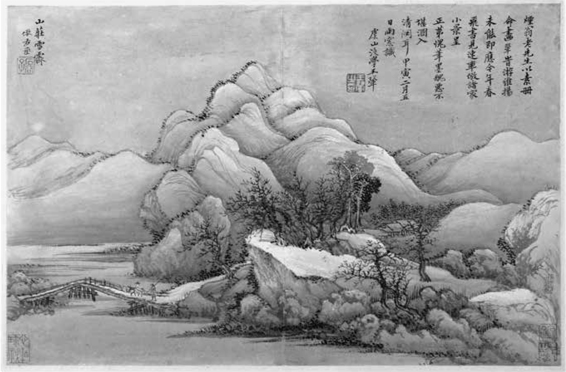
Wang Hui (ca. 1632–1717). This “mountain and river” painting is ink and watercolor on paper. It is a copy of an unnamed earlier painting from the classical period. Great Chinese painters often copied earlier masters, a practice called fanggu, which is largely how we know of the ancient paper painting traditions since the originals have not survived.
Appropriately enough, legend has it that Li Po’s end came one night when he was on a boat, drinking wine. He tried to reach for the moon, fell over, and drowned.
Another of the seventh-century greats, Tu Fu, also a Taoist, used his poetry and painting to address social and political issues. “We have everything good government could possibly want now but good government,” he wrote. Tu Fu at times could sound strikingly similar to a modern protest poet. He often denounced war, and in a poem titled “Song of the War-Carts” once wrote that because of war,
Even a son’s birth is tragic now
People prefer a daughter’s birth
These were words of incredible power in eighth-century China.
PAPER EVENTUALLY SPREAD from China to East Asia, along with the rest of Chinese culture. The written Chinese language was introduced to Vietnam in 186 CE, and Vietnam was among the first countries to make paper for Chinese writing. Sometimes this paper was used locally, and sometimes it was exported back to paper-hungry China. Vietnamese papermaking is thought to have begun in the third century, at a time when China ruled the northern part of Vietnam. In 284 CE, 30,000 rolls of something called mi hsiang zhi—a honey-scented paper, perhaps made from the bark of the garco tree—was brought to China from Vietnam. About 10,000 rolls of a very fine paper thought to have been made from either seaweed or fern were also sent to China in this period. These were considerable quantities of paper. The Vietnamese were apparently good at papermaking, however, because the Chinese continued to import both Vietnamese paper and Vietnamese paper products such as fans even after the tenth century, when Vietnam gained independence from China.
Paper also made its way to India from China, via Tibet in the seventh century. The Indians then proceeded to make paper from jute, old gunnysacks, and, at a fairly early date, recycled old paper. But the Indians were relatively late to papermaking and did not use paper extensively until the twelfth century. This is surprising, because they were the originators of Buddhism, which played an important role in the spread of paper elsewhere in Asia.
All of the Asian religions were drawn to paper, but Buddhism in particular made extensive use of it because Buddhists believe that blessings are earned by drawing or painting Buddhist images, writing down Buddhist prayers, or copying books of sermons of the Buddha, known as sutras. In China, many artists painted portraits of the Buddha or of other deities and patriarchs. In the fifth century, Chinese Buddhist monks would add pigments to pulp and made colored paper for writing—especially pink, but also sky-blue, peach blossom, gray, and yellow.
Also in the fifth century, Chinese books started to arrive on the Korean peninsula. Back in the year 109, when papermaking was still a new idea, the Chinese invaded Korea and began moving to the peninsula. By midcentury, the Koreans had regained political control, but they never reversed the now-entrenched and seemingly irresistible Chinese civilization. They started learning to write with Chinese characters and to make paper. Chinese characters were not well suited to the Korean language, a fact that the Koreans struggled with for centuries, but Chinese script was the only form of writing used in Korea until the sixth century.
Chinese Buddhist monks traveled to Korea to teach not only their religion, but also brush making, ink making, and painting, so that the Koreans could be good Buddhists and write prayers and paint deities. The Koreans wrote sutras both in their Chinese versions and by translating them directly from the original Sanskrit Indian texts.
Korean papermaking was in every respect like that of the Chinese. They made paper from rice, straw, hemp, bamboo, rattan, seaweed, and most of all, the inner bark of the paper mulberry tree. This bark was bleached in the sun, pounded, boiled, and mixed with the slime of a mucilaginous plant related to okra, which gave firmness to the sheet. The Korean paper mold, like the Chinese paper mold, was usually made of woven bamboo, but sometimes a particular Korean grass was also used.
THE JAPANESE ARCHIPELAGO, made up of mountainous islands with only small strips of arable land around the coast, was one of the poorest corners of Asia. While China had vast space in which to develop a civilization built on thriving agriculture, Japan struggled to produce enough food, and could not even produce enough salt to preserve what little food they had. This reality is still reflected in the lean, spare tastes of the modern Japanese.
By the third century BCE, when the Han dynasty began in China, Japan was still in the Stone Age. There is considerable debate, which has gone on for centuries now, over whether the Japanese had a written language before Chinese was introduced. If they did, no evidence of it has been discovered. Early in the Han dynasty, China, reaching out to all the known world and beyond, had made contact with Japan. Some Japanese people learned to read and write in Chinese, although these were only a small, elite group. There was no trade and very few relations between the two countries. But after China invaded Korea in 109 CE, some of the Chinese who had immigrated to Korea went over to the nearby archipelago and taught the Japanese rice cultivation—which became a mainstay of their diet—and helped them acquire more advanced tools, horses, and swords. In 286, Atogi, the son of the king of Korea, visited Japan and taught the Japanese people Chinese writing.
Then in 370, Japan, the once-backwards little country that now had swords, invaded Korea, and held on to Korean territory for almost the next two hundred years. This began to open up contacts among the people of China, Korea, and Japan. In 608, four Japanese students were sent to China and when they returned, they spread Chinese culture even more widely. Two years later, paper was made in Japan for the first time, perhaps under the direction of a Buddhist monk named Dancho, who was also said to be a gifted painter, skilled ink maker, and physician. Dancho presented the empress of Japan with several books of Buddhist sutras.
Japanese culture thus became increasingly Chinese, adopting Confucian concepts of government, Chinese writing, and Buddhism as their official religion. This Chinese influence dominated Japan throughout the entire Heian period (794 to 1185), which took its name from the capital city of Heian-Kyo, today known as Kyoto. Calligraphy took on tremendous social importance. People were judged by their calligraphy skills both in the professional world and in courtship. No one, it seemed, wanted someone with bad handwriting.
If the Chinese and Koreans had brought only papermaking to Japan, it might have had little long-term impact. But they brought an entire paper culture—written language, Buddhism, Confucianism, calligraphy, painting, and even bureaucracy. As in China, the government in Japan began to demand ever more paper. Every family was required to register births, marriages, and deaths with two copies—one for the government and one for the family. This paper was of such high quality that many records have survived into modern times without yellowing, foxing, or becoming brittle. Through these documents, many Japanese can trace their family as far back as 700.
By the eighth century, paper mills were operating in nine Japanese provinces, and by the Heian period, papermaking had spread to forty provinces. By the ninth century, the Emperor’s Library, which kept all of the emperors’ books and paintings, established paper mills with four expert papermakers whose job it was to maintain or elevate the standards of Japanese paper. Once a year, these mills gave 20,000 sheets of their finest paper to the kuraryo, the curator of the emperor’s storehouse. In addition, papermakers in the province of Mino sent in 4,600 sheets of colored paper.
Japanese paper has lasted because it has no acid content and so it does not yellow. A 1,200-year-old sheet looks much the same today as it did when freshly made. It was also fashioned using the same technique and from almost the same materials as is Japanese handmade paper today. The main materials were, and are, bark from mulberry trees—mitsumata and kajo (today replaced by kozo)—and another bush, gampi. Gampi, which grows wild in Japan, was probably one of the rare Japanese originals in the art of papermaking, and the Japanese began to use it around the ninth century.
The shoots were beaten with a mallet so that the bark could be stripped off. The sticks were sometimes used as firewood for the heaters and the ash made good fertilizer. The root of tororo aie, the same relative of okra with beautiful white edible blossoms that the Chinese used, was cooked to a slime that was added to give body to the pulp. Hemp was also used, and in 1031 we can see the first record of recycled paper—paper made from old, used paper. Since the Japanese had no way of stripping off the ink, as is done with modern recycled paper, the resulting product was gray. But it was widely used, even in the Imperial Palace.
As in China, the Japanese used paper for many things other than writing. At Shinto shrines, the one religion that originated in Japan, fortunes were, and still are, written on handmade paper and sold to be hung from trees. Gohei is paper cut and folded in a specific pattern, a series of angled rectangles, and hung from rice straw rope to mark a sacred area. Among these sacred areas are fermentation rooms for sake; before the Japanese learned about chemistry, they believed that there were spirits who created fermentation.
Paper was also used to build the traditional Japanese home. This was another idea imported from China, but the Japanese used it for much longer. Instead of glass windows, there were translucent paper panels called shoji, and instead of interior walls separating rooms, there were sliding opaque decorative panels called karakami. In the traditional Japanese home, art cannot be hung on paper walls. Homeowners pride themselves on owning a good collection of paintings that can be hung only one at a time and in one designated spot. The painting changes with the season, or sometimes with the month, and some families have a special painting that they put out to honor certain guests.
There is an interesting unresolved argument about technology and development in regards to the Japanese home. The Japanese were extremely late to make glass, and according to some experts, this is the reason why shoji were used. But others argue that the Japanese did not make glass because they didn’t need it, because they were happy with shoji. It is much the same argument as that about the Incas and their slow development of writing, due perhaps to their skill with knotted ropes.
Shoji are very pleasant. They give a room soft and diffused warm light. In the winter, a shoji panel absorbs humidity and holds in heat. In the summer, panels can be slid open to let in a breeze. The only difficulty with shoji is that they are expensive and difficult to maintain, and need to be regularly replaced. Another difficultly, in the minds of parents at least, is that holes can easily be poked in its panels, leading to the popular boys’ prank of making tiny pinholes and spying in on the neighbors.
The Japanese made paper work for them. Paper umbrellas lasted at least as long as cloth ones do today, grain was stored in durable paper bags, and paper tarpaulins protected goods in open carts from the rain.
FOR ABOUT SIX centuries, paper was an exclusively Asian product. China had outlasted the Roman Empire and was the most advanced civilization in the world. They had developed a society that needed paper and had exported it to neighboring Asian societies. But another advanced civilization was about to come along, and they, too, would need paper.