
Chapter 6

The invention of printing is the greatest event in history. It is the mother of all revolution, a renewal of human means of expression from its very roots. Printed thoughts are everlasting, provided with wings, intangible and indestructible. They soar like a crowd of birds, spread in all four directions and are everywhere at the same time.
—VICTOR HUGO, The Hunchback of Notre-Dame
PRINTING WAS BORN OUT OF THE NEEDS OF THE BUDDHIST religion. A devout Jew reads his religious books over and over again. When antique Jewish books are found, they are usually nearly worn out. Christian books have been preserved in excellent condition because only a few people read them. A devout Muslim memorizes the entire Qur’an. But the devout Buddhist earns a blessing by copying down a prayer or, even better, making a copy of an entire sutra. So reproducing texts was central to the religion, and paper was therefore much promoted by Buddhism.
Before there was paper, there was an early form of printing: seals carved into stone or bronze, impressed into clay, then inked and printed on silk. The Chinese have always loved seals, and still do, stamping receipts, books, artwork, and any other paper they can with an official seal, usually a few characters in red ink.
In the late seventh century, perhaps earlier, the Chinese began printing wood blocks—an image carved in wood, inked, and pressed on paper. Parchment, papyrus, tapa—these other writing materials did not work well for printing. Like stamps and seals, this was reverse printing; the carved-away areas remained white and the uncut areas came out black. A skilled carver could create a black line drawing using this technique, or a lengthy text of black characters on white paper. The oldest known woodblock print is thought to have been produced, judging by the style of the calligraphy, around the year 710. It is a scroll printed on mulberry bark paper, made thick for rolling, about two and a quarter inches wide and twenty feet long. The scroll is the text of a Buddhist prayer book originally written in Sanskrit and translated into Chinese.
Though printing was a Chinese concept, the first press run we know of was executed by a Japanese royal, Empress Shōtoku, in 770 in the capital city of Nara, a city that was dominated by Buddhism. The empress ruled from 749 to 769. In 735, a smallpox epidemic had devastated Japan and the empress enlisted 116 Buddhist priests to work on the problem of driving out the disease. The solution they decided upon was to house 1 million copies of a prayer, known as a darani, in 1 million little three-story four-and-a-half-inch-high wooden pagodas. The prayer was in Sanskrit but was written with Chinese characters. The empress probably could have hired an unlimited number of scribes to write the prayer 1 million times, but she had a teacher, Kibi-no-mabi, who had studied in China for nineteen years, which is where the Japanese of that time went to learn. Kibi-no-mabi, who had seen Chinese block printing, came up with the idea of carving the prayer into blocks and printing it 1 million times on strips of paper. Most historians believe that the blocks were wood, but they could have been metal or even porcelain or stone. Some Japanese historians of the eighteenth and nineteenth century believed copper was used for the printing. If it was wood, the blocks would have worn out and would have had to be re-carved perhaps one hundred times to make 1 million prints.
The printing of the prayers and building of the miniature pagodas took six years and was not completed until 770. The pagodas with the printed prayers inside were then lined up in special halls in ten temples. Historians regard this as the beginning of printing, although both Taoists and Buddhists in sixth-century China printed similar charms to drive away disease. The Taoist artist would hold his breath while making prints of suns or moons or stars.
Once printing was invented, the Buddhists did enormous print runs, though none were as large as the empress’s. In the tenth century, a Buddhist monk made 140,000 copies of a picture of a pagoda in China. There are records of Buddhist printings of 20,000, 50,000, or 70,000 copies. The more copies, the greater the blessing.
THE OLDEST PRINTED book in the world that has yet been found is called the Diamond Sutra, a Chinese Buddhist prayer book printed in 868. The quality and sophistication of the printing and woodcut illustrations suggest that it was not the first such book printed but simply the oldest we have found. It was discovered along with numerous other archaeological treasures in 1907 by the famous Hungarian-born British archaeologist Marc Aurel Stein. Until the discovery, Westerners had no idea that printing in Asia had begun more than half a millennium earlier than in the West. Many thought the Asians had picked it up from the Europeans.
Sir Marc, as he was known, the prototype of the intrepid archaeologist, led four expeditions to Central Asia and lived in a tent in the Himalayas. Whether on a dig or in his mountain home, his constant companion was a dog named Dash. In his eighty-year life, he had seven Dashes.
Stein explored an area in eastern Turkestan that had been the starting point for the Silk Road under the Han. China is far too humid a climate in which to preserve paper, and thus very little ancient paper has been found there, just as few papyrus documents have been found in Europe. But eastern Turkestan has a dry climate, and that helped to preserve treasure troves of Chinese paper artifacts. Most of the pre–Cai Lun paper has been found in this region, some of it by Stein.
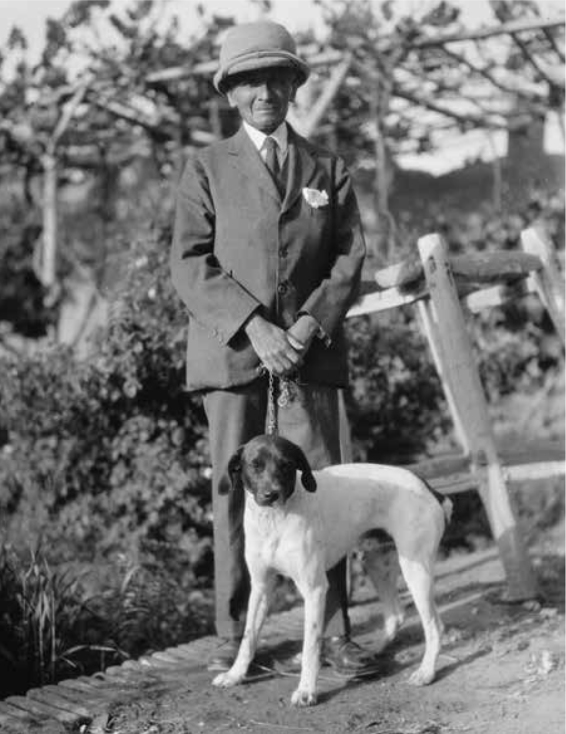
Sir Marc Aurel Stein and his dog, Dash. May 1932.
The frontier town of Dunhuang in present-day Gansu Province was the military and commercial outpost for the westward expansion of the Han. In the fourth century, Buddhists carved a complex of temples into the side of a mountain overlooking the town, and in subsequent centuries, the Buddhists deposited statues, manuscripts, and wall murals in these temples. For unknown reasons, about a thousand of the temples were sealed, perhaps because of a fear of invading armies.
The temples disappeared, but the legend of Qian Fo Dong, a series of hidden deposits also known as the Caves of the Thousand Buddhas, was passed on through time. In 1900, on Stein’s first expedition, he met a Taoist monk, Wang Yuanlu, who claimed to have found Qian Fo Dong. What the monk had discovered was a mural that was painted on stone. By chipping away at the bricks in a section of the mural where something had clearly been covered over, he found a hidden chamber about nine feet square piled ten feet high with rolled manuscripts. There were 1,130 bundles in all, perfectly preserved in cloth wrapping, each containing about a dozen rolls—a total of about 50,000 documents. Stein bought some of the documents and works of art from Wang and shipped them back to the British Museum. He returned in 1907 to further explore and pay, or bribe (depending on your viewpoint), the Taoists for more treasures, including manuscripts written in Sanskrit, Chinese, and Hebrew. It was then that he found the Diamond Sutra, which is still in London today. He also shipped twenty-four cases of manuscripts and four cases of artwork back to London. The British government knighted him, but the Chinese government called him a thief.
The Diamond Sutra is a perfectly preserved six pages of printed text with one elaborate woodcut showing more skill in woodcutting and in printing than Europe would demonstrate for another six centuries. Not only the illustration but also the pages of text were carved with a single block per page, a technique that came to be known in fifteenth-century Europe as a “block book.” At the end of the text, also printed by woodblock, are the words “Printed on May 11, 868, by Wang Jie, for free general distribution, in order in deep reverence to perpetuate the memory of his parents.” We know nothing of his parents or of Wang Jie himself, the first known book printer in history. And he might not even have been first. He might just have been the first to have a work wrapped in cloth and carefully placed in a sealed cave in the desert.
The Diamond Sutra is a popular example of Buddhist writing in which the Buddha lectures Subhuti, his aging disciple, on the nonexistence of everything. Repeatedly, the Buddha enjoins his student to make copies of this book and pass them around. Buddha says, “Whatever place constitutes a repository for this sacred scripture, there also the Lord Buddha may be found.” Copying the Diamond Sutra therefore became a way of “gaining merit.” In it, Buddha also says, “If a good disciple whether man or woman, in the morning, at noonday and at eventide, sacrificed, sacrificed lives innumerable as the sands in the Ganges, and thus without intermission throughout infinite ages; and if another disciple, hearing this scripture proclaimed, steadfastly believed it, his felicity would be appreciably greater than the other.”
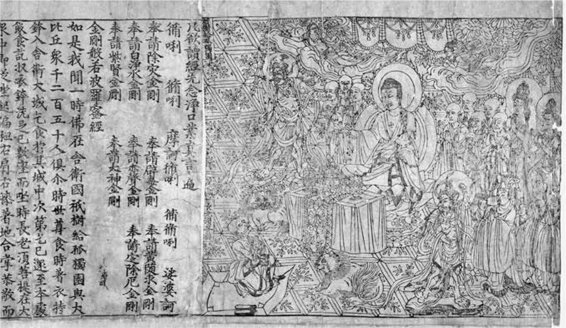
Diamond Sutra frontispiece, 868 CE. The earliest printed book ever found. In a garden Buddha responds to questions from an aged disciple, Subhuti. Buddha is attended by monks with shaved heads and other figures, including an emperor and empress at the lower right corner.
So, as these excerpts make clear, a Buddhist would be interested in the process of duplication and naturally drawn to printing. If there was merit in copying one edition of a sutra, how much more merit would there be in printing a hundred or a thousand copies, perhaps in less time? In fact, the Diamond Sutra became a standard text for printing by those seeking “merit,” or punya.
Though there is almost no evidence of book printing earlier than the Diamond Sutra, but because there is so much shortly afterward that it would not be surprising if printing had begun before 868. And not all of the writing found from around the same time is Buddhist. In about 880, a man named Liu Pin wrote of finding a schoolbook in Szechuan printed from wooden blocks. In the caves of Dunhuang, several printed calendars and almanacs were found, one dating to 877. And in 932, Feng Dao, the official imperial scholar, ordered the Confucian classics to be printed.
In fact, the Koreans may have been the first to print a book. A scroll of a block-printed sutra dated to about the year 700 was discovered in 1966. It consists of twelve sheets of mulberry paper bound together, and is therefore older and longer than the Diamond Sutra.
Bi Sheng, an eleventh-century commoner, may have been the inventor of moveable type, which would make him one of the greatest inventors of all time. Yet we know nothing about him. Because of his low social status, there are no records of his life. The type Bi Sheng used was made of clay baked into porcelain. The type was laid into an iron plate with a paste of pine resin, wax, and ashes of burned paper. When the type was completely set, he heated the iron plate to melt the paste and then pressed the type with a board so that the individual types would all be of even height.
As early as the twelfth or thirteenth century, both China and Korea may have been printing with moveable type made from metal, which was an important improvement over wood and clay. The purpose of printing is defeated if the type wears out after a limited number of uses, as it would inevitably do with those earlier materials. But wooden type was still being used in the fourteenth century. Wang Zhen, a magistrate and an agronomist who wrote voluminously, ordered the cutting of 60,000 characters in wood and used them to print his work as well as a local gazette. But with those characters, he could print only about a hundred copies.
Wang Zhen arranged his type on special revolving tables that he invented, assigning each character a number. To help remember where each character was, he arranged them in accordance with traditional rhymes. Then he placed them tightly in bamboo racks and kept the type flush against each other. But for all of his inventiveness, his work illustrates the essential problem of printing Chinese with moveable type: There are too many characters. He used 60,000, but literary Chinese can use up to 200,000. And common characters need to have duplicates made because a single page might require the same character to be used numerous times.
In 1403 King Taejong of Korea ordered that type be made from bronze. Sand was packed into a metal mold in an impression pressed from a carved wooden cube. Then a type was cast by pouring in molten bronze or sometimes lead. The Chinese greatly valued the quality of both Korean paper and ink. Korean ink, made from lampblack and glue from deer antlers, was extremely black. An oil was added to make the ink better suited for metal type, which produced a far better ink than the one the Europeans would use when they developed metal type.
Once the Koreans began printing with moveable type, they quickly moved away from the Chinese writing system and invented an extremely efficient twenty-eight-character system. It was launched in 1444 in a decree called The Standard Sounds for the Instruction of the People. Like all new ideas, it was disliked by some and became sneeringly known as onmun, or “sound writing,” a pejorative that persisted until the early twentieth century when the name Hangul was devised. Koreans still write in Hangul; the system now contains only twenty-four characters.
The Chinese made bronze type, but for centuries showed a preference for Wang Zhen’s wooden type and even block books. Both types of printing became commonplace in China, which greatly increased the demand for paper. More and more paper mills went into operation. But papermaking always remained difficult, low-status work for the poor and was often assigned to prisoners—a practice also adopted in India, where it persisted until the late nineteenth century, when papermakers protested about having to compete with unpaid prison labor.
The Chinese did not use printing to churn out huge editions, which may explain why the easily worn wooden type worked for them. A large printing of a Chinese book was 100 copies. By the Middle Ages, the Islamic world was producing more books than the Chinese, even though the Arabs were not printing at all; they just had extremely efficient scribes. Their graceful, swirled cursive style of writing did not adapt well to type. Both the Chinese and the Arabs, it has been postulated, loved their calligraphy too much to wholeheartedly embrace printing.
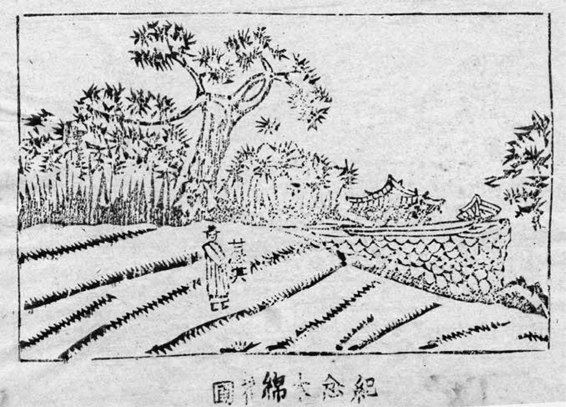
Woodcut illustration from a Korean book from the beginning of the twentieth century that is not greatly different from a Korean book five hundred years earlier. It is a biography of Moon Ik-jeom, prepared by his descendants in the early 1900s. Born in 1329, Moon Ik-jeom lived in a time when Korea was struggling to gain more independence from China. He is celebrated for stealing the Chinese secret of cotton by smuggling seeds in the hollow stem of a calligraphy brush.
Some historians believe that it was because Europe did embrace printing, whereas Asia and the Islamic world did not, that Europe advanced and Asia and the Islamic world receded. But this is the technological fallacy at work again. Exactly the reverse occurred. Europe needed printing because it was bursting with creativity. New ideas in the arts and sciences, as well as in social justice and religion, desperately needed to be expressed and disseminated. The Chinese and Muslim eras of innovation were mostly behind them. They were societies in decline and didn’t really need printing, which is why the Chinese, who had learned how to print, even with their impossible writing system, did not use it very much.
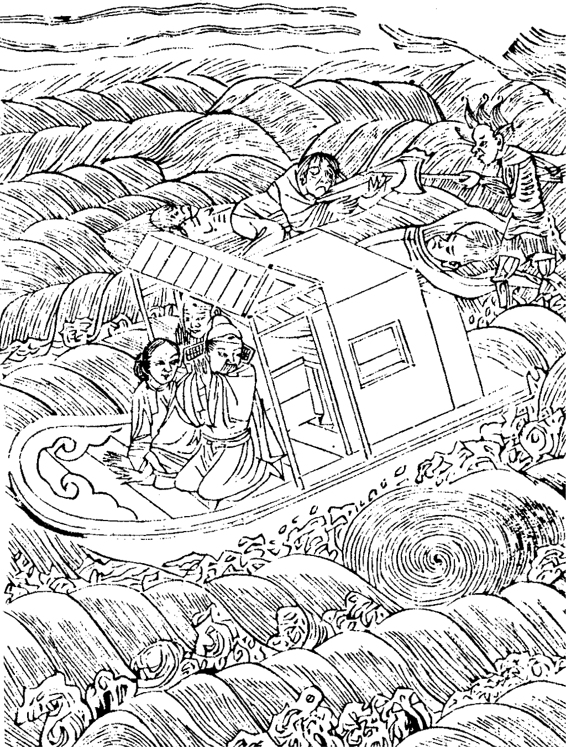
Wood block from a seventeenth-century printed Chinese book. In the eight centuries since the Diamond Sutra, the style of woodcuts in printed books changed very little.
This is an example of another basic rule of technology. There is a tendency to imagine that technology is a Pandora’s box, that once a new way is invented, it unavoidably falls into use and is unstoppable. But when a technology is invented that doesn’t correspond to the needs of a society, it falls into obsolescence.
___________
EUROPE HAD ARRIVED at a point by the fifteenth century where it needed a faster way of reproducing books and documents. A number of people were trying to solve this problem, without knowing that the Asians had already solved it.
Several ancient European societies had almost invented printing. The Athenians engraved maps onto smooth metal plates, and the lines they cut could have held ink. All they needed to do was ink the plate and press it onto parchment or papyrus, and they would have printed a map. And they could have printed numerous copies of that map. But instead they just used the plate as the map. If they needed a second map, they carved a second plate. And since they weren’t printing, they did not need to engrave in reverse.
The Assyrians made stamps to press images onto pottery, and Roman potters copied this technique, stamping their signature on the pots they made. According to Theodore Low De Vinne, a nineteenth-century American printer who studied the history of his craft, some Roman potters made individual stamps for each letter of their name and used them to stamp their name on clay lamps. This, in a sense, was a very early use of moveable type.
The first-century BCE Roman philosopher Cicero presents a curious argument. Velleius, an atheist, insists that the world was made by chance. Balbus refutes this by saying, “From such a man I cannot understand why he should not also believe that if he threw together, pell-mell, a great number of the twenty-one letters, either of gold or some other material, the Annals of Ennius, could be legibly put together from the forms scattered on the ground.” So even Cicero imagined moveable type, but only in his polemic as an absurd idea. He used the phrase formae literarum, and when moveable type was finally made some sixteen centuries later, that is the name they gave it—though it was not such an absurd idea after all.
De Vinne believed that printing went no further in the Roman world because it lacked ink suitable for the task and it also lacked paper. Printing on papyrus would have been difficult. But the Romans might have resolved those difficulties if they had needed printing. They didn’t. Their scribes were producing all the books they wanted, and most people heard rather than read them, in public readings, at dinners, and at the baths.
There is a possibility that the world’s first printing with moveable type occurred in Europe, on the island of Crete by the Minoans, who had a highly developed civilization with a written language four thousand years ago. In 1908, a disk with a diameter of slightly more than six inches was found and dated to the seventeenth century BCE. Printed on both sides there are 241 impressions of forty-five different symbols on the disk in a spiral that either reads out from the center or in from the edge. Because the symbols are stamped with varying degrees of pressure, it is thought that individual types were used for each symbol—in other words, moveable type. The symbols are marked off in groupings, and it is believed that this is a text. The groupings are words. But they are written in an as-yet undeciphered language.
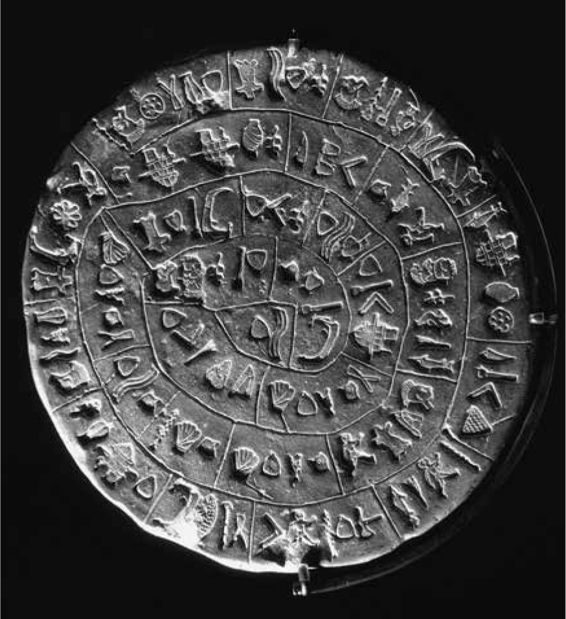
“Side A” of the Phaistos Disc. Fired clay. Archaeological Museum of Heraklion, Greece.
If the Phaistos Disc, as it is called, named after the place where it was found, actually says something, and contemporary research increasingly suggests that it does, then moveable type was used in ancient Crete. But since nothing else similar to it has been found, it would have to be assumed that the civilization on Crete did not have much use for the ingenious idea and it was ignored. It is as though someone in Charlemagne’s court had invented a computer. Since almost no one read or wrote, and the few who did had no sense of urgency in communication, the invention would not have jump-started civilization to the twentieth century. It would have sat in a corner of the castle gathering dust, waiting a very long time for society to catch up with technology. This may have been the fate of the Phaistos Disc.
JUST AS PLATO needed written language to work out his ideas, fifteenth-century Europe, bursting with its own ideas, required a method of disseminating them that was faster and more immediate than the slow process of dictating to scribes. Printing proved to be that method; it freed up scientists, artists, thinkers—blossoming European geniuses—from the tyranny of their dependence on scribes.
Starting in the thirteenth century with the growth of the universities, there was steadily increasing pressure for more manuscripts and more copies of each manuscript. By the fifteenth century, with the thirst for ideas that is called Humanism, the shortage of written material had become an acute problem. This was particularly true in Italy and Germany, where there was a spectacular growth in universities, greatly influenced by Italian humanism. Cicero and the Roman classics were studied, as well as Roman law, and there was demand for copies of these early works. Germany at the time was also engaged in programs to spread literacy.
Private commercial interests trying to profit from a growing market for the written word further increased the need for more books and faster production. Private bookselling had become an important international trade, and the limited number of available books was limiting the booksellers. In the early 1400s, woodblock books began to be made, apparently a solution that the Europeans thought up themselves and did not learn from Asia. Logically, block books should have been the forerunner of printed books, but block books did not become popular until after moveable-type books were printed.
JOHANNES GENSFLEISCH GUTENBERG, most historians acknowledge, changed the world. And yet we know little more about him than we do about Bi Sheng. We don’t know what he looked like, as there are no portraits from his lifetime. The images we commonly see of him weren’t made until after his death. We are not even sure when he was born, though it must have been between 1394 and 1399 in Mainz, Germany. Mainz had a population of 6,000, which was smaller than nearby Frankfurt and much smaller than farther-away Nuremberg, which had 20,000. But it was a comfortable, middle-class, commercial town growing affluent from charging duties on the ships passing on the nearby Rhine. Gutenberg’s father was an affluent middle-class man of commerce. Nothing written by Gutenberg has survived either. But fortunately, he and his associates seem to have been of a somewhat litigious temperament, because most of what we know about him is from numerous lawsuits.
We know that Gutenberg was a goldsmith, which is significant. Many early printers were goldsmiths, because it took skill with metal to make moveable type; there were numerous high-quality goldsmiths in Mainz. It is not certain if it was because there were too many goldsmiths in Mainz or because of political upheavals but in 1428 or 1429 Johannes and his brother Friele moved to Strasbourg. There Gutenberg began experimenting with moveable-type printing around 1440. We do not know if he realized he had competitors. Similar experiments were taking place at the same time in Bruges, Avignon, and Bologna. He may have suspected this, as he was very secretive about his printing experiments. His fellow goldsmiths knew only that Gutenberg had some “secret project.” One, Hans Dünne, once blurted out that he thought his colleague was doing something that “had to do with printing.” This was a reasonable guess, as Gutenberg had acquired a press from the owner of a nearby paper mill who had died.
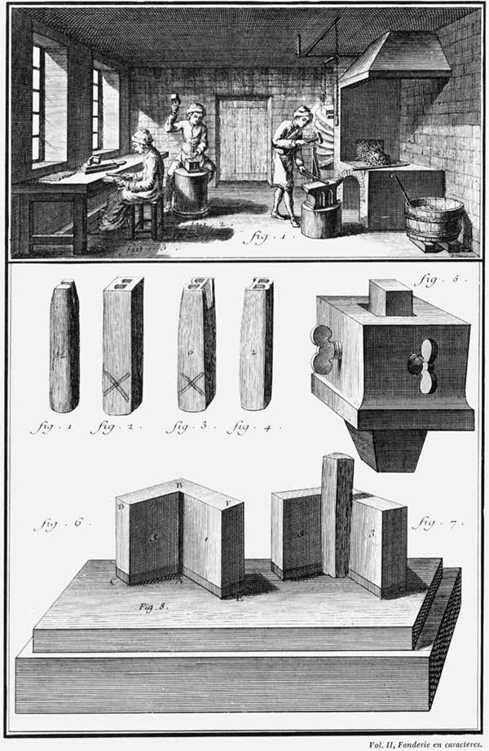
Making punches for fashioning a typeface plate. Diderot, Trade and Industry, Volume II.
Gutenberg carved each individual letter into small blocks of hard metal in the same way that a goldsmith did when making an ornament. The letter was carved in reverse. Carving letters backwards into hard metal in the style of a scribe required impressive skill. This hard metal letter, called a punch, was then struck into softer copper. This was called the matrix, and Gutenberg poured molten lead into the matrix to cast a typeface. He had used the process many times before when making jewelry. He then put the letters into a rack, keeping them exactly level, tied them together with string, inked them with his own formula of gallnut shaving—bulbs formed on oak trees from wasp larva—soot, and water, and pressed them onto wet paper, whose watermark indicated that it had been made in Fabriano. The hard surface of European paper’s animal-hide sizing made it perfect for printing.
Since Gutenberg had acquired his press from a paper mill, it had probably been used to press stacks of felt and wet paper sheets. Some historians say that the press was a copy of an olive-oil press, but more likely it imitated a wine press, as Gutenberg came from Mainz, the heart of the Rheingau wine country. Here, the normally south-north-flowing Rhine flows east-west, and the reflected sun heats up the slopes on its northern bank to yield some of the best wine in Germany.
Gutenberg introduced various innovations. He developed an ink for metal printing, which had not previously existed in Europe. The mold he used for casting, the matrix, was probably his own innovation, and it allowed him to make as many identical pieces of type for each character as he needed. Since every page requires a great number of letters, making multiple types allowed for printing numerous pages without ripping up the previous ones.
If the Asians had had the right religion for spreading the use of paper, the Europeans had the right alphabet—only twenty-six fairly simple characters. A complete set of type with uppercase and lowercase letters, numbers, and various signs came to about 100 pieces of type—considerably less than Wang Zhen’s set of 60,000. Gutenberg used 290 pieces of type for his first book, including extra pieces for commonly used letters. The book was printed in late-medieval Latin. The typeface was carved to resemble calligraphy, and the initial letters of the individual chapters were hand-painted in red.
Many Europeans did not believe that a mechanically printed manuscript would compare with the visual standards of handwritten manuscripts. Perhaps they don’t, but Gutenberg’s first book, a Bible printed between 1452 and 1456, was stunningly beautiful and technically perfect, laid out in twelve hundred two-column pages, each column forty-two lines in length, in two volumes. It is commonly known as the 42-line Bible. In fact, it is so perfect that historians are convinced that Gutenberg must have experimented on a considerable number of pages before producing the Bible, though no such pages have ever been found. There is a decade-long gap between the time he moved to Strasbourg and the printing of his first book in which he may have been working on his idea.
Usually the person credited with an invention, the one who makes it work and makes it profitable, is a savvy businessman. This was probably true of Cai Lun, but it was not true of Gutenberg. He never became wealthy. A businessman, Johann Fust, had financed Gutenberg’s years of experimentation, and Gutenberg was not able to keep up with the interest payments on Fust’s loan. Fust took him to court and gained control of Gutenberg’s equipment and his ideas.
In 1588, 120 years after Gutenberg—who may have gone blind—died a near pauper, Hadrianus Junius, a Dutch poet, physician, historian, and jack-of-many-trades, published a book on another inventor of printing, Laurens Janszoon Coster of Haarlem. Coster enjoyed teaching, reading, and writing to his grandchildren. To this end, he cut letters into wood blocks and printed them. Then he started printing whole pages with the wooden type. Next he decided that type made out of lead and tin would be better. And that is how Coster came to be known as the inventor of moveable type.
According to Junius, on Christmas night 1440, a student from Mainz stole all of Coster’s type. Junius’s source for this claim was the older people of Haarlem—apparently it was well known in the town that moveable type had been invented there. Junius’s leading source was a bookseller named Cornelius, who said that he had slept in the same bed as the thief from Mainz. Unfortunately, however, Cornelius appears to have been born one or two years after the incident occurred. In any event, Coster was a well-respected citizen of Haarlem during his lifetime. And Haarlem was known for a certain type of block book. Coster may have been engaged in that craft.
Another early printer was Johannes Brito of Bruges, but the evidence seems to show that Gutenberg was first in his invention. Also, in the Italian town of Feltre, which Dante may or may not have mentioned in Paradiso, a statue was erected in 1868 to Panfilo Castaldi, physician, poet, and . . . the inventor of moveable type. He may have invented the type independently, but there is no evidence of him printing with it until 1470.
Then there was a goldsmith in Avignon, Prokop Waldvogel from Prague, who certainly had the skill to make moveable type. He was said to have been engaged in “artificial writing.” But he was secretive, and was well paid by a watchmaker in Trier on the condition that he told no one what he was working on. Waldvogel also made Hebrew letters for an Avignon Jew named David of Caderousse, who also pledged secrecy.
Historians and, especially, the local people of Haarlem, Bruges, Avignon, and Feltre enjoy entertaining the possibilities of who was really the inventor of moveable type. But the truth is that none of them, Gutenberg included, was the original inventor. Gutenberg, like Thomas Edison and probably Cai Lun, took an idea and executed it so well, proving it to be workable, that he caused the world to adopt it. He is thought to have printed two hundred Bibles, though only forty have been found. Once Gutenberg started printing, most Europeans saw it as the way of the future. After Gutenberg, there were no significant changes in printing until the nineteenth century.
MOVEABLE TYPE DID not eliminate handwritten books. Many people who could afford them still preferred them. And following Gutenberg’s lead, most printed books imitated the look of the old manuscripts. A style of lettering resembling the work of scribes was used, and a blank space was left at the opening of every section for a woodcut of an ornate first letter. Sometimes that letter was painted by hand. Gutenberg had preferred using carved wood blocks for these, and on occasion he would print the letter in two colors by using two blocks. Eventually, printers maintained a collection of blocks of letters, sometimes loaning them out to other printers. Often the blocks included figures hanging playfully or resting on the letters. One book of sermons has a chapter opening with the letter Q; on it are figures of lovers in an embrace under attack by a pious multitude.
Hans Holbein the Younger, the most well known painter and portrait artist from a distinguished family of painters in Augsburg, Germany, also created famous sets of wood blocks for the initial capitals of three books—Alphabet of Children, Peasant Alphabet, and The Dance of Death. The workmanship was so fine that it was very difficult to print.
Of course, not everyone loved printing. As with every other new technology, there were those who were disdainful—some who thought it was barbarism, some who thought it was the end of civilization, and some who thought it was a threat to their jobs. The scribes and copyists felt threatened, though in reality their jobs continued. Many of the aristocrats who employed scribes and maintained libraries of handwritten books were contemptuous of what they saw as sleazy imitations, which in a sense the printed books were. Federico of Urbino, a wealthy fifteenth-century arts patron whose entire library, said to be second in size to the Vatican’s, was entirely handwritten on parchment, usually by his own scribes, and bound in red velvet with silver clasps—as were all the books in the Vatican Library—said that he would never stoop to having a printed book in his collection and that he “would have been ashamed to own a printed book.”
Books had been rare, and their power had been well appreciated. So these newfangled printers with their strange ability to produce books for sale by the hundreds were regarded in some quarters with great suspicion. Was there a dangerous political agenda? Were they in league with the devil? When Johann Fust, Gutenberg’s ex-partner, went to Paris with cases full of books to sell, he had to flee, accused of being sent by the devil.
The powerful block printers’ guild, which included card makers, block book makers, painters, artists, scribes, illuminators, and wood engravers, would not let typographers—the printers who used moveable type—join their guild. A certain human touch was missing in the way the letters and the words all had exactly the same spacing, they said. It was rigid and uncreative. Even twentieth-century anthropologist Marshall McLuhan, dividing history into pre-Gutenberg and post-Gutenberg, believed that the latter was more “constricted” in its thinking.
Moveable-type printing ended the competition between parchment and paper. Gutenberg printed thirty-five of his two hundred Bibles on parchment, which served to show that paper worked better for printing. Parchment was for handwritten documents and manuscripts, and printing was to be done exclusively on paper, which considerably increased the demand for it. The idea remained fixed that anything meant to be permanent, which is to say anything of great importance, should be written on parchment. But paper was no longer regarded as a low-quality material to be used only for inconsequential jottings. Printing gave paper standing; it too was enduring and important, a sentiment that has itself endured. In 1831 sentiments had changed, and Victor Hugo wrote that printing bestowed a greater permanence and durability to the written word: “The book of stone, so solid and enduring, was to give way to the book of paper, more solid and enduring still.”
By the end of the fifteenth century, Europe, with its paper and printing presses, had for the first time in history become the most advanced civilization in the world. In science, music, art, mathematics, architecture, literature, geography, philosophy—in fact, in most any field imaginable—Europe was producing the leading thinkers and printing their ideas on paper.