
Chapter 7

The science of design, or of line drawing, if you like to use this term, is the source and very essence of painting, sculpture, architecture.
—ATTRIBUTED TO MICHELANGELO IN
“Dialogues sur la Peinture dans la Ville de Rome”
BY FRANCIS OF HOLLAND,
ARCHITECT AND ILLUMINATOR, 1538
PAPER CREATED A MONUMENTAL SHIFT IN EUROPEAN art. Printing changed it even more.
Drawing is a primal urge. Almost everyone throughout history has had the urge to draw. But drawing only became a standard art form when paper became available. In the case of Europe, this occurred during the Renaissance, when paper was still a new idea on the Continent. Previously, there had been very little informal use of parchment for art because it was too expensive and too difficult to erase. At first, European paper was also too expensive to be used to dash off a quick sketch and had too low a standing to be used for serious art. But by the late fifteenth century, this had all changed. Paper opened up the possibility of the sketch. Renaissance artists sketched out their work before they drew, painted, or sculpted it—or, in the case of Albrecht Dürer’s woodcuts, carved it. This new ability to not only plan but toy with ideas raised their art to a level not known in the Middle Ages.
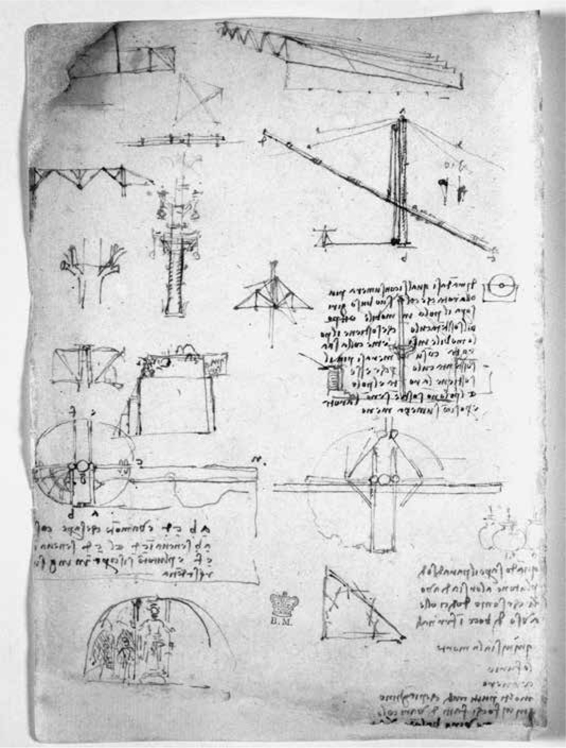
By the sixteenth century paper had become essential for mathematical, engineering, and scientific calculations. This is Leonardo da Vinci’s sketch on the mechanical powers and forces—percussion, gravity, motion, optics, and astronomy—with various arithmetical and geometrical propositions, courtesy of the British Library.
Artists drew and sketched with varying degrees of skill. Leonardo da Vinci was legendary for his skills as a draftsman. Michelangelo, known for his frescoes and sculptures, was equally brilliant as a draftsman—many art historians consider him to have been the greatest draftsman who ever lived—though most of his drawing was scribbled chaotically on sheets of paper not intended for public view. Both artists used Fabriano paper at least some of the time.
Sixteenth-century artist and historian Giorgio Vasari, whose Lives of the Most Eminent Painters, Sculptors, and Architects is the leading source of biographical information on the Italian Renaissance artists, tells the story of a sketch by Michelangelo that was displayed in the Palazzo Medici for art students to copy. Since the sheet, like most of Michelangelo’s sheets, had a variety of sketches on it, students started tearing off pieces of it, and they became “scattered over many places.” According to Vasari, those fortunate students who ended up with a remnant treasured it and regarded it as something “more divine than human.”
Michelangelo used a great deal of paper, in part because he considered himself as much a poet as an artist. Between five hundred and six hundred sheets of Michelangelo’s drawings have survived, and written on many are poems, personal letters, notes, and details about finances. Almost any piece of paper he used contained a few sketches. A few are finished drawings. A stunning drawing of the resurrection of Christ is also marked with a shopping list. Masterful drawings were folded up, with notes about the banal ephemera of everyday life jotted on the reverse side. Rarely is there a single drawing on a sheet. He also wrote some three hundred poems, invented dialogues, theoretical essays, proposals, and outlines for essays on art theory, including a response to Dürer’s Four Books on Human Proportion. But most of this paper was not intended for anyone else to see, and before his death he attempted to destroy as much of it as he could.
Michelangelo may have been among the first to jot down quick ideas for himself. Some 2,000 letters from and to Michelangelo have also been collected. Letter writing is another practice that blossomed with the widespread use of paper.
Leonardo da Vinci was notorious in his lifetime for his inability to complete projects. He would accept a commission for some grand undertaking and would never get beyond the start. As a government official in Florence said in 1506 about a mural the artist had only begun, “He made a very small beginning of a very large thing.” Leonardo’s problem was well summed up by Pope Leo X, who once saw him engrossed in trying to create the perfect formula for varnish instead of painting: “This man will never do anything, for he begins by thinking about the end before the beginning of his work.”
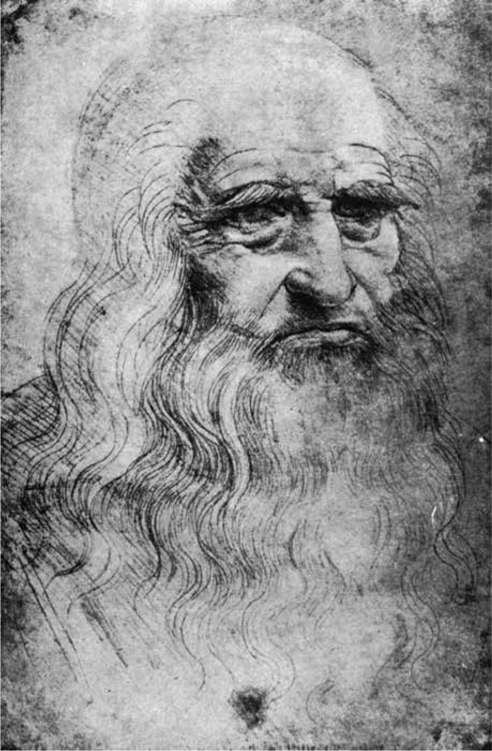
Leonardo da Vinci. This drawing, originally in red chalk on brown paper, is generally recognized as being by Leonardo and is thought to be a self-portrait, although this is not certain.
Fortunately, there was paper, on which Leonardo could capture his genius. Though he is usually thought of as a painter, only fifteen paintings, some unfinished, have been found, along with two damaged murals. He also attempted some sculpture, though he never finished one piece. But he left behind thirty bound notebooks. Unlike Michelangelo, he did want people to see this work on paper, including the notes he made in his mirror-image script—a curious response to being left-handed. He left drawings depicting all kind of inventions, and notes on literature, arts, mythology, anatomy, engineering, and, most of all nature. He also left instructions on how his drawings should be printed; printing was still a fairly new development in Italy and France at the time of his death in 1519. But somehow none of this work was published or shown to the public until 1880.
Leonardo also left behind four thousand sheets of drawings of staggering beauty.
He was the first artist to be recognized for his drawings on paper. Leonardo’s work became the standard for art in Renaissance Florence. Studying art now meant working on paper, learning to draw. Leonardo had learned art that way himself, in the workshop taught by Andrea del Verrocchio. Artists have been trained on paper ever since.
ONE OF THE major products of fifteenth-century Cologne—known for its religious printing—was a Dutch Bible printed by Heinrich Quentell in 1479. This Bible was particularly influential because it contained a high-quality woodcut illustration, which others eagerly imitated. Quentell was also one of the first to include title pages in his books; these presented the opportunity to create woodcut borders as decorations.
German papermaking had begun in Nuremberg, and by the fifteenth century, the city was the largest printing center in Germany. One of the biggest presses there was run by Anton Koberger, a goldsmith, who had given up his craft in 1470 at the age of thirty to open a print shop. The following year, he started putting out books. With twenty-four presses and one hundred employees, he became the first industrial printer—subcontracting and making arrangements all over Germany for printing and selling his volumes, even running a book bindery.
One of the trademarks of Koberger’s books was their use of numerous woodcuts. Sometimes these were colored in with watercolors, which meant that each book was different from the next. His more successful books sold hundreds of copies. Nuremberg Chronicle, a history of the world, known in German as Die Schedelsche Weltchronik (Schedel’s world history, after the author, Hartmann Schedel), sold between 1,400 and 1,500 copies in Latin and as many as 1,000 in German. The book contained 654 woodcuts, hand-painted in watercolor in some editions. Among the illustrations is one of the Ulman Stromer paper mill—the first depiction of a paper mill in a European book.
The woodcuts from Koberger’s books were not only integrated into the texts but were also printed to be sold separately. A few were done by Koberger’s young godson, Albrecht Dürer. More were done by Wilhelm Pleyden and Michael Wohlgemut, artists best remembered today as Dürer’s teachers.
Dürer was a paper artist of the same generation as Michelangelo; Leonardo was a generation older. But because Dürer was German and had a great printer for a godfather, he was much more influenced by printing. Although Dürer made more than seventy-five paintings, he always struggled with them, whereas his paper work seemed to pour out of him. In the age of woodcuts, he was the single greatest woodcut artist, and, in fact, was an important reason for their popularity.
THANKS TO PAPER and then printing, one of the greatest changes in the history of art occurred in the fifteenth and sixteenth centuries: the birth of affordable art.
Woodcuts were the first cheap art form, art for the lower classes, first made popular in the fourteenth century, when many Christians went on pilgrimages. Woodcut illustrations of saints were for sale at shrines and along pilgrimage paths. Wealthy pilgrims might have a medallion of a saint or some other figure made by a jeweler; Gutenberg had made many of them when he was a goldsmith. But for the commoner, there were woodcuts.
Even before that, wooden blocks had been used for printing playing cards. Card playing is believed to have started in ancient China as a form of divination, and only later became a game. Europeans may have learned about cards from the Arabs during the Crusades, and cards seem to have followed a similar historical path as paper, which is needed to make them. When paper came to Europe, so did cards. Cards became popular in fourteenth-century France, Germany, Italy, and Spain—the papermaking countries of fourteenth-century Europe—and were printed with wood blocks. By the fifteenth century, there was a card-printing industry, sometimes illegal but always popular. In the sixteenth century, when Lyon, France, became a major printing center, the woodcutters who illustrated the books came from the playing-card industry.
The craft of printing from carved blocks of wood had probably started much earlier, as a textile craft. Roger of Sicily, for example, had a shop in Palermo for printing cloth as far back as the twelfth century. Fifteenth-century block books were often about religious themes and usually involved storytelling. They looked a bit like modern graphic novels, often with several illustrations to a page, marked off in boxed sections that divided them up. Some even had dialogue bubbles. Their market was people who were caught up in the contemporary trend toward books but had not yet mastered reading.
Yet from the beginning, printed books with text often included a few woodcuts as well. Their ornate capital letters were usually printed from woodcuts. In 1462, the early books of Gutenberg’s former colleagues Fust and Peter Schöffer carried woodcuts of their two coats of arms, and after that, many of the leading book printers copied this practice, using woodcuts to “sign” their books. Printed books often had a few woodcut illustrations too. Woodcuts are a logical companion to printing because, like type, they are carved in relief and can be inked and pressed. A woodcut is, in effect, a large, complicated piece of type. As with type, the uncut parts are printed and the cut-away parts remain white spaces. The printer has only to set the woodcut in a rack and print it with the same press as the type. Sometimes a small woodcut would be set on a page with a moveable-type text.
Woodcuts were part of printing almost from the beginning. An early print shop in Bamberg, Germany, started by Albrecht Pfister in 1460, copied Gutenberg type and was the first moveable-type shop to incorporate woodcuts in their books. The woodcuts were very simple line figures and were supposed to be filled in with watercolors. Johann Zainer, meanwhile, published a number of books in Ulm in the 1470s with woodcuts, and by the late fifteenth century, they were growing in popularity. From an artist’s point of view, they had an advantage in that the prints could both be used in books and sold separately as popular art. But block books, where every page was cut from wood in its entirety, died out in the sixteenth century. They were far more difficult to produce than printed books. The market of illiterate book buyers may also have been shrinking.
When creating a woodcut, an artist would design the block on a piece of paper and then turn it over to a Formschneider, a wood-block carver. A good Formschneider, such as Hieronymus Andreä, who sometimes called himself Hieronymus Formschneider, could become famous in his own right. Andreä worked in Nuremberg and executed some of Dürer’s most famous work.
Formschneiders joined the ranks of scribes and others who opposed printing. This was somewhat surprising because, unlike scribes, Formschneiders got work from printers. But once block books started to decline, the artisans feared that printing would reduce their work to just a few blocks in a book of words. Formschneiders had a well-organized guild, and in 1466, the guild tried to prevent Günter Zainer of Strasbourg, probably the brother of Johann Zainer who was printing in Ulm, from opening a print shop in the Bavarian town of Augsburg. The Formschneiderswere successful at first. But then a local abbot, a great admirer of the new printing who would later set up his own print shop at his monastery, negotiated a settlement wherein Zainer could open his shop if he agreed to regularly use an ample number of woodcuts.
_____________
DÜRER’S FATHER WAS not a particularly affluent goldsmith. Originally from Hungary, he had immigrated to Nuremberg and trained his son to work in the craft. Young Dürer, like Gutenberg, became a skilled carver as a result of that training and was one of the rare artists who, though his designs were very complicated, could carve them himself. As he grew older, more famous, and more in demand, however, he carved less and less. After 1515, Andreä did almost all of Dürer’s cutting.
The quality of woodcuts and book illustration was already on the rise when Dürer was still a young man. In 1486 in Mainz, the birthplace of printing, the first known woodcut art book was published. The author was a skilled writer, Bernhard von Breydenbach, an aristocrat who undertook a trip to Jerusalem, and took with him a well-known Dutch artist and printer who lived in Mainz, Erhard Reuwich. Von Breydenbach then published an account of his trip with Reuwich’s woodcuts. The result, Sanctae Peregrinationes, was the first illustrated travel book ever printed.
The book included five foldout woodcuts, something never before seen in Europe. A panoramic view of Venice, which von Breydenbach and Reuwich passed along the way, was five feet long. Other illustrations were double spreads. Some blocks were in black and white, and others colored. The text was well printed in an ornate typeface with wood-block prints of elaborate capital letters starting off each page. The book also featured an Arabic alphabet—the first time Arabic was printed. In addition, Reuwich did woodcuts of the exotic animals that the two men supposedly saw, such as a camel, a crocodile, and what he claimed was a unicorn.
The book contained another important first—the colophon, the seal at the end of a book that provides information about the publisher. This first colophon included a woodcut of the coat of arms of the archbishop of Mainz, which featured the first cross-hatching to create gray tones ever used in a woodcut. Originally published in Latin, then German, and then French, Spanish and Dutch, Sanctae Peregrinationes was successful in much of Europe and had an influence on future publishing. It probably influenced Dürer as well.
Dürer most likely worked in his godfather’s print shop, where he must have quickly shown extraordinary ability. His woodcuts do not look anything like anyone else’s. At the time, most woodcuts were simple line illustrations awaiting a watercolorist to fill in all the blank spaces. But with Dürer, there were no blank spaces. The entire block was a rich picture full of characters and action; and through such techniques as cross-hatching, there were shades of gray and areas of light and shadow. Worked out first on paper, the compositions were complete tableaus, like Renaissance oil paintings on canvas.
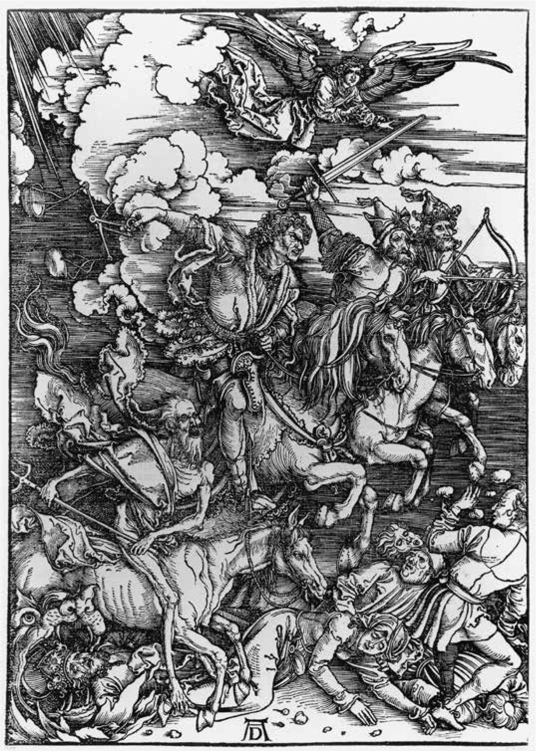
Albrecht Dürer, The Four Horsemen of the Apocalypse, woodcut, 1498, from The Revelation of Saint John.
Only a nobleman or the church could afford an oil painting, but a woodcut, whether in a book or sold separately, could be bought by most people. In addition, an almost limitless number of copies of a single block could be printed. That Dürer himself saw these individual paper prints as works of art to be sold is indicated by the fact that he was one of the very first artists to sign and date his prints. On the one hand, Dürer was lifting woodcuts from low to high art, and on the other, he was inventing art for the masses.
A great patron of woodcuts and the idea of art printed on paper was the Holy Roman Emperor Maximilian I, who commissioned histories, musical dramas, architecture, paintings, and sculptures. When the woodcut reached new heights of popularity in Germany, he commissioned at least 1,000 woodcuts, including three huge projects. Maximilian commissioned much of his work from Hans Burgkmair, the other great genius of woodcuts. The first artist to print a woodcut with color, he was also the first to use three separate blocks for several colors. This technique, later made famous by such modernists as Pablo Picasso, is called chiaroscuro, which despite the Italian name and the Italian claim to having invented it, was done in Germany a decade earlier, in 1508, by Lucas Cranach the Elder while working with two blocks. The leading chiaroscuro cutter and printer, one of the top Formschneiders of this golden age, was Jost de Negker, who was Flemish-born, but worked in Augsburg at the time.
Maximilian wrote an autobiography, Weisskunig (White king), for which Burgkmair made 117 of the 211 woodcuts used to illustrate it. He also made 14 of the 118 woodcuts that illustrate Theuerdank, Maximilian’s account of his courtship of Mary of Burgundy. Most of the other woodcuts were done by Hans Schäufelein, Dürer’s former assistant. Theuerdank was not a romantic story but rather the history of the intense negotiation undertaken by Maximilian to acquire Burgundy, one of the wealthiest countries in Europe. That acquisition led to fifteen years of warfare, which Maximilian paid for with the dowry from his second wife, after Mary. Mary had died only a few years after they were married, in a horse-riding accident.
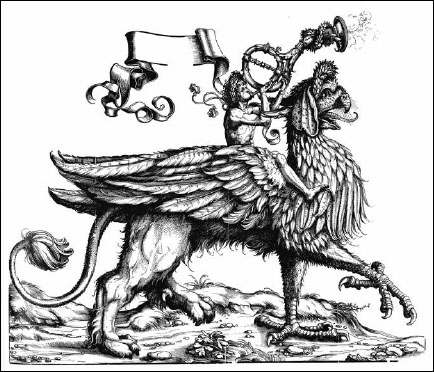
The opening of The Triumph of Maximilian I. Woodcut by Hans Burgkmair, circa 1512.
The first of Maximilian’s grand woodcut commissions was a series of ninety-two woodcuts based on Caesar Augustus’s arch in Rome, but highly ornamented with Renaissance details. It was followed by the equally grand Triumphal Arch, designed, cut, and printed from 1512 to 1515. Fully displayed on a wall, the work measures nine feet high and ten and a half feet wide. It is telling that Maximilian also commissioned a series of paintings on vellum for his own private collection; the woodcuts were for “the people.” Painting was for the rich; paper art was for everyone else. Maximilian’s first two commissions were drawn by Dürer and cut by Andreä.
For the third commission, The Triumph of Maximilian, at least 137 blocks were carved by a team of Formschneiders, including Andreä. The leading artists in Germany designed these blocks. Dürer was among them, but many more blocks were designed by Albrecht Altdorfer—an artist of the Danube school, which depicted biblical stories in Romantic European landscapes—and Dürer’s woodcutting student, Hans Springinklee. The Triumph of Maximilian depicted an imaginary march led by a naked herald mounted on a griffin, followed by horses, exotic animals, musicians, jesters, fencers, drummers, falconers, and jousters. It was 177 feet long and designed so that copies could be made and hung along the walls of public buildings.
There are two important things to be learned from these works. The first is that Maximilian took the Holy Roman Emperor idea very seriously. The first Holy Roman Emperor was Charlemagne, who reigned in 800, three hundred years after the end of the Roman Empire. Parts of Italy were included in the Holy Roman Empire, as was Burgundy, thanks to Maximilian. The Holy Roman Emperor, who was supposed to embody the Roman emperors of old, was elected by noblemen and crowned by the pope. It has been popular among high school history teachers for many years to point out that the Holy Roman Empire was neither holy nor Roman nor an empire. But Maximilian wanted to be a true Roman Emperor. Roman or not, he was a great promoter of woodcuts and printed paper art. Had a Medici of Florence or Rome commissioned a depiction of a triumphal march measuring 177 feet long, it would have been a frieze, a mural, or a fresco. But this Roman Emperor was German, and he wanted woodcuts printed on paper.
IN 1515, WHEN Dürer stopped cutting wood and farmed his drawings out to Andreä the Formschneider, he started, not coincidentally, to learn of a new way of making prints: etching.
The idea is thought to have originated with Daniel Hopfer, an armor decorator and sometime woodcutter. Etchings are made with a metal plate—Hopfer used iron, but copper was soon substituted—that is covered by a soft, waxlike, acid-resistant ground. Originally the ground was made of wax, mastic, and amber. The plate was heated so that the ground could be rolled out evenly, and a blunt instrument called a burin could be used to draw lines into the substance down to the metal. The plate was then dipped in acid and cleaned off. Those parts of the metal plate covered by the waxy ground remained unaltered, but the lines where the metal plate had been exposed were eaten away by the acid. How deeply the lines were etched was determined by how long the plate was left in its acid bath.
Dürer probably took so quickly to this new technique—he was producing it within two years of learning about it—because the burin was a tool that he knew well. It was used by goldsmiths to engrave metal. But ordinarily, a burin scratched into metal makes all the lines the same. With this new technique, the lines could be thinner or thicker depending on how you applied the tool. Also, even darker lines could be made by leaving the plate in the acid for a time, pulling it from the bath, varnishing over the lines that were to remain lighter, and putting the plate back in the acid for further “biting.” Compared to carving wood, it was a very fast and precise process, making it easier to create the fine lines and rich detail that Dürer loved.
Intaglio printing also emerged in this age. A print idea involving inked metal on paper, it is the reverse of moveable type and woodcuts. The difference is that the parts that are cut away get the ink and the parts that are not cut away remain white. After the plate is inked and rubbed, it is put in a printing press. Dürer was one of the pioneers of intaglio printing as well, though he only did it from 1515 to 1518. Since then, it has become one of the most popular techniques for printmaking on paper, partly because it only requires drawing skills, not carving ones.