
Chapter 8

He became so absorbed in his books that he spent his nights from sunset to sunrise, and his days from dawn to dark, poring over them; and with little sleep and much reading his brains got so dry that he lost his wits.
—MIGUEL DE CERVANTES,
The Ingenious Gentleman Don Quixote of La Mancha
MORE BOOKS WERE MADE IN EUROPE IN THE SECOND half of the fifteenth century—some 8 million is a conservative estimate—than in all of previous European history. From Gutenberg on, printing overtook Europe, step by step. Johann Fust, the businessman who had gained control of Gutenberg’s operation, not only possessed his press and process but had also taken on his assistant, Peter Schöffer, a talented man with an eye on the future, a former scribe turned printer. Under Fust, the Gutenberg press, which had failed to earn money for its creator, became a profitable house selling books throughout Germany and France. Another member of Gutenberg’s team established a print shop in Bamberg in Bavaria, while others stayed and plied their craft in Mainz.
Printing might not have spread as quickly as it did if Bishop Adolf von Nassau had not lost his perch as archbishop of Mainz and decided, with the pope’s backing, to take it by force. This sacking of Mainz in 1462, a virtual destruction of the city, caused many residents, printers included, to flee. A remarkable group of Germans, starting with those who had studied under Gutenberg or Fust and Schöffer, then took some of their equipment and, more important, their skills and knowledge, and traveled throughout Europe. They would establish print shops in one town, teach apprentices there, and then move on to the next town.
A print shop was not portable. The large oak press was heavy, as was a complete set of lead type. So the printers took with them only their punches, used to make type molds. They followed the Rhine to cities that had book markets—cities with universities, such as Cologne and Strasbourg. Universities were hungry for more books, and printing could now provide them. Between 1348 in Prague and 1508 in Frankfurt, fifteen German cities successfully established universities; in addition, Ulm, Lünenburg, and Breslau started universities that failed. Upon arriving in a university town, the printer would simply find a carpenter who made wine presses and instruct him on how to build a printing press. Then, using his punches, he would make new molds and type.
Ulrich Zell was one of those who had learned printing from Fust and Schöffer, and who fled Mainz in 1462. By 1463 he was printing in Cologne, producing mostly books for the university with a typeface very similar to that of Fust and Schöffer. He seemed to prosper as a printer, as he lived grandly in a palatial estate, though his marriage to a wealthy woman undoubtedly helped as well. But whatever the case, people believed that printing was the source of his wealth, which led to many imitators and competitors.
By the time Zell died in 1503, there were more than twenty other printers in Cologne and the city had become a printing center. The Cologne printers had also spread printing north to Northern Germany and Holland.
They then took their printing south to Italy and Spain, and west to France. There was even interest to the east, in Russia under Tsar Ivan V, though his printing press, started in 1563, was soon destroyed in a riot. Russia did not even have a paper mill until 1576; like England and Holland, it did not start papermaking until it needed paper for its own printing industry.
Italy took an early lead in printing because it was very quick to welcome German printers. The Subiaco monastery, a Benedictine monastery near Rome, invited German Benedictines who knew how to print to come to teach them, despite the fact that the principal activity of the Subiaco monks was copying manuscripts. But they were interested in a more efficient way to copy, and the Subiaco monastery became the first printing house in Italy, producing printed books as early as 1464. By the late fifteenth century, there were also numerous German printers in Rome, both religious and secular. A few prospered, many struggled, and some failed.
One of the great German successes in Rome was Ulrich Hahn, who started printing there in 1468 and was probably the first in Italy to print a book illustrated with wood blocks. But by the turn of the century, these were commonplace, with illustrated Italian books being printed in Rome, Verona, and Naples, to be followed soon thereafter by Florence and Venice. In Naples in 1485, Sextus Riessinger, a German, printed a much-admired edition of the Greek classic Aesop’s Fables, illustrated with thirty-seven woodcuts for Italian publisher Francesco Del Tuppo.
Venice, one of Europe’s most important paper trading centers, quickly became the printing capital of Italy. By the beginning of the sixteenth century, when Naples had 67 printers, Rome 41, and Florence only 37 despite its dominance in art, Venice had 268.
The first Venetian printer was a goldsmith from Mainz, Johannes de Spira. The chief magistrate of Venice, known as the doge, granted him an exclusive five-year contract to print books in Venice, but shortly after producing his first book in 1469, he died. His brother Wendelin tried to continue the exclusive arrangement, but the doge would not recognize an heir to the contract and this left the field open for many competitors, including a number of Germans.
Venetian books became renowned for their beauty. In 1490 the Venetian printers Giovanni Ragazzo and Lucantonio Giunta published Niccolo de Mallermi’s Italian translation of the Bible. The pages have a two-column format and, unusual for the time, four hundred small woodcuts one-column wide that run throughout the book. The book also has a woodcut border of architectural design. Later, small woodcuts and decoratively bordered title pages came to typify the celebrated Venetian book.
The most celebrated name in Venetian books was Aldus Manutius. Before becoming a printer, Aldus had been a scholar in Rome specializing in ancient Greek writing. He lived in the household of the wealthy nobleman and noted philosopher and author Giovanni Pico, Count of Mirandula. Aldus was instructor to the count’s sister, the princess of Capri, but struggled to teach her because he could find few useful textbooks—no doubt the plight of many teachers at the time.
Aldus moved to Venice, where he gave lectures, though his greater aspiration was to print books, including textbooks. But something else was on his mind as well. He believed that the world was changing and that printed paper would take over. Anything that was not printed would disappear, or at least be doomed to obscurity. Almost none of the great Greek classics had been printed—it became his mission to save these works through printing.
He opened a shop, but he may not have had a shopkeeper’s temperament. A sign on the front of his shop, the Aldine Press, read, “State your business briefly, and then immediately go away.” His success was not based on his personality, however, but on the beauty and innovation of his books.
True to his original plan, his first book, in 1494, was a Greek grammar textbook. Five years later, he printed the fictional Hypnerotomachia by Francesco de Colonna, a book that garnered more attention. It was an erotic romance, not at all shocking for the time; pornography was a popular genre in the emerging printing trade. The book was illustrated with 168 woodcuts, many of them erotic.
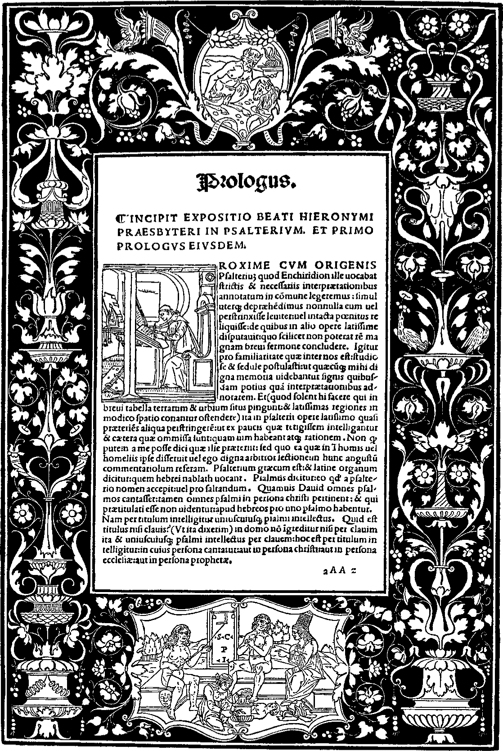
Opening page of Gregorius, printed in Venice in 1498. It is often considered one of the finest pieces of ornamental book printing from the Renaissance.
Aldus believed that the times called for smaller and more portable books. To facilitate these little books, he invented a new typeface supposedly based on Petrarch’s handwriting. His first book in the new type, which he called italics, was published in 1501. Italics was subsequently copied all over Europe, even though Aldus jealously guarded his invention and was angered when other publishers printed in italics.
In point of fact, italics was not Aldus’s invention but his punch cutter’s, a dubious character named Francesco Griffo who eventually had a falling-out with Aldus and returned to his native Bologna, where he was arrested for beating his son-in-law to death with an iron bar. According to some accounts, he was subsequently hanged for his crime. Griffo was probably also the punch cutter for Bembo, a very readable Roman typeface designed by the poet and Greek scholar Pietro Bembo in 1496 for one of his books published by the Aldine Press. Bembo, like italics, is still in common use. And the Aldine symbol, a dolphin coiled around an anchor, is today the symbol of the American publisher Doubleday.
By the time of his death in 1515, Aldus Manutius, the man who had sought to revive the classics; the first to print Aristotle, Sophocles, Herodotus, Euripides, Aristophanes, Plato, and Thucydides; and the first to consult several texts to find the most accurate classical scribe, had completely revolutionized book printing. The Aldine Press was continued by Aldus’s family until 1579.
Tens of thousands of Aldus’s books, known as Aldines, have survived. Not only are they still perfect, beautiful small books, but their pages have survived half a millennium remarkably well. Historians have written much about the unreliability of paper in the sixteenth century, but these pages remind us of the quality of rag paper. They are flat and smooth and pearly white, with no discoloration and no spots. These small, portable books, which Aldus called libelli portatiles, are credited with changing people’s reading habits. This, of course, is the technological fallacy at work once again. Aldus did not change reading habits. Rather, a change in reading habits prompted him to produce a different kind of book. He could see that books were too big for the way the new readers wanted to use them. Books were no longer read only by learned monks and scholars at stands in monasteries and castles but by a broad range of people, especially in Italy and France. People wanted to read while lounging in chairs or at a café; they wanted to take books to work to read on breaks or on trips. And another small point, or two actually; Aldus was the first to use the modern semicolon.
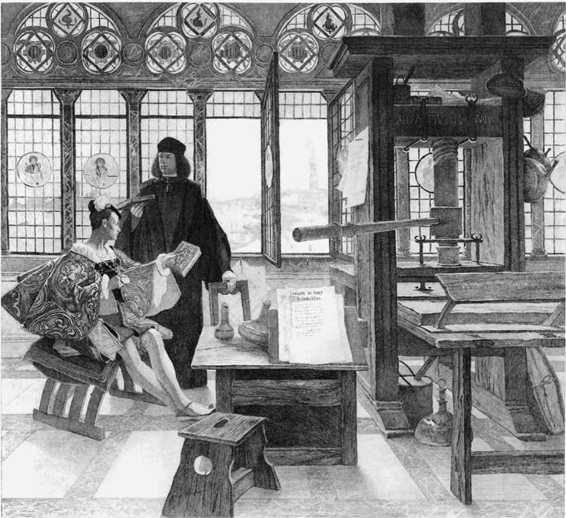
Aldus in His Printing Establishment in Venice Showing Grolier Some Book Bindings. Etching by Léopold Flameng, 1891. Jean Grolier de Servières (1489–1565) was a French treasurer general, an avid book collector, and an enthusiastic fan of the Aldine Press.
WITH ITS LARGE and growing university, Paris was Europe’s leading intellectual center and therefore a leading destination for German printers selling their wares. But no printing was done in Paris until 1470, when two professors from the Sorbonne, the German-born Johann Heynlin and the Frenchman Guillaume Fichet, sent for three printers from Germany: Ulrich Gering, Michael Friburger, and Martin Crantz.
Heynlin and Fichet’s first book, the first book printed in France, in 1470, was Epistolae Gasparini, a student’s guide to writing Latin by Gasparinus de Bergamo. Over the next two years, they printed about thirty more books, many aimed at an academic audience. Then they moved their operation to the nearby rue Saint-Jacques, a major street in Paris. One of their apprentices, Pierre de Kaysere, went into business for himself and established a competing press, the Soufflet-Vert, on the same street. And soon the rue Saint-Jacques became the publishing and bookselling center of Paris.
Being one of the longer streets in Paris and a major thoroughfare until the nineteenth-century redesign of the city, the rue Saint-Jacques was an ideal location for the delivery of bulky paper supplies and the shipping of books. The street was lined with booksellers, while printers and bookbinders set up shop in the adjacent narrow streets. By the seventeenth century, several thousand workers and their families lived off the thoroughfare’s book business. The bookstalls along the Seine today are what remain of that trade.
THE GERMAN PRINTERS also went to other French cities, most notably Lyon. Lyon had a strong Italian connection because, like Italy, they had a silk industry; the Italian silk was said to be of higher quality, but the Lyonnais silk was more affordable. The city also had commercial ties to Germany.
Silk manufacturing in Lyon was a competitive and demanding industry. Because Lyon was located just above the meeting of the Rhône and Saône Rivers, it was often said that Lyon had three rivers: the Rhône, the Saône, and the tears of the silk workers. Living beside the hard-pressed working class, however, was a very affluent silk merchant class that stimulated banking and commerce, and sponsored fifteen-day international trade fairs four times a year. In the fifteenth century, Lyon was still, for the most part, an oral society. Certainly the silk workers and other workers could neither read nor write, and the merchant class could only do so to the extent needed for their business. Yet among the population also lived an educated elite that had heard of, and yearned for, the new printed books.
Lyon printing began with Bathélemy Buyer, who was born in Lyon in 1433 to a prominent family—lawyers on his father’s side and garment makers on his mother’s. He probably met the Paris publishers Heynlin and Fichet while he was studying at the Sorbonne, and in 1472 returned home with a passion for the new German printing devices. He brought to Lyon an experienced printer named Guillaume Le Roy, who was from Liège but probably learned his craft in Germany. Le Roy in turn brought with him four German workers. It is believed that the group then set up shop on the rue Mercière on the left bank of the Saône—the location of the city’s flourishing print trade for centuries to come.
Lyonnais books were not known for their elegance or beauty. The printers there had little interest in competing with the work of scribes or with the finer books being published in Germany, Italy, and Paris. Instead, their books tended to be printed on smooth and white, albeit thick, paper. The print they used was dark and clear but difficult to read due to their fondness for Gothic typeface.
The Lyonnais sold their books throughout Europe. And, taking advantage of their close commercial relationship with Venice, they were infamous for copying Venetian books. Aldus Manutius denounced the Lyonnais printers and listed the many errors in their books, but the Lyonnais, rather than apologizing or denying the theft, simply used his denunciations to make corrections.
The Lyonnais printers thought of themselves as popular publishers, as opposed to the academic presses of Paris. Their readers were not scholars or intellectuals. One of their important markets was doctors, and they published numerous books on diseases and remedies. But the core of their market were the booksellers from around Europe who attended their fairs and bought hundreds of books to sell elsewhere. The Lyonnais publishers tried to produce editions in print runs of five hundred; sales of five hundred gave a book bestselling status.
The Lyonnais produced the first books ever printed in the French language (the first Paris-published books were in other languages), starting with Livre des merveilles du monde (The book of wonders of the world) in 1475 or 1476. Martin Husz, a German printer in Lyon, printed the first French books with woodcuts embedded in them. The Lyonnais books were often printed from blocks made in Germany, but local woodcutters who had developed their craft in the playing-card industry also contributed.
By the end of the fifteenth century, Lyon was printing more books than any other city except for Venice, Frankfurt, and Paris. Germans went to other French cities, including Bordeaux in 1486, to start printing operations, and by the end of the century, Parisians too were bringing printing to southwest France, including Périgueux in 1498. Many of the fifteenth-century printers, especially the Germans, continued to live a traveling life. They spent a few years in one town, a few in another, and then moved on.
SPANISH PRINTING BEGAN with Germans as well. Jakob Vizlant, a representative of the German trading company Ravensburg-Constance, started up printing shops in Valencia that produced their first book in 1475. Another German, Paulus Hurus, began a printing press in Zaragoza that was unusual for the time; rather than reprinting classics or other existing books, he commissioned new works. Barcelona was also a site for an early Spanish printing shop, founded by German printer Johann Rosenbach.
To induce Spain to develop a paper industry, the Spanish Crown exempted papermakers from military service. This had also occurred in some parts of Italy, where papermakers were not only exempted from military service, but from some taxes. This was not to say that Spanish paper workers were well treated. The paper mill was a closed community. Catalan paper historian Oriol Valls i Subirà described it as “a sort of convent, but with very hard living conditions.”
Another way of putting it might be a labor camp. The paper mill was the home of the owner, along with the workers and their families. Even married men and women were required to sleep separately. There were no set working hours. The mill operated around the clock, as paper mills still do today. This meant that the workers and their families seldom knew quiet, for the loud stampers that pounded rags into pulp never stopped. The workers’ only respite from the noise occurred during the weekly cleaning of the vats and stampers—the most arduous work in the mill.
In sixteenth-century Spain, as in much of Europe, the average life expectancy of a paper worker was less than thirty years. Tuberculosis was rampant. But by the standards of the time, paper workers were not considered poor. Their working conditions were no worse than the working conditions in the lesser-paying cloth, iron, and flour industries. Conditions were no harsher than in France and Italy. But French and Italian workers did gain some rights, such as holidays, by organizing in guilds; there was no such organizing in the Spanish mills.
As had occurred in earlier centuries in Italy, the growth of paper mills in Spain created a tremendous need for rags, and in the early 1600s, the Spanish king Philip IV banned the export of rags from the region along the Huécar River near Cuenca, the site of a very large and high-quality paper mill. The late-sixteenth-century Spanish author Francisco de Quevedo wrote:
Those that were rags yesterday,
and thrown away by the cook,
are today documents that govern two worlds
and threaten three others.
AT FIRST, THE paper produced by the Spanish mills after the Reconquista, the centuries-long period when the Christians fought to regain control of the Iberian Peninsula from the Muslims, was not as high quality as the paper produced elsewhere in Europe, and Spain imported paper from France and Italy. But in time, that began to change. By the year 1500, there were printers in the Spanish cities of Valencia, Barcelona, Cuenca, Zaragoza, Seville, Lleida, Tortosa, Salamanca, Valladolid, Zamora, Toledo, Tarragona, Palma de Mallorca, Burgos, Murcia, Pamplona, and Granada—seventeen in all—and Spanish books became known for a certain style and beauty, with rounded gothic lettering and ornate title pages.
It was in 1605 that Spanish publishing hit its famous low and high point. Francisco de Robles decided to publish the latest work of Miguel de Cervantes, a fifty-eight-year-old struggling writer. His stories had been mostly ignored, though his poetry had garnered a few awards and a little attention. He had written a very long work—but it was only Part One. Part Two was coming later, the author said. It was called El Ingenioso Hidalgo Don Quixote de La Mancha, which today we recognize as the world’s first novel. In 1605, however, it wasn’t clear what to call it.
Robles was taking a risk. Cervantes had given readings from the book before it was published, leading the playwright Lope de Vega, the most illustrious writer in Spain at the time, to say, “There is none so foolish as to praise Don Quixote.”
For his printer, Cervantes chose Juan de la Cuesta, whose shop on Calle Atocha is a museum today. He had published some of Cervantes’s earlier work, and more important at the time, was the publisher of Lope de Vega—no small feat since de Vega wrote, or was soon to write, 1,800 plays, three book-length poems, thousands of sonnets, and three novels. That was a lot of paper.
Machine-made books and handmade paper were a tough combination. From the fifteenth century, when printing was invented, until the nineteenth century, when machine-made paper was developed, purchasing enough paper was the greatest problem confronting the book-publishing industry. De la Cuesta obtained his paper from a paper mill at the monastery of El Paular in Segovia—not one of the better paper mills in Spain. For the mill to produce, and Robles to pay for, enough paper to publish a significant edition of Cervantes’s very large book took four years. The total purchase came to 1,100 reams of paper, some 550,000 sheets, each folded down to eight printed pages, which was called a quarto.
Robles may have used low-grade paper because he expected the book to be a hit and could not afford huge quantities of good paper. Or he may have intended to put out a cheap edition because he expected it to sell to a lower class of readers. Still another possibility is that he chose low-quality paper out of habit; he had used the same El Paular paper to print Cervantes’s other works. But whatever the case, the book was an immediate hit—and has continued to be so for more than four hundred years. According to some historians, it is the most-sold secular book in the history of publishing. Its ideas are incredibly durable, and throughout all of the shifts in history the book has always remained relevant. When Fidel Castro came to power in Cuba in 1959, this was the first book his government published; they used it for a mass literacy campaign.
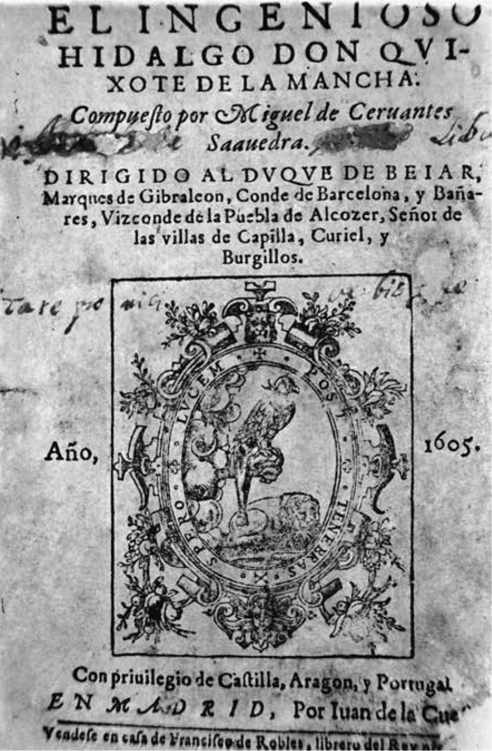
Cover of Don Quixote. First edition printed in Madrid by Juan de la Cuesta in 1605. Courtesy of the Biblioteca Nacional de España, Madrid.
Many handsome editions of Don Quixote have been printed over the centuries, but the first edition was not pretty. Its paper, made from a very low grade of cloth, was lumpy and marked with impurities and wrinkles. It was also extremely brittle. Juan de la Cuesta’s work was inferior as well. The printing wasn’t crisp and was extremely difficult to read, especially because the type from the reverse side tended to bleed through.
DON QUIXOTE, LIKE all great works of literature, has many layers of meaning, but fundamentally it is the story of an old-fashioned man who lives in a fast-changing world in which he cannot find his place. The instant enthusiasm of the Spanish public for the book is testimony to the fact that this is what Europe was like at the beginning of the seventeenth century. Don Quixote, wanting to be a chivalrous medieval knight, is confronted with an emerging middle class that is pragmatic, not romantic. They are stirred not by idealism but by the notion that if they work hard they can get ahead. Most everyone in the book except Don Quixote—even his faithful “squire,” Sancho Panza—belongs to this emerging class.
But there is a twist. The book Don Quixote was being published for this very same emerging class. And the problem with Don Quixote—the reason why he seems mad and fails to grasp the world around him—is that he reads too much. In particular, he reads medieval romances, one of the most popular genres of the time. There is clearly an intended irony here, because Cervantes himself loved reading. Known to be an uncontrollable reader, he would even pick up scraps of paper from the street to see what was written on them.
Don Quixote’s niece, distraught by the bizarre behavior of her uncle, takes a clergyman to her uncle’s library to show him the source of the problem. The curate examines the books, some large and finely bound, and others smaller. The niece suggests that he sprinkle them all with holy water, but the priest laughs at her naïveté. Clearly the only way to save her uncle, he says, is to burn his books. The pair even contemplate burning a book by a certain Cervantes called Don Quixote, but decide that since it is only Part One, they will wait to see if Part Two is any better.
To return the Old World to the way it was, all books would have to be burned.