
9

Sorting the Skittles
Say you’re walking down the street as a family. There on the sidewalk, a couple you don’t know erupts in an argument at full volume. She’s a Mount St. Helens of vile obscenities and venomous accusations. He shoves and vehemently threatens her. Someone they know comes out to successfully intervene, but your kids’ eyes volley questions faster than a Star Wars blaster. What do you do?
A. Cover your kids’ eyes with your free hands and shoot the couple the evil eye as you stalk off. (“Some people! Get your act together, folks.”)
B. Smile at the couple. Act like nothing happened.
C. Wait until you’re out of earshot, then mumble, “Whoa. What a jerk. And what a witch! How does he live with her? If I ever see you kids acting like that…”
D. Something else?
Permanent Truth
Discernment is to interact with God throughout the day in soul-level listening to his Spirit—creating ownership of our faith in an intimate, personal relationship. It is about:
• learning to apply the Bible to daily situations
• picking out various rights and wrongs, personal reactions, and amoral behaviors—like sorting a bag of Skittles by color—rather than making sweeping, all-or-nothing statements
• listening for God’s voice and watching how he works—and looking for opportunities to participate with him
Kids present or not, we joust with these situations daily: a teenager mouthing off to his mom in Starbucks, the friend who gossips at our dinner table, the language on primetime TV. We’re caught: Part of us wants to push back at such behavior. Part of us wants to offer the benefit of the doubt.
We wrestle with what values look like considering full measures of compassion and mercy and justice. Lately, we’re encouraged to keep our own “version” of truth and values to ourselves: Your values are A-OK as long as they don’t interfere with mine.
Rich possibility lies in choosing to discern right from wrong. On my better days, running into someone else’s wrong is a chance to play out all over again to someone else the kindness God shows me constantly. That kindness is the air I breathe.
You know people who exude this kindness. They lean in. They make you want to slide down your inner mask and examine what’s really going on under there.
In the context of a loving relationship, discernment extends a chance to gently, precisely apply healing to what embezzles life and true comfort from a person and those they love, with as little damage as possible.
I think of it like a fellow athlete throwing an arm around a shoulder: We’re in the game together. Try this.
Our hearts are dark, and they’re complex places. As Aleksandr Solzhenitsyn so poignantly wrote,
If only it were all so simple! If only there were evil people somewhere insidiously committing evil deeds, and it were necessary only to separate them from the rest of us and destroy them. But the line dividing good and evil cuts through the heart of every human being. And who is willing to destroy a piece of his own heart?1
Determining whether someone else’s actions are right or wrong is important. But if we poorly manage our responses, if we convey arrogance and lack of nuance and understanding, our behavior can fall short of genuine love and even holiness. What’s the difference between humbly, firmly identifying what’s right (even if only in our own minds), and bulldozing people?
In a couple of words: humility and love. In John 8, where a woman caught in adultery is brought to Jesus, the Pharisees believe they finally have the ammo needed to trap him: “In the Law Moses commanded us to stone such women. Now what do you say?” they ask him in verse 5.
Jesus’s response is simple. “Let any one of you who is without sin be the first to throw a stone at her” (verse 7).
The men wander away, oldest first (perhaps more aware of their own collected failures). When no one is left to kill the woman, Jesus says, “Neither do I condemn you…Go now and leave your life of sin” (verse 11).
This entire narrative forms an essential model for us and our kids. Rather than an opportunity to peer down from a moral high horse, discernment is a chance to lay down the stone we were about to lob. Judgment, in this story, kills. Mercy hews out space for a restored life.
Deuteronomy 6 does say we must talk about God’s commands as they lay their loving grid over all of life—on the road, in our home, when we lie down, when we rise. And maturity has its “powers of discernment trained by constant practice to distinguish good from evil” (Hebrews 5:14 ESV). Discernment is like looking for infection beneath a microscope, with the goal of eliminating what infects us.
Yet when we’re about to slide others’ faults under the scope, discernment also whispers, “What do you have that you did not receive? And if you did receive it, why do you boast as though you did not?” (1 Corinthians 4:7).
There’s more than a little Pharisee inflating all our chests. We feel it in that subtle inclination to utilize someone’s weakness to quietly acknowledge ourselves as making better choices, possessing better character. Or we view a certain type of people with mild disdain. Or we mentally rehearse a friend’s inadequacies. Not long ago, I was ashamed to realize I’d been selectively comparing myself to others to make myself feel good as a parent.
The opposite of judgment, I’m convinced, is the gospel. It’s keeping my own need for effusive mercy in front of my eyes, extending that same gospel to others from my daily experience at the cross. This is wise discernment for our kids.
So one possible solution to the previous dilemma could be…
D. When you’re alone as a family, ask your kids questions about what they noticed, your concern for the couple evident in your tone. Ask what they would do if someone treated them like that. Acknowledge what you don’t know about the couple and what they might be going through. Pray together for the people you saw.
I’ve created the following table to help me slice between judgment and discernment. I wish I’d known this—making it part of me—before I’d left such a trail of ashes among people I care about. Maybe it will help you avoid similar destructive mistakes. I now long for the scent of Christ I leave with people—from the bank teller to my ten-year-old—to be that of compassionate truth-telling and graciousness. Training my kids in discernment means identifying what’s right in light of all contributing circumstances, responding a lot like the way Jesus came to us: alongside (rather than above) in both grace and truth (John 1:14).
|
Judgment |
Discernment |
|
self-serving |
loving; operates from a place of humility; speaks at the proper time and in the proper way (Ephesians 4:29) |
|
works to curse and punish |
works for deep, lasting goodness |
|
separates; creates “us/them” categories |
creates unity, removing the sin in our way and remembering we’re all equal at the cross |
|
condemns |
offers hope; bears the burden together |
|
looks at the outside; does not seek to see oneself in the person’s situation |
acknowledges what we don’t know; seeks to compassionately understand |
|
wields shame |
takes its cues from grace |
|
sees people without hope and faith in view |
sees people as being “in process,” with capacity to change |
|
makes self superior |
works not from above, but diligently alongside (Galatians 6:1-2; Luke 18:13); keeps our own utter and constant struggle with sin in mind |
|
often focused on outward behavior |
works prayerfully with the Holy Spirit to understand the whole truth in someone’s heart, asking God to first work change within oneself (Matthew 7:5) |
|
often operates out of fear, pride, or control |
beckons into the light, as God’s kindness leads to repentance (Romans 2:4) |
Flight of the (Media) Navigator
Am I the only one who cringes at the media evaluator role of parenthood? I constantly feel like the bad cop, monitoring the Xbox and Microsoft reports and Fall Out Boy lyrics.
Here’s what I don’t want to happen: I don’t want my kids to get to college and not know how to evaluate the media everyone’s gulping down like Kool-Aid—or hole up with their Jesus music and flip out when someone plays Imagine Dragons. I know God gives all of us different perspectives to raise our own kids. I’m personally trying to navigate going outside my preferred “bubble boy” mode while still shooting for “unstained from the world” (James 1:27 ESV). The method I’m working through with my kids is training wheels for a biblical worldview rather than not doing stuff simply because “Mom said no.”
So if my kids want to purchase a song, I first have them look up the lyrics for me. We discuss what people are craving in this song. What’s it about? What do they want? Is anything in this song not meeting those desires in ways God says are okay? Are there ways that their solutions overpromise, like expecting romantic love to solve all our problems?
I also ask my kids how Jesus is the ultimate yes to all these desires. In every love song, every song about dreams or passion, how does God ultimately fulfill those real cravings?
Conclusions our kids come to themselves are 100 percent more effective than those we come to for them. (No, that’s not an actual statistic.) If we can have open conversations about what they think is right or wrong, steering them in the right direction with good questions, we raise kids who can choose right for themselves.
So walk with your kids through their media—not just to say yes or no, and not even to be the bad cop. We’re helping our kids construct a worldview about what kind of entertainment they’ll marinate in and helping them build wise judgment for more complex issues they’ll inevitably encounter.
Perhaps the most critical discipline in discernment is knowing God’s Word. I think of a basic analogy: If my son were away from home and wondered what he should do about something, he would probably know what to do based on what he’s heard me say before. Similarly, kids have 66 books of God’s Word to help them hear God’s voice and learn and absorb exactly what he’s said. Over time, they gain discernment based on what they know of God and his ways.
To help them in this process, let’s ask thoughtful questions about how they listen to God; that is, allow the Holy Spirit to apply God’s Word to their situation. Let’s probe their hearts, encouraging them toward a genuine relationship with God.
In conversation, we can quietly work toward helping kids understand more than meets the eye. Move toward thoughtful, detailed complexity so that the pieces of each situation are accurately weighed: As Proverbs 4:7 puts it, “Though it cost all you have, get understanding.” Ask kids for relevant verses that apply to situations you encounter, add your own, and together pray verses over your world and those you love.
Writing on the Wall: Practical Ideas
Allow me to suggest a few ideas from a season where I’m personally discerning popcorn kernels from Airsoft bullets on my kitchen floor. Grab a few ways to work smarter, not harder, in trust-filled and Godward ways.
Read Hebrews 5:14 and have a blindfolded taste test.
Can kids tell the difference between peanut butter and almond butter? Honey and maple syrup? Salt and sugar? Almond milk and cow’s milk? Cheerios and Honey Nut Cheerios? Ketchup and tomato paste? How can they tell? Answer: They’ve tasted enough of at least one in each pair to know the difference between that and a “fake.” Discuss how we discern good from evil by constant practice.
Have one partner stand at one end of your living room and blindfold her. If you have an odd number in your family, the extra person can be a referee and official distracter. Toss obstacles of pillows or cushions onto the floor. When you say go, the voices of the unblindfolded partners should guide the blindfolded partners across the living room—without touching any obstacles. It gets hairy with all partners yelling at once—especially if you have a distracter shouting nonsense. Talk to your kids about the need to pick out the Holy Spirit’s voice amid all the other voices in our lives—particularly that of Satan, who “masquerades as an angel of light” (2 Corinthians 11:14) and “prowls around like a roaring lion looking for someone to devour” (1 Peter 5:8).
Chat about the sermon on the way home from church.
Keep a general climate of goodwill toward the church (rather than downright pickiness). Acts speaks of the Bereans, who were of “more noble character” because they “received the message with great eagerness and examined the Scriptures every day to see if what Paul said was true” (17:11). What do your kids agree with? What do they have questions about or disagree with?
Sort the Skittles.
Open a small bag of Skittles, M&M’s, Smarties, or another multicolored candy. Ask kids to sort them into colors. (Smarties will require more careful examination and better lighting!) Challenge kids: “Are you sure this one’s green? How can you tell? It looks a little like the yellow in some ways. What colors are mixed together to create this color?” Talk about discernment—the need to sort through a situation and determine what’s wrong, what’s right, and what’s neither or a mix of both.
Find some popular memes.
In its humor, what is each meme trying to say? How would the Bible agree or disagree with its message? Hint: Often it’s not all bad or all good. For example, the meme might be telling the truth about something that’s frustrating, but complaining rather than addressing it in a constructive way.
Ask, “How could it have ended?”
Choose a media headline, movie, or historical event, and ask how it could have ended had a person involved exercised discernment. Do this without judging or acting superior; it’s an opportunity for some lighthearted humor. What could have happened if a main character (maybe Shakespeare’s Juliet?) were able to phone their past self and say, “You might not want to do that”?
When talking through tough issues, ask kids to physically place themselves on a spectrum.
Maybe the “spectrum” is from one end of the living room or sofa to the other. Where do they fall if one end of the room is “not confident” and the other end is “very confident”? Where do they fall if one end of the room is “pro welfare” and the other end is “against welfare in all circumstances”? In an encouraging environment, ask them to present their reasoning, using Scripture when possible. The goal isn’t to get your kids to think like you; it is to exercise scriptural discernment and progress in their reasoning skills.
Help older kids examine what they’re reading.
When Corinne read Lord of the Flies, I asked her what the author was trying to say. We delved into a great discussion of humanity without social constraints, how humans decide on whom to bestow authority, and what she thought would happen if her English class were suddenly stranded on a desert island. (“Yikes, Mom.”)
At the risk of oversimplifying, I’ve noodled on a method kids can use on their fingers to think spiritually about decisions. Hey! There’s even an acronym: Gertie Had Lunch With Tom, examining the categories of God, Heart, Love, Wisdom, and Trust. Grab a printable version of this at janelbreitenstein.com/permanentmarkers.
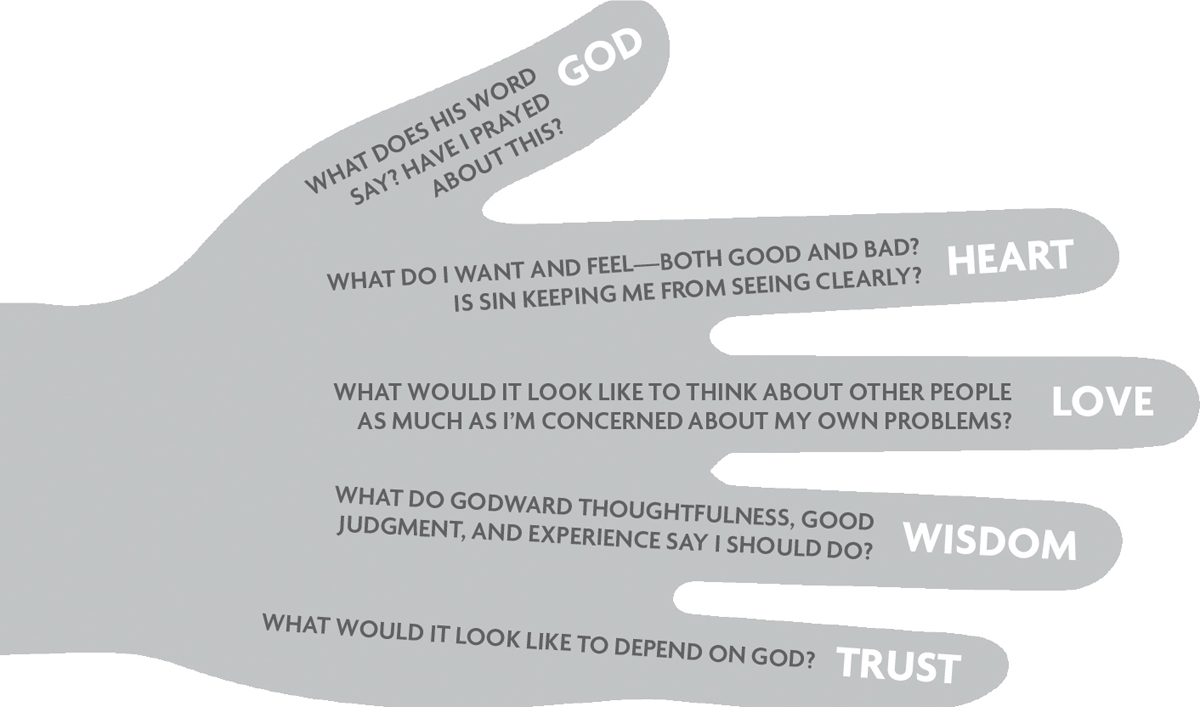
For more activity ideas, discussion questions, and other resources for teaching discernment, visit janelbreitenstein.com/permanentmarkers/discernment.
Fresh Ink: Resources for Vibrant Faith
•The children’s book A Bargain for Frances by Russell and Lillian Hoban is a fantastic resource to start the conversation about manipulation in kids’ friendships.
•We’ve enjoyed the Sticky Situations series (Tyndale, 2001, 2006) to help elementary-aged kids think through concrete ethical situations they might encounter.
•PluggedIn.com, Kids-in-mind.com, and CommonSenseMedia.org help parents preview media before their kids dive in. When my kids wanted to try out Star Wars’® The Mandalorian, Common Sense had great conversation prompts: “Why do you think George Lucas and Disney decided to make a Star Wars TV series? Characters who die are mostly faceless characters, often in uniform. How does that change your perception of the violence? How do the characters in The Mandalorian demonstrate courage and compassion?”2 My daughter has since come back to me with more thoughts about facelessness and violence.
•ClipShout—at clipshout.com/fcce—offers a two-week free subscription on their library of licensed movie clips for (secular) character education!
True Colors: Discussion Questions for Kids
•When you’re trying to decide what’s right, how do you know what God wants you to do?
•How can you tell the difference between what God wants you to do and what you want to do?
•What book have you loved that had an ugly cover or maybe had something spilled on it, got moldy, or smells weird? What about the opposite—a book that looked good but ended up being trash? How can we be too easily swayed by something’s appearance? Have you found this to be true with people or other things?
Think Ink: Contemplative Questions for Parents
•When teaching your kids discernment, what are your natural inclinations? Are you likely to lean toward judgment? A lack of confidence or hatred for evil (Romans 12:9)? Favoring emotion or gut instinct over Scripture? Smothering emotion or intuition entirely?
•What are you most likely to mistake for the Holy Spirit (intuition, convenience, ambition, my own idols, pride, or what others want me to do)? What tends to stand in the way of your discernment?
•What spiritual practices or circumstances help you shut out the “noise” around you and allow Scripture and the knowledge of God to inform your decisions?
The skill of spelling requires a number of aptitudes: forming a letter with your hands, photographic memory, working memory, phonological understanding, sound-letter associations, and more.
Teaching our kids discernment combines a lot of aptitudes too: memory of and understanding of God’s Word; empathy; higher-level abstract reasoning, which develops later in the human brain; humility and self-restraint as we wait for more pieces to the puzzle we’re assembling; cultural awareness; and a lot more. So keep in mind that your kids’ discernment is cumulative, constantly growing like a ball of Play-Doh as life experiences are added, processed (accurately, we hope), and observed.
Prayer of the Dependent Parent
Lord, thank you that your Spirit is far stronger and more accurate than if I were my kids’ conscience! I’m grateful you go with them wherever they go.
Please teach my kids’ hearts in ways they can’t resist, and bring them to surrender to you in every corner of their souls. Let them know and love your ways. You say your sheep know your voice (John 10:3-5,27); let my children know and follow yours.
In their discernment of good and evil—down to the lines of good and evil in their own hearts—let them encounter how deep and wide your undeserved favor is because of Jesus.
