
7

We Are More Than This
When I was little—my parents should be acquitted from this—I took to calling a boy’s most private part exactly what it looked like to me. That is, a tail. (I have it on good authority that I am not the only girl to find this a remarkable similarity. Plus, I lived on a farm. Things have tails.)
This generally wasn’t an issue until my father, who regularly performs car maintenance, informed the family he was going to fix the neighbor’s taillights.
You’re seeing this one coming.
Preschool-age Janel: “[Name excluded to protect the innocent] has lights on his tail?”
This is to say, considering the private nature of sexuality, there’s bound to be a lot of confusion, assumptions, and questions, asked or not.
Where do we want our kids to get this information?
Parenting kids toward holy sexuality involves a series of conversations to shape their worldview and create open, truthful, shame-free communication.
Permanent Truth
Rather than demonizing sexuality or dividing it into categories of “pure” and “impure,” holy sexuality is about
• honoring marriage and God’s best design
• targeting a high view of sex based on integrity—a oneness with who we aim to be in Christ
• viewing sex as intimately tied to our wholeness of person
• anchoring our identity in Christ so we’re less likely to be swayed by insecurity
(Talking About) Sex Begins in the Kitchen
On my African back porch, a friend’s and my own fingers curled around toasty warm mugs of ginger tea that exhaled ribbons of steam. She sort of asked the air around us if it was called rape if a boyfriend forced you. My grip on my mug tightened as her anecdote continued.
But I never talked to my parents about it. They left sex ed to my fifth-grade teacher, and my boyfriend was the one who showed me the rest. My family doesn’t talk about that kind of stuff.
I grieved with my friend, recognizing the gravity of what was taken from her.
Later, the situation begged the question: Is there anything on my parental “off-limits conversations” list?
That conversation whispered in my ear when a few weeks later, my then ten-year-old wandered into the kitchen as I decrudified counters and scooped leftovers into waiting Rubbermaid mouths.
“Mom, what’s pornography?” An avid reader, he’d come upon the word on the back of a nonfiction work for Christian adults. (This time.) I wrung out the dishrag, tried to wring the freak-out from my face, and reviewed my mental list of How to Deal: What I Believe About Awkward, Hairy Topics with Children.
•I want to be the go-to gal (just as my hubby wants to be the go-to guy) for this stuff with my kids. How I deal with it now affects whether they ask later. It will only get funkier as they get older.
•I want to help them construct their own biblical worldview, assembled not once but piece by piece as we apply each issue to real life, with Scripture informing them, rather than Google or the kids at the back of the bus autofilling the blanks in their minds.
•Evil is not only outside our kids. It’s within us because sin is part of us. Therefore, protecting my kids isn’t enough. Working with the Holy Spirit, I must shape their consciences.
So…deep breath. Maintain eye contact.
“Great question. Glad you asked. Know how we’ve talked about sex, how it feels good and welds people together?”
Tripping all over those first sentences, I somehow cobbled together a kid-level definition of porn—and an open warning of its power and addictive properties. I told him it has snared many Christians we know, ruining many marriages. I mentioned billboards and the bodice-busting women on the covers of romance novels on the public library’s website. I wanted him to know he has the power and loving obligation to “bounce” his eyes from them.
And I recommended he talk to his dad because dads naturally relate to the male experience—just as I understand more of what Corinne experiences—immediately eliminating the shame factor of speaking with the opposite-sex parent. A bond with a same-sex parent is valuable here. But don’t give up if you’re a single parent. A college-age female mentor answered a lot of my questions as a teen that felt awkward to ask my parents. Perhaps a youth group or small group leader or a wise relative could step in.
Of course, we should have these conversations privately so our kids aren’t perpetually wishing they could burrow beneath the carpet. But questions are an open door to talk about Scripture as we “walk by the way,” to the maximum level of what’s age appropriate.
Some of the best parents I know aren’t necessarily those who withhold information in an attempt to protect their kids. They don’t glance around for a fire escape from the awkwardness. They take their child’s hand and show them how to navigate difficulty. These conversations secure trust and honesty. They communicate, I will always tell you the truth. We’ve got a good thing going here, so come to me with anything.
Talking to our kids gives them vocabulary to talk maturely about emotions, sticky situations, money, sex, and real life. They’re then less likely to be swayed by peers or lies in the midst of their decisions and more likely to know how the Word applies to every situation—and is “useful for teaching, rebuking, correcting and training in righteousness, so that the servant of God may be thoroughly equipped for every good work” (2 Timothy 3:16-17).
Typically, when finding themselves in unfamiliar territory, kids look for indications of where they should turn: “I remember watching something like this.” “I don’t remember my folks dealing with this.” So they’re left to their own kid-size toolbox: their best guess, the advice of friends, or other information.
Maybe they’ll wing it.
But this is another area where even the most careful, wholehearted, wisely informative training still involves leaving the results up to God. Our kids may make painful sexual decisions—or fall victim to someone else’s. Over and over, sexuality is an opportunity to trust and reiterate the power of God’s mercy and undeserved kindness to humanity. Sexuality can acknowledge he is always greater than human failure and frailty, a God drawing beauty from ashes.
So stay approachable, occasionally masking your shock or dismay for the sake of welcoming your child as Jesus does.
The Life Stages of the Talk
In our sexually saturated culture, kids are confronted with sex at earlier and earlier ages by media, friends, and billboards. Try to tell your children what they need to know at the earliest appropriate developmental age. Over the years, the more opportunities you take to instill a biblical worldview—and before the topic becomes titillating—the better.
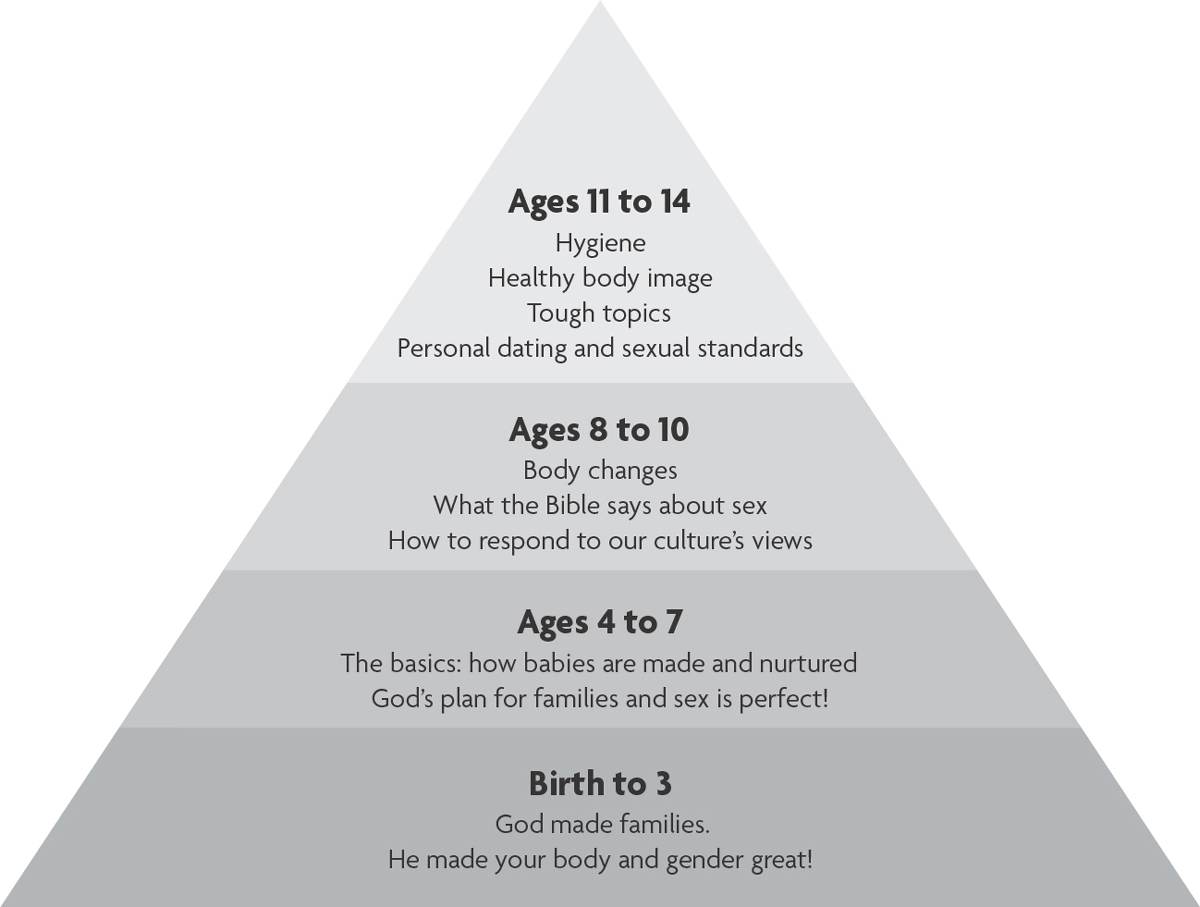
The graphic that follows is a quick reference of the life cycle of the sex talks you may have with your kids. The list following introduces a few more specific topics that are appropriate for each age range. These age ranges are not prescriptive. Every child’s development and sensitivities are different, so consider these as you evaluate when to hand each child another piece of the sexual-worldview puzzle.
A healthy sexual worldview is developed from infancy onward. Rather than “the talk” being an event, consider it an ongoing discussion. That worldview is communicated even through how we respond to kids talking about their bodies, how we talk about and to a spouse, and how we refer to subjects like gender: Women are so…! or Gah! Men! (Do both genders in your house serve one another and communicate worth?)
Your kids are keenly aware of the cues you give off about this “secret” topic. My embarrassment, shame, and condemnation—or joy and grace and honesty—can show up when they confront this stuff elsewhere. Even in their marriages.
As parents, we aim to uphold 100 percent of God’s holiness and 100 percent of our and his approachability and acceptance amid failure and tsunami levels of shame. If our children experience homosexual temptation or transgender thoughts or get snagged in porn, will they distance themselves and go to elaborate lengths to make sure we never find out? A pastor struggling with same-sex attraction writes, “Christians struggling with SSA often feel especially ashamed and embarrassed…We often feel too dirty to be in community with others, or to be in communion with God.”1
With your tone and body language, communicate essential truths:
You are a deeply loved child of God. No matter what.
You are also my deeply loved child. No matter what.
You can come to me anytime.
You can trust me to tell you the whole truth.
Your gender is so valuable. Neither gender is better or more valuable.
This isn’t something you need to be embarrassed about.
Sex is good and created by God.
Your body and desires are good. Using them the right way is important.
If someone tells you not to tell about this, please trust me; come and tell me.
We’re going to hold a high view of sex and your body, with some standards worthy of this gift, but I will not shame you when you mess up.
Sex and Tech
Throughout the life cycle of the talk, take “next steps” to make sure your family is managing technology—and the flow of illicit sex into your home—rather than the other way around. Kids lack an impulse-controlling, fully developed frontal lobe. So that means handing them addictive tech can be like putting a family-size bag of sour cream ’n’ onion chips in their lunch box with a sticky note that says, “Careful! Not too much!”
But the problem is far worse with the back-pocket accessibility of porn. The Witherspoon Institute has released an extensive study comparing pornography in its addictiveness to both cocaine and heroin—more like both, since it precipitates the wash of dopamine found in arousal (the same chemical produced by cocaine) and a climax of relaxing release similar to heroin.2
These well-trodden neurological pathways widen over time, making them more easily traveled. Because these areas of our brains are particularly changeable, arousal stimuli carry the capacity to change brain structure, demanding greater stimulation for the same amount of satisfaction, leading in this case to more twisted forms of porn (for example, physical torture or children becoming linked with arousal). This ultimately results in dissatisfaction with a normal, healthy sexual relationship.
As if that weren’t enough, the Institute reports, “There is no timeframe of abstinence that can erase the pornographic ‘reels’ of images in the brain that can continue to fuel the addictive cycle.”3
So, along with me, work to stay ahead of technology, and assume your kids are smarter than you think they are. These steps help us control the flow of information into our home. But remember that ultimately, holy sexuality starts in our hearts and continues with open conversation.
•Nix Snapchat, aka “the sexting app.” Blogger and youth worker Cameron Cole writes, “We have had many teenage girls confirm that a normal experience for a teenage girl today is for a boy to ask her for naked pictures. We have not had a single girl deny this.”4 Since Snapchat autodeletes photos and videos, kids are more daring about what they post.
•Get a watchdog on your router. We use OpenDNS, a free service, on our router at home. This means that any device using our router is guarded; I choose the level of security. The Circle security device is another great choice.
•No phones in bed at night. All phones are charged away from the bedroom. And create family guidelines asking that all technology be used out in the open.
•Rule: Hand over your phone immediately when asked, or lose your phone. I’m totally that mom performing random checks on my kids’ devices. Honestly? My kids’ safety and well-being are more important than their privacy. After a friend’s child met up with a predator through online gaming, I’m not taking chances.
•Regularly check Internet history and texts. If someone tries to delete something before they hand over their phone, it’s mine. You may also enroll in free accountability services like x3watch.com.
•“Last kid in the class to get a phone wins.” I appreciated this mantra of a mom in an article about measures Silicon Valley parents are putting in place to guard their kids from what they know well to be the effects of too much screen time.5 I’m not convinced that my need to communicate with my child always supersedes the dangers they face with a phone in their pocket. We do want our son to be able to handle a smartphone wisely before college, so we opted for an old smartphone, limiting app access.
•Turn off MMS (multimedia texting) to minimize sexting, and turn off data on your child’s phone, which hopefully means Internet is accessed largely through filtered routers (school, the library, and home).6
•If you have tweens or teens, consider subscribing to Axis’s “The Culture Translator,” a weekly e-newsletter that informs Christian parents of current trends, along with tips on how to talk about them and have tough conversations.
•Consider a social media contract and phone contract—not from the store but with your teen—to establish agreed-upon guidelines about how your teen will use and not use his or her phone. Include consequences for breaking that contract. Templates are available for free online.
You see the core problem, right? Ultimately, these steps are like attempts to prevent robbery overseas. You can toss up accordion wire, get the best locks, get a dog—the works. But ultimately, if a thief wants to get in—or more accurately, if someone in my home wants to let him in—their heart is the issue.
If our kids can’t answer the questions their peers ask—“Why don’t your parents let you date?” “Why can’t you see that movie?”—standing against the tide becomes a lot harder. So in all our conversations about sexuality, we can hand kids more than a set of rules. We can help them nurture their own convictions through conversations that build on each other.
Talk with kids about:
•boundaries they will choose before they’re in a tempting situation
•what kinds of people they hope to date and marry, and what makes a marriage thrive
•family rules, such as no members of the opposite sex in your bedroom or around when parents aren’t home, and open doors except when changing, bathing, or using the bathroom
•disease, pregnancy, heartbreak, and the vast, painful fallout of abortion—and how to compassionately understand the tough stories behind these choices (Tip: Don’t make this an us-versus-them discussion. If your child is ever on the difficult side of these situations, you want to be an “us.”)
•definitions of words (better from you than looking them up)
•how to respond to pressure from someone you respect
•what constitutes abuse, and what to say and do if you’re in a potentially abusive situation
One of the best ways to protect our kids is to help them develop thoughtful ownership of their own convictions, motivated primarily by their understanding of God’s reward inlaid in holy sexuality. Pastor Kempton Turner explains that when ranchers seek to keep horses on their property, “feasts” are far more effective than fences. When horses are well nourished and enjoying a robust buffet of thick pasture, they’re not as tempted by what lies beyond the fence.7 This falls in line with Hebrews 13:4’s reminder for all of us to honor the marriage bed, to show God’s plan for the richness and delight it is, rather than just warning our kids to stay away from the fence. (Which is not unlike saying, “Don’t press the big red button, kids.”)
Sex Can Be More Than This
Surely we can teach and expect our kids to have a higher view of sex because, despite the media’s opinion, we are physically able to resist sex. Though it’s a valid, genuine need, it’s not in the same category as food or air. Consensual, unmarried sex is a bit like consensual shoplifting.
First Thessalonians affirms this higher view of sex: “It is God’s will that you should be sanctified: that you should avoid sexual immorality; that each of you should learn to control your own body in a way that is holy and honorable, not in passionate lust like the pagans, who do not know God; and that in this matter no one should wrong or take advantage of a brother or sister” (4:3-6, emphasis added).
There’s a reason this holy sexuality chapter is after the self-control and fasting chapters. Holy sexuality is about controlling our bodies for the sake of a sweeter, more loving, more mind-blowing beauty of unselfish, monogamous sex that reaffirms our marriage vows.
God continues in 1 Thessalonians with gale-force words about the critical nature of sexual integrity, using words we shy away from: “The Lord will punish all those who commit such sins, as we told you and warned you before. For God did not call us to be impure, but to live a holy life. Therefore, anyone who rejects this instruction does not reject a human being but God, the very God who gives you his Holy Spirit” (verses 6-8).
But the church itself is reeling from some of its own nomenclature. Some of us grew up amid “purity culture,” which created two categories of people: pure and impure. But as sinful beings, none of us fall in the pure category. Ephesians 2:8-9 speaks of a salvation “not from yourselves.” Implying we fall in a different, more favored class of Christian defames this vital aspect of the gospel.
In her work, Dr. Juli Slattery instead argues for the term sexual integrity, implying a wholeness of substance, an undividedness. Our behavior can increasingly, year after year, match who we claim to be because of Jesus. That means sexual integrity continues into marriage—where couples pursue healing from past sexual hurts, turn away from porn, and work against selfish married sex.8
For millennia there have been people who were able to wait—who possessed the moral fiber, self-control, respect of others, regard of their own sacred sexuality, a high bar for marriage (see Hebrews 13:4), and the power of God to say no for a little while longer. And they’ve humbly sought forgiveness and restoration when they’ve selfishly taken from someone. Remind your kids that their desires and struggles aren’t unique to them or their generation—and that they have the power to make these sacred decisions too.
I resonate with historian Lauren Winner, who writes poignantly, “The biblical story of the body is very different from the stories Cosmo and Maxim tell. The magazines (and movies, TV shows, and advertising campaigns) speak of bodies that are both too important and not important at all. Scripture speaks of bodies that God created in His image, bodies that are doing both redemptive work and being redeemed.”9
Good guys, like the biblical Joseph, run the other way. And call me naive or an upended ostrich, but we can ask our kids for more. They thrive when we beckon them to more than what the media make of them. (Scientific research backs me up on this: “Impulsivity is a tendency with adolescence, not an absolute.”10)
A Note to My Kids: We Are Whole People
I was a good Christian kid, raised in the church and lathered in vital discussions of sexuality, peer pressure, and well-considered dating standards. Those were critical in shaping me toward steadfastness and sexual faithfulness.
Yet inwardly (and well within the range of normal), I longed so much for approval, for validation of who I was. Insecurity led to flirtatiousness and gaps I longed to have occupied by guys. Remember those soul holes discussed in chapter 1? When kids are flailing for who they are, their identity could undermine all our desires for their sexual integrity.
If my kids read this someday, I’d want to tell them, You are capable of being a giver far more than a taker.
You were made for so much more than intimate theft, even if it’s accepted as the norm. You are capable of waiting to give and take something this holy until you can give someone your whole life, rather than stealing part of them for yourself and refusing to care for the rest.
I know you’ll hear something diametrically different from nearly all of your world. But know you can’t compartmentalize your sexuality or someone else’s body. We are whole people.
I believe you can stand among people of integrity, and that, by God’s grace, you will.
Writing on the Wall: Practical Ideas
Here are more detailed conversation starters, separated by age groups. (Again, these age ranges are guidelines. Please consider your child’s particular development and temptations.)
Birth to 3
•God loves us. Everything he makes is great!
•God made families and marriage to give us a picture of his love.
•He made boys and girls each special. They have different body parts. Here is what they’re called. (Studies show that using proper terminology helps protect kids from abuse.)
•Your genitals are special and private. They feel good to touch, but we don’t touch them in public.
•Your genitals shouldn’t be touched by anyone except Mom or Dad or a doctor—like when you’re taking a bath, using the bathroom, or being examined by a doctor. If someone touches you, it’s okay to say no and run away. Tell your mom or dad if someone tries to disobey this rule.
Ages 4 to 7
•You can talk with me or your other parent about this stuff. But let other kids’ parents be the ones to talk to them.
•God made boys’ and girls’ bodies different. I’m glad God made you the way you are! Boys and girls both need to be strong, intelligent, compassionate, nurturing, and hardworking.
•Remember, no one except your mom or dad or a doctor should touch your genitals. Tell your mom or dad if someone tries to disobey this rule.
•Here is what happens in a mother’s womb as babies grow. Here’s how babies are born and fed.
•God originally designed for families to have a dad and a mom, and for them to have kids after they get married. Not all families look like this. But we treat everyone with love and kindness. Let other kids’ parents be the ones to talk to them if their families look different than you expect.
•Here are the basics of how babies are made—people often call this “having sex.”
•God made sex for married people. When a man and a woman feel attracted to each other, their bodies can lie very close together. The man’s penis becomes hard and straight, and it can fit in the woman’s vagina. The man and woman move their bodies together, and at the end, sperm from the man’s body is left in the woman’s body, where it can join a tiny egg from her body. That sometimes makes a baby, which grows inside the woman’s body. Sex can feel very good and makes the husband and wife feel close. But this is also a private gift, which a couple enjoys alone, maybe when they don’t have clothes on. So you can ask your parents questions, but please don’t talk about this with anyone else or make jokes about it. Let’s respect this special gift.
•What we watch on TV or play on screens affects our brains, so we watch what builds up our brains and hearts, not what tears them down. We should spend most of our time doing things in the real world, with real people.
Ages 8 to 10
•God designed sex only for heterosexual marriage. He created sex as a way to create babies, as a gift for closeness and unity in marriage, and as a “glue” to make a man and woman one flesh. Marriage between a man and a woman shows the world what God is like and Christ’s relationship with the church (Mark 10:6-9; Ephesians 5:22-33).
•Here’s what the Bible says about sex. (Use passages like Genesis 2:24-25; John 8:1-11; 1 Corinthians 6:12-20; Ephesians 5:3; Hebrews 13:4; 1 John 1:9; and verses from the Song of Solomon to openly communicate God’s design for pleasure.)
•The Bible says homosexuality is a sin (Romans 1:26-28; 1 Timothy 1:9-11; Leviticus 20:13). But even as we oppose sin, we love homosexuals like any other sinners, like we love ourselves (check out Matthew 22:27-29 and John 8:1-12). We treat all people, no matter their sin struggles, with dignity and respect (1 Peter 3:15), counting others more significant than ourselves (Philippians 2:3). And you need to understand the delicate, inflammatory nature of discussing this matter with people outside our family. Homosexuals are nearly five times more likely to attempt suicide, so our compassion is critical.11
•Here’s how your body will change and how the bodies of the opposite sex will change.
•Here’s how you can react to pressures from the outside world about sex—and some ideas of what you can say, using strong, calm body language, looking the person in the eye without making excuses or apologies: I don’t want to. I’m not “everybody.” If you loved me, you wouldn’t pressure me to do something I’m saying no to. If we need to have sex to stay together, then we need to break up.12
•Here’s what it looks like to dress and behave appropriately. No, you’re not responsible for how the other gender behaves. But we approach modesty and behavior—flirting included—with an attitude of being our “brother’s [or sister’s] keeper.” (In contrast to Cain, Jesus is the ultimate brother’s keeper, who rescued the rest of God’s family—see Hebrews 2:11-15). We also consider verses like 1 Corinthians 8:9: “Be careful…that the exercise of your rights does not become a stumbling block to the weak.” Christians will interpret modesty and behavior differently from their secular peers.
•You need to know the proper names of your body parts so we can communicate clearly. Please let me know if someone makes you uncomfortable or touches a part of you usually covered by your swimsuit! (Note: Other parts can be touched inappropriately, but start here.)
•Let’s practice saying “stop” to someone if you don’t want someone to touch you. And if someone says they want you to stop, you need to respond too.
•Let’s talk about who you trust; keep me posted if you no longer trust someone. Even safe people can suddenly make you feel unsafe. So trust your instincts and draw boundaries when it comes to someone who makes you feel uncomfortable.
•I want you to know I’ll always tell you the truth about sex—and I’ll believe you when you talk to me too.
Ages 11 to 14
•Let’s talk about healthy body image and avoiding some of the traps into which our culture often falls.
•Here’s how your body (and mind and emotions) will continue to change. Let’s talk about the details you might be tempted to look up but which I’d like to explain to you instead so you don’t stumble upon raunchy explanations.
•Here’s how your body will change as it develops—and the basics of what the opposite sex is also juggling.
•Let’s talk specifics of how a woman gets pregnant and delivers a baby.
•Here are a few terms you may hear that you’ll need to understand referring to sexual acts and our bodies. Some of them will be vulgar—usually because they’re degrading rather than holding sex and a person’s body in high value. But I want you to know what people are talking about so you don’t joke about it the wrong way, or Google it (which could lead to things you can’t unsee), or be naive. The Bible says it’s “shameful even to mention what the disobedient do in secret” (Ephesians 5:12), so I won’t go into full detail or tell you everything you might hear someday. Please ask me if you hear about something and don’t know what it is.
•We need to talk about the gravity of pornography, and we need to talk about masturbation. (Seriously. Don’t let your kids find out about this one from friends in the locker room.)
•Here’s why God made sex for marriage and never outside of it. Let’s begin to set your personal dating standards: what kind of person to date, when to date, and physical activity in which you won’t engage. Remember that forming an alliance with someone who isn’t a Christ-follower is like trying to hold hands with someone when you’re on two moving sidewalks heading in opposite directions (see 2 Corinthians 6:14-15).
•Let’s continue to talk about what the Bible says about homosexuality and how to respond with love and truth.
•Boys and girls bear mutual responsibility for keeping themselves and each other from lust (that is, illicit sexual desire) and taking every thought captive to make it obedient to Christ (2 Corinthians 10:5). Furthermore, girls aren’t the only “brakes” on a physical relationship. Let’s protect each other.
•Particularly for girls, the first few times—perhaps longer—can be painful and unfulfilling, particularly when the relationship isn’t committed. Find out more about why 83 percent of women prefer committed sex.13
•Many people feel deep regret when they sin sexually. But you might not immediately. It might feel satisfying and very connecting. Yet that temporary pleasure could have lifelong consequences and undermine your married sexual relationship. But God will love you no matter what. I will love you no matter what. I will not shame you. And no sin is too much for God to forgive. Come to me when you’re struggling with something, and we’ll work through it together.
For more activity ideas, discussion questions, and other resources for teaching sexuality, visit janelbreitenstein.com/permanentmarkers/sexuality.
Fresh Ink: Resources for Vibrant Faith
•Kristen Jenson’s Good Pictures, Bad Pictures: Porn-Proofing Today’s Young Kids is a helpful, emotionally intelligent, secular resource to talk to older elementary and younger middle school kids about the realities of porn and how it affects our brains. There’s also Good Pictures, Bad Pictures Jr.: A Simple Plan to Protect Young Minds for younger elementary kids.
•You might also like Kimberly and Zack King’s I Said No! A Kid-to-Kid Guide to Keeping Private Parts Private.
•I like Justin and Lindsey Holcomb’s God Made All of Me: A Book to Help Children Protect Their Bodies (New Growth Press, 2015). It’s a great picture book to start conversations about our bodies—and keeping them safe—in constructive ways that celebrate God’s creation.
•To start the conversation of appreciating kids’ gender at a picture-book age, try Marty Machowski’s God Made Boys and Girls: Helping Children Understand the Gift of Gender.
•We also found helpful Stan and Brenna Jones’s classic The Story of Me and Before I Was Born.
•Teens may dig the YouTube channel Paul and Morgan—a series of Christian advice vids on life, love, and dating.
True Colors: Discussion Questions for Kids
•From what we’ve talked about, what’s more beautiful and loving about married sex that outshines the temporary high of doing what feels good? Why is waiting for married sex the better choice in the long run?
•What are some of the not-a-good-idea things people are trying to get you to do at school? Which ones are the hardest to say no to? Why is it so hard? After this discussion, let’s go have some fun, and remember: You’re more than what your friends think!
Think Ink: Contemplative Questions for Parents
•Who was influential in shaping your views of sexuality? How did they speak of or demonstrate those values?
•What current circumstances feed into your views of sexuality? (Hint: If you think you’re not influenced, that’s problematic.)
•What are your fears in talking to your kids about sex? (Tip: Get honest about them so they don’t subconsciously manipulate you.)
•What pain and regrets do you carry about your sexuality?
•In what ways might you personally lack “sexual integrity”—a wholeness in the way you pursue God-honoring, unifying sexuality?
•If a Christian friend of yours struggled with sexual urges or sins outside the norm, would you be able to respond compassionately the same way God responds to your temptations (see 1 John 2:8-11)? Would your friend see in you God’s acceptance of them—totally apart from what they do?
•Do you believe Jesus’s work on the cross is as powerful to embrace homosexuals, those who’ve undergone abortions, transgender people, etc. as it is to embrace you?
Even in marriage, it’s our hope to move ever closer to God’s idea of sex: an expression of each-for-the-other unity. Sex carries the unique quality of acting as a microcosm of our lives and eventually a marriage, of how we relate and love. That’s why preparing our kids for God-honoring, whole-person sexuality (or even lifelong chastity in singleness) starts so young. We’re saying, Here. Love like this.
Prayer of the Dependent Parent
Lord, the voice of my culture is so loud when it comes to sex. It’s hard to know what, when, and how to control so my child knows how to respond with strength, dignity, honesty, class, and integrity to all temptation’s avatars.
I ask for your protection of my child and their heart when I’m not there. Let my child get caught as soon as possible if they’re dabbling in sexual sin.
It’s so easy for my fears in parenting to loom larger than your power and loving sovereignty over my kids’ lives. Bring me to deep trust in you regarding my kids’ deepest, most intimate vulnerabilities. Draw me to surrender even here. Even in my parenting nightmares, you create resurrection and beauty from ashes (Isaiah 61:3). Ultimately, I’m only your manager of these kids—your kids. Remind me again that my success or failure here is not the goal; it is not the sign of my worth as a parent.
Forgive me for the ways I haven’t acted with sexual integrity. Show me ways my sexuality diverts from the wholeness you created me for.
Help me be a safe emotional place for my child and their failures or wounds; let me replay your redemption of me, your inexhaustible grace, over and over.
