
On the front page of your actual test booklet, you will find some information about the test. Because you have studied this book, none of it should be new to you, and much of it is similar to other standardized tests you have taken.
The page will tell you that the following exam will take 3 hours and 5 minutes—55 minutes for the multiple-choice section and 2 hours and 10 minutes for the three essays. Fifteen minutes of the time for Section II is a mandatory reading period, primarily for the DBQ. There are two booklets for this exam, one for the multiple-choice section and one for the essays.
The page in your test booklet will also say that SECTION I:
• Is 55 minutes
• Has 80 questions
• Counts for 50 percent of your total grade
Then you will find a sentence in capital letters telling you not to open your exam booklet until the monitor tells you to open it.
Other instructions will tell you to be careful when you fill in the ovals on the answer sheet. Fill in each oval completely. If you erase an answer, erase it completely. If you skip a question, be sure to skip the answer oval for it. You will not receive any credit for work done in the test booklet, but you may use it for making notes.
You will not only find a paragraph about the guessing penalty—a deduction of one-quarter point for every wrong answer—but also words of advice about guessing if you know something about the question and can eliminate several of the answers.
The final paragraph will remind you to work effectively and to pace yourself. You are told that not everyone will be able to answer all the questions and it is preferable to skip questions that are difficult and come back to them if you have time.
ANSWER SHEET FOR PRACTICE TEST 2
Section I Time-55 Minutes 80 Questions
Directions: Each of the questions or incomplete statements below is followed by five suggested answers or completions. Select the one that is best in each case, and then fill in the corresponding oval on the answer sheet.
1. The educational innovation of the Renaissance humanists was the
(A) use of classical primary sources.
(B) study of modern languages.
(C) return to traditional teaching methods.
(D) focus on purely religious themes.
(E) emphasis on theoretical instead of practical lessons.
2. During the sixteenth century, the Netherlands were known for
(A) religious tolerance and acceptance.
(B) strict adherence to Protestant tradition.
(C) strict obedience of papal orders.
(D) religious intolerance.
(E) persecution of all who were different and nonconformist.
3. The city once referred to as the Third Rome was
(A) Constantinople.
(B) Moscow.
(C) Prague.
(D) Belgrade.
(E) Venice.
4. Enlightenment thinkers considered themselves
(A) reformers.
(B) conservatives.
(C) anarchical.
(D) revolutionaries.
(E) equal to all men.
5. On the eve of the Revolution in France, the large debt could be partially, if not mostly, attributed to
(A) the decrease in the value of French money in response to the collapse of the largest bank in Europe.
(B) the huge army and navy built by Louis XV.
(C) a significant loss of French sources of income.
(D) the large war loans made to the American colonies.
(E) the interest on loans borrowed from the American colonies.
6. The dark and sometimes horrifying Gothic literature, such as Frankenstein, was a manifestation of the intellectual movement known as
(A) the Scientific Revolution.
(B) the Enlightenment.
(C) the Age of Reason.
(D) the Age of Anxiety.
(E) Romanticism.
7. At the height of the British Empire, the jewel of the British crown was
(A) South Africa.
(B) Kenya.
(C) India.
(D) Australia.
(E) New Zealand.
8. In the 1960s, protests against the Vietnam War and the lack of decision making within the university system were most often employed by
(A) socialists.
(B) students.
(C) faculty.
(D) feminists.
(E) writers and intellectuals.
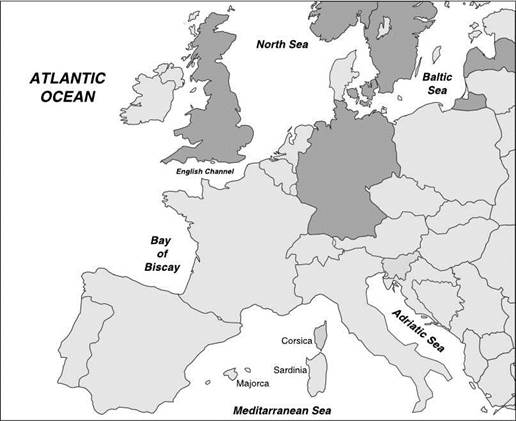
9. In the map below, which depicts Europe c. 1550, the dark shaded area most likely represents the regions
(A) most severely affected by the bubonic plague.
(B) most influenced by Gutenburg’s printing press.
(C) under Catholic influence.
(D) under Protestant influence.
(E) hardest hit by the Inquisition.
10. Under Oliver Cromwell, the government of England most closely resembled
(A) a constitutional monarchy.
(B) an absolute monarchy.
(C) a democracy.
(D) an oligarchy.
(E) a military dictatorship.
11. The immediate cause of the Parisian women’s march on Versailles was
(A) the women’s demands for suffrage.
(B) the women’s demands for an end to the violence.
(C) a shortage of money in Paris.
(D) a shortage of bread in Paris.
(E) the amassing of troops in Paris.
12. The Declaration of Pillnitz was issued in 1791 to
(A) support the revolutionaries in France.
(B) spread the revolutionary spirit across Europe.
(C) unite Europeans against Napoleon.
(D) invite European monarchs to restore the French king to the throne.
(E) demand the execution of the French king.
13. The diplomat who dominated the Congress of Vienna in 1815 was
(A) Prince Klemens von Metternich.
(B) Viscount Castlereagh.
(C) Napoleon Bonaparte.
(D) Prince Talleyrand.
(E) Otto von Bismarck.
14. A unified Italy was achieved only after
(A) a plebiscite in the Papal States and the support of the Two Sicilies for the union of the Italian states.
(B) Garibaldi and his Red Shirts attacked Rome and forced the capitulation of the Papal States.
(C) Victor Emmanuel III declared himself emperor of Italy.
(D) Napoleon III defeated Austria and ceded the land to Cavour.
(E) the Vatican had been granted sovereignty.
15. “Owing to this struggle (for existence), variations, however slight. . . will tend to the preservation of such individuals, and will generally be inherited by the offspring.” This statement refers to Darwin’s theory of
(A) survival of the fittest.
(B) origin of the species.
(C) descent of man.
(D) natural selection.
(E) special relativity.
16. The elimination of the Jews by the Nazis was known as Hermann Goring’s
(A) answer to prayers.
(B) Kristallnacht.
(C) final solution to the Jewish problem.
(D) blitzkrieg.
(E) NEP.
17. “God, gold, and glory” best describes the motivations of
(A) the papacy during the late nineteenth century concerning imperialism.
(B) Louis XIV’s military expansion.
(C) Napoleon Bonaparte’s military expansion.
(D) Peter the Great’s westernization of Russia.
(E) expeditions to the New World during the Age of Exploration.
18. The Ptolemaic System, which was challenged by Copernicus,
(A) placed the sun at the center of the universe.
(B) did not take into account the existence of God and His place in the physical universe.
(C) rejected the idea of epicycles of planetary objects.
(D) was rejected by the Church.
(E) was based upon a geocentric universe.
19. The junkers were
(A) soldiers from the Ottoman Empire.
(B) Russian peasants under Ivan IV.
(C) Russian peasants during Stalin’s rule.
(D) aristocratic German landowners.
(E) serfs on the Habsburg lands.
20. The Russians, to defeat Napoleon’s Grand Army, used a military strategy known as
(A) flanking maneuvers.
(B) divide and conquer.
(C) seek and destroy.
(D) scorched earth.
(E) slash and burn.
21. The Corn Laws
(A) allowed for free trade of agricultural products in Great Britain.
(B) reduced the price of bread in Great Britain.
(C) were welcomed with open arms and sighs of relief by the British.
(D) placed high tariffs on imported grain.
(E) benefited the working class more than any other class.
22. The primary targets of Bismarck’s Kulturkampf were
(A) Communists.
(B) Nationalists.
(C) Catholics.
(D) Protestants.
(E) Conservatives.
23. The imperialism of the late nineteenth century was greatly impacted and even encouraged by the theory of
(A) Social Darwinism.
(B) Aryan superiority.
(C) Communism.
(D) Socialism.
(E) Bolshevism.
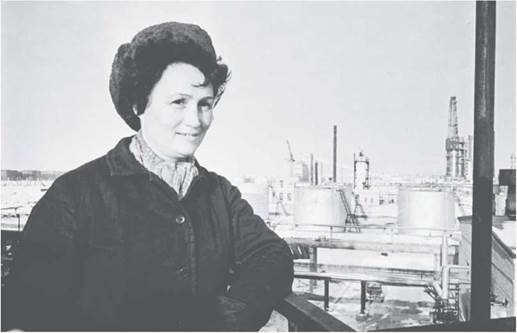
24. The poster on the next page most likely
(A) was used to encourage women to make frivolous purchases.
(B) was used to show the effects of factory work on women.
(C) depicted the way factories polluted the environment.
(D) persuaded women to turn their backs on industrialization.
(E) encouraged women to work in factories.
25. Luther would have most approved a woman
(A) staying at home to be a wife and mother.
(B) seeking election to a public office.
(C) holding a leadership position in a church.
(D) taking an active role in the leadership of a community.
(E) leading a woman’s suffrage movement.
26. Jethro Tull, Charles Townsend, and Robert Bakewell each played significant roles in the
(A) Price Revolution.
(B) Agricultural Revolution.
(C) Industrial Revolution.
(D) Glorious Revolution.
(E) Russian Revolution.
27. During the new “Republic of Virtue” following the French Revolution, the renaming of the days of the week and the months of the year reflected
(A) the desire to do away with traditions.
(B) the attempt to disassociate France with the Church.
(C) the attempt to return to classical Greek and Roman values.
(D) the desire to institute Napoleonic ideals concerning time.
(E) France’s attempts to emulate the United States.
28. With regard to Industrialization, Britain differed from countries of the Continent in that
(A) Britain practiced free trade and the countries of the Continent used protective tariffs.
(B) the countries of the Continent practiced free trade and Britain used protective tariffs.
(C) Britain lacked the capital of the other countries.
(D) railroads first made their impact on the Continent.
(E) Britain relied on an agrarian economy far longer than the Continent.
29. The Decembrists
(A) were Russians who defended Nicholas I from revolutionaries in 1825.
(B) sought woman suffrage in Russia and peacefully demonstrated for that cause in 1825.
(C) led the revolt that overthrew Czar Nicholas I in 1825.
(D) appealed to Czar Nicholas I for the preservation of serfdom in 1825.
(E) revolted in 1825 and sought a constitutional monarchy and the abolition of serfdom in Russia.
30. Count Camillo Cavour hoped to unify Italy by means of
(A) popular revolts against foreign rulers.
(B) a military alliance with France against Austria.
(C) a democratic plebiscite in all Italianspeaking areas.
(D) conquest of the Papal States and the Kingdom of Naples.
(E) a military alliance with Prussia against France.
31. The primary targets of Stalins purges were
(A) Catholics.
(B) Jews.
(C) Kulaks.
(D) Old Bolsheviks.
(E) Capitalists.
32. The European Economic Community, or Common Market, grew out of
(A) the European Coal and Steel Community.
(B) the North Atlantic Treaty Organization.
(C) the Warsaw Pact.
(D) the United Nations.
(E) OPEC.
33. The Medici family, a wealthy banking family of Florence, exerted their influence during
(A) the Renaissance.
(B) the Catholic Reformation.
(C) Italian Unification.
(D) the rule of Mussolini.
(E) the Cold War.
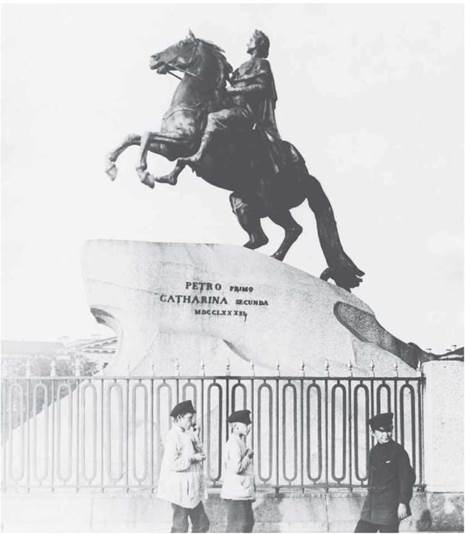
34. This statue of Peter the Great is most likely intended to
(A) show his great military prowess.
(B) show his enormous physical stature.
(C) intimidate visitors.
(D) symbolize his greatness and his leadership of Russia in a new direction.
(E) commemorate his love of horses.
35. John Locke’s idea of the human mind as a tabula rasa illustrated his belief that
(A) man can never really know anything.
(B) there are no innate ideas.
(C) God can wipe the slate clean for any who ask.
(D) the mind is resistant to influences from the external world.
(E) only deductive reasoning produces true knowledge.
36. The main purpose of Napoleon’s Continental System was to
(A) cripple continental nations by cutting them off from other continental nations.
(B) cripple Britain by cutting them off from the continent.
(C) establish an elaborate system of trade routes on the continent.
(D) develop a system by which he could move his massive armies across the continent quickly.
(E) bring the continent under one law code.
37. Romantics criticized the philosophes for
(A) the subjection of nature to endless rationalization and reason, thus suppressing emotion and feeling.
(B) being too emotional and sentimental.
(C) their fascination with all things medieval.
(D) their support of the Catholic Church.
(E) their fascination with things that seemed to exist beyond the reasonable, rational world.
38. Britain’s Prince Albert said, “Man is approaching a more complete fulfillment of that great and sacred mission which he has to perform in this world. . . to conquer nature to his use.” Prince Albert was referring to
(A) the Scientific Revolution.
(B) British Imperialism.
(C) the discovery of the New World.
(D) British conquest of Africa.
(E) the Industrial Revolution.
39. The importance of Giuseppe Mazzini to Italian history was his
(A) conservatism.
(B) resistance to the movement for Italian nationhood.
(C) zeal for Italian nationalism.
(D) resistance to Garibaldi and Cavour.
(E) overthrow of Austrian power in Italy.
40. At the onset of World War I, most people believed that
(A) the war would be over very quickly.
(B) the war would eventually involve nearly all European nations.
(C) the war had the potential to be the bloodiest war of all time.
(D) the crisis in the Balkans would escalate to a worldwide conflict because of the volatility of the issues.
(E) Germany intentionally started the war with the aim of conquering all of Europe.
41. While the bankers and merchants were the art patrons during the Renaissance, during the Middle Ages, the leading patron(s) of the arts
(A) were also the bankers and merchants.
(B) was the aristocracy.
(C) were the monarchs.
(D) was the Church.
(E) were the other artists.
42. The religious orders such as the Jesuits and the Ursuline Order were created
(A) to combat the spread of Protestantism.
(B) to find people who read books on the Index of Prohibited Books.
(C) as a tool in the Inquisition.
(D) to stop the spread of Nazism.
(E) to convert the Jews to Protestantism.
43. Henry IV said, “Paris is worth a mass,” referring to
(A) his conversion from Catholicism to Protestantism.
(B) his conversion from Protestantism.
(C) the issuance of the Edict of Nantes.
(D) his revocation of the Edict of Nantes.
(E) his baptism at the Notre Dame cathedral in Paris.
44. German princes were made sovereign rulers according to the
(A) Peace of Augsburg.
(B) Edict of Nantes.
(C) Peace of Westphalia.
(D) Six Articles.
(E) Council of Trent.
45. “The first principle to be followed by the monarchs, united as they are by the coincidence of their desires and opinions, should be that of maintaining the stability of political institutions against the disorganized excitement which has taken possession of mens minds... ” This statement most likely could be attributed to
(A) Napoleon Bonaparte.
(B) Giuseppe Garibaldi.
(C) Maximilien Robespierre.
(D) Oliver Cromwell.
(E) Klemens von Metternich.
46. Although the ostensible cause of the Crimean War was a dispute over the protection of certain Christian holy sites, the reason Britain and France entered the war was to
(A) support Russia in its attempt to crush the Ottoman Empire.
(B) prevent Russia from upsetting the European balance of power.
(C) prevent Austria from becoming the dominant power in the Mediterranean.
(D) maintain the Concert of Europe.
(E) prevent the defeat of Russia by the combined forces of Austria and the Ottoman Empire.
47. During the Second Industrial Revolution, women
(A) found many new job opportunities in factories.
(B) were forced to work in sweatshops or as prostitutes.
(C) were encouraged to give up domestic responsibilities in lieu of joining the work force.
(D) experienced a new sense of equality because their wages were nearly equal to those of the men.
(E) found lucrative new opportunities doing piecework in their homes.
48. The Soviet Union, after World War II,
(A) experienced the Western Renaissance.
(B) reinstated the totalitarian policies of the 1930s.
(C) underwent extensive social and cultural transformations.
(D) reinstated the political and economic policies of Lenin.
(E) granted political freedom to the nations of eastern Europe.
49. The European contact with the Americas
(A) led to cooperative efforts between European societies and Native American societies.
(B) eventually led to deflation in Europe.
(C) was primarily motivated by the desire to Christianize the inhabitants of the New World.
(D) led to the destruction of several American civilizations.
(E) relaxed tensions between such powers as Spain and Portugal.
50. For defending the sacraments against attacks by
the likes of Sir Thomas More, Pope Leo X bestowed the title of Defender of the Faith upon
(A) Martin Luther.
(B) Ignatius of Loyola.
(C) Mary Tudor.
(D) William Tyndale.
(E) Henry VIII.
51. One of the first great European novels was written during the Golden Age of Spain by
(A) Dante Alighieri.
(B) El Cid.
(C) Miguel de Cervantes.
(D) Sancho Panza.
(E) Don Juan.
52. During the reign of Elizabeth I, England’s main enemy was
(A) France.
(B) Spain.
(C) Germany.
(D) Portugal.
(E) Scotland.
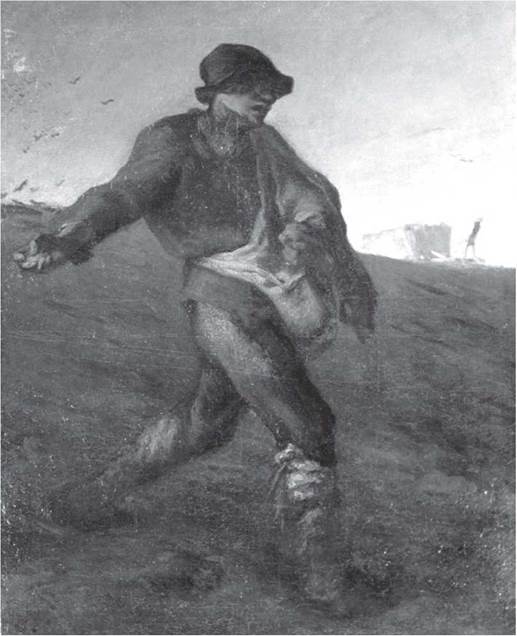
53. The painting on the next page, part of the realism movement, by Jean Francois Millet
(A) depicts a scene that usually would have been unidealized by other artistic movements.
(B) glorified women and the work they did in rural areas.
(C) was one of the most famous of the Renaissance period.
(D) was one of the most famous of the twentieth century.
(E) depicts a scene of Russian serfs before they were emancipated.
54. “Christianity has taken the side of everything weak, base, ill-constituted, it has made an ideal out of opposition to the preservative instincts of strong life.” This statement reflects the beliefs of
(A) Sigmund Freud.
(B) Adolf Hitler.
(C) Elie Wiesel.
(D) Friedrich Nietzsche.
(E) Otto von Bismarck.
55. The increased influence of military leaders in European nations in the years before World War I resulted from the
(A) nations’ desires for a return to order.
(B) collapse of the parliamentary system in Europe.
(C) spread of Communism and the threat of a violent Communist revolution.
(D) desire for a new avenue for social mobility.
(E) increased size and importance of the militaries in European nations.
56. The Truman Doctrine was intended to
(A) rebuild the nations that had been hardest hit by Allied bombs.
(B) offer assistance to those nations that had been attacked by Germany.
(C) offer economic assistance to nations who might need protection from Communism.
(D) ease the suffering of the children in cities that were hit by the German blitzkrieg.
(E) offer financial rewards to agents offering information about Communist governments.
57. The foundling hospitals in Paris and London were examples of the
(A) increased emphasis on caring for the mentally ill.
(B) desire to care for unwanted children.
(C) mobile military hospitals created during the Crimean War.
(D) advances made by Pasteur and Lister.
(E) facilities used by Nazis during the holocaust.
58. Baron de Montesquieu’s work The Persian Letters was typical of Enlightenment writings in that the
(A) author was open and honest about his feelings.
(B) real, critical message of the book was hidden behind a satirical story.
(C) author personally addresses the reigning monarch and called for reform.
(D) content was considered pornographic.
(E) author defended contemporary religious institutions from attacks by secular critics.
59. One of the most important features of the Enlightenment was the
(A) Jacobin clubs.
(B) Star Chamber.
(C) salons.
(D) court of Louis XIV.
(E) duma.
60. The Quadruple Alliance against Napoleon included all of the following EXCEPT
(A) Great Britain.
(B) Austria.
(C) Spain.
(D) Russia.
(E) Prussia.
61. For Germany, one of the most dynamic results of the Franco-Prussian War was the
(A) institution of social reforms throughout the German empire.
(B) institution of the zemstvos.
(C) institution of the Zollverein.
(D) rise of German nationalism.
(E) establishment of a standing army.
62. During the Victorian Age, the primary institution of the middle-class was the
(A) Church.
(B) university.
(C) family.
(D) workplace.
(E) parlor.
63. The issue addressed in Rudyard Kipling’s White Mans Burden is
(A) socialism.
(B) imperialism.
(C) nationalism.
(D) isolationism.
(E) appeasement.
64. Hitler’s motivations of space and race referred to his
(A) desire to put the first astronaut in space and his desire to eliminate subhuman races.
(B) desire to advance technologically and his desire to eliminate all subhuman races.
(C) attempts to race the other world powers to be the first in space.
(D) dream of conquering both nature and man.
(E) dream of more land for Aryans and the elimination of subhuman races to create that living space.
65. “. . . The force of gravity towards the whole planet did arise from and was compounded of the forces of gravity towards all its parts, and towards every one part was in the inverse proportion of the squares of the distances from the part.” This statement was made by
(A) Sir Isaac Newton.
(B) Jean Jacques Rousseau.
(C) René Descartes.
(D) Francis Bacon.
(E) Albert Einstein.
66. For René Descartes, existing things were related to either
(A) good or evil.
(B) government or anarchy.
(C) mind or body.
(D) classical ideas or contemporary ideas.
(E) man or woman.
Increase in European Population, 1700s
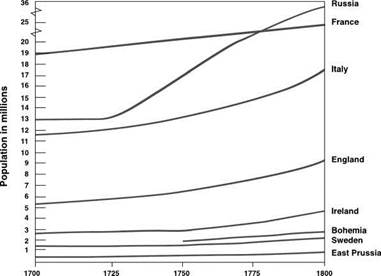
67. The huge increase in Russia’s population during the eighteenth century can be attributed to natural population increases and
(A) the agricultural revolution.
(B) the industrial revolution.
(C) the use of midwives in childbirth.
(D) territorial expansion.
(E) the reduction in the number of men who died in wars.
68. The open-field agricultural system was replaced by
(A) crop rotation.
(B) enclosure.
(C) the three-field system.
(D) the manorial system.
(E) slash and burn farming.
69. The concordat between Napoleon and Pope Pius VII
(A) gave the clergy the option to declare their loyalty to the state.
(B) satisfied the pope’s wishes for post-war France.
(C) established the dominance of the Catholic Church in France.
(D) required Rome to pay the salaries of the bishops.
(E) stated that Catholicism was the religion of the majority of French citizens.
70. The Zollverein was which of the following?
(A) The lower house of the German parliament
(B) A customs union that encouraged trade among German states
(C) A Russian unit of local government dominated by the lower classes
(D) A tariff that restricted trade among the German states
(E) A tariff that restricted imports from non- German states
71. The total war effort in World War I caused all of the following EXCEPT the
(A) rise of the status of women.
(B) realization that socialism was a workable economy for European governments.
(C) increase in the destructive powers of the nations fighting the war.
(D) faster resolution of the conflict.
(E) increased profits for many businesses and industries.
72. In the Spanish Civil War of 1936, General Francisco Franco received assistance from
(A) the United States.
(B) Russia.
(C) the pope.
(D) Hitler and Mussolini.
(E) Great Britain.
73. The time when Parliament ensured that no monarch would ever rule again without Parliament’s assistance and guidance was the
(A) Supremacy Act.
(B) Long Parliament.
(C) Short Parliament.
(D) Great Charter.
(E) Glorious Revolution.
74. Although Cardinal Richelieu and France were both Catholic, Richelieu supported Protestants elsewhere because he
(A) secretly had converted to Protestantism.
(B) felt sympathy for the Protestants who had suffered at the hands of Catholics.
(C) tried to achieve a favorable balance of trade by doing business with Protestants.
(D) conspired with foreign Protestants to overthrow Louis XIII.
(E) pursued an anti-Habsburg foreign policy.
75. The revocation of the Edict of Nantes, originally intended to be a political and religious move, eventually turned out to be a military blunder because
(A) the Catholics rose up against the French government.
(B) the Huguenots rose up against the French government.
(C) many of the exiled Huguenots joined other militaries and eventually fought against France.
(D) England came to the defense of the Huguenots.
(E) Spain attacked the French fleet that carried the Huguenots away from France.
76. The so-called print culture played a major role in the development and spread of the
(A) Reformation.
(B) Scientific Revolution.
(C) Industrial Revolution.
(D) Enlightenment.
(E) Age of Anxiety.
77. The British Combination Acts of 1799 and 1800 outlawed
(A) exploitation of children in the factories.
(B) exploitation of women and children in the factories.
(C) labor organizations.
(D) protective tariffs.
(E) free-trade practices.
78. Because of the restoration of the nobility and the Romantics’ fascination with the Middle Ages,
(A) people turned away from religion during the age of Romanticism.
(B) Catholicism experienced a revival during the age of Romanticism.
(C) Catholicism experienced a sharp decline during the age of Romanticism.
(D) governments began outlawing religious worship during the age of Romanticism.
(E) Protestant-Catholic wars of religion erupted in Western Europe.
79. The leader of Czechoslovakia when the Soviet Union invaded in 1968 was
(A) Marshall Tito.
(B) Lech Walesa.
(C) Alexander Dubcek.
(D) Gustav Husak.
(E) Vaclav Havel.
80. The foundation of Mikhail Gorbachev’s reforms was perestroika, or
(A) the imposition of high tariffs on foreign goods in order to protect the Soviet economy.
(B) the heating up of the arms race with the West.
(C) the restructuring of the Soviet economy to allow for some private property and some free enterprise under a limited market economy.
(D) the openness toward western culture and ideas.
(E) free trade with all European nations.
END OF SECTION I.
If you have time, you may go back and review your answers.
Section II Total Time-1 30 Minutes 3 Questions
Directions: The following question is based on the accompanying documents 1-11. (Some of the documents have been edited for the purpose of this exercise.) Write your answer on the lined pages of the pink essay booklet.
This question is designed to test your ability to work with historical documents. As you analyze the documents, take into account both the sources of the documents and the authors’ points of view. Write an essay on the following topic that integrates your analysis of the documents. Do not simply summarize the documents individually. You may refer to relevant historical facts and developments not mentioned in the documents. Take 15 minutes to read all documents and 45 minutes to write your essay.
Part A
1. Describe and analyze the views of those involved in the women’s suffrage movement in England in the late nineteenth and early twentieth centuries.
Historical Background: In the 1830s and 1840s, the Chartists unsuccessfully called for women’s suffrage. Throughout the rest of the nineteenth century, other prominent individuals, such as John Stuart Mill, advocated women’s suffrage, but leaders such as Queen Victoria, William Gladstone, and Benjamin Disraeli opposed a woman’s right to vote. In 1897, the cause gained momentum when several suffrage groups merged to form the National Union of Woman Suffrage Societies.
Document 1
From a magazine article, The Lancashire Factory Girl, written by Selina Cooper in 1898
I have often heard the ‘sarcastic’ remark applied to the factory worker, “Oh she is only a factory girl,” thus giving the impression to the World that we have no right to aspire to any other society but our own. I am sorry to say that we are not fully awakened to the facts that we contribute largely to the nation’s wealth, and therefore demand respect and not insult. For in many a Lancashire home are to be found heroines whose names will never be handed down to posterity; yet it is consoling to know that we as a class contribute to the world.
Document 2
From the book Women and Socialism written by Isabella Ford in 1906
The Socialist movement, the Labour movement, call it which you will, and the Women’s movement, are but different aspects of the same great force which has been, all through the ages, gradually pushing its way upwards, making for the reconstruction and regeneration of Society.
Document 3
From a speech given in 1913 by the Reverend Rupert Strong
The movement for women’s suffrage was one of vital importance to the morality and welfare of the nation. I believe women should have some share in the government in order to promote clean living.
Document 4
An excerpt from a letter written to a newspaper in 1914
The impression is given that this and other countries are at war with one another. They are not. Their governments, composed of men and responsible only to the men of each country, and backed by the majority of men who have caught the war and glory fever, have declared war on one another. The women of all these countries have not been consulted as to whether they would have war or not. If men deliberately shut out women, the peace-loving sex, from their rightful share in ruling their countries, then all the appeals and sentiments and prayers will be of no avail in preventing hostilities.
Document 5
From a speech given by a woman suffragist and reported by The East Grinstead Observer in 1918
As an industrial worker, and since as a wife and mother, she realized how much legislation concerned her... women had expert knowledge to enable them to deal with great reform. Take the housing problem, a woman was far more likely to detect anything lacking in a house than a man was. They needed women’s idea of economy and her grasp of detail.
Document 6
From the book Unfinished Adventure by Evelyn Sharp in 1933
At first, all I saw in the enfranchisement of women was a possible solution of much that subconsciously worried me from the time when, as a London child, I had seen ragged and barefoot children begging in the streets...
When the early sensational tactics of the militants focused my attention upon the political futility of the voteless reformer, I joined the nearest suffrage society, which happened ironically to be the non-militant London Society.
When militants and non-militants alike hastened to offer war service to the Government, no doubt many of them felt, if they thought about it at all, that this was the best way of helping their own cause. Certainly, by their four years’ war work, they did prove the fallacy of the anti-suffragist’ favorite argument, that women had no right to a voice in questions of peace and war because they took no part in it.
Document 7
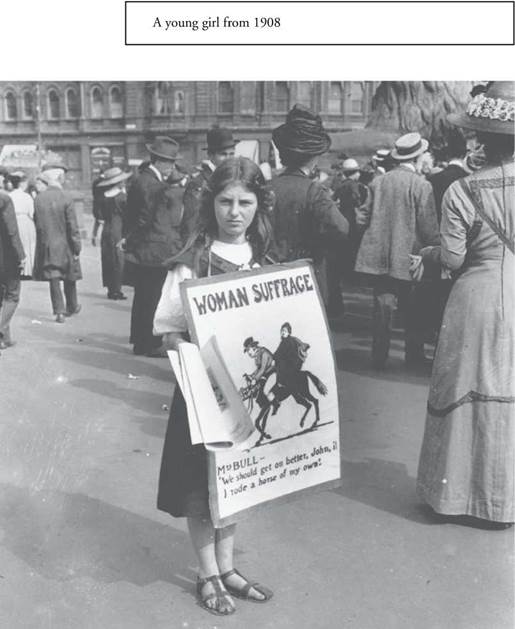
Document 8
A selection written by Mary Humphrey Ward and published in the February 1909 edition of The Times
Women’s suffrage is a more dangerous leap in the dark than it was in the 1860s because of the vast growth of the Empire, the immense increase of England’s imperial responsibilities, and therewith the increased complexity and risk of the problems which lie before our statesmen—constitutional, legal, financial, military, international problems—problems of men, only to be solved by the labour and special knowledge of men, and where the men who bear the burden ought to be left unhampered by the political inexperience of women.
Document 9
From a report of a meeting of Parliament published in May 1911
The speaker said that women had never possessed the right to vote for Members of Parliament in this country nor in any great country, and although the women’s vote had been granted in one or two smaller countries, such as Australia and New Zealand, no great empires have given women’s a voice in running the country. Women have not had the political experience that men had, and, on the whole, did not want the vote, and had little knowledge of, or interest in, politics. Politics would go on without the help of women, but the home wouldn’t.
Document 10
A published summary of a statement made by Lady Musgrave, President of an Anti-Suffrage League in 1911
Lady Musgrave, President of the East Grinstead branch of the Anti-Suffragette League said she was strongly against the franchise being extended to women, for she did not think it would do any good whatsoever, and in sex interests, would do a lot of harm. She quoted the words of Lady Jersey: “Put not this additional burden upon us.” Women were not equal to men in endurance or nervous energy, and she thought she might say, on the whole, in intellect.
Document 11
From a newspaper report of a 1911 Anti-Suffrage Society meeting
There was a large attendance—chiefly of ladies—at the Queen’s Hall on Friday afternoon, where there was a debate on Women’s Suffrage. Mr. Charles Everard presided. Mr. Maconochie spoke against the extension of the franchise to women. Mr. Maconochie was opposed to suffrage because there were too many women to make it safe. There were 1,300,000 more women than men in the country, and he objected to the political voting power being placed in the hands of women.
Directions: Choose ONE question from this group. The suggested writing time for this question is 30 minutes. You are advised to spend 5 minutes planning your answer in the space provided. Use specific examples to support your answer.
Part B
2. “The Reformation was not only a religious movement but also a political and economic movement.” Assess the validity of this statement.
3. Evaluate the revolutionary nature of the Scientific Revolution in Europe.
4. Analyze and discuss the origins of nationalism in Europe during the Napoleonic Era and the role of nationalism in the fate of Napoleon.
Directions: Choose ONE question from this group. The suggested writing time for this question is 30 minutes. You are advised to spend 5 minutes planning your answer in the space provided. Use specific examples to support your answer.
Part C
5. Choose TWO of the following people and analyze their political goals, their methods, and the degree to which they succeeded in reaching those goals:
Prince Klemens von Metternich
Camillo de Cavour
Otto von Bismarck
Napoleon III
6. Discuss the extent to which music, art, and literature reflected the feelings and thoughts of Europe in the early twentieth century. Use specific examples to support your answer.
7. Analyze and discuss the steps taken by Western Europe toward economic recovery in the second half of the twentieth century.
END OF TEST