
In this chapter, we will examine each of the three types of questions you will encounter on the test: multiple-choice questions, document-based questions, and thematic essays. We will take you step by step through each type of question and show you not only what to expect, but also what the graders of the exam will expect from you. In addition, we will show you exactly how to attack each type of question successfully.
THE MULTIPLE-CHOICE SECTION
The first section of the AP European History test consists of 80 multiple-choice questions that test the entire period of European history that is covered in the AP course (from 1450 to the present). The multiple-choice section counts as 50 percent of your exam grade, and you are allowed 55 minutes to complete the section.
The questions on this section of the exam have been carefully designed and organized by the test-making team at the College Board. Questions aren’t scattered haphazardly throughout the exam, they’re presented in a precise order that is based on chronology and level of difficulty.
Chronology
The multiple-choice questions are placed together in small groups. Within each group, the questions are arranged roughly in chronological order. For example, the first question in a given group may cover the Reformation, while one of the questions in the middle of the group may address the Industrial Revolution. The final question in the group may ask about the post-Cold War Soviet Union. You should be aware that a new group of questions has begun when the the questions change from a more modern subject to one from the very earliest part of the AP European History course.
The multiple-choice section covers the period of time from 1450 to the present and does not only deal with particular topics within that time period. You can count on the questions to be rather consistent in at least one respect. Approximately half of the multiple-choice questions will focus on the time period from the Renaissance through the French
Revolution/Napoleonic Era. Therefore, approximately one half of the questions will focus on the time period from the French Revolution/Napoleonic Era to the present. Not all of the multiple-choice questions will focus on one era or time period. Some questions will require you to draw on your knowledge of a topic or an issue that spans several periods of history.
Level of Difficulty
The multiple-choice section of the AP test has been designed so that the first questions in the section are relatively easy, with an increasing level of difficulty as you proceed. Don’t be lulled into a false sense of security by the simplicity of the first few questions. Because the questions toward the end of the multiple-choice section will be difficult and complex, concentrate on making good decisions in the early stages of the multiple-choice section in order to bolster your score. In other words, take advantage of the less difficult questions up front to compensate for questions you may not know toward the end of the section.
You must also remember that you will most certainly encounter questions about a topic or a subject with which you are not familiar. THAT IS OK. The test-makers designed the questions in the multiple-choice section to test the limits of your knowledge. The test is not designed to trick, frustrate, or overwhelm you, but to find out what you know and what you don’t. If you need a score of 3 on the exam, you only need to focus on the first 60 questions and try to correctly answer as many of those as you possibly can. If you want a 4, focus on the first 70 questions, and if you want a 5, try to get as many correct as you can on the entire section. In other words, you can miss several questions and leave several questions unanswered without really hurting your chances for a good score.
Themes Tested by Multiple-Choice Questions
The questions in the multiple-choice section test knowledge in all three themes of AP European History (intellectual and cultural history, political and diplomatic history, social and economic history) and the number of questions that deal with each theme is fairly predictable. Between 20 and 30 percent—16 to 24 questions—of the multiple-choice section will deal with cultural and intellectual topics or subjects. Between 30 and 40 percent, or 24 to 32 questions, will test political and diplomatic topics or subjects. The remaining 30 to 40 percent of the questions will address social and economic topics or subjects. Remember that some questions require knowledge of a topic from the perspective of more than one theme. Also remember that the themes will not appear in any particular order throughout the section, so don’t read anything extra into the questions based on the themes you see.
Types of Multiple-Choice Questions
The AP European History test contains several different types of multiple- choice questions. You should understand, though, that the types of questions are very predictable. In other words, you can expect to see several of each of the following types of multiple-choice questions: identification, analysis, reading-based, EXCEPT, and illustration-based. This section will break down each and provide a strategy for answering each type of question.
Identification Questions
The most common type of multiple-choice question is one that asks you to identify something. You could be asked to identify a person and his ideas, an invention or development and its historical period, a group of people and their actions, or any other person, place, thing, or event that has particular historical importance. A basic knowledge of the topic is all that is required to correctly answer an identification question. Detailed analysis is not necessary to choose the correct answer or to eliminate possible wrong answers. Here is a good example:
The writings of Mary Wollstonecraft argued
(A) that Christian women should devote themselves to the proper maintenance of the household.
(B) for equality among the sexes.
(C) against women in the workplace and institutions of higher learning.
(D) that France should restore the rights of the ancien regime.
(E) that women of the lower classes should serve the women of the upper classes.
The correct answer is (B). To answer the question, you must know that Mary Wollstonecraft was a women’s rights advocate. Even without knowledge of Wollstonecraft’s specific political agenda or the names of any of her writings, you can answer this correctly by knowing that she was a champion of women’s rights.
Analysis Questions
Another common type of multiple-choice question, the analysis question, is one that requires you to break down a larger topic into more basic elements. The analysis question tests your ability to draw conclusions and determine causation. A question of this nature may require you to analyze an event for cause and/or effect or to analyze a treaty to determine its results or effects. You can answer this type of question if you have less specific knowledge of a topic and a broader understanding of trends, relationships, or the big picture. By using context clues, knowledge of the topic, and knowledge of the chronology of the question and the answer choices, you can eliminate wrong answers and choose the correct answer. Below is an example of this type of question:
The Treaty of Versailles (1919)
(A) convinced the United States to join the League of Nations.
(B) placed blame on several major European countries for the outbreak of war.
(C) never really settled the issues that originally led to the war.
(D) allowed Germany to keep all of its territories and colonies.
(E) created the United Nations.
The correct answer is (C). The example above requires you to examine each answer choice and determine its validity. By analyzing the provisions of the Treaty of Versailles (1919), you can determine that the treaty never settled the issues that caused World War I, resulting in the outbreak of World War II only twenty years later. If you don’t know the answer immediately, you can use the process of elimination to disqualify some—if not all—of the incorrect answers. For example: The Treaty of Versailles (1919) actually deterred the United States from joining the League of Nations, so if you know about the treaty and the League of Nations, you can eliminate choice (A). If you remember that Germany shouldered all the blame for World War I and that Germany lost much of its territory, choices (B) and (D) can be eliminated as well. If you use your knowledge of twentieth-century chronology and remember that the United Nations came into existence after World War II, which obviously ended many years after 1919, choice (E) can be eliminated, leaving choice (C), the correct answer.
Reading-Based Questions
Several questions on the AP exam will require you to read a quote or a passage from a piece of literature and identify the author, the religion, or the philosophical school of thought to which it is attributed. If you recognize the quote or the passage, the correct answer should be easy to find. If the quote or passage seems unfamiliar, you should look for key words or clues within the passage that might indicate authorship or the ideology represented. Questions of this nature are generally very answerable. This is a typical question involving a quote or reading sample:
“The modern bourgeois society that has sprouted from the ruins of feudal society has not done away with class antagonisms.
It has but established new classes, new conditions of oppression, new forms of struggle in place of old ones.”
The quotation is from the writings of
(A) Machiavelli.
(B) Sartre.
(C) Darwin.
(D) Locke.
(E) Marx and Engels.
The correct answer is (E). This question uses a passage that may not be immediately recognizable to you. However, the theme of the passage is clearly that of class struggles. You should be able to associate the theme of class struggles with Marx and Engels to correctly select choice (E) as the answer, but if you did not recognize the passage as that of Marx and Engels, you could, again, use the process of elimination to narrow down the choices. You should be able to identify Machiavelli with style of government or behavior of a ruler, Sartre with twentieth-century philosophy, Darwin with natural selection, and Locke with natural rights. By eliminating all of these as wrong answers, you are left with choice (E).
EXCEPT Questions
There is one question type that can really catch you off-guard if you’re not prepared: the EXCEPT question. EXCEPT questions are tricky because they ask you to throw traditional test-taking logic out the window. Rather than looking for a correct answer choice, you’re supposed to choose one that doesn’t fit the statement or question. Fortunately, these questions will all end with the word EXCEPT, but they can still be a little confusing. When you encounter an EXCEPT question, circle the word EXCEPT in the test booklet to remind you of what you’re really being asked. Here is an example of the EXCEPT question type:
Martin Luther believed all of the following EXCEPT
(A) each man’s eternal fate has been predestined.
(B) salvation is granted by the grace of God.
(C) women should be good wives and mothers.
(D) indulgences had no place in the church.
(E) the Catholic church was in need of reform.
The correct answer is (A). Be careful! If you’re not paying close attention, you may read the name “Martin Luther” and hastily choose the first right answer you see. Recognize that this is an EXCEPT question and start looking for the answer choice that is not a belief of Martin Luther’s. All of the answers are in line with Luther’s conservative, protestant beliefs except choice (A), which you should recognize as the theology of Calvin. It is extremely important when you come across an EXCEPT question to read all of the possible answers before choosing one, even if the first answer appears to be correct.
Illustration-Based Questions
The final type of question that the College Board includes on the AP exam requires the interpretation of an illustration. Illustrations that may appear on the multiple-choice section of the AP European History exam include maps, graphs, charts, political cartoons, posters, photographs, and works of art, such as paintings and sculptures. These questions are usually very straightforward, so avoid trying to read too much into the illustrations. Here is an example of a question that uses an illustration:
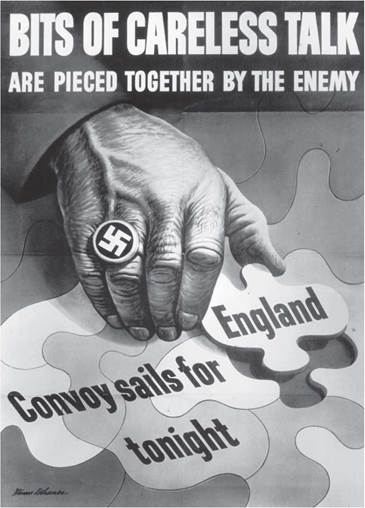
The poster on the previous page reflects the idea that
(A) Hitler controlled all of Europe.
(B) German citizens should be on the look-out for spies.
(C) indiscriminate conversation may allow Hitler to learn valuable secret information.
(D) prisoners of war should avoid confessions so as not to give information to the enemy.
(E) Hitler has the power to solve the problems of Europe.
The correct answer is (C). By carefully studying the poster and then carefully reading each answer, you should be able to glean the information you need to make the correct choice. Let’s examine the poster. Notice the way the poster depicts the German hand, signified by the Nazi ring, as dark and menacing. The hand is putting together a puzzle which, when complete, reveals a message. By putting this message in historical context, you should see that a message such as the one in the puzzle might aid Hitler’s efforts and harm the efforts of the Allies. The text at the top of the poster serves as a warning to citizens not to carelessly reveal any information about the Allied war efforts. The enemy, Hitler and his forces, might be able to piece together a large amount of information from small pieces of information (the pieces of the puzzle). Based on these observations of the poster and your historical knowledge of World War II, you should be able to identify choice (C) as the correct answer. Choice (A) is incorrect because the hand is putting together a puzzle with a message, not moving about puzzle pieces that represent European countries. Choice (B) is incorrect because a poster meant for German citizens would be written in German. Choice (D) is incorrect because propaganda posters were used to send messages to citizens on the home front, not prisoners of war. Choice (E) is incorrect for the same reason choice (A) is incorrect. You might also use the process of elimination to discard all the incorrect answers. Either way, by taking your time and thinking about each answer, you can choose the right answer—not only on this example but also on any question like this you may encounter.
SCORING THE MULTIPLE-CHOICE SECTION
The multiple-choice section contains 80 questions and counts as one half of the exam grade. Each question answered correctly will earn you one point; therefore, the highest possible score on the section is 80 points. You earn no points for questions that are not answered at all, and you are penalized one fourth of a point for each incorrect answer. The penalty is to correct the score for random guessing. Basically, if you hope to make a 3 on the exam, you need to correctly answer 50 percent of the multiple- choice questions (in addition to demonstrating competency on the free- response section).
GUESSING ON THE MULTIPLE-CHOICE SECTION
Because the scoring system for the multiple-choice section of the AP European History Test penalizes for incorrect answers, some people think that guessing is a foolish thing to do. Granted, blind, random, shot-in- the-dark guessing is probably not the most advisable approach to take if you want a high score, BUT educated, calculated guesses can prove to be valuable on this section of the exam.
If you cant eliminate any of the choices by identifying them as incorrect, skip the question altogether. On most questions, however, you will probably be able to eliminate at least one or two of the potential answers. If you guess after two of the incorrect answers have been eliminated, the chances of guessing the correct answer have been improved from a shaky one-in-five chance to a much better one-in-three chance. If you can eliminate three wrong answers, which is a very good possibility on many questions, the chances of guessing the correct answer improves to one-in-two—you’ve got a 50-50 shot.
Consider this scenario: If you were to eliminate three wrong answers on four different questions and then guess on each of those four questions, the odds are that you would answer two questions correctly and two questions incorrectly. You would get two points for the two correct answers and would be penalized one-half of a point for the two incorrect answers. Instead of receiving no points for leaving the four questions blank or guessing randomly on all four questions and possibly receiving a penalty of minus two points, you would net one and one-half points. You can see from this example that it is beneficial to be aggressive and attack the multiple-choice section instead of being intimidated by it. Just remember not to guess blindly; instead, try to eliminate incorrect answers and make an educated guess from the remaining answers.
HINTS AND STRATEGIES FOR MASTERING THE MULTIPLE-CHOICE SECTION
1. Read the question carefully. Make sure you know exactly what the question is asking. Sometimes you can even pick up clues by the other words in the sentence.
2. Read each answer choice carefully. Read all the answers before making your final choice. Some wrong answer choices may contain words or phrases that make the answer appear correct at first glance. Only by slowing down to get the full meaning can you be sure to choose the best answer.
3. As you read each question, underline or circle the key ideas or key words in the question. This will help to reinforce the ideas in your mind before you read the answer choices.
4. When you come to an EXCEPT question, circle the word EXCEPT to reinforce what the question is asking you to find among the answer choices.
5. As you eliminate incorrect answers, cross them out. Do this on every question except for the easiest questions. (The answers to the easiest questions should be obvious to you.)
6. Go with your first instinct. Your first choice is usually the correct choice. Be confident in your ability to answer the question correctly.
7. Make educated guesses only after you have eliminated some of the incorrect answers. Don’t guess blindly.
8. Choose the best answer. Sometimes two or more answers may seem as if they could answer the same question, but each question will have one answer that is better than the others.
9. Don’t spend too much time on one question. You do not have to answer every question and you will not be penalized for questions left unanswered. Circle any question you leave unanswered and come back to it later if you have time.
THE FREE-RESPONSE SECTION
The second section of the exam is the 2 hour and 10 minute free-response section, which includes a Document Based Question (DBQ) and two thematic essay questions. As with the multiple-choice section, the free-response section counts as 50 percent of your exam grade. This section begins with a MANDATORY 15-minute reading period. After the 15-minute reading period, you will begin Part A, the Document Based Question, for which you will be allotted 45 minutes to write your essay. You will have 70 minutes in Part B to write two thematic essays. We will examine in detail each part of the free-response section in the following sections of this book.
ORGANIZATION OF YOUR THOUGHTS
Before we get to each part of the free-response section, let’s consider the writing strategy you will need to be successful on the exam. First, before you start writing on your exam, use the 15-minute reading period to organize your thoughts. After all, the 15-minute reading period is mandatory! Use this time to read through the directions, the background information and the question in the DBQ, the DBQ documents, and the thematic essay questions. Start thinking about how you want to organize your thoughts on the DBQ.
In the following sections, well show you how to interpret the different types of essay questions you will see and how to develop your thesis. Well also show you how to use a chart or grid to organize your thoughts on the DBQ and how to use an outline for the DBQ and the thematic essays. Don’t underestimate the power or value of organization on this part of the exam! One of the secrets to quality writing is being clear, concise, and organized.
Types of Free-Response Questions
To write a great essay that answers the question, you first must know what the question is asking. In other words, it is important for you to know exactly what types of questions the exam will ask you as well as the vocabulary the questions will contain. The secret to correctly interpreting questions is actually not a secret at all. To correctly interpret questions, you simply need to be familiar with the vocabulary found in typical AP essay questions. Let’s look at the most common essay question vocabulary, in no particular order, and see what each means.
Describe Questions
The word describe requires you tell about, or give an account of, something. In other words, when asked to describe something, you should paint a picture using words. Example: “Describe the economic and social conditions of the French urban poor and rural peasants in the months and weeks prior to the French Revolution.”
Explain Questions
The word explain is your signal to discuss the meaning of or clarify something. Another option would be to give greater detail. Example: “Explain the effects of the printing press on the spread of religion and literacy throughout Western Europe in the late fifteenth century.”
Compare and Contrast Questions
In everyday usage, many people use the words compare and contrast interchangeably. However, that usage is erroneous. Remember that the two words have two very different meanings. Compare means identify the similarities between two or more things, while contrast means find the dissimilarities, or differences, between two or more things. The test- makers and readers know the difference between the two words and they expect you to, as well. These words are frequently used together in the same question, but that does not change the meanings. Example: “Compare and contrast the extent to which Louis XIV and Peter the Great were absolute monarchs.”
Discuss Questions
When asked to discuss a topic, you should write about the topic and include a treatment of more than one point of view. When you discuss a subject, you should address the pros and cons or different sides of the subject. Example: “Discuss the Marshall Plan and its effects on Western Europe, particularly Germany.”
Assess Questions
When you are asked to assess something, frequently a statement or generalization, you must evaluate that statement. In other words, you should judge the character, validity, or reliability of a statement or generalization. Example: “‘The Scientific Revolution was not a scientific revolution but an intellectual revolution.’ Assess the validity of this statement. Include facts in your assessment that support your argument.”
Analyze Questions
Some of the most common essay questions are those that require you to analyze. When you analyze something, be it an event, a trend, or something else, you are to break it down to its most basic elements or components. You should also examine the relationship between the elements or between the components and the whole. Quite often you will be asked to examine a cause-and-effect relationship. Example: “Analyze the key developments of the Industrial Revolution that occurred in Europe in the early nineteenth century.”
Devoloping Your Thesis
To write a good essay in the free-response section, you must include a good thesis. Your thesis may be the most important part of any essay you write on the exam. Your thesis should set the tone for the rest of the essay and, more importantly, your thesis should tell the reader exactly what you are about to say in your essay.
When writing your thesis, answer the question that is being asked. Do not simply restate the question. This may seem simplistic, but AP readers report that the most common mistake made by test-takers is the use of a thesis that does not answer the question. The readers are looking for an original thought, argument, or a statement based on facts or evidence. Without a good thesis, your essay will be mediocre, at best. With a good thesis, your essay will be well on its way to a great score!
Now that you have an idea about how to organize your thoughts for the essays, let’s move on to each of the types of questions in the free- response section, the DBQ, and the thematic essays.
PART A: THE DBQ
Part A of the free-response section is the Document Based Question, or DBQ. The DBQ counts as 45 percent of your free-response score. After a mandatory 15-minute reading period, you are given 45 minutes in which to write your answer.
What Is a DBQ?
The DBQ is a unique question that requires both analysis and synthesis. Basically, a DBQ presents a question followed by some historical background information and several historical documents. In the past few years, the number of documents has been between ten and twelve. You are to read these documents, analyze the information provided by the documents, and then answer the question based upon your analysis. The purpose of the DBQ is not to test your knowledge of the subject of the documents. Rather, the DBQ tests your ability to work with historical evidence and formulate an answer to the question based upon that evidence. In other words, the DBQ requires you to act as a historian who must piece together information to shed light upon a particular topic. And, just like with the work of a historian, there will be no single right or wrong answer to a DBQ. Instead, your answer will be graded according to a rubric, which we will explain later in this section.
Sample DBQ
Let’s look at a good example of a DBQ. We’ll use the following DBQ through- out the rest of this section to show you how to interpret the question, organize your thoughts with a chart, develop a thesis, and write the essay. Part A of the free-response section will look very much like the following DBQ, including the directions, structure of the question, and the types of documents. Carefully read the following Document Based Question and pay close attention to the directions, the question, and the documents.
Directions: The following question is based on the accompanying Documents 1-12. (Some of the documents have been edited for the purpose of this exercise.)
This question is designed to test your ability to work with historical documents. As you analyze the documents, take into account both the sources of the documents and the authors’ points of view. Write an essay on the following topic that integrates your analysis of the documents. Do not simply summarize the documents individually. You may refer to relevant historical facts and developments not mentioned in the documents.
1. Analyze and discuss how the issue of child labor in factories was perceived by different groups during the Industrial Revolution in Great Britain.
Historical Background: In the early nineteenth century, Great Britain found herself in the midst of sweeping industrial change. Machines were replacing workers and workers were needed to operate new machines. Many factory owners turned to children, instead of adult laborers, to fill their factories.
Document 1
From a speech by Henry Thomas Pope to the House of Commons, 1832
It is obvious that, if you limit the hours of labour, you will, to nearly the same extent, reduce the profits of the capital on which the labour is employed. Under these circumstances, the manufacturers must either raise the price of the manufactured article or diminish the wages of their workmen. If they raise the price of the article the foreigner gains an advantage. I am informed that the foreign cotton-manufacturers, and particularly the Americans, tread closely upon the heels of our manufacturers.
Document 2
An advertisement that appeared in The Derby Mercury on September 20, 1781.
Wanted at Cromford. Forging & Filing Smiths, Joiners and Carpenters, Framework-Knitters and Weavers with large families. Likewise children of all ages may have constant employment. Boys and young men may have trades taught them, which will enable them to maintain a family in a short time.
Document 3
From a speech by Lord Francis Egerton to the House of Commons, 1836
I perceive that the growth of the cotton manufacture in America has proceeded with a rapidity almost equal to our own, and that of France, although the progress has not been so great, it is still but little short, and quite sufficient to make me deeply apprehensive. I therefore think that any legislation by which our manufactures are likely to be effected, we should keep the increased production of foreign countries closely in view.
Document 4
From a speech by William Bolling to the House of Commons, 1836
I mistrust interference on behalf of the poor which the poor are themselves to pay for. Let the question be presented honestly and fairly. Let the parents of factory children know that the diminishing of the hours of daily toil must diminish the amount of weekly pay. Certainly, there are cases of hardship and oppression, but I dislike all cases of legislative interference between master and man—between parent and child. And, moreover, all such interference would be unsuccessful. Your laws to regulate wages, and hours of labour, and conditions of contract for work—they are merely cobwebs broken through at will— because it is the interest of master and servant that they should be broken. Cultivate commerce with all the nations of the world; this will raise wages and will prevent the necessity for exhausting labour.
Document 5
From The Philosophy of Manufactures by Andrew Ure, 1835
I have visited many factories, both in Manchester and the surrounding districts, during a period of several months and I never saw a single instance of corporal punishment inflicted on a child. The children seemed to be always cheerful and alert, taking pleasure in using their muscles. The work of these lively elves seemed to resemble a sport. Conscious of their skill, they were delighted to show it off to any stranger. At the end of the day’s work they showed no sign of being exhausted.
On my recent tour through the manufacturing districts, I have seen tens of thousands of old, young and middle-aged of both sexes earning abundant food, raiment, and domestic accommodation, without perspiring at a single pore, screened meanwhile from the summer’s sun and the winter’s frost, in apartments more airy and salubrious than those of the metropolis in which our legislature and fashionable aristocracies assemble.
Document 6
A chart showing the weights of children factory workers and children not working in factories.
Age |
Average Weight of Males in Factories |
Average Weight of Males Not in Factories |
Age |
Average Weight of Females in Factories |
Average Weight of Females Not in Factories |
9 |
51.76 |
53.26 |
9 |
51.13 |
53.44 |
10 |
57.00 |
60.28 |
10 |
54.80 |
54.44 |
11 |
61.84 |
58.36 |
11 |
59.69 |
61.13 |
12 |
65.97 |
67.25 |
12 |
66.08 |
66.07 |
13 |
72.11 |
75.36 |
13 |
73.25 |
72.72 |
14 |
77.09 |
78.68 |
14 |
83.41 |
83.43 |
15 |
88.35 |
88.83 |
15 |
87.86 |
93.61 |
Document 7
Resolution passed by the Leeds Short Time Committee, 1831
The ten hour day would equalise labour by calling into employment many male adults, who are a burden on the public, who, though willing and ready to work, are obliged to spend their time in idleness, whilst children are compelled to labour from twelve to sixteen hours per day.
Document 8
A letter by Richard Oastler published in the Bradford Observer, July 17, 1834
The mill-owners obtained their wealth by overworking and by defrauding the factory children. They were praying people, but took care their work people should neither have time nor strength to pray. These hypocrites pretended it was necessary to keep these poor infant slaves at this excruciating labour just to preserve them from “bad company” and to prevent them learning “bad habits”.
Document 9
From a report by Leonard Horner, Inspector of Factories, 1850
On the 4th May, Mr. Jones and I visited the factory of Christopher Bracewell & Brothers at Earby. It stands apart from the village, in an open field, and as we came near, one of the brothers was seen running with considerable speed from the house to the mill. This looked very suspicious, but we did not discover anything wrong. A few days afterwards I received an anonymous letter stating that when Mr. Bracewell saw the factory inspector he went to the mill, and got those under age into the privies. He also said that the children worked from 13 to 14 hours a day. In a few days, Mr. Jones went again to the mill, taking the superintendent of police at Colne along with him. After having made his first examination, he directed the constable to search the privies, and there were found in them thirteen children. All of them were found to be illegally employed in the mill.
Document 10
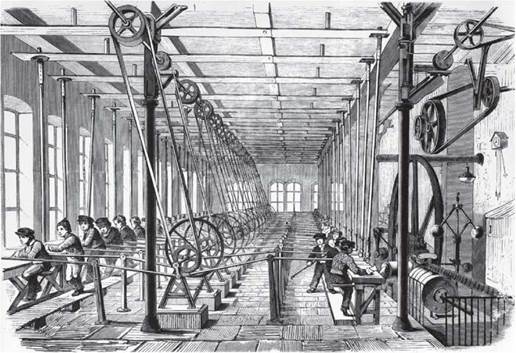
An illustration of boys working in a factory.
Document 11
Submission by a group of factory working children from Manchester’s Factory Children Committee which was sent to the House of Commons, 1836
We respect our masters, and are willing to work for our support, and that of our parents, but we want time for more rest, a little play, and to learn to read and write. We do not think it right that we should know nothing but work and suffering, from Monday morning to Saturday night, to make others rich. Do, good gentlemen, inquire carefully into our concern.
An interview of Robert Owen before Robert Peel’s House of Commons Committee, April 26, 1816
Question: At what age do you take children into your mills? Robert Owen: At ten and upwards.
Question: Why do you not employ children at an earlier age? Robert Owen: Because I consider it to be injurious to the children, and not beneficial to the proprietors.
Question: What reasons have you to suppose it is injurious to the children to be employed at an earlier age?
Robert Owen: Seventeen years ago, a number of individuals, with myself, purchased the New Lanark establishment from Mr. Dale. I found that there were 500 children, who had been taken from poor-houses, chiefly in Edinburgh, and those children were generally from the age of five and six, to seven to eight. The hours at that time were thirteen. Although these children were well fed their limbs were very generally deformed, their growth was stunted, and although one of the best schoolmasters was engaged to instruct these children regularly every night, in general they made very slow progress, even in learning the common alphabet. I came to the conclusion that the children were injured by being taken into the mills at this early age, and employed for so many hours; therefore, as soon as I had it in my power, I adopted regulations to put an end to a system which appeared to me to be so injurious.
Question: Do you give instruction to any part of your population?
Robert Owen: Yes. To the children from three years old upwards, and to every other part of the population that choose to receive it. Question: If you do not employ children under ten, what would you do with them?
Robert Owen: Instruct them, and give them exercise.
Question: Would not there be a danger of their acquiring, by that time, vicious habits, for want of regular occupation. Robert Owen: My own experiences leads me to say, that I found quite the reverse, that their habits have been good in proportion to the extent of their instruction.
Interpreting the Question
Using the sample DBQ, let’s look at the question and break it down into its basic elements. The question states:
Analyze and discuss how the issue of child labor in factories was perceived by different groups during the Industrial Revolution in Great Britain.
First, the question requires that you analyze and discuss. Remember that analyze means to break down into component parts and discuss means to provide a treatment of the topic from more than one point of view. Therefore, in your essay, you are to break down the topic into its component parts and write about those parts from more than one point of view. But what should you analyze and discuss?
The next step is to find the topic or subject of the question to analyze and discuss. In this question, the subject is the perception of child labor as held by different groups during the Industrial Revolution. How do you write about such a specific topic?
In the DBQ, the information you need is found within the documents provided. Use the documents, along with the historical background information, and find the information needed to answer the question. Now you simply put all the steps together. Based on all that you have learned thus far, you can determine that the question is asking you to identify the different perceptions of child labor during the Industrial Revolution, break those perceptions down into their component parts, and write about those perceptions from different points of view, using the documents as historical evidence upon which you will base your essay.
Interpreting the Documents
To use the documents as the basis for your essay, you must understand the types of documents you may encounter and what information to look for in those documents. First, using our sample DBQ as a point of reference, let’s look at some of the documents that may appear in a DBQ. A common DBQ document is an excerpt from a book (Document 5). Another very common document is a letter (Document 8). Speeches, or at least excerpts from speeches, are frequently used (Documents 1, 3, and 4). Charts, graphs, and tables are documents that historians use, so they are commonly found in DBQs (Document 6). Government reports provide valuable historical information (Document 9). Advertisements, both written and illustrated, can be valuable, too (Document 2). Many DBQs will include artwork of some kind; this artwork may be a painting, a sculpture, a cartoon, an illustration, or a photograph (Document 10). Resolutions, petitions, legislation, and other statements made to or by a legislative body serve as valuable sources (Documents 7, 11, and 12). Other types of historical documents you may see include journal entries, songs, and excerpts from periodicals.
Now you know the types of documents with which you will be working, but what should you look for within each of those documents? Look for what historical information is offered by the document. Understand, though, that a document is not necessarily true, valid, or accurate just because it is a historical document. You may or may not be able to determine the validity or accuracy of each document, and that is okay.
One of the things that will help you determine the trustworthiness of each document is consideration of the authorship of the document. This involves a few things. First, who wrote or authored the document? Second, why was this document created, and for whom was it created? Did the author have a motive, an agenda, or an axe to grind? All of these factors can affect whether or not you take the document at face value. Third, does the document demonstrate any bias or sarcasm? Bias and sarcasm definitely affect whether or not a document can be taken at face value, and you absolutely must be able to detect either of these in an historical document.
Let’s apply this information to a document from our DBQ to get you started. Let’s use Document 3 as our example:
Document 3
From a speech by Lord Francis Egerton to the House of Commons, 1836
I perceive that the growth of the cotton manufacture in America has proceeded with a rapidity almost equal to our own, and that of France, although the progress has not been so great, it is still but little short, and quite sufficient to make me deeply apprehensive. I therefore think that any legislation by which our manufactures are likely to be effected, we should keep the increased production of foreign countries closely in view.
First, let’s consider the authorship of this document. This an excerpt from a speech given by Lord Francis Egerton to the House of Commons. From the excerpt, Egerton appears to be trying to dissuade Parliament from changing any laws that might affect the manufacturing industry. By putting this document in historical context and by looking for bias, it is safe to say that Egerton is using the national economy as a reason why new legislation should not be introduced when, in fact, Egerton is concerned that the elimination or restriction of child labor would hurt his business. Therefore, you should not take this document at face value but in the manner in which it was intended—to be persuasive.
By practicing with this sample DBQ and on the DBQs found in the practice tests, you will get better and better at analyzing the documents like we did in the preceding paragraph. As you read each of the documents, make notes about the documents concerning the things we mentioned (authorship, bias, sarcasm, etc.). This will help tremendously when you start to use your chart to organize the information.
Organizing the Information in the Documents
The DBQ will present information to you in the form of historical documents, but these documents, and the information in them, will need to be organized. Usually the documents will be grouped in one of two ways. First, they may be organized chronologically. If this is the case, you may need to deal with the question and the answer over that specific period of time. Second, the documents may be arranged by point of view or some other grouping. If this is the case, the question is likely to ask you to compare and/or contrast in your essay or look at a topic from several points of view, as in our sample DBQ.
To use the information from the documents in an organized manner to support your essay, you should organize the information so that you can look at the information and see it all at one time. Perhaps the best and most efficient way to do this is to create a chart or grid. You can create a chart for any DBQ. To do this, look at what the question is asking. In our sample DBQ, the question is asking about perceptions of child labor during the Industrial Revolution and different points of view. Therefore, your chart might look similar to this:
|
Child Labor— Necessary |
Child Labor— Unnecessary |
Economic Reasons |
|
|
Social Reasons |
|
|
Medical Reasons |
|
|
By creating a chart like this one, you can write the numbers of the documents in the appropriate cells. For example, a document that uses economic reasons to justify child labor, such as Document 3, would be put in the column under “Child Labor—Necessary” and in the row across from “Economic Reasons,” like the chart that follows.
|
Child Labor— Necessary |
Child Labor— Unnecessary |
Economic Reasons |
3 |
|
Social Reasons |
|
|
Medical Reasons |
|
|
At this time, read through the documents in the sample DBQ again and fill in the remainder of the chart. This will be good practice for you and it will help you when you write the essay for this DBQ. (You didn’t know you would have to practice on this one, did you?) After you have organized all the documents, you will be ready to decide how you want to answer the question. Remember, there is no right or wrong answer on a DBQ. Look at the way the documents are organized in your chart. Do you see a pattern? Reread the question. Now you should be able to formulate an answer for the question.
Developing Your DBQ Thesis
The first and most important thing to remember when writing your DBQ thesis is to answer the question being asked. Do not restate the question. As was mentioned earlier, it is imperative that you answer the question and tell the reader what you are going to say in your essay. Think about how you are going to answer the question and what evidence you are going to use to support your answer; your thesis should be a summary of this. A well-written thesis makes it much easier to write a good essay, so take your time and develop a strong thesis.
Developing an Outline
Once you have developed a good, strong thesis, you need to plan a strategy for clearly writing the rest of your essay. One of the best ways to write a clear, concise essay is to use an outline. An outline provides structure and organization for your essay. If you follow an outline, you will stay on task and not get sidetracked. To develop a good outline, follow this simple model:
I. Introduction—This should be an introductory paragraph that includes your thesis. Tell the reader what you are going to say in your essay.
II. First point or argument that supports your thesis (one to two good paragraphs)
III. Second point or argument that supports your thesis (one to two good paragraphs)
IV. Third point or argument that supports your thesis (one to two good paragraphs)
V. Conclusion—This should be a conclusory paragraph that includes a summation of your arguments. Remind the reader of what you said in the essay. Provide closure.
By using an outline, you can confidently attack the DBQ. By arguing three main points, you will be able to support your thesis, but you wont get bogged down in an endless amount of information. Finally, an outline of this size will keep you on a good time schedule and will not allow you to waste your writing time.
Writing the Essay
With a clear plan of attack, you are now ready to write your DBQ essay. Let’s review the process. First, read the question and make sure you understand exactly what the question is asking. Second, carefully examine each of the documents. Note things about each document (such as bias, sarcasm, point of view, and intended audience) that will help you organize the documents later. Third, organize the documents using a chart. Fourth, based on the evidence before you, develop a thesis that answers the question and tells the reader what you are going to say in the essay. Fifth, create an outline to follow as you write your essay. Finally, put all the steps together and write each of the paragraphs in your essay just as you planned in your outline. Follow this plan and you will be on track to write a good DBQ essay.
Scoring the DBQ
You will be delighted to know that the readers, who spend countless hours grading exams like yours, do not grade the exams based on whether or not they like your exam or your handwriting or some other arbitrary characteristic. On the contrary, the graders use a rubric to evaluate your essay. The scoring scale is from 0-9. In order to score a 7, 8, or 9, you must first receive all six of the Basic Core Points. You can earn The Expanded Score Points only after you earn the Basic Core Points. Let’s look at exactly what the rubric measures.
Each item below, which is included in the basic core, is worth one point toward a total of six Basic Core points:
1. The essay has an acceptable thesis that directly addresses the question.
2. The essay uses a majority of the documents.
3. The essay addresses all parts of the question.
4. The essay demostrates understanding of the documents by using them to support an argument (the thesis).
5. The essay analyzes a point of view or bias in at least three documents.
6. The essay analyzes documents by organizing them in at least three groups.
Once the reader awards you the six Basic Core points, he or she can add up to three Expanded Core Points for any of the following:
1. The essay has a clear, analytical, and comprehensive thesis.
2. The essay uses all, or almost all, of the documents.
3. The essay addresses all parts of the question thoroughly.
4. The essay uses documents persuasively as evidence.
5. The essay shows understanding of nuances in the documents.
6. The essay analyzes bias or point of view in at least four documents cited in the essay.
7. The essay analyzes documents in additional ways or by grouping the documents in additional groups.
8. The essay brings in relevant outside information not found in the background information or documents.
This rubric demystifies the DBQ, because you now know exactly what the readers will be looking for in your DBQ essay. Use this rubric as a checklist when you write your practice DBQ essay and the DBQ essays included in the practice exam in the last section of this book.
HINTS AND STRATEGIES FOR MASTERING THE DBQ
1. Use the 15-minute reading period to read the DBQ question, historical background, and documents. Make notes of anything that will help you organize the documents.
2. Underline or circle any important words in the question that may help you better understand the question or what to look for in the documents.
3. Don’t get frustrated trying to find the right answer. These questions are designed so you can argue from different perspectives.
4. Use as many of the documents as you can in your essay. However, do not force documents into your essay just so you have all of them included. It is not necessary to include all of the documents in your essay.
5. Cite documents in your essay by using the author’s name and/or using the number of the document. The readers will be familiar with the documents.
6. Incorporate the documents into your essay. Do not simply give a “laundry list” of documents or a summary of the documents.
7. Don’t quote long passages from the documents; just cite the documents. Again, the readers will be familiar with all of the documents.
8. Include some “outside” historical information but be careful not to use a wrong date or an inaccurate fact.
9. Be sure to look for and explain the point of view or bias of at least three or four documents. For a top-notch essay, show the point of view of every document you cite!
10. If the question is a two- or three-part question, be sure to answer every part of it.
11. Avoid writing in first person using I, me, and my.
12. When organizing the documents, be sure to group them into at least three groups or by at least three perspectives or points of view. For a top-notch essay, use four or five groupings!
13. Use the information at the beginning of each document to help you find its point of view.
PRACTICE DBQ
The time has come for you to put all this information to use. Choose a quiet place, perhaps the library, and set aside one hour in which to write your practice essay using the sample DBQ. When your time begins, use the first 15 minutes as your mandatory reading time, just like the real exam. (You know what to do with this time!) After 15 minutes, begin writing your essay. Stop writing after 45 minutes and take a break. You deserve it! After your break, check your essay against the rubric to make sure that you have included at least all of the six elements listed under basic core points. If you have earned all six basic core points, check your essay to see if you are eligible for any of the expanded core points. You should read the sample DBQ essay and see how your essay compares. If your essay is not just like the sample essay, don’t worry! No two essays will be exactly like. Are you ready to write?
Sample DBQ essay
In Great Britain during the nineteenth century, in the midst of the Industrial Revolution, the issues of child labor and the length of the childrens work day became topics for much debate. During this time, social activists lobbied heavily against the evils of child labor and the exploitation of children, while businessmen and industrialists countered those efforts by arguing the importance of the children workers to the economy. These debates took place in the factories, in books, in periodicals, and even in houses of Parliament. The two sides in this debate differed for economic, social, and medical reasons.
Defenders of both child labor and the longer than 10-hour work day argued that the children employed by factories and mills learned valuable trades, as noted in Document 2. In addition, the document contends that boys and young men were able to maintain a state of constant employment in the factories, thus enabling them to have the means to support families. However, it should be noted that the document is an advertisement trying to attract workers, including children, so the document may be written from the point of view that makes child labor seem beneficial. Likewise, Andrew Ure notes in Document 5 that the children he observed not only learned skills but also were happy to show off their sills.
Henry Thomas Pope and William Bolling, in Documents 1 and 4, respectively, went even further in their arguments. They both insisted that the national economy depended on the production of goods by factories that employed children. Both speakers warned that any legislation that affected child labor and the work day also affected the national economy, which happened to be in fierce competition with America. These two men are most likely businessmen with profits at stake so their concern for the national economy may be a disguise for their concern for their own financial well-being.
Anti-child labor activists countered these statements with economic arguments of their own. A shortened work day, argued the Leeds Short Time Committee, would create opportunities for unemployed adult males to find jobs, thereby reducing the burden on the public. This economic situation was unacceptable to the childrens rights advocates.
In Ure’s The Philosophy of Manufactures, Ure argued that, based upon his own travels and experiences, the children who worked in factories earned both food and housing. Occasionally, he pointed out, the housing conditions were quite favorable. Additionally, he claimed that the children seemed to be enjoying themselves, both during and after work. Ure saw no evidence of substandard social conditions among the children he witnessed.
The children’s rights advocates painted a different picture of the children’s social condition. Richard Oastler, in his letter, claimed that many children were being employed to keep them away from “bad company,” and yet the children were worked to the point where they had neither the “time nor strength to pray.” In an interview before Parliament, Robert
Owen argued that children did not need to be employed at a young age to keep them away from bad influences. Owen went on to say that children actually did better at an early age with instruction and exercise than with employment. The children’s social condition was thought to be so poor that a group of children were actually brought before a committee that then sent a report to Parliament. In Document 11, the children pleaded for legislation that would give them relief from their suffering.
Finally, child labor advocates offered evidence that no real harm was done to the children who worked in the factories. Ure explained that the children he witnessed had not once been abused. He added that the children were constantly screened from the sun and the cold and they often worked without even sweating. Document 6 shows that there was no significant difference between the weights of children who worked in factories and children who did not. Document 10 is an illustration showing boys working in a clean, well-lit environment. These offered validation to the argument that factory labor was not necessarily bad for children. However, since there is no source given for either document, the reliability of the documents could be suspect.
Opponents of child labor disagreed. In Owen’s interview, Owen argued that factory work caused not only injury to children but also disfigurement in some cases. The unsanitary, unhealthy conditions, according to many children’s rights advocates of the day, were quite common at factories and mills.
People on both sides of the debate over child labor and the length of the work day offered volumes of evidence to support their arguments, evidence that was economic, social, and medical in nature. Ultimately, though, Parliament sided with the children’s rights advocates. During the nineteenth century, Great Britain passed numerous pieces of legislation, such as the English Factory Act and the Ten Hour Act, that sought to end the exploitation of British children by factories and mills.
PART B: THE THEMATIC ESSAYS
Part B of the free-response section consists of the thematic essay questions. The thematic essay questions count as 55 percent of your free-response score. You will have 70 minutes to answer two essay questions, one each from two groups of three questions. In other words, you will choose one question from Group 1 and one question from Group 2; each group contains three questions. It is recommended that you use 5 minutes as planning time for each question and 30 minutes for writing. In the paragraphs ahead, we will explore the essay topics and types of questions that may appear and show you how to decide which question is the best question for you to answer. Finally, we’ll help you develop a strategy for writing good essays.
The Most Common Essay Questions
Although no one can predict the exact questions you will see on the exam, we can tell you which types of questions have appeared the most on past AP exams. Based on the released exams and free-response questions, the most common type of thematic essay question is one that requires analysis. Coming in at a close second is the compare and contrast question. With almost the exact same frequency, describe and discuss questions are third and fourth. The remaining types of questions appear intermittently from year to year.
What does this mean? This information tells us that you can almost count on seeing an analyze question or a compare and contrast or maybe both. You are also likely to see a describe or a discuss question. Knowing what types of questions you probably will encounter should help you go in to take the exam with some added confidence.
Possible Essay Topics
When it comes to the types of questions that may appear, no one can predict which topics will be on this year’s exam. But, just like before, we can tell you what topics have been used before and how often. Some of the most common topics have been women’s issues, the Reformation, the Cold War, family life and structure, the French Revolution, art interpretation, and economic issues and the nineteenth century. The three themes (intellectual and cultural, political and diplomatic, social and economic) are pretty well balanced in this section. Each theme has been represented more or less equally over the past six exams.
Choosing the Best Questions to Answer
When you get to the thematic essay section, you will need to choose two questions to answer. This decision is important because, naturally, you will be better prepared to answer some questions than others. You will want to find the questions you match up with the best. How do you find the best questions to answer?
First, carefully read each of the questions in Group 1. Make sure you understand exactly what each question is asking. You do not want to try to answer a question if you aren’t sure what it’s asking! Jot down next to each question some things that come to mind when you read the question. After you have read all of the questions in Group 1 and have made some notes, think about which question you feel the most adequately prepared to answer. Do the same thing for the questions in Group 2.
Is there a question you simply don’t understand? If so, mark through it with your pencil and don’t go back to it. Remember, no question is worth more than another and there is no secret question that will be graded differently than the others. The readers, the professionals who grade the AP exams, are not going to penalize you for choosing one question instead of another.
Is there a topic in one of the questions on which you did a paper or report? Is there a topic in one of the questions on which you focused in your course? If so, choose that question to answer. You should answer the question in each group with which you feel the most comfortable. Once you choose the question you want to answer, you are ready to start organizing your thoughts.
Your Thesis
After you have read and interpreted the questions and have chosen the question you are going to answer, begin to think about how you want to answer the question. What you want to say in response to the question should be summed up in your thesis. Remember, when writing your thesis, answer the question that is being asked. Do not simply restate the question. The readers are looking for an original thought, an argument, and a statement based on facts or evidence.
Use of an Outline
Now that you have chosen a question and developed your thesis, you are ready to finish your plan of attack. One of the best ways to write a clear, concise essay is to use an outline. An outline provides structure and organization for your essay. If you follow an outline, you will stay on task and not get sidetracked. To develop a good outline, follow this simple model:
I. Introduction—This should be an introductory paragraph that includes your thesis. Tell the reader what you are going to say in your essay.
II. First point or argument that supports your thesis (one to two good paragraphs)
III. Second point or argument that supports your thesis (one to two good paragraphs)
IV. Third point or argument that supports your thesis (one to two good paragraphs)
V. Conclusion—This should be a conclusory paragraph that includes a summation of your arguments. Remind the reader of what you said in the essay.
By using the model above, you can sufficiently address most any essay question on the exam or elsewhere. By arguing three main points, you will be able to support your thesis, but you wont get bogged down in an endless amount of information. In conclusion, you will be able to manage your time well if you stick to the outline.
Writing the Essay
Now you have a very clear strategy for attacking and answering a thematic essay question. All that is left to do is put the steps together. Let’s review the process. First, read each of the questions and make sure that you understand what each is asking. Second, consider the topic of each question and choose the question you feel the most adequately prepared to answer. Third, think about how you want to answer the question and develop a good thesis that answers the question. Fourth, devise an outline that supports your thesis and answers the question. Finally, put all the steps together and write each of the paragraphs in your essay just as you planned in your outline. If you use this recipe and provide good, solid information, you will have a clear, concise, and solid thematic essay.
HINTS AND STRATEGIES FOR MASTERING THE THEMATIC ESSAYS
1. Write legibly. The exam readers spend hour after hour reading essay after essay. They probably won’t be very excited about trying to decipher handwriting that looks like a secret code. The readers will not deduct points for poor handwriting, but they certainly won’t look favorably upon an essay that requires a translator. In addition, you may make a brilliant argument in your essay but if they can’t read it, then it doesn’t matter.
2. Use good sentence structure. Your sentences don’t have to be long and complicated to make a good point. In fact, if you try to make your sentences complicated, you are very likely to make a grammatical or some other type of error.
3. Don’t use a word if you don’t know what it means. Use your vocabulary to write the essay. You will hurt your credibility if you misuse a word in an effort to impress the reader.
4. Clarify terms that may have multiple meanings. If you use a word like conservative or liberal, explain to the reader what you mean when you use that word.
5. Don’t include a fact if you aren’t sure of its accuracy. Again, you may damage your credibility by misusing or misquoting a fact, a date, or some other information in an attempt to score some extra points with the reader.
6. Be confident in your essay. Your writing should convey confidence to the reader, confidence that shows you know the subject. Don’t be wishy-washy and indecisive—you are trying to prove your point to the reader.
7. Proofread your essay. Check for misspellings, grammar errors, and poor sentences. Also look for factual inconsistencies that may weaken your argument.
8. Try to make at least three points or arguments in each essay.
9. If the question is a two- or three-part essay, be sure to address each part of the question in your essay.
10. Quality is often better than quantity so make your points, support them with evidence and move on. The readers will not be impressed by endless ramblings that are only slightly relevant to the question.