Chapter 13
In This Chapter
 Getting ready to submit your work for publication
Doing market research
Sending out your poems in a methodical manner
Publishing your poems on the Internet
Self-publishing your work
If you’re an aspiring poet, you’ve probably looked at all the poetry you read in books, magazines, journals, and the Internet, and wondered, “How can I get in there?” Getting published is a mark of accomplishment, a building block in your career and a chance to learn something about your poetry through contact with editors and readers. And is it ever encouraging!
In this chapter, we offer some guidelines on publication, as well as the methods and attitudes to bring to your quest.

The advice here is a series of tips, not commandments. By all means, forge your own path in the way that suits you best.
Submitting Your Poetry to Journals, Literary Magazines, and Web-Based Publications
Most poets don’t have literary agents who can land them a publishing contract with a magazine or book publisher, at least not until they’ve become quite established. This means you will need to personally undertake a serious effort to get in to print. While some very talented poets might have it easy getting published, that is not the norm. Most published poets have worked very hard before the day they saw their work in print. If you’re ready to make the leap from showing your poems to your friends and mentors to showing the world your verse, this section provides step-by-step guidelines for putting your “getting published” plan into action.
Knowing whether you’re ready
Getting published feels great: You see your poetry and your name in print, it gives you something to put on your résumé, and you can send copies to all your friends and family members. But don’t try to get published until you’re ready. (You don’t want to look back years later on your published work and, after reading it again, want to change your name!)

How can you tell whether you’re ready for publication? You can be relatively certain you’re ready for publication if you:
 Have not just started writing, but have written a fair amount and for some time.
Have had your poetry read by knowledgeable friends or mentors who have given you frank, constructive criticism and some advice about the poetry market.
Have done some market research. You’ve done a great deal of reading in a variety of magazines and journals, and you know the journals to which a poet like you should send poetry like yours. You also know what journals to avoid (some welcome first-time writers, and others publish only well-known poets).
Are willing to commit yourself to being methodical about getting published.
Have a realistic attitude. You are aware that publication of poetry is extremely competitive (thousands of poets are trying to get published along with you); response is often slow or nonexistent (weeks or months later, you get your stuff back in the self-addressed stamped envelope you enclosed, and it may or may not be accompanied by a note); and you usually get paid only with a copy of the issue your poem appears in, if that.
Have a thick skin and are ready for rejection. Rejection doesn’t mean you’re a bad poet — it can be a great opportunity to learn something about your poetry.
Where should you start? Many poets start locally, with regional journals and literary magazines — or any publication that prints poetry. So start looking around. Which colleges, universities, and writing groups are nearby? Do any publish literary magazines? If not, find the nearest ones — or cruise the Internet and check out Web sites that invite contributors.
Doing market research
As a poet, you need to be just as market-savvy as any other entrepreneur. You need to survey your territory and identify target publications to which you want to send your poetry. (If this suggestion sounds cynical, it’s not meant to be; it’s simply a piece of solid advice.)
Knowing what to look for
Your main guides as your read through magazines and journals should be your own tastes and interests. You want your poems to appear alongside other writing that you admire. So look at your poetry and imagine it in the pages of a specific journal. If you read a poem in a journal and like it, read more and decide whether this is the environment for your work, too.
Although there are over a thousand poetry journals in the world, these journals and their editors often have quite different ideas of what constitutes poetry. So before you start sending your stuff out, know your market.
Some journals may accept poetry
Only from people who live in a certain area. For example, don’t send to ZYZZYVA unless you live in the West.
Only about certain subjects. If your poem is about plants, don’t bother sending it to a journal that wants only poems about dogs. Don’t send a poem on bowel surgery to Cowboy Poets Today.
Only in certain forms. Don’t send an epic poem to a journal named Haiku; the journal called The New Formalist is looking for poems in traditional forms, so a sprawling, Whitmanesque open-form poem isn’t going to fly. The Southern Review has published leading poems in the great American tradition for generations — but its vision is very different from the hip, urban viewpoint you may encounter in Painted Bride Quarterly.
How can you find out which journal publishes which kind of poetry? Peruse the books that list journals and their self-described expectations. Go out and start reading literary journals. And talk to people who publish and edit.
Several publications list entries for literary journals in which the editors describe what they’re looking for. The International Directory of Little Magazines and Small Presses lists hundreds of such entries. Another good resource is Poet’s Market. Sometimes the information in these books furnishes good leads. Use these references as a good starting point. But get to know other important resource journals, such as Writer, Writer’s Market, Poets & Writers, and the Directory of Poetry Publishers.
Finding places to start
Seldom will a mere ad or statement from a publication tell you all you need to know. You’ll have to read a few issues of a journal to know its editorial fingerprint. That you can do by writing or calling for copies, or by finding them at your local bookstore or library. Better yet, subscribe to a few magazines or journals. Share subscriptions with other poets and friends. Many poets — especially those just starting to get methodical about it — devote an hour or more a week to sampling different journals. If you’re interested in poetry, you’ll want to know the entire field.
You could start with the many fine, first-line publications put out by colleges in the United States, including the following:
The Antioch Review (Antioch University)
The Beloit Poetry Journal (Beloit College)
The Colorado Review (University of Colorado)
The Georgia Review (University of Georgia)
The Gettysburg Review (Gettysburg College)
The Harvard Review (Harvard University)
The Iowa Review (University of Iowa)
The Kansas Review (University of Kansas)
The Massachusetts Review (University of Massachusetts)
The Michigan Review (University of Michigan)
Ploughshares (Emerson College)
Raritan (Rutgers University)
Salmagundi (Skidmore College)
The Southern Review (Louisiana State University)
The Southwest Review (Southern Methodist University)
TriQuarterly (Northwestern University)
The Western Humanities Review (University of Utah)
The Yale Review (Yale University)
Colleges and universities aren’t the only places that put out excellent poetry journals. Other journals are published independently by folks who love good writing. These include
Conjunctions
The Greenfield Review
Hambone
The Hudson Review
New American Writing
The Paris Review
The Partisan Review
The Threepenny Review
Tikkun
American Poetry Review, a tabloid published in Philadelphia, is one of the most widely-read of all poetry journals. Poetry Flash out of Berkeley, California, is a true newspaper of poetry, oriented to one region of the country (in this case, the West) but quickly becoming national, as is The Poetry Project’s Newsletter (published in New York City). Poetry is one of the longest continually-publishing poetry journals in the United States. And several leading magazines — including Atlantic Monthly, The New Yorker, The New Criterion, and The Nation — publish poems with each issue.
Establishing personal contacts
Personal contacts are everything in the world of poetry. People are the best source of information about the poetry market. If your circle of writing friends and mentors includes folks who have published poetry, ask them where they have sent stuff and what the editors like. Ask them whether you can use their names in a cover letter when you send your poems to editors they know.
Journals reflect the tastes of their editors, and what doesn’t attract one may attract another. Knowing the editor, or knowing people who know the editor or have published in the journal, is a step toward knowing the journal. If you find that a journal’s editor appears to share your tastes or interests, your chances of appearing in that journal someday may be greater. If not, don’t waste your time or the editor’s time by sending your material there.
Don’t hesitate to make contacts. Networking is the nervous system of the poetry world. Take advantage of every opportunity to meet and speak with people who get published and people who publish. Become part of a community of poets.
Many poets begin by being published by their friends, colleagues, and fellow poets. Later, if they start a press or magazine, they may publish their friends in return. That’s right: A number of publishing poets know or have met the editors who publish them. They meet them at readings, at poetry conferences, anywhere poets gather.
A poet by any other name?
Throughout history, poets have been known to take on pseudonyms or pen names. Take Enheduanna (born around 2350 B.C.), the earliest poet with a name we know: The word Enheduanna means “the high priestess of Nanna” in Sumerian. No one knows what her real name was.
Some poets take on shorter versions of their names, as did Dante (baptized Durante Alighieri) and Michelangelo (Michelangelo di Lodovico Buonarroti Simoni). Some Japanese poets of the classical era went by their nicknames. Basho’s name means “banana plant” in Japanese (he took the name in honor of a plant near his house). The revered poet Issa’s name means “bubble in a cup of tea.”
Some women poets chose androgynous names for a variety of reasons. These include H.D. (short for Hilda Doolittle) and Ai. Some get their pen names by accident: The Irish poet George William Russell wanted to go by the name Aeon, but a typesetter got it wrong, and from then on Russell went as AE.
The modernist Portuguese poet Fernando Pessoa wrote under a number of names, which he devised as separate personas for himself. He even went as far as to have his different personas comment on one another’s work! Other poets with more than one name include: Jack Kerouac (Jean-Louis Lebris de Kerouac), Pablo Neruda (Neftalí Ricardo Eliecer Reyes Basoalto), Claire Malroux (Claire Sara Roux), Doris Lessing (Doris May Taylor and Jane Somers), Maya Angelou (Marguerite Johnson), Anne Sexton (Anne Gray Harvey), and Sylvia Plath (Victoria Lucas).
Poets are still taking on different names today. In light of the Cultural Revolution and the Tiananmen Square massacre, several Chinese poets have taken on pen names as a form of political comment. World-famous poet Zhao Zhenkai adopted the pen name Bei Dao, which means “Northern Island.” His pseudonym is a private symbol and a reminder of the kind of poetry the Communist government dislikes. Therefore, Bei Dao’s name is a permanent protest against Communist oppression.
Self-renaming is especially popular in the world of performance or slam poets, who have taken names like Big Poppa E, Jennifer Blowdryer, Sapphire, and blackberry revolution. Why do poets take other names? Sometimes in imitation of others, other times to make a political statement, and, more often than not, to keep their identities as poets separate from the rest of their lives.
Sending out your poems
Many literary journals accept submissions by e-mail. Find out if that’s a possibility for your target journal. Keep in mind that a brief cover-letter is still an important courtesy, even when e-mailing your submission.
But let’s say you’re ready to mail out your poems. How do you do it? Read on.
Typing and printing your poems
Your poems should appear, in type, exactly as you want each poem to appear if it is published. No page should have more than one poem on it. Don’t double-space a poem unless you want it to be published double-spaced. Try not to break stanzas in mid-page. If you must do so, put a bracketed note — such as “[continued without stanza break]” — at the bottom of the page.
Put your name in the upper-right-hand corner of each page, so the editor can keep track of your submission if the pages become separated.
Proofread and spell-check everything. A typo in a poem is like a bad note in a symphony.
Getting organized
On your work desk, put a stack of 20 manila envelopes, size 91/2-x-12 inches. Get a notebook that you can use as a log of your submissions. Next to that, put a neatly typed group of three to five poems — that’s how many you’re sending out at this first go. (Many poetry editors ask for three to five poems, but make sure you know your target journal’s preference.)
Gather two of the manila envelopes and your group of poems. Then go to the post office and weigh the package. Find out how much first-class postage would be. Purchase that postage times 20. (The postage will be different, of course, if you’re mailing abroad.)

Most editors expect that you are sending your poems only to their journal. Do not multiple-submit (send the same poem to more than one journal) unless the journals to which you are doing so explicitly allow it — and even then, make sure you explicitly tell all the journals involved you are multiple submitting these poems. Submitting the same poem to more than one journal at a time is messy, and it can lead to confusion and bad feelings if more than one journal accepts the same poem.
Writing a cover letter
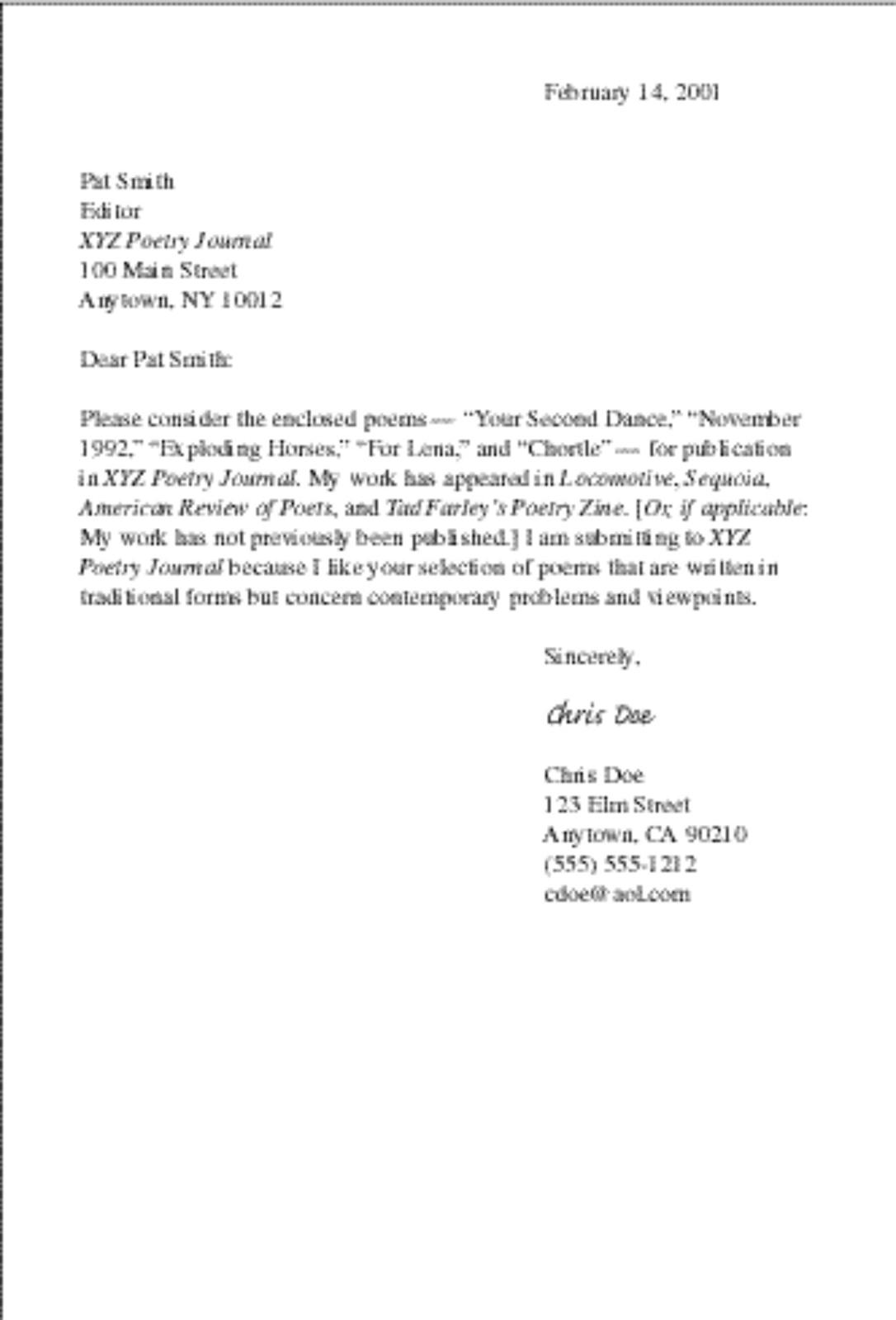
Enclose a brief cover letter with your submission. The cover letter is a courtesy to your editor and will give him some important information, including the following:
Who you are (your name and contact information).
The titles of the poems you’re submitting.
Whether and where you’ve been published before. Providing this information is optional, but many editors like to know it. If you haven’t been published before, you’re not necessarily at a disadvantage (most editors like discovering new talent), and if you have been published before, you’re not necessarily any better off (it sets the bar higher, if anything — besides, your editor is dealing with large numbers of already-published poets, so join the club).
A sentence or two about the magazine. This is where you can tell the editor what it was about his publication that inspired you to submit your work. Be concrete. Refer to something in the past that you especially liked. For example, “I admired the emphasis on experimental poetry in your Winter issue” or “I have enjoyed your journal’s emphasis on working life and everyday experience — especially ‘What Work Is’ by Philip Levine.” Such comments show the editor that you know something about the journal and are not picking it at random; they also engage the editor on a subject he cares about: choosing good poetry.
Cover letters can be as brief as the one shown in Figure 13-1.
Don’t include the following in your cover letter:
Your assessment of your own work. Offering your opinions (such as, “I believe these poems are timely and eloquent”) serves no purpose and may only annoy the editor. Let the editor decide for herself whether she likes your work.
An explanation of the themes, meanings, or forms of the poems. Saying something like, “‘Your Second Dance’ is about the fears and frustrations of doing something a second time when the first time wasn’t so good” or “‘Exploding Horses’ is a triple dizaine in acephalic anapestic heptameter,” is only stating the obvious. The editor can figure these things out for herself.
An explanation of your motives for seeking publication. Throwing in a line like, “I’ve been writing a long time, and it’s really time for me to get my poems out there,” doesn’t serve any purpose. The editor won’t care what your motives are; she only cares whether your poetry will work for her publication.
Knowing what to include with your poem
When you submit poems to a journal, include the following in the envelope:
A cover letter.
Your three to five poems.
A self-addressed stamped envelope (SASE). No editor will send your poetry back without one, and some won’t even read your work.
|
|
If you get rejected
Most editors do not have the time or the staff to send personalized notes to every poet whose work they reject. So you will often receive form-letter rejections or very brief notes (here’s a favorite one: “Respectfully, no”) enclosed with your SASE. If an editor takes the time to write a substantive, personalized rejection note, feel very, very good. It means you came close. The editor liked your work enough to take time to encourage you and tell you why you didn’t make it this time. Pay close attention to such notes; they could help you get published in the future.
If you get a personal rejection note, wait a few weeks, send out a new batch of poems to the same editor, and in your cover letter, include some words of thanks to the editor, reminding him of the kindness of the rejection note. This constitutes a contact.
Don’t flood responsive editors with huge gobs of new material. Meditate on the advice given in the note and think about what you want to send next, taking into consideration any comments made by the editor on your earlier submission.
We can’t promise you won’t sometimes get an editor who says something ill-mannered and cranky in a rejection note (such as “Consider auto mechanics”). But this is rare. If it happens, put it out of your mind, and forget that editor for a while.
Take one manila envelope, address it to yourself, and put postage on it. That’s your SASE. Address another envelope to the journal and put the postage on. Make sure each has a return address. Fold the one addressed to you (leave it unsealed!) and slip it into the envelope addressed to the journal.
Gather your designated group of poems. Print them out with your name in the corner. Assemble them with their cover letter, sign the cover letter, affix a paper clip to the upper-left-hand corner, slip everything into the envelope, lick, close, kiss the whole package, and stick it in a mailbox. Done.
Keep a submission log. Note the titles of the poems, the journal to which you sent them, and the date sent.
Figuring out what to do next
After you send out your poems, start planning where to send this same group of poems if they return rejected. And start on the next batch.
We know poets who have groups of poems in stacks on one side, envelopes on another side. As the SASEs come back with rejections, these poets simply re-input the cover letters and ship the rejected stuff out to the next editor, like clockwork. They make themselves do it as a point of professional discipline.
Taking Advantage of Internet Publishing
Several Web sites invite people to post poetry. Some operate just as regular literary magazines do, with a rigorous editing and selection process. These are the ones we like the most, because rigorous editing teaches you about your poetry and about editorial standards.
But we also like the come-one-come-all sites. These invite everybody to post their poetry and to comment on the poetry of others. Being part of such a virtual writer’s group has many advantages over other forms of self-publishing. The feedback from readers, although it may vary in quality, may at least give you the sense of being read and — who knows? — it may even give you some ideas about how to improve. You may strike up contacts with other poets and perhaps get e-mail correspondences going. You’ll be in touch with people trying to do what you’re trying to do, all in the public medium of the Web.
Web publication — especially on rigorously edited sites — is becoming more and more highly regarded. In fact, as of this writing, poets who apply for National Endowment for the Arts (NEA) grants may use Web publications to account for up to half the number of their published pages in their applications.
Another way to become virtually published is to create your own Web site. The downside is that there are a lot of these sites — and you’ll have to find ways to get people to visit yours. The upside is that, with the Internet, you never know what will come your way. Creating your own Web site on which you can publish your poetry is certainly less expensive and less time- intensive than lugging cartons of books around to unenthusiastic buyers. Plus, you’re going easier on the environment by not using paper.
If you create your own Web site, make sure that you do the following:
Install a counter, so you can tell how many hits you get. A hit is Internet lingo for a visitor to your site; the more hits (the more visitors) the better.
Create a bulletin board or e-mail feature through which readers can leave their comments and invite your responses. Another handy feature is “Recommend this site?” If a user clicks “Yes,” it enables her to send your Web address by e-mail to other aficionados of poetry.
Find out about ways to cross-list your site with other poetry Web sites, so that folks browsing the Web for poetry may find out about yours and come grazing.
Read other Web sites and pick up tips on construction, features, and publicity. Some Web poets advertise on the Web or in print media; if you see an advertisement you like, you can try to create something similar for yourself.
Paying to get into a poetry book
Perhaps you’ve seen them — those ads that cry, “Get your poetry published today!” All you do is send in your poem with an application form and a fee ($25 seems a popular amount) — and, voilà! You’ll be published . . . along with 1,249 other poets, in tiny type, all the poems jammed in, 30 to a page. And that $25 only gets you in. If you want to actually own a copy of the book, another check is required.
Paying to get your poem in print is not a good way to get published. Your poem isn’t read or edited by knowledgeable professionals; it’s merely printed. So you’re denied the chance to learn anything about your poetry. Few people who read poetry take these books seriously. In fact, such books are widely regarded as a swindle. A legal swindle, yes — but a swindle nonetheless. They take advantage of people who don’t really understand the nature of publication.
Our advice: Don’t go this way.
Being Aware of Publishing Pitfalls
The biggest pitfalls of publishing involve one common mistake writers make: They think that getting in print is the same as getting published. Keep in mind the following when you’re looking to publish your poetry:
If anyone asks you to pay them to appear in a book of poetry, be very skeptical.
Never pay a printer to crank out 100 books of your verse, unless you’re ready to be the proud owner of these books — and are ready to lug cartons of them all over the place.
Don’t desktop-publish a book of your own unless you have strong reasons for doing so and you’re ready to do all the work of distribution and publicity.
Self-Publishing Your Poetry
Getting published is difficult. There are thousands of poets and only dozens of spaces. Many writers try to get around the process by creating self- published books. Desktop publishing has made it easy to make your own books, and the results, as they say, “look great.”
Should you publish your own book? The answer is yes, if you know what you’re doing and you’re doing it for the right reasons.
Self-publishing has a long and glorious history. (In the days before printing, self-publishing was publishing.) The Beat poets of the 1950s used to hand out mimeographed poems as the “daily news for the masses.” Julia Vinograd, the “Bubble Lady” of Telegraph Avenue in Berkeley, California, has been self- publishing her poems in little books for years and has even made it into some anthologies published by others.
Self-publication often is part of the life of a poet. Self-published books can be useful as calling cards to give to fellow poets, to distribute or sell at open mikes and slams, or to send to poets you admire. And some poets have been able to establish presses of their own, assembling mailing-lists, creating Web sites, and reaching an appreciative audience. Writers such as Kathy Acker have moved back and forth between self-publishing and conventional publishing. From bookstore to bookstore, day after day, famed publisher David Godine drives boxes of the books he has published. A veritable one-man band of publication, he upholds the very highest standards of selection, editing, and printing.
The decision to self-publish or start a press often arises from communication with other poets who read one another’s work and start magazines, journals, or presses. Poets who self-publish often do so because they have become part of a mutually-supportive circle of other poets and want to join the conversation about poetry here and now. What’s nice about starting your own poetry press is that it lets you be a part of that conversation. When you publish yourself or other poets, you are in effect saying, “This poetry is worth your attention. What do you think?”
Self-publishing means self-publicizing, self-selling, self-stocking, and self-driving to local bookstores. Distributing your book, even in your locale, much less far and wide, requires a lot of time and effort. But it can have its rewards.
To publish is to send your words out into the world. It’s an exciting endeavor, and sometimes you hit the jackpot: useful responses from readers. Don’t rush into publication, but when you feel ready, be professional and patient about the quest, and you’ll discover a great deal about yourself, the poetry world, and your own verse in the process.