Chapter 12
In This Chapter
 Starting a reading or writing group
Performing at readings, open mikes, or poetry slams
Eventually, you may decide you’re ready to take your poetry out into the world. That’s an exciting decision — it can bring great changes for you and your poetry. And if you do it with the right attitude, you’re bound to see the poetry you read and write from a new perspective — that of your readers — which is something every poet needs to do. Some writers claim they don’t write to be read by an audience. Fair enough. But very few writers who have taken their verse public have failed to learn something from the experience.
In this chapter, we consider two ways to join a community of readers and writers: starting a poetry group and reading in public.
Starting a Reading or Writing Group
No one has counted, but there are possibly thousands of poetry groups in existence. From the U.S. 1 group in Northern New Jersey, to the lovers of Indian poetry who meet in a garage each month in a small town in Illinois, to teenagers who gather to rap, poetry is everywhere.
Getting started: Questions to think about before you begin

If you want to start a group that reads or writes poetry together, you have a few things to decide:
 How big of a group do you want? Try a group of three to five people. Some reading groups are larger, but anything larger than ten can require a lot of work. Plus, the more people you have in your group, the less time each person has to discuss poetry or have his poetry discussed.
How often do you want to meet? Try meeting monthly. A once-a-month meeting gives members something to look forward to, is easier to schedule, and allows folks to get their reading done. But you can find weekly groups, as well as groups who meet once a season.
Where do you want to meet? Some poetry circles meet at the same place every time; some rotate among the homes of the various members; some meet at bars, coffee shops, or bookstores that agree to host them.
How ambitious do you want your group to be? In her book How to Read a Poem . . . and Start a Poetry Circle, Molly Peacock warns against trying to do too much. The main thing is to keep the circle from being a burden on anyone, especially yourself. Poetry groups should be a pleasure — a time to enjoy and contemplate poetry in the presence of like-minded people. It’s a nutty, high-pressure world, so why create one more pressure point in your poetry group?
How do you plan to get people to join? Chances are, you already know the folks you’d like to invite. So invite them! Or you can always advertise at your local bookstore, coffee shop, community arts center, or college or university. Try running an ad in your local newspaper or events calendar. Your local library may also have a Web site that lists local poetry groups. Or you may be able to get such a list by calling the library.
The Poetry Society of America can send you a starter kit for a poetry circle or put you in touch with local poets or poetry groups. Contact them by calling 888-872-7636 (toll-free) or 212-254-9628. Or visit them online at www.poetrysociety.org.
Discovering ways to spend your meetings
The nice thing about poetry circles is that they don’t have to have a particular agenda — the idea is to meet to discuss poetry. Most meetings will end with a discussion of “Who should we read next?” and people will have different suggestions and agree on the next poet. The Poetry Society of America’s starter kit (see the preceding section) has suggestions for poetry books to read every month as well.

Poetry circles should be friendly, humane gatherings. So what if you cover only two poems? Or one? Or one phrase? You’re doing what you like to do, which is its own reward. Relax and enjoy it.
If you’re looking for ways to spend your meetings, try one of the following activities:
Attend a poetry reading together. Dinner and a reading — not a bad group activity.
Invite a local poet to address the group.
Watch poetry-related movies on video. Some good ones include Stevie, Il Postino (The Postman), Barfly, Dead Poets’ Society, Shakespeare in Love, and Poetry Nation. Or watch television shows about poetry, such as Bill Moyers’s The Language of Life, which you can order on the Web at sites such as www.moviesunlimited.com.
Do some collaborative writing. See Chapter 12 for some suggestions for ways to create poetry together in a group.
Play a Surrealist game. “Tzara’s Hat,” in which members all write a line and pitch it into a hat, after which the emcee fishes out lines or phrases and creates the poem, is a great game to play.
Have a group Web site at which members can post poems or write poems collaboratively.
Give a group reading at either your normal meeting place or a local venue (such as a bookstore or coffee shop).
Arrange for a local teacher of poetry to give the group a writing workshop.
Reading Your Poetry in Public
Performance poetry is a vigorous part of the worldwide entertainment culture. No, it’s not as big as movies, sports, or popular music, but most major cities in the world have venues at which poets read their work in public. Many are the countries in which you can list itinerant poet as your occupation. In Iran, poets wander from place to place, reciting epic poetry about the exploits of, among other heroes, Alexander the Great. In India, poets read classic ghazals to appreciative audiences who recite the refrains. The tradition of oral poetry is still strong throughout Africa as well. So if you’re considering reading your verse in public, you’re in good company.
We consider three types of reading in the following sections. Each type is a world unto itself, and each brings with it an etiquette and a style. None should be embarked on without a little preparation.
Readings
The phrase poetry reading can mean almost anything. What it usually means is that a limited number of poets — common numbers are one, two, or three — get up and read, usually one at a time. Each poet usually reads 3 to 5 poems and usually reads for a total of 20 to 25 minutes. The entire reading typically lasts about an hour, more or less. Then the reading breaks up and becomes an onsite party or adjourns to a local coffee shop or bar to talk poetry.
A word on how to read your verse
Poetry is meant to be read aloud. All the rules of good public speaking — don’t rush; use a positive conversational tone; project — hold true when reading poetry.
You want to come across as a humane, interesting person who writes interesting poetry. Don’t whisper or appear cold and disdainful. And don’t (unless you’re at a slam) shout and gesticulate with wacky histrionics. (We’ve seen all three types, believe us.)
When it comes to reading your own poetry, read to a friend or practice in front of small groups before reading before large crowds.
Videotape or record yourself and watch the recording. Many people find doing this difficult, but that’s what’s good about it. The videotape shows you how you sound and look as you read. If you don’t like something, you can work on it.
Most poets — even some experienced poets — could use some work as readers. They forget that poetry isn’t just print, that a certain element of performance is involved when they read. So after you’ve selected the poems you’re going to read, consider these things:
The volume, tone, and dynamics of your voice. Poetry is one of the least monotonous things human beings do. Why read it in a monotone?
Your posture. Don’t slouch, and don’t stand bolt-upright. Find a comfortable way to hold yourself.
The mood of your poems and how you will get that mood across. If a poem is happy, don’t make the audience sad. If it’s intense, don’t make the audience bored.
The difficult moments in your poems. How will you bring these moments across to the audience? (Often, slowing down a little helps.)
How your poems come across as a group. Are they all the same in length, subject, and tone? If so, mix them up.
Which poem you’ll begin with and which you’ll end with. The typical audience needs a few minutes to begin to follow your reading well. You may want to warm them up with a shorter poem or two, or inject some humor or an anecdote into your opening remarks. Try for a certain rhythm that keeps the audience’s attention throughout, and try to end with a highpoint of concentration, mood, or significance.
But readings can take other forms as well. After all, they involve a certain amount of spontaneity. We’ve attended affairs billed as readings that involved up to 20 poets and lasted for hours and hours.
So how do you go about getting the opportunity to participate in a reading? One way is to publish some poetry and get asked to read. Colleges, universities, and bookstores routinely invite experienced, known poets to read their work. In fact, the reputation of these places often rests partly on their ability to attract good readers. (Bookstore readings very often are by poets with a new book to sell — and that’s as it should be.)
You can also set up a reading for yourself. We cover a few ways to do that in the following sections.
Holding a reading at your house
Having a reading in your home is a great way to start out slowly, before diving into the unfamiliar terrain of a more public place. The only disadvantage to holding a reading in your house is that your audience is made up of your friends, which means that they may be too nice about your poetry.
You can arrange this kind of reading as you’d arrange any party, with invitations and light refreshments. We have attended many readings in folks’ living rooms and garages, and even a few in their kitchens.
Even if your friends are not the poetry type (whatever that means), they’re your friends, and parties are an excuse for them to enjoy themselves — and they will. Imagine their pleasure when they discover they actually like hearing poetry. Also, after everyone has heard 45 to 60 minutes’ worth of verse, they all have an experience in common that may furnish hours of post- reading chat.
Don’t be the only poet. Invite a couple other poets to read, each for 15 to 20 minutes (and adhere to this limit).
There are many permutations to this kind of reading. Some (or all) of these may work for you:
Ask friends to read your poetry for you.
Invite them to bring their own poetry or their favorite poems to read.
Create an open mike at home.
Reading at your local coffee shop or bookstore
Coffee shops and bookstores like it if you can bring people in who will buy coffee and books. So get chummy with the owners of the coffee shop or bookstore. One day, after the purchase of a year’s worth of lattes or poetry books, broach the subject. If you set up a reading, do the public relations. The coffee shop or bookstore will do a certain amount in brochures and ads and on its Web site, but you have to get the word out and get folks to come. If you draw a good crowd, it’ll be that much easier to get a second reading.
Reading at coffee shops or bookstores works best if people in your area put on readings anyway.
Giving a reading at your local community arts center
Some centers have community readings. Subscribe to their brochures and watch for announcements. If your center doesn’t do readings, suggest it or volunteer to organize one.
Open mikes
Open mikes are just that: a chance for anyone to come up and read with a microphone. Some have admissions fees; others are free. At many open-mike readings, there’s an old-fashioned pass-the-hat at intervals.
If you’re at an open mike and they pass the hat, please contribute. It’s probably how the open mike keeps going.
Finding an open mike that’s right for you
You find open mikes at places such as coffee shops, bars, bookstores, colleges and universities, and community arts centers. Consult the Entertainment section of your local newspaper or your community Web site. Some local radio stations (especially public radio and college stations) also have community events announcements that may tell about open mikes in your area.
Some places have sign-up sheets for their open mikes. Some want you to sign up a few days in advance. For others, you can just walk in and sign up on the day of the event. Know the ground rules before you go.
Getting ready to read at an open mike
Visit your chosen venue before your performance — preferably at another open mike — to get a sense of the place and the poets who read there. Certain venues have their own atmosphere, and when people go there they act a certain way. Knowing such things before taking the mike for the first time is a good idea.
Introduce yourself to the person running the open mike. He may be connected with the sponsoring venue or may simply be someone who goes around putting on open mikes at different places. Either way, say hello and make friends.
Don’t worry too much about the poets who read just before and after you. Audiences do compare readers; it comes with the territory. What you’re here to do is perform and learn.
Surviving your first reading
When you’re reading at an open mike, consider your audience. There may be five people in the place — or a hundred. Either way, you have a couple of things going for you:
They’re here, and you can show them a good time.
A good number of them like poetry and enjoy hearing it.
Most people like performers.
In this corner: Poetry contests through the ages
Poetry contests have been part of the poetry scene since the beginning of verse. The poetry of the Greeks and Romans featured many poetry contests among shepherds, evidently a great way to stay interested in governing sheep. By A.D. 885 in Japan, the first uta-awase (poetry-writing contests) were being held. The poets of Renaissance England conducted poetic duels in the press, where they tried to outdo one another in verse and bravado. Basho, the 17th-century Japanese master of haiku, often made money as a judge of poetry at poetry circles, where he would correct verses or act as a referee in haiku contests, which often offered prizes. Perhaps these qualify as the earliest known slams!
Nervous? Good. For most people, nervousness goes away once they get started. If you’re really nervous, however, concentrate on your job: to give a good reading. That means connecting somehow with your audience. Concentrate on being in the poem, keeping a steady pace and making the poem accessible to the audience. Pay attention to your poetry. With experience, you’ll find that at a certain point you forget you’re up there. You’re into the material, delivering it, feeling its rhythms and emotions — it’s a peak experience.
For your first open-mike reading, start small, with a poem that takes just two or three minutes to read. Come prepared — practice ahead of time. Select a poem that moves your audience, something interesting. Avoid extremely personal poetry (“How I Broke Up with My Girlfriend,” “Why I Never Have Any Money”) unless you’re feeling strong — you don’t want to give the impression of being self-indulgent. When nerves come, welcome them and keep steady.
The main killer of poetry readings is rushing. The second killer is not knowing when to stop. Go up to the mike with a large-faced watch so that you can keep track of the time.
Read your poem, say, “Thank you,” and leave the stage. We’ve seen some open mikes at which poets read for up to half an hour, which is obnoxious and could well get you uninvited for future open mikes.
Be ready for anything in terms of the audience’s reaction — absolutely anything. They may do nothing at all. Or they may go crazy over your reading of the word the. This may be the kind of place at which it’s cool to boo, or uncool to show any reaction, or where you’re expected to offer vegetables if you like a poem. Try to learn from whatever happens. If someone approaches you after your reading and wants to talk about your work, talk. Never disparage other poets’ work; instead, engage them in talk about the craft. (How did she put the poem together? What parts were especially challenging to write?)
Stick around. Don’t come in, read, and bolt. If you leave immediately after you read, people may think that you don’t care about the other readers. Besides, you can learn a great deal from watching and listening to other poets read.
If someone reads something you really like, find the person and tell him. It’s a good way to meet other poets, and perhaps you’ll learn what he thought of your stuff.
Poetry slams
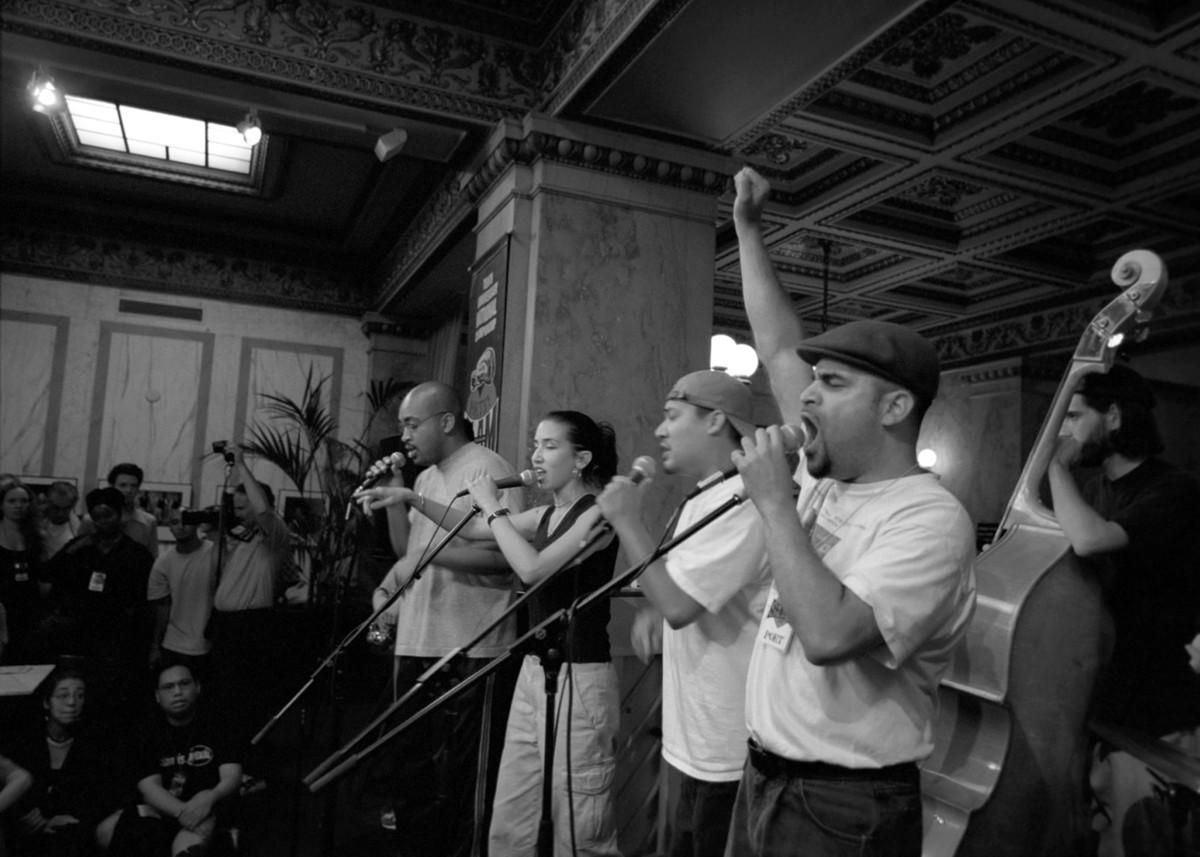
Now we’re into the roughest kind of public readings: the poetry slams (see Figure 12-1). Poetry slams are a lot of fun to attend, and participating in them can be entertaining and useful. But it’s not a world for the faint of heart. Slams are, most commonly, competitive readings at which audience reaction, or the reaction of a panel of judges, decides who “wins.” You may win nothing, or a cash prize, or a free drink.
You can find slams in all the ways you can find readings and open mikes. They take place in the same kinds of places as well. Poetry slams, just like readings and open mikes, have ground rules, and you need to be aware of them. Some require a mere sign-up; others require that you submit your poetry for consideration or read in an audition beforehand. Often, there is a time limit for readings — 3 minutes and 20 seconds is a popular limit. Know what the limit is and prepare accordingly.
A certain kind of poet, and a certain kind of poetry, goes over well at slams. Self-indulgence is expected. Performers will do just about anything in a poem (or a performance!) to win the audience.
What should you read at a slam? The kind of poetry that wins very often has:
Striking, often outrageous or violent stories with interesting characters. We’ve heard poems about suicide, illness, drugs, crime, childhood abuse, discrimination, poverty, sex (there is a great deal of sex in slam poetry), and mental illness at poetry slams. But you’ll find that different venues are associated with particular kinds of poetry — which is something to pay attention to as you shop for slams.
A strong, assertive first-person narrator (an I).
Immediately striking language — often ribald, vulgar, hip, or slang.
Lots of jokes and other humor.
Constant allusions to contemporary popular culture (movies, TV, music), social history, politics, and poetry.
An ending that leaves the audience with a concluding shock or joke.
|
|
© David Huang
Slams are slams. If you’re going to do them, you have to:
Like the rough-and-tumble of it, the theater, the zaniness.
Embrace the need to be a real actor, a ham if necessary.
Grow the triple-thick, titanium-coated rhinoceros skin you’re going to need if response to your work is less than, shall we say, wonderful.
Learn to be a good sport, to congratulate your conquerors, to be gracious and full of good humor if an audience or panel lets you have it. Conversely, if you win, you should be just as gracious.
Promise yourself you won’t go to only one slam. Experience is everything, especially in this world halfway between fine arts and the World Wrestling Federation. Become part of the regular audience, get to know the poets and their entourages, and enjoy yourself.
Keep reading your poetry in public. Each chance to perform will teach you about yourself and your poetry. Many are the times that we’ve discovered — in mid-reading! — a flaw or problem we needed to fix in a poem. But that sort of discovery makes a reading worthwhile.
It’s the human connection that’s most important when it comes to poetry readings. Folks get to hear your poetry. What could be better than that? What more direct way of sharing your poetry could there be than delivering your own words your own way? What’s more, readings can be your introduction to a community of poets you may want to join. By organizing poetry circles or reading groups of your own, you can create your own community. However you go, keep your focus on poetry and on its power to touch people.
Recipe for fun: Slam across America
Ingredients: Assemble 100 of the best North American performance poets, 7 legs, 32 U.S. cities, a sizable amount of Grand Marnier, and a place in a large bus.
Directions: Drive the bus from Seattle, Wash-ington, to Providence, Rhode Island, in one month. Stop at bookstores, cafés, bars, clubs, and concert halls. At each venue, have 15 to 25 poets get off the bus and duke it out slam-style (in which performance poets are pitted against one another for cash prizes and personal glory in audience-judged competitions). Promote new anthology: Poetry Slam!: The Competitive Art of Performance Poetry. Get back on the bus. Drive to the next city. Repeat for all 32 cities until you reach Providence. Get off the bus and take part in the National Poetry Slam, a 4-day poetry competition extravaganza involving 56 teams of poets from across the country. Laugh, cry, scream, and shout. Judge and be judged. Be part of a growing movement of performance poets who have delivered the spoken word to thousands of spectators and have breathed life into the notion of what a poetry event can be.
Go to freshpoetry.com/slamamerica/poets.htm or www.poetryslam.com to read more about the trip, the winners, the friendship, and to get information on how to get in on the fun. Call it the first-ever SlamAmerica Bus Tour.
Participating in Your Local Poetry Community
Another way to go public with poetry is to be a part of your poetry scene. Here are a few ways:
Attend slams and open mikes.
Take courses or attend workshops.
Go to your favorite poets’ readings. And tell your friends about them.
Become a member of a local or national poetry organization. Groups such as the American Academy of Poets or the Poetry Society of America offer very active Web sites, full calendars of events, and links to other groups and poetry sites.
Buy books of your favorite poets’ work. If your local bookstore doesn’t have them in stock, order them. Hard-to-find poetry books are available at Web sites such as www.spdbooks.org.
Volunteer at poetry readings or festivals.
Subscribe to poetry magazines or journals. Locate a magazine that discusses your local poets and poetry events. Not only will you keep up with current events, but you also may well be supporting nonprofit literary organizations or publications.
All of these are good ways to sharpen and widen your listening skills, your knowledge of what’s happening, and your circle of friends, acquaintances, and fellow poets.