
Chapter 4
In This Chapter
 Understanding the elements of interpretation
Getting comfortable with speculating (as opposed to knowing for sure) about a poem’s meaning
Understanding what is explicit in a poem and what is implied
Practicing informed speculation
Using subject, tone, language, music, and narrative elements to help you interpret a poem
Poems are meaningful things. In fact, poetry is famous for having more meaning per word than other kinds of writing. Poetry is supposed to burst with meaning.
Ah, but when you start asking “What does this poem mean?” all too often it’s like walking onto a battleground. How often have you been told, “No! You’re wrong!” when discussing a poem or a song lyric in a classroom? How often have you decided, “Well, this is too hard. I won’t like this stuff”?
Interpretation is the act of accounting for the feelings the poem gives you when you read it. When you look closely at a poem and see how it works, you find a way into it; you discover feelings, meanings, and richness, some of which the poet creates, some of which you make for yourself.
So interpretation is in part the discovery of how a poem makes meaning and feeling. You ask: Why does this poem make me feel the way I do? What is the poem doing, and how does the poet do it?
In this chapter, we give you guidelines and pointers to become a good interpreter. And we look at different approaches to this tricky and rewarding activity.
Reading at a Deeper Level
The first place to start when it comes to interpreting poetry is reading it at a deeper level than you read other things. When you pay closer attention to poetry, you’re rewarded with an understanding of it that goes much deeper — and lasts much longer — than a quick read gives you. In fact, poetry, as the poet Robert Creeley once said, is “an act of attention.” Reading (and writing) poetry is a great way to learn how to pay attention to the world.
Reading poetry means you pay attention to at least two things at once: what a poem is doing and how the poem accomplishes it. This assignment is a tricky one — kind of like making bread while riding a unicycle — but it’s worth it. The question is, what do you pay attention to?

Start by paying attention to two general aspects of poetry, and focus on those:
 Sense: What the poem is saying or appears to be exploring.
Music: The total of the poem’s sounds and rhythms.
We cover sense and music in more detail in the following sections.
Sense: Determining what a poem is saying
Many people think of poetry as being full of profound statements and insights. And it is! You need to pay attention to those statements and insights when they occur. But not all poems make statements. Some poems simply present a picture, ask a question, or plunge the reader into an experience. Almost all poems have a sense, something they mean to express, to do, or to call your attention to.
Poems that make you feel (instead of making a statement)
Take a look at this poem, “The Solitary Reaper” by the English Romantic poet William Wordsworth. Notice how it gives you an experience but doesn’t offer much in the way of bold statements or insights:

Behold her, single in the field,
Yon solitary Highland Lass!
Reaping and singing by herself;
Stop here, or gently pass!
Alone she cuts and binds the grain,
And sings a melancholy strain;
O listen! for the Vale profound
Is overflowing with the sound.
No Nightingale did ever chaunt
More welcome notes to weary bands
Of travellers in some shady haunt,
Among Arabian sands:
A voice so thrilling ne’er was heard
In spring-time from the Cuckoo-bird,
Breaking the silence of the seas
Among the furthest Hebrides.
Will no one tell me what she sings? —
Perhaps the plaintive numbers flow
For old, unhappy, far-off things,
And battles long ago:
Or is it some more humble lay,
Familiar matter of to-day?
Some natural sorrow, loss, or pain,
That has been, and may be again?
Whate’er the theme, the Maiden sang
As if her song could have no ending;
I saw her singing at her work,
And o’er the sickle bending; —
I listened, motionless and still;
And, as I mounted up the hill,
The music in my heart I bore,
Long after it was heard no more.

Here is a short list of words in this poem that may be unfamiliar to you:
Highland: An area of Scotland with elevated hills and moors.
the Vale profound: Another way of saying “the profound (deep) valley.”
chaunt: A different spelling of the word chant.
ne’er: The poetic way of saying the word never.
Hebrides: A group of islands in the west of Scotland.
plaintive numbers: Melancholy rhythms.
lay: Song.
Whate’er: The poetic way of saying the word whatever.
o’er: Another way of saying over.
mounted: Climbed.
Wordsworth’s poem plunges you into the midst of an experience. The speaker of the poem sees a girl working in the fields and hears the melancholy song she sings. The picture is vivid: the highlands, the deep valley, the girl’s work as she reaps the grain. And you get a general feeling about her song: The speaker says it is beautiful and melancholy, and that it echoes throughout the valley. He compares her song to that of two birds: the nightingale and the cuckoo. (Both the nightingale and the cuckoo are mentioned in poems throughout history. If you consult your reference books, you’ll find that the nightingale is famous for its melodious warble, and the song of the cuckoo usually announces the coming of spring, with all the joy and rebirth that season brings.) Yet this girl’s song outdoes them both. Clearly, the speaker (evidently just a traveler passing through) is charmed and maybe a little intoxicated by the tune. The girl sings as if “her song could have no ending.” The speaker stops for a moment, then climbs up the next hill and leaves the scene, with the memorable song in his heart.
Nice poem — but what does it mean? The speaker tells you everything but the meaning of it all. Notice he doesn’t even know what the song is about. He asks whether anyone will tell him, but there’s no answer (certainly not from the girl, who keeps working). He speculates: Is it a song of war? Or something more humble? An old song? Or something new? He gets no answers to these questions, either, and neither do you, the reader. The speaker doesn’t know what her song means or says, but when he leaves, it stays with him “long after it was heard no more.”
Many poems, like this one, simply present an experience without explaining it. They leave you to interpret it — or perhaps no interpretation is possible or necessary. Maybe Wordsworth simply wants you to enjoy the picture here: the girl in the midst of nature, singing a song that is the loveliest thing in a lovely environment.
What should you do with such poems? Let yourself have the experience. Envision the landscape of the Highlands; sense the rhythm of the girl’s scything; hear the echo of her song throughout the deep valley. There’s a mystery to the scene. You can’t get to the bottom of it — but then, you can’t get to the bottom of music either. You may find yourself thinking about how some songs stay with you long after you hear them, and how you can get the feeling from the melody of a song even though you can’t understand the words. There is a sweetness to this momentary encounter. Neither girl nor traveler have anything to do with each other directly, but something pretty has happened — to the traveler and to you.

This poem does not make a statement — although it leads you into a singular, compelling experience. Many experiences are like this: They simply are and resist further explanation. What’s interesting is how you respond to them. The poem is like the song: You can’t really tell what it means, but it is lovely, melancholy, and stays with you long after you’ve read (or heard) it.
Poems that have a point to make (or a statement to convey)
Many poems do make outright statements. The poet has something to say about life, a judgment to make, a truth to reveal.
Here’s an example, by the Arabian poet Abû-l-`Alâ’ al-Ma’arrî:
Friend, this world is like an unburied corpse,
And we’re the dogs barking round it.
If you go in and eat, you’re a loser;
If you stay out, and hunger, you gain.
Anyone the night doesn’t mug
Gets rolled: Time’s disasters at dawn.
Even though this poem’s statements are bold, reading a poem isn’t just a matter of dragging your eyes over it. It’s a way of paying attention. But just as you can listen to a friend talk while you’re watching TV, or you can sit across the table and stare into that friend’s eyes while she talks and really hear every word she says, you can pay attention to a poem on several different levels as well. Here are three different levels of attention you can pay to the poem by Abû-l-`Alâ’ al-Ma’arrî. You can apply this to any other poem as well:
Base-level attention: Base-level attention is what you do when you quickly scan the poem’s length, the name of the poet, the title, and the structure. With this poem, you may notice that it is short and doesn’t rhyme. It is written by an Arabian poet of the 10th and 11th centuries A.D. (The poet’s name may suggest that the poet is Arabian — or, if it suggests nothing to you, consult your reference books. As for the date, if you didn’t know that bit of information, you could turn to an encyclopedia and look it up.) The speaker doesn’t see the world as a happy place.
Mid-level attention: Mid-level attention is a little deeper — you read the poem through once and pick up anything that jumps out at you. You may notice the simile in the first line of the Abû-l-`Alâ’ al-Ma’arrî poem: “[T]his world is like an unburied corpse.” This simile is followed by a metaphor: “And we’re the dogs barking round it.” The world (human experience) is like a corpse that “we” (all people) feed on like scavengers with nothing better to eat. These sentiments don’t exactly speak well for people — but think about that metaphor for a minute. It seems to imply a few things about people in general. Exactly what does it imply, though? Asking such a question will lead you to the next level of attention.
High-level attention: High-level attention is what you do when you dig deeper, applying the experiences you get in poems in powerful and transcendent ways. Follow the sense of the metaphor, and you find that Abû actually has a little philosophical advice: Don’t get too involved with “this world.” (“If you stay out,” he says, “you gain.”) That way, when you suffer (and everybody either gets “mugged” by night or “rolled” by daylight, which brings “disasters”), you can at least control your own behavior.
High-level attention is a wonderful place. We can’t tell you how much we enjoy going there. Don’t be afraid of such intense attention. It means you care and are involved in what happens to you and around you.

Paying attention brings many rewards. We proposed a main message in Abû’s poem: Don’t get too involved in the world, and your sufferings will be less. But then we read this line: “If you stay out, and hunger, you gain.” This line is a paradox (where two things appear to conflict, or even contradict, and yet coexist as if they were both true). You gain if you stay out — but staying out also leaves you hungry. We love that moment of realization. It’s one of those moments poetry can give you. A weary speaker advises you to stay apart from the world — but then admits, to some degree, that it will be hard. Feel all the complicated experience behind those words?
High-level attention is what you do all the time. Bring it to poetry sometimes — after bringing it to your job, your favorite TV show, your loved ones, the purchase of underwear, skateboarding — and you may gain, and not be hungry.
To follow the sense of a poem, pay close attention. Watch both what a poem is doing and how it does it — and later, pay close attention to your conclusions and how you draw them.
Music: Hearing a poem’s sounds and rhythms
We use the word music to mean the total of the sounds and rhythms in a poem. That means the rhymes, the chimes, the line endings, the pauses, just to name a few. But you don’t have to know the labels to enjoy the sounds, any more than you have to know the number of a symphony to appreciate the music. (If you absolutely have to know the sound and rhythm jargon, we explain much of it in Chapter 3.)
Related to the aural (heard) music is the visual rhythm of the poem — how it looks, its shape, the line lengths, and the impact of all that word-sculpture on you.
The term form refers to the mode, shape, or structure in which a poem is written (ballad, sonnet, epic), its rhyme scheme (or lack of one), the way it sounds, and even the way a poem looks — its physical body. The way a poem looks is part of its message. Shape conveys feelings, just as sounds do. A poem written in bursts of brief lines strikes you differently from a poem that sprawls across the page in long lines.
In poetry, the form and the content (what the poem contains — images, message, viewpoint) are mixed up in each other. Form is content and content is form. Remember that as you read.
Here’s a passage from W.S. Merwin’s poem “Leviathan” with a lot of luscious music in it. This fact for free: It concerns a whale. Pay attention to the sounds and rhythms you hear as you read.
This is the black sea-brute bulling through wave-wrack,
Ancient as ocean’s shifting hills, who in sea-toils
Travelling, who furrowing the salt acres
Heavily, his wake hoary behind him,
Shoulders spouting, the fist of his forehead
Over wastes gray-green crashing, among horses unbroken
From bellowing fields, past bone-wreck of vessels,
Tide-ruin, wash of lost bodies bobbing
No longer sought for, and islands of ice gleaming,
Who ravening the rank flood, wave-marshalling,
Overmastering the dark sea-marches, finds home
And harvest.
Do you feel the hugeness of the whale? If so, part of what’s bringing that hugeness across is the poem’s music, its sounds, its rolling rhythms. You can’t really read these lines quickly. How quickly can you even say, “This is the black sea-brute bulling through wave-wrack”? The words force you to go slowly: The repeated bs and rs give your mouth a lot to do.
Read that first line again:
This is the black sea-brute bulling through wave-wrack
Your mouth is working like a whale’s jaw in a squid school! And W.S. Merwin, one of America’s most honored poets, wants it that way. He has put slow, solid, heavy music in there to weigh down the lines so you move like a . . . well, like a whale. The lines are describing a whale, but they’re doing more: They’re embodying a whale.
Music is never there only for its own sake. It can reinforce, represent, or even be the meaning of the poem. It’s never just pretty, just window-dressing. Why not? Because poetry is dense (intense and compressed, like a really good cheesecake) and hasn’t a syllable to spare.
Rhyme is an instrument that leads us to meanings as well. Here is “Nothing Gold Can Stay,” by Robert Frost, a poet whose work has beckoned millions of readers with its descriptions of the New England way of life, its sensitive depictions of nature and the ways of the human beings Frost writes about.
Nature’s first green is gold,
Her hardest hue to hold.
Her early leaf’s a flower;
But only so an hour.
Then leaf subsides to leaf.
So Eden sank to grief,
So dawn goes down to day.
Nothing gold can stay.
How does Frost write this tiny poem, which doesn’t seem to be much, and say what he manages to say? First, the lines are short, and they rhyme in couplets (pairs of lines). Each rhyme is part of the meaning. Gold is what nature can’t seem to hold for very long. The flower of gold lasts only for an hour, reinforcing the message of the poem. And then the magic: Frost shifts from the leaf, which is what became of the flower, to Eden, the fall of humanity, and how things can’t seem to stay at their best state for very long. He fits all of this in a tight, deceptively simple poem.
Rhythm can be visual (seen) as well as aural (heard). That’s because poetry is as much sculpture as it is music. Poets build their poems in specific shapes for specific reasons, and those shapes become part of the poem’s message and impact. A good example is Poem 15 from a series titled “A Coney Island of the Mind,” by Lawrence Ferlinghetti, which is about poets themselves:
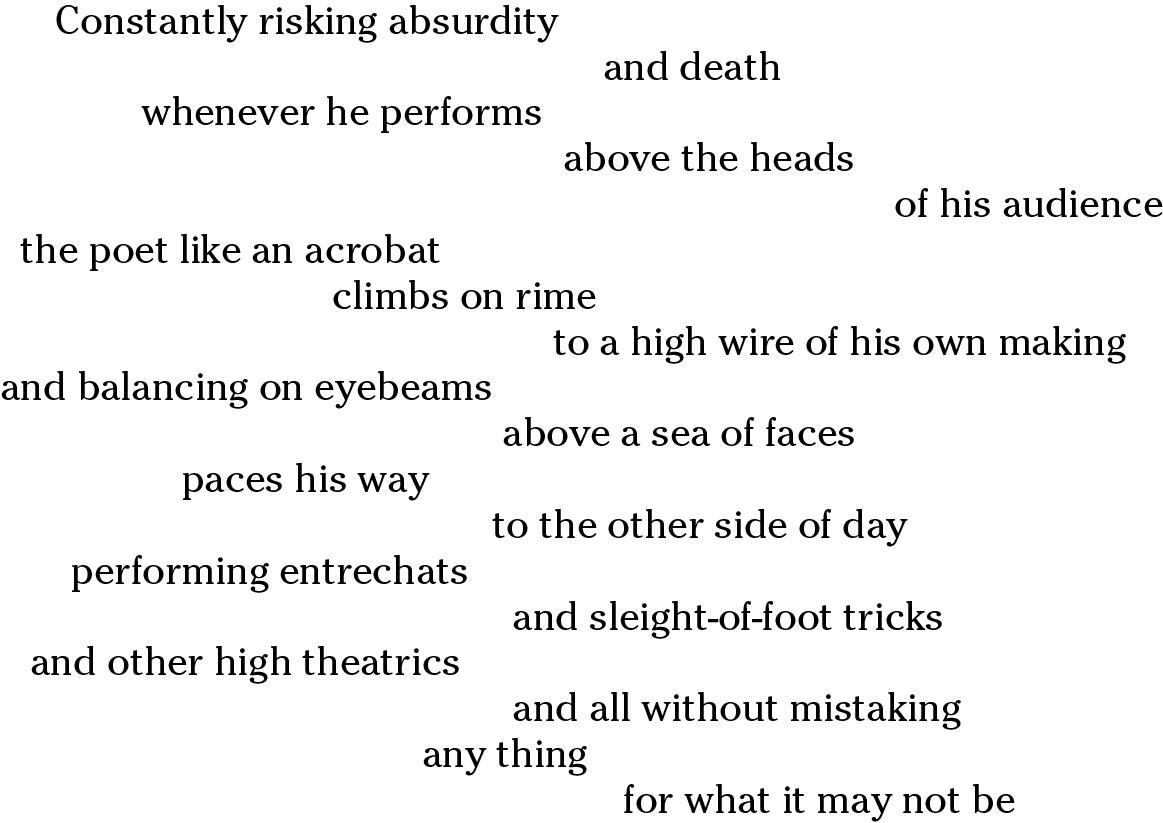
When reading this poem, slow down between lines, take your time, communicate Ferlinghetti’s delicate, humorous tone. Notice the rhymes. And look up entrechats if you need to (we’ll save you a step: it means an athletic ballet move in which the dancer leaps in the air and crosses his legs [or beats them together] several times).
You can apply the three levels of attention to the music of poetry as well:
Base-level attention: What kind of music is there? Vowels? Consonants? Rhyme? Rhythms? Free verse? Do you see any interesting shapes?
Mid-level attention: What is the music accomplishing? What’s it doing in the poem? What are the big effects?
High-level attention: This part is tricky but worth it. Ask, “What does the music add to the poem? How does the poem’s form contribute to its content?”
Ferlinghetti’s poem certainly does contain a lot of music. Read these lines aloud again:
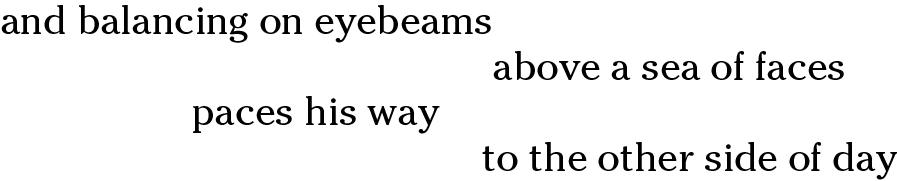
In these few brief lines, you can notice the following based on the three levels of attention:
Base-level attention: The lines have several long a and i sounds. And some very interesting shape-building is going on — the interspersed lines, the spaces between them, the lack of punctuation.
Mid-level attention: Why the long a and long i sounds? Well, as a reader you have to guess. Perhaps to establish a little tension (the high-wire walker may fall any second). Or maybe to recall the sounds a crowd makes as a high-wire walker performs. As for the visual rhythms, the poet is said to be performing on a high wire, and the freewheeling lines, hanging mobile-like in the air, reinforce the risk and daring of it all.
In fact, Ferlinghetti once said that he was influenced by the artist Alexander Calder, who is famous for his many modernist mobiles. Ferlinghetti actually was trying to write word-mobiles!
High-level attention: Now you get to balance on the high wire of your own imagination. How does this poem’s form contribute to its content? The spacious, jagged arrangement of the lines recalls the height and depth and risk surrounding the poet, which reinforces the excitement (and a little of the fear) in the poet’s heart, and the anticipation in the reader’s heart, when a poem begins. And how is the poem’s content reflected in its form? The poem’s content is playful and profound at the same time. It’s an example of the risk a poet takes each time he writes a poem.
Speculating as You Read
The trick about interpreting poetry is that most poems have different levels of meaning. There is a literal or explicit level, on which things are stated straight out, they happen, and no one can argue about it. In Robert Browning’s poem “The Pied Piper of Hamelin,” the guy with the pipe leads the kids out of town, and they’re never seen or heard from again. That’s the literal, explicit event in that poem, and if someone who has read the poem says, “No, he was playing a saxophone,” or, “No, they all return as investment bankers,” we can say, “Er, no. Says here they left and didn’t come back.”
But poetry has another world of meaning — one that isn’t certain. You feel it and know it’s there, but it takes some work to say how you know or exactly what you’re feeling. So you speculate — you speak, not in certainties, but in a provisional way about what you think you see. You start from concrete evidence (that’s crucial), but you soon branch out from that evidence to build theories to account for your feelings. When you speculate, you never know for sure if your interpretation is right, but you’re building on clues and intuitions to make an educated guess.
People speculate constantly in their daily lives: They speculate about people, about love and courtship, about music. They interpret street signs: “ROAD WORK LANE ENDS 17 FT MERGE LEFT NOW.” They interpret telephone schedules at hotels: “Local calls touch 8 plus area code plus local number. Hotel surcharge of $0.75 per call, for calls up to 20 minutes. $0.10 charge for each additional minute after the first 20 minutes (per call).” And poetry cries out for interpretation, too.
How do you know when an interpretation is “right”? Right answers sometimes do exist. (For example, if you said “Homer’s Iliad is not set in 1956 Brooklyn,” you’d be right.) But much of the time in the world of poetry, right answers either don’t exist or aren’t that interesting. So set aside the notion of “right” for a moment. Instead, think about interpretations that really say something useful, interpretations that are attentive to the poem. When coming up with an interpretation, shoot for an interpretation that is
Comprehensive: It takes in as much of the poem as possible — its form; the speaker, theme, plot, problem, or character(s); the implications of the metaphors and figures of speech; the music (sound, rhythms, and so on); and visual aspects.
Accurate: It tries to say nothing that is contradicted by something else in the poem, including its meaning, its form, or the historical and biographical facts surrounding the poem and its writer.
Mastering Three Steps to Interpretation
Some people think that when you’re interpreting, you’re trying to figure out what the poet intended in the poem. Others say that you can’t ever be sure what the poet intended. But we recommend coming up with intelligent ways to account for the feelings the poem gives you when you read it. Try to explain what you think the poem is doing and how the poem does it.
When you interpret poetry, you do the same thing you do when you interpret anything:
Understand the explicit, literal meaning.
Consider what’s implied, unsaid, or suggested — often by asking attentive questions about the poem.
Build an interpretation based on your speculations about what’s implied.
You may not take these steps in this order, and you may do some steps more times and other steps fewer, but all these steps are involved in the interpretation of poetry.
Understanding the literal
If the poem in front of you tells a story or seems to have a fairly explicit topic (one that’s given to you), take note. A poem’s literal meaning is its body, and you need to know it. That literal meaning, however, may be pretty complicated. But that’s what’s beautiful and worthwhile about poetry.
Here is the poem “Richard Cory,” by Edward Arlington Robinson, one of the finest poets in U.S. history. Watch what the poem explicitly lays out for you.
Whenever Richard Cory went down town,
We people on the pavement looked at him:
He was a gentleman from sole to crown,
Clean favored, and imperially slim.
And he was always quietly arrayed,
And he was always human when he talked;
But still he fluttered pulses when he said,
“Good-morning,” and he glittered when he walked.
And he was rich — yes, richer than a king —
And admirably schooled in every grace:
In fine, we thought that he was everything
To make us wish that we were in his place.
So on we worked, and waited for the light,
And went without the meat, and cursed the bread;
And Richard Cory, one calm summer night,
Went home and put a bullet through his head.
On the explicit or literal level, this poem tells the story of a high-class, rich, much-admired man who, contrary to all expectations, commits suicide. But that isn’t all: The speaker in this poem, the voice telling it to us, is “We people on the pavement,” and the people have a story, too, which Robinson explicitly lays out: They admire Richard Cory, they “wish that [they] were in his place,” and they have lives filled with work and disappointment, which is fairly explicit in that line “went without the meat, and cursed the bread,” an echo of a biblical image of misery.
Getting at what’s implied
The literal part of a poem is important, but it’s not all there is. Refer to “Richard Cory” by Edward Arlington Robinson in the preceding section. There’s a further feeling in the poem, emanating from the words. The feeling isn’t explicit, but it’s pretty strong nevertheless.
When you have strong feelings as you read a poem, start interrogating the poem. Step back and ask global questions about things like setting, speaker, character, and situation:
Where does the poem take place? In this poem, the setting is an American town.
What kind of town? Some of the people are ordinary (“people on the pavement”) and others aren’t (Cory is “imperially” slim, which has overtones of royalty, picked up in the phrase “richer than a king”).
What’s the problem or conflict here? The ordinary people wish they were like the richer, extraordinary ones. They find their lives hard and disappointing (implied in the phrase “went without the meat,” as if meat were something they expected to have and didn’t get, to be replaced by “bread,” a second-best food that is “cursed”). Yet one of the extraordinary people, one of the most admired, kills himself. That gives you an unexpected, uneasy feeling, a feeling of surprise, of anxiety related to the workings of fate. Maybe you can identify a source for that feeling later.
You see some interesting things in “Richard Cory.” The poem suggests a whole world of class divisions, based on wealth. Cory isn’t a king, but he is like one. People look at him and think he’s simply different, and they want to be in his place. Nowhere does the poem contain the phrase class divisions or envy, but you can feel these forces at work nevertheless.
Speculating on what’s implied
In the previous two sections, we uncover many things that are implied or suggested in the poem “Richard Cory” by Edward Arlington Robinson. You’re looking for ideas about class and social life in general. So you need to keep asking questions. What questions you ask depends on the poem. Often, you’ll be asking about what isn’t there, what doesn’t happen, what is surprising or confusing.
For example, you may ask, “How well do the ‘people of the pavement’ know Richard Cory?” Not well, it seems. Almost all the adjectives describe his outward behavior and appearance. He glitters when he walks and is “admirably schooled.” He is “imperially slim,” “quietly arrayed,” “human.” The last two descriptions have a little overtone of surprise, as if the “people of the pavement” expect him to be a showoff in his dress and condescending when he speaks to them. Instead, he dresses “quietly” and speaks in a “human” way.
Maybe you feel less than satisfied with all this description. Ask yourself why. What aren’t you getting here? Possibly this: None of these words really penetrate to Cory’s personality or intimate concerns. Cory keeps to himself. He is civil to people but not self-revealing. He is known to be rich and have everything that everyone wants. And did you notice what you aren’t told about him? He doesn’t appear to work for a living. Somebody “schooled” him, but there is no mention of parents, a mate, children, or any emotion or love in his life. Cory’s life is so apart from the other people that they can’t guess what’s going on inside him. They are concerned with their own hard lives, which arouse resentments in them. Meanwhile, Cory has a life that somehow leads to suicide.
The last line of the poem comes as a shock. And notice, the speaker doesn’t say, “He shot himself.” The speaker is more explicit, which increases the shock: Cory “put a bullet through his head” — a violent moment. In fact, the moment is so violent that you may want to go back over the poem looking for clues that led up to that point. And when you do, you realize that the poem gets darker as it goes on, until you reach the final stanza, with its working, cursing, and suicide. Cory is all the things that make the people wish they had his life and not their own. He is a reminder of the class system, a sign of everything these people want and can’t get. Maybe they’re looking at him not as a person, but as a symbol of what they want and can’t have.
Many people have taken away this implication from “Richard Cory”: All his riches couldn’t buy happiness. This is a perfectly good moral to the story, if you’re looking for one. But see how much more our speculations have revealed: the frustrations of class, the deceptive nature of social life, the way people can hide great suffering from others, the brute facts that we envy other people and sometimes hate our own lives. That speculation brings you a lot more than a simple moral to the story.
When interpreting poems, start with what’s explicit. Then begin to consider what’s suggested or implied and speculate on those suggestions. Try to build up an account of why you feel the way you do.
Good interpreters also watch out for the elements of poetry and take them into account when building interpretations. In the following sections, we discuss some of these elements of poetry, including subject, tone, language, music, and narrative elements, and how you can use them as clues when interpreting a poem.
Paying Attention to Subject and Tone
Your mind looks for certain things (like subject and tone) automatically when you’re interpreting a poem. But you can help your interpretation along by being aware of them.
Searching for the subject
With the poem “Richard Cory” (earlier in this chapter), you can nominate any of several subjects: social life, class, alienation (the feeling of being apart from people). When you’ve said, “I think the subject of this poem is X,” you now have a direction to take in your speculations — that is, what does the poem do with that subject? Where does the poem take it?
Some poems don’t have subjects. Some are just wild howls of happiness or playful games with words. But it’s hard to use words (even if they’re flung all over the page) and not involve some aspect of the world and human life.
Tuning in to tone
Tone is the emotional atmosphere of the poem. Is it happy, sad, satirical, something else? Tone tells you a lot about the poet’s feelings about the poem’s subject and about his attitude toward the audience and life in general.
How do you figure out the tone of a poem? Watch your own responses. Many readers are obedient. If a poet says they should be happy, they’ll be happy. If a poet is angry, readers will feel that anger as well.
The tone of “Richard Cory” (discussed earlier in this chapter) is ironic. How do we know that? In three ways:
Many readers get a fatal, surprised feeling, at the end of the poem. This kind of feeling is a common response to irony.
The poem presents things that are contrary to expectation (one of the definitions of irony). Readers see what the townspeople expect of Richard Cory and his very different reality. They assume that Cory is happier than they are — partly because they themselves are not happy. His suicide suggests that he is even unhappier than they are — and that’s ironic.
Readers may spot the trouble with Cory before the townspeople do. They may realize that the townspeople assume that Cory is happy — but the poem gives readers little reason to think so. If you’re paying attention, you may feel trouble far in advance of anyone else in the poem. That’s called dramatic irony, in which the reader guesses a truth that the characters in a poem or story are unaware of.
Note, in the midst of the last, very eventful stanza, the “one calm summer night.” This is even more irony. You may expect that a night of suicide somehow would be a violent night — but it isn’t. The night of Cory’s suicide recalls the “quiet” way he dressed and the “human” way he talked. Cory kept himself in reserve. There was no sign of trouble about him. And the night he kills himself is quiet as well.
How does all this irony help you interpret the poem? It makes you realize how little you know about people, how deceiving their exterior self-presentation may be. All may be quiet and calm on the surface but desperate and raging beneath. You realize the extent of human unhappiness — even in the midst of wealth. In the end, you get a profound sense of how human life works: The message is sad, but it is much larger than the scope of this short poem.
Looking at Language
Stay alert for symbols, metaphors, images, and surprising turns of speech as you read poems. These elements of language are all opportunities for interpretation, and you should take advantage of such opportunities when you find them.
In a graveyard, Hamlet lifts up the skull of Yorick, a jester who used to carry young Hamlet around on his back. That’s a symbol, an invitation to interpret: Skulls often symbolize death or the passage of time, two things Hamlet is worried about.
When in “Coal,” American poet Audre Lorde writes, “Some words live in my throat / breeding like adders,” you see a metaphor (the words living in the throat) followed by a simile (“breeding like adders”). Right away, you can start to interpret: If a word “lives” in a throat, it grows, but maybe it never gets out, always stays in the throat, is never expressed. And the unpleasant image of snakes breeding — especially poisonous snakes like adders — suggests danger and ugliness. Connect that with never being expressed, and you may begin to think of the speaker as frustrated, angry, with dangerous things to say.
Listening to the Music in a Poem
Very often, a poem’s music is a direct guide to interpretation. The music helps establish a poem’s emotional weather.
First, listen to some smooth, ravishing music, from Alfred, Lord Tennyson’s poem “Now Sleeps the Crimson Petal”:
Now sleeps the crimson petal, now the white;
Nor waves the cypress in the palace walk;
Nor winks the gold fin in the porphyry font.
The firefly wakens; waken thou with me.
Tennyson’s lines are liquid and whispery, with plenty of s, l, and f sounds. Those sounds are physical things and are partly responsible for the poem’s impact on you. As the melody and harmony in a song spur certain feelings, so do the sounds in a poem. The setting is the fall of evening, and the speaker calls to someone else to wake up. If you feel as though Tennyson’s lines are slow, quiet, perhaps sensuous, the whispering music can help you account for that feeling.
Rhythm, too, can be a clue to interpretation. Elizabethan poet John Donne’s Holy Sonnet 14 begins with four lines that assault you with their insistent rhythms:
Batter my heart, three-personed God; for You
As yet but knock, breathe, shine, and seek to mend;
That I may rise and stand, o’erthrow me, and bend
Your force to break, blow, burn, and make me new.
The lines stop and start, as the speaker calls on God to intervene decisively in his life. You can connect this jerky rhythm with the speaker’s agonized, desperate call. The rhythm is a strong clue to the speaker’s emotional state.
Rhythm also informs these lines from Lucille Clifton. Listen as the words tumble forth from a speaker trying to explain her poetic gift:
i don’t know how to do
what i do in the way
that i do it. it happens
despite me and i pretend
to deserve it.
but i don’t know how to do it.
only sometimes when
something is singing
i listen and so far
i hear.
The rolling, tumbling lines lead you to feel the speaker’s excitement at her gift for writing poetry. But notice the three strong pauses after the fourth, fifth, and ninth lines. (Pauses are part of rhythm, too!) That pause between “pretend” and “to deserve it” emphasizes the speaker’s awareness that she can’t deserve such a gift. It’s a pause suggesting humility. She knows it may not be a permanent gift, as the pause between “so far” and “i hear” suggests. I hear so far, but it could change at any moment.
In traditional forms and free verse alike, you can use a poem’s rhythms to figure out a poem’s message, or at least your reactions to the poem.
Using Narrative Elements as You Interpret
Many poems tell a story, in which case, suddenly, all the aspects of narration — speaker, setting, situation, plot, and character among them — come into play.
Try paying attention to the narrative elements in this poem, “The Honey Bear,” by Eileen Myles.
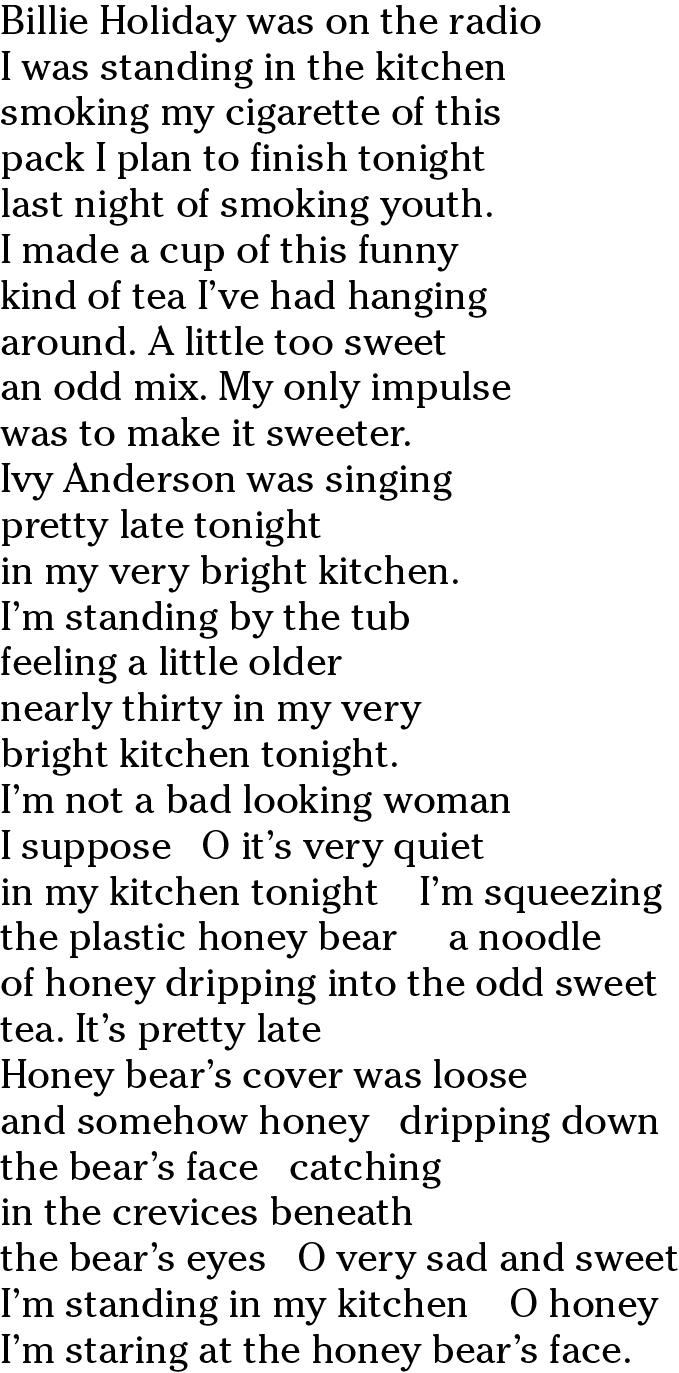
This poem certainly has a speaker, an “I” who makes the tea and tries to pour the honey into it. Whenever you see speakers, ask questions. What kind of person is this, and how do you know? You may see signs of loneliness (the repetition of the phrase “my very bright kitchen”), insecurity or perhaps self-mockery (“I’m not a bad-looking woman / I suppose”), dissatisfaction with herself.
The poem has a clear setting also — a bright kitchen in a woman’s residence. Now, is this residence a house or an apartment? You may have a sense that her personal space is small. The tub is in the kitchen, so you can imagine it’s a small place, maybe a studio apartment in a big city like New York.
The poem has at least two allusions as well — to Billie Holiday and Ivy Anderson, two great jazz singers of the mid-20th century. If you research those names — or even listen to some of their music — you’ll see they often sang sad or bluesy songs, which may fit this scene.
The speaker is straightforward and conversational, which hides some clever metaphors. Note a few statements that could have more than one meaning. “It’s pretty late” could refer to the time of night or the time in the speaker’s life. And when the speaker tells you of her impulse “to make it sweeter,” the word “it” could refer to the tea or to her life in a more general way. And “O honey” could be an exclamation at the potential mess she’s making — or a call to an absent lover (or reader).
Ask, too, exactly how it is that the cover gets loose and honey “somehow” drips over the bear’s face. Note the spaces in these lines:

Those spaces suggest that you’re watching the slow drip of the thick honey. Is the speaker being careful and attentive as she pours the honey? What may be distracting her? Consider her state of mind. Honey dripping all over the bear’s face (What else drips down a face? How about tears?) may be a metaphor for the speaker’s sadness and self-pity. It’s a sweet sadness.
With this poem, as with any other, interpret by paying attention to what the poem says and your responses to it. And then the fun begins — building a bridge of speculation between the poet’s words and suggestions and your reaction. Interpretation is the best part of reading poetry.
You may feel insecure at first, but you’ll get to like the feeling. A good poem can be as sweet as a honey bear with the cover loose.