
AS THE 2020 ELECTION DREW NEAR, a group of nearly seventy political communication scholars wrote what they called an emergency set of recommendations for how the news media should approach covering the end of the election season, what to do if the results were contested or one of the candidates would not concede, and what to do if there was civil unrest after the election.1 They were worried that there would be attempts to undermine the integrity of the election and even efforts to subvert the will of the people on Election Day. Their recommendations—such as denying platforms to those making baseless claims about the election, striving for equity in news coverage, and publicizing plans regarding the decision process on who won a state—were made with the knowledge that the news media had considerable power with respect to shaping public confidence in American electoral administration.
Americans are almost wholly dependent on the news media to learn about politics. At the same time, Americans are notoriously critical of the news media. Less than 20 percent of the public have “a lot” of trust in the information they get from national or local news sources.2 Three-quarters of citizens believe the news tends to favor one side in coverage of politics.3 Of course, newspapers, television news, magazines, and online outlets are not the only places people learn about politics. People also talk with their friends, coworkers, and family members about contemporary issues. Moreover, they increasingly use social media to share, engage, learn, and express their own ideas about politics.
The American people are not the only ones engaged in a need–hate relationship with the news media. Politicians are chronic critics of journalists as well. President Donald Trump regularly derided coverage with which he disagreed as “fake,” “unfair,” and “nasty.” Fact-checkers were particularly busy during the Trump era; as the Washington Post’s Glenn Kessler and colleagues noted, the president made 30,573 false or misleading claims while in office.4 In this chapter, our learning objectives for understanding the state and consequences of political communication include:
· Applying the major functions of the news media to our own assessments of media performance
· Learning how individuals select and assess their news and bias in the media
· Exploring the media’s role in polarization, persuasion, and participation
· Examining how social media is changing politics
· Identifying how political communication can change individual attitudes
THE NEWS MEDIA: FUNCTIONS, TYPES, AND USERS
Despite being a crucial intermediary that connects a diverse array of people in myriad ways, the news media are a frequent punching bag for politicians, scholars, and the public alike. Much of the ire aimed at the media stems from critiques of the ways in which the media perform their basic functions. Doris Graber has argued that there are four functions of the mass media: surveillance, interpretation, socialization, and manipulation.5
Surveillance is the process by which the news media inform people of important events. Since most people do not wake up asking themselves, “How do I hold my government accountable today?,” journalists convey to readers, listeners, and viewers which events are important and which are not. This begins with judgments about what is newsworthy. In general, newsworthy stories are those that are timely, proximal, and familiar and contain some kind of conflict, violence, or scandal. The surveillance function of the media is closely connected to the concept of gatekeeping—which is the power the media have to convey to the audience what is important and what isn’t. Which of the fifteen items on the city council agenda merit public attention? Does a public protest merit media coverage, or is it small potatoes? Which elements of the COVID-19 recovery legislation deserve emphasis in the story, and which can be ignored? Surveillance is public in the sense that it brings attention to public officials, organized interests, and the like, and it is private in that it helps provide people an avenue to stay informed. Some critics argue that the media’s choices about what to cover rely too much on the discourse of political elites and ignore the challenges and issues facing everyday citizens. Others accept that the news media will spend most of their attention on public figures, but blanch at the amount of coverage some politicians receive as compared to others, especially since more ideologically extreme politicians get more media attention.6
In the 2020 campaign, Trump got the most attention—by far. Political scientist Stuart Soroka’s chronicling of 2020 coverage found that out of every ten stories about the campaign, Trump received seven to eight, and Joe Biden received two to three.7 While incumbents tend to get more attention than challengers, the disparity in 2020 was the largest in the forty years of data Soroka analyzed.
Interpretation is the function of the media that puts an issue into context. Interpretation goes beyond surveillance to explain to the audience what an event means. For example, when Biden selected Kamala Harris to be his running mate, NPR’s website ran an article arguing that Biden’s choice was a “statement on what it means to be an American” and that Biden is willing to listen to people who disagree with him.8 These kinds of articles praising Biden’s choice were common in 2020, with more conservative critics complaining that the news media favored the Biden–Harris ticket.9 While the surveillance function of the media certainly contains some biases regarding who gets covered the most, the interpretation function is often home to charges of ideological bias in news coverage, something we consider later in the chapter.
Despite the positive interpretation of Harris’s selection as the vice-presidential nominee, news coverage of politics tends to be negative. Campaign coverage, however, tends to be more positive for one candidate and more negative for the other. Though Trump received far more coverage than Biden, Biden received more positive coverage. Table 7-1 shows analyses from the Shorenstein Center on Media, Politics and Public Policy that compared coverage from Fox News and CBS News. A cursory look at this result might suggest a bias that the news media had in favor of Biden. However, a closer look at the topics that generated positive and negative coverage for each candidate reveals that the news media’s interpretation of events on the campaign trail is highly predictable and largely governed by professional norms that reporters apply to all candidates. While Biden enjoyed more positive coverage than Trump, Table 7-1 shows that the main reasons were related to the tone of horserace stories—coverage that examined campaign strategy and who was winning and losing in the polls—and stories about COVID-19, which were overwhelmingly negative for Trump. In other words, since nearly every poll showed Biden winning the race and the public being dissatisfied with the Trump administration’s handling of the pandemic, the news media’s coverage of the polls was more positive for Biden.
Table 7-1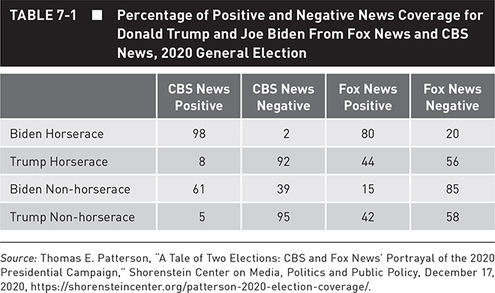
Source: Thomas E. Patterson, “A Tale of Two Elections: CBS and Fox News’ Portrayal of the 2020 Presidential Campaign,” Shorenstein Center on Media, Politics and Public Policy, December 17, 2020, https://shorensteincenter.org/patterson-2020-election-coverage/.
The third media function, according to Graber, is socialization. This is the function in which the mass media help citizens learn basic values that prepare them to live in their society. For instance, the news media tend to cover the two major political parties but largely ignore third parties. When third parties are covered, it is usually to speculate about which of the major parties might lose votes to the third party. Thus, news coverage helps socialize Americans to accept the two-party system of government and see important differences between the parties.10 Broader, cultural socialization can come from the mass media as well; notable examples include changing attitudes about premarital sexual behavior, sexual orientation, and racial attitudes. An example of socialization on display in 2016 occurred when Trump apologized after the Access Hollywood video, mentioned in Chapter 2, leaked. The early news coverage of the video focused on both the objectionable nature of the comments Trump made in the video and speculation about when Trump would apologize, which media commentators reasoned he would surely have to do to survive politically. The news media socialize the public to expect an apology from a lawmaker when one has said something incredibly offensive about a large group of people.
Finally, the news media engage in what some scholars call manipulation. Manipulation can mean many different things, including journalists engaging in “muckraking,” the digging up of dirt on government behavior designed to force lawmakers to “clean up their act.” However, Graber notes that manipulation also can mean the sensationalizing of facts to try to increase an audience’s interest in a story to boost ratings and profits, and it can even mean the media surreptitiously advocating for the positions of some politicians or trying to alter the preferences of other politicians. One example of manipulation in the 2020 campaign was the news media’s focus on Joe Biden’s son Hunter and his dealings with a Ukrainian energy company called Burisma. Though a Republican-led Senate report about the younger Biden’s dealings with the company found no evidence of wrongdoing or influence on foreign policy, they concluded the former vice president’s behavior was problematic.11 For most of the general election season, conservative news outlets aired hundreds of stories about Hunter Biden, calling the situation a scandal.
Other scholars think about the functions of the news media with respect to whether news coverage enhances the prospects and performance of democratic citizenship. A number of scholars have pointed out that it may be rational for voters to ignore much of the political information around them. Rational choice theorists, following the lead of economist Anthony Downs, argue that the benefits derived from reaching a “correct” decision on a candidate or policy may not be worth the costs the voter incurs in finding out the information.12 It is rational, therefore, for the voter to take a number of information shortcuts, such as relying on someone else’s judgment or voting according to one’s established party identification. Samuel L. Popkin uses the analogy of “fire alarms” versus “police patrols” to explain how most people view political information.13 Instead of patrolling the political “neighborhood” constantly to make sure nothing there requires their attention, most citizens rely on others to raise the alarm when something truly important happens. Television news and newspaper headlines may be enough to tell average citizens whether they need to delve deeper into a story.
Michael Schudson, a sociologist of news, argues that good citizens need not be fully informed on all issues of the day but that they ought to be “monitorial.”14 That is, a good citizen scans the headlines for issues that might be important enough about which to form an opinion or on which to take some action. Political scientist John Zaller argues for a “burglar alarm” standard of media coverage in which reporters regularly cover nonemergency but important issues in focused, dramatic ways that simultaneously entertain and allow traditional news makers like political parties and interest groups to express their views about the issue.15
For the media to have an impact on an individual’s political attitudes and behavior, the individual must give some degree of attention to the media when political information is being reported. Even in an age of difficult economic times for newspapers and local television news stations, there is the ever-expanding number of media outlets and platforms. People can read newspapers; watch local television news, national network news, mainstream cable news, or ideologically oriented cable news; listen to the radio over the air or via paid satellite services or listen to podcasts; read magazines; read web-only news sites; share information via social media; and do all of the above on a computer, tablet, or phone.
Almost all Americans have access to television and watch political news at least some of the time. In 2021, 86 percent of Americans claimed to get at least some news from their smartphones.16 On the one hand, use of smartphones expands access to political information, but as Johanna Dunaway and colleagues discovered, excessive smartphone use for political information could be a problem for the acquisition of political knowledge as people pay less attention for less time to news on their smartphones.17 While a majority of Americans reported reading a daily newspaper regularly, often online, only about 5 percent of people said they prefer using a hard copy of a newspaper.18 Somewhat fewer reported reading a newspaper for political news. This represents a decline in daily newspaper readership from more than 70 percent early in the 1990s. Occasional newspaper reading is higher. Television remains the main source of news for most Americans, but the internet has passed newspapers and radio as the second most commonly used source.19
Network television news viewership is down over the past several decades, but increased by five million between 2016 and 2020 to about twenty-nine million Americans who watch the NBC, ABC, or CBS evening news programs on an average weeknight.20 Prime-time viewers of CNN, Fox News, and MSNBC combined averaged just under six million people each weeknight.21 While over 90 percent of Americans listen to the radio at some point during the week, only about one-third told the Pew Research Center that they listened “yesterday.” The percentage of people listening to the radio online has increased to over 50 percent.22 In 2020, the public continued reporting that television was a main source for campaign news. The use of mobile technologies—from reading newspapers online to listening to podcasts—all continued to grow in 2020. More than a fifth of Americans now say they get some of their news from podcasts.23
QU: Please add text callout.
 Description
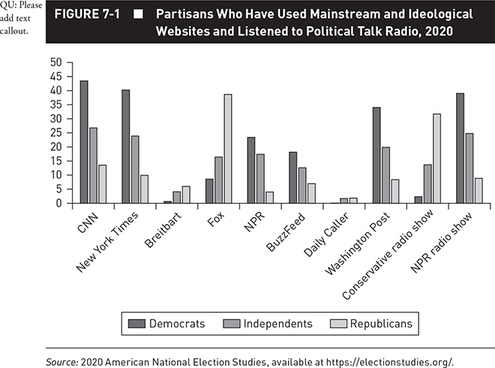
Figure 7-1 Partisans Who Have Used Mainstream and Ideological Websites and Listened to Political Talk Radio, 2020
Source: 2020 American National Election Studies, available at https://electionstudies.org/.
The American National Election Studies (ANES) asked respondents whether they had used various news websites and listened to political talk radio. Republicans were far more likely to choose Fox News’s website while Democrats preferred CNN and the New York Times. Republicans listened to conservative talk radio while Democrats and independents were more likely to use NPR. Only 6 percent of Republicans used the far-right, and frequent misinformation purveyor, Breitbart.
One major consequence of the growth of technologies that can deliver the news is the increased choice media consumers have about what they will watch on television, read in a paper or magazine, listen to on the radio or in a podcast, or surf on the web. Markus Prior has called the era in which we live a period of “post-broadcast democracy,” meaning that the rise of cable news and the internet has fundamentally altered who gets the news, which, in turn, has affected citizen political knowledge, voter turnout, polarization, and congressional and presidential elections.24 During the early age of television, there was a limited number of networks (and no cable), thus constraining the choice of what people could watch. Moreover, they all tended to air the news at the same time, so if you wanted the television to be on in your home at 5:30 on a Wednesday night in Madison, Wisconsin, you had to be watching the news. This meant that some people who were not so interested in politics, but interested in watching television, would learn a bit about what was going on in spite of their own interests. Prior calls this “by-product learning.” During the 1950s and 1960s, by-product learning helped produce a more informed, moderate, and participatory electorate. The television news media tended to air broad, nonideological journalism because that was the best way to appeal to the highest number of potential viewers in an era of constrained viewer choice. The moderate coverage helped produce more moderate public preferences, and the increased (if unintended) attention to politics spurred enough interest in enough people to increase voter turnout.
The development and growth of cable news, with cable networks like CNN, Fox News, ESPN, and HBO, changed all of that. Now, you can have the tube on at 5:30 p.m. and watch a movie on HBO instead of the news. You can even watch a show you digitally recorded a year ago. Or you can play a game on your phone, or Snapchat with a friend. Thus, those with a higher preference for entertainment compared to news are now opting out of watching the news and choosing instead to watch ESPN’s SportsCenter or binge Bridgerton or Cobra Kai on Netflix. As the opportunities for by-product learning dropped for those who preferred entertainment to hard news coverage, so did their political knowledge and civic engagement. Moreover, those who like politics do not have to watch the broad, nonideological network news anymore. They can watch Fox News or MSNBC, stations whose prime-time lineup is full of ideological opinion programs hosted by strong personalities like Rachel Maddow and Sean Hannity. One consequence of the availability of these kinds of choices was that those who prefer ideological news are able to watch programs that spend more time providing justification for their points of view and attacking opposing points of view, leading to a greater polarization of the politically engaged.
What’s more, Shanto Iyengar and Kyu Hahn have shown that when given the choice of stories to select from a variety of different news outlets, conservatives are more likely to choose Fox News, and liberals are more likely to reject Fox News for almost anything else. A Pew Research Center study similarly revealed that liberals had a wide variety of “main sources” for news, including CNN, MSNBC, NPR, and the New York Times (all ranging from 10 to 15 percent of liberals choosing a particular source). Conservatives, on the other hand, overwhelmingly chose Fox. Moreover, liberals had more trust than distrust for a variety of sources, from the major television networks and public broadcasting outlets to the Daily Show and the New Yorker. Conservatives had more trust than distrust for specific, conservative-oriented talk shows like Hannity’s show on Fox, Glenn Beck’s show on TheBlaze, and Rush Limbaugh’s radio show.25 This emergence of “red media” and “blue media” could exacerbate polarization and further turn off those who find themselves in the middle.26
Though partisans engage in some selective exposure to news sources, people have different media repertoires—the overall constellation of sources from which people prefer to get the news. A study of the media repertoires of Trump supporters in the swing state of Wisconsin found that while some Trump supporters lived in a Fox News bubble, others were news “omnivores,” using a variety of sources and platforms for news. Nearly one-fifth of Trump supporters exposed themselves to ideologically heterogeneous sources (in their case, sources advocating more liberal positions). The largest group of Trump supporters, however, were media avoiders, people who consumed less news, on average, than other adults.27
MEDIA BIAS AND AUDIENCE BIAS
One reason those highly interested in politics choose more ideological outlets to serve their information-consuming desires is that they believe that the mainstream media are biased. Most scholarly researchers investigating questions of media bias find that the biases exhibited by the media are more structural than ideological. That is, they favor the two-party system, give more attention to the president, provide more positive coverage to parties on issues for which the parties have a strong public reputation, and cover partisan lawmakers who disagree with their party more than they cover members of the loyal rank and file. These slants in coverage, though, are a far cry from ideological bias that favors one political point of view over another.
Political scientist and economist Tim Groseclose, sometimes along with economist Jeffrey Milyo, has argued that the mainstream media are stunningly left wing in their coverage of national and international affairs. The main measure used to demonstrate this claim is a comparison of how often partisan members of Congress cite particular think tanks when they are speaking on the floor of the House or Senate to how often the news media use those same think tanks in their reporting. Groseclose and Milyo found a news media far more likely in their reporting to use think tanks favored by liberals compared to those favored by conservatives.28 Even the Wall Street Journal, a paper with a conservative editorial page, produced news coverage using think tanks favored by Democrats more often than those cited by Republicans. Political scientist Brendan Nyhan has argued that Groseclose’s evidence is not persuasive, as liberal members of Congress tend to favor quoting nonpartisan think tanks, which feeds into the media norm of providing balanced coverage, while conservative lawmakers speaking on the floor of the House or Senate prefer think tanks with a professed conservative point of view. Nyhan concludes that this is evidence not of media bias but of a difference in lawmakers’ preference for the use of particular kinds of evidence.29
Despite the fact that most bias research finds little to no evidence of ideological bias from the mainstream media30—finding instead biases toward entertainment, scandal, and conflict—research has not stopped the public from believing that ideological bias is pervasive in the mainstream news media. Nearly three times more Republican voters than Democratic voters thought that the press influenced the outcome of the 2012 presidential election.31 A Gallup poll from September 2012 showed distrust in the news media hitting a new high of 60 percent of the American people. Of course, there are partisan differences in media trust. Attitudes about the media are also strongly driven by political context. In 2016, when the election was closely contested, a nearly equal number of Republicans and Democrats agreed that media criticism keeps leaders from doing things they should not do. After Trump took office, the percentage of Democrats holding that belief leapt from 74 percent to 89 percent while the percentage of Republicans holding that attitude plunged from 77 percent to 42 percent!32 Thus, despite fairly paltry empirical evidence that the media are providing ideologically biased coverage, individuals are not convinced. In fact, people tend to view the news media as hostile to their own point of view, regardless of what that point of view is.
Research investigating this “hostile media” perception has repeatedly shown that people of different ideological orientations can read the same story and think that it is biased in completely different directions. Joel Turner has shown that people also judge how fair a story is based on the source reporting the news rather than the content of the story. He found that liberals who thought they were watching a CNN story thought it was fair, while liberals who saw the exact same story, but thought they were watching Fox News, thought that the story was conservatively biased. He found the exact same relationship for conservatives: they more favorably evaluated the Fox version of the story compared to the exact same story under the CNN banner.33 In a study of how people interpreted election polls in 2016, research led by Mallory Perryman discovered that partisans were more likely to believe that bad news (their candidate was losing in a poll) was biased.34 Social and political psychologists argue that one reason these attitudes persist is because of a concept called motivated reasoning. Motivated reasoning refers to a kind of information processing that fits conclusions about an issue to an individual’s preexisting goals or views. Ironically, those with the most education are often the guiltiest of motivated reasoning because they have had more schooling and more training in the evaluation of evidence and the art of debate. Thus, they are more able to produce counterarguments to evidence that challenges their point of view. Indeed, conservatives who had a college education were more likely to falsely believe that Barack Obama was born in Kenya and not the United States. It is not hard to imagine an astute arguer countering evidence of the president’s birthplace with questions about whether the birth certificate the president produced was a forgery or asking why it took as long as it did for the president to produce it, even though the fact remains that the president was born in the United States.
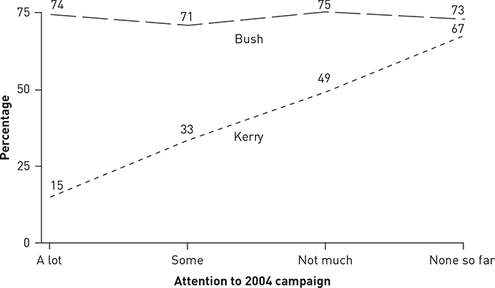
After President George W. Bush declared the end of “formal hostilities” in Iraq in May 2003, many surveys documented a pattern of beliefs among partisans about the factual evidence for the existence of weapons of mass destruction (WMDs) in Iraq, Iraqi nuclear arms development, and Iraqi dictator Saddam Hussein’s involvement in the attacks on September 11. A year later, Bush supporters disproportionately believed that Iraq had WMDs and, to a lesser degree, that they had actually been found in Iraq. People not sympathetic to the president believed the opposite. Newsweek magazine polls in 2003 and 2004 showed that nearly one-half of the American people believed that Hussein was involved in the September 11 attacks on the United States. Figure 7-2 shows that views on the existence of WMDs were strongly associated with vote intention in 2004.
The motivated reasoning argument turns the traditional view—that misinformation or ignorance is the result of apathy or inattention—on its head. Rather than expecting the better educated and more interested to be accurately informed about WMDs in Iraq, the motivated reasoning argument suggests the opposite. But is the traditional view wrong? No. In fact, both the traditional view and the motivated reasoning argument are right. Among Bush supporters, those who were highly attentive and those who were least attentive to the election campaign were equally likely to believe there were WMDs in Iraq. That is, they held an inaccurate opinion. The supporters of challenger John Kerry, represented by the sloping line in Figure 7-2, had different views depending on their level of interest in the campaign. The least attentive Kerry supporters had about the same views as the Bush supporters.
 Description
Figure 7-2 Percentages Believing Iraq Has Weapons of Mass Destruction, by Attention to the Campaign and Vote Intention, 2004
Source: CBS News/New York Times Monthly Poll, April 2004.
Scholars like Brendan Nyhan and Jason Reifler have shown how persistent misperceptions are and how difficult they can be to overcome for conservatives and liberals alike. One thing that helps people change their attitudes in the face of facts that dispute their own point of view is the presence of visual data. Nyhan and Reifler showed that when liberals saw visual evidence of fewer American soldier deaths after President Bush’s “surge” plan in Iraq, they were more likely to believe the surge had worked, and conservatives who saw visual evidence of an economy adding more jobs under the Obama administration were more likely to believe that the economy was getting better.35
Media sources are not the only context in which motivated reasoning and the holding onto misperceptions occurs. Another kind of thinking, supporting conspiracy theories, is largely driven by individuals with low levels of trust toward institutions such as government and the media and high levels of interest in politics. Political scientists Joanne Miller, Kyle Saunders, and Christina Farhat have found that the party that controls the presidency also affects who is more likely to endorse conspiracy theories. For example, a set of surveys conducted by the scholars found Republicans more likely to endorse conspiratorial thinking when Obama was in the White House, but the propensity to endorse conspiracy theory thinking shifted from Republicans to Democrats shortly after Trump took the oath of office.36 Media use, or lack thereof, can also help account for conspiracism. Those who believe “news finds me”—that is, those who think they do not need to follow the news because they will eventually hear about the important stuff on social media or somewhere else—are more likely to engage in conspiratorial thinking.37
The rise of ideological media is not the only major change to the information environment in recent years. One major area of growth in journalism is in the area of fact-checking. Journalists have always engaged in a rigorous checking of basic facts in their stories—how to spell the names of the people quoted and so forth—but the fact-checking movement is something different. Fact-checking outlets like PolitiFact and fact-checkers like the Washington Post’s Glenn Kessler conduct fact-checks about the veracity of politicians’ statements. In the 2016 primary campaign, Trump accused Grand Old Party (GOP) opponent Ted Cruz’s father of being involved in the assassination of John F. Kennedy, falsely claiming that the elder Cruz had been photographed with Kennedy assassin Lee Harvey Oswald. Later, Trump claimed that Cruz had never denied that his father was in the photograph. PolitiFact checked Trump’s claim, noting that it was so false that it deserved the rating “pants on fire.” Cruz had denied his father was in the photograph, his campaign denied it, and Cruz’s father denied it.
Fact-checkers hope that their work makes it less likely that politicians will lie and more likely that people will believe the corrected record that fact-checkers provide. The early evidence on the effects of fact-checking suggests that people often approach their interpretation of fact-checkers’ conclusions with the same partisan-colored glasses that they use to approach other kinds of news coverage. Those who are willing to admit what they do not know are the most likely to benefit from a fact-check. But, fact-checks can come at a cost—even when fact-checks help people learn what is true, they also lead to people believing the news source conducting the fact-check is biased.38
THE NEWS, THE PUBLIC AGENDA, AND PARTISAN POLARIZATION
As noted in the section about the surveillance function of the media, much discussion has ensued in the scholarly literature on mass media about the capacity to bring matters to the attention of the public or to conceal them.39 This is usually referred to as agenda setting. The literature suggests that the media have great influence over what the public is aware of and concerned with, issue wise. Television news and front-page stories in newspapers focus the public’s attention on a few major stories each day. With just under eight billion people living in 196 countries on the planet, the front page of the New York Times averages about eight stories a day. Indeed, there are so few words spoken during a typical half-hour network television newscast that they could all fit on the front page of a newspaper. Thus, the stories that the news media choose to cover are of great consequence because the media’s agenda sends a strong signal to the public about what is important, and what is worth their time. While the media’s agenda is generally fairly stable, major political events, such as the killing of Osama bin Laden; the September 11, 2001, terrorist attacks; or scandals such as President Bill Clinton’s sexual liaison with White House intern Monica Lewinsky, along with celebrity milestones, such as the death of Kobe Bryant, push other stories off the agenda.40 The media make it almost impossible for an ordinary American to be unaware of these events. These are examples of agenda setting, but the concept also refers to the consequences of people finding an issue to be more important than they did before as a direct result of increased media coverage about that issue.
Candidates for office want to set the public’s agenda for a variety of reasons. First, if you are thinking about issues a candidate wants you to be thinking about, you are not thinking about other things that could be damaging to the candidate. For example, in 2008, John McCain’s campaign staff knew that McCain was being tied to the Bush economy, which had fallen off a cliff just a month before the election. McCain tried to burnish his foreign policy credentials, hoping some voters would focus on Obama’s comparative lack of foreign policy experience. Second, the issue ownership hypothesis developed by John Petrocik (see Chapter 5) shows evidence that the public thinks that each party is better at dealing with certain issues.41 For example, people think Democrats are strong on health care and Republicans are better on handling crime. Thus, candidates for office want to set our agendas on issues on which we favorably evaluate their political party. Recent evidence shows that candidates even pivot away from tough questions in debate settings to circle back and highlight issues they want the public to be thinking about when they enter the voting booth.42 Moreover, studies reveal that the coverage candidates receive on issues that their party owns is more positive than their media attention about other issues.43
Television often plays a critical role in bringing events and issues to the public’s attention, presenting certain types of information in an exceptionally dramatic or impressive way. The Persian Gulf War and the start of the Iraq war were televised to an unprecedented extent. The American public watched a real-life video arcade of modern warfare. In January 1991, 67 percent of a national sample reported following the Persian Gulf War “very closely.”44 Attention was not as high in 2003, but over half the public followed the invasion of Iraq very closely.45 In the short run, the coverage created the impression of an overwhelming military victory and great satisfaction with the performance of each president. In each instance, the president’s job approval ratings soared, and support for the war increased dramatically.46 Evaluations became more mixed with the passage of time.
Perhaps nothing in television history compares with the coverage of the attacks on the World Trade Center and the Pentagon on September 11, 2001. The major news channels abandoned regular programming and focused on the attacks and their aftermath for days. Virtually everyone in the country was attentive to this coverage, and most people had strong emotional reactions to the graphic, disturbing, and frightening images they saw.
In the information age, scholars are starting to find consistent evidence that there is more to agenda setting than the news media signaling to the public what the important issues are so that the public comes to think the issues are important too. In an era in which the news media carefully track the number of clicks their web stories get, there is evidence that the people can set the media’s agenda as well. Individuals’ own information search behavior on tools like Google signals to the media that there is enough interest in some issues to ensure that news coverage about those issues is likely to “earn clicks.” In other words, when many people search the web for information at about the same time, the mainstream media respond by being more likely to produce stories about that topic.47 Later in this chapter, we will review evidence of how social media platforms like Twitter are also influencing both the public’s and the media’s agenda.
Because the most interested voters are also the most partisan, a relationship exists between attention to the media and partisanship. The fact that strong partisans and politically interested people are most attentive to the media accounts for the somewhat paradoxical finding that those with the most exposure to the media are among the least affected by it. Philip E. Converse, in his study of the impact of mass media exposure on voting behavior in elections in the 1950s, drew several conclusions.48 The voters most stable in their preferences (whether stability is measured during a campaign or between elections) are those who are highly attentive to mass media but firmly committed to their party or candidate. Those who pay no attention to media communication remain stable in their vote choices because no new information is introduced to change their votes. The shifting, unstable voters are more likely to be those with moderate exposure to mass media. However, efforts at replicating Converse’s findings for other election years have failed to uncover similar patterns. One difficulty may be that in recent years, there have been hardly any voters with no exposure to the mass media. Nevertheless, the reasoning behind this expected relationship is compelling: the impact of the media is likely to be greatest when the recipients of the message have little information and few existing attitudes or attitudes that are not strongly held.
Kevin Arceneaux and Martin Johnson tested this idea experimentally by first randomly assigning some participants to watch Fox News and others to watch MSNBC. Next, with other participants, they gave people the choice of what to watch. When people were randomly assigned to watch particular media, they found outlets broadcasting counterattitudinal ideas to be biased. When people chose what to watch themselves, as most people usually do outside of an experimental lab, the effects diminished significantly.49 Thus, some of the worries about partisan media exacerbating polarization might be overstated because it is the people who are already polarized who are choosing the ideological news organizations in the first place. On the other hand, Natalie Jomini Stroud, in her book Niche News, found that using media that reinforces one’s political beliefs can increase partisan divisions between people while also spurring greater participation.50
In general, there is clear evidence that liberals and conservatives prefer different news media sources. The differences in information preferences do not stop there.51 One analysis of web use showed that liberals and conservatives also prefer to use different political blogs to learn about politics. While liberals are slightly more likely than conservatives to check out the other side’s websites online, neither group is very likely to spend much time on websites that offer views supportive of a different political perspective. These choices have consequences for the issues people learn about from their news sources, the perspectives they are exposed to, and their political knowledge.
Liberals and conservatives also showed differences in their assessments of how well the news media do at keeping people informed. As with other media attitudes, the people’s views are largely driven by which political party is in power. In 2016, the Pew Research Center reported little difference between Republicans and Democrats with respect to their beliefs about the job the news media did at informing the public. After President Trump took office, liberals became 5 percent more likely to positively evaluate the media’s performance while conservatives became 6 percent more likely to negatively evaluate the news media.52
The news media can also exacerbate polarization by the lawmakers they choose to cover. From 1993 to 2013, an analysis of which members of Congress got covered by the New York Times and by network television news programs revealed that ideologically extreme members of the House of Representatives earned three times the media attention as moderates. The same trend did not hold up in the Senate because the institutional practice of using the filibuster focuses media attention on more moderate lawmakers, whose votes are required to either keep filibusters going or invoke closure to stop them. Interestingly, extreme Republicans were more likely to get news media attention than extreme Democrats. This could be a sign of ideological bias from reporters, casting Republican lawmakers as extremists. However, recent analyses also show that the average incoming Republican in Congress is more conservative than the average returning (reelected) Republican in Congress and the average newly elected Democrat is more moderate than the average returning Democrat. That is, extreme Republicans may get more media attention not because journalists are trying to paint Republicans as ideologically extreme, but because more ideologically extremist Republicans are getting elected to office.53
When the COVID-19 pandemic hit, an analysis from Ceren Budak, Ashley Muddiman, and Talia Stroud showed that cable sources like MSNBC and Fox News were more likely to interview partisans than health officials about the health crisis.54 Fox was 46.7 times more likely than CNN to discuss China, using the words “Chinese communist” to describe the origins of the virus. Fox also was more likely than CNN and MSNBC to positively characterize unproven treatments of the coronavirus touted by President Trump. When he famously speculated about the potential of injecting bleach or using ultraviolet light inside human bodies to fight COVID-19, fact-checkers leapt to report the danger of these methods while Fox News was less likely to cover the president’s words. Moreover, the Pew Research Center presented evidence that Americans’ news choices influenced how they perceived COVID-19.55
An underappreciated aspect of political communication is the simple, everyday political talk people engage in with friends, family, and coworkers. While many people avoid talking about politics, Kathy Cramer has found that a wide variety of Americans include political talk in their regular conversations with others. In her focus group conversations with individuals in rural areas in Wisconsin, Cramer found that political talk in these parts of the country focuses on people’s sense of “rural consciousness”—the feeling that those in rural areas are hardworking, deserving of benefits yet ignored, and even mocked for their way of life by urbanites, including political and university elites. This leads to resentment of urbanites, including political and university elites, and contributed to Trump’s success in 2016. Trump visited rural areas, reified rural Americans’ deservingness of government benefits, and promised to take their concerns seriously.56 Other analyses have found that when politics gets particularly contentious and polarized, it infiltrates parts of lives that were previously apolitical. A group of scholars led by Chris Wells found that fully one-third of Wisconsinites stopped talking to someone in their social network in the wake of the contentious recall election of Republican Scott Walker, who survived his recall election that was called after a Walker-led effort to end collective bargaining rights for public employees in Wisconsin.57
SOCIAL MEDIA AND CONTEMPORARY POLITICS
Perhaps the most consequential change to the media landscape over the past two decades has been the rise of social media. Nearly 90 percent of Americans say that they use the internet. Nearly all of them use some form of social media. About 81 percent of adults use YouTube, and 70 percent of adults use Facebook, making them the most used, by far, social media platforms. Forty percent of people use Instagram, 25 percent use Snapchat, and 21 percent use TikTok.58 While Twitter is heavily used by politicians, journalists, and activists, only 23 percent of Americans report using the platform. This makes the finding that the attention people give to issues on Twitter affects the news media’s agenda all the more impressive—and potentially troubling, since such a modest percentage of the public can drive what the news media cover for the entire public. Of course, young people are more likely than those over the age of sixty-five to use social media, but 50 percent of senior citizens reported using Facebook in 2021. Interestingly, urban and rural Americans are just as likely to use Facebook while suburban Americans are slightly less likely to use the social networking site.59
About seven in ten Americans get news from social media, with 53 percent using social media sometimes or often for political information.60 Some platforms are more likely to be used by political information seekers than others. Users of Reddit, Facebook, and Twitter are especially likely to get news from those platforms while users of Tumblr, YouTube, Instagram, LinkedIn, and Snapchat do not get much political information from those sites. In general, there are more Democrats using social media sites than Republicans, but this is largely a reflection of there being more Democrats than Republicans in the electorate. People of color make up a higher percentage of Twitter, YouTube, and Instagram users than their national demographics would suggest.61
One way social media use has affected contemporary politics is through the practice of “second screening”—using an internet platform to comment on one’s use of a more traditional media platform. For example, citizens used to be passive viewers of presidential debates. Now, people can comment on Twitter or Facebook during the debates, potentially shaping the interpretation others, including the media, have of who won the debates. Evidence gathered by Dhavan Shah and his colleagues show that people become more likely to tweet about a moment in a debate when candidates use particular kinds of body language. In fact, body language appears to drive more of the commenting behavior on Twitter than the actual content of what candidates are saying. What is more, many politically interested individuals and media outlets alike use social media to engage in “real-time” fact-checking of candidates during debates and other major speeches.
Social media provide people increased opportunities to learn about the views of a wide array of people, but they also make it easier for folks to cloister themselves in ideological echo chambers that serve to reinforce their own views. As noted in Chapter 4, when people build friendship networks on Facebook or follower networks on Twitter that are primarily filled with like-minded people, it becomes easier for individuals to become more confident and extreme in their views, serving to further exacerbate polarization in the electorate.
Since social media are constant, they are a platform through which rumors and misinformation can be spread very quickly. During and after the 2016 campaign, Trump and some of his staffers claimed that negative stories about Trump were examples of “fake news.” While satirical news sites like The Onion prided themselves on being fake news sources, reporters working in the mainstream news media did not appreciate the characterization that what they were doing was fake. Disputes over what constitutes fake news have sprung up in political and scholarly communities. From our point of view, fake news is not bad news that politicians do not like; it is stories that are demonstrably false. These kinds of stories can have real-world consequences. For example, a fake story widely circulated on the internet falsely and recklessly claimed that Hillary Clinton was involved in running a secret child-sex ring that was being operated out of a Washington, DC, pizzeria. One person took the story so seriously he showed up at the pizzeria with a gun, demanding to know where the kids were so he could save them. Thankfully, the situation was defused before anyone got hurt.
Social media are not all fake news and ideologically cloistered networks of followers. Some people enjoy rich and varied networks of people who espouse a wide range of views. These users tend to express higher degrees of political tolerance than those with more homogeneous social networks. Among young people in advanced democracies like the United States, Facebook use is positively correlated with increased political participation (see Chapters 3 and 4).62
Members of Congress have also gotten deeply involved in social media. Congressional lawmakers use Twitter to spread news about their voting behavior and availability to meet with constituents as well as to support their party and criticize the other major party. Female candidates for office are a little more likely to use Twitter than male candidates. In terms of the styles of Twitter use, Heather Evans and her colleagues found that challengers engage in more attacking behavior, while most candidates spend about 30 percent of their Twitter time sharing personal information, 10 to 15 percent of their tweets on issues, and 15 to 25 percent of their tweets on the campaign.63
Social media is also critically important to social movements. In a comprehensive report about social media and the Black Lives Matter movement, Deen Freelon and colleagues found that activists on Twitter were critical to the spreading of BLM messages. Moreover, users of the #BLM hashtag were successful at building new narratives about police relationships with Black communities and in sharing media criticism of how the movement was covered.64 They also found that supportive online communities attracted more attention than unaligned people and opposed communities. The authors concluded that the unconventional participation (see Chapter 4) in the BLM movement might be a model for future civics education.
POLITICAL COMMUNICATION AND ATTITUDE CHANGE IN POLITICAL CAMPAIGNS
It is clear that individuals receive ideas and information intended to alter their political opinions from a variety of sources. Some sources are political leaders and commentators whose views arrive impersonally through the mass media; others are friends, coworkers, and family members who influence opinions through personal contact. Much remains to be learned about political persuasion and communication, but at least occasionally, many Americans engage in attempts to influence others, and almost everyone is regularly the recipient of large quantities of political communication.
A useful but oversimplified perspective on the transmission of political information would have the media presenting a uniform message to a mass audience made up of isolated individuals. The audience would receive all or most of its information from the media. Thus, public opinion would be a direct product of the information and perspective provided through the media. A more complex view suggests that information is transmitted in a “two-step flow of communication.”65 Information is transmitted from opinion elites (leaders in society, such as politicians, organizational heads, and news commentators) to a minority of the public—the opinion leaders—and from them to the remainder of the public.
The information from opinion elites usually is sent through the mass media, but this view implies that only a portion of the audience—the opinion leaders—is attentive to any particular type of information such as political news. The opinion leaders, as intermediaries, then interpret, modify, and explain facts and events to those friends and neighbors who are less interested in or concerned with these happenings. In the process, the original message conveyed through the media becomes many somewhat different messages as it reaches the public. Of course, this same process can skip over the traditional media in contemporary society as politicians and activists use social media to communicate with people, and people increasingly expose themselves selectively to the news outlets that tend to share their ideological perspective.
The two-step flow model may not be strictly true in most cases, and public opinion research has generally failed to turn up many people who recognize themselves as opinion leaders. Even so, most members of the public probably receive information from the mass media in the context of their social groups. Thus, they filter the information and interpretations of the media through not only their own perceptions, experiences, and existing attitudes but also those of people around them. Only when the media have the attention of most members of the audience, and a virtual monopoly over the kinds of information received by a public that has few existing attitudes about the subject, can the media produce anything like a uniform change in public attitudes. As noted earlier, the twenty-first century’s media ecology is one in which the two-step flow is further complicated by individuals’ ability to interact directly with the news media, elites, and each other on social media platforms like Twitter and Facebook. While the primary direction of influence may still flow through the media from political elites to the public, it is certainly the case that individuals expressing their own views in the contemporary media landscape can influence how journalists do their jobs and how politicians read public opinion.
Another factor that affects how political elites’ messages are accepted by individuals is how they are framed in media coverage. An analysis of issue frames (e.g., “women should have the right to choose what happens to their body”) used by Democratic politicians showed they were more effective at affecting attitudes when they focused on specific policy ideals while Republican politicians’ frames were more persuasive when they dealt with more symbolic frames that were not policy specific. Simple consistency matters as well. The more consistent the messages that Democrats and Republicans espoused in the media, the more likely their frames were to influence public opinion, thanks, in part, to the clear signal they sent about what the party’s position was on a particular issue.66
A different argument, also based on the role of social influences on the development of public opinion, has been made by Elisabeth Noelle-Neumann in The Spiral of Silence.67 She argues that members of society sense that some views are increasing in popularity, even if these ascending viewpoints are held only by a minority. Under such circumstances, people become reluctant to express opinions contrary to the presumed ascending view, whereas individuals holding that view are emboldened and express themselves more freely. This effect can often occur in social situations from conversations in a church group to jury deliberations. This furthers the illusion that one viewpoint is widely shared. People then become more likely to adopt the viewpoint because of this (perhaps) imaginary public pressure.
The internet as a news source is a more recent development, with intriguing characteristics. Providing almost unlimited access to information, it requires the consumer to seek out that information actively. As noted earlier, it also offers opportunities to “talk back” or comment on the news, share information within social networks, and be in touch with other like-minded people. Few gatekeepers operate on the internet, and the issues of the reliability and credibility of information are largely left to the user to determine. Opportunities abound for whispering campaigns of rumor and misinformation.
One factor we have not yet considered is the impact of editorial endorsements by newspapers (television and radio stations rarely make endorsements). These should be assessed independently of news coverage, although editorial preferences may bias news stories. Newspaper endorsements seemingly have a minimal impact in presidential elections, given that many other sources of influence exist.68 In less visible, local races, a newspaper editorial may influence many voters.69 Some concern exists that major newspaper chains could wield significant power nationally by lining up their papers behind one candidate. In recent years, however, the large chains have generally left their papers free to make decisions locally. Still, additional concerns come from evidence showing that candidates who receive editorial endorsements receive more favorable coverage on the news side of the paper as well.70
We also need to make the distinction between the impact of news coverage by the media and political advertising carried by the media (see Chapter 2). This is not an easy task, especially because the news media often cover political advertising as if it were news and consciously or unconsciously pick up themes from political ads and weave them into their own coverage.71 Placing political advertising in news programs makes it harder to separate news from ads. Even the “ad watches” that news organizations use to critique candidates’ advertising may contribute to the confusion over what is news and what is paid advertising. Moreover, the growth of advertising on social media sites like Facebook is complicating political campaign strategies and scholars’ ability to isolate advertising effects.72 One study showed that, in 2016, the groups that did not file with the Federal Election Commission (FEC) ran the most divisive issue ads. Perhaps worse, many of those ads appear to have been sponsored by Russian groups.73
The Impact of Political Campaigns
Political campaigns are efforts to present candidates or issues to voters with information, rationales, characterizations, and images to convince them that one candidate or position is better than the alternatives and to get them to act on that preference. Massive amounts of money are spent in modern campaigns to saturate the airwaves in an effort to influence voters. A perennial question for politicians, political commentators, and scholars is “How much difference does a campaign make?”
Although most professional politicians take for granted the efficacy of political campaigns, scholarly analysis has often questioned their impact. In most elections, the majority of voters decide how they will vote, based on partisanship or ideological leanings, before the general election campaign begins. Beyond this, the generally low level of political information among the less politically interested throws doubt on the ability of undecided voters to absorb ideas during a campaign. Indeed, Andrew Gelman and Gary King have offered an especially interesting form of this argument.74 They contend that a voter’s eventual choice can be predicted satisfactorily at the start of a campaign, well before the candidates are even known. Furthermore, because a voter may move away from this ultimate choice during the course of a campaign, intermediate predictions—so popular in media coverage and campaign organizations—are misleading.
Recall from Chapter 2 that some political scientists, using economic forecasting models, argue that the outcome of the election—and the margin of victory—can be predicted long before the election campaign from such variables as the rates of economic growth, inflation, and unemployment.75 It may be difficult to believe that an individual voter’s choice is made before the start of a campaign or is determined by economic forces; yet evidence indicates that in most years, the vote choices of most voters are not affected by the general election campaigns. The ANES regularly asks voters when, during the presidential campaign, they made their voting decisions.76 In most years, about two-thirds of the electorate reports deciding before or during the conventions, with the final one-third deciding during the campaign. Over the years, fewer people report deciding during the conventions—presumably because, in recent decades, the candidates have essentially been chosen by the end of the presidential primaries in the late spring.
The decision times of partisans and independents are different because the loyal party voters line up early behind the party’s candidate. In all recent presidential elections, the strong partisans made their decisions by the end of the conventions, whereas many of the less committed partisans and independents were typically still undecided at the start of the general election campaign. In close elections (2012, 2016, and 2020, for example), this relatively uncommitted group can swing the election either way, with 10 to 15 percent of the voters claiming to decide in the last days of the election campaign.
Campaigning influences a small but crucial proportion of the electorate, and many elections are close enough that the winning margin could well be a result of campaigning. Professional politicians drive themselves and their organizations toward influencing undecided voters in the expectation that they are the key to providing, or maintaining, the winning margin. One can easily think of examples of elections in which the only explanation for the outcome was the aggressive campaign of one of the candidates. In 2016, the Republican Party elite did not want Trump to be their nominee, but they could not stop him as the attention he received in the primary campaign eclipsed that of his several opponents many times over.
The Impact of Debates
New information has the greatest impact in situations in which little is known about the candidate or issue and in which the voters have few existing attitudes. The application of this generalization can be seen in many areas. For example, the candidate who is less well known has the most to gain (or lose) from joint appearances, such as debates. The 1960 debates between Kennedy and Richard M. Nixon, the first-ever series of televised presidential debates, appear to have had a substantial impact on the election outcome, in large part because at the time Kennedy was not well known to the public. According to several different public opinion polls in 1960, about half of the voters reported that they were influenced by the debates, with Kennedy holding an advantage of three to one over Nixon.77 Although Nixon’s poor showing is often blamed on his five o’clock shadow, it is unlikely that his appearance caused many to turn against him, because he had been in the public eye as vice president for eight years. Instead, Kennedy’s advantage came from undecided Democrats who had little information about Kennedy (but were favorably disposed toward him because he was the Democratic candidate) and who were influenced by his appearance and good performance. The immediate effect of the 1960 experience was the abandonment of presidential debates until 1976. Incumbent presidents or campaign front-runners were unwilling to offer such opportunities to their lesser-known challengers.
The 2008 debates presented a similar situation for Barack Obama. As the younger, less experienced, and less familiar candidate, he had the chance and the challenge to shape the impressions that voters had about him to a greater extent than the more familiar candidate, John McCain. Although public opinion polls generally showed that Obama “won” all the debates,78 his greater victory was probably in reassuring those already leaning in his direction that he had the right characteristics to be president, as Kennedy had done in 1960.
In 2012, the general consensus was that Mitt Romney won the first debate. Much ink was spilled and airtime was spent analyzing President Obama’s performance, looking for slight changes in the day-to-day tracking polls (which gave Romney a small, short-lived boost) and speculating about whether the first contest was a “game changer.” It wasn’t. The remaining debates, including Vice President Biden’s lone contest with Congressman Paul Ryan, failed to meaningfully influence the polls.
Postelection polls and social media sentiment on Twitter and Facebook revealed that most people thought Hillary Clinton won all three debates against Donald Trump in 2016. Even so, there is not much evidence that these debate wins helped Clinton, who was very well known to the public. Trump’s attacking style; willingness to violate traditional norms, such as not interrupting his opponent; and making claims that were easily demonstrable as false did not give his supporters pause. On the contrary, Trump’s behavior fit with his campaign’s narrative that he was not a phony politician but a strong leader who would make America great again by the sheer will of his winning personality.
Controlling the Message
Campaigns and the information they provide are also effective in influencing attitudes when counterinformation is not available. The obvious example is when one candidate has substantial resources for campaigning and the opponents do not. Such well-financed candidates can present a favorable image of themselves—or an unflattering image of their opponents—without having those images contradicted. This situation is more likely to occur in primaries, when candidates must rely on their own funds and whatever they can raise from others, than in general elections, when both candidates can tap party resources. However, strategic decisions may also lead to a failure to counter information. In 2004, Kerry delayed responding to the Swift Boat Veterans for Truth ads attacking his war record. The Swift Boat Veterans had been following him with similar accusations for years. He may have underestimated their potential harm to him when these allegations were played on a national stage, with higher stakes and an audience less knowledgeable about him than were his constituents in Massachusetts. Most major campaigns now have a “rapid response team” as part of their campaign staff to fire back when hit with unexpected and potentially damaging attacks. Obama reportedly beefed up his team after his campaign was slow to respond when allegations about his connections to 1960s radical William Ayers and indicted Chicago developer Tony Rezko surfaced in the spring of 2008. Even with the capability to respond quickly, candidates and their advisers still must make the strategic decision whether a response will be effective or will only serve to keep the story alive.
In presidential elections, the national nominating conventions offer each party the opportunity, at least temporarily, to get its message to the public without the annoyance of sharing the stage with the other party. The televised acceptance speech of the nominee and the ability to showcase rising stars and celebrate past heroes—all before a prime-time audience—offer unique opportunities for the political parties to present themselves and their campaign themes as they wish the public to see them. Although the news media interject commentary and analysis, the media’s view of what is interesting generally leads them to emphasize strategy and motives instead of outright contradiction of a party’s claims. The result of this nationwide opportunity for favorable publicity is the convention “bounce” that presidential nominees typically receive in their approval ratings and trial heat results immediately after their party’s convention.79 Obama had a 2008 convention bounce of about 5 percent at the end of August, and McCain’s bounce was of the same amount after the Republican convention a week later. In 2012, Gallup reported a small, 3-point bounce for Obama after the Democratic National Convention (DNC) and no bounce for Romney after the Republican National Convention (RNC).
The 2012 election showed that political parties have not always been able to use the nominating convention to their advantage. Many previous nominating conventions corroborate this point. The battle-marred DNC in 1968 and George McGovern’s acceptance speech long after midnight in 1972 represent dramatic failures to use this opportunity to benefit the party’s nominee. Opponents within one’s party may present the case against a nominee as effectively as the opposing party could. In recent years, when the nomination has been a foregone conclusion well before the nominating convention, both parties have tried to control their conventions as tightly as possible, keeping controversial issues and personalities under wraps. However, as the conventions have become more staged in an effort to promote the most favorable image of the candidate, the audience and the news coverage for them have shrunk, making it less likely that those images will be conveyed to the public. In 2008, the Obama campaign sought to increase the audience appeal of the DNC by showcasing the nominee’s acceptance speech in a stadium filled with over eighty thousand enthusiastic supporters. Although the speech was well received, the effect was short lived, as McCain countered by announcing his running mate the following morning.
In 2016, the two parties’ nominating conventions diverged widely in their execution. The RNC earned low marks from the news media for being poorly organized. Senator Cruz made headlines (and earned boos from the convention crowd) when he spoke about, but did not endorse, Trump at the convention. Trump’s wife Melania got unwanted attention for taking passages of Michelle Obama’s 2008 DNC speech and repeating them as her own. Trump’s own speech was ridiculed for statements that suggested he did not understand how democratic governance worked. At one point in his speech, Trump said, “Nobody knows the system better than me, which is why I alone can fix it.”80 While pundits panned Trump’s speech, the often appealing message (see Chapter 1) played well with his supporters, many of whom preferred a more authoritarian leadership style.81
The Democratic Party’s convention was dramatic for reasons the party would have preferred to avoid as well. The head of the DNC, Congresswoman Debbie Wasserman Schultz, was not able to continue serving in her party position, a consequence of the anger Bernie Sanders supporters felt after leaked DNC emails suggested that the party apparatus was favoring the Clinton candidacy over the Vermont senator’s presidential bid. On the other hand, Clinton’s speech, and the speeches of many of her surrogates, was generally praised. The DNC, on the whole, received favorable appraisals from the news media and the voters when compared to the Republican effort. In 2020, the campaign was conducted in very different ways—with President Trump continuing to hold in-person events while Biden mostly campaigned virtually.
The fact that voters respond differently to information depending on its presentation offers campaign managers opportunities to use sophisticated techniques to create favorable images of their candidates. Highly paid political consultants use an arsenal of social science knowledge and techniques in an attempt to do just that. Although some of these attempts have been notably successful, serious limitations also exist.
To successfully “sell” a candidate with advertising techniques, image makers must be able to control the information available about their candidates, thereby controlling the perceptions the voters hold about them. Ronald Reagan was more successfully handled in this way than most other presidential candidates. Perhaps his training as an actor made him more amenable to management by his advisers. However, to a considerable degree, maintaining his public image depended more on protecting him from the press and public exposure than on manipulating the content of publicity about him. This approach was especially effective in the 1980 campaign, when the focus of attention and public dissatisfaction rested on President Jimmy Carter and not the challenger, Reagan.
For most candidates, however, manipulating a public image by controlling information is either impossible or self-defeating. For a relatively unknown challenger, such as Bill Clinton in 1992 or Barack Obama in 2008, this type of strategy would appear self-defeating because few candidates have had the resources to become well known nationwide through advertising and staged appearances alone. Billionaire Ross Perot was an exception in 1992, purchasing blocks of airtime to speak to the American voters. Billionaire Donald Trump was another exception in 2016, earning six times the free media attention of his nearest competitor in the primaries.
Typically, unknowns scramble for exposure in any forum they can find, and this prevents the careful manipulation of an image. Conversely, well-known candidates or incumbents, who can afford to sit back and let the public relations people campaign for them, probably already have images that are impossible to improve in any significant way over the relatively short period of time available in an election campaign. The most famous alleged attempt to repackage a candidate was the effort of the Nixon campaign staff in the 1968 presidential election.82 However, the evidence suggests that more voters decided to vote for other candidates during the course of the campaign than decided to vote for Nixon. After about twenty years of nationwide public exposure, a “new Nixon” reinforced existing images, both negative and positive. He simply could not create a new, more attractive image. Romney faced criticism in 2012 for what critics called repeated attempts to change his image. Fearing his moderate record as governor of Massachusetts could hurt him in the GOP primary, Romney used one of the primary debates to refer to himself as a “severe” conservative. However, once Romney secured the nomination, a staffer of his went on television to claim that it was time to “shake” the Etch A Sketch and remake Romney’s image for the general election. Al Gore received criticism in the 2000 election for a switch to “earth tones” in the way he dressed on the campaign trail.83
Campaign organizations also attempt to affect the public image of their candidates by supplying the news media with favorable information. If successful, this strategy can be particularly effective, because the information arrives through the more credible medium of news coverage instead of paid advertising. Media events can be staged that provide the media—particularly television—with an attention-grabbing headline, sound bite, or photo opportunity. The campaigns of Nixon in 1968 and George H. W. Bush in 1988 were particularly successful in manipulating news coverage favorable to their candidates by staging media events and otherwise limiting access to the candidates. In 2004, the campaign of George W. Bush went to great lengths to handpick the audiences at appearances of the president or vice president, thereby ensuring an enthusiastically supportive crowd. President Trump followed suit in 2020, but was sometimes thwarted by the new information environment. For one rally in Tulsa, Oklahoma, TikTok users who opposed the president requested upwards of one million tickets for the event, though they had no intention of showing up. The result was fewer than 6,200 people having their tickets scanned for the event in the nineteen-thousand-seat arena.84
Limiting exposure of the candidate to staged media events works better for well-known incumbents than for challengers. Attempts by the McCain campaign to keep national politics newcomer Sarah Palin under wraps in 2008 were ultimately unsuccessful because the press and public demanded to know more about a person who might be a heartbeat away from the presidency. Furthermore, recent advances in technology make carefully controlling the image of a candidate even more daunting. A casual remark at a reception of supporters, captured by cell phone video and uploaded to YouTube, can become an overnight sensation on the internet with catastrophic consequences for the candidate. In 2016, Trump’s Access Hollywood video was an example of how a secretly taped conversation can affect a campaign. Hillary Clinton’s campaign suffered with respect to the media attention it received when a video of Clinton at a fundraiser showed her referring to some Trump supporters as a “basket of deplorables.” In 2020, the Trump campaign regularly argued that Biden was being managed and controlled, arguing he was campaigning from his basement.
In recent years, campaign organizations have had difficulty getting news stories aired or printed about their issue positions and policy stands, but they have had more success with negative stories and attacks on other candidates. A key tactic is to seduce the media into covering paid political advertising, usually negative, as if it were news. In her book Dirty Politics, Kathleen Hall Jamieson details how, in 1988, the news media continually reinforced the premise behind the infamous Willie Horton ads that attacked Democratic candidate Michael Dukakis’s position on crime.85 For some years afterward, television and newspapers regularly featured ad watches that attempted to dissect the claims made in candidates’ paid advertising; ironically, in the course of doing so they provided the ads with a wider audience. Clinton’s 2016 campaign was atypical in that her advertising was largely devoid of policy information, as compared to the general election candidates of the past twenty years.
Negative campaigning and advertising offer an effective way to hurt an opponent’s image. In recent years, candidates’ campaigns and independent organizations have attacked the images of candidates in personal and political terms. The volume of this particular form of negative advertising, sometimes called attack ads, has increased greatly. Many of these ads are paid for by committees, interest groups, and organizations not connected directly to a candidate or a campaign. The Supreme Court has ruled that such attack ads are issue advocacy and therefore cannot be limited because of the First Amendment.86 As a result, a candidate can be hit with a massive campaign for which the opposing candidate need take no responsibility and that is basically outside the regulations and agreements governing the candidates and their campaign organizations. Three generalizations about negative campaigning can be made: (1) The public disapproves of negative campaigning; (2) even so, it sometimes works; and (3) negative advertising typically contains more useful policy information than positive ads. Because the public disapproves of negative advertising, some candidates have managed to be positive in their own ads while allowing independent organizations to trash their opponents for them, though presidential candidates in recent years have aired a high percentage of negative ads on their own.
If negative campaigning illustrates the capacity to use the mass media to accomplish political purposes, the difficulty candidates have in using the media to respond to these attacks reveals its limitations. Victims of negative campaigning have tried to ignore the attacks, attempted to answer the charges, or counterattacked with their own negative campaign. None of these responses appears to be notably successful—a fact that encourages the continued use of negative campaigning. Attacks in the form of ridicule or humor may be particularly difficult to answer. Some strategists have urged the victims of negative campaigning to respond immediately and defend themselves aggressively. This may be good advice, but following it requires much from the victim. To respond promptly with advertising requires a great deal of money (perhaps near the end of a campaign, when resources are limited) and a skilled staff. Moreover, victims of negative campaigning need to have a strong, effective answer to such attacks.
In their study of the 1992 presidential campaign, Marion R. Just, Ann N. Crigler, Dean E. Alger, Timothy E. Cook, Montague Kern, and Darrell M. West offer a useful way to look at the “construction” of a candidate’s persona over the course of an election campaign.87 Instead of the candidate’s image being the creation of a campaign staff or the product of straight news coverage, it will evolve through the three-way interaction of the candidate’s campaign, the news media, and the public. The candidates’ initial attempts at establishing themselves face a range of reactions from the press and public—encouragement, incredulity, boredom—and the candidates adjust accordingly. Likewise, the news reporters assess and react to the response of colleagues and the public to their coverage of candidates. Finally, the public’s judgments in public opinion polls, radio call-in programs, live interviews, and email indicate displeasure or support of the behavior of both candidates and news media. The final picture may not be a faithful reflection of the candidate’s inner being, but neither is it an artificial creation of campaign technicians, nor is it the distortion of an overbearing press.
The Special Case of Primary Elections
Because the impact of new information is greatest when there are few existing attitudes, the impact of campaigns should be greatest in primary elections, especially with little-known candidates. In primaries, when all the candidates are of the same party, the voter does not have partisanship to help in the evaluation of candidates. In such situations, whenever new information is provided, it can have a substantial impact.
After 1968, reforms in the presidential nominating process led to an increased use of presidential primaries as a means of selecting delegates to the Democratic and Republican nominating conventions. The purpose of the reforms was to make the choice of the presidential candidates more reflective of the preferences of the party’s supporters in the electorate. In fact, the increased use of presidential primaries opened the door, at least initially, to the nomination of candidates little known to the general public. Political newcomers, such as Carter in 1976, Gary Hart in 1984, Steve Forbes in 1996, and Howard Dean in 2004, had an opportunity to focus their energy and campaign resources on a few early primaries or caucuses, gain national media attention by winning or doing surprisingly well in those early contests, and generate momentum to allow them to challenge more established and well-known potential nominees. Such candidates often do not have long-term viability. Their early appeal, based on little information, dissipates as more, often less flattering, information becomes available. Nevertheless, by the time this happens, the candidate may already have secured the nomination (Carter in 1976) or severely damaged the front-runner, as Hart damaged Walter F. Mondale in 1984. Primaries can do considerable harm to candidates’ images under some circumstances. Well-known front-runners such as George H. W. Bush in 1992 and Bob Dole in 1996 suffered a loss of popularity that they never recovered under the campaign attacks of fellow Republicans. Intraparty fighting is typically destructive for established candidates.
Before the 1988 election season, Southern Democratic leaders decided that concentrating their states’ primaries early in the election year would focus media and candidates’ attention on the Southern states as well as give a head start to more conservative candidates who could pick up a large bloc of delegate votes from these states. Although this strategy did not work in the short run—the Democrats nominated the liberal northeastern governor Dukakis in 1988—the creation of Super Tuesday considerably shortened the primary season by allowing candidates to amass enough delegates to secure the nomination months before the summer convention.
Every four years since 1988, additional states have moved their primaries forward, hoping to capture some media attention or, at least, to have a say before the nominations are decided. By 2008 and 2012, this process had gone so far that half the states had their primaries or caucuses by early February, far supplanting the old Super Tuesday in early March. This “front-loading” of primaries originally had the effect of favoring the front-runner and decreasing the opportunity for lesser-known candidates. Because the primaries are so close together in time, candidates cannot concentrate their resources in a few states and use victories there to generate favorable coverage in other states. Instead, after the early states of Iowa and New Hampshire, which now have their caucuses and primary in early January, candidates must campaign all across the country in many states. Unknown candidates have almost no time to capitalize on early success in Iowa or New Hampshire by raising money and creating state campaign organizations. The established, well-known candidates again seem to have the advantage.
Although the Obama phenomenon in 2008 seems to contradict the conventional wisdom about the front-loading of primaries advantaging the front-runner, we should be careful about jumping to conclusions, especially given how the primary calendar benefited Hillary Clinton in 2016. Obama was unusual among lesser-known candidates because he was able to raise an enormous amount of money and create a substantial grassroots organization across many states before the primary season began in January 2008. None of the other non-front-runners (except Dean in 2004 and Sanders in 2016) were able to come close to that. Whether other lesser-known candidates of the future will have those fundraising and organizational skills—and the staying power that Obama and, to a slightly lesser extent, Sanders had and Dean did not—is unclear. In any event, if the Democrats had held a national primary on February 5 (a national primary being the logical outcome of the current process of moving more and more primaries to the beginning of the season), it is quite likely that Clinton, the established front-runner, would have won, according to the nationwide trial heat results of the time in 2008.
The role of the news media in influencing presidential primaries with their coverage has changed as the format of the primaries has changed. In the 1970s and 1980s, the media had considerable potential to enhance one candidate’s campaign momentum and to consign others to obscurity. Thomas E. Patterson’s study of the role of the media in 1976 shows that, during the primaries, Carter benefited from the tendency of the press to cover only the winner of a primary, regardless of the narrowness of the victory or the number of convention delegates won.88 Even the accident of winning primaries in the eastern time zone gave Carter disproportionately large, prime-time coverage on evenings when other candidates enjoyed bigger victories farther west.89 This was possible because few voters were well informed about or committed to any of the many Democratic candidates. During the same period, the media exaggerated the significance of President Gerald R. Ford’s early primary victories without noticeably influencing the public’s feelings about him or his challenger, then governor of California Reagan.90 It is much more difficult to influence voters who have well-informed preferences.
Attention focuses on who does better or worse than expected, regardless of the number of votes they receive. This was the case with Clinton’s third-place finish in Iowa in 2008 (which led to the media writing her candidacy off), as well as her “surprise” win in New Hampshire, where she won more votes—but ultimately fewer delegates—than Obama. The same thing happened to Rick Santorum, who won the Iowa caucus after all the votes were counted; the media named Romney the winner on the night of the caucus even though the results were not all in and too close to call. The irony of this type of commentary is that it essentially converts the errors in the media’s preelection coverage into newsworthy political change. With the front-loading of the primaries, however, media coverage becomes less relevant after the first few primaries.
Inequality in the resources available to candidates in presidential primary campaigns is likely to have a greater effect than in the presidential general election, in which public financing is available to both major-party candidates. In the 2000 election campaign, George W. Bush raised more than $100 million, more money by far than any of the other candidates and more than twice as much as any previous candidates for president. He also raised his money early. Six months before the first primary, he had raised more than half his eventual total. This enormous war chest served both to discourage other potential candidates and to defeat his most serious rival for the nomination, John McCain. In 2008, Hillary Clinton followed a similar strategy of raising and spending so much money that it would create an aura of invincibility and scare off would-be rivals for the nomination. Unfortunately for the strategy, her fundraising was more than matched by Obama’s, and Clinton’s campaign was chronically short of funds later in the season. Indeed, Obama’s fundraising prowess was so formidable that it enabled him to forgo public financing in the general election, giving him a considerable financial advantage over Republican candidate McCain, who had accepted public financing. Both Romney and Obama eschewed public financing in 2012. Those choices, along with the Citizens United decision from the Supreme Court, led to record spending from the candidates and from outside groups.
In 2016, the largest inequalities were related not to fundraising, but to earned media coverage. Figure 7-3 shows that Trump received more than $1.8 billion in free media attention, outpacing his closest competitors, Cruz, Jeb Bush, and Marco Rubio, by well over a billion dollars’ worth of news coverage. Clinton enjoyed more attention than Sanders, though her advantage was more typical, getting twice the free media Sanders received.
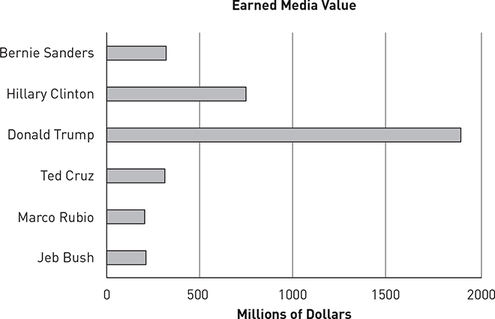 Description
Figure 7-3 Dollar Value of Free Media Coverage in the 2016 Primaries
Source: Nicholas Confessore and Karen Yourish, “$2 Billion Worth of Free Media for Donald Trump,” Upshot, New York Times, March 15, 2016, https://www.nytimes.com/2016/03/16/upshot/measuring-donald-trumps-mammoth-advantage-in-free-media.html?mcubz=0.
In 2020, presidential campaign financing skyrocketed. Biden raised over $1 billion, significantly outraising Trump, who came in just under $775 million. Even though Biden spent a record amount on advertising, he ended the campaign with money left in his campaign coffers and no debt. Trump’s campaign, in contrast, ended up in debt.91 Near the end of the campaign, Biden had more money on hand, and handily outspent Trump on television advertising three to one. Trump, as noted in Chapter 2, spent a lot on internet advertising.92 In the end, it is unclear what impact all of this spending had on the election outcome, given that most people had decided to vote for or against Trump long before Election Day.
CONCLUSION
The current media environment is a vast, immediate, and polarized one. Politically interested individuals can, and often do, select news sources that reinforce their own views, while people who are not living and breathing politics find it easier than ever to avoid politics given the wide array of alternative forms of entertainment. Politicians devote considerable effort in trying to influence us to change our attitudes and participate in politics. Our own partisan blinders can affect what we believe to be true and who we are willing to trust—especially when the information we come in contact with suggests that our views might be incorrect. Still, those who regularly read newspapers, watch television news, or share news stories on social media are more likely to be interested in politics, knowledgeable about politics, and engaged civically.
Study Questions
1. What are the different sources and platforms that make up the news media?
2. What is selective exposure, and what are some of the consequences it has on American elections?
3. How does evidence related to media bias compare to evidence related to biases in the audience?
Suggested Readings
Graber, Doris. Processing the News. New York: Longman, 1988. An in-depth study of a few respondents on the handling of political information from the media.
Jamieson, Kathleen Hall. Dirty Politics: Deception, Distraction, and Democracy. New York: Oxford University Press, 1992. A blistering commentary on political advertising strategies and the interaction between advertising and news coverage.
Just, Marion R., Ann N. Crigler, Dean E. Alger, Timothy E. Cook, Montague Kern, and Darrell M. West. Crosstalk: Citizens, Candidates, and the Media in a Presidential Campaign. Chicago: University of Chicago Press, 1996. A multimethod study of the 1992 presidential election campaign.
Peeck, Reece. Fox Populism: Branding Conservatism as Working Class. New York: Cambridge University Press. Fascinating treatment of how Fox News blended tabloid journalism and populism to define its audience as the “real” Americans.
Popkin, Samuel L. The Reasoning Voter. Chicago: University of Chicago Press, 1991. A wide-ranging discussion of campaigning and presidential vote choice.
Sides, John, and Lynn Vavreck. The Gamble: Choice and Chance in the 2012 Presidential Election. Princeton, NJ: Princeton University Press, 2013. A political science-oriented election book produced as the 2012 campaign was occurring.
Stroud, Natalie Jomini. Niche News: The Politics of News Choice. New York: Oxford University Press, 2011. A groundbreaking examination of how expanding news choice divides us.
Vavreck, Lynn. The Message Matters: The Economy and Presidential Campaigns. Princeton, NJ: Princeton University Press, 2009. A creative and original account of when and how candidates’ campaign messages ought to include economic messages as compared to messages on other issues.
West, Darrell M. Air Wars: Television Advertising in Election Campaigns, 1952–2008. Washington, DC: CQ Press, 2009. The fifth edition of a study of many aspects of television advertising in presidential elections.
Internet Resources
The Pew Research Center conducts numerous political surveys throughout the year as well as the best study of American media behavior done in the spring of even-numbered years. Not only does the center make the data available freely, at www.pewresearch.org/topic/politics-policy, but the website offers extensive analysis of many political and media topics as well. During election years, most major news organizations have websites with survey data on many political items, but poll aggregating websites, such as elections.huffingtonpost.com/pollster, provide stronger estimates of candidate support and changes thereof in real time.
NOTES
1. “Recommendations for Media Covering the 2020 U.S. Presidential Election,” Election Coverage and Democracy Network, accessed July 9, 2021, https://mediafordemocracy.org/recommendations-for-media-covering-the-2020-u-s-presidential-election/.
2. Amy Mitchell, Jeffrey Gottfried, Michael Barthel, and Elisa Shearer, “Trust and Accuracy,” Pew Research Center, July 7, 2016, http://www.journalism.org/2016/07/07/trust-and-accuracy/.
3. “2017 Pew Research Center’s American Trends Panel,” Pew Research Center, March 17–27, 2017, http://assets.pewresearch.org/wp-content/uploads/sites/13/2017/05/09125944/PJ_2017.05.10_Media-Attitudes_TOPLINE.pdf.
4. Glenn Kessler, Salvador Rizzo, and Meg Kelly, “Trump’s False or Misleading Claims Total 30,573 Over 4 Years,” Washington Post, January 24, 2021, https://www.washingtonpost.com/politics/2021/01/24/trumps-false-or-misleading-claims-total-30573-over-four-years/.
5. Doris A. Graber, Mass Media and American Politics, 8th ed. (Washington, DC: CQ Press, 2010).
6. Michael W. Wagner and Mike Gruszczynski, “Who Gets Covered? Ideological Extremity and News Coverage of Members of the U.S. Congress,” Journalism and Mass Communication Quarterly 95, no. 3 (2018): 670–690; Jeremy Padgett, Johanna L. Dunaway, and Joshua P. Darr, “As Seen on TV? How Gatekeeping Makes the U.S. House Seem More Extreme,” Journal of Communication 69, no. 6 (2019): 696–719.
7. “News Coverage of the 2020 Presidential Election,” Institute for Social Research, Center for Political Studies, University of Michigan, October 16, 2020, https://cpsblog.isr.umich.edu/?p=2871.
8. Domenico Montanaro, “5 Takeaways on the New Biden-Harris Presidential Ticket,” NPR, August 12, 2020, https://www.npr.org/2020/08/12/901537144/5-takeaways-on-the-new-biden-harris-presidential-ticket.
9. Tim Murtaugh, “More Evidence Emerges That the Media Is on Team Biden,” Heritage Foundation, March 17, 2021, https://www.heritage.org/civil-society/commentary/more-evidence-emerges-the-media-team-biden.
10. Michael W. Wagner, “The Utility of Staying on Message: Competing Partisan Frames and Public Awareness of Elite Differences on Issues,” The Forum 5 (2007): 1–18.
11. “Hunter Biden: Republicans Release Report on Joe Biden’s Son,” BBC News, September 23, 2020, https://www.bbc.com/news/election-us-2020-54268887.
12. Anthony Downs, An Economic Theory of Democracy (New York: Harper and Brothers, 1957).
13. Samuel L. Popkin, The Reasoning Voter (Chicago: University of Chicago Press, 1991), 47–49.
14. Michael Schudson, The Good Citizen: A History of American Public Life (New York: Free Press, 1998).
15. John Zaller, “A New Standard for News Quality: Burglar Alarms for the Monitorial Citizen,” Political Communication 20, no. 2 (2003): 109–130.
16. Elisa Shearer, “More Than Eight-in-Ten Americans Get News From Digital Devices,” Pew Research Center, January 12, 2021, https://www.pewresearch.org/fact-tank/2021/01/12/more-than-eight-in-ten-americans-get-news-from-digital-devices/.
17. Johanna Dunaway, Kathleen Searles, Mingxiao Sui, and Newly Paul, “News Attention in a Mobile Era,” Journal of Computer-Mediated Communication 23, no. 2 (2018): 107–124.
18. Shearer, “More Than Eight-in-Ten Americans Get News From Digital Devices.”
19. “Internet Overtakes Newspapers as News Outlet,” Pew Research Center, News Interest Index, December 23, 2008, http://www.pewresearch.org/politics/2008/12/23/internet-overtakes-newspapers-as-news-outlet/.
20. Brad Adgate, “TV News Ratings Remain Strong, but Pandemic Fatigue Seems to Be Setting In,” Forbes, May 13, 2020, https://www.forbes.com/sites/bradadgate/2020/05/13/tv-news-ratings-remain-strong-but-pandemic-fatigue-seems-to-be-setting-in/?sh=721773fa6f12; Katerina Eva Matsa, “Network News: Fact Sheet,” last updated June 2016, p. 37, in State of the News Media 2016, Pew Research Center, June 15, 2016, https://assets.pewresearch.org/wp-content/uploads/sites/13/2016/06/30143308/state-of-the-news-media-report-2016-final.pdf.
21. A. J. Katz, “Thursday, May 27 Scoreboard: Tucker Carlson, Hannity Lead Fox News to No. 1,” TVNewser, May 28, 2021, https://www.adweek.com/tvnewser/thursday-may-27-scoreboard-tucker-carlson-hannity-lead-fox-news-to-no-1/479694/.
22. Nancy Vogt, “Audio: Fact Sheet,” last updated June 2016, p. 68, in State of the News Media 2016, Pew Research Center, June 15, 2016, https://assets.pewresearch.org/wp-content/uploads/sites/13/2016/06/30143308/state-of-the-news-media-report-2016-final.pdf.
23. Shearer, “More Than Eight-in-Ten Americans Get News From Digital Devices.”
24. Markus Prior, Post-broadcast Democracy: How Media Choice Increases Inequality in Political Involvement and Polarizes Elections (New York: Cambridge University Press, 2007).
25. Amy Mitchell, Jeffrey Gottfried, Jocelyn Kiley, and Katerina Eva Mitsu, “Political Polarization & Media Habits,” Pew Research Center, October 21, 2014, http://www.journalism.org/2014/10/21/political-polarization-media-habits/.
26. Shanto Iyengar and Kyu S. Hahn, “Red Media, Blue Media: Evidence of Ideological Selectivity in Media Use,” Journal of Communication 59, no. 1 (2009): 19–39.
27. Sadie Dempsey, Jiyoun Suk, Katherine J. Cramer, Lewis A. Friedland, Michael W. Wagner, and Dhavan V. Shah, “Understanding Trump Supporters’ News Use: Beyond the Fox News Bubble,” The Forum 18, no. 3 (2020): 319–346.
28. Tim Groseclose and Jeffrey Milyo, “A Measure of Media Bias,” Quarterly Journal of Economics 120, no. 4 (2005): 1191–1237.
29. Brendan Nyhan, “Does the U.S. Media Have a Liberal Bias? A Discussion of Tim Groseclose’s Left Turn: How Liberal Media Bias Distorts the American Mind,” Perspectives on Politics 10, no. 3 (2012): 767–771; and “The Problems With the Groseclose/Milyo Study of Media Bias,” Brendan-Nyhan.com, December 22, 2005, http://www.brendan-nyhan.com/blog/2005/12/the_problems_wi.html.
30. Hans J. G. Hassell, John B. Holbein, and Matthew R. Miles, “There Is No Liberal Media Bias in Which News Stories Political Journalists Choose to Cover,” Science Advances 6, no. 14 (2020), doi: 10.1126/sciadv.aay9344.
31. “Low Marks for 2012 Election,” Pew Research Center, November 15, 2012, http://www.pewresearch.org/politics/2012/11/15/section-4-news-sources-election-night-and-views-of-press-coverage/.
32. Michael Barthel and Amy Mitchell, “Americans’ Attitudes About the News Media Deeply Divided Along Partisan Lines,” Pew Research Center, May 10, 2017, http://www.journalism.org/2017/05/10/americans-attitudes-about-the-news-media-deeply-divided-along-partisan-lines/.
33. Joel Turner, “The Messenger Overwhelming the Message: Ideological Cues and Perceptions of Bias in Television News,” Political Behavior 29 (April 2007): 441–464.
34. Mallory Perryman, Jordan Foley, and Michael W. Wagner, “Is Bad News Biased? How Poll Reporting Affects Perceptions of Media Bias and Voter Behavior,” International Journal of Communication 14 (2020): 1–21.
35. Brendan Nyhan and Jason Reifler, “When Corrections Fail: The Persistence of Political Misperceptions,” Political Behavior 32, no. 2 (2010): 303–330.
36. Christina E. Farhat, Kyle L. Saunders, and Joanne M. Miller, “The Relationship Between Perceptions of Loser Status and Conspiracy Theory Endorsement” (paper presented at the Annual Meeting of the Midwest Political Science Association, 2017). Other descriptions of this evidence came from Professor Miller during a panel of the 2017 conference, “Truth, Trust, and the Future of Journalism,” sponsored by the Center for Journalism Ethics and the University of Wisconsin–Madison.
37. Jordan Foley and Michael W. Wagner, “How Media Consumption Patterns Fuel Conspiratorial Thinking,” TechStream, Brookings Institution, May 26, 2020, https://www.brookings.edu/techstream/how-media-consumption-patterns-fuel-conspiratorial-thinking/.
38. Jianing Li and Michael W. Wagner, “The Value of Not Knowing: Partisan Cue-Taking and Belief Updating of the Informed, Uniformed and Ambiguous,” Journal of Communication 70, no. 5 (2020): 646–669; Jianing Li, Jordan Foley, Omar Dumdum, and Michael W. Wagner, “The Power of a Genre: Political News Presented as Fact-Checking Increases Accurate Belief Updating and Hostile Media Perceptions,” Mass Communication and Society, published online June 1, 2021, https://doi.org/10.1080/15205436.2021.1924382.
39. For an early statement of this point, see Bernard C. Cohen, The Press and Foreign Policy (Princeton, NJ: Princeton University Press, 1963).
40. Amber E. Boydstun, Making the News: Politics, the Media, and Agenda-Setting (Chicago: University of Chicago Press, 2013).
41. John R. Petrocik, “Issue Ownership in Presidential Elections, With a 1980 Case Study,” American Journal of Political Science 40 (August 1996): 825–850.
42. Amber E. Boydstun, Rebecca A. Glazier, and Claire Phillips, “Agenda Control in the 2008 Presidential Debates,” American Politics Research 41, no. 5 (2013): 863–889.
43. Danny Hayes, “Party Reputations, Journalistic Expectations: How Issue Ownership Influences Election News,” Political Communication 25, no. 4 (2008): 377–400.
44. “The People, the Press and the War in the Gulf,” Pew Research Center, January 31, 1991, http://www.people-press.org/1991/01/31/the-people-the-press-and-the-war-in-the-gulf/.
45. “March 20–April 7, 2003 Iraq War Tracking Poll,” Pew Research Center, accessed July 9, 2021, http://www.pewresearch.org/politics/dataset/march-20-april-7-2003-iraq-war-tracking-poll/.
46. CBS News/New York Times Poll, press release, January 17, 1991, and CNN/USA Today/Gallup Poll, March–April 2003, available at www.pollingreport.com.
47. Mike Gruszczynski and Michael W. Wagner, “Information Flow in the 21st Century: The Dynamics of Agenda-Uptake,” Mass Communication and Society 20, no. 3 (2017): 378–402.
48. Philip E. Converse, “Information Flow and the Stability of Partisan Attitudes,” Public Opinion Quarterly 26 (Winter 1962): 578–599.
49. Kevin Arceneaux and Martin Johnson, Changing Minds or Changing Channels? Partisan News in an Age of Choice (Chicago: University of Chicago Press, 2013).
50. Natalie Jomini Stroud, Niche News: The Politics of News Choice (New York: Oxford University Press, 2011).
51. Eric Lawrence, John Sides, and Henry Farrell, “Self-Segregation or Deliberation? Blog Readership, Participation, and Polarization in American Politics,” Perspectives on Politics 8, no. 1 (March 2010): 141–157.
52. “Americans’ Attitudes About the News, Media Deeply Divided Along Partisan Lines,” Pew Research Center, May 10, 2017, http://www.journalism.org/2017/05/10/americans-attitudes-about-the-news-media-deeply-divided-along-partisan-lines/.
53. Wagner and Gruszczynski, “Who Gets Covered?”
54. Ceren Budak, Ashley Muddiman, and Natalie (Talia) Stroud, “How Did U.S. Television News Networks Cover the Pandemic? Here’s a Scorecard,” Monkey Cage (newsletter), Washington Post, February 3, 2021, https://www.washingtonpost.com/politics/2021/02/03/how-did-different-us-television-news-networks-cover-pandemic-heres-scorecard/.
55. Mark Jurkowitz and Amy Mitchell, “Cable TV and COVID-19: How Americans Perceive the Outbreak and View Media Coverage Differ by Main News Source,” Pew Research Center, April 1, 2020, https://www.journalism.org/2020/04/01/cable-tv-and-covid-19-how-americans-perceive-the-outbreak-and-view-media-coverage-differ-by-main-news-source/.
56. Claudia Wallis, “Trump’s Victory and the Politics of Resentment,” Scientific American, November 12, 2006, https://www.scientificamerican.com/article/trump-s-victory-and-the-politics-of-resentment/.
57. Chris Wells, Katherine J. Cramer, Michael W. Wagner, German Alvarez, Lewis A. Friedland, Dhavan V. Shah, Leticia Bode, Stephanie Edgerly, Itay Gabay, and Charles Franklin, “When We Stop Talking Politics: The Maintenance and Closing of Conversation in Contentious Times,” Journal of Communication 67, no. 1 (2017): 131–157.
58. Brooke Auxier and Monica Anderson, “Social Media Use in 2021,” Pew Research Center, April 7, 2021, https://www.pewresearch.org/internet/2021/04/07/social-media-use-in-2021/.
59. Shannon Greenwood, Andrew Perrin, and Maeve Duggan, “Social Media Update 2016,” Pew Research Center, November 11, 2016, http://www.pewresearch.org/internet/2016/11/11/social-media-update-2016/.
60. Elisa Shearer and Amy Mitchell, “News Use Across Social Media Platforms in 2020,” Pew Research Center, January 12, 2021, https://www.journalism.org/2021/01/12/news-use-across-social-media-platforms-in-2020/.
61. Jeffrey Gottfried and Elisa Shearer, “News Use Across Social Media Platforms 2016,” Pew Research Center, May 26, 2016, http://www.journalism.org/2016/05/26/news-use-across-social-media-platforms-2016/.
62. Michael Xenos, Ariadne Vromen, and Brian D. Loader, “The Great Equalizer? Patterns of Social Media Use and Youth Political Engagement in Three Advanced Democracies,” Information, Communication, & Society 17, no. 2 (2014): 151–167.
63. Heather K. Evans, Victoria Cordova, and Savannah Sipole, “Twitter Style: An Analysis of How House Candidates Used Twitter in Their 2012 Campaigns,” PS: Political Science and Politics (April 2014): 454–462.
64. Deen Freelon, Charlton D. McIlwain, and Meredith D. Clark, Beyond the Hashtags: #Ferguson, #BlackLivesMatter, and the Online Struggle for Offline Justice (Washington, DC: Center for Media and Social Impact, February 2016), https://cmsimpact.org/wp-content/uploads/2016/03/beyond_the_hashtags_2016.pdf.
65. Elihu Katz and Paul F. Lazarsfeld, Personal Influence: The Part Played by People in the Flow of Mass Communications (New York: Free Press, 1964).
66. Michael W. Wagner and Mike Gruszcsynski, “When Framing Matters: How Partisan and Journalistic Frames Affect Individual Opinions and Party Identification,” Journalism & Communication Monographs 18, no. 1 (2016): 5–48.
67. Elisabeth Noelle-Neumann, The Spiral of Silence (Chicago: University of Chicago Press, 1984).
68. Everette E. Dennis, The Media Society (Dubuque, IA: Wm. C. Brown, 1978), 37–41.
69. Michael B. MacKuen and Steven L. Coombs, More Than News (Beverly Hills, CA: SAGE, 1981).
70. Kim Fridkin Kahn and Patrick J. Kenney, “The Slant of the News: How Editorial Endorsements Influence Campaign Coverage and Citizens’ Views of Candidates,” American Political Science Review 96 (2002): 381–394.
71. Kathleen Hall Jamieson, Dirty Politics: Deception, Distraction, and Democracy (New York: Oxford University Press, 1992).
72. Adina Gitomer, Ravel V. Oleinikov, Laura M. Baum, Erika Franklin Fowler, and Saray Shai, “Geographic Impressions in Facebook Political Ads,” Applied Network Science 6, no. 18 (2021), https://link.springer.com/article/10.1007/s41109-020-00350-7.
73. Young Mie Kim, Jordan Hsu, David Neiman, Colin Kou, Levi Bankston, Soo Yun Kim, Richard Heinrich, Robyn Baragwanath, and Garvesh Raskutt, “The Stealth Media? Groups and Targets Behind Divisive Issue Campaigns on Facebook,” Political Communication 35, no. 4 (2018): 515–541, https://www.tandfonline.com/doi/abs/10.1080/10584609.2018.1476425?journalCode=upcp20.
74. Andrew Gelman and Gary King, Why Do Presidential Election Campaign Polls Vary So Much When the Vote Is So Predictable? (Cambridge, MA: Littauer Center, 1992).
75. Michael S. Lewis-Beck and Tom W. Rice, Forecasting Elections (Washington, DC: CQ Press, 1992). These economic forecasts limit themselves to two-party races and cannot accommodate third-party candidates, such as Ross Perot.
76. American National Election Studies, 1948–2004, www.electionstudies.org.
77. Recomputed from Elihu Katz and Jacob J. Feldman, “The Debates in the Light of Research: A Survey of Surveys,” in The Great Debates: Background, Perspective, Effects, ed. Sidney Kraus (Bloomington: Indiana University Press, 1962), 212.
78. Post-debate polls by USA Today/Gallup and CNN/Opinion Research Corporation, “Campaign 2008,” October–December 2008, available at www.pollingreport.com.
79. James E. Campbell, Lynna L. Cherry, and Kenneth A. Wink, “The Convention Bump,” American Politics Quarterly 20 (July 1992): 287–307.
80. Politico Staff, “Full Text: Donald Trump 2016 RNC Draft Speech Transcript,” Politico, July 21, 2016, http://www.politico.com/story/2016/07/full-transcript-donald-trump-nomination-acceptance-speech-at-rnc-225974.
81. Wendy Rahn and Eric Oliver, “Trump’s Voters Aren’t Authoritarians, New Research Says. So What Are They?,” Monkey Cage (newsletter), Washington Post, March 9, 2016, https://www.washingtonpost.com/news/monkey-cage/wp/2016/03/09/trumps-voters-arent-authoritarians-new-research-says-so-what-are-they/?utm_term=.a1d5fa972912.
82. Joe McGinniss, The Selling of the President (New York: Trident Press, 1969).
83. Dana Millbank, “For Al Gore, It Was Too, Too Tuesday,” Washington Post, March 8, 2020, https://www.washingtonpost.com/archive/lifestyle/2000/03/08/for-al-gore-it-was-too-too-tuesday/52103f71-85f5-481f-8347-50d48a2d7ba1/.
84. Taylor Lorenz, Kellen Browning, and Sheera Frenkel, “TikTok Teens and K-Pop Stans Say They Sank Trump Rally,” New York Times, first published June 21, 2020, last updated November 6, 2020, https://www.nytimes.com/2020/06/21/style/tiktok-trump-rally-tulsa.html.
85. Jamieson, Dirty Politics, Chapter 1.
86. Federal legislative attempts to curb negative ads, such as the McCain–Feingold Act, have generally been thwarted by the courts. In 2007, the Supreme Court ruled in FEC v. Wisconsin Right to Life, Inc. (551 U.S. 449) that issue ads may not be banned.
87. Marion R. Just, Ann N. Crigler, Dean E. Alger, Timothy E. Cook, Montague Kern, and Darrell M. West, Crosstalk: Citizens, Candidates, and the Media in a Presidential Campaign (Chicago: University of Chicago Press, 1996).
88. Thomas E. Patterson, “Press Coverage and Candidate Success in Presidential Primaries: The 1976 Democratic Race” (paper presented at the annual meeting of the American Political Science Association, Washington, DC, 1977).
89. James D. Barber, ed., Race for the Presidency (Englewood Cliffs, NJ: Prentice Hall, 1978), Chapter 2.
90. Thomas E. Patterson, The Mass Media Election (New York: Praeger, 1980), 130–132.
91. “2020 Presidential Race,” OpenSecrets.org, accessed July 10, 2021, https://www.opensecrets.org/2020-presidential-race.
92. Elena Schneider, “Biden Takes Huge Cash Lead Over Trump While Outspending Him 2 to 1,” Politico, September 21, 2020, https://www.politico.com/news/2020/09/21/joe-biden-fundraising-surge-419308.
Descriptions of Images and Figures
Back to Figure
The horizontal axis shows different websites. The vertical axis ranges from 0 to 50 in increments of 10. The approximate data from the graph are tabulated below.
Back to Figure
The horizontal axis is labeled attention to 2004 campaign. The vertical axis is labeled percentage and ranges from 0 to 75 in increments of 25. The data from the graph are tabulated below.
Back to Figure
The horizontal axis shows millions of dollars and ranges from 0 to 2000 in increments of 500. The vertical axis shows 2016 primaries. The approximate data from the graph are tabulated below.