

CHAPTER 1. THE PROBLEM
1. For surveys of the field demonstrating this, see Bart Ehrman, Jesus, Interrupted: Revealing the Hidden Contradictions in the Bible (and Why We Don't Know about Them) (New York: HarperOne, 2009); Burton Mack, The Christian Myth: Origins, Logic, and Legacy (New York: Continuum, 2001); Gerd Theissen and Annette Merz, The Historical Jesus: A Comprehensive Guide, trans. John Bowden (Minneapolis: Fortress Press, 1996).
2. Quoted in Stanley Porter, The Criteria for Authenticity in Historical-Jesus Research: Previous Discussion and New Proposals (Sheffield, UK: Sheffield Academic Press, 2000), p. 115.
3. Ibid., pp. 116–17. See also Stanley Porter's summary critique in James Charlesworth and Petr Pokorný, eds., Jesus Research: An International Perspective (Grand Rapids, MI: William B. Eerdmans, 2009), pp. 16–35.
4. Dale Allison, “The Historians’ Jesus and the Church,” in Seeking the Identity of Jesus: A Pilgrimage, eds. Beverly Roberts Gaventa and Richard B. Hays (Grand Rapids, MI: William B. Eerdmans, 2008), pp. 79–95 (quoting p. 79). His conclusion has only become stronger after a decade of critical research: compare Dale Allison, Jesus of Nazareth: Millenarian Prophet(Minneapolis: Fortress Press, 1998), pp. 1–77.
5. Hector Avalos, The End of Biblical Studies (Amherst, NY: Prometheus Books, 2007), pp. 203–209; Michael Bird, “The Criterion of Greek Language and Context: A Response to Stanley E. Porter,” Journal for the Study of the Historical Jesus 4, no. 1 (2006): pp. 55–67.
6. Stanley Porter, “The Criterion of Greek Language and Its Context: A Further Response,” Journal for the Study of the Historical Jesus 4, no. 1 (2006): 69–74 (in response to Bird, cited in the previous note). Porter concludes his new criteria only establish the possibility of historicity, but that's of no use if you want to know what actually is historical. And there's more wrong with his new criteria than even Porter concedes (as I'll show in chapter 5).
7. See Dale Allison, “The Historians’ Jesus and the Church” and The Historical Christ and the Theological Jesus (Grand Rapids, MI: William B. Eerdmans, 2009); Gerd Theissen and Dagmar Winter, The Quest for the Plausible Jesus: The Question of Criteria, trans. M. Eugene Boring (Louisville, KY: John Knox Press, 2002); Chris Keith and Anthony Le Donne, eds., Jesus, Criteria, and the Demise of Authenticity (T & T Clark, 2002); and Porter, Criteria for Authenticity. Similar doubts can be found almost anywhere the criteria have ever been critically discussed, e.g., M. D. Hooker, “Christology and Methodology,” New Testament Studies 17 (1970): pp. 480–87; John Gager, “The Gospels and Jesus: Some Doubts about Method,” Journal of Religion 54, no. 3 (July 1974): 244–72; Eugene Boring, “The Beatitudes in Q and Thomas as a Test Case,” Semeia 44 (1988): 9–44; John Meier, “Criteria: How Do We Decide What Comes from Jesus?” A Marginal Jew: Rethinking the Historical Jesus, vol. 1 (New York: Doubleday, 1991), pp. 167–95; Christopher Tuckett, “Sources and Methods,” in The Cambridge Companion to Jesus, ed. Markus Bockmuehl (Cambridge: Cambridge University Press, 2001), pp. 121–37; H. W. Shin, Textual Criticism and the Synoptic Problem in Historical Jesus Research: The Search for Valid Criteria (Dudley, MA: Peeters, 2004), pp. 135–220, pp. 320–34; Eric Eve, “Meier, Miracle, and Multiple Attestation,” Journal for the Study of the Historical Jesus 3, no. 1 (2005): 23–45; William John Lyons, “The Hermeneutics of Fictional Black and Factual Red: The Markan Simon of Cyrene and the Quest for the Historical Jesus,” Journal for the Study of the Historical Jesus 4, no. 2 (June 2006): 139–54 (cf. 150–51, n. 51) and “A Prophet Is Rejected in His Home Town (Mark 6.4 and Parallels): A Study in the Methodological (In)Consistency of the Jesus Seminar,” Journal for the Study of the Historical Jesus 6, no. 1 (March 2008): 59–84; and Rafael Rodríguez, “Authenticating Criteria: The Use and Misuse of a Critical Method,” Journal for the Study of the Historical Jesus 7, no. 2 (2009): 152–67. The discussion of the same criteria in the Jesus Seminar's manual on method, edited by Bernard Brandon Scott, Finding the Historical Jesus: Rules of Evidence (Santa Rosa, CA: Polebridge, 2008), is almost wholly uncritical and entirely unresponsive to any of the literature above.
8. Although see Fernando Bermejo-Rubio, “The Fiction of the ‘Three Quests’: An Argument for Dismantling a Dubious Historiographical Paradigm,” Journal for the Study of the Historical Jesus 7.3 (2009): 211–53, who calls into question the entire paradigm of numbering and distinguishing three separate “quests” for the historical Jesus in this excellent study of the history of the three quests that will be extremely informative even for those who disagree with its thesis—in fact, I believe it should become required reading in the field.
9. For various demonstrations of this failure, see R. Joseph Hoffmann, ed., Sources of the Jesus Tradition: Separating History from Myth (Amherst, NY: Prometheus Books, 2010) and Thomas Verenna and Thomas L. Thompson, eds., ‘Is This Not the Carpenter?’ The Question of the Historicity of the Figure of Jesus (Sheffield, UK: Equinox, 2012). But the works in the following note already document and exemplify the problem.
10. For some of the best (although one must read them all in light of Bermejo-Rubio, “The Fiction of the ‘Three Quests,’” cited in n. 8) see Dale Allison, The Historical Christ; David Gowler, What Are They Saying about the Historical Jesus? (New York: Paulist, 2007); Mark Strauss, Four Portraits, One Jesus: An Introduction to Jesus and the Gospels (Grand Rapids, MI: Zondervan, 2007), pp. 358–82 (with pp. 397–98 and p. 491); Ben Witherington III, What Have They Done with Jesus? Beyond Strange Theories and Bad History (New York: HarperOne, 2006), sounding a more desperate note than in his earlier but still relevant account of Jesus studies’ failures in The Jesus Quest: The Third Search for the Jew of Nazareth (Downers Grove, IL: InterVarsity, 1997); Robert Price, The Pre-Nicene New Testament: Fifty-Four Formative Texts (Salt Lake City: Signature Books, 2006), pp. 1169–80; Craig Evans, Fabricating Jesus: How Modern Scholars Distort the Gospels (Downers Grove, IL: InterVarsity: 2006); James Dunn and Scot McKnight, eds., The Historical Jesus in Recent Research (Winona Lake, IN: Eisenbrauns, 2005); Craig Evans, ed., The Historical Jesus: Critical Concepts in Religious Studies, vol. 1: The History of the Quest: Classical Studies and Critical Questions (London: Routledge, 2004); Donald L. Denton, Historiography and Hermeneutics in Jesus Studies: An Examination of the Work of John Dominic Crossan and Ben F. Meyer (New York: T & T Clark, 2004); Darrell Bock, Studying the Historical Jesus: A Guide to Sources and Methods (Grand Rapids, MI: Baker Academic, 2002); Markus Bockmuehl, Cambridge Companion to Jesus, pp. 121–83; Bruce Chilton and Craig Evans, eds., Studying the Historical Jesus: Evaluations of the State of Current Research (New York: E. J. Brill, 1998); Mark Allen Powell, Jesus as a Figure in History: How Modern Historians View the Man from Galilee (Louisville, KY: John Knox, 1998); Raymond Brown, An Introduction to the New Testament (New York: Paulist 1997), pp. 817–30; Luke Timothy Johnson, The Real Jesus: The Misguided Quest for the Historical Jesus and the Truth of the Traditional Gospels (New York: HarperSanFrancisco, 1996); Marcus Borg, Jesus in Contemporary Scholarship (Valley Forge, PA: Trinity, 1994); with additional surveys in many of the previously cited references on historicity criteria, for example, Porter, Criteria for Authenticity, pp. 28–62 (with even more discussion and bibliographies throughout pp. 63–125). And this is not even remotely a complete list. For more detail on the history of the quest in earlier eras (which has obvious similarities to more recent developments), see Walter P. Weaver, The Historical Jesus in the Twentieth Century, 1900–1950 (Valley Forge, PA: Trinity, 1999) and Albert Schweitzer, The Quest of the Historical Jesus: A Critical Study of Its Progress from Reimarus to Wrede, trans. W. Montgomery (New York: Macmillan, 1910).
11. Strauss, Four Portraits, pp. 365–77.
12. Ibid., pp. 366–68.
13. Ibid., pp. 368–69.
14. Ibid., pp. 369–71.
15. Ibid., pp. 372–77.
16. Ibid., p. 377.
17. Alvar Ellegård, Jesus—One Hundred Years before Christ: A Study in Creative Mythology (Woodstock, NY: Overlook, 1999); Israel Knohl, The Messiah before Jesus: The Suffering Servant of the Dead Sea Scrolls (Berkeley: University of California Press, 2000); and Robert Eisenman, in a whole career of books: The Dead Sea Scrolls and the First Christians (Edison, NJ: Castle Books, 2009), The New Testament Code: The Cup of the Lord, the Damascus Covenant, and the Blood of Christ (London: Watkins, 2006), and James the Brother of Jesus: The Key to Unlocking the Secrets of Early Christianity and the Dead Sea Scrolls (New York: Viking, 1997).
18. Scot McKnight, Jesus and His Death: Historiography, the Historical Jesus, and Atonement Theory (Waco, TX: Baylor University Press, 2005).
19. William Herzog II, Prophet and Teacher: An Introduction to the Historical Jesus (Louisville, KY: John Knox, 2005), p. 12.
20. Thomas Verenna, Of Men and Muses: Essays on History, Literature, and Religion (Raleigh, NC: Lulu.com, 2009), pp. 46–47, gives an even longer list, with references; likewise Verenna and Thompson, “Introduction,” ‘Is This Not the Carpenter?’ (cf. pp. 9–10). Another list (and the same conclusion) is provided in John Dominic Crossan, The Historical Jesus: The Life of a Mediterranean Jewish Peasant (New York: HarperSanFrancisco, 1992), p. xxviii. For a detailed study of this scandalous diversity of views, see Powell, Jesus as a Figure in History.
21. Helmut Koester, “The Historical Jesus and the Historical Situation of the Quest: An Epilogue,” in Chilton and Evans, Studying the Historical Jesus, pp. 535–45 (quote from p. 544).
22. Charlesworth and Pokorný, eds., Jesus Research: An International Perspective, p. 1.
23. For example, see John C. Poirier, “Seeing What Is There in Spite of Ourselves: George Tyrrell, John Dominic Crossan, and Robert Frost on Faces in Deep Wells,” Journal for the Study of the Historical Jesus 4, no. 2 (2006): 127–38, and James Crossley, Jesus in an Age of Terror: Scholarly Projects for a New American Century (Oakville, CT: Equinox, 2008). Of course popularviews of the historical Jesus deviate much farther from even the many Jesuses reconstructed by expert historians, and these also track what people want Jesus to have been rather than what he really was, but that won't be my concern here. For example, see Stephen Prothero, American Jesus: How the Son of God Became a National Icon (New York: Farrar, Straus and Giroux, 2003) and Adele Reinhartz, Jesus of Hollywood (Oxford: Oxford University Press, 2007). Here my concern is with what should be well-founded expert historical conclusions about Jesus, not popular, dogmatic, or religious conclusions about Jesus.
CHAPTER 2. THE BASICS
1. For the epistemology underlying these axioms and the concepts and assumptions within them, see my book SGG (esp. pp. 21–62 and pp. 211–52) and my essay “Epistemological End Game” (November 29, 2006) at http://richardcarrier.blogspot.com/2006/11/epistemological-end-game.html. I further discuss the epistemology of history in my essay “Experimental History” (June 28, 2007) at http://richardcarrier.blogspot.com/2007/07/experimental-history.html. These issues are also discussed to some degree by other scholars of historical method, as listed in note 3 for chapter 4, page 306.
2. It's therefore scandalous that historians typically do not even study logic. The perils of this neglect are thoroughly documented by David Hackett Fischer, Historians’ Fallacies: Toward a Logic of Historical Thought (New York: Harper & Row, 1970).
3. See Richard Carrier, “The Function of the Historian in Society,” History Teacher 35, no. 4 (August 2002): 519–26.
4. Note that I am deliberately subverting the usual convention of calling these “objective” and “subjective” probabilities, respectively. That distinction is actually confusing and illogical and should be avoided. Here I shall only use those terms to denote what they usually mean in epistemological theory: subjective probabilities are estimates based on how things seem to the individual estimator, and objective probabilities are the actual probabilities individuals are trying to estimate. This convention is to be preferred because all probabilities, even “subjective” or “epistemic” probabilities, reduce to physical frequencies, as I'll demonstrate in chapter 6 (pp. 265–80). Hence, objective probabilities are “true” or “false,” but subjective probabilities are “close to” or “far from” some true probability.
5. If P(m) is the probability of any single expert missing an error and P(1000m) is the probability of a thousand such experts missing that same error, and they are all acting independently, then when P(m) = x, then P(1000m) = x1,000, which is extraordinarily small, but still not zero. For example, even if x were as extraordinarily high as 0.5 (i.e., an error is missed fully half the time), x1,000 would still be less than 1 in 10301, the latter a number of ghastly size (a one followed by over three hundred zeroes), entailing an unimaginably small fraction. Yet that's still not zero. Note that this does not mean if everyone agrees, then they must be right, because we must also account for causes of their agreement other than the examined claim being true (and how to do that I will explain in chapter 3). For example, in Condorcet's Jury Theorem (which holds that if the probability of an expert being wrong is less than 0.5, then the majority opinion of a pool of experts will be correct to a probability exceeding 0.5 and approaching 1 as the number of experts increases), the base probability of an “expert” being “correct” only really reflects the degree to which an expert opinion is “correctly caused” (and according to Condorcet's theorem, when that probability falls below 0.5, a majority consensus becomes increasingly incorrect) and furthermore assumes experts all decide independently of each other (which is rarely if ever true). Thus to apply Condorcet's theorem we would have to rule out errors shared by all experts (such as a shared bias, or a shared method that's logically invalid), and this is what makes critical surveys of expert biases and methods so crucial.
6. Although I believe the traditional definition can be preserved if all knowledge claims are stated as probabilities: if all propositions of the form K (“I know that x”) translate to Kp (“I know that probably x”), and Kp derives from data sampling all the way down to raw uninterpreted experience (which as such has a zero probability of being false), then Kp (and thus also K) can be “justified true belief” even when x is false. For this reason I believe the only valid or useful epistemology is probabilistic, wherein all claims K translate to claims Kp (except claims of raw uninterpreted experience). But demonstrating that is beyond the scope of the present work.
7. For discussion of this point using a real example, see TETs, pp. 180–82.
8. Of course, epistemologically, the difference between facts and theories is, like the difference between mountains and hills, a matter of degree: apart from the undeniables of immediate experience, all facts are theoretical. Even if you are dreaming or hallucinating the page now before you, it is still a fact that you are now seeing a page before you, but it is a “theory” that you are reading a real physical book and not dreaming or hallucinating it. It's just that this is a theory we conclude has an extremely high probability of being true, so high that we designate it a “fact,” in order to distinguish it from theories we must be less certain of.
9. I make the most detailed case for this in TETs, especially on pp. 155–97. Many scholars agree with me in significant detail, including James Tabor, “Leaving the Bones Behind: A Resurrected Jesus Tradition with an Intact Tomb,” paper presented in 2008 at the “Sources of the Jesus Tradition” conference in Amherst, NY; Bruce Chilton, Rabbi Paul: An Intellectual Biography (New York: Doubleday, 2004), pp. 57–58; Gregory Riley, Resurrection Reconsidered: Thomas and John in Controversy (Minneapolis: Fortress 1995); and Adela Collins, “The Empty Tomb in the Gospel According to Mark,” Hermes and Athena: Biblical Exegesis and Philosophical Theology, ed. Eleonore Stump and Thomas Flint (Notre Dame, IN: University of Notre Dame Press, 1993), pp. 107–40. Support is also found in Peter Lampe, “Paul's Concept of a Spiritual Body,” Resurrection: Theological and Scientific Assessments, Ted Peters, Robert John Russell, and Michael Welker, ed. (Grand Rapids, MI: William B. Eerdmans, 2002), pp. 103–14; Dale Martin, The Corinthian Body (New Haven, CT: Yale University Press, 1995); and C. F. Moule, “St. Paul and Dualism: The Pauline Conception of the Resurrection,” New Testament Studies 12 (1966): 106–23. Many more historians (far too many to name) likewise agree that the empty tomb story is a legend or could be a legend.
10. This was an actual debate, which has been conclusively resolved from extensive examination of the evidence (comprising a good example of the complexity of generalizations and the evidence required to establish them): everyone in antiquity read silently when they wanted to, read aloud as performance and entertainment more frequently than we do, and just as we read aloud sometimes even to ourselves, so did they. See William Johnson, “Toward a Sociology of Reading in Classical Antiquity,” American Journal of Philology 121, no. 4 (Winter 2000): 593–627; A. K. Gavrilov, “Reading Techniques in Classical Antiquity,” Classical Quarterly 47 (1997): 56–73; M. F. Burnyeat, “Postscript on Silent Reading,” Classical Quarterly 47 (1997): 74–76; and Bernard Knox, “Silent Reading in Antiquity,” Greek, Roman, and Byzantine Studies 9 (1968): 421–35.
11. I explain why in Richard Carrier, “History Before 1950,” April 30, 2007, at http://richardcarrier.blogspot.com/2007/04/history-before-1950.html.
CHAPTER 3. INTRODUCING BAYES'S THEOREM
1. John Earman, Bayes or Bust? A Critical Examination of Bayesian Confirmation Theory (Cambridge, MA: MIT Press, 1992), p. 117.
2. On the evidence for Thallus and its problems, see Robert Van Voorst, Jesus Outside the New Testament: An Introduction to the Ancient Evidence (Grand Rapids, MI: William B. Eerdmans, 2000), pp. 20–23. But many of his inferences are fallacious or naive: contrast his conclusions with the more astute analysis of Felix Jacoby, Fragmente der griechischen Historiker (Leiden: Brill, 1954), § 256 F1 (for a complete translation and commentary thereof, see Richard Carrier, “Jacoby and Müller on ‘Thallus,’” Secular Web, 1999, at http://www.infidels.org/library/modern/richard_carrier/jacoby.html); and see Richard Carrier, “Thallus and the Darkness at Christ's Death,” Journal of Greco-Roman Christianity and Judaism (forthcoming).
3. For an extensive list, see n. 3 for chap. 4 (page 306).
4. For examples and discussion of this kind of ‘scientific history,’ see Matthew Hedman, The Age of Everything: How Science Explores the Past (Chicago: University of Chicago Press, 2007). See also Cynthia Stokes Brown, Big History: From the Big Bang to the Present (New York: New Press, 2007) and Eric Chaisson, Epic of Evolution: Seven Ages of the Cosmos (New York: Columbia University Press, 2006).
5. For demonstrations of why the preceding analysis is philosophically sound, see Massimo Pigliucci, Nonsense on Stilts: How to Tell Science from Bunk (Chicago: University of Chicago Press, 2010), pp. 18–23 and pp. 45–55; Marc Trachtenberg, The Craft of International History: A Guide to Method (Princeton, NJ: Princeton University Press, 2006), pp. 14–29; and (most extensively and valuably) John Lewis Gaddis, The Landscape of History: How Historians Map the Past (New York: Oxford University Press, 2002). I will say more about the equivalence of history and science in chapter 4, where I discuss the hypothetico-deductive method (p. 104).
6. The present book greatly expands on and perfects my earlier arguments in support of the same conclusion: Richard Carrier, “Bayes's Theorem for Beginners: Formal Logic and Its Relevance to Historical Method,” Sources of the Jesus Tradition: Separating History from Myth, ed. R. Joseph Hoffmann (Amherst, NY: Prometheus Books, 2010), pp. 81–108, with corrections published in Richard Carrier, “Sources of the Jesus Tradition,” May 30, 2011, at http://richardcarrier.blogspot.com/2011/05/sources-of-jesus-tradition.html, which should also be read with the associated adjunct document at http://www.richardcarrier.info/CarrierDec08.pdf, which concludes with a useful tutorial (on pp. 27–39, the section beginners will find the most useful after reading the present book). See also my evolving “Bayesian Calculator,” at http://www.richardcarrier.info/bayescalculator.html. I also provide a discussion and application of BT in the endnotes and text of TCDw as well as in TECs and TECd. For a historical background of the theory up to the present (including irrational hostility toward it and its eventual success in practice, see Sharon Bertsch McGrayne, The Theory That Would Not Die: How Bayes’ Rule Cracked the Enigma Code, Hunted Down Russian Submarines, and Emerged Triumphant from Two Centuries of Controversy (New Haven, CT: Yale University Press, 2011).
7. For example, Richard Lempert, “Modeling Relevance,” Michigan Law Review 75, no. 5/6 (April–May 1977): 1021–57; Daniel Kornstein, “A Bayesian Model of Harmless Error,” Journal of Legal Studies 5, no. 1 (January 1976): 121–45. Semi-Bayesian methods have also been proposed in biblical textual analysis, though only at a very rudimentary level, for example, Winsome Munro, “Interpolation in the Epistles: Weighing Probability,” New Testament Studies 36 (1990): 431–43; James Albertson, “An Application of Mathematical Probability to Manuscript Discoveries,” Journal of Biblical Literature 78 (1959): 133–41.
8. The two best examples, which are designed as introductory texts on the subject and well recommended, are Caitlin Buck, William Cavanagh, and Clifford Litton, Bayesian Approach to Interpreting Archaeological Data (Chichester, England: Wiley, 1996); and W. G. Cavanagh et al., “Empirical Bayesian Methods for Archaeological Survey Data: An Application from the Mesa Verde Region,” American Antiquity 72, no. 2 (April 2007): 241–72. Both demonstrate that BT methods are superior to subjective judgments, even by experts. And though both are very advanced, the general principles can still be grasped and employed without having to adopt the full apparatus of their methodology.
9. The best: E. T. Jaynes, Probability Theory: The Logic of Science, ed. G. Larry Bretthorst (Cambridge: Cambridge University Press, 2003); Luc Bovens and Stephan Hartmann, Bayesian Epistemology (Oxford: Oxford University Press, 2003); Richard Swinburne, ed., Bayes's Theorem(Oxford: Oxford University Press, 2002); and Earman, Bayes or Bust? (cited earlier in n. 1). Also of use is a Washington University website on Bayes's Theorem highlighting the work of E. T. Jaynes (bayes.wustl.edu) and the online Stanford Encyclopedia of Philosophy entries on Bayesian epistemology (plato.stanford.edu/entries/epistemology-bayesian) and Bayes's Theorem (plato.stanford.edu/entries/bayes-theorem). A complete proof of the formal validity of BT in modern notation is provided in A. Papoulis, “Bayes’ Theorem in Statistics” and “Bayes’ Theorem in Statistics (Reexamined),” in Probability, Random Variables, and Stochastic Processes, 2nd ed. (New York: McGraw-Hill, 1984), pp. 38–39, pp. 78–81, and pp. 112–114 (cf. §3-5 and 4-4). For the most technical and advanced discussions: Peter Lee, Bayesian Statistics: An Introduction, 3rd ed. (London: Hodder, 2004); James Berger, Statistical Decision Theory and Bayesian Analysis, 2nd ed. (New York: Springer-Verlag, 1993); Colin Howson and Peter Urbach, Scientific Reasoning: The Bayesian Approach, 2nd ed. (Chicago: Open Court, 1993); José Bernardo and Adrian Smith, Bayesian Theory (Chichester: Wiley, 1994); J. A. Hartigan, Bayes Theory (New York: Springer, 1983); Thomas Ferguson, Mathematical Statistics: A Decision Theoretic Approach (New York: Academic, 1967); and H. Jeffreys, Theory of Probability, 3rd ed. (Oxford: Oxford University Press, 1961).
10. Two notes for experts in advance of the ensuing discussion: (1) though it is common to omit conditioning information from notation if it runs through the whole analysis (i.e., the inclusion of b in the given equation for BT), this is only because it is already understood to be present, which is an assumption experts enjoy but novices do not, thus I will always include it as a reminder that it is indeed there and must always be included in one's understanding of what is being represented; and (2) scientists accustomed to employing BT may find my demarcation of b and e different from theirs; this difference reflects the different nature of history as a field of inquiry, whose data is more variegated and complex and almost always post hoc, which facts require the demarcation I employ (b as a typicality measure derived from the total field of background data, and e as the particular data to be explained by h), in contrast to what's more typical in science (b as all past data and e as all new data). Mathematically this makes no difference, as long as the demarcation is consistently applied (see chap. 6, p. 242).
11. The reason the actual frequency is still a factor is that dishonesty and error have a base rate in any given population, so as the frequency of the event being claimed decreases, so does the probability of the claim being true: P(TRUE CLAIM|b) = N1 {the number of claimants telling the truth} / Nt {the total number of claimants}; Nt = N1 {the number of claimants to whom the event actually happened} + N2 {the number of claimants lying or in error}. As the frequency of the event decreases, so does N1. But N2 is not connected to the frequency of the event. It will stay more or less the same, or increase or decrease in various ways due to the influence of other factors (it can occasionally decrease in exactly the same proportion as N1, but such a coincidence would have to be demonstrated and explained). So without any confirmed reason to expect N2 to differ for this claim than for any other claim, a decrease in event frequency will decrease P(TRUE CLAIM|b). But the P(TRUE CLAIM|b) will still not equal the event frequency; it will instead equal N1/Nt. This very same analysis entails that extremely reliable sources produce epistemic probabilities approaching the actual physical probabilities—as I will discuss in chapter 6 (p. 265).
12. The terms normally used for this (such as ‘sampling distribution’ and ‘likelihood’) are not well conceived in my opinion. This is a problem more obvious to laypeople, who are easily confused by these terms, than to mathematicians, who are so accustomed to them they are blind to their defects, e.g., in ordinary English (and thus to everyone in the humanities) “likelihood” is simply a synonym of “probability,” and it would be a hard effort to reprogram their brains to assign it so new and highly specialized a meaning as BT requires. A new convention is needed. A ‘consequent’ is the ‘then’ clause of a conditional proposition, and thus well suited here: P(e) is the probability of e consequent to h; in other words, if h, then P(e) (given b).
13. Instead, P(~e|h.b), which is the probability of not having the evidence we do if h is true, and P(e|h.b) must sum to 1 for any single h. In other words, it must always be the case that P(e|h.b) + P(~e|h.b) = 1 and P(e|~h.b) + P(~e|~h.b) = 1, therefore P(e|h.b) = 1 – P(~e|h.b) and P(e|~h.b) = 1 – P(~e|~h.b). I discuss how to make use of this fact in chapter 6 (p. 225).
14. I am assuming here of course that “supernatural” phenomena are not logically impossible, according to the definition I have developed elsewhere: Richard Carrier, “On Defining Naturalism as a Worldview,” Free Inquiry 30, no. 3 (April/May 2010): 50–51; supported by Yonatan Fishman, “Can Science Test Supernatural Worldviews?” Science & Education 18, no. 6–7 (2007): 813–37.
15. Aptly noted by Alan Cromer in Uncommon Sense: The Heretical Nature of Science (New York: Oxford University Press, 1993). Of course, this was also a centerpiece of Karl Popper's philosophy of science, as described in The Logic of Scientific Discovery (New York: Basic Books, 1959) and updated (answering his critics) in Conjectures and Refutations: The Growth of Scientific Knowledge, 5th ed. (New York: Routledge, 1989). For the extent to which he was right, see Zuzana Parusniková and Robert S. Cohen, eds., Rethinking Popper (Dordrecht: Springer-Verlag, 2009).
16. The human brain has evolved many inept data-processing routines (cf. TCD, pp. 47–80 and TEC, pp. 155–78), and scientific methods are among the tools we developed to correct for them. But many of the brain's oldest (and most automatic and reliable) decision-making systems are already Bayesian: Laura Sanders, “The Probabilistic Mind: Human Brains Evolved to Deal with Doubt,” Science News (October 8, 2011): 18–21.
17. Of course “historical facts” do include direct uninterpreted experience, because all observations of data and of logical and mathematical relations reduce to that, but no fact of history consists solely of that; and “the logically necessary and the logically impossible” are empirical facts in the trivial sense that they can be empirically observed, and empirical propositions depend on them, and logical facts are ultimately facts of the universe (in some fashion or other), but these are not empirical facts in the same sense as historical facts, because we cannot ascertain what happened in the past solely by ruminating on logical necessities or impossibilities. Logical facts are thus traditionally called analytical facts, in contrast to empirical facts. Some propositions might combine elements of both, but insofar as a proposition is at all empirical, it is not solely analytical (and thus has some nonzero epistemic probability of being true or false), and insofar as it is solely analytical, it is not relevantly empirical (and thus cannot affirm what happened in the past, but only what could or couldn't have).
18. We shouldn't be. Such attitudes are materially dangerous in modern society. See John Allen Paulos, Innumeracy: Mathematical Illiteracy and Its Consequences (New York: Hill and Wang, 1988) and Charles Seife, Proofiness: The Dark Arts of Mathematical Deception (New York: Viking, 2010). To get up to speed on all the basics of mathematics, there are two superb approaches designed for laypeople and liberal arts majors: Ronald Staszkow and Robert Bradshaw, The Mathematical Palette, 3rd ed. (Brooks Cole, 2004) and Marc Zev, Kevin Segal, and Nathan Levy, 101 Things Everyone Should Know about Math (Washington, DC: Science, Naturally!, 2010). Danica McKellar (a beautiful actress who became a published mathematician in defiance of stereotype) has also begun a series of books to help the novice get the point that math is important and not as hard as your lousy high school teachers led you to believe: Math Doesn't Suck: How to Survive Middle-School Math without Losing Your Mind or Breaking a Nail (New York: Hudson Street Press, 2007), Kiss My Math: Showing Pre-Algebra Who's Boss (New York: Hudson Street Press, 2008), and Hot X: Algebra Exposed (New York: Hudson Street Press, 2010). Expect more to come. Though aimed at girls, they are just as useful to boys (being equally comprehendible and entertaining to either gender), and though marketed as being for ‘middle schoolers’ (through high school—the three books cover grades six through ten in the American school system), they are not too dumb for adults. When I was at a seminar on this topic (of applying math to history) an actual university professor asked me how you multiply percentages (because “100% × 80% would be 800% and what kind of result is that!?”); I then realized everyone should be reading McKellar. She is not a celebrity poser, by the way, but a real mathematician. The Chayes-McKellar-Winn Theorem is based on her published work: L. Chayes, D. McKellar, and B. Winn, “Percolation and Gibbs States Multiplicity for Ferromagnetic Ashkin-Teller Models on Z2,” Journal of Physics A: Mathematical and General 31, no. 45 (1998): 9055.
19. Some advanced Bayesian methods could still be applied to the study of history, but usually at very little relative gain at too enormous a cost in increased complexity—for example, Dempster-Shafer theory is specifically designed for knowledge fields like history where information is limited and ambiguous, but it's methodologically excruciating and requires extremely advanced mathematical skills. And yet, the outcome will rarely differ in any significant way, leaving its cost-benefit ratio for historians well beyond any benchmark of utility. I have already incorporated some elements of Dempster-Shafer theory in my presentation of Bayes's Theorem in this book, but in a fashion that bypasses its extremely complex apparatus. For those nevertheless still interested see Arthur Dempster, “A Generalization of Bayesian Inference,” Journal of the Royal Statistical Society 30, Series B (1968): 205–47; Glenn Shafer, A Mathematical Theory of Evidence (Princeton, NJ: Princeton University Press, 1976); Kari Sentz and Scott Ferson, “Combination of Evidence in Dempster-Shafer Theory,” technical report, Sandia National Laboratories SAND 2002 -0835, available at http://www.sandia.gov/epistemic/Reports/SAND2002-0835.pdf.
20. Which even scientists can be guilty of: Tom Siegfried, “Odds Are, It's Wrong: Science Fails to Face the Shortcomings of Statistics,” Science News 177, no. 7 (March 27, 2010): 26–29 (with supplemental materials at http://bit.ly/aq1x28; see also the more classic analysis of Jerome Cornfield, “The Frequency Theory of Probability, Bayes’ Theorem, and Sequential Clinical Trials,” in Bayesian Statistics, Donald Meyer and Raymond Collier Jr., ed. [Itasca, IL: F. E. Peacock, 1968], pp. 1–28). Notably, Siegfried argues that better acquaintance with Bayes's Theorem may be the solution, citing a detailed defense of this fact by George Diamond and Sanjay Kaul, “Prior Convictions: Bayesian Approaches to the Analysis and Interpretation of Clinical Megatrials,” Journal of the American College of Cardiology 43, no. 11 (June 2, 2004): 1929–39, which notably describes a formal model for a fortiori reasoning with Bayes's Theorem (a crucial idea I will discuss later in this chapter, albeit less formally) and argues that such a method should become an empirical standard. I agree.
21. You should also read Kees van Deemter, Not Exactly: In Praise of Vagueness (Oxford: Oxford University Press, 2010), which provides a thorough and convincing defense of the necessity and logical validity of this and many other kinds of imprecision.
22. On the validity of this conclusion, see Sérgio B. Volchan, “Probability as Typicality,” Studies in History and Philosophy of Science Part B: Studies in History and Philosophy of Modern Physics 38, no. 4 (December 2007): 801–14. I discuss this point again in chapter 6 (p. 250).
23. See my demonstration of this in TCDw, pp. 298–99 (with the corresponding Bayesian notation given in the notes on pp. 310–11). I also discuss the logical validity of that principle here in chapter 4 (p. 114), and its application in chapter 5 (p. 177).
24. Yudkowsky (in “An Intuitive Explanation”) discusses examples where even expert medical scientists have made hugely incorrect estimates of probability that can (and actually have) lead to wasteful and even harmful medical decisions, all because the actual logic of evidence is not as simple as even experts regularly assume. The recent confusion over mammograms and breast cancer overtreatment is one such case (see McGrayne, The Theory That Would Not Die, pp. 255–58).
25. See NIF and TECs.
26. Several chapters in TCD support this conclusion.
27. Because as stipulated A = (D and C), and B = (D and ~C), and P(D) = P(D and C) + P(D and ~C).
28. Note that the remainder of this chapter (and much of chapter 6) addresses all the concerns regarding BT raised in C. Behan McCullagh, Justifying Historical Descriptions (New York: Cambridge University Press, 1984), p. 58.
29. The following points are smartly supported by Giulio D’Agostini, “Role and Meaning of Subjective Probability: Some Comments on Common Misconceptions” in Ali Mohammad-Djafari, ed., Bayesian Inference and Maximum Entropy Methods in Science and Engineering (Melville, NY: American Institute of Physics, 2001): 23–30, also available at http://arxiv.org/abs/physics/0010064.
30. For a complete demonstration of this point (and supporting my arguments to follow), see Giulio D’Agostini, “Teaching Statistics in the Physics Curriculum: Unifying and Clarifying Role of Subjective Probability,” American Journal of Physics 67, no. 12 (December 1999): 1260–68.
31. It's well worth reading the astute remarks on this point by Sandra LaFave, “Thinking Critically about the ‘Subjective’/‘Objective’ Distinction,” http://instruct.westvalley.edu/lafave/subjective_objective.html.
32. This happens a lot in history, an outcome many scientists will find unfamiliar. Imagine a drug study for treating the common cold in which all five of the first patients in the cohort immediately die as soon as they receive the treatment; the study would be canceled at once, no further collection of data required. Though it's statistically possible those deaths were a fluke, the odds are already too small to credit that hypothesis, even with a sample of only five. Analogously, once we find five diverse and independent cases of silent reading in the extant evidence from antiquity, we don't have to bother collecting more data to conclude ‘ancient readers could and sometimes did read silently’ (see n. 10 for chap. 2, pp. 298–99).
33. The objection might be raised that Bayesian argumentation could be used to “hoodwink” people by cloaking bad arguments in the regalia of mathematical language that nonexperts cannot evaluate. But this objection applies to all methods whatever, even the semantics of ordinary language already employed by historians (as more than amply demonstrated in Hackett Fischer, Historians’ Fallacies), but especially standard scientific statistical languages (many a complex statistical argument has been used to hoodwink the public) and symbolic logic (many a philosophy paper has disguised bad reasoning in formalized languages impenetrable to nonexperts). The solution is obviously not to abandon such methods, but to master them and police their abuse. As for symbolic logic, classical statistics, and ordinary language, so for BT.
34. You should also be familiar with the following symbols: = (equals); > (greater than); < (less than); >> (much greater than); << (much less than); >>> (very much greater than); <<< (very much less than); ≥ (greater than or equal to); ≤ (less than or equal to); ≈ (approximately equal to); and → (approaching); the latter symbol will also mean other things in different contexts: in contexts pertaining to causal sequence it will mean ‘and then’; and, pertaining to logical entailment, ‘entails.’
CHAPTER 4. BAYESIAN ANALYSIS OF HISTORICAL METHODS
1. John Earman, Bayes or Bust? A Critical Examination of Bayesian Confirmation Theory (Cambridge, MA: MIT Press, 1992), p. 63. I discuss some of Earman's pro-and-con analysis in chapter 6.
2. See SGG, pp. 227–52.
3. As can be inferred from all the leading works in historical method. Most directly: C. Behan McCullagh, The Logic of History: Putting Postmodernism in Perspective (New York: Routledge, 2004), The Truth of History (New York: Routledge, 1998), and Justifying Historical Descriptions. Most recently: David Henige, Historical Evidence and Argument (Madison: University of Wisconsin Press, 2005); Marc Trachtenberg, The Craft of International History: A Guide to Method (Princeton, NJ: Princeton University Press, 2006); J. Tosh, The Pursuit of History: Aims, Methods and Directions in the Study of Modern History, 4th ed. (New York: Longman, 2006); and Allan Megill, Historical Knowledge, Historical Error: A Contemporary Guide to Practice (Chicago: University of Chicago Press, 2007). Likewise: Walter Prevenier and Martha Howell, From Reliable Sources: An Introduction to Historical Methods (Ithaca, NY: Cornell University Press, 2001); Clayton Roberts, The Logic of Historical Explanation (University Park: Pennsylvania State University Press, 1996); Joyce Appleby, Lynn Hunt, and Margaret Jacob, Telling the Truth about History(New York: Norton, 1995); Robert Shafer, A Guide to Historical Method, 3rd ed. (Homewood, IL: Dorsey, 1980); David Hackett Fischer, Historians’ Fallacies: Toward a Logic of Historical Thought (New York: Harper & Row, 1970); Homer Hockett, The Critical Method in Historical Research and Writing (New York: Macmillan, 1955), see especially part 1; Louis Gottschalk, Understanding History: A Primer of Historical Method (New York: Knopf, 1950); and Gilbert Garraghan, A Guide to Historical Method (New York: Fordham University Press, 1946). And reinforcing those (though more from the perspective of epistemology than method): John Lewis Gaddis, The Landscape of History: How Historians Map the Past (New York: Oxford University Press, 2002); G. R. Elton, The Practice of History, 2nd ed. (New York: Wiley-Blackwell, 2002); David Cannadine, ed., What Is History Now? (New York: Palgrave Macmillan, 2002); Richard Evans, In Defence of History (London: Granta Books, 1997) and Return to Essentials: Some Reflections on the Present State of Historical Study (New York: Cambridge University Press, 1991); Robin Collingwood, The Idea of History (with Lectures 1926–1928) (New York: Oxford University Press, 1994) and The Principles of History and Other Writings in Philosophy of History (New York: Oxford University Press, 1999); Murray Murphey, Philosophical Foundations of Historical Knowledge (Albany: State University of New York Press, 1994); J. L. Gorman, Understanding History: An Introduction to Analytical Philosophy of History (Ottawa, ON: University of Ottawa Press, 1992); Arthur Danto, Narration and Knowledge (Including the Integral Text of Analytical Philosophy of History) (New York: Columbia University Press, 1985); Paul Veyne, Writing History: Essay on Epistemology (Middletown, CT: Wesleyan University Press, 1984); John Lukacs, Historical Consciousness: The Remembered Past (New York: Harper & Row, 1968) and The Future of History (New Haven, CT: Yale University Press, 2011); Morton Gabriel White, Foundations of Historical Knowledge (New York, Harper & Row, 1965); William Dray, ed., Philosophical Analysis and History (New York: Harper & Row, 1966); Edward Carr, What Is History? (New York: Knopf, 1961); and Marc Bloch, The Historian's Craft (New York: Knopf, 1953).
4. Note that this category of evidence (the unbiased or counterbiased source) is related to the Argument from Embarrassment, which I will examine in considerable detail in the next chapter (starting on p. 124, there from the different perspective of friendly sources rather than neutral or hostile).
5. I describe and discuss this miracle and cite the scholarship on it in SGG, pp. 228–31.
6. C. Behan McCullagh, Justifying Historical Descriptions (New York: Cambridge University Press, 1984), p. 19. That all “inferences to the best explanation” are inherently Bayesian is argued in Peter Lipton, Inference to the Best Explanation, 2nd ed. (Routledge, 2004); on which see Notre Dame Philosophical Reviews, June 1, 2005, http://ndpr.nd.edu/news/24796-inference-to-the-best-explanation-2nd-edition.
7. Formally demonstrated by William H. Jefferys and James O. Berger, “Sharpening Ockham's Razor on a Bayesian Strop,” Technical Report #91-44 C, Department of Statistics, Purdue University, August 1991, available at http://bayesrules.net/papers/ockham.pdf. See also E. T. Jaynes, Probability Theory: The Logic of Science, ed. G. Larry Bretthorst (Cambridge: Cambridge University Press, 2003), pp. 601–13; and P. M. B. Vitanyi and Ming Li, “Minimum Description Length Induction, Bayesianism, and Kolmogorov Complexity,” IEEE Transactions on Information Theory46, no. 2 (March 2000): 446–64.
8. I suspect prior probability is also implicit in standard statistical significance tests, even when mathematicians don't realize it, and that in result significance testing is also reducible to BT. To say the RESULT of a statistical test has a p-value of 5 percent is to say that this RESULT is only 5 percent likely to have been produced by chance, which in Bayesian terms is equivalent to assuming that the prior probability that chance caused e is 0.05 and that h is equivalent to “chance did not cause e” and ~h to “chance did cause e.” Because “chance did not cause e” is what it formally means to reject the null hypothesis. To say “either the null hypothesis is false or an unusual event has occurred” is to say that, given the data observed, the null hypothesis is true only if the result was produced by chance and not by the hypothesized phenomenon (the HYPOTHESIS), which is simply to say that the null hypothesis is that chance produced the observed result, which in Bayesian terms is ~h. It is then being covertly assumed that all other hypotheses (e.g., fraud, magic, other uncontrolled variables) that are not being tested all have a prior probability of zero (or as near to zero as can be ignored), based on the not-always-valid assumption that experimental controls, like double-blind procedures, have eliminated them (in reality, such procedures can at best only reduce the probability of other causes, not eliminate them). (I'm not the first to suggest this; see the articles by Siegfried and by Diamond and Kaul cited in n. 20 for chap. 3, pp. 303–304.) One might think converting a standard test into Bayesian terms would make the p-value the consequent probability of the evidence on a hypothesis of chance, but in fact the claim being made by significance testing is that, for a p-value of 5 percent, P(CHANCE|DATA) = 0.05, which is P(~h|e), a posterior probability, which in BT is entailed by P(CHANCE) = 0.05 (a 0.05 prior probability) and P(RESULT|CHANCE) = 1 (a consequent probability of 1, the same value assumed for P(RESULT|HYPOTHESIS)). This is because the p-value represents the probability of a comparable result when the null hypothesis is true, and the null hypothesis is mathematically equivalent to the hypothesis that random chance caused the result, so assuming that that hypothesis is true, i.e., that chance did cause e, is in effect to assign chance a consequent probability of 1, leaving us only the task of ascertaining how often chance would do that, which happens to be the p-value. In other words, to declare a p-value of 0.05 is to declare that 1 in 20 times chance will be the cause of data like the RESULT, and if 1 in 20 times chance will do that, then the prior probability that chance will produce something like the RESULT is 0.05 and the RESULT will be observed in 100 percent of those 1 in 20 times (every time both the null hypothesis is true and that result is observed). See my analogous discussion of determining the prior probability of being cheated at poker in chapter 6 (p. 254).
9. Demonstrated in detail by Jaynes and Bretthorst, Probability Theory.
10. For some examples, see my essay on “Experimental History,” July 28, 2007, at http://richardcarrier.blogspot.com/2007/07/experimental-history.html.
11. P3 = ~(B and ~A), from which it follows by modus tollens, if B, then ~(~A); ergo, if B, then A; P4 = ~(A and C), from which follows by modus tollens, if B, then ~C; if we accept logic, then B; ergo, ~C.
12. See Tom Siegfried, “Odds Are, It's Wrong: Science Fails to Face the Shortcomings of Statistics,” Science News 177, no. 7 (March 27, 2010) and George Diamond and Sanjay Kaul, “Prior Convictions: Bayesian Approaches to the Analysis and Interpretation of Megatrends,” Journal of the Amerian College of Cardiology 43, no. 11 (June 2, 2004). See n. 20 for chap. 3 (pp. 303–304). I suspect we could go even further (see n. 8 above, and chap. 6, p. 265).
13. By disjunction: either A (the priors are equal) or B (they are not); therefore, if ~A, then necessarily B; and if B, then BT will entail a different probability than any method that ignores a difference in priors; therefore any such method will contradict BT. In other words, if the priors aredifferent, then you must account for that in your math, otherwise your result will not be valid, logically or mathematically.
14. The underlying logic shouldn't have to be laid out, but here it is:
Note that P6 is true by definition; therefore, the burden is on anyone to challenge P5 with a valid counterexample. Otherwise, the conclusion follows.
15. See further discussion in TCDw and SGG (especially pp. 209–52, with pp. 154–57, pp. 159–60). Hundreds of examples are cataloged in the books and articles of Joe Nickel, James Randi, Robert Todd Carroll, and Massimo Polidoro; the websites of the Committee for Skeptical Inquiry (CSI) (http://www.csicop.org) and Snopes (http://www.snopes.com); in various anthologies and issues of the Skeptic and the Skeptical Inquirer; and in various encyclopedias, including The Skeptic Encyclopedia of Pseudoscience (Santa Barbara, CA: ABC-CLIO, 2002) and An Encyclopedia of Claims, Frauds, and Hoaxes of the Occult and Supernatural (New York: St. Martin's, 1995). For an essential bibliography and discussion on classifying and explaining “miracles” in historical and oral reports, see Robert Shanafelt, “Magic, Miracle, and Marvels in Anthropology,” Ethnos 69, no. 3 (September 2004): 317–40; with support (especially in the abundant scholarship cited) in Craig Keener, “A Reassessment of Hume's Case against Miracles in Light of Testimony from the Majority World Today,” Perspectives in Religious Studies 38, no. 3 (Fall 2011): 289–310.
16. See the extensive collection of examples in Stith Thompson, Motif-Index of Folk-Literature: A Classification of Narrative Elements in Folk-Tales, Ballads, Myths, Fables, Mediaeval Romances, Exempla, Fabliaux, Jest-books, and Local Legends, vols. 1–6 (Helsinki: Academia Scientiarum Fennica, 1932–1936); Louis Ginzberg, The Legends of the Jews, vols. 1–7 (Philadelphia: Jewish Publication Society of America, 1909–1938); and Wendy Cotter, Miracles in Greco-Roman Antiquity: A Sourcebook for the Study of New Testament Miracle Stories (New York: Routledge, 1999).
17. The pervasive unreliability of ancient historians and biographers is well proven by now, varying only in degree (but notoriously at or near its worst in the case of hagiography, i.e., the biographies of heroes and saints). See, for example, Charles Fornara, The Nature of History in Ancient Greece and Rome (Berkeley: University of California Press, 1983); Michael Grant, Greek and Roman Historians: Information and Misinformation (London: Routledge, 1995); A. B. Bosworth, From Arrian to Alexander: Studies in Historical Interpretation (Oxford: Oxford University Press, 1988); Alan Cameron, Greek Mythography in the Roman World (New York: Oxford University Press, 2004); Mary Lefkowitz, The Lives of the Greek Poets (Baltimore: Johns Hopkins University Press, 1981); and Ava Chitwood, Death by Philosophy: The Biographical Tradition in the Life and Death of the Archaic Philosophers Empedocles, Heraclitus, and Democritus (Ann Arbor: University of Michigan Press, 2004). See also TETs, pp. 168–82 and TCDw, pp. 291–93.
18. Accordingly, Hume's antiquated argument against miracles has been corrected using BT, verifying my conclusion here: Aviezer Tucker, “Miracles, Historical Testimonies, and Probabilities,” History and Theory 44 (October 2005): 373–90 (with further sources cited, e.g., p. 374, n. 3); Robert Fogelin, A Defense of Hume on Miracles (Princeton, NJ: Princeton University Press, 2003); Michael Levine, “Bayesian Analyses of Hume's Argument Concerning Miracles,” Philosophy and Theology 10, no. 1 (1997): 101–106; Jordan Howard Sobel, “On the Evidence of Testimony for Miracles: A Bayesian Interpretation of David Hume's Analysis,” Philosophical Quarterly 37, no. 147 (April 1987): 166–86. See also Mark Strauss, Four Portraits, One Jesus: An Introducrtion to Jesus and the Gospels (Grand Rapids, MI: Zondervan, 2007), pp. 456–68 (with pp. 363–65); and Yonatan Fishman, “Can Science Test Supernatural Worldviews?” Science and Education 18, no. 6–7 (August 2007): 813–37. Also pertinent is Jaynes's Bayesian treatment of ESP, in Jaynes and Bretthorst, Probability Theory, pp. 119–48. As a result, while “naive” Humean arguments against miracles are soundly refuted in Keener (“A Reassessment”), sound Bayesian reconstructions (such as I have briefed here) are not.
19. See, for example, Israel Finkelstein and Neil Silberman, The Bible Unearthed: Archaeology's New Vision of Ancient Israel and the Origin of Its Sacred Texts (New York: Free Press, 2001) and Thomas Thompson, The Mythic Past: Biblical Archaeology and the Myth of Israel (New York: Basic Books, 1999). Scholars all across the spectrum agree on this point (apart from biblical literalists, who prefer dogma to logically valid empirical argument), e.g., William Dever, What Did the Biblical Writers Know, and When Did They Know It? What Archaeology Can Tell Us about the Reality of Ancient Israel (Grand Rapids, MI: William B. Eerdmans, 2001) on the one hand, and Avalos, The End of Biblical Studies on the other.
20. Garraghan, Guide to Historical Method, §149a. See also Shafer, Guide to Historical Method, p. 77; Gottschalk, Understanding History, pp. 45–46; and Neville Morley, Writing Ancient History (Ithaca, NY: Cornell University Press, 1999), pp. 67–68.
CHAPTER 5. BAYESIAN ANALYSIS OF HISTORICITY CRITERIA
1. Christopher Tuckett, “Sources and Methods,” in The Cambridge Companion to Jesus, ed. Markus Bockmuehl (Cambridge: Cambridge University Press, 2001), pp. 132–33. That this seems to contradict the more usual rule of rejecting inaccuracies and anachronisms in a story is a point I'll return to (on p. 176).
2. Mark Allan Powell, “Sources and Criteria,” in Jesus as a Figure in History: How Modern Historians View the Man from Galilee (Louisville, KY: John Knox, 1998), pp. 31–50, 187–89 (quoting p. 47).
3. The example given is that ‘Jesus intimately addressing God as his father is dissimilar to Jewish practice,’ which is false: see Mary Rose D—Angelo, “Abba and Father: Imperial Theology in the Contexts of Jesus and the Gospels,” in The Historical Jesus in Context, ed. Amy-Jill Levine, Dale C. Allison Jr., and John Dominic Crossan (Princeton, NJ: Princeton University Press, 2006), pp. 64–78; and Joachim Jeremias, “Abba as an Address to God,” in The Historical Jesus in Recent Research, ed. James Dunn and Scot McKnight (Winona Lake, IN: Eisenbrauns, 2005), pp. 201–206.
4. Tuckett, “Sources and Methods,” p. 132.
5. See Stanley Porter, The Criteria for Authenticity in Historical-Jesus Research: Previous Discussion and New Proposals (Sheffield, UK: Sheffield Academic Press, 2000), pp. 70–76, pp. 114–16; and Gerd Theissen and Dagmar Winter, The Quest for the Plausible Jesus: The Question of Criteria, trans. M. Eugene Boring (Louisville, KY: John Knox Press, 2002), which is entirely devoted to refuting the validity of this single criterion. I summarize more arguments and examples against its validity in Richard Carrier, “Bayes’ Theorem for Beginners: Formal Logic and Its Relevance to Historial Method,” in Sources of the Jesus Tradition: Separating History from Myth, ed. R. Joseph Hoffmann (Amherst, NY: Prometheus Books, 2010), pp. 90–92.
6. Dennis Ingolfsland, “The Historical Jesus according to John Dominic Crossan's First Strata Sources: A Critical Comment,” Journal of the Evangelical Theological Society 45, no. 3 (2002): 405–414 (quoting p. 413, n. 40).
7. Theissen and Winter, Quest for the Plausible Jesus, p. 168.
8. For the most useful discussion, including its origins and historical development: Porter, Criteria for Authenticity, pp. 106–10 (its history: pp. 106–107, esp. note 9). John Meier, “Criteria: How Do We Decide What Comes from Jesus?” A Marginal Jew: Rethinking the Historical Jesus, vol. 1 (New York: Doubleday, 1991), pp. 168–71, provides the most well-known discussion (mostly credulous, but with some critique). That the EC is a variant of the more general criterion of dissimilarity (which entails asking more generally “why would Christians attribute that statement or behavior to Jesus unless it were true?”), see Dennis Polkow, “Method and Criteria for Historical Jesus Research,” in Society of Biblical Literature 1987 Seminar Papers, ed. Kent Harold Richards (Atlanta, GA: Scholars Press, 1987), pp. 336–56 (cf. p. 341).
9. For example: Bernard Jefferson, “Declarations against Interest: An Exception to the Hearsay Rule,” Harvard Law Review 58, no. 1 (Noveber 1944): 1–69; John Capowski, “Statements against Interest, Reliability, and the Confrontation Clause,” Seton Hall Law Review 28 (1997): 471–511. Examples of the current rule at law are Rule 804(b)(3) of the US Federal Rules of Evidence and Section 230 of the California Evidence Code.
10. Meier, Marginal Jew, vol. 1, p. 168.
11. Mark's penchant for fabrication is often denied, but is fairly well confirmed by now, e.g., Randel Helms, Gospel Fictions (Amherst, NY: Prometheus Books, 1988); Burton Mack, A Myth of Innocence: Mark and Christian Origins (Philadelphia: Fortress Press, 1988); Dennis MacDonald, The Homeric Epics and the Gospel of Mark (New Haven, CT: Yale University Press, 2000); Thomas Thompson, The Messiah Myth: The Near Eastern Roots of Jesus and David (New York: Basic Books, 2005). See also Michael Vines, The Problem of Markan Genre: The Gospel of Mark and the Jewish Novel (Atlanta, GA: Society of Biblical Literature, 2002). On this same subject I have also found useful the cautious but often apt analysis of R. G. Price, The Gospel of Mark as Reaction and Allegory (Raleigh, NC: Lulu.com, 2007). I will demonstrate this point in my next volume, On the Historicity of Jesus Christ.
12. As catalogued, for example, in Wayne Kannaday, Apologetic Discourse and the Scribal Tradition: Evidence of the Influence of Apologetic Interests on the Text of the Canonical Gospels (Atlanta, GA: Society of Biblical Literature); Bart Ehrman, The Orthodox Corruption of Scripture: The Effect of Early Christological Controversies on the Text of the New Testament (New York: Oxford University Press, 1993); and C. S. C. Williams, Alterations to the Text of the Synoptic Gospels and Acts (Oxford, UK: Basil Blackwell, 1951).
13. For a full discussion, see TETt, pp. 358–64.
14. Porter, Criteria for Authenticity, p. 109 (see pp. 106–110 for Porter's full critique of the EC).
15. Mark Strauss, Four Portraits, One Jesus: An Introduction to Jesus and the Gospels (Grand Rapids, MI: Zondervan, 2007), p. 361. Meier concedes the same point: Meier, Marginal Jew, vol. 1, p. 170.
16. Theissen and Winter, Quest for the Plausible Jesus, p. 175.
17. M.D. Hooker, “Christology and Methodology,” New Testament Studies 17 (1970): 482.
18. I demonstrate this point with numerous examples, and explore the sociological and anthropological underpinnings of it, in NIF.
19. Hooker, “Christology and Methodology,” p. 482.
20. For example, we know almost nothing of the context behind 1 Corinthians 15:29, or the whole of 1 Corinthians 12 and 14, or the myriad undescribed “other gospels” and “other communities” of Christians competing with Paul's (e.g., Galatians 1:6–9; 1 Corinthians 1:12, 3:4–6; 2 Corinthians 11:4, 13; Romans 16:17–18; Philemon 1:15–17; and after Paul: 2 Thessalonians 2:2–5, 15; 1 Timothy 4:1–3, 7, 5:15; 2 Timothy 2:16–18, 3:4–7, 9–10, 13–14; 2 Peter 2:1–3, 3:16; 1 John 4:1; Jude 3–4, 8–16; Hebrews 13:8–9). The diversity of Jewish thought in the same period is likewise bewildering, and our ignorance extends well beyond even that: TETs, pp. 107–10, 180–82.
21. Craig Evans, “Life-of-Jesus Research and the Eclipse of Mythology,” Theological Studies 54 (1993): 3–36 (referencing pp. 24–26).
22. Meier, Marginal Jew, vol. 1, p. 170.
23. Ibid., pp. 170–71. Meier's point is not of his own invention; it had already been thoroughly confirmed by previous scholars (see n. 43 below, p. 315). On Mark's extensive use of the Psalms here, see Douglas Moo, The Old Testament in the Gospel Passion Narratives (Sheffield, UK: Almond Press, 1983), pp. 264–83.
24. I demonstrate this in TETs, pp. 163–65, but it's also argued in Jerry Camery-Hoggatt, Irony in Mark's Gospel: Text and Subtext (New York: Cambridge University, 1992), and many other scholars have remarked upon it. For example: Paul Danove, The End of Mark's Story: A Methodological Study (Leiden, Netherlands: Brill, 1993) and Adela Collins, “The Empty Tomb in the Gospel According to Mark,” in Hermes and Athena: Biblical Exegis and Philosophical Theology, ed. Eleonore Stump and Thomas Flint (Notre Dame, IN: University of Notre Dame, 1993), pp. 107–40.
25. For a full discussion of the evidence, see TETs, pp. 158–61.
26. For the most concise expert demonstration of this point, see Gerd Lüdemann, “Paul as a Witness to the Historical Jesus,” in Sources of the Jesus Tradition: Separating History from Myth, ed. Joseph Hoffmann (Amherst, NY: Prometheus, 2010), pp. 196–212. Note that many of the New Testament Epistles are now generally recognized as forgeries written a century later (and hence must be excluded from this category of evidence). For a good summary of the evidence and scholarship on this point, see Bart Ehrman, Forged: Writing in the Name of God—Why the Bible's Authors Are Not Who We Think They Are (New York: HarperOne, 2011).
27. Evans, “Life-of-Jesus Research,” pp. 24–26.
28. For both examples, see NIF, pp. 17–49.
29. See Timothy Peter Wiseman, The Myths of Rome (Exeter, UK: University of Exeter Press, 2004), pp. 46–47, 138–48.
30. Of course we now know that entire prophecy was a fabrication, the book of Daniel having been forged centuries after it purports to have been written, cf., e.g., André Lacocque, The Book of Daniel (Louisville, KY: John Knox, 1979). Although some early pagan critics of Christianity had noticed this, too. On this and other evidence of Jewish speculation regarding a “dying messiah” who would redeem Israel or otherwise presage the end of the world, see NIF, pp. 34–44 and Richard Carrier, “The Dying Messiah,” October 5, 2011, http://richardcarrier.blogspot.com/2011/10/dying-messiah.html. Key evidence includes a pre-Christian Jewish pesher recovered from Qumran that makes this claim explicit, and at the same time links the dying messiah of Daniel 9 to the suffering servant of Isaiah 52–53 (11QMelch ii.18, aka 11Q13, http://www.gnosis.org/library/commelc.htm).
31. Mark 13:14 quotes Daniel directly (and Matthew provides the attribution: Matthew 24:15); on Matthew's allusions to the tale of Daniel in the lion's den, see later in this chapter (p. 199). Matthew connects Daniel to the nativity by including magi, a term that appears nowhere else in the Bible except in Daniel (in the Greek), and paralleling and reversing elements therein (e.g., in Daniel, kings are troubled by omens and summon their wise men to explain them, including the magi and a foreigner, Daniel; in Matthew, the king is troubled by an omen and summons his wise men to explain it, including the magi, who this time are the foreigners).
32. Porter, Criteria for Authenticity, p. 110.
33. As noted earlier, Porter, Criteria for Authenticity, and Theissen and Winter, Quest for the Plausible Jesus, are effectively devoted to demonstrating this.
34. Quoting Goodacre's weblog comments (from November 21, 2005) now archived at http://web.archive.org/web/20080921090341/http://ntgateway.com/weblog/2005/11/sbl-monday-afternoon.html, which he has developed into a detailed argument against both the EC and multiple attestation criteria in Mark Goodacre, “Criticizing the Criterion of Multiple Attestation: The Historical Jesus and the Question of Sources,” in Jesus, History and the Demise of Authenticity, ed. Chris Keith and Anthony LeDonne (New York: T & T Clark, forthcoming, 2012). See also Rafael Rodriguez, “The Embarrassing Truth about Jesus: The Demise of the Criterion of Embarrassment,” in the same volume.
35. John Meier, “The Circle of the Twelve: Did It Exist During Jesus’ Ministry?” Journal of Biblical Literature 116, no. 4 (Winter 1997): 665 [635–72].
36. I discuss both these facts (the likely influence of pagan and Old Testament precedents on the core structure of the Christian Gospel) in more detail in NIF, pp. 17–49; see note 30 above (p. 313). I will cover the evidence in even greater detail in my next volume, On the Historicity of Jesus Christ.
37. This is essentially the argument of Earl Doherty, The Jesus Puzzle: Did Christianity Begin with a Mythical Christ? (Ottawa, ON: Canadian Humanist, 1999) and Jesus: Neither God nor Man (Ottawa, ON: Age of Reason, 2009); the argument is not as far-fetched as usually assumed, but I will examine it properly in the next volume.
38. The evidence at Qumran is cited in note 30 (p. 313).
39. See TETb, pp. 373–79.
40. According to the Talmud, b.Sanhedrin 43a.
41. As the Gospels could seem to imply, suggesting Jesus may have declared himself king and marshaled an armed force: e.g., Mark 14:47, John 18:10, Luke 22:36–38, and all of Mark 15 and parallels. For the most valiant attempt to make this case, see S. G. F. Brandon, Jesus and the Zealots: A Study of the Political Factor in Primitive Christianity (Manchester, UK: Manchester University Press, 1967). But it would not take much for the Romans to misunderstand apocalyptic religious talk as code for armed rebellion and convict and execute Jesus on those grounds alone, as demonstrated by their equally decisive response to other occasions of that very thing illustrated in Josephus, cf. Craig Evans, “Josephus on John the Baptist and Other Jewish Prophets of Deliverance,” in Levine, Allison, and Crossan, Historical Jesus in Context, pp. 55–63. The later execution of Christians for arson may reflect exactly the same misunderstanding: just read Tacitus, Annals 15.44 in light of 2 Peter 3.
42. See TETb, pp. 375–77.
43. Which was Meier's own point about the cry of dereliction; this has been thoroughly confirmed by other scholars: George Nickelsburg, “First and Second Enoch: A Cry against Oppression and the Promise of Deliverance,” in Levine, Allison, and Crossan, Historical Jesus in Context, pp. 87–109, and “The Genre and Function of the Markan Passion Narrative,” Harvard Theological Review 73, no. 1/2 (January–April 1980): 153–84; see also Thompson, Messiah Myth, pp. 191–93.
44. See NIF, pp. 51–83.
45. Eric Laupot, “Tacitus’ Fragment 2: The Anti-Roman Movement of the Christiani and the Nazoreans,” Vigiliae Christianae 54, no. 3 (2000): 233–47.
46. J. S. Kennard, “Was Capernaum the Home of Jesus?” Journal of Biblical Literature 65, no. 2 (June 1946): 131–41; and “Nazorean and Nazareth,” Journal of Biblical Literature 66, no. 1 (March 1947): 79–81, responding to W. F. Albright's reply in “The Names Nazareth and Nazoraean,” Journal of Biblical Literature 65, no. 4 (December 1946): 397–401.
47. Gospel of Phillip 66:14, 56:12, 62:8, 62:15.
48. René Salm, The Myth of Nazareth: The Invented Town of Jesus (Cranford, NJ: American Atheist, 2008): pp. xii–xiii and 299, n. 109(c).
49. Irenaeus, Against All Heresies 1.21.3. We do not know of any such word; more likely the actual derivation was from something else, like natsar, as perhaps “keeper of secrets” (i.e., the mysteries; by derivation from, e.g., Isaiah 48:6 and 42:6), which Christians proclaimed (and thus equated with) “the truth.”
50. See, e.g., Susan Levin, “Platonic Eponymy and the Literary Tradition,” Phoenix 50, no. 3/4 (Autumn–Winter 1996): 197–207.
51. See Kennard in note 46 above.
52. Salm, Myth of Nazareth, pp. 299–305, is admittedly right about this. The matter is also well discussed in Robert Price, The Incredible Shrinking Son of Man: How Reliable Is the Gospel Tradition? (Amherst, NY: Prometheus Books, 2000), pp. 51–54.
53. Note that Matthew is known to provide (or correct) the citations to OT texts we know Mark used, yet didn't explicitly identify, as in the case of Daniel mentioned in n. 31 (p. 314).
54. For the now-fragmentary Hazon Gabriel (or Revelation of Gabriel) as a possible foundational scripture for the Christians, see Israel Knohl, “‘By Three Days, Live’: Messiahs, Resurrection, and Ascent to Heaven in Hazon Gabriel,” Journal of Religion 88, no. 2 (April 2008): 147–58. It is likewise a known fact that many ancient manuscripts of the OT had variant readings unknown to us. The Dead Sea Scrolls revealed so many examples of new variants in the texts, peshers, and targums recovered there that we must conclude the quantity of still-lost variants is vast beyond reckoning, as that collection represents just a single library, and that of relatively small size.
55. For a discussion of this amusing literary fiasco, see Marcus Borg, “The Historical Study of Jesus and Christian Origins,” in Jesus at 2000, ed. Marcus Borg (Boulder, CO: Westview, 1997), pp. 121–48 (this specific point on pp. 135–36).
56. Meier, Marginal Jew, vol. 1, pp. 168–69.
57. For more on the literary role of inventing a baptismal link between Jesus and John, see Thompson, Messiah Myth, pp. 33–37, 46–47; and Price, Incredible Shrinking Son of Man, pp. 101–30.
58. John Gager, “The Gospels and Jesus: Some Doubts about Method,” Journal of Religion 54, no. 3 (July 1974):262–63, citing as an example the theory proposed in Morton Scott Enslin, Christian Beginnings (New York: Harper & Row, 1956), p. 156.
59. Mark 1:11; see Ehrman, Orthodox Corruption, pp. 47–118, for scribal attempts to conceal this in the manuscripts of Luke; that Mark probably underwent the same erasure is argued by the fact that Mark is clearly quoting Psalm 2:7, which contains the words now curiously erased from Mark, yet those missing words were fundamental to Christian tradition (Acts 13:33; Hebrews 1:5, 5:5) and obviously fit Mark's intentions. Meanwhile, Q cannot be invoked to rescue the baptism's historicity either: see Goodacre, “Criticizing the Criterion of Multiple Attestation.”
60. Meier, Marginal Jew, vol. 1, p. 169.
61. See also NIF, pp. 369–72.
62. On all purported statements of Jesus predicting the end being possibly fabricated: Gager, “Gospels and Jesus,” pp. 263–64. For the alternative view: John Loftus, “At Best Jesus Was a Failed Apocalyptic Prophet,” TCD, pp. 316–46.
63. See Gager, “Gospels and Jesus,” pp. 264–66. But see also Mogens Müller, The Expression ‘Son of Man’ and the Development of Christology: A History of Interpretation (Oakville, CT: Equinox, 2008) and Larry Hurtado and Paul Owen, eds., Who Is This Son of Man? The Latest Scholarship on a Puzzling Expression of the Historical Jesus (New York: T & T Clark, 2011). See also the additional sources (and yet another theory) provided in P. M. Casey, “Son of Man,” in The Historical Jesus in Recent Research, ed. James Dunn and Scot McKnight (Winona Lake, IN: Eisenbrauns, 2005), pp. 315–24; but the analysis of Leslie Walck, The Son of Man in the Parables of Enoch and in Matthew (London: T & T Clark, 2011) is also now essential reading on this subject.
64. Meier, “Circle of the Twelve,” p. 658.
65. Theissen and Winter, Quest, p. 175.
66. I am increasingly convinced there was no Q in the traditional sense, but the designation still conceptually defines some source, even if it turns out to be Matthew or some lost Gospel. I'll revisit this question in my next volume; but for now, I'll follow the widest consensus, which favors a Q tradition, although that consensus has been seriously challenged: see Mark Goodacre in The Case against Q: Studies in Markan Priority and the Synoptic Problem (Harrisburg, PA: Trinity, 2002); and his accompanying website at http://www.markgoodacre.org/Q.
67. Luke says Judas was replaced, though forty-seven days later (Acts 1:1–12: forty days plus a week = forty-seven days), which was also a full week after Luke says these appearances of Jesus had ended and Jesus had finally departed into the sky (Acts 1:15–26); this simply contradicts Paul's assertion that the very first people Jesus appeared to were Peter “and then the twelve” just three days later, only then followed by several more appearances to all the other brethren and apostles (last of all Paul: see 1 Corinthians 15:5–8). Someone is lying. Even if we conclude someone has doctored Paul's letter (see Robert Price, “Apocryphal Apparitions: 1 Corinthians 15:3–11 as a Post-Pauline Interpolation,” TET, pp. 69–104), they would then be contradicting Luke. Luke's story is packed with implausibilities as it is. And there is ample reason to distrust Acts in general: see Richard Pervo, The Mystery of Acts: Unraveling Its Story (Santa Rosa, CA: Polebridge, 2008) and Acts: A Commentary (Minneapolis: Fortress Press, 2009). Possibly neither version is true, but the one that appears to come from Paul is the more credible (see TCDw pp. 300–301 and 305–306), and at any rate must predate the Judas story, unless no contradiction was perceived by its author, which would negate an EC argument from the start. This is just one of countless examples of how so much of the evidence in Jesus studies is hopelessly problematic.
68. Fairly thoroughly established by the analysis of Haim Cohn, The Trial and Death of Jesus (New York: Harper & Row, 1971). It can be added that publicly crucifying a beloved demagogue on (or the day before) a high holiday (Mark 11:1–11; Matthew 21:1–11; Luke 19:29–44; John 12:12–19) would be so politically suicidal (virtually guaranteeing riots and violence in the city) that it's simply unbelievable. The prior probability that the Jewish elite would be that stupid is vanishingly small (a fact fully admitted by Mark, cf. 14:1–2, who nevertheless has them stupidly contradict themselves in the very next chapter, which is a sign of bad fiction more than honest history). It's vastly more likely that they would simply have jailed him, incommunicado, until the holiday passed, and conducted a trial then, when the vast throngs of visitors in Jerusalem had thinned and the passions of the holiday had passed.
69. Modern translations render his name familiarly as “Judas” when in fact his actual name in all NT documents is Judah (Ioudas). The word for Jew (Ioudaios) is the adjective of Judah, meaning “People of Judah” (hence “People of Judas”); likewise the word for the Holy Land, Judea (Ioudaia), means “Land of Judah” (hence “Land of Judas”). The latter is of particular note considering the legend that land was bought with Judas's money and consecrated with his blood (if Matthew 27:3–10 and Acts 1:18–20 derive from a common story). In fact, according to Matthew, the land thus bought was declared to belong to “foreigners,” in fact dead foreigners, and thus no longer Jewish, nor the land of the living. The symbolism is just too apposite to be anything but mythical (see following notes).
70. Compare Zechariah 11 (esp. in the LXX) and Matthew 27:3–10 (with possible allusions as well to Jeremiah 18:1–11 and 32:6–26). See Randel Helms, Gospel Fictions, pp. 112–17 and the relevant section of John Nolland, The Gospel of Matthew: A Commentary on the Greek Text (Grand Rapids, MI: William B. Eerdmans, 2005). Note that the thirty shekels Judas is paid in Matthew's version is exactly the legal value of a slave (Exodus 21:32), in fact a dead slave (thus it is what God's law declares you shall receive in place of a living servant). Credit for some of these observations is owed to Evan Fales, Reading Sacred Texts: An Anthropological Approach to Matthew (forthcoming). Even though I don't always agree with Fales, he has an astute eye for mytho-symbolic parallels.
71. The Zechariah tale has him giving the money “to the potter in God's temple” (Zechariah 11:13), so Matthew has Judas cast the money into God's temple (Matthew 27:5) and then the priests give it to the potter (for his field: 27:7); Acts 1:18 has Judas just buy a field (no details given). Matthew might also be alluding to Jeremiah 32 (see also Jeremiah 18–19), where Jeremiah is to buy a field and put the deed for it in a pot (Jeremiah 32:14, thus connecting a potter and a field), and that plot of land is saved while the sinners of the city are forsaken (Jeremiah 32:25); the Judas story reverses this: the buyers of the plot are to be forsaken (they are now foreigners who will inherit the grave—literally: Matthew 27:7), and the sinners of the city will be saved (in Jesus). That Matthew emphasizes how the Jewish elite in the end break their covenant with God (by their violation of the Sabbath) thus dovetails with his version of the Judas tale: cf. TETt, p. 362. Evan Fales also suggests that the priests in Matthew's account have in effect given away a parcel of the holy land (to foreigners—since burial establishes inheritance) in violation of God's covenant, and canceled their share of the atonement sacrifice (by taking back the money they paid for it). The Jewish elite are thus portrayed as total sell-outs who completely abdicate their participation in God's covenant. All of which would explain why Matthew even bothers to tell this story (as otherwise, what use is our knowing any of it?).
72. Dennis MacDonald also finds some literary parallels between the betrayer of Jesus and the betrayer of Odysseus: MacDonald, Homeric Epics, pp. 38–40 (cf. pp. 33–43). One can also see parallels in the betrayal of Joseph by his brother Judas in Genesis 37:18–36 (Joseph's cloak is taken and he is cast into a grave, sold to his enemies, and declared dead; Jesus’ cloak is taken and he is cast into a grave, sold to his enemies, and declared dead; notably Joseph is betrayed by being sold into slavery, and in Matthew 27:9 Jesus is sold for the price of a slave); but also in the reversal of Israel's device of betraying his way into God's inheritance with a kiss (Genesis 27), while Judas betrays his way out of God's inheritance with a kiss—indeed, in the OT the one kissed is Isaac, the sacrificed firstborn son for whom an animal is substituted (Genesis 22), while in the NT the one kissed is Jesus, the sacrificed firstborn son substituted for that same animal. We might not know if these allusions were intended, but they cannot simply be dismissed. They seem far too apposite to be mere coincidence.
73. For example, see the analysis of William John Lyons, “A Prophet Is Rejected in His Home Town (Mark 6.4 and Parallels): A Study in the Methodology (In) Consistency of the Jesus Seminar,” Journal for the Study of the Historical Jesus 6, no. 1 (March 2008): 59–84.
74. The entire pericope thus looks artificial in Mark 3:21–30; John turns this single pericope into a running gag: John 7:20, 8:48, 8:52, 10:20 (accusations similarly leveled at John the Baptist, or so we're told: Matthew 11:18, Luke 7:33). That Christians were worried about being accused of madness is evinced in 1 Corinthians 14:23 and Acts 2:12–15, 26:24–25. It bears repeating that in Mark and John, Jesus is not said to be insane, but as being unjustly accused of it, which is not embarrassing to the self-righteous, who perceive themselves as facing such unjust accusations routinely. Further analysis of this pericope's literary function is provided in Lyons, “A Prophet Is Rejected in His Home Town.”
75. See NIF, pp. 54–56.
76. I thoroughly discuss this fact in NIF, pp. 297–321 (where I also present several literary reasons for Mark inventing not only women in this story, but those particular women).
77. MacDonald, Homeric Epics, pp. 20–23.
78. Paul Danove, The End of Mark's Story: A Methodological Study (Leiden, Netherlands: E. J. Brill, 1993).
79. The closest thing we have to a statement of method in the Gospels appears in Luke 1:1, which is sometimes touted as indicating an effort at verification, but which when properly translated and understood actually entails the absence of any valid effort at verification: see NIF, pp. 178–82.
80. Note that N(P) could be much larger than the number of such stories that actually survive for us to know of them now, because N(SURVIV) = N(P) × n, where n = the percentage of stories that happened to survive for reasons unrelated to whether the story was fabricated or embarrassing. Since n does not discriminate between T and ~T it won't affect the ratio we're looking for—whatever the ratio of surviving true stories is to surviving false ones, it will be the same as the ratio of preserved true stories to preserved false ones (at least to a very high probability if N(SURVIV) is sufficiently large, and even if it's small, any effect on that ratio will have been unpredictably random, and thus the percentage remains applicable, being what it is “so far as we know”). See chapter 6 (p. 214) for a discussion of coefficients of contingency (like n is here).
81. In other words, as many times as N(~T.M) / [N(~T.M) + N(~T.~M)] is greater than N(T.M) / [N(T.M) + N(T.~M)]. Since N(~T.M) = N(~T) and therefore N(~T.~M) = 0, it follows that N(~T.M) / [N(~T.M) + N(~T.~M)] = 1; and since N(T.M) / [N(T.M) + N(T.~M)] = q, “as many times as N(~T.M) / [N(~T.M) + N(~T.~M)] is greater than N(T.M) / [N(T.M) + N(T.~M)]” becomes “as many times as 1 is greater than q.”
82. Quoted in Porter, Criteria for Authenticity, p. 109.
83. Marcus Borg, “The Historical Study of Jesus and Christian Origins,” Jesus at 2000, pp. 121–48 (quotes from pp. 145–46).
84. This criterion is discussed and criticized in Tuckett, “Sources and Methods,” pp. 133–34; and Porter, Criteria for Authenticity, pp. 79–82; as well as in many of the critical references cited earlier.
85. Tuckett, “Sources and Methods,” p. 134.
86. Anthony Le Donne, The Historiographical Jesus: Memory, Typology, and the Son of David (Waco, TX: Baylor University Press, 2009), p. 90.
87. See David Sim, The Gospel of Matthew and Christian Judaism: The History and Social Setting of the Matthean Community (Edinburgh, UK: T & T Clark, 1998); with David Sim, “Matthew's Use of Mark: Did Matthew Intend to Supplement or to Replace His Primary Source?” New Testament Studies 57, no. 2 (April 2011): 176–92; and “Matthew, Paul and the Origin and Nature of the Gentile Mission: The Great Commission in Matthew 28:16–20 as an Anti-Pauline Tradition,” Hervormde Teologiese Studies 64, no. 1 (2008): 377–92.
88. See evidence and references in Margaret Williams, “VII.2. Pagans Sympathetic to Judaism” and “VII.3. Pagan Converts to Judaism” in The Jews among the Greeks and Romans: A Diasporan Sourcebook (Baltimore: Johns Hopkins University Press, 1998), pp. 163–79.
89. Tuckett, “Sources and Methods,” pp. 134–35.
90. Ibid., p. 134. Many problems with this criterion are discussed in Goodacre, “Criticizing the Criterion of Multiple Attestation”; Porter, Criteria for Authenticity, pp. 82–89, 117–19; Eric Eve, “Meier, Miracle, and Multiple Attestation,” Journal for the Study of the Historical Jesus 3.1 (2005): 23–45; and in Carrier, “Bayes’ Theorem for Beginners,” pp. 92–93.
91. See Herman Waetjen, The Gospel of the Beloved Disciple: A Work in Two Editions (New York: T & T Clark, 2005); C. K. Barrett, The Gospel According to St. John, 2nd ed. (Philadelphia: Westminster Press, 1978), pp. 15–26; C. H. Dodd, Historical Tradition in the Fourth Gospel(Cambridge: Cambridge University Press, 1963); also: TETs, pp. 155–56, 191–93; Robert Price, The Pre-Nicene New Testament (Salt Lake City: Signature Books, 2006), pp. 665–718; and Andrew Gregory, “The Third Gospel? The Relationship of John and Luke Reconsidered,” in Challenging Perspectives on the Gospel of John, ed. John Lierman (Tübingen, Germany: Mohr Siebeck, 2006), pp. 109–34, although arguing the reverse thesis, nevertheless summarizes the scholarship arguing the authors of John knew the Gospel of Luke; arguing a middle thesis (of shared sources), though still again cataloging evidence of dependence, is Raymond Brown and Francis Moloney, An Introduction to the Gospel of John (Minneapolis: Doubleday, 2003) and Raymond Brown, The Gospel According to John (Minneapolis: Doubleday, 1966–1970).
92. Most persuasively argued by Goodacre, Case against Q, who also makes many direct and valuable points about fallacious methodology in the field.
93. On the extrabiblical evidence for Jesus and its paucity and problems, see Robert Van Voorst, Jesus Outside the New Testament: An Introduction to the Ancient Evidence (Grand Rapids, MI: William B. Eerdmans, 2000) and Gerd Theissen and Annette Merz, The Historical Jesus: A Comprehensive Guide, trans. John Bowden (Minneapolis: Fortress press, 1996).
94. Tuckett, “Sources and Methods,” p. 134.
95. Borg, “Historical Study,” pp. 144–45.
96. Most importantly argued in Michael Grant, Greek and Roman Historians: Information and Misinformation (New York: Routledge, 1995).
97. Strauss, Four Portraits, One Jesus, p. 262. A better formulation of this criterion is found in H. W. Shin, Textual Criticism and the Synoptic Problem in Historical Jesus Research: The Search for Valid Criteria (Dudley, MA: Peeters, 2004), pp. 167–90, yet is there more clearly just an unwitting restatement of BT (in fact almost wittingly, e.g., pp. 210–18: although on p. 218 he gives an invalid mathematical model, violating basic principles of probability theory, correcting him produces BT).
98. Tuckett, “Sources and Methods,” p. 135; see also Marcus Borg, Jesus: Uncovering the Life, Teachings, and Relevance of a Religious Revolutionary (New York: HarperSanFrancisco, 2006), pp. 72–73. Notably, this criterion can easily conflict with the Criterion of Dissimilarity, a methodological problem in itself (as I noted earlier).
99. For instance, the increasingly accepted theory that Luke used the writings of Josephus to precisely that purpose: Richard Pervo, Dating Acts: Between the Evangelists and the Apologists (Santa Rosa, CA: Polebridge, 2006); Steve Mason, “Josephus and Luke-Acts,” Josephus and the New Testament (Peabody, MA: Hendrickson, 1992), pp. 185–229; Gregory Sterling, Historiography and Self-Definition: Josephos, Luke-Acts and Apologetic Historiography (Leiden, Netherlands: Brill, 1992); Heinz Schreckenberg, “Flavius Josephus und die lukanischen Schriften,” in Wort in der Zeit: Neutestamentliche Studien, Karl Rengstorf and Wilfrid Haubeck, eds. (Leiden, Netherlands: Brill, 1980), 179–209; Max Krenkel, Josephus und Lucas: Der Schriftstellerische Einfluss des Jüdischen Geschichtschreibers auf den Christlichen (Leipzig, Germany: H. Haessel, 1894).
100. Tuckett, “Sources and Methods,” p. 136.
101. Porter, Criteria for Authenticity, pp. 116–22, discusses problems with this criterion and the previous two, which he treats as special cases of this one.
102. Borg, Jesus at 2000, pp. 73–75.
103. Borg, “Historical Study of Jesus,” p. 145. On the late dating of the final edition of John (the one we have), see scholarship cited in note 91 (p. 320),
104. For example: Eric Kandel, In Search of Memory: The Emergence of a New Science of Mind (New York: W. W. Norton, 2006); C. J. Brainerd and V. F. Reyna, The Science of False Memory (New York: Oxford University Press, 2005); Alan Baddeley, Your Memory: A User's Guide, new illustrated ed. (Buffalo, NY: Firefly, 2004); Daniel Schacter, The Seven Sins of Memory: How the Mind Forgets and Remembers (Boston: Houghton Mifflin, 2001); Daniel Schacter and Joseph Coyle, eds., Memory Distortion: How Minds, Brains, and Societies Reconstruct the Past (Cambridge, MA: Harvard University Press, 1995); Elizabeth Loftus and James Doyle, Eyewitness Testimony: Civil and Criminal, 3rd ed. (Charlottesville, VA: Lexis Law, 1997); and Gary Wells and Elizabeth Loftus, eds., Eyewitness Testimony: Psychological Perspectives (New York: Cambridge University Press, 1984). Experts on the reliability of oral traditions have always concurred, noting specifically that oral traditions in which we no longer have access to a living tradent are particularly suspect (such as we have in the Gospels, e.g., we cannot interview their authors or ascertain their chain of transmission): Jan Vansina, Oral Tradition: A Study in Historical Methodology (London: Routledge, 1965); Paul Richard Thompson, The Voice of the Past: Oral History (New York: Oxford University Press, 1978); David Henige, Oral Historiography (New York: Longman, 1982); Rosalind Thomas, Oral Tradition and Written Record in Classical Athens (New York: Cambridge University Press, 1989). On applying these findings to the sources for Jesus, see Dale Allison Jr., Constructing Jesus: Memory, Imagination, and History (Grand Rapids, MI: Baker Academic, 2010).
105. Tuckett, “Sources and Methods,” p. 136. Problems with this criterion are discussed by Porter, Criteria for Authenticity, pp. 110–13.
106. Borg, “Historical Study of Jesus,” p. 145. This is essentially the converse of the Criterion of Embarrassment (in which claims against the fabricatory trend are assumed to be more true—which, as we saw, is too simplistic).
107. For quote and critique: Porter, Criteria for Authenticity, pp. 77–79.
108. Phenomena now well understood scientifically. On the science of memory, see note 104 (p. 322).
109. See discussion and references in NIF, pp. 161–87, and SGG, pp. 246–47.
110. See Porter, Criteria for Authenticity, pp. 181–209. This and the following three criteria are the very ones refuted by Avalos and Bird, and then conceded even by Porter as not demonstrating historicity after all (see nn. 5 and 6 in chap. 1, p. 293).
111. A demonstrated phenomenon in the Gospels: Mark Goodacre, Case against Q, pp. 40–43.
112. Porter, Criteria for Authenticity, pp. 127–80 (quoting pp. 143–44). See note 110.
113. Ibid., pp. 89–100. Porter is more critical of this criterion than his own, even though many of the same problems attend.
114. Tuckett, “Sources and Methods,” p. 136.
115. Porter, Criteria for Authenticity, p. 79 (quoting E. P. Sanders).
116. Porter, Criteria for Authenticity, pp. 210–37 (quoting p. 217). See note 110 on the Criterion of Textual Variance. Discourse features analysis can be a valid technique, but requires far better source materials than we have for Jesus, cf., e.g., Robert Eagleson, “Forensic Analysis of Personal Written Texts: A Case Study” and Wilfrid Smith, “Computers, Statistics and Disputed Authorship,” in Language and the Law, ed. John Gibbons (New York: Longman, 1994), pp. 362–73 and 374–413. Similarly: Erica Klarreich, “Bookish Math: Statistical Tests Are Unraveling Knotty Literary Mysteries,” Science News 164, no. 25–26 (December 20 and 27, 2003): 392–93; Donald Foster, Author Unknown: Tales of a Literary Detective (New York: H. Holt, 2000); Ian Marriott, “The Authorship of the Historia Augusta: Two Computer Studies,” Journal of Roman Studies 69 (1979): 65–77.
117. James Dunn, “The Characteristic Jesus,” A New Perspective on Jesus: What the Quest for the Historical Jesus Missed (Grand Rapids, MI: Baker Academic, 2005), pp. 69–78 (quoting p. 69).
118. On this and other ancient educational practices: David Gowler, “The Chreia,” in Levine, Allison, and Crossan, Historical Jesus in Context, pp. 132–48; Tim Whitmarsh, Greek Literature and the Roman Empire: The Politics of Imitation (New York: Oxford University Press, 2001); Raffaella Cribiore, Gymnastics of the Mind: Greek Education in Hellenistic and Roman Egypt(Princeton, NJ: Princeton University Press, 2001); MacDonald, The Homeric Epics and the Gospel of Mark, pp. 4–6 and Christianizing Homer: The Odyssey, Plato, and the Acts of Andrew (New York: Oxford University Press, 1994); and extensively in Thomas Brodie's doctoral dissertation, “Luke the Literary Interpreter: Luke-Acts as a Systematic Rewriting and Updating of the Elijah-Elisha Narrative in 1 and 2 Kings” (Pontifical University of St. Thomas Aquinas, 1981), pp. 5–93.
119. For example: Robert Stein, “Criteria for the Gospels’ Authenticity,” Contending with Christianity's Critics: Answering New Atheists and Other Objectors, eds. Paul Copan and William Lane Craig (Nashville, TN: B & H Academic, 2009), pp. 88–103 (cf. p. 98).
120. Employed throughout Anthony Le Donne, The Historiographical Jesus and Historical Jesus: What Can We Know and How Can We Know It? (Grand Rapids, MI: William B. Eerdmans 2011).
121. Le Donne, Historical Jesus, p. 37.
122. Ibid., p. 78.
123. Ibid., pp. 91–92; his dependence on the same invalid criteria to distinguish memories from inventions is explicitly stated, for example, in Historiographical Jesus, pp. 82 and 86–91.
124. Ibid., pp. 126–31.
125. See 1 Corinthians 3:15–17 and 6:19 (even the Pseudo-Pauline Ephesians 2:20–22).
126. See TETs, pp. 139–47 and 156–57 (with 219, nn. 263 and 264). Curiously Luke represents the saying (that Jesus would destroy the temple) as originating with Stephen, not Jesus (Acts 6:14), but in so doing completely erases its metaphor, dropping the elements of “in three days” and “building with hands/without hands,” even though Luke certainly knew they belonged, having used Mark as his source—yet he deliberately deleted this material from the trial and crucifixion. He might thus be deliberately erasing the metaphor altogether (as he would be inclined to do, having a different theology of resurrection than Paul's, per the analysis in TETs), and in Acts only alluding instead to Luke 21, which redacts Mark 13, where Jesus literally, not metaphorically, refers to the temple being destroyed—but not to his doing it, nor to rebuilding it, much less in three days, and without any mention of these temples being made with or without hands; whereas all those details, obvious Pauline markers, are carefully included by Mark in verse 14:58, which makes this far more likely a literary invention of Mark (or his Pauline sources). Notably the saying is only actually placed within Jesus’ ministry in John, the last and least reliable Gospel to be written. Mark never places it in his ministry, but instead has it reported secondhand as having been there (twice, in both cases illustrating the ironic failure of his enemies to “get” the secret Pauline meaning of the saying, in accord with Mark 4:11–12, 33–34; Matthew then fumbles the irony by having his enemies “get” it after all, Matthew 27:61–65, although that may have been intentional, because it generated a new irony: TETt, p. 362).
127. Le Donne, Historical Jesus, p. 80.
128. Quotation from ibid., p. 43.
129. Strauss, Four Portraits, One Jesus, pp. 360–65 (quoting pp. 361 and 362).
130. Dennis MacDonald, “Imitations of Greek Epic in the Gospels,” in Levine, Allison, and Crossan, Historical Jesus in Context, pp. 372–84 (quoting p. 374). On these criteria and their application, as well as more on the teaching of mimesis in ancient schools, see Dennis MacDonald, Homeric Epics; Does the New Testament Imitate Homer? Four Cases from the Acts of the Apostles(New Haven, CT: Yale University Press, 2003); “The Shipwrecks of Odysseus and Paul,” New Testament Studies 45 (1999): 88–107; and “Secrecy and Recognitions in the Odyssey and Mark: Where Wrede Went Wrong,” Ancient Fiction and Early Christian Narrative, ed. Ronald Hock, J. Bradley Chance, and Judith Perkins (Atlanta, GA: Scholars Press, 1998), pp. 139–54. Also proving the same results are the published works of Thomas Brodie, e.g., The Birthing of the New Testament: The Intertextual Development of the New Testament Writings (Sheffield, UK: Sheffield Phoenix Press, 2004), and Randel Helms, e.g., Gospel Fictions (Amherst, NY: Prometheus Books, 1988); see also Dennis MacDonald, ed., Mimesis and Intertextuality in Antiquity and Christianity(Harrisburg, PA: Trinity Press International, 2001). I will survey some of their examples and more from other published scholars in my next volume.
131. Thomas Brodie, Proto-Luke: The Oldest Gospel Account: A Christ-Centered Synthesis of Old Testament History Modeled Especially on the Elijah-Elisha Narrative: Introduction, Text, and Old Testament Model (Limerick, Ireland: Dominican Biblical Institute, 2006), p. 3.
132. TETt, pp. 349–68.
133. Thomas Mathews, The Clash of the Gods: A Reinterpretation of Christian Art (Princeton, NJ: Princeton University Press, 1993), pp. 66, 72, 77–84 (with figs. 55, 59); Robin Margaret Jensen, Understanding Early Christian Art (New York: Routledge, 2000), pp. 174–78 (with figs. 21, 24).
134. Against biblical fundamentalists who protest against this obvious conclusion, see TETt, pp. 358–59, and my more complete response in my online FAQ for that chapter, at http://www.richardcarrier.info/TheftFAQ.html#harmonization.
135. On generic prediction, see chapters 3 (p. 77) and 6 (p. 214). On Matthew's literary aims in converting Jesus’ tomb into Daniel's den, see TETt, pp. 358–64.
CHAPTER 6. THE HARD STUFF
1. David Hackett Fischer, Historians’ Fallacies: Toward a Logic of Historical Thought (New York: Harper & Row, 1970), p. 264.
2. And if you're more mathematically inclined, sophisticated techniques for pooling disagreeing probability estimates from informed experts have also been developed and shown to actually increase accuracy, and such techniques could be employed even when disagreement persists, in order to generate a result that will likely be even more correct than any single expert opinion. See Thomas Wallsten and Adele Diederich, “Understanding Pooled Subjective Probability Estimates,” Mathematical Social Sciences 41, no. 1 (January 2001): 1–18. However, this only works well when all the experts in the pool are more or less equally informed.
3. The reasoning (and scientific and cultural facts) underlying this point are thoroughly discussed in TCD.
4. SGG, pp. 11–14 (“mystically” experiencing the Tao); TETs, pp. 184–88 (“physically” combating a demon), and for the science pertaining to the latter see Bruce Bower, “Night of the Crusher: The Waking Nightmare of Sleep Paralysis Propels People into a Spirit World,” Science News 168, no. 2 (July 9, 2005): 27–29.
5. As suggested throughout this book, historians should classify as e the specific evidence that requires explanation (i.e., that h purports to explain), and classify everything else as b (i.e., everything all historians know or should be able to know). As long as logical consistency is maintained, the evidence can be divided in any way between b and e, and BT will always generate the same conclusion. I'll demonstrate this further below.
6. I also say more about improving probability estimates in my tutorial at http://www.richardcarrier.info/CarrierDec08.pdf (cf. pp. 36–38).
7. This same problem has also vexed a number of philosophers of history, cf. C. Behan McCullagh, Justifying Historical Descriptions (New York: Cambridge University Press, 1984), pp. 33–38 (McCullagh resolves the problem differently, but his solution can be reduced to the solution entailed by BT, which I shall here describe).
8. The priors don't help either (for a variety of reasons they would heavily favor the Big Bang over God in this case), but here I'm concerned only with the consequents.
9. In fact scientists even decide between different versions of the Big Bang Theory by looking for different patterns of radiation in the star field (where the exact pattern of, for example, the microwave background radiation is not what different theories predict, but only differences in generic features of that background).
10. Although scientists already get the point: see Sérgio B. Volchan, “Probability as Typicality,” Studies in History and Philosophy of Science Part B: Studies in History and Philosophy of Modern Physics 38, no. 4 (December 2007): 801–814. Volchan essentially demonstrates mathematically the entire point I make here, only using statistical mechanics as an extended example.
11. Indeed, information in b might even entail that an observation of Dr. Smith is more likely than Dr. Jones due to such facts as that Dr. Jones is on vacation, or missing and presumed dead. And yet if Dr. Jones makes the observation anyway, it would be perverse to allow this to render h less probable merely because Dr. Jones's being the one to make the observation is less probable—because that would have nothing to do with h being true or false.
12. McCullagh, Justifying Historical Descriptions, pp. 33–38.
13. This is thoroughly discussed (using BT) in my own TECd, which relies on the even more thorough mathematical demonstrations of Michael Ikeda and Bill Jefferys, “The Anthropic Principle Does Not Support Supernaturalism,” bayesrules.net/anthropic.html, an earlier version of which appeared in Michael Martin and Ricki Monnier, eds., The Improbability of God (Amherst, NY: Prometheus Books, 2006), pp. 150–66; and Elliott Sober, “The Design Argument,” philosophy.wisc.edu/sober/design argument 11 2004.pdf, an earlier version of which is in the 2004 edition of Charles Taliaferro, Paul Draper, and Philip Quinn, eds., A Companion to Philosophy of Religion (Cambridge, MA: Wiley-Blackwell), pp. 117–48.
14. See my essay (and the references therein): Richard Carrier, “Statistics & Biogenesis,” May 1, 2009, at http://richardcarrier.blogspot.com/2009/05/statistics-biogenesis_01.html.
15. As I prove specifically in TECd, pp. 289–92.
16. According to Laplace's Rule of Succession: (s + 1) / (n + 2) = (67 + 1) / (67 + 2) = 68 / 69 = 0.98550 (rounding off at the fifth decimal place), which is roughly 98.6 percent. We could be wrong about that. Due to random fluctuations in the data, the actual probability could be different than Laplace's Rule predicts, but with such a large sample that becomes increasingly unlikely (see discussion of hypothetical vs. actual frequencies later in this chapter). Moreover, an a fortiori estimate of ‘at least 95%’ substituted for the exact result of 98.6% would be accurate to an even higher probability. Likewise the other case, of colonies without special patronage, if we had 100 prior cases and 20 had libraries, then (s + 1) / (n + 2) = (20 + 1) / (100 + 2) = 21 / 102 = 0.20588, or roughly 21%, not strictly the 20% you might expect (20/100 = 20%), but such a small difference is rarely significant, and diminishes as the population size increases, such that for a hypothetical set containing infinite elements (i.e., every logically possible member) the probability is simply 20%.
17. This problem is discussed by John Earman, Bayes or Bust? A Critical Examination of Bayesian Confirmation Theory (Cambridge, MA: MIT Press, 1992), pp. 139–41.
18. I realize the whole of the above simply colloquializes a lot of what could be stated in exact mathematical terms (which, especially when given the original data, could show that the prior probability in this example should indeed be heavily weighted in favor of P(NP)), but the aim of this book is to convey the logic that historians need to use, without pressing upon them excessively complicated mathematics that they won't really require in order to reach the same conclusions with enough approximation to suit their needs. Nevertheless, someday historians might start employing detailed mathematical arguments when such is necessary and useful to establishing their conclusions, and I encourage that—as long as everything is intelligibly explained so their peers can verify the steps in their argument.
19. Though mathematically this is identical to using 0.5 as the prior (or anything else we determine from any background evidence that we reserve for determining the prior) and then multiplying all consequents for all cases—and sometimes that's just easier, e.g., we can run a series BT1→ BT2→BT3 or just run one BT1,2,3 by substituting for P(e|h.b) the sequence P(e1|h.b) × P(e2|h.b) × P(e3|h.b), and substituting for P(e|~h.b) the sequence P(e1|~h.b) × P(e2|~h.b) × P(e3|~h.b). For example, if P(h|b) = 0.8, P(e1|h.b) = 0.8, P(e2|h.b) = 0.7, P(e3|h.b) = 0.6, and P(e1|~h.b) = 0.5, P(e2|~h.b) = 0.4, and P(e3|~h.b) = 0.3, then using the step-by-step method BT1 = 0.8 × 0.8 / (0.8 × 0.8) + (0.2 × 0.5) = 0.8649, and thus BT2 = 0.8649 × 0.7 / (0.8649 × 0.7) + (0.1351 × 0.4) = 0.9181, and thus BT3 = 0.9181 × 0.6 / (0.9181 × 0.6) + (0.0819 × 0.3) = 0.9573, which is the final posterior probability once all evidence is considered. Comparatively, using the all-at-once method, BT1,2,3 = 0.8 × (0.8 × 0.7 × 0.6) / (0.8 × (0.8 × 0.7 × 0.6)) + (0.2 × (0.5 × 0.4 × 0.3)) = 0.9573. The same result. So whether you use one equation or a nested series of equations is only a matter of which approach is more convenient to the occasion; otherwise they produce identical results.
20. Because if BT1→ BT2→BT3 = BT1,2,3 (and, as shown previously by example, it is), then the converse is true (BT1,2,3 = BT1→ BT2→BT3); a case where there is one pair of consequents to calculate is mathematically identical to multiplying those consequents against a pair of consequents equal to 1 (representing all the other evidence that is just as entirely expected on h as on ~h); and if BT1 contains only the latter evidence (of consequent probability 1) and starts with a neutral prior, then its e will entail a posterior probability of 0.5 for BT1, and if BT2 contains all the other evidence, then it also has a prior of 0.5 (being the posterior probability of BT1). We are positing that BT2 has a P(SILENCE|h.b) = 0.2 and a P(SILENCE|~h.b) = 0.6; by the law of commutation BT1→ BT2 = BT2→ BT1 (i.e., it doesn't matter to the conclusion in what order you will examine the evidence); so if we started with the final probability of BT2 that would become the prior probability in BT1 and as they must, when combined, entail the same final posterior probability (the output of BT1,2), this means the consequents of BT2 entail a prior probability, as in this case they entail what becomes the prior probability in BT1 (and as for this case, so for all others), ergo every pair of consequents entails some reference class from which a prior can be derived instead (if, e.g., we wanted to use the evidence in BT2 to construct a reference class and derive a prior probability from it, rather than to construct a pair of consequent probabilities from that same evidence and derive our prior probability from another set of data).
21. The reason why a fortiori estimates avoid the problem is that they negate the effect of any inconsistency that might arise from them, i.e., if we recalibrated our estimates to produce strict consistency, our revised final probability will always more strongly support the conclusion, so we don't need to ensure strict consistency. In other words, the practice of arguing a fortiori ensures our inconsistencies will always be in the same direction, the one direction that won't affect our overall conclusion (e.g., if the conclusion is “P(h|e.b) is more than 0.8” and we used a fortiori estimates to arrive at that conclusion, no enforcement of consistency would alter that conclusion, e.g., doing so might revise our result to “P(h|e.b) is more than 0.9” but since 0.9 is already more than 0.8, the original conclusion remains correct). Of course, if we are inconsistent in assigning probabilities even a fortiori, then we'll always be wrong no matter what we do, but such inconsistencies usually won't require mathematical tests to detect.
22. Per the preceding example, BT1→ BT2→BT3 = BT3→ BT2→BT1 = BT3→ BT1→BT2 = etc. Thus one reference class in this series can always simply be diverted into developing a pair of consequent probabilities in that series instead, so it won't matter which class you start with to determine the prior. The final probability will, in the end, always be the same. Because, simply put, b and e always exhaust all knowledge available to you, no matter how you divide the evidence between them.
23. Indeed the number of persons claimed to have been thus raised in antiquity is well more than two dozen: see NIF, pp. 85–127. And those are just the ones we know about.
24. See my essay: Richard Carrier, “Our Mathematical Universe,” at http://richardcarrier.blogspot.com/2007/10/our-mathematical-universe.html, published October 5, 2007.
25. Since all those superfluous hypotheses have a P(e|h.b) of 0 (or near enough), it is possible to ignore them when using the odds form of Bayes's Theorem (p. 284), since then you only need to consider the ratio of the priors among the remaining hypotheses. And you can also ignore them when using any form of Bayes's Theorem by setting the highest consequent (among all contenders) as equal to 1 and setting all the remaining consequents in proportion to that (in the same way we could for the consequent possibilities in the Trustworthy Neighbor example, on page 74). The priors of disregarded hypotheses are then folded into ~h.
26. This should warn you against ever assigning a prior of exactly 1 or 0, because doing so commits a textbook fallacy of begging the question (i.e., it produces a circular argument) since a 1 means all elements of a set match our h (and 0 means that none do), but one of the elements of that set is obviously any h we are testing, and we can't begin by presuming that our hypothesis is true (or false). There would be no point in continuing the analysis were that the case. More importantly, such certainty for us is logically impossible (at least for all substantive claims about history; for propositions that really do have a prior of 0 or 1, see chap. 2, p. 23), therefore it would be a violation of logic to assert that a prior probability was exactly 0 or 1. We can use (or presume) a 0 or a 1 in an actual working equation only with the understanding that on a higher resolution analysisthat 0 or 1 would actually be a number very near (but not exactly) 0 or 1, and not actually in fact 0 or 1 (except in self-evident cases of logical necessity, where we don't need BT, because we already know a proposition cannot be true or cannot be false).
27. See Sérgio B. Volchan, “Probability as Typicality,” Studies in History and Philosophy of Science Part B: Studies in History and Philosophy of Modern Physics 38, no. 4 (December 2007). In formal mathematical notation BT is actually represented by:
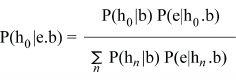
This represents the fact that: BT is P(h|e.b) = [P(h|b) × P(e|h.b)] / ([P(h|b) × P(e|h.b)] + [P(~h|b) × P(e|~h.b)]), which equals [P(h|b) × P(e|h.b)] / ([P(h0|b) × P(e|h0 .b)] + [P(h1|b) × P(e|h1.b)] + [P(h2|b) × P(e|h2.b) + [P(h3|b) × P(e|h3.b)] +…+ [P(hn|b) × P(e|hn.b)] ) for all possible hypotheses, which entails that [P(h|b) × P(e|h.b)] + [P(~h|b) × P(e|~h.b)] = [P(h0|b) × P(e|h0 .b)] + [P(h1|b) × P(e|h1.b)] + [P(h2|b) × P(e|h2.b) + [P(h3|b) × P(e|h3.b)] +…+ [P(hn|b) × P(e|hn.b)], which entails that, when h = h0, then [P(~h|b) × P(e|~h.b)] = [P(h1|b) × P(e|h1.b)] + [P(h2|b) × P(e|h2.b) + [P(h3|b) × P(e|h3.b)] +…+ [P(hn|b) × P(e|hn.b)], therefore removing any hypothesis (e.g., [P(h1|b) × P(e|h1.b)]) from ~h must necessarily reduce the result of [P(~h|b) × P(e|~h.b)] by exactly as much as would account for it if it were the one being tested instead (i.e., if it became h0), therefore [P(~h|b) × P(e|~h.b)] must include all possible hypotheses besides h. The value of [P(~h|b) × P(e|~h.b)] for all those other hypotheses must then equal the value of [P(h1|b) × P(e|h1.b)] + [P(h2|b) × P(e|h2.b) + [P(h3|b) × P(e|h3.b)] +…+ [P(hn|b) × P(e|hn.b)]. And this is what entails that the sum of prior probabilities for all hypotheses must equal 1: P(h0|b) + P(h1|b) + P(h2|b) + P(h3|b) +…+ P(hn|b) = 1, because P(h|b) + P(~h|b) = 1, since h and ~h exhaust all logical possibilities, and the probability is 100% that the truth is one of all the possible things there are, and because P(h|b) = P(h0|b), and P(~h|b) = P(h1|b) + P(h2|b) + P(h3|b) +…+ P(hn|b). Therefore only hypotheses whose removal from ~h would have no visible effect on our math (i.e., any hypothesis n for which [P(hn|b) × P(e|hn.b)] ≈ 0) can be safely ignored.
28. Although I selected this example precisely because it is not physically impossible to transmute lead into gold (and thus we're not facing any mere ‘bias against the supernatural’ here as discussed in chap. 4, p. 114). Rather, our b entails it's just not possible for anyone of ancient Galilee to have done this, not having had any of the technological infrastructure or scientific knowledge known to be necessary to accomplish it. Gold is far more efficiently transmuted from mercury or platinum, but can be transmuted from lead by simply knocking out a few protons. But the only way to do that is to employ a particle accelerator or nuclear reactor; and to produce enough gold to get rich on, one would have to apply these technologies on a remarkably vast scale (and even then the gold produced might be so radioactive as to kill its possessor). As we know of no other way to do it, and in fact know a great deal about what prevents it being done any other way, we are correct in assigning it a vanishingly small prior probability in the case of Matthias (until, of course, we discover some new physics or power).
29. More precisely, the prior in this case would be 99.7%, according to Laplace's Rule: (998+1) / (1000 + 2) = 999 / 1002 = 0.997 (rounded), but for a hypothetical set of infinite extension, it's 99.8%. Meanwhile the consequent probability in this analysis is simply 1 (for both h and ~h), so the prior probability is also the posterior probability, and thus simply the probability. Of course the same problem can be analyzed the other way around, but it would produce the same results: if 99.8% amazing hands are fair, and “amazing hand” is defined as having a probability of 1 in 100,000 on a fair deal, then P(e|CHEAT.b) = 1 (assuming a cheater would want no other outcome), while P(e|FAIR.b) = 0.00001 (the 1 in 100,000 natural odds); but on that model, “0.998 amazing hands are fair” then entails P(CHEAT|b) = 0.00000002 (i.e., only one in fifty million of all hands dealt can then be cheats—meaning all hands whatever, whether amazing or not), so P(FAIR|e.b) would still equal 99.8%.
30. An example of a “no one ever thought of that” factor is a recent study proving that coin tosses are not random but always slightly favor the side of the coin that was facing up before the toss: Erica Klarreich, “Toss Out the Toss-Up: Bias in Heads-or-Tails,” Science News 165, no. 9 (February 28, 2004): 131.
31. For more on all this and its broader philosophical relevance, see my essay: Richard Carrier, “Our Mathematical Universe,” at http://richardcarrier.blogspot.com/2007/10/our-mathematical-universe.html, published October 5, 2007.
32. On the reason we reject that ‘aliens’ hypothesis, see the concluding section of my essay: Richard Carrier, “Defining the Supernatural,” January 18, 2007, at richardcarrier.blogspot.com/2007/01/defining-supernatural.html. That essay elaborates a more general argument later published in Richard Carrier, “On Defining Naturalism as a Worldview,” Free Inquiry 30, no. 3 (April/May 2010): 50–51.
33. According to Laplace's Rule of Succession: (s + 1) / (n + 2) = (4 + 1) / (4 + 2) = 5 / 7 = 71.4%.
34. Some of the underlying mathematics is discussed in William Faris's book review of Probability Theory: The Logic of Science (by E. T. Jaynes), in Notices of the American Mathematical Society 53, no. 1 (January 2006): 33–42.
35. And as Giulio D’Agostini demonstrates, no one really does, not even the most stalwart of frequentists: “Teaching Statistics in the Physics Curriculum: Unifying and Clarifying Role of Subjective Probability,” American Journal of Physics 67, no. 12 (December 1999): 1261–62.
36. A funerary inscription attests an industrial mechanic who achieved rather considerable wealth under the Roman Empire in what is now modern Turkey: Tullia Ritti, Klaus Grewe, and Paul Kessener, “A Relief of a Water-Powered Stone Saw Mill on a Sarcophagus at Hierapolis and Its Implications,” Journal of Roman Archaeology 20 (2007): 138–63.
37. In this case, of course, we might not be talking about the prior probability of someone getting rich by being an industrial mechanic, but the prior probability of this specific evidence (the funerary inscription) being produced by its occupant's success in industrial mechanics, rather than by this evidence (the inscription) being forged, or the inscribers lying or being mistaken, etc., although the one frequency does relate to the other (see n. 11 for chap. 3, p. 301, on the effect of the frequency of events on the believability of testimony).
38. See note 4 for chapter 2, p. 297, regarding the illogical terminological equation of these two ideas of probability with the phrases ‘objective probability’ and ‘subjective probability’ respectively (which convention I believe should be abandoned, for the reasons stated there).
39. Almost every other dispute between frequentists and Bayesians is quickly dispatched by Giulio D’Agostini, “Role and Meaning of Subjective Probability: Some Comments on Common Misconceptions,” October 26, 2000, http://arxiv.org/abs/physics/0010064. D’Agostini demonstrates the frequentists are engaged in far more folly than the Bayesians. But he stops just short of the last step I take here, which finally folds everything that's correct about frequentism into Bayesianism, thus eliminating everything frequentists claim is incorrect about Bayesianism.
40. Faris's book review of Probability Theory, p. 36.
41. A confidence level of 100% is mathematically and logically impossible, as we never have access to 100% of all information, i.e., we're not omniscient, and as Gödel proved, no one can be, for it's logically necessary that there will always be things we won't know, even if we're God—like whether a belief that we're omniscient and infallible is true, which cannot be noncircularly asserted as known with 100% confidence, even by God.
42. Formally speaking: if P(r)→1, then (1 – P(r))→0 and therefore [(1 – P(r)) × P(d')]→0, because {(→0) × P(d')}→0 (since anything times zero is zero); ergo the entire factor “+ [(1 – P(r)) × P(d')]” can effectively be ignored, leaving P(h|b) = P(r) × P(d), and if P(r)→1, then P(h|b) = P(r) × P(d) = (→1) × P(d), and ((→1) × P(d))→P(d); ergo P(h|b)→P(d). Which also means the fact that (obviously) we almost never know P(d') is irrelevant—as its value can make no difference to this result: because P(d') only differs from P(d) to a probability of 1 – P(r), so when P(r) is extremely high (approaching 1), P(d') will almost certainly not differ significantly from P(d), that is, it will do so only with extreme rarity
43. Of course, if we were truly omniscient and infallible, we wouldn't need to run a BT analysis, as we'd already know the answer. So assume that by ‘omniscient’ we only know general and not specific facts (like the hero of the ill-fated television series John Doe), e.g., we know how many people won the lottery, but not exactly who those people are.
44. The example being referred to is discussed in C. Behan McCullagh, Justifying Historical Descriptions (New York: Cambridge University Press, 1984), p. 22.
45. John Earman, Bayes or Bust?: A Critical Examination of Bayesian Confirmation Theory (Cambridge, MA: MIT Press, 1992), p. 114.
46. Which is essentially Earman's solution to the problem, cf. Bayes or Bust? p. 117 (cf. also 120ff. and 158).
47. Although it's worth noting his geocentric model was also very predictively successful, only failing after a very long time (with the notable exception of apparent diameters, which never conformed to the theory, past or future).
48. See discussion in chapter 3 (p. 79) of the folly of trying to “ignore” evidence (leaving it out of both e and b), which can never be logically valid.