
2
In exactly what sense is Quentin Meillassoux both a Cartesian and a Humean? Let us address this question more explicitly in order to clarify the manner in which After Finitude might be included within the para-methodological tradition of “rationalist empiricism.”
Meillassoux is a Cartesian insofar as he affirms the power of mathematical formalization to separate knowledge of the primary qualities of objects and events from their empirical givenness. His approach to what he calls “the problem of dia-chronicity”—the problem of how to establish knowledge of a time anterior or posterior to human existence—is Cartesian: such knowledge is enabled by the capacity of mathematics to formalize physical properties so as to subtract them from their sensory correlates. Science gleans knowledge of spatio-temporal relations from empirical experimentation, but the mathematization of such knowledge—both prior and subsequent to experimentation—renders it thinkable in a manner indifferent to the existence of human experience. According to Meillassoux, “the world of Cartesian extension is a world that acquires the independence of substance, a world that we can henceforth conceive as indifferent to everything in it that corresponds to the concrete, organic connection that we forge with it.”1 It is this speculative import of modern mathematical science—its capacity “to deploy a world that is separable from man,” that “Descartes theorized in all its power.”2 For Meillassoux, what is properly signified by “the Copernican revolution” is “not so much the astronomical discovery of the decentering of the terrestrial observer within the solar system, but rather the much more fundamental decentering which presided over the mathematization of nature.” It is Descartes who philosophically affirms the link at issue in this Galilean/Copernican revolution: that “science carried within it the possibility of transforming every datum of our experience into a dia-chronic object—into a component of a world that gives itself to us as indifferent, in being what it is, to whether it is given or not.”3 In terms of his own approach to Descartes, Meillassoux is a Cartesian insofar as he affirms that the Copernican decentering of man relays the Galilean mathematization of nature that renders graspable, at the crux of the empirical and the rational, “a world that is essentially unaffected by whether or not anyone thinks it.”4
Meillassoux is a Humean insofar as he reactivates Hume’s problem of induction: How can we know that the conjunction of causes and effects we observe will remain constant in the future, as it has in the past? In effect, this is the problem of how we can draw the necessity of constant conjunction from the contingency of the world that we observe: By what right do we think the same “effects” will necessarily continue to follow from the same “causes,” that the regularities linking series of events will continue to function in the future as they have in the past? That is, how do we know that “Relations of Ideas” are and will remain an adequate guide to “Matters of Fact?”5 Hume resolves these “Sceptical Doubts” with a pragmatic solution: we do not know that our reasoning concerning necessary conjunction is valid on the basis of our experience of constant conjunction, but the mechanism of habit provides a non-rational, yet reliable, guide to matters of fact, since it performs a statistical synthesis of regularities precisely (though unconsciously) calibrated to the frequencies of their past occurrence. Belief is thus the probabilistic means by which “a kind of pre-established harmony” is generated “between the course of nature and the succession of ideas”6—we believe in practice, through habit, in the conjunction of causes and effects to the extent that they have been conjoined in the past. However, Hume must still acknowledge that “we only learn by experience the frequent CONJUNCTION of objects, without being ever able to comprehend anything like the CONNEXION between them.”7 The laws of nature are known through conjunction, not connection, and thus our belief in the continuity of future events with past experience is gleaned only from the regularity of conjunction, rather than the necessity of connection. “Hume,” notes Meillassoux, “was the first to maintain that from a determinate situation, one can never infer a priori the ensuing situation, an indefinite multiplicity of futures being envisageable without contradiction.”8
Meillassoux affirms the critical import of Hume’s problem against its pragmatic resolution. He notes that what is at issue in the epistemological articulation of Hume’s problem is the justification of an assumed ontological principle—the necessity of the uniformity of nature. Hume asks a question concerning the genesis of knowledge: How do we know that the succession of events will obey the same laws in the future as they have in the past? But this epistemological question is intimately linked with an ontological problem, which is precisely what the question puts at issue: Is there a reason the future should continue to resemble the past? The question “how do we know” involves a reference—“how do we know that …”—and what is at issue in this reference is the assumption of a state of affairs that could be known: precisely that the future will resemble the past. It is the status of this assumption that raises an ontological problem through an epistemological question: Is there a necessary uniformity of nature that we somehow understand and act upon, though we cannot elucidate either the rational or empirical ground of our understanding? Meillassoux seeks to preserve the ontological scope of this problem: How do we know (epistemological) that there is (ontological) a uniformity of nature, given that we only have our past experience of such uniformity to assure us of its continuity? One question—how do we know this uniformity is necessary?—implies also the question of whether or not there is such a necessary uniformity.
Some would say that Meillassoux (1) “ontologizes” Hume’s epistemological problem of induction and that he (2) derives his argument for the necessity of contingency from this gesture.9 The first claim is imprecise, and the second is incorrect. Meillassoux aims to sustain the ontological implications of Hume’s epistemological problem (how do we know that…) by intervening against the probabilistic assumption concerning those implications: the assumption that if the uniformity of nature we have observed were not necessary, but rather contingent, the regularities of nature would not be uniform, but rather subject to constant change. Against this probabilistic assumption, Meillassoux mobilizes transfinite set theory and Russell’s paradox to demonstrate that the assumption rests upon a covert concept of the whole that post-Cantorian mathematics challenges: we cannot construct the set of all sets of cases wherein we could apply the laws of probability to the statistical evaluation of the likelihood of events. Considered at the level of a total universe of cases, probability theory is inoperative, because we cannot think a total universe of cases, an absolute set of cases to which probabilities could be applied. Thus we see again the ontological implications of an epistemological problem. Epistemological recourse to probability aims to resolve an ontological problem: if there were not a necessary unity of natural laws, it is highly improbable that we would not have observed their al teration; thus we can assume that there is a necessary unity of nature—or at least we can assume that we need not worry about the question, and can dismiss it as an ontological problem.
Meillassoux does not, however, derive his ontological argument for the necessity of contingency from his Cantorian intervention against probabilistic reasoning. On the contrary, he derives the necessity of blocking the probabilistic deflation of Hume’s problem from the principle of factiality itself, which he aims to demonstrate “anhypothetically” (without the ground of a previous principle) in Chapter 3 of After Finitude and in Part 2 of “L’inexistence divine.” I engage the latter version of this anhypothetical demonstration in Chapter 4. For now, it suffices to say that Meillassoux recognizes an implicit ontological question in Hume’s epistemological formulation of the problem of induction, that he thus aims to defend the ontological scope of the question (is there a necessary uniformity of nature that we could know?) against its dismissal, and that he constructs his own approach to answering the ontological question and its epistemological correlate: there is not a necessary uniformity of nature (ontological), yet we can coherently think the contingency of natural constants despite the uniformity that we observe (epistemological). He shows that the deflation of the ontological implications of Hume’s problem on probabilistic grounds is epistemologically incoherent.
Meillassoux thus reactivates the problem of induction by “grafting the Humean thesis onto that of Cantorian intotality.”10 This gesture “grafts” the central problem of empiricism (what reason can we find amid the contingency of the given?) onto the mathematical resources of a contemporary philosophical rationalism. It is the philosophical consequences of transfinite mathematics—the delinking of the infinite from the whole—that enables a reengagement of Hume’s problem against its probabilistic deflation. And it is Meillassoux’s method of demonstration without deduction—wherein the necessity of contingency is anhypothetically derived from conflicts among philosophical positions (After Finitude), or from the question of whether the category of contingency can be applied to itself (“L’inexistence divine”)—that enables him to reverse the ontological import of Hume’s problem, exploring the consequences of the position that there is not a necessary uniformity of nature, and thus displacing the principle of sufficient reason as a cornerstone of philosophical rationalism. Importantly, it is the history of philosophical argumentation and the history of mathematics that enables Meillassoux to establish a disjunctive tension between rationalism and empiricism: an empiricist problem (problem of induction) suggests the ontological scope of the problem of the relation between necessity and contingency; a rationally derived principle forces an epistemological defense of the coherence of defending the contingency of physical law (rather than the necessity of its regularity); this epistemological defense enables rational speculation upon the ontological consequences of the principle of factiality. To summarize: Meillassoux is an empiricist insofar as
1. he affirms the critical force of the problem of induction, with respect to both epistemology and ontology
2. he affirms the speculative import of the physical sciences, which force us to think a time prior to the existence of thought
3. he attends to the historical conflict of philosophical positions as integral to the experience of thinking: to the import of what happens in philosophy for the determinations of what has to be thought
He is a rationalist insofar as
1. he addresses the ontological implications of the problem of induction through a rationally derived anhypothetical principle (the necessity of contingency)
2. he affirms the power of mathematical formalization to separate knowledge of primary qualities from their phenomenal correlates
3. he affirms the speculative vocation of philosophy beyond the purview of the physical sciences: to think the ontological difference between being and beings
Many of the apparent “problems” with Meillassoux’s philosophical work—for example, the application of the term “in-itself” to both the (ontic) primary qualities of objects and to the (ontological) necessity of contingency—require an understanding of how the rationalist and empiricist dimensions of his work intersect: the mathematization of the empirical sciences demands a defense of the speculative scope of philosophical reflection on dia-chronicity; the rational demonstration of an anhypothetical principle has consequences for the ontological implications of Hume’s problem; the pure mathematics of transfinite set theory enable a defense of the epistemological coherence of those consequences; the principle of factiality forces philosophical thought to move beyond the theoretical ratification of empirical science to the speculative level of ontological reflection. There is no inconsistency between Meillassoux’s affirmation of the philosophical import of the empirical sciences and the speculative demands of philosophical rationality; they simply pertain to different levels of reflection (ontic/ontological). Importantly, Meillassoux is one of the few thinkers to respect both of these levels. He does not denigrate the “merely” empirical, ontic vocation of the sciences, but thinks its philosophical consequences; he does not inveigh against the “merely” speculative problems of ontology, but he recognizes their irrevocable philosophical import and takes them up on their own ground.
SPECULATIVE MATERIALISM, DIALECTICAL MATERIALISM
While Chapter 4 returns in detail to the question of the ontological difference, the burden of this chapter is to show that in order to think through the relationship between rationalism and empiricism in Meillassoux’s philosophy, we also have to think through the precise manner in which After Finitude intervenes in the conflict between materialism and idealism. So the question now is: How do we think the position of After Finitude vis-à-vis the two major “oppositions” that structure the philosophical field?
1. rationalism v. empiricism
2. materialism v. idealism
I hope to show that the best way to approach this question is by thinking through the relation of Meillassoux’s “speculative materialism” to a certain tradition of “dialectical materialism” analyzed and practiced by Althusser. Thus, I aim to respond to a problem raised by Peter Hallward in his review of After Finitude. Hallward argues that “to the degree that Meillassoux insists on the absolute disjunction of an event from existing situations he deprives himself of any concretely mediated means of thinking, with and after Marx, the possible ways of changing such situations.”11 While I do not think Meillassoux’s work has any direct bearing upon concrete political practice, here I want to explore a broader sense in which Meillassoux might nevertheless be considered to think “with and after Marx.” In fact, I want to demonstrate that After Finitude might feasibly be taken as a contribution to what Althusser calls “Marxist philosophy.” I will do so not by positioning Meillassoux directly in relation to Marx, but rather by thinking through the mediation of that relationship by Althusser’s engagement (in “The Philosophy Course for Scientists” and in “Lenin and Philosophy”) with Lenin’s Materialism and Empirio-Criticism. For After Finitude not only revisits and recasts Lenin’s attack on the “correlativist” and “fideist” orientation of post-Kantian philosophy, as Ray Brassier has noted; it also—perhaps unconsciously—routes its substantial modifications of Lenin’s polemical itinerary through the exigen cies of Althusser’s theory of dialectical materialism. It is the manner in which Meillassoux answers the Leninist/Althusserian injunction to “draw a line of demarcation” between materialism and idealism that renders Meillassoux’s book an exemplary instance of what Althusser calls “rationalist empiricism.” And it is the manner in which Meillassoux determines the relation between materialism and idealism that allows us to understand the relational disjunction of rationalism and empiricism his work entails.
Let us explore Althusser’s deployment of the term “rationalist empiricism” in greater detail than we could accord it in the Introduction. In his 1966 text: “The Philosophical Conjuncture and Marxist Theoretical Research,”12 Althusser lays out three “elements” in French philosophy that he takes to be constitutive of the theoretical conjuncture:
1. a religious-spiritualist element with origins in the middle ages (persisting most powerfully in the form of Bergsonism)
2. a rationalist-idealist element deriving from aspects of Cartesian philosophy and developed by the critical idealism of Kant and Husserl (considered by Althusser to be the dominant element in the theoretical conjuncture of French philosophy)
3. a rationalist empiricism13
Here is Althusser’s description of this last element:
Alongside these two elements—religious-spiritualist and rationalist-idealist—there subsists another element, another theoretical layer, whose origins may be traced back the eighteenth century: rationalist empiricism in its two forms, idealist and materialist. Materialist rationalist empiricism lives on in the ideology of certain scientific practices (psycho-physiology, etc.). Idealist rationalist empiricism does too, and has produced the more interesting results. It was this current which, setting out from other, materialist aspects of Descartes’ work, spawned the great work of the Encyclopédie, d’Alembert, Diderot, and so on. This tradition was taken up by the only great French philosopher of the nineteenth century, Auguste Comte. It saved the honor of French philosophy, if one may use a term from the sports world here, during the terrible spiritualist reaction of the nineteenth century. It has given us the only philosophical tradition that we can trace, almost uninterruptedly, from the seventeenth century down to our own day: the tradition of the philosophy of the sciences to which we owe such great names as Comte, Cournot, Couturat, Duhem, and, closer to our own time, Cavaillès, Bachelard, Koyré, and Canguilhem.14
Note that there are two traditions included under the umbrella of rationalist empiricism:
1. materialist rationalist empiricism
2. idealist rationalist empiricism
The first of these, which Althusser links to the ideology of scientific practices like “psycho-physiology,” would seem to be a reductionist materialism—what we might today call “eliminativist materialism” (referring to neurology and cognitive science rather than “psycho-physiology”). It is the second form, Althusser feels—idealist rationalist empiricism—which has “produced the more interesting results.” This is the current—running from d’Alembert and Diderot through Comte up to Cavaillès, Bachelard, Koyré, and Canguilhem—which has “saved the honor of French philosophy,”15 and this is no doubt the tradition from which Althusser’s own work on “the philosophy of the sciences” most immediately emerges. It is also the tradition in which one would have to situate the work of both Badiou and Meillassoux. The problem, however, is that we know for Althusser—at least by the time of his 1967–68 “Lecture Course for Scientists”—the partisan role of the Marxist philosopher is to intervene in the philosophy of the sciences on behalf of materialism, and against idealism—not on behalf of “idealist rationalist empiricism.” If this passage thus productively complicates the schema of the later lecture course, it would seem the task of the Marxist philosopher would not be to intervene on the side of materialist rationalist empiricism (considered by Althusser a reductive scientism), nor exactly on behalf of idealist rationalist empiricism, but rather to transform the resources of the latter tradition into a non-reductive materialist orientation. That is, to transform the tradition that has saved the honor of French philosophy into a dialectical materialist rationalist empiricism.
But it is crucial, given the dialectical character of this materialism, that it cannot itself result from a mere inversion of idealist rationalist empiricism; it would rather have to be produced through a transformation within it. The model for this sort of transformation is provided by Althusser himself in “Contradiction and Overdetermination,” through his treatment of Marx’s “inversion” of Hegel, Marx’s effort to “set Hegel on his feet.”16 At issue in that essay is Marx’s remark about extracting the “rational kernel” from the “mystical shell” of Hegel’s thought, and the question is whether we can simply extract the rational method of dialectical materialism from the mystical teleology of absolute idealism. Althusser’s theory of structural causality emerges in part from his recognition that we cannot do so, and that such an extraction would have to involve a real transformation of the dialectic itself.
On this model, it would be necessary to perform not an inversion, but a real transformation of idealist rationalist empiricism through a modification of its constitutive elements. What is notable in this regard is Althusser’s curious remark that it is this idealist orientation of rationalist empiricism that sets out from “materialist aspects of Descartes’s work.” Perhaps the project would be to recover and reactivate these “materialist aspects” of Descartes’s work within the tradition of idealist rationalist empiricism so as to transform it, internally, into a properly dialectical form of materialist rationalist empiricism. My argument is that this is precisely the task carried out in After Finitude, through Meillassoux’s effort—against the conjunctural dominance of critical idealism, or “correlationism”—to recover and reactivate Descartes’s claims for the capacity of mathematical physics to separate primary qualities of objects from their sensory correlates, but without Descartes’s religious-spiritualist recourse to God as a guarantor of human reason. This is what Meillassoux attempts through his speculative precipitation of formerly metaphysical problems. The question is, then: How can what Meillassoux terms his “speculative materialism” be understood as a form of dialectical materialism?
Althusser offers his most detailed and direct definition of dialectical materialism in a 1965 text, “Theory, Theoretical Practice and Theoretical Formation: Ideology and Ideological Struggle”:
In dialectical materialism, it can very schematically be said that it is materialism which represents the aspect of theory, and dialectics which represents the aspect of method. But each of these terms includes the other. Materialism expresses the effective conditions of the practice that produces knowledge—specifically: (1) the distinction between the real and its knowledge (distinction of reality), correlative of a correspondence (adequacy) between knowledge and its object (correspondence of knowledge); and (2) the primacy of the real over its knowledge, or the primacy of being over thought. Nonetheless, these principles themselves are not ‘eternal’ principles, but the principles of the historical nature of the process in which knowledge is produced. That is why materialism is called dialectical: dialectics, which expresses the relation that theory maintains with its object, expresses this relation not as a relation of two simply distinct terms but as a relation within a process of transformation, thus of real production.17
There are two primary components here: a definition of materialism and a definition of dialectics. Though I do not mean to forward an argument concerning influence or intention, I would hold that the philosophical itinerary, the structural articulation, and the argumentative method of After Finitude adhere to the determination of dialectical materialism spelled out by Althusser—or better, that Meillassoux’s book unfolds from the complex exigencies of combining the criteria articulated by Althusser.
Althusser’s definition of materialism itself includes two criteria, the first of which is also internally divided:
1. (a) distinction between the real and its knowledge (criterion of distinction) (b) correspondence between knowledge and its object (criterion of adequacy)
2. primacy of the real over its knowledge, or primacy of being over thought (criterion of primacy)
Note that the first of Althusser’s materialist criteria—itself twofold—in no way challenges the program of transcendental idealism: the distinction between the real and its knowledge is accounted for by the distinction between noumena and phenomena; the correspondence between knowledge and its object is accounted for by the synthesis of the manifold by the forms of intuition and the categories of the understanding. It is the categories that, for Kant, ground the universality of scientific knowledge of the phenomena. According to Meillassoux, however—and also according to Lenin and to Althusser—no “correlationist” or critical idealist philosophy can properly meet the second criterion: “the primacy of the real over its knowledge, or the primacy of being over thought.” What does Althusser mean by primacy? He might be taken to refer to a broadly Marxist foregrounding of “the primacy of practice,” or the structure of social relations in and through which knowledge is produced. But more fundamentally, “the primacy of the real over its knowledge, or the primacy of being over thought” refers us to the passage in the Grundrisse, often cited by Althusser, in which Marx states that the real (or what Althusser calls “the concrete real” or “the real object”) “retains its autonomous existence outside the head just as before.”18 That is, it refers us to the chronological primacy of the real—the anteriority of its exteriority to thought. In Meillassoux’s terms, it refers to the “temporal discrepancy of thinking and being,” or the “dia-chronicity” of being and thought.19
THE ORDER OF REASONS
Meillassoux’s strategy is thus to begin with this crux in Chapter 1 of After Finitude, by showing how the problem of ancestrality exposes the impossibility of properly affirming the primacy of being over thought from within the framework of correlationism: that is, of properly affirming the chronological anteriority of being over the logical anteriority of the act of thinking. The heuristic of the arche-fossil is intended to show that the logical “retrojection of the past on the basis of the present”20 performed by the correlationist—by which the act of the thought, the transcendental conditions of understanding, the auto-positioning of the subject, primordial auto-affection, or the structure of signification is posited as logically prior to that which is thought—undermines our capacity to properly grasp the chronological primacy of the real over its knowledge, or to accede to the dia-chronicity of being and thinking.
The difficulty for the materialist then becomes how to meet the ontological criterion of primacy while meeting the double epistemological criteria of distinction and adequacy. Doing so involves moving from the heuristic of the arche-fossil to a refutation of the correlationist, who either rejects the order of primacy (absolute idealism) or covertly undermines its proper sense (transcendental idealism). The crucial point here is to acknowledge that the problem of ancestrality is not itself intended to produce a refutation of transcendental or absolute idealism, only to motivate such a refutation by producing a line of demarcation between materialism and idealism. The method by which Meillassoux performs this refutation over the course of Chapters 2 and 3 of After Finitude is “dialectical” in precisely the sense articulated by Althusser. He first “accounts for the historical nature of the process in which knowledge is produced”21 by diagnosing the complicity of fideist correlationism with the “postmodern” return of the religious. He thereby establishes the most pertinent historical condition of his philosophical practice through an analysis of the theoretical-ideological conjuncture (a conjuncture, for example, in which so-called constructivist epistemologies of science are deployed by the religious right against evidence of global warming or in favor of creationist “alternatives” to Darwin’s theory evolution). He then takes up his philosophy’s relation to that conjuncture as a “process of transformation” by working within the positions of his opponents—the dogmatist, the correlationist, and the absolute idealist. The argument gauges the implications of those positions for each other until it locates the weakest link in the system of their relationships—the problem of the facticity of the correlation itself—and then, in Althusserian terms, demarcates the stake inherent to that problem. We must understand the order of reasons at issue in After Finitude in order to properly evaluate the relationship between its various arguments and the consequences they are each accorded. (See Figure 3.)
Meillassoux notes that the initial response of subjectivist metaphysicians to Kant’s correlational disqualification of thought’s access to the absolute was to absolutize the correlation itself:
They acknowledge correlationism’s discovery of a fundamental constraint—viz., that we only have access to the for-us, not the in-itself—but instead of concluding from this
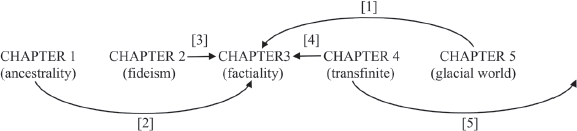
Figure3. After Finitude, articulation of the argument according to the order of reasons. The goal is to defend the Copernican revolution (Descartes) against the Ptolemaic counter-revolution (Kant).
Strategy: absolutization of mathematics.
Tactics: [1] demonstrate a nondogmatic absolute (factiality); [2] motivate demonstration via scientific problem with correlationism (ancestrality); [3] motivate demonstration via ideological problem with correlationism (fideism); [4] defend absolute against one form of mathematical reasoning (probability) with another (transfinite); [5] establish absolute scope of transfinite by deriving it from nondogmatic absolute (factiality).
Order of Reasons: A defense of the Copernican revolution against the Ptolemaic counterrevolution (Chapter 5) requires the demonstration of a nondogmatic absolute (Chapter 3) in order to break the correlationist circle (Chapter 1); Chapter 2 sets up the argument of Chapter 3, while Chapter 4 defends that argument against objection; Chapter 4 then suggests the necessity of deriving the absolutization of mathematics from a nondogmatic absolute.
that the in-itself is unknowable, they concluded that the correlation is the only veritable in-itself. In so doing, they grasped the ontological truth hidden behind sceptical argumentation.22
Yet this metaphysical counteroffensive against Kantian correlationism was itself countered by “the second principle of correlationism—the essential facticity of the correlation, which has proven to be its most profound decision—the one which disqualifies idealist as well as realist dogmatism.”23 What Meillassoux tries to show is that this assertion of the facticity of the correlation against its absolutization by the subjective idealist implicitly oversteps the skeptical gesture it had attempted to defend: in order to counter the absolutization of the correlate, the facticity of the correlate must implicitly be thought as an absolute. The absolutization of facticity the correlate involves a claim not only that the regularities of nature we observe are subjective, but also that they are not necessary. As soon as we demur from this assertion, claiming that the contingency of knowledge is only a function of our ignorance, the subjective idealist once again claims the ground we have conceded: we do not know the in-itself because there is no in-itself. In order to sustain the disjunction between the for-us and the in-itself, the correlationist must go beyond what they mean to say: they must assert not only that the in-itself could be otherwise (because of our ignorance) but also that we have to think either that laws in-themselves are necessary or that they are contingent. As we noted in the Introduction, the Kant of Third Critique will say we must think they are necessary, in order to account for the regularity of our experience. In doing so, he dogmatically asserts that we must think the necessity of the order of nature. For the subjective idealist, this must think merely indexes the absolute purview of the correlation itself, an implicit extrapolation from the conditions of possible experience to what we must think concerning the modality of regularities beyond experience. Kant encountered the crux of a problem at the limit of his own philosophy: if we are to defend the distinction of the for-us from the in-itself, we must nevertheless think the conditions through which these could be consistent with one another. The only path to such consistency that Kant could recognize was to assert the subjective necessity of thinking the principle of the uniformity of nature. But asserting the contingency of the uniformity of nature opens another path: one that counters both the absolutization of a necessary being (dogmatism) and the absolutization of the correlation (subjective idealism). This is the possibility which the correlationist would have to think in order to defend against both metaphysical and subjective necessity. The necessity of contingency is not metaphysical (since it bars the existence of a necessary being) and it is not subjective (since it has to posit the contingency of subjectivity itself). In order to secure the contingency of the in-itself against subjective idealism’s claiming of the correlate as the in-itself, the necessity of contingency must be thought as not only subjective, but as an absolute.
What interests me about this argument is the methodological gesture its unfolding implies. Meillassoux reconstructs the philosophical Kampfplatz in which the recursive determinations of philosophical argumentation force the adoption of certain position, on pain of either refutation or self-contradiction. The consequences that follow from this reconstruction, first and foremost the principle of factuality (that to be is necessarily to be a fact, or that everything that is is necessarily contingent), are thus consequences inherent to the codetermination of philosophical positions constitutive of the conjuncture, drawn through an assessment of the relational field of forces therein, as Althusser would put it. Meillassoux works through the intra-systemic consequences of his opponents’ logic and the relations between their positions, marking an acknowledgment that all philosophical hypotheses are already immersed in the conjunctural field within which one establishes a position. The import of this “indirect” method of demonstration is that it does not simply posit philosophical principles in an axiomatic fashion and then draw the consequences. Meillassoux establishes a principle that is “anhypothetical” insofar as it is not deduced from some prior proposition but is rather proved by argument—“by demonstrating that anyone who contests it can do so only by presupposing it to be true, and thereby refuting himself.”24 In fact, one could choose to be a subjective idealist. Meillassoux’s argument therefore presumes a partisan basis: it requires a rejection of idealism. Indeed, it would be difficult to find a more exact demonstration of a materialist philosophical practice as it is defined by Althusser, on the model of Lenin’s polemic against his correlativist and fideist contemporaries, than the demonstration of the principle of factiality in Chapter 3 of After Finitude.
We then return, in the final two chapters of After Finitude, to the materialist upshot of this dialectical procedure. Having demarcated one’s philosophy from dogmatic metaphysics, subjective idealism, and transcendental idealism by thinking through the relation between their positions, how is it then possible to affirm, on the side of materialism, both the distinction of the real from knowledge and the adequacy of knowledge to its object, while properly recognizing the primacy of the real over its knowledge, or of being over thought? The answer offered at the end of After Finitude is that we can do so by reestablishing the absolute scope of mathematical discourse proper to the “decentering of thought relative to the world within the process of knowledge,”25 which Meillassoux takes to have been constitutive of the Copernican revolution and its Galilean/Cartesian development. “What is mathematizable,” argues Meillassoux, “cannot be reduced to a correlate of thought.”26 This formulates the condition for the distinction between the real and its knowledge. Mathematical physics manifests “thought’s capacity to think what there is whether thought exists or not.”27 This formulates the condition for the correspondence between knowledge and its object: adequacy of the object of knowledge to the real object. In other words, the mathematization of experimental science enables the adequation of thought to the distinction of the real. And, most pertinently for the materialist criteria outlined by Althusser, it is the mathematical formalization of empirical science that answers the question at the root of the paradox of manifestation: “How is empirical knowledge of a world anterior to all experience possible?”28 For Meillassoux, it is mathematical physics that enables us to adequately think what there was before thought: to think the adequation of thought to the distinction of a real which is prior to thought.
This is the “materialist aspect” of Descartes’ work that we might hope to locate at the root of the tradition of “idealist rationalist empiricism” identified by Althusser, and which might be mobilized toward a materialist transformation of that tradition. Again, Meillassoux holds that “it is this capacity, whereby math-ematized science is able to deploy a world that is separable from man … that Descartes theorized in all its power.”29 Thus, when Meillassoux claims allegiance to what he calls “an in-itself that is Cartesian, and no longer just Kantian”30—one grasped by mathematical formalism—he does so in the name of materialist criteria such as those enumerated by Althusser. And when Meillassoux arrives at this affirmation through a conjunctural assessment of the consequences of relations between discrepant philosophical positions and their ideological entailments, he does so according to Althusser’s criterion for dialectical thought.
It is on these grounds, I would argue, that when Meillassoux elaborates his own criteria of a properly speculative materialism, he also elaborates the criteria of what we could call, adjusting Althusser, a dialectical materialist rationalist empiricism:
Every materialism that would be speculative, and hence for which absolute reality is an entity without thought, must assert both that thought is not necessary (something can be independently of thought), and that thought can think what there must be when there is no thought. The materialism that chooses to follow the speculative path is thereby constrained to believe that it is possible to think a given reality by abstracting from the fact that we are thinking it.31
In his “Lecture Course for Scientists” and in “Lenin and Philosophy,” Althusser positions the defense of such a materialism as a vocation of Marxist philosophy, or of thinking with and after Marx. The defense of dialectical materialism accompanies the articulation of historical materialism by fending off ideological incursions upon materialism per se, and this is why Lenin attempted such a defense by writing Materialism and Empirio-Criticism alongside his political and economic writings.
MEILLASSOUX WITH LENIN
One might then turn to the mediated relation of Meillassoux’s work to Lenin’s philosophical project in Materialism and Empirio-Criticism, a relation which runs through Althusser’s engagement with Lenin’s project in the late 1960s. Briefly, for the Althusser of the “Lecture Course” there are two “spontaneous philosophies of the scientists” (SPS) at work in scientific practice. SPS1 is a materialist belief (of intra-scientific origin) in “the real, external and material existence of the object of the scientific knowledge,” and in “the existence and objectivity of the scientific knowledges that permit knowledge of this object.”32 SPS2 is an extra-scientific reflection upon scientific practice by spiritualist or critical-idealist “philosophies of science,” which operate by “calling into question the external material existence of the object (replaced by experience or experiment)” and “by calling into question the objectivity of scientific knowledges and of theory (replaced by ‘models’).”33
According to Althusser, SPS1 (or materialism) is “massively dominated”34 by SPS2: by the critical-idealist orientation of post-Kantian philosophy, which “exploits” scientific-practice by submitting it “to a preliminary question that already contains the answer which it innocently claims to be seeking in the sciences.”35 The task of the Marxist philosopher (the practitioner of dialectical materialism) in relation to the sciences is to intervene on the side of SPS1, thus combatting the critical-idealist orientation that works against the spontaneous materialism of scientific practice. In “Lenin and Philosophy,” Althusser formulates this obligation as follows:
Materialist philosophy … is particularly concerned with what happens in scientific practice, but in a manner peculiar to itself, because it represents, in its materialist thesis, the “spontaneous” convictions of scientists about the existence of the objects of their sciences, and the objectivity of their knowledge. In Materialism and Empirio-Criticism, Lenin constantly repeats the statement that most specialists in the sciences of nature are “spontaneously” materialistic, at least in one of the tendencies of their spontaneous philosophy. While fighting the ideologies of the spontaneism of scientific practice (empiricism, pragmatism) Lenin recognizes in the experience of scientific practice a spontaneous materialist tendency of the highest importance for Marxist philosophy. He thus interrelates the materialist theses required to think the specificity of scientific knowledge with the spontaneous materialist tendency of the practitioners of the sciences: as expressing both practically and theoretically one and the same materialist thesis of existence and objectivity.36
In the terminology we’ve developed, we can say that Lenin’s project is emblematic of the Marxist vocation of that strange compound, “dialectical materialist rationalist empiricism.” To recapitulate the Althusserian schema: Marxist science (historical materialism) intervenes through a critique of political economy, one that tells us why it is the masses—not men or philosophers or scientists—who make their own history, though not under conditions of their own choosing. Marxist philosophy intervenes against idealist philosophy on behalf of the materialist tendency of the sciences. According to this model, the relation of Marxist philosophy to politics is thus not direct but is mediated by its relation to the critique of political economy (Marxist science). Insofar as one expects a direct relation between philosophy and politics, one will underestimate the importance of the Marxist critique political economy in mediating that relation.
It is through their discrepant approaches to the results and operations of science that we have to think the complex relation of After Finitude to Lenin’s practice of Marxist philosophy in Materialism and Empirio-Criticism. Meillassoux’s project is closest to Lenin’s in its unabashed defense of the literalism of scientific statements. Lenin’s target in the section of Materialism and Empirio-Criticism titled “Did Nature Exist Prior to Man?” is precisely that of Meillassoux’s chapter on the problem of ancestrality: a critique of extending a “chain of experience” of possible objects of perception through a time series prior to the genesis of experience itself. This “idealist sophistry” is glossed by Lenin as follows: “only if I make the admission (that man could be the observer of an epoch at which he did not exist)—one absurd and contradictory to natural science, can I make the ends of my philosophy meet.”37 Like Lenin, whose goal in Materialism and Empirio-Criticism was to “liberate the realm of objects from the yoke of the subject,”38 Meillassoux seeks to defend the realist sense of scientific statements against the juridical ideology of critical idealism. It is thus the “literal” meaning of science’s ancestral statements that the first chapter of After Finitude defends against their inversion by the correlationist—against the “for-us” performing a retrojection of the past from the present upon any statement concerning what occurred “before us.” Against this “for us,” which Meillassoux calls the “codicil of modernity” (“event Y occurred X number of years before the emergence of humans—for humans”),39 both he and Lenin hold that “an ancestral statement only has sense if its literal sense is also its ultimate sense.”40 When we say “event X occurred prior to the emergence of thought for thought,”41 both Lenin and Meillassoux hold that this codicil is irrelevant when it comes to analyzing the significance of the statement.
Unlike Lenin, however, Meillassoux does not endorse the literal sense of scientific statements as a “direct connection of the mind with the external world,”42 but rather as a discourse enabled by mathematical formalization. Meillassoux accepts Bachelard’s dictate in The Philosophy of No that “the world in which we think is not the world in which we live”43—and this is the point of mathematical physics. Meillassoux endorses the “literal sense” of scientific statements as scientific statements (not statements of immediate experience). He recognizes that their “literal meaning” carries far more powerful counter-intuitions than the banal retrojection performed by the codicil of modernity. This is why Meillassoux insists—unlike Lenin—“that we remain as distant from naïve realism as from correlationist subtlety, which are two ways of refusing to see ancestrality as a problem.”44 If the virtue of transcendentalism lies in rendering realism astonishing (“i.e. apparently unthinkable, yet true, and hence eminently problematic”),45 then what Lenin ignores is the paradox of manifestation that renders the literal sense of ancestral statements profound. The problem is not to elide this profun dity, but to think it in a manner traversing the relation of transcendental philosophy to realism without collapsing into correlationism. This is why it is crucial to recognize that the problem of ancestrality is by no means intended to refute transcendental idealism in After Finitude. It merely functions as a heuristic to prepare the ground for the articulation of the principle of factiality performed through and against transcendental idealism in the book’s central chapter.
As is probably obvious, the other major difference between the program of Meillassoux and that of Lenin is that the latter has little to say about the absolute contingency of absolute time. How are we to consider the relation of this aspect of Meillassoux’s argument to his defense of scientific materialism? If we are to take this problem seriously, we have to consider it methodologically: via Meillassoux’s dialectical practice of philosophy. The problem of absolute contingency follows from the logical consequences of the absolutization of facticity arrived at in the third chapter of After Finitude, which itself follows from an indirect demonstration based on the competing claims of discrepant philosophical positions. If we follow Meillassoux’s argumentative itinerary, absolute contingency emerges as the sole absolute that it is possible to salvage from correlationism without absolutizing the correlation itself—that is, without affirming speculative idealism rather than speculative materialism. Absolute contingency is therefore the sole means of refuting critical idealism’s limitation of reason to make room for faith, without equating reason with absolute subjectivity. In order to sustain the facticity of the correlation against subjective idealism, the critical idealist must covertly think contingency itself as an absolute. The rationalist delineation of absolute contingency’s structural position within a balance of philosophical forces is not, then, some flight of fancy (a simple positing that being is absolutely contingent), but rather follows from the dialectical recognition that the effects of philosophical arguments—and of their mutual interpellations—are irreversible, and that they force certain lines of thought. It follows from a commitment, in Althusserian terms, to the fact that “there is a history in philosophy rather than a history of philosophy: a history of the displacement of the indefinite repetition of a null trace whose effects are real.”46 The principle of factiality registers a displacement of the “null trace” dividing materialism and idealism, and Meillassoux’s thinking of absolute contingency, in order to sustain a materialist position, shows that the displacement of this trace has real effects, in philosophy. This displacement and its effects result from an immersion in the restrictive dialectical exigencies of correctly reinscribing the line of demarcation between materialism and idealism, a line that is incorrectly drawn by Lenin due to his concessions to naïve realism.
Meillassoux’s defense of scientific materialism thus inheres precisely where we might least expect to find it: in his rejection of the principle of the uniformity of nature. Ray Brassier helps to clarify the relation between Meillassoux’s position and Karl Popper’s anti-inductivist epistemology of science. Popper defends the invariance of natural laws as a methodological rule but rejects the principle of the uniformity of nature as a metaphysical interpretation of that rule. According to this position, any absolute affirmation of the invariance of physical law falls afoul of the problem of induction, and thus threatens the conceptual validity of the empirical operations of science. Thus Popper “abstain[s] from arguing for or against faith in the existence of regularities.”47 For Meillassoux, however, this abstention would itself constitute a threat to science, insofar as the limitation upon thought that it imposes would concede that which lies beyond reason to piety (or “faith” as Popper puts it), and thus tolerate a “see-sawing between metaphysics and fideism.”48 Even if science must remain indifferent to philosophical legislation concerning the invariance of physical law, any effort to guard such questions against rational inquiry remains deleterious insofar as the abdication of reason only opens the field for assertions of faith. Since philosophy cannot absolutely secure the uniformity of nature for science—and since science has no need of such security—the role of philosophy is thus to foreclose the metaphysical or theological appropriation of this question by refuting the basis of that appropriation: by showing, through rational argument, that we cannot secure the absolute uniformity of nature because this uniformity must be thought as contingent. A speculative demonstration of the contingency of uniformity in nature would thus function as a bulwark, in philosophy, against idealism and spiritualism: against the (Kantian) pretense of philosophy to rationally ground the rules of scientific practice, against the (Cartesian/Leibnizian) assertion of a metaphysical guarantee of natural uniformity, and against the fideist abdication of the question of uniformity to faith. Science does not need philosophy in order to dispose of its rules or to inform us of their ground, but philosophy can aid the operations of science by defending materialism against idealism.
DREAM AND LAG
If there is no contradiction, but rather a relation of positive reinforcement between Meillassoux’s defense of absolute contingency and the fundamental role that Althusser accords to dialectical materialism (the defense of the materialist tendency of scientific practice against its domination by idealism and spiritualism), this defense is more complex, more counter-intuitive, and more compelling in After Finitude than in Materialism and Empirio-Criticism. Lenin holds that there is no “inherent incompatibility between the outer world and our sense perceptions of it,” that “perceptions give us correct impressions of things” by which “we directly know objects themselves.”49 Meillassoux, on the other hand, affirms not the immediate evidence of the senses but the evidence of science, allowing for discrepancies between the scientific image and the manifest image, and asserting that it is mathematical physics that provides us with the knowledge of the real Lenin accords to the senses. Lenin’s goal is the same as Meillassoux’s: to defend both the “distinction of reality” and what Althusser terms the “correspondence of knowledge” while rigorously maintaining the “primacy of being over thought.” But while Lenin fails to adequately grasp the formidable difficulties that these exigencies impose upon anyone who would meet them after Kant, it is Meillassoux’s more careful assessment of these difficulties to which the counter-intuitions of After Finitude attest.
It is on these grounds that I would finally align After Finitude with Althusser’s “philosophical ‘dream’ ” of a text that could complete and correct the program of Marxist philosophy undertaken by Lenin:
If it is true, as so many signs indicate, that today the lag of Marxist philosophy can in part be overcome, doing so will not only cast light on the past, but also perhaps transform the future. In this transformed future, justice will be done equitably to all those who had to live in the contradiction of political urgency and philosophical lag. Justice will be done to one of the greatest: to Lenin. Justice: his philosophical work will then be perfected. Perfected, i.e. completed and corrected. We surely owe this service and this homage to the man who was lucky enough to be born in time for politics, but unfortunate enough to be born too early for philosophy. After all, who chooses his own birthdate?50
Of course, Althusser immediately acknowledges that this philosophical dream is just a dream. Regardless of his own criteria for that judgment, I would posit that it is just a dream because there will never be a time at which we do not live in the contradiction of political urgency and philosophical lag. But within the lag that is philosophy, we can say that After Finitude does indeed “render justice” to Lenin’s philosophical work. In doing so, it also renders justice to a phantom lineage that was the shadow of another Althusserian dream: that of dialectical materialist rationalist empiricism.