
PART II
3
If Louis Althusser’s brief reference to “rationalist empiricism” suggests the task of reconstructing the dialectic of reason and experience as the non-transcendental, ungrounded framework of a materialist epistemology, it is G. W. F. Hegel’s response to Kant’s transcendental critique that inaugurates a tradition of speculative critique in modern philosophy. This is what Hegel calls “true critique.” Elucidating the stakes of that designation, the project of the next two chapters is threefold: (1) to properly frame the distinction of Hegel’s speculative critique from Kant’s critical methodology; (2) to show that the movement of speculative critique is a form of rationalist empiricism: Hegel’s immanent interrogation of the determinations of thought in the Science of Logic implicitly relies upon a dialectic of reason and experience that displaces the opposition between the a priori and the a posteriori; and (3) in Chapter 4, to situate the epistemological impasse of Hegel’s speculative critique in his commitment to speculative idealism, and thereby to motivate and elucidate an alignment of rationalist empiricism with speculative materialism. Materialism divides itself from idealism by refusing to divide rationalism and empiricism against one another, while nevertheless recognizing the distinct regions of philosophical applicability to which each pertains. In Chapter 4 we will take up the complex relation of Hegel’s speculative critique to this materialist criterion. But in order to pursue this itinerary, we have to orient ourselves by clearly delineating Hegel’s approach to speculative critique in the Science of Logic.
TRUE CRITIQUE
The difficulty of constructing a correct approach to the Science of Logic does not lie in grasping Hegel’s intentions. On the contrary, his Introduction to the Logic tells us with perfect clarity how the project of the book is to be understood. Rather, the difficulty lies in respecting and holding together these indications, so as to grasp how the Logic follows them through in a way that is both ontologically and epistemologically coherent. The formulations from the Introduction that I will restate below are as famous as they are explicit; yet they are worth reproducing, concisely, since their clarity is often obscured by conflicting interpretations, as we shall see. In my view, what any valid interpretation of the Logic must affirm are the two primary ways in which Hegel positions his text as a work of critical metaphysics. Its vocation as such is predicated upon (1) a critique of pre-Kantian metaphysics and (2) a critique of Kant’s transcendental philosophy.
First, for Hegel, as for Kant, pre-critical metaphysics erroneously applied the pure forms of thought to such figurative substrata as the soul, the world, and god “without previously investigating whether and how they could be the determinations of the thing itself.”1 Hegel thus intends to investigate the forms of thought “free of those substrata,” considering “their nature and value in and for themselves.”2 Addressed directly to the determinations of thought, “the objective logic is therefore the true critique of such determinations—a critique that considers them, not according to the abstract form of the a priori as contrasted with the a posteriori, but in themselves according to their particular content.”3 Let us hold onto this crucial point, to which I will return: “true critique” displaces the opposition of the a priori and the a posteriori. Despite Hegel’s clear indication of this displacement, it has been difficult for commentators to resist the temptation of assimilating Hegel’s method back into standard philosophical oppositions. According to Robert Pippin, “that the Logic is a work of a priori philosophy is hardly controversial.”4 If that is true, it is hardly owing to Hegel’s own position, which is stated forthrightly: his immanent investigation of the determinations of thought is not properly conceived as an a priori investigation.
Second, Hegel’s critical metaphysics rejects the transcendental framework of Kantian critique due to its attachment of the determinations of thought to the “I” as the subject of thinking:
Now because the interest of the Kantian philosophy was directed at the so-called transcendental nature of the categories, the treatment itself of the categories came up empty. What they are in themselves apart from their abstract relation to the “I,” a relation which is the same for all, how they are determined and related to each other, this was not made a subject of consideration, and therefore knowledge of their nature was not in the least advanced by this philosophy.5
Hegel insists that in order to cognize the “infinite form” of thought (the concept), “the finite determinateness in which that form is as ‘I,’ as consciousness, must be shed.”6 So, just as the critique of pre-Kantian metaphysics requires us to shed the figurative substrata of the determinations of thought, the critique of Kant’s transcendental philosophy requires us to shed the form of the “I,” of consciousness, as the subject of thinking. Without clearly recognizing and holding together these two constitutive elements of Hegel’s critical metaphysics, no coherent approach to the Science of Logic is possible.
The problem is that the difficulty of reconciling Hegel’s critique of Kant with his critique of pre-Kantian metaphysics has pushed commentators toward an elision of one or the other, and thus toward the affirmation of either a dogmatic or a transcendental Hegel—both readings which the Introduction to the Logic aims to block. In what follows I want to elucidate the stakes of this difficulty and propose an approach to its resolution.
I will do so in two steps. First, I locate the implicit site of an unstated formulation I call “Hegel’s cogito.” In order to develop the implicit structure of this cogito, I articulate six features of the philosophical position it entails, contrasting my approach with that of other prominent readers of Hegel, including Hyppolite, Brandom, Pippin, Houlgate, and Deleuze, isolating singular points of disagreement in each instance. My goal is to elucidate and frame the character of Hegel’s critical metaphysics with particular attention to the relation between being and thought at stake in the Logic.
Second, I turn to the epistemology of Hegel’s critical metaphysics. I argue that we can understand Hegel’s rejection of the opposition between the a priori and the a posteriori through an account of how the methodological relation between rationalism and empiricism functions, implicitly, in the Logic. Foregrounding the relation between what has to be said and what happens in thought as Hegel’s discourse unfolds and focusing on the relation between necessity and contingency this entails, I elucidate the bearing of this relation upon philosophical methodology, situating its consequences in terms of both the ontology and epis-temology of the Logic. My claim is that by drawing together, discursively, the necessity of what must be with the contingency of what happens, Hegel displaces both the opposition between rationalism and empiricism and Kant’s transcen dental critique of that opposition, through a form of critique that is not transcendental but imminent and speculative.
Thus, I offer a global—if pointed and condensed—approach to Hegel’s ontology, epistemology, and methodology in the Logic. Aside from my elaboration of the dialectic as a form of rationalist empiricism, the issues at stake will be familiar for those engaged with Hegel; the questions I take up have been subject to a dense history of commentary that I do not aim to address in detail. But as I hope to make evident in the first part of this chapter, the stakes of how one distributes particular decisions concerning key points of Hegel’s framework are high indeed. My goal is to arrive at a salient distribution of conceptual determinations that can inform a correct approach to Hegel’s critical metaphysics—one that respects the capacity of his epistemology to be at once ungrounded and coherent. Let me begin with the opening of the Logic’s first chapter.
THINKING BEING
Thought is; thought exists. This is Hegel’s cogito. Crucially, however, he never states it directly. Rather, it is recessed within the first clause of the first sentence of the first chapter of the Logic: “Being, pure being” (Sein, reines Sein).7 This statement, indexing the thinking of being, implies the being and existence of thought. I call the implicit relation between being and thinking, recessed in this inaugural statement, Hegel’s cogito. We can write its structure like so:
“Being, pure being”
(Thought is; thought exists)
Without explicitly presenting it, the thinking of being—indexed by language—makes manifest the being and existence of thought. When we think, when we say, when we write, when we read “Being, pure being,” thought is, thought exists, thought appears. Thought is made actual in language.
Thus, it is important to note that while, at the opening of the Logic, being is said as immediate and entirely undetermined (ohne alle weitere Bestimmung), thought has already passed through several stages in the progression of the Logic’s movement. The concept of being is as yet indeterminate, but in articulating the mere category of “pure being” in language, thought has implicitly moved through being to the truth of being (essence), to the truth of essence (appearing), to the truth of appearing (actuality). In its actual articulation as language, the immediacy of being is already mediated by the existence of thought. Though it remains to make this explicit (and thereby to comprehend its significance), we can say that if, in the opening clause of the Logic’s first chapter, the thinking of being is made actual in the written articulation of the category, then the concept is implicitly unified with reality in the Idea. The category of pure being—articulated, written, read—recursively inaugurates the movement of the concept, its internalizing self-recollection. The conceptual actuality of being is already lodged in the apparent immediacy of its appearing: its articulation in thought through writing and speech.
Let me expand this brief elucidation of Hegel’s cogito by discriminating six closely related determinations of the post-Kantian philosophical position it implies. Each of these, taken independently, might seem like received wisdom; yet they nevertheless turn out to be controversial in the combination I propose here. Hegel’s cogito is:
1. discursive
2. immanently subjective
3. not transcendental
4. neither a priori nor a posteriori
5. idealist
6. critical
It is the difficulty of holding these determinations together that constitutes the difficulty of recognizing, respecting, and sustaining the integrity of Hegel’s project in the Logic. In the process of trying to do so, I will isolate key points at which other commentators have let go of one or another of these six determinations of Hegel’s position.
First, Hegel’s cogito is discursive. As I have noted, it is not explicitly discursive. The accompaniment of the saying of being, “thought is; thought exists,” goes unsaid, but it is implied through discourse. Thought must be articulated in order to be intelligible; language is the material existence of the being of thought. On this point, I agree with the emphasis upon discursive rationality in interpretations of Hegel by both Jean Hyppolite and Robert Brandom.8
Second, insofar as it holds to the immanence of thinking, Hegel’s cogito is immanently subjective, not intentionally or self-consciously so. The Logic begins with a methodological rejection of the “I” in the “I think.” Again, in order to focus on “thought as such”—in order to cognize the “infinite form … of the concept”—“the finite determinateness in which that form is as ‘I,’ as consciousness, must be shed.”9 If our goal is to remove the opposition between subjective determinateness and the object of knowledge, then it is “superfluous,” Hegel argues, “to hold onto this subjective attitude by determining pure knowledge as ‘I.’”10 Thus, Hegel sheds the apodictic “I think” of Descartes in order to set out from the assertoric fact of thinking as it occurs in the objective thinking of being. The objectivity of thought becomes subjective not through an a priori deduction of the “I,” as in Kant, but rather through what Hegel calls an “immanent deduction.”11 This immanent deduction contains, in its movement, the genesis of the unity of apperception. According to Hegel, the unity of apperception is immanent to the genesis of the concept, and the subjective dimension of objective thinking cannot be grasped in a representation of the “I” as that which has concepts or as that which thinks.12 Hegel makes clear that “the concept is not to be considered here as the act of the self-conscious understanding, not as subjective understanding, but as the concept in and for itself.”13 Thus, precisely because the relation of thinking to being is immanently subjective, it cannot be determined a priori through the category of the “I” as res cogitans.
On this point, and with these passages in mind, I distinguish my approach to Hegel from that of Hyppolite and Brandom, as well as that of Terry Pinkard and Robert Pippin. In Logic and Existence, Hyppolite claims that dialectical discourse “is the authentic unity of that of which one speaks and the one who speaks, of being and of the self, the sense which appears only in the medium of intelligible language.”14 But, as Hegel insists, it is not “the one who speaks” that is at issue. It is not the unity “of being and of the self,” but rather the unity of being and thought (the concept), which is at stake in the discursive rationality of logical ontology. For his part, Brandom claims that “Hegel’s distinctively linguistic version of the social recognitive model of normativity opens up a powerful and original notion of positive expressive freedom and normative selfhood, as the product of the rationality-instituting capacity to constrain oneself by specifically discursive norms.”15 Brandom approaches Hegel primarily through the Phenomenology of Spirit, and it is important to note that his understanding of Hegel is not adequate to the account of rational norms developed in the Logic. In the Logic, it is not “normative selfhood” that is at issue, nor is it “oneself” that is constrained by discursive norms. It is thought itself that is immanently normative in the Logic. Thought—the movement of the concept itself—investigates the rules it must follow in the process of its articulation. Just as it is not concerned with the finite determinateness of the “I,” the Logic is not concerned with how to “distinguish us as rational animals” (Brandom),16 nor is it concerned with the question of “what it is to be a self-interpreting animal” (Terry Pinkard).17 Robert Pippin, whose rhetoric and argumentation has become increasingly influenced by Brandom’s, has recently characterized Hegel’s logical metaphysics as an effort to account “for the complex, rule-governed activities materially embodied beings are capable of.”18 But it is of the utmost importance to recognize that the Science of Logic is not concerned with distinguishing “us” as “rational animals” or “self-interpreting animals” or “materially embodied beings.” The Logic is not concerned with thinking beings; it is concerned with thinking being per se.
Third, Hegel is not a transcendental philosopher. Just as one must insist that, in the Logic, there is no subject of the experience “of” thought, insofar as thought remains within the immanence of its unfolding as experience, one must also insist that there can be no determination of conditions of the “possible” experience of thought which would be prior to thinking. Rather, thought is the rational immanence of experiencing thinking. As I noted earlier, Hegel finds that “because the interest of Kantian philosophy was directed to the so-called transcendental nature of the categories, the treatment itself of such categories came up empty.”19 By detaching the categories from “their abstract relation to the ‘I’” in order to address “what they are in themselves,”20 Hegel’s Logic eliminates the transcendental standpoint necessary to constitute a priori conditions of possibility.
On this point, I agree with Stephen Houlgate’s critique of Robert Pippin.21 Hegel describes the transition from concept to idea as follows: “the concept is essentially this: to be distinguished, as an identity existing for itself, from its implicitly existent objectivity, and thereby to obtain externality, but in this external totality to be the totality’s self-determining identity. So the concept is now the idea.”22 Pippin claims this passage does not mean the concept is “identical with ‘externality’ as such, which is preserved.” Rather, he argues, “conceptual determinations constitute the original moments required by thought for there to be empirical determinations of externality.”23 But however much such an interpretation might appeal to Kantian good sense, we have to insist that what is at stake in the Logic are not “original moments required by thought” for something else (empirical determinations of externality). Rather, it is the movement of thought in-and-for-itself that is at stake, and this is already internal to itself precisely insofar as it is already “external” to any subject. Pippin reads Hegel as concerned with “how thought determines for itself the conditions under which any subject must think in order to think objectively at all.”24 But Hegel does not approach thought as the activity of a (or any) subject. His argument is that thought is its own subject, insofar as it determines, for itself, its own objectivity. In Hegel, the unity of apperception is not transcendental, but immanent. Thought does not determine itself in order to determine conditions of rationality through which “any subject” must think. The Logic is emphatically not a preparatory exercise; its pages are not prolegomena to any future metaphysics. It is the meta physics of thinking being: thought’s objective determination as the subjectivity of substance.
Fourth, Hegel’s cogito displaces the opposition of the a priori and the a posteriori. Again, the Logic’s stated aim is to consider the determinations of thought “not according to the abstract form of the a priori as contrasted with the a posteriori, but in themselves according to their particular content.”25 The being of thought is its becoming; it is, it exists, only in the manifestation of itself to itself: in its conceptual appearing. There is no thinking of that which is prior to the immanent experience of thought, its movement. And thought is unthinkable as posterior to the movement of such experience. Thought is; thought exists: this fact displaces the opposition between the a priori and the a posteriori because it involves the rational experience of thought, as it takes place.
Here I want to contrast this position with the “transcendental empiricism” of Gilles Deleuze. Against Kant, Deleuze demands an analysis not of conditions of possible experience but rather conditions of real experience. But this would still be an analysis of conditions. “Something in the world forces us to think” (Il y a dans le monde quelque chose qui force à penser),26 writes Deleuze: what is insensible in experience, the being of sense, agitates thought. What we find in Hegel, on the other hand, is not a description or theory of those conditions determining how we begin thinking; rather, we encounter the real experience of thinking. Deleuze asks for an account of the genesis of real experience; he gives us a theory of the idea, a theory of immanence. Hegel gives us the immanent experience of the genesis of the idea. For all the power and precision of Deleuze’s thought, contrasting his itinerary with Hegel’s Logic makes clear that he remains a theoretician of the plane of immanence, rather than inhabiting it. It is Hegel’s Logic, with Spinoza’s Ethics, which truly displays the immanence of thinking being. If Hegel realizes the metaphysical implications of Kant’s transcendental idealism, it would take another such thinker to properly realize the potential of Deleuze’s transcendental empiricism.
Fifth, Hegel’s cogito is idealist. For Hegel, being cannot be thought independently of thinking, or as external to thinking. This is the import of explicating the implicit assertion of the being and existence of thought in the inaugural articulation of pure being itself. Ontology is a discourse; it cannot detach pure being from its discursive articulation, nor can it detach thinking from its becoming in order to give a transcendental account of its a priori conditions. Ontology does not think conditions for thinking being; it thinks being, such that being is thought.
Here I disagree with Stephen Houlgate. Properly asserting Hegel’s ontologi cal commitments against Pippin’s transcendental reading, Houlgate nevertheless errs when he argues that Hegel “is an idealist not merely because he understands our judgments about things to have pure conceptual conditions but because he understands ideality, or ‘being-a-moment-of-a-process,’ to be an ontological structure, or a quality that is exhibited by things themselves independently of our thought or judgments about them.”27 The problem is that the structures or qualities exhibited by things themselves independently of our thoughts about them are never at stake in the Logic, and cannot be. Houlgate is right to criticize Pippin for reducing the subjective objectivity of thinking to an analysis of the conditions under which objectivity can be thought by a subject. But he is wrong to assert the thought-independence of objectivity in the Logic. Hegel’s idealism resides neither in transcendental reflection nor in dogmatic metaphysics. To be precise: Hegel’s idealism resides in thinking the objectivity of thought as the subjectivity of being. The objectivity of thought (“Being, pure being”) entails the subjectivity of being (thought is; thought exists).
Sixth, Hegel’s cogito is critical. Hegel argues at the end of the Introduction that the Objective Logic is the “true critique” of metaphysics because it interrogates the determinations of thought, the pure forms of thought, detached from the figurative substrata—such as “the soul, the world, and God”—of pre-critical metaphysics.28 Yet Hegel also goes further than this. His radicality, vis-à-vis Kantian critique, lies in recognizing that the unity of apperception cannot be transcendental, and thus the immanent deduction of the “I,” as the genetic movement of the concept, is also its immanent critique. The “I” emerges in thought only as thought’s self-criticism, the productive process of its negative explication: the dialectic. The critical power of the Logic resides in the combination of the traits enumerated earlier: by displacing the opposition of the a priori and a posteriori, Hegel’s cogito ungrounds thought’s transcendental security and thereby subjects not only the figurative substrata of pre-critical metaphysics but also the transcendental unity of the “I” itself to an immanent critique of its own determination. The immanent construction of the idea through the movement of the concept is thus unmoored from any transcendental guarantee of its coherence. Only the immanent negativity of thought itself determines the consistency of its movement. The question is, how is this consistency determined?
WHAT HAS TO BE SAID, WHAT HAPPENS IN THOUGHT
The preceding analysis of Hegel’s cogito is meant to delimit, describe, and differentiate an approach to the specific character of Hegel’s critical metaphysics. But how are we to understand the methodology at issue in this species of critique? Like Kant, Hegel displaces the traditional opposition of the a priori and the a posteriori through critical philosophy. Unlike Kant, he does so through immanent critique, rather than transcendental critique. In my view, understanding the methodological stakes of this transformation of critical philosophy requires that we grasp the difference between Kant’s and Hegel’s respective displacements of the pre-critical opposition between rationalism and empiricism. Placing these alongside the methodological innovations of Kant and Hegel, let me schematically define four orientations in modern thought as follows:
1. Rationalism is the a priori determination of what is the case on the basis of what has to be thought. It investigates the determinations of reason according to their order and consistency.
2. Empiricism is the a posteriori determination of what is the case on the basis of what happens. It investigates the determinations of experience according to their order and consistency.
3. Transcendental critique is the a priori determination of what has to be the case for things to happen as they do. It investigates the conditions of possibility for experience to have order and consistency.
4. Immanent critique is the processual explication of what happens in the course of thinking what is the case. It investigates the order and consistency of the experience of thinking being as it determines itself.
Working from these definitions and acknowledging the torque this term exerts on received intellectual history, I argue that Hegel’s critical metaphysics is a species of rationalist empiricism.
Descartes offers a rationalist justification for his cogito: it has to be said that “I think, therefore I am.” Reason demands the indubitable affirmation of this principle. As Nietzsche points out, however, it is not rationally necessary that the “I” be appended thinking. It is thought that takes place, while the “I” is presupposed. Kant, on the other hand, shows that although the “I” is necessarily thought a priori, it cannot be asserted directly: the validity of the “I think” requires a transcendental deduction. The “I think” of both Descartes and Kant is arrived at a priori, but Descartes’s rationalism grounds itself upon a dogmatic assertion of the “I,” while Kant’s is neither rationalist nor empiricist, but transcendental. Displacing transcendental philosophy itself, Hegel’s critical metaphysics displaces the opposition between rationalism and empiricism by conjoining them in a relational disjunction. In Hegel’s Logic, the “I” is neither dogmatically asserted nor transcendentally deduced. It cannot be arrived at a priori. Rather, it is only thought that first appears on the scene through the thinking of being, while the “I” is only arrived at through the experience of the order and consistency of thinking. In the introduction to the Subjective Logic, Hegel tells us that “the content and determination” of the concept “can be proven solely on the basis of an immanent deduction which contains its genesis, and such a deduction lies behind us.”29 The objective unity of the concept is “the unity of the ‘I’ with itself,”30 and this “I” is only the unity of the concept, only the consistency of thinking being. Again, contra Pippin, Hegel insists that the “I” cannot be understood as “self-conscious understanding” or as “subjective understanding.”31 Hegel’s cogito—thought is, thought exists—attains the consistency of the “I” only as the immanent consistency of the concept: of thinking being. The immanent deduction of this consistency is rationalist, insofar as it is a deduction; it is empiricist, not because it is the experience “of” a subject, but insofar as the deduction is immanent to a genetic process that can only be posited once it already “lies behind us.” The consistency of reason taking place is the unity of the concept: the coherent experience of rationality as it happens—a rationality which cannot be presupposed but must be traversed. To say that the deduction of this unity is “immanent” is to say that it is not transcendental, precisely insofar as it is both a priori and a posteriori, both rationalist and empiricist.
Both a priori and a posteriori: the apparent contradiction at issue here is coherent insofar as it propels the movement of the concept, the immanent negativity of thinking being. But what kind of epistemology is involved in thinking through this moving contradiction, in its immanence? Our primary question is: How can we give an account of the genetic epistemology involved in Hegel’s rationalist empiricism such that his metaphysics, his ontology, can be said to be critical and his critique can be described as immanent? My claim—and Hegel’s, I think—is that it is only insofar as the movement of thought is without transcendental guarantee, insofar as its movement is ungrounded, that it can be rigorously critical. Critique does not consist in grounding, through deduction, conditions of possible experience or possible objects of experience. Rather, a properly immanent critique consists in ungrounding such conditions through the elaboration of the rational experience of actual thinking. So, what is the relation between the ungrounding of thought and the ungrounding of being? How do we situate the critical operation of ungrounding at the intersection of logic and ontology, epistemology and metaphysics? How do we traverse the rift that opens up not between dogmatism and skepticism, but rather between transcendental critique and pre-critical metaphysics? How do we keep our balance as we proceed along the thin ridge of speculative critique, of rationalist empiricism?
Rationalist empiricism involves at once exposing the necessity of rationality (what has to be thought) to the contingency of what happens (the experience of thought as it takes place) and also, retroactively, deriving the necessity of rationality from its contingent movement. If what has to be thought can be said outside the immanent experience of thought—if it can be posited a priori—then rationalism would be all that is required; it would be the necessary, rather than merely dogmatic, thinking of being. But, for Hegel, the experience of thought in its unfolding is crucial to establishing what has to be said of being. Why? Because of the negativity of thought, which is only manifest, which only becomes apparent, which only exists in the process of thought as it happens.
This is the methodological basis of Hegel’s critique of Spinoza. The problem is that Spinoza bars negativity from being, and this is a problem not only for ontological reasons (the claim that there is negativity in being, which would simply be a dogmatic assertion) but also for epistemological reasons. The point is that in order for being to be thought it has to include negativity because thought involves determination—and according to Spinoza’s own principle, all determination is negation. Therefore, thought, in order to be the thinking of being, has to include negativity in the determination of being. We see that this is the case as soon as the movement of the Logic begins: as soon as we think, as soon as we write or say “Being, pure being,” being has already passed over into nothingness. Being’s purported absence of determination, its being “pure” (reine), is in fact identical to its determination as nothing (nichts), and this contradiction already forces us into the movement of becoming. How does this happen, and why? Because to think being is already to determine it, and therefore to include negation within the thought of being, and therefore to think its becoming other. Because “being, pure being” also means “thought is, thought exists,” being is determined as thinking being—and thought is the mediation that, by determining being, makes it negative and thus turns it into the movement of contradiction: becoming.
NECESSITY AND CONTINGENCY
This is an example of how drawing what has to be said of being from the immanent experience of what happens in thought constitutes an epistemological framework for thinking being. Ontology is a discourse; insofar as it is a rational discourse, what it can say of being is constrained by what has to be said, and the necessity of what has to be said can only be drawn the rational coherence of the contingent experience of thinking. Hegel’s epistemology is strictly inex tricable from his ontology (logic is metaphysics) because what can be said of being proves inextricable from the immanent determinations of what has to be said: the contingent experience of thinking unfolds through the necessary movements of its structure. But how are we to understand—rationally rather than paradoxically—this codetermination of necessity and contingency, which provides Hegel’s rationalist empiricism with its epistemology? How can the thinking of being be, at once, necessary and contingent? We find the answer to this question in the Logic of Essence—in the relation between the chapter on “Actuality” and the chapter on “Ground.” The task is to arrive at an interpretation of the relation between these chapters that is at once epistemological and ontological.
Here I will rely in part upon articles dedicated to Hegel’s chapter on “Actuality” by Stephen Houlgate and Raoni Padui (building on earlier articles by Dieter Henrich, George di Giovanni, and John Burbidge).32 These articles work through the relation between Hegel’s account of necessity and contingency to the categories of actuality and possibility. In order for A to be understood as possible, it must also be the case that not-A is possible. Thus, possibility is itself something actual. It is not only the case that A can or will come to be in the future; rather, both A and not-A are possible at present. We can say that if A comes to be the case, its existence is contingent: it could have been otherwise. Since this “could have been” is predicated upon the actuality of the initial possibility, Hegel defines contingency as the “unity of possibility and actuality.”33 Moreover, there is a sense in which contingency is necessary, since possibility is actual. Because it is possible that either A will be the case or it will not, if A becomes actual its existence is contingent. But if A is determined as possible, then it is necessary that either A will be the case or it will not, and in this sense contingency is necessary. As Hegel writes, “the contingent is therefore necessary because the actual is determined as possible.”34
Thus far we have only considered the relation between contingency and necessity in the case of the formal actuality of formal possibility: whether something will or will not become the case. But we also need to consider what Hegel calls real actuality and real possibility. Real actuality involves the content, rather than merely the form, of the actual; that is, it involves the determinations, the circumstances, and the conditions of what is actually the case. It is not only the fact of existence, but the internal determination of the fact. According to Hegel, real actuality has possibility immediately present in it, and when we investigate real possibility we do not only ask whether A is possible, but also what conditions make it possible. “The real possibility of a fact,” Hegel says, “is therefore the immediately existent manifoldness of circumstances that refer to it.”35 Real possibility “constitutes the totality of conditions” for a fact to be the case, and “whenever all the conditions of a fact are completely present, the fact is actually there; the completeness of the conditions is the totality as in the content, and the fact is itself this content determined as being equally actual as possible.”36 (See Figure 4.) Thus, when something is really possible, it is actual, such that the real possibility of a contingent being makes its existence necessary. As Hegel puts it, “what is really possible can no longer be otherwise; under the given conditions and circumstances, nothing else can follow.” Thus, “real possibility … is already itself necessity.”37 This is, then, another register of the unity of contingency and necessity, which Hegel calls “absolute actuality.”38
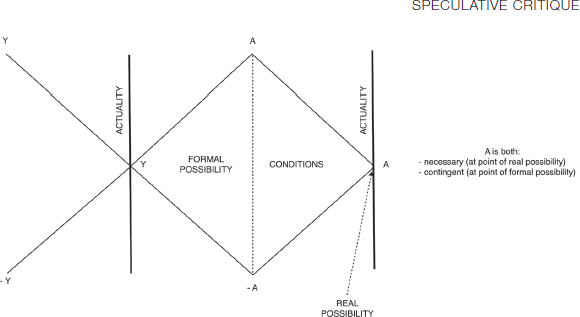
Figure 4. Formal Possibility, Real Possibility, and Actuality in the Science of Logic. Formal possibility passes to real possibility through the existence of adequate circumstances, and when all the conditions of a fact are completely present, the fact becomes actual. Considered in terms of formal possibility, A is contingent. Considered in terms of real possibility, A is necessary.
This dialectic is the basis of Hegel’s claim that contingency becomes in necessity; it is the in-itself of necessity, because it is “necessity’s own becoming.”39 How can we understand this dialectical structure? The coming into existence of a possible fact is determined as necessary when it becomes really possible, on the basis of the totality of its conditions. The actual existence of such a fact then becomes a condition for the possible existence of other facts. Actuality thus mediates the unity of necessity and contingency: a contingent fact that becomes necessary exists, is actual, and thus becomes part of the ground of possibility for the becoming of further contingent facts. Hegel can claim that “it is necessity itself, therefore, that determines itself as contingency.”40 The unity of necessity and contingency is a unity in movement, mediated by the becoming of actuality. “In its being,” Hegel writes, necessity “repels itself from itself, in this very repelling has only returned to itself, and in this turning back which is its being has repelled itself from itself.”41 Necessity repels itself into its other, contingency, and returns to itself; in this turning back it is other than itself, and this movement its being.
It is at this point that Hegel’s account becomes properly ontological. The self-repelling being of necessity, which Hegel calls “absolute necessity” is the “simple self-identity of being in its negation, or in essence.”42 “This identity of being with itself in its negation is now substance,” he writes, and “it is this unity as in its negation or as in contingency.”43 Let me unpack these claims. Essence, the truth of being, is the self-identity of being in its negation. This negation is the movement of being (being is becoming), the actuality of contingency which is the becoming of necessity—according to the dialectic analyzed above. Necessity is absolute insofar as it repels itself from itself and thus includes contingency, its negation. Essence, determined by Hegel as the self-identity of being in its negation, is the self-repelling movement of the unity of necessity and contingency: actuality. Actuality, in its becoming, is the truth of being: essence.
Let me now mobilize this framework toward an interpretation of what I view as Hegel’s fundamental ontological claim: that being is the identity of absolute necessity and absolute contingency. Being is actual, but being itself—as the un-conditioned—has no ground. Because it is without ground, unconditioned, being is absolutely contingent: it has no sufficient reason. But because it is unconditioned, without ground, being is absolutely necessary: there is no ground of possibility for it not to be. Thus being is the identity of absolute contingency and absolute necessity. One might point out that this is precisely the sort of reasoning that Kant performs in the cosmological antinomies in order to show that reason, when it exceeds possible experience, arrives at contradictions, and thus a null result. But Hegel’s speculative thinking hinges upon the claim that this identity of apparently opposing terms (contradiction) is dialectically and rationally productive: as the identity of absolute necessity and absolute contingency, being is becoming. The chapter on “Actuality” I have just analyzed offers a theory of how such a claim can be coherently thought. But to further elucidate the dialectical productivity of this ontological contradiction, we need to turn to a crucial passage from Hegel’s chapter on “Ground.”
In the final section of that chapter, titled “Procession of the fact into concrete existence,”44 Hegel follows the conditions of a fact’s existence into the groundlessness of being. Here is the relevant passage, the import of which for Hegel’s ontology can hardly be overstated:
The conditions are the whole content of the fact, because they are the unconditioned in the form of formless being. But because of this form, they also have yet another shape besides the conditions of this content as this is in the fact as such. They appear as a manifold without unity, mingled with extra-essential elements and other circumstances that do not belong to the circle of existence as constituting the conditions of this determinate fact. —For the absolute, unrestricted fact, the sphere of being itself is the condition.45
“The sphere of being” (die Sphäre des Seins) is the condition of those determinate facts that belong to what Hegel calls “the circle of existence” (dem Kreise des Daseins). Facts in the circle of existence refer, through their conditions, to their ground in the sphere of being, but the sphere of being itself is unconditioned: It is the absolute, unrestricted fact. Moreover, within the sphere of being, the conditions of any determinate, existent fact are a “manifold without unity” mingled with “extra-essential elements.” Insofar as “the conditions are the whole content of the fact,” the fact is necessary: within the circle of existence, the fact has to be as it is. But insofar as those conditions are “mingled with extra-essential elements and other circumstances” in the sphere of being, it is contingent that precisely this fact, rather than another, comes to exist. Again, thinking the relation between contingency and necessity requires us to think the mediated relation between being and existence, which Hegel calls actuality.
For example, the statement “Being, pure being” exists, and its existence has its condition in the being and existence of thought. As thinking being, it is actual. This is why this statement implies another, unspoken fact: thought is; thought exists. And the existence of thinking being, its actuality, has thought through its ground in the sphere of being itself. Thought has now demonstrated its existence, and it has done so not only by saying indeterminate Being, but by thinking through the determinations of being. Thus we can turn over and modify our earlier figure:

In Hegel’s chapter on “Ground,” thinking finds its way from the contingent fact that it exists to the absolute, unrestricted fact that being is: thinking investigates its ground in the groundlessness of being.
Of course, in the Logic we are dealing with statements about being: the discourse of ontology. What is the modality of these statements? Are they contingent, or are they necessary? This is an epistemological question, bearing upon the relation between logic and ontology. In the chapter on “Ground,” thinking finds that it is groundless because, in its being, it is both absolutely necessary and absolutely contingent. In the chapter on “Actuality,” the becoming of thinking finds its structure. In its becoming, thinking moves between the contingency and necessity of its moments: this is the movement of the dialectic, which we experience over the course of the Logic. What is said about the necessity and contingency of being is, therefore, also said according to the relation between the necessity and contingency of logical discourse, of thinking. It is thinking being that interrogates, at the same time, what can be said of thinking and what can be said of being, and thus elaborates a logical ontology and an ontological logic.
I want to emphasize that Hegel’s analysis of contingency and necessity, which is also an analysis of the structural movement of thinking, is both epistemo-logical and ontological. And I want to propose that we understand his genetic epistemology, through the modal relation between necessity and contingency, in terms of the methodological relation of rationalism and empiricism. Insofar as ontology is a rational discourse it is constrained, conditioned, by what has to be said of being. It cannot say just anything. And insofar as it is not a dogmatic discourse, but rather immanently critical, ontology has to unfold across the reflexive experience of what happens in thought. I propose that Hegel’s analysis in the chapter on “Actuality” allows us to understand how the movement between what happens and what has to be can be coherently grasped as both contingent and necessary, and thus requires an approach which is both empiricist and rationalist at the same time. It requires the immanent determination of what has to be said as it happens, as it becomes actual. Because this determination is ungrounded (immanent), it cannot be transcendental. Because it is not transcendental, it has to displace the precritical opposition between rationalism and empiricism by other means: by holding them together, conjoined in the productivity of dialectical contradiction (a moving contradiction), without falling entirely into either one—and therefore without falling entirely into either logical necessity or logical contingency, but rather thinking within their actual complicity.
This complicity is without epistemological guarantee, but it is not without epistemological coherence. It articulates what has to be said of being as it is determined by the rationally conditioned becoming of what happens in thought. Such a statement about Hegel’s Logic is not particularly unfamiliar, but I hope to have given it a framework in which it makes particular sense—a framework that uncovers rationalist empiricism as the dialectical movement of Hegel’s speculative critique.