
PART III
5
If philosophy speculates ontologically—if it reasons about the in-itself, beyond the purview of empirical science—it also thinks the operations of science that determine, with exquisite rigor, relations among physical properties subtracted from their phenomenal immediacy. Science is indeed ontic—it pertains to the determinacy of beings—but this does not mean that it is “merely” ontic, as if the speculative rationality of ontology were somehow a higher calling than the determination of ontic predicates. The being of beings is not a being, but it is the being of beings. Science thus makes manifest what Hegel calls “the concrete truth of being”1 by delivering, through both theory and practice, the determinations of how being is deployed in concrete worlds, of the regularities that happen to characterize them. That is what ontology can never deliver, just as science cannot inform us of all that may be the case, or even what must be the case. Science is the discourse of what is the case. To understand that distinction, we require not only critique but a speculative critique capable of navigating the ontological difference. To do so while preserving a sense of astonishment at the precision and complexity of science’s ontic operations, and also at the ontological questioning of philosophy, is the double task of rationalist empiricism.
Having pursued the ontological horizons of speculative critique in philosophy, let us cultivate an informed appreciation for the ontic operations of science, at the rational rigor of its empirical determinations, by considering a problem that situates us at the reflexive limit of scientific measurement: the measurement of metrical units themselves. We can approach this limit through a case study: the recent revision of the International System of Units, brought to completion in 2018 by the redefinition of the kilogram unit. We will study the project of that redefinition in some detail, but my interest is not only in the scientific particulars of this liminal case of measurement; I also want to think through its conceptual consequences. We can do so by considering the redefinition of the kilogram in light of Hegel’s theory of measure as “the concrete truth of being,” a theory which accords the ontic its proper respect through a philosophically sophisticated understanding of determination. Hegel’s theory requires us to think the relation between measurement and measure, understanding measure as the unity of quality and quantity that makes any determinate being what it is. Measure is what is measured. It is the concrete determinacy of determinate being that is accorded a quantitative value by measurement.
Thus, measurement draws from the ontic determinacy of beings the relation between quantity and quality that makes them what they are, rather than how they appear in any given phenomenal context. In the case study we will pursue, the qualitative aspects of physical properties that are measured are empirical, but they are not phenomenal. Measurement abstracts the concreteness of the object (its measure) from its phenomenal presentation. And it does so precisely through the “transmutation of epistemological values”2 theorized by Bachelard: by imposing a rational framework (mathematically and theoretically determined) upon an empirical inquiry (a technologically mediated experimental process) and then revising, on that basis, the very system of rational-empirical coordination (scientific theory) that enabled such inquiry in the first place. Let us follow the movement of this process, folding Hegel’s speculative theory of measure into the history of metrology and its contemporary practice.
THE CONCRETE UNIVERSAL
In 1799, two unusual objects were deposited in a vault at the International Bureau of Weights and Measures (BIPM) in Sèvres, France: a platinum bar and a platinum cylinder that would serve as standard international reference units for the meter and for the kilogram. (See Figure 5.) How were the quantities and the qualities of these objects determined? In 1791, the meter was defined by the French Academy of Sciences as one ten-millionth of the length of the earth’s meridian, passing through Paris between the North Pole and the Equator. The measurement of the meridian itself was carried out through a six-year surveying project, from 1792 to 1798, determining the length of a portion of the meridian running from Dunkirk to Barcelona through a complex system of triangulation between observation points.3 The kilogram was defined as the mass of a cubic decimeter of water at 4 degrees Celsius (the temperature of water’s maximum density). Once these measurements were taken and the reference objects fabricated and archived, the properties of the objects themselves then served to define the meter and the kilogram as units. By definition, a meter was equal to the length of the prototype in Sèvres; a kilogram was equal to the mass of the kilogramme des archives. These objects would serve as reference standards until 1889, when they were replaced with platinum-iridium alloy reference standards following the international adoption of the metric system. The initial determination of these units and the creation of their first reference standards in the late eighteenth century was aligned with the rationalist, universalist political philosophy of the French Revolution. As the Marquis de Condorcet put it, the metric system was developed as a rational coordination of measurement standards “for all people, for all time.”4
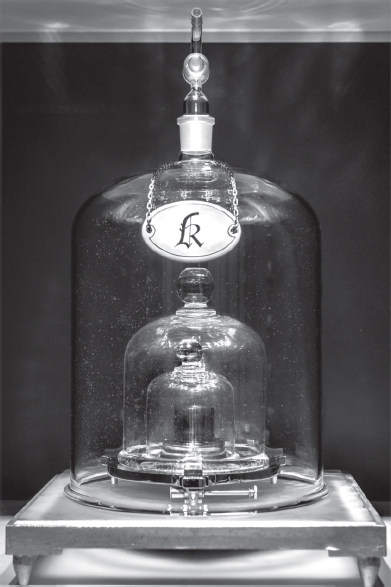
Figure 5. Le Grand K, The International Prototype Kilogram, Bureau Internationale des Poids et Mesures. The platinum-iridium International Prototype Kilogram replaced the original kilogrammes des archives as the reference mass in 1889, following the international Convention du Mètre in 1875.
Hegel’s theory of measure, articulated in Book One of the Science of Logic and first published in 1812, was written in the wake of this breakthrough in the history of measurement. It is perhaps due to this context that Hegel develops such a sophisticated approach to the problem of measure, sensitive not only to the assignment of quantities or the consensual development of standards but also to the way in which the possibility of quantitative measurement relies upon the qualitative properties of particular material bodies, as well as the manner in which a series of measure-relations depends upon the inscription of quantitative relations in relative independence of physical units. It is this emphasis on the relation of quality and quantity in particular physical units that I want to approach as crucial to thinking about the distinction between measure and measurement.
“Whatever is, has a measure,” Hegel tells us. “Every existence has a magnitude, and this magnitude belongs to the very nature of a thing; it constitutes its determinate nature and its in-itself.”5 Hegel points out that a thing “is not indifferent to its magnitude, as if, were the latter to alter, it would remain the same; rather the alteration of the magnitude alters its quality.”6 Indeed, quantity, Hegel claims, is “quality itself in such a way that outside this determination, quality as such would yet not be anything at all.”7 To grasp this claim, consider Kant’s analysis of sensation in terms of what he calls intensive magnitudes. Every sensation, Kant argues, has a degree—however slight it may be, a sensation has an intensive magnitude that can always be diminished but can never be wholly negated while remaining a sensation. “Every color, e.g. red, has a degree, which, however small it may be, is never the smallest, and it is the same with warmth, with the moment of gravity, etc.”8 Every quality has a quantity, and without some quantity it would not be a quality at all. The quality red exists insofar as it has some intensity, a degree of intensity (or intensive magnitude) that can always be diminished but cannot be diminished entirely without extinguishing that quality, red, altogether. The quality red does not exist without some quantity of intensity. In Hegelian terms we could say (thinking in terms of this relation between quality and quantity): every red has a measure.
It is interesting to note that, if we turn to the International Vocabulary of Metrology, a ‘quantity’ is defined as a “property of a phenomenon, body, or substance, where the property has a magnitude that can be expressed as a number and a reference.”9 It is the phrase “can be” that I want to mark. Quantity is not itself numerical, nor is it necessarily expressed as a number; it is a property that has a magnitude that can be expressed as a number and a reference (for example, one kilogram), where a “reference” can be a measurement unit, a measurement procedure, a reference material, or a combination of these. We could say that quantity is thus prior to measurement—it is potentially measurable—but it is not prior to measure. It is part of what constitutes something’s “determinate nature” (Hegel). The International Vocabulary tells us that “measurement” is “the process of experimentally obtaining one or more quantity values that can reasonably be attributed to a quantity.”10 So if measurement involves the reasonable expression of a quantity in terms of number and reference, measure, on the other hand, is the immanent determination of a thing by its magnitude, the immanent constitution of its determinate nature as it is in itself.
Hegel’s chapter on “Measure” implicitly draws our attention to this crucial distinction between measure and measurement by thinking through the relation between quantity and quality that is constitutive of measure. Whereas our official definition of measurement (the International Vocabulary) makes no reference to quality at all, but only to obtaining quantity values that can be attributed to a quantity, Hegel famously defines measure as the unity of quantity and quality. “Quality and quantity are in measure united,”11 he writes. Thus, we might consider the unity of quantity and quality as crucial to the immanent determination of a thing involved in measure (as opposed to the epistemic determination of a quantity involved in measurement). If measurement bears upon what we can know about something in terms of quantity values, measure refers to the unity of quality and quantity that makes something what it is. The determinate being of a thing is its measure, and this is what leads Hegel to claim that measure “is the concrete truth of being.”12 Let me unpack this claim.
Measure is the concrete truth of being because being, initially thought as without measure, can only be thought as absolutely indeterminate. Yet, at the opening of the Logic, Hegel shows that being cannot, in fact, be thought as absolutely indeterminate. He shows that when we attempt to think being as such, without determination, what we are thinking is nothing, and the negation of being by nothingness leads us to think becoming as the movement of this negation. The effort to think being as absolutely indeterminate ends up determining being as becoming. Determinate being is qualitative, and, as both Kant and Hegel show, qualitative being is itself unthinkable without some relation to quantity (magnitude or degree). Quality and quantity thus come to be thought as unified in measure, and measure is the concrete truth of being because measure is the category at which thought arrives as it moves from the impossibility of thinking being as absolutely indeterminate to the possibility of thinking being as a process of determination. Like many of the statements in the Logic, a claim like “measure is the concrete truth of being” seems at first to be wildly speculative—and it is speculative, since it involves the complex identity of quantity and quality—but it proves to have a well-determined sense when considered according to the internal argument of the text, its order of reasons.
While I want to set out from these central aspects of Hegel’s theory of measure, it is not my goal to systematically reconstruct or interrogate the intricate structure of Hegel’s arguments in this section of the Logic. Rather, beginning with a distinction between measure and measurement, and noting the unity of quantity and quality foregrounded by the concept of measure, I want to ask: Under what conditions does the scientific practice of measurement come into contact with the philosophical concept of measure? Or, if it always does, when and how does this problem come to the fore, become inescapable, in the history of measurement?
Note what happens when an object—as in the case of the prototype meter or kilogram—is fabricated and defined as the reference standard for a unit of measure: the qualities of the object—what it is made of, how it is shaped—are determined according to our best efforts at instantiating and preserving certain quantitative properties (the length of a portion of the meridian, the mass of a certain volume of water). Moreover, the quantitative properties of the object are correlated to and determined by a qualitative process—experimental procedures that have to be carried out in a certain way, and that are intended to be reproducible as such. It is the quality of reproducibility that purportedly grounds the unit of measure in a procedure that could, in theory, refute or verify its value as a standard. A reference standard, when it takes the form of a physical artifact like the meter bar or International Prototype Kilogram (IPK), offers a clear example of measure understood as the unity of quality and quantity. The measure of the standard makes measurement possible. Measurement, defined as “the process of experimentally obtaining one or more quantity values that can reasonably be attributed to a quantity,” both produces and depends upon the unity of quantity and quality instantiated in the reference artifact defined as a standard.
What happens, then, when measurement standards of change? And how does this scientific process bear upon the philosophical problem of measure?
THE NEW SI
In 1960, the meter bar was retired as the operative reference artifact for measurements of length. That year, the Meter Convention of the nineteenth century was replaced by the International System of Units (SI), and the meter was redefined: correlated to a certain number of wavelengths of the orange-red emission line in the electromagnetic spectrum of a krypton-86 atom. In 1983, a more elegant redefinition correlated the meter with the speed of light. A meter was defined as “the length of the path travelled by light in vacuum during a time interval of 1/299,792,458 of a second.”13 Consider the consequences of this definition. When it was formulated, the speed of light (c), had been determined as 299,792,458 meters per second with a measurement uncertainty of 4 parts per billion (4 × 10⁻⁹). The redefinition of the meter in 1983 sets this number as that fraction of a second during which light in a vacuum travels exactly one meter. This means that the measurement uncertainty previously attending the determination of the speed of light has been eliminated, in the direct determination of the number, and transferred over to the definition of the meter itself. By redefining the meter in terms of the speed of light we have also indirectly fixed the latter as exactly 299,792,458 meters/second, which is now the exact numerical value of the universal constant c, without any specification of measurement uncertainty. The number assigned to the constant c now grounds the definition of the meter, such that we can no longer turn the meter back upon the indeterminacy of the constant.
This is an example of how the history of measurement standards performs operations of circular self-grounding—at once displacing and regrounding the framework of our knowledge claims. We could say that our measurement of the speed of light (our quantitative determination of the numerical value of the constant) has come unmoored from its measure: We no longer refer to the possible gap between our knowledge of the speed of light in a vacuum and what that speed actually is. Uncertainty, which is due to qualitative variables affecting measurement procedures, is the qualitative remainder of the assignment of quantitative value. Since this qualitative remainder cannot be eliminated, the redefinition of the meter shifts it from one quantity to another: while uncertainties attending the initial determination of the meter previously factored in our measurement of c, fixing the numerical value of the latter shifted that uncertainty onto our new definition of the meter. c is now absolute, but the previous uncertainty of its quantitative determination has been integrated into the uncertainty budget of the revised metrical unit by which it was previously measured.
The redefinition of the meter on the basis of c exemplifies an approach to defining base units that is at the heart of a broader overhaul of the International System of Units. The “New SI,” taking effect in 2019, correlates the definition of each base unit to a fundamental physical constant, improving the efficiency with which standards can be disseminated and measurements can be traced while eliminating reference to physical artifacts14 (see Figure 6). With the second already correlated to the periodicity of the cesium atom15 and the meter defined in terms of c, the International System of Units now:
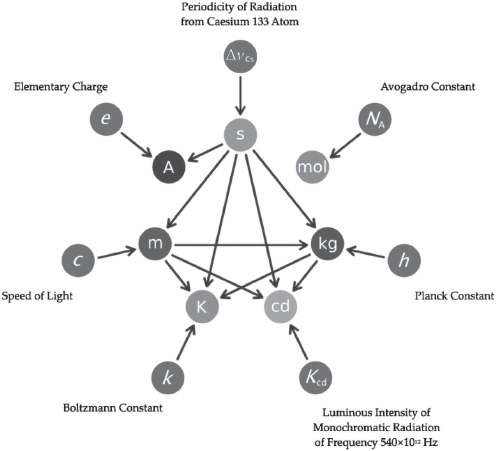
Figure 6. The New International System of Units. In the revised International System of Units, codetermining metrical units are correlated to fundamental physical constants. Clockwise from top, the units are the second, mole, kilogram, candela, kelvin, meter, and ampere. Arrows indicate involvement of one unit definition in others (e.g., the second is included as a unit in definitions of the kilogram, candela, kelvin, meter, and ampere).
i. defines the second in terms of the hyperfine transition frequency of the Cesium 133 atom
ii. defines the ampere in terms of the elementary charge (e)
iii. defines the mole in terms of the Avogadro constant (NA)
iv. defines the meter in terms of the speed of light (c)
v. defines the kilogram in terms of the Planck constant (h)
vi. defines the kelvin in terms of the Boltzmann constant (k)
vii. defines the candela in terms of the luminous intensity of monochrome radiation of Frequency 540 × 1012 Hz
The kilogram was the last unit of measure still tied to a physical artifact, and its redefinition was at the center of efforts to complete this revision of the SI. Since the Planck constant is the minimal unit of action which relates energy to frequency in quantum mechanics, and since energy is related to mass by a number of fundamental equations (including E = mc2), 16 the redefinition project deployed the former kilogram as a reference for measuring the Planck constant in correlation with the unit of mass, then reversed this correlation in order to define the kilogram on the basis of a fixed value for the Planck number.
The first step of this redefinition project was to measure the numerical value of the Planck with sufficient accuracy to fix it as an exact value (as the speed of light had been fixed by the meter redefinition). In this context, “sufficient accuracy” means something pragmatic: the degree of uncertainty deemed acceptable by the International Committee for Weights and Measures, which required at least three measurements of the Planck with relative uncertainties below 50 parts per billion (5.0 × 10⁻⁹), and at least one with a relative uncertainty at or below 20 parts per billion (2.0 × 10-9) by 2018.17 In 2010, the official value for the Planck published by the US National Institute of Standards and Technology (NIST) was 6.626 069 57 × 10-34 with a relative uncertainty of 44 parts per billion.18 By 2014, the results of two different experiments19 had made it possible to reduce the relative uncertainty of the Planck value to 12 parts per billion, with an official value of 6.626 070 040 × 10–34 Js.20 By July 2017, there were four measurements from different national metrology labs below 20 parts per billion, setting a course for the redefinition of the kilogram to go forward in 2018, with the Planck value now permanently set at 6.626 070 15 × 10–34 Js.
The primary experimental procedure for measuring the Planck in correlation with the kilogram relies upon an apparatus previously called the Watt balance, renamed the Kibble balance in 2018 in honor of its inventor (see Figures 7 and 8).21 The principle of Kibble balance experiments is to correlate mechanical and electrical quantities by measuring the amount of electromagnetic force required to balance a test mass against the pull of the earth’s gravity. A kilogram prototype (a national copy of the IPK) is placed on a balance pan that is connected to a coil of copper wire, which surrounds a superconducting electromagnet. When electric current is sent through the coil, electromagnetic forces are produced to balance the weight of the test mass. The apparatus measures both current and force. The apparatus also can move the coil vertically, inducing a voltage which can be measured along with the velocity of the coil’s movement. These four measurements determine the relationship between mechanical and electrical power, which can then be used to relate energy to mass.
A measurement of the Planck constant—relating it to a macroscopic mass (1 kg)—can be derived from this experiment through the correlation between mass and energy in several fundamental equations.22 Crucially, Kibble balance measurements can also be reversed. First, one uses a prototype kilogram as a test mass and measures the electromagnetic force necessary to offset it, indirectly deriving a measurement of the Planck number from this measurement; then, in order to “realize” the kilogram unit from a definition based on the Planck constant, one sets a quantity of electromagnetic force and measures the quantity of mass required to offset it. As the NIST metrology team involved in the redefinition project explains: “If we know h precisely, we can build an electromagnet and measure exactly the amount of electric current it needs to lift a kilogram off the ground, and define the kilogram in terms of the current.”23
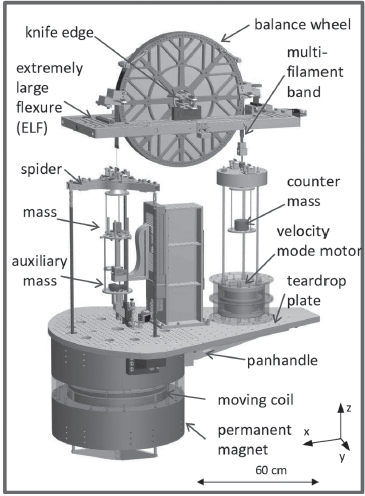
Figure 7. Schema of the NIST-4 Kibble balance, National Institute of Standards and Technology. Kibble balance experiments correlate mechanical and electrical quantities by measuring the amount of electromagnetic force required to balance a test mass against the pull of the earth’s gravity.
A second, quite different, experimental procedure involves calculating the exact number of atoms in a meticulously crafted silicon sphere. The physical constant defining the number of atoms in a particular amount of substance is Avogadro’s number, which can be related to both the Planck constant and to the kilogram through a number of equations.24 The International Avogadro Coordination (IAC) project thus aimed to arrive at a measurement of Avogadro’s number with the requisite uncertainty of 20 parts per billion, converting this into a value for the Planck constant which could then be correlated to the kilogram. The determination of a more accurate value for Avogadro’s number requires the crafting of an object even more remarkable than the original prototypes of the meter and the kilogram: a sphere of exceptionally uniform and pure silicon crystal—the “roundest” object in the world as of 2019 (see Figure 9). Its surface is so consistent that if it were blown up to the size of the earth, the distance between the highest and lowest point on its surface would be only 3 to 5 meters.25 Fabricated by a master lens maker, the sphere cost about $3.2 million to manufacture. The materials are highly enriched, consisting of 99.9995 percent silicon-28 (refining away other isotopes found in natural silicon), with a highly regular crystalline structure defining a regular pattern of spacing between atoms. The dimensions of the sphere can be measured to nanometer precision and x-ray crystallography can be used to determine its crystalline structure. This geometrical information, along with the well-known mass of each silicon atom, enables a calculation of the quantity of silicon atoms composing the 1 kg sphere, which in turn enables Avogadro’s number to be determined with unprecedented accuracy. This measurement can then be converted into a value for the Planck constant through the equation for the molar Planck constant, N h. By 2015, the International Avogadro Project had arrived at a numerical value for NA (convertible to a value for h) with an uncertainty of 20 parts per billion, while the German Physikalisch-Technische Bundesanstalt (PTB) achieved an uncertainty of 12.0 parts per billion in 2017, both meeting the level of uncertainty recommended for redefinition.26
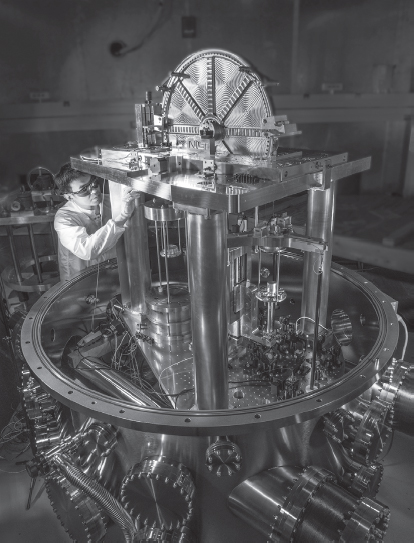
Figure 8. NIST-4 Kibble Balance, National Institute of Standards and Technology. NIST-4 commenced operation in 2015, replacing the older NIST-3.
By August 2017 four different measurement campaigns using these two methods had yielded values of the Planck constant with a relative uncertainty of under 20 parts per billion or less:
6.626 070 404 × 10–34, relative uncertainty 12.0 × 10⁻⁹ (PTB 2017, silicon sphere)
6.626 070 147 × 10–34, relative uncertainty 19.6 × 10⁻⁹ (IAC 2015, silicon sphere)
6.626 070 133 × 10–34, relative uncertainty 9.1 × 10⁻⁹ (NRC 2017, Kibble balance)
6.626 069 934 × 10–34, relative uncertainty 13 × 10–9 (NIST 2017, Kibble balance)
The achievement of the last result, deriving from a 2015 to 2017 measurement campaign at the US NIST using a newly constructed Kibble balance, offers an instructive case study in how shifting qualitative aspects of the experimental process are related to quantitative results in the numerical determination of physical constants. Prior to their construction of a new balance, completed in 2015, the NIST had been working with an apparatus called NIST-3, whose construction dates back to the 1970s. Visiting the NIST in 2013, toward the end of their last measurement campaign with the older balance, I was taken to a region of its 578-acre campus called “Siberia,” where NIST-3 was kept in relative isolation from possible interference by environmental stimuli. Housed in a bunkerlike building with a number of smaller, cluttered rooms containing instruments to measure local gravity, vibration, magnetism, and other variables, the balance itself was a huge and complex apparatus, occupying two stories separated by a false floor. Though simplified diagrams published in scientific papers on the experiment make the balance look relatively pristine, it is in fact a somewhat cobbled together device with thousands of discrete components, networks of crisscrossing wires and jerry-rigged solutions to local problems that have occurred over its years of operation and modification (see Figure 10). NIST-3’s last round of measurements ended in disappointment, achieving a relative uncertainty of 45 parts per billion (rather than a figure under 20) and a value for the Planck significantly at variance from previous measurements with the same apparatus.27 Despite “more than fifteen years of experience with this apparatus,” the scientists had to “acknowledge that we do not understand the cause of the approximately 70 × 10-9 relative shift.”28
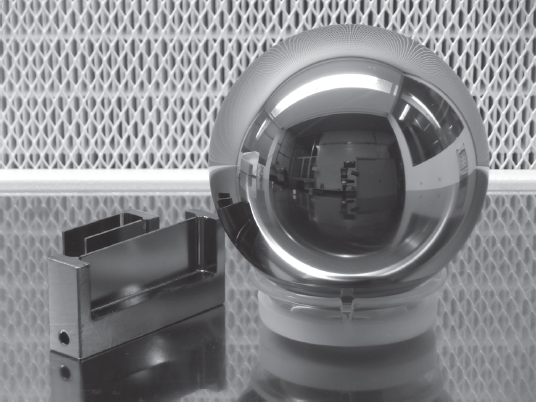
Figure9. Silicon sphere, International Avogadro Coordination project (IAC). The sphere is the roundest known object; its well-defined dimensions and regular crystal structure enable a highly accurate determination of the quantity of atoms composing the sphere.
In 2015 the balance was replaced with the newer NIST-4, similar to the apparatus in use at Canada’s National Research Council, which had previously been purchased from the UK. Two years later, and just one day prior to the deadline set by the BIPM for results relevant to the kilogram redefinition, the NIST team was able to publish their new value for the Planck at an uncertainty of 13 parts per billion—a result derived from statistical analysis of 1174 sets of measurements with NIST-4.29 Their result was very closely aligned with the number obtained by both the NRC Kibble balance and the International Avogadro Coordination project, but it was gleaned statistically from a total data set that took two years to accumulate. The authors of the paper acknowledge by way of conclusion:
After the revision of the International System of Units, NIST-4 will be used to realize the mass unit. In this case, a mass value has to be measured much more quickly. A conservative estimate gives a statistical uncertainty of 21.8 × 10⁻⁹ for a 24 hour-long measurement. This yields a total relative standard uncertainty of 25 × 10-9. Integrating four days of data will reduce the total relative uncertainty to below 20 × 10-9.30
We see here the pressure of circumstance upon the submission of scientific results. At the eleventh hour, the NIST had arrived at a value for the Planck that is beneath the degree of uncertainty stipulated by the BIPM, but considered in terms of a twenty-four hour measurement cycle that might be practically applicable to realizing the kilogram following redefinition, the relative standard uncertainty for its experiment would be over 20 parts per billion.
Thus, after the redefinition was affirmed by a vote of SI member countries on November 16, 2018, and came into effect on May 20, 2019, the mise en practique for a redefined kilogram remained a work in progress. The National Metrology Institute of Germany has developed a new electromechanical balance called the Planck balance, which may become the standard apparatus for realizing the kilogram.31 That there are currently two methods of numerically determining the Planck constant (Kibble balance and silicon sphere) means that qualitatively heterogeneous methods may arrive at nearly identical quantitative measurements. But within any one methodological approach, the replacement of NIST-3 with NIST-4 and the international standardization of balances that is underway indicates that qualitative and quantitative consistency are also closely aligned. The redefinition of the kilogram via the Planck constant is a key example of how measurement approaches measure without ever quite arriving at exact quantitative results: there is always some uncertainty in the determination of the number for the Planck, and that is because the qualitative particularity of experimental procedures remains ineradicable. Measurements of the Planck assigning it quantitative values would always be a little bit different; but now the Planck is fixed at an exact value, statistically determined by the relation between past measurements, and quantitative uncertainties bred by the qualitative particularities of those measurements have shifted into the new definition of the kilogram itself. However, the definitional relation between the Planck and the kilogram unit will include a measurement of those uncertainties, a specification of the range within which we can numerically determine physical properties in this case.
HISTORY AND METHOD
The point at which we touch upon the foundations of measurement—upon the measure of metrical units—involves a historical dialectic through which the very systems of measurement that make scientific knowledge possible are revised in accordance with the results of that knowledge. The metric system at once emerges from and re-grounds the work of early modern science. With the metric system at its disposal, the language of mathematical physics becomes empirically expressible with greater clarity and consistency across the international operations of scientific practice. With the redefinition of the SI, the revolutionary results of early twentieth-century physics—the equations of relativity theory and quantum mechanics—enter into the system of units itself, revising that system in accordance with the knowledge it has helped to make possible. That is, the relationship between a certain history of measurement and its results (fundamental physical equations) is inverted: those results now come to ground the system of measurement that was integral to their achievement. This historical dialectic relies for its dynamism upon a methodological dialectic, integral to the movement of science, between formalization and experiment. The equations of relativity theory and quantum mechanics deploy quantities expressing physical constants of nature. And these equations, the theoretical fruits of modern experimental science, make possible further experimental determinations of these quantities themselves. Because equations including h made Watt balance experiments possible, we now have a more accurate determination of h than we did before.
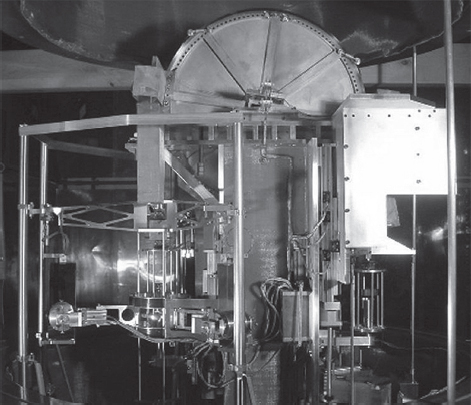
Figure 10. Upper Level of NIST-3 Kibble Balance, National Institute of Standards and Technology. NIST-3 dates back to the 1970s, undergoing several rounds of modification through its decades of use. Including its upper and lower levels, the apparatus occupies two floors of a laboratory. It was replaced by NIST-4 in 2015 (see Figure 8).
The redefinition of the kilogram shows with exemplary clarity how this methodological-historical dialectic also entails the displacement of intuitive self-evidence through the reciprocal critique of experiment and formalization, the manner in which each successively refines the other. To ask “how much does this weigh” is to ask for a measurement, for a quantitative determination of a quality that will be given in metrical units: for example, “10 kilograms.” But to ask what a kilogram “is” involves a question about measure: about the determinacy of the unit itself. The International Prototype Kilogram is a charmingly concrete answer to this question. As an object, it instantiates a unity of quality and quantity at which one could point, thus grounding measurement through its measure. The IPK itself was the unity of quality and quantity defining the determinacy of the metrical unit. The qualitative properties of the object were selected according to their capacity to retain its quantitative properties, as were the qualitative conditions of its preservation. As the physical instantiation of a metrical unit, the IPK exemplified something like a limit case of “measure” as the persistence of the “determinate nature” of something over time; the International Prototype Kilogram had to be protected against qualitative change in order to preserve its quantitative properties. This consistency of the unity of quality and quantity, of measure, is what enables the object to serve as a point of reference for measurement: the qualitative stability of the prototype unit ensures the quantitative stability of measurements referring to its standard. However, it is the degree of the prototype object’s quantitative stability that becomes uncertain, given that it is the very standard of measurement through which its mass could be compared. It is precisely the singularity of the object, its status as a unique measure, that make it both authoritative and inopportune as a global standard of measurement.
Now that the kilogram has been redefined, it is the quantitative stability of the Planck constant that has displaced the unique role of the prototype object as a reference. The universality of the constant displaces the singularity of the object. “The kilogram” is now nowhere in particular, and the unity of quantity and quality it embodied is dispersed into, and traceable to, a set of procedures mediating between formalization (the Planck, the equations in which it is involved) and experiment (Kibble balance apparatuses for realizing the unit). The “measure” of the kilogram previously inhering in the object has been split between a quantitative value and a qualitative procedure while relying for their recombination upon the mediating framework of a new system of units (including definitions of the meter and the second that were already correlated with the speed of light in a vacuum and the periodicity of radiation cycles from the cesium 133 atom). This displacement of immediacy is an apt synecdoche for the power of abstraction and systematicity characteristic of the dialectical relation between formalization and experiment that propels the history of science, which must be adequate not only to the determinacy of measure but also to the complexity of measurement.