
The true philosophic question is, How can concrete fact exhibit entities abstract from itself and yet participated in by its own nature?
—Alfred North Whitehead, Process and Reality
6
Nicolas Baier is a photographer—by which I mean that he digitally scans the surfaces of antique mirrors, produces lush black ink jet prints of their distressed opacities, and displays them in vast irregular grids, thus replacing the reflection of the viewer with the tenebrous topography of a material surface (see Figure 11). Through a microscope, Baier meticulously photographs a postage stamp-sized slice of meteorite more than four thousand times and then assembles these thousands of photographs into a glossy six-by-eight foot enlargement of impeccably precise resolution and immersive depth (see Figure 12). When a computer crash saturates his monitor with a color field of densely pixilated red lines, receding toward an apparently distant horizon over a crimson sea beneath an incarnadine sky, he renders this image as a chromogenic transparency and displays it in a light box under the title Failed. When he travels to the south of France to view prehistoric cave paintings, Baier photographs the bare stone wall beside these inaugural images, recording the non-representational traces, contours, and fractures of the rock (Figure 13).
At Parc des Buttes-Chaumont in Paris, Baier photographs a stream of light pouring through to the interior of a man-made cave. The resulting composition, Photons (The World of Ideas), is a digital allegory of the cave in twenty-five carefully arranged ink jet prints. If we look at the composition closely, we can see from the angle of the light that Baier has inverted the image, so that light seems to fall up at a diagonal to stalagmites rather than down through hanging stalactites (see Figure 14). This image of an inverted Platonism suggests a materialism of the Idea wherein it is the lens, rather than the eye, that turns away from Simulacra toward the Eidos, if only to render a simulacral image of that turning as a portrait of the photographic medium. From this perspective, digital photography might be taken as the state of an art of exteriorization, of mimesis, that took its course on the walls of caves millennia ago and which now returns to render the materialist truth of those simulacral exteriorizations: that the world of ideas is particulate, that light is itself a medium.
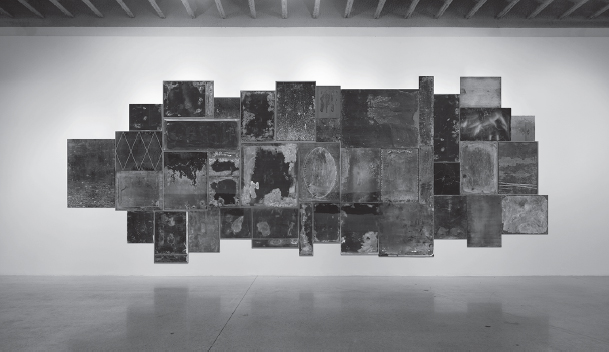
Figure 11. Nicolas Baier, Vanitas 01 (2007–2008), inkjet prints, installation view, 345 × 900 cm. Composed of digital scans of forty antique mirrors, Vanitas 01 replaces a reflection of the viewer with the distressed topography of a material surface.
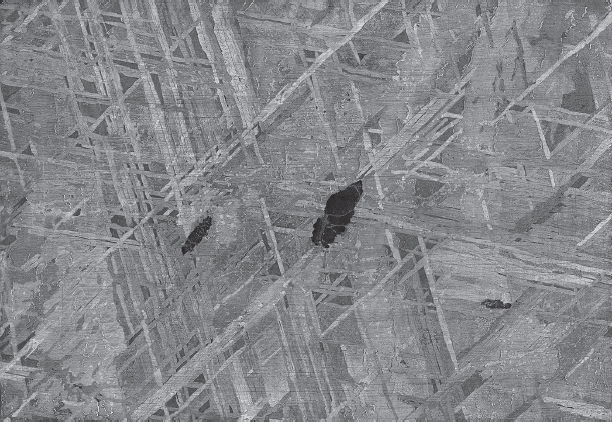
Figure 12. Nicolas Baier, Meteorite 01 (2008), chromogenic print, 183 × 254 cm. Meteorite 01 is a composite of more than four thousand photographs, taken through a microscope, of a postage stamp-sized slice of meteorite.
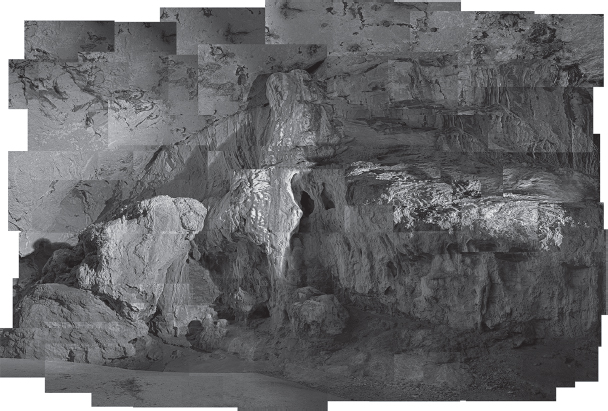
Figure 13. Nicolas Baier, Canvas (2010), inkjet print, 295 × 445 cm. Rather than record images of cave paintings in southern France, Baier photographs the stone wall beside these inaugural representations, presenting the bare “canvas” of the stone.
Across the gallery from Photons, poised on the facing wall behind a pane of plexiglass, hovers a glass replica of Baier’s left eyeball (see Figure 15). It is an eye that does not see, but that presides over the scene as we look at its blind unlooking. Like Lacan’s sardine can glinting in the sea, it localizes the gaze. As we turn our back upon it, toward Photons, we can feel ourselves prehended by the Gaze itself, occupying a specific position within the field of vision of which the photographic apparatus functions as prosthesis. In Baier’s installation, The World of Ideas is both a visual image upon which we look and a relation, which has to be thought, to an eye that does not see, to in-visibility. The field of the Gaze is this mediated relation of the sensible and the intelligible, a field in which we come to feel the factical presence of our body situated not only between looking and being somehow blindly looked at, but also between eye and mind, photons and Ideas. Two mediations then: the corporeal presence of a body and the technical reproduction of an image and an eyeball. In Photons (The World of Ideas) the light of the intelligible is cast as material photons into the cave, and it is the sensible experience of our embodied relation to this image that solicits thinking.
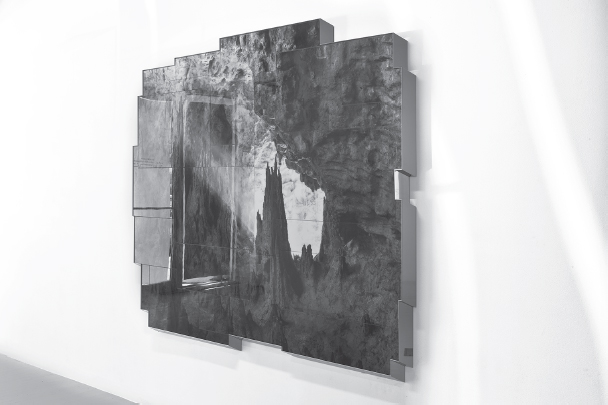
Figure 14. Nicolas Baier, Photons (The World of Ideas) (2010), inkjet print, 152 × 183 cm. Light pours into an artificial cave in the Parc des Buttes-Chaumant, Paris. The image is inverted, disturbing the viewer’s sense of spatial orientation and suggesting the materialist reversal performed by the title.
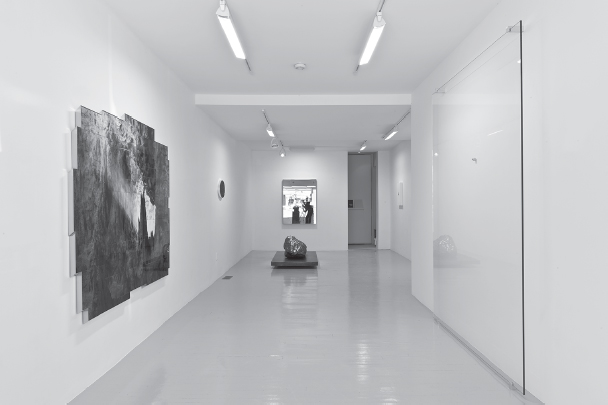
Figure 15. Nicolas Baier, Photons (left) and Without Title (right) (2010), installation view. Looking toward a cracked mirror at the end of the room, the viewer’s body is situated between an image of light and thought, on the left, and a reproduction of the artist’s eyeball, on the right.
If Photons emphasizes the illumination of an obdurate stone surface, in Vanitas, Baier’s monumental assemblage of scanned mirrors, this relation of light to surface to sight to the technics of photography is reversed. Here the reflective surface of the mirror is not transmitted as an image; rather, its surface is rendered opaque by a process of digital recording that devours whatever light the mirror reflects back to the sensor of the scanner. “The scanner captures only the marks or the missing parts,” notes Baier. “In closed circuit, the reflective plane does not receive information (the mirror facing itself). Once digitized, the avatar is revealed: a somber deep black span.”1 Reflection is subtracted from the surface by an absorptive recording of the light that it reflects, such that “in these images the surface does not reflect the viewers’ likenesses back to them.”2 The viewer’s likeness—my own image, which I would have seen—is subtracted along with the reflective surface: erased. In its place we are confronted with a “somber deep black span” of “marks or missing parts.” It is as if the tain of the mirror, its obverse, had bled through to its hither side. As if these marks and missing parts, seen in lieu of ourselves, were the uncanny residue of this reversal. As if it had become the vocation of photography to transmit the reversal of the obverse of the image (see Figure 16).
As if—but this is not what happens. What we see is not a reversal (itself a function of a mirror), but rather the remorseless exposure of a surface shorn of reflection: facticity rather than phantasm. It is the function of the mirror phase, in Lacan’s account, to give way onto an “inexhaustible squaring of the ego’s audits,” torn as the I is, at the moment of its emergence as imago, by its splitting between identity and alienation, insufficiency and anticipation. And it is the mediation of the image—as exteriorization—that casts the specular “lure of spatial identification” which thus captivates the subject and “turns out fantasies.”3
The effect of Baier’s Vanitas is more on the order of the scene from Lowry’s Under the Volcano analyzed by Clement Rosset in Le réel: Traité de l’idiotie. “Why was he here,” the Consul in Lowry’s novel asks himself: “why was he always more or less, here?” “He would have been glad of a mirror,” Lowry writes, “to ask himself that question. But there was no mirror. Nothing but stone.”4 For Rosset, the substitution of stone for mirror is emblematic of the idiocy of the real by which the Consul is confronted. The problem is not, as for Lacan, that of a spatial capture precipitated by the doubling of the body as an image, but rather the recondite and stupid sufficiency of the real to itself, over and against one’s desire for reflection. Rosset reads Lowry’s passage as follows:
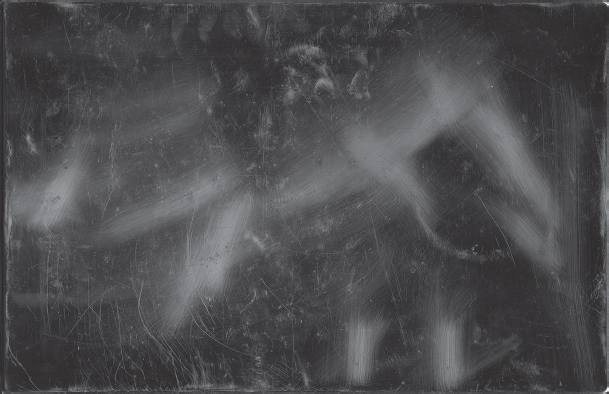
Figure 16. Nicolas Baier, Vanitas 01 (2007–2008), detail, inkjet print, 62 × 96 cm. The image as subtraction of reflection and reversal of the mirror, as if the tain had bled through onto its facing surface.
To know oneself, to know who one is and why one is there, one must have a mirror; but the world around him offers nothing other than stone. … There are, in effect, two great possibilities of contact with the real: rough contact, which runs up against things and draws from them nothing other than the feeling of their silent presence; and smooth contact, polished, in a mirror, which replaces the presence of things with their apparition in images. Rough contact is a contact without double; smooth contact does not exist without the help of the double.5
Whereas Medusa turns to stone when confronted by the mirrored doubling of her own gaze, Baier’s Vanitas draws us into the idiocy of the real by turning the mirror itself to stone, subtracting its doubling function, as a specular apparatus, through the photographic representation of the opacity beneath its surface. To confront Vanitas is to confront a technical doubling of the real put under erasure, cancelled out, as double, by the transmission of an obdurate absorption. In place of a reflection, we see a “somber deep black span” that one cannot see through or into. And again: it is the mediation of technics that performs this subtraction of the specular double. It is the mediation of a device (the digital scanner) that traces nothing other than the residue or remainder of a reflective mirage.
FLINT AND CORTEX
Mirror and stone. Cave painting and digital scanner. The rock wall beside the primordial inscription of an image and the somber deep black span beneath the surface of a specular double. These are not only the preoccupations of Baier’s work as a photographer but also of Bernard Stiegler’s work as a philosopher of technology. In the first volume of Technics and Time, Stiegler broods upon what he calls “the de-fault of origin” that ungrounds the emergence of both the technical object and the human species. He investigates the coevolutionary process of “the technical inventing the human, the human inventing the technical,” a process occurring through the slow course of a “genetic drift” whereby the development of the who and the what, of the cortex and the tool, take place together.6 Stiegler’s important revision of Heidegger’s existential analytic consists in establishing that both historicality (the already-there) and projective anticipation (the not-yet)—as well as the ruptural temporalizing of their non-coincidence—depend in the first instance upon technics: upon the exteriorization of retention through the tool, the trace, the inscription, the organization of inorganic matter as recording.
For Stiegler, the coevolution of technics and the human occurs through a process of “embryonic fabrication” that cannot be localized on either side of the apparent divide between animal and man, inorganic and organic matter, technical object and living being. This coevolution is initially effected in stone, through the carving of inscriptions with flint. What Stiegler calls “a mirror protostage” is this production of a psychic interior through exteriorization, a meeting of “grey matter and mineral matter” whereby the cortex “reflects itself … like a mirrored psyche, an archaeo- or paleonotological mode of reflexivity, somber, buried, freeing itself slowly from the shadows like a statue out of a block of marble.”7 Rendered by digital technology, the distressed opacity of Baier’s mirrors returns us to this primal scene: an opaque mise-en-abyme wherein the difference between mirror and stone collapses. Facticity rather than phantasm, I said, by way of opposing Rosset’s stone to Lacan’s mirror. But with Stiegler in mind we might say that it is the coevolution of facticity and phantasm that is legible in Baier’s work. The “somber deep black span” of Vanitas is what Stiegler calls an “archaeo- or paleontological mode of reflexivity, somber, bur ied”: one that has to be located at the surface of contact between gray matter and mineral matter.
It is the feeling of such contact that we can call, by way of reference to Alfred North Whitehead, a “prehension.” This modality of feeling cannot be grasped through the opposition of stone and mirror. A prehension entails neither brute contact with the sheer idiocy of the real, which draws from things “nothing other than the feeling of their silent presence.” Nor does it involve the specular lure of the mirror, “which replaces the presence of things with their apparition in images.” A prehension is a determinate bond, insofar as it either excludes or includes another item in the real internal constitution of what Whitehead calls an actual entity or an actual occasion. “Prehension” is a term equally applicable to the inscription by flint and cortex of a “somber, buried” mode of reflexivity, emerging over evolutionary time, or to the movement of a scanner’s sensor over the surface of a mirror, its absorption of a reflected light that will not be reflected back to the viewer’s gaze. Between Photons (The World of Ideas) and Vanitas, it is the technics of prehension that is at stake for Baier: the manner in which contact, recording, and exteriorization grasp, mediate, and transmit any relation to the real.
TRANSFORMATIONS
Baier’s Project Star (Black), an installation exhibited in the fall of 2010 as part of the exhibition Transformations, is a stunning demonstration of his commitment to thinking through the capacity of digital art to experiment with the technics of prehension. If we turn away from Photons (The World of Ideas)—from our eerie position between a digital allegory of the cave and an unseeing eyeball—and if we look toward the back wall of the gallery housing Baier’s exhibition, we find our image reflected in a broken mirror, its fractures spiraling outward like a spider’s web from a singular point of impact (see Figures 17 and 18). Its title is a repetition: Vanitas (2010).
Arrayed on the walls surrounding this fractured repetition of Baier’s earlier work are several mysterious objects. Immediately to the right, a white ink jet print stretched around a deep frame depicts a caved-in hole at its center. Titled Impact (Figure 19) the piece seems to be a non-reflective double of Vanitas. It appears to be collapsed inward by a collision which the adjacent mirror projects and distributes outward, but in fact it is the image of such a collapse—a somewhat eerily two-dimensional photograph of an unspecified impact sustained by the wall of Baier’s studio. To the right of Impact are photographs of two circular aluminum paint trays titled Satellite 01 (Figure 20) and Satellite 02 (Figure 21), both of which bear traces of a grainy black substance. Across the room from these photographs is an oval canvas densely covered with what appears to be the same dark substance with which the trays are stained. The trays activate a strange sense of the painting they confront across the room as the residue of its own composition. Its black surface seems to draw all the light of the gallery’s white walls into its own opacity, stabilizing the play of reflections and repetitions by which it is surrounded. The piece is titled Monochrome (black) (Figure 22).
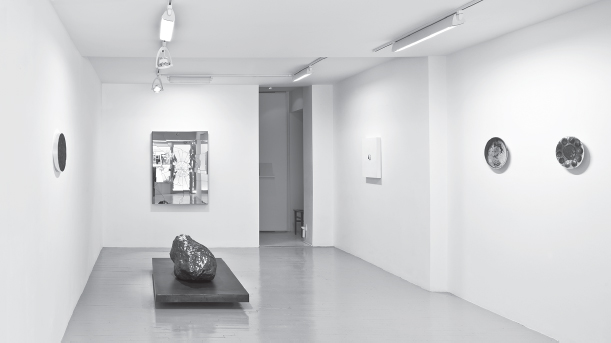
Figure 17. Nicolas Baier, Project Star (Black) (2010), installation view. An enlarged 3D reproduction of a piece of meteorite from Diablo Canyon is surrounded by traces the object’s existence or effects.

Figure 18. Nicholas Baier, Vanitas (2010), mirror, aluminum, 114 × 81 cm. Baier has reproduced a mirror, broken with his fist, through a painstaking mimetic process. The pieces of the mirror were individually scanned, then corresponding pieces were cut by hand from other mirrors and assembled into a jigsaw replica of the original.
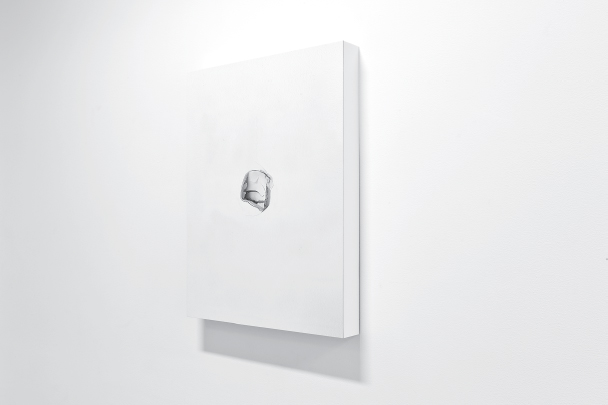
Figure 19. Nicolas Baier, Impact (2010), inkjet print, 56 × 43 cm. Impact is a photographic reproduction of a hole in the wall of Baier’s studio, made with his fist “acting like a meteorite,” he says.
At the center of the installation I have been describing, functioning as a point around which it pivots, is a large acrylic, graphite, and steel sculpture titled Star (Black). It appears to be a massive hunk of silver ore extracted from the earth, polished, and displayed on a rectangular stone plinth resembling Kubrick’s black monolith. But in fact, what we are looking at is a replica of another object that is nowhere present, though its traces surround us in one form or another. Star (Black) (Figure 23) is a vastly enlarged reproduction of a palm-sized nugget of graphite meteorite acquired from Diablo Canyon, Arizona (Figure 24). Having held this piece of meteorite in my hand while visiting Baier’s studio in November 2009, having written my name with it on a sheet of paper, having watched its owner toss it in his hand like a magician with something up his sleeve, a simple question concerning this small but curiously heavy object comes to mind when confronted with Baier’s installation: Where is it?

Figure 20. Nicolas Baier, Satellite 01 (2010), inkjet print, 25 × 4 cm.
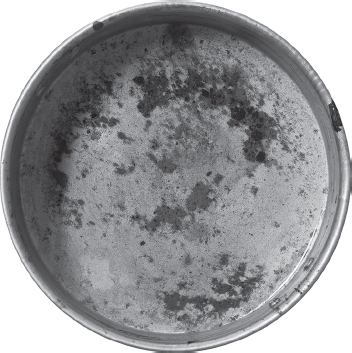
Figure 21. Baier, Satellite 02 (see Figure 21). Photographs of the trays into which Baier melted the graphite of the meteorite, which he then used to paint Monochrome (black) (see Figure 23).
In 2009 I hold this object in my hand; I prehend it. It is compact, heavy, uneven but smooth, scored with narrow crevices traversing its surface, dull black speckled with rust-colored patches in its indentations. In September 2010 I see a pitch black material evenly spread across an oval canvas on the wall of a gallery, fading in places toward an opaque grey, broodingly matte but with glinting speckles distributed across its roughly pebbled surface. And in between this canvas and the residue of its production is a massive reproduction of the object I once held, at once entirely transformed and uncannily faithful to “the original.”

Figure 23. Nicolas Baier, Star (Black) (2010), acrylic, graphite, steel, 50 × 40 × 91 cm. Baier used 3D scanning and stereolithography to make an enlarged reproduction of a palm-sized nugget of meteorite from Diablo Canyon, Arizona.
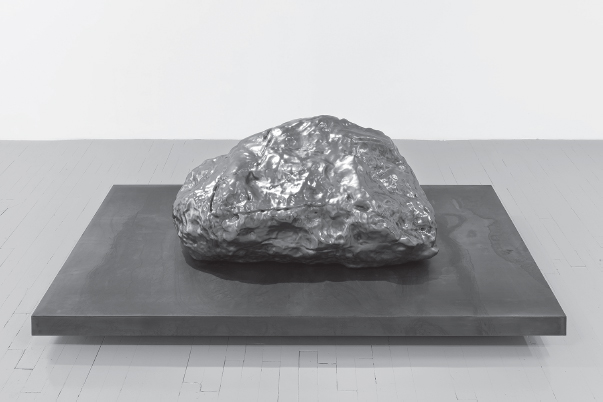
Figure 22. Nicolas Baier, Monochrome (black) (2010). Meteorite graphite, acrylic medium on canvas, aluminum, 31 × 41 × 4 cm. Divided from its form, the matter of the meteorite is used to paint a somber monochrome in the shape of an anisotropy of the cosmic microwave background.
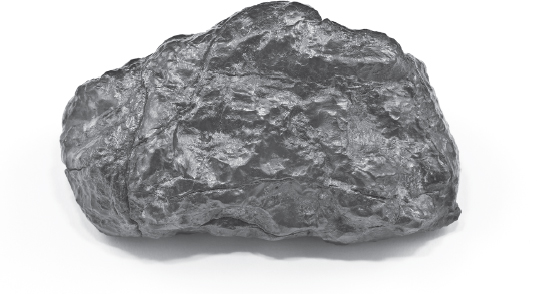
Figure 24. Nicolas Baier, Project: photo 01, Star (Black) (2010), inkjet print, 43 × 56 cm. A photograph of the “original” piece of meteorite. Melted down after having been digitally scanned, what remains of the object are reproductions of its form, residues of its matter, traces of its transformations.
At his studio Baier told me what he planned to do with the meteorite I held in my hand (Figure 25). He would digitize its contours using a 3-D scanner, dividing the surface of the object into twenty discrete sections, each functioning as the digital map of a determinate surface area of the object. He would then “print” enlarged three-dimensional models of these discrete units using a stereolithography machine, before assembling them into a compound sculptural replica. Having produced this replica (Figure 26), he would then powder the meteorite and liquefy the graphite of which it is composed, using it to paint an oval canvas whose shape is intended to suggest maps of the cosmic microwave background radiation.
Along with these works, he would exhibit the reproduction of a cracked mirror and of a ruptured gypsum wall, both of which he broke with his fist. His fist, he says, “acting like a meteorite.”8 All of these pieces are what Baier calls “transformations,” and their production is mediated not only by labor and technique—Baier’s manual skill as an artist and the conceptual itinerary of his project—but also by sophisticated digital instruments, by technics.
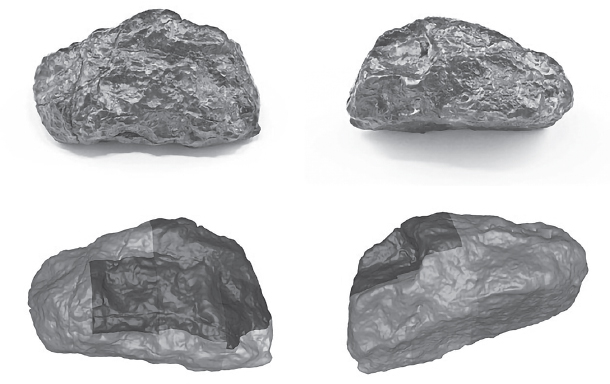
Figure 25. Nicolas Baier, Project: splitting, Star (Black).The process of reproducing the meteorite involved dividing a digital model of the scanned object into twenty discrete sections which could then be printed using stereolithography and reassembled as an enlarged replica.
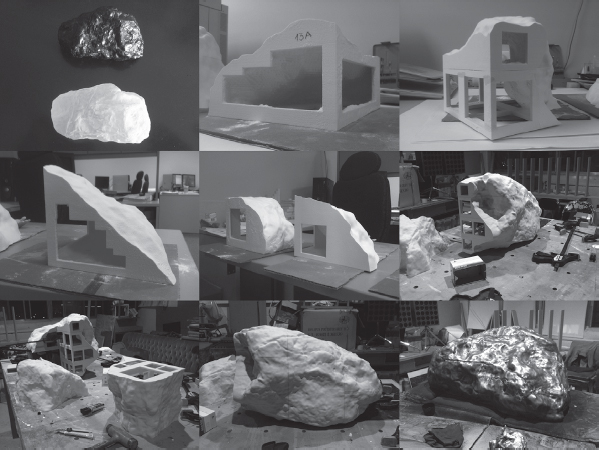
Figure 26. Nicolas Baier, Project: 9 stages, Star (Black). Like many of Baier’s pieces, the reconstruction of the scanned and printed meteorite requires both sophisticated digital technologies and meticulous manual craft.
INDEXICAL EXACTITUDE
Why speak of these transformations in terms of the technics of prehension? The process of transformation is technical not only because it involves the mediation of 3D scanners and stereolithography but, more fundamentally (from the perspective of Stiegler’s analytic of technics and time), because it involves recording and transcription. It is a process of prehension for much the same reason. For Whitehead, a prehension is not only “the activity whereby an actual entity effects its own concretion of other things” (“actual entities involve one another by reason of their prehensions of each other”); it is also the activity by which an actual occasion reproduces the “perpetual perishing” of the past and the present. Whitehead specifies two kinds of process or “fluency,” both of which depend upon the function of prehension. First, concrescence is “the process in which the universe of many things acquires an individual unity in a determinate relegation of each item of the ‘many’ to its subordination in the constitution of the novel ‘one.’”9 Concrescence is the processual composition of one actual entity among others. Second, there is the fluency of transition from particular existent to particular existent. “Transition” (and we might consider Whitehead’s term as analogous to Baier’s title, Transformations) entails a perishing of the process of an actual entity whereby its particular existence is constituted as “an original element in the constitutions of other particular existents elicited by repetitions of process.”10 These two kinds of fluency have a precise relation: transition is the process whereby any actual entity becomes the datum for a new concrescence.
To speak of “the technics of prehension” is to specify the mutual pertinence of Stiegler’s and Whitehead’s conceptual itineraries as follows. What Stiegler calls the coevolution of technics and the human, a coevolutionary process that emerges from the mutual prehension of hand and flint, depends upon a particular relation of transition and concrescence. The technical exteriorization of memory as recording—what Stiegler calls the tertiary memory of technical retention—constructs the already-there of a contextual historicality from which further technical invention (involving projection, anticipation, planning) can emerge. “It is the process of anticipation itself that becomes refined and complicated with technics,” writes Stiegler. Technics is “the mirror of anticipation, the place of its recording and of its inscription as well as the surface of its reflection, of the reflection that time is, as if the human were reading and linking his future to the technical.”11 Epiphylogenesis is Stiegler’s term for the tracing of time as a process of technical retention and transmission, split between facticity and anticipation: a history of traces in which what develops (process, genesis) is conserved (concrescence, epigenesis) and passed on (transition, epiphylogenesis) through the coevolution of the human and the technical. To think this particular coevolution is not to formulate a theory of prehensions in general, but rather to think the specificity of the sort of prehensions made possible by the historicity of technics. If “flint is the first reflective memory, the first mirror,”12 and if this is the coupling from which the coevolutionary history of technics unfolds, what sort of prehensions evolve as epiphylogenesis passes over into technical syntheses of memory made possible by digital technologies—that is to say, “new media”?
While the destabilization by digital technologies of the indexical function of photographic recording and of the reliability of the photographic frame has often been emphasized by theorists of new media, it is evidently the indexical exactitude of digital recording that comes to the fore in Baier’s installation. The capacity to precisely record and reproduce subtle contours of an object’s surface—to formalize its surface in three dimensions, to retain that form in a digital medium, and to characterize a precise three-dimensional replica at a larger scale through stereolithography: this is made possible by the superior indexical exactitude of digital technologies. It is made possible by a superior capacity to retain and transmit complex traces of an existent object. Baier’s Project Star (Black) plays with different instantiations of the index as trace, but all of these foreground what Stiegler calls the “orthothetic” precision of digital images.13
Vanitas (2010) is perhaps the clearest emblem of this obsession. The piece that we see in the gallery is not simply the presentation of a cracked mirror; rather, it is an elaborate reproduction of that object. Baier reports that he scanned each of the pieces of a broken mirror, generating a vector document for each of the shards. He then laboriously chiseled out replicas of these fragments from other mirrors, assembling these into a painstaking reproduction of the broken surface.14 This process, which took over three hundred hours, constitutes a glacial homage not only to the fraction of an instant during which fault lines initially spread from the point of contact across the mirror’s surface, but also to the indexical exactitude of scanning the broken pieces and then transferring this digital record into the vector space serving as sculptural model. Baier’s manual “craft” as an artist tests itself against the precision of these digital indices. The “reflective memory” first enabled by the coupling of cortex and flint now mirrors itself in carving of traces of traces, inscribing the time of the work into the materials of its production through a complex coordination of object, thought, eye, hand, tool, and mnemotechnics.
Formalization, retention, characterization. The articulated, transversal process of recording and reproduction that we find in Baier’s work—one that White-head and Stiegler allow us to describe as a process of concrescence and transition, of epiphylogenesis mediated by tertiary memory—pushes us to reframe debates between important positions in contemporary media theory. What is at issue in Baier’s work is not primarily the affective “framing “of digital mediation by a human body (as for Mark Hansen),15 nor primarily an excision of such a frame by the inhuman transmission of coded information by computational systems (as for Friedrich Kittler),16 nor the middle road of “intermediation” emphasizing emergent processes operative through dynamic feedback loops between humans and computers (as for N. Katherine Hayles).17 What each of these models relies upon, however deconstructed or intermediated it becomes, is an initial distinction between human bodies and computational systems. Reference to the technics of prehension, on the other hand, allows us to shed this provisional distinction and, rather, begin with actual entities/actual occasions relationally constituted by prehensions. Moreover, beginning with Whitehead also enables us to shed the rhetorical entanglements encountered by Stiegler due to his use of the term “the human” to designate the conceptually deconstructed (yet terminologically retained) site of a structural coupling with technics. From this perspective we can see that it is not the phenomenological nor “emergent” encounter of a “human” and a “tool” that is of interest in Baier’s work (nor the “inhuman” processing and transmission of digital code), but rather the manner in which the pertinence of those categories is displaced by the specific particularity of reticulated prehensions instantiated in differential media, constituting and traversing processes of concresence and transition. It is from such a perspective, and through such a terminology, that we can grasp and come to terms with what Stiegler refers to as the “default of origin.” It is within this default (neither “before” nor “after”) that such categories as “human” and “tool” come to make sense in the first place. Yet they neither begin nor end making sense because they have no origin and no telos. It is not that these categories have to be abandoned because they have been superseded; it is their self-evidence that has to be questioned. Thinking through the technics of prehension exposes “the human” and “the tool” to the mutual constitution of an already there, a tertiary memory, that Stiegler unearths within Heidegger’s existential analytic.
Such terminological resources, however, do not mitigate the enigmatic situation of the object in Baier’s installation. Let us return to our earlier question: Where is the meteorite that we seem to find everywhere displaced in Project Star (Black)? What counts as the trace of such an object, and where can we find one? The object is nowhere present, but nevertheless larger than ever and right in the middle of the room. It has become the coherence of its technical construction, and the coherence of this construction thus circulates throughout the becoming of its traces. The object, existing neither here nor there as a simple location—but rather modulated in and through a series of transformations—has become the differential resonance of what remains of those transformations. It inheres as much within the series of retentional, transcriptive traces as it does within any one term.
Discussing the morphological resemblance of the oval canvas of Monochrome (black) to a map of the cosmic microwave background, Baier describes the piece as “an attempt to paint the universe with some star dust.”18 So, in the terms of C. S. Peirce’s semiotic theory, is Monochrome (black) the icon of an anisotropy, a symbol of “the universe,” or an index of the object—of which the black residue composing the surface is a trace? Perhaps this question would be no more pressing than asking if the Mona Lisa is an icon of the woman it depicts or an index of the flax plant from which the linseed oil of its paints was pressed—were it not for the presence in Baier’s installation of an enlarged replica of the object with which Monochrome was painted. Situated precisely where a viewer might stand in order to apprehend the surface of the painting, the presence of the replica suggests that the interrogation of these questions has already been undertaken by the composition of the installation in which the painting is included. A mimetic reproduction of the object in question already occupies the place of the questioner—in front of a broken mirror, between a universe painted with stardust and the mundane satellites deployed in the process of the painting’s production.
If, as Baier says, both Vanitas (2010) and Impact record the impact of his fist “acting like a meteorite,” rather than the impact of the meteorite itself, then they record an idea evoked by an object enacted by a body recorded in a substrate. But given that the pieces of the broken mirror are scanned and recut rather than directly exhibited, and given that Impact is an ink jet print of a digital photograph rather than a punctured slab of gypsum, what these pieces have in common is not their immediate presentation of an index but rather the technical mediation of indexical traces shifting through a network of prehensions. If there is a destabilization of the indexical function of technical retention in Baier’s work, it is not due to the malleability of digital media (since, again, it is the retentional exactitude of the latter that is foregrounded). Rather, it is due to the radical expansion of the category of the index to include any and all traces: conceptual, affective, mnemonic, corporeal, technical.
We can approach this radicalization of the index in Baier’s work by reading Peirce according to Whitehead’s principle of relativity, which asserts that “every item in its universe is involved in each concrescence.”19 According to the principle of relativity, “an actual entity is present in other actual entities” and “in fact if we allow for degrees of relevance, and for negligible relevance, we must say that every actual entity is present in every other actual entity.”20 To decide, then, that a sign functions as an icon or a symbol rather than an index is to account for what Whitehead calls “degrees of relevance.” Nevertheless, Whitehead’s principle of relativity entails a recognition of the sense in which every actual entity to some degree functions as an index of every other. Each concrescence, that is, has a real relation, a determinate relation, to every item in its universe, and the actual entity it composes might be taken as a “sign” of such relation. If an index, for Peirce, is “a sign determined by its dynamic object by virtue of being in a real relation to it,” then a prehension is the vector of that determination, the real relation of an actual entity to an object which it includes within its own constitution as datum, cause, condition.
Thus, given this radicalization of the index, what is crucial to Baier’s work as a photographer and conceptual artist is not only to seize but to delimit the play of such indexical traces, to make manifest specific or determinate transformations. He does so by exploring the technical conditions of their recording and transmission. The problem of the relation between object, sign, and interpretant in Baier’s Project is to specify what the installation includes, and this is largely what it means to ask “where” the object apparently motivating its transformations might be. That is, how are we to specify or to think the constitution of that which traverses this series of transformations?
DESCARTES, WHITEHEAD, BACHELARD
The problem is proximate to the basic question of Descartes’s wax experiment: Where is the wax, as all of its sensible properties undergo transformations in time when held up to the heat of the fire, and what then is the essence of this body—what does it essentially include? According to Descartes, there are too many modifications of the object for the imagination to follow their unfolding, “an immeasurable number of changes,” he says.21 We have to abstract from the mutability of secondary qualities, from any particular instantiation of the wax as this or that collection of sensible data, and thus, for Descartes, it is the mind alone that is capable of perceiving the intelligible object as extended, flexible, changeable. It is the mind alone which is capable of grasping the primary qualities of the wax as irreducible to the particularity of sensible concrescence.
We can situate Baier’s exploration of the technics of prehension by considering his approach to this Cartesian problem in relation to two responses to Cartesian epistemology: that of Whitehead and that of Gaston Bachelard. For Whitehead, the conclusions Descartes draws from the wax experiment would be exemplary of the “bifurcation of nature” endemic to modern philosophy and encapsulated by the distinction between primary and secondary qualities. In The Concept of Nature, Whitehead rejects any division of knowledge into those qualities which are apprehended (secondary qualities) and those which are the cause of apprehension (primary qualities)22—what we could call, following Wilfred Sellers, the manifest and scientific image.23 Whitehead subverts the bifurcation of nature by reframing the distinction between “causal” and “apparent” components of an object in terms of the general framework of his theory of prehensions. But Whitehead does not account (in any detail) for the specificity of the technics of prehension in the constitution of scientific knowledge. Doing so will help us to grasp the specificity not only of scientific practice but also, in a different but closely related register, of an art practice like Baier’s.
The conclusions drawn by Gaston Bachelard concerning the epistemological implications of non-Euclidean geometry and postclassical physics might seem starkly opposed to those of Whitehead, since Bachelard seems to affirm a distinction between the manifest and the scientific image. For instance, Bachelard asserts that “the world in which we think is not the world in which we live,”24 where the world in which we think is that of scientific representation and the world in which we live is that of “everyday” sensory perception or intuition. What Bachelard calls “the philosophy of no” is charged with the strict monitoring of this distinction. “The philosophy of no,” he writes, “would become a general doctrine if it could coordinate all the examples where thought breaks with the obligations of life.”25 The philosophy of no is Bachelard’s term for a scientific epistemology capable of making the distinction between intuition and scientific knowledge and clearing away the epistemological obstacles of the former as impediments to the latter. “Intuitions are very useful,” he states; “they serve to be destroyed.”
For both Whitehead and Bachelard, however, contemporary physics requires us to reject the conditions for the determination of objects laid out by Kant in the Critique of Pure Reason. It turns out, both argue, that these conditions obtain only for a particular class of objects which is relatively restricted (for example, it can’t account for the objects of non-Euclidean geometry or postclassical physics). And, with Whitehead, Bachelard rejects the vulgar materialist principle that you can determine an object as a simple location: that “you can adequately state the relation of a particular material body to space-time by saying that it is just there, in that place.”26 Whitehead calls this the fallacy of misplaced concreteness. Against this fallacy, both he and Bachelard demand that we account for the dispersed, relational, and processual constitution of objects.
As I argued in the Introduction, at the core of Bachelard’s theory of scientific knowledge is an effort to reconcile the opposing claims of rationalist and empiricist epistemologies. He recognizes that if one rejects the Kantian effort to displace the opposition of rationalism and empiricism through transcendental philosophy, then the relation between them will have to be rethought. And this problem will help us to conceptualize the form of mediation that is at stake in Baier’s work. “The philosophy of science,” Bachelard argues, “fails to recognize the transmutation of epistemological values which contemporary scientific thought constantly executes between a priori and a posteriori, between experimental and rational values.”27 For Bachelard, science conjoins experiment and reason by constantly exposing each to the imperatives of the other, and this is what Descartes both suggests and overlooks in his analysis of the wax experiment.
More directly than Whitehead, Bachelard attends to the particular mediation of the relation between rationalism and empiricism, theory and practice, which constitutes the “epistemological terrain” of science.28 And this will bring us back to Baier. What we find in this terrain, mediating between empiricism and rationalism, is the conjunction of technics (technique, technology) and formalization (proofs, formulae, inscribed chains of logical entailment). “In order to establish a determinate scientific fact, it is necessary to put a coherent technique to work,” states Bachelard.29 A coherent technique conjoins technics and formalization: an empirical rigor enabled by the disciplined application of procedures and instruments (technics), a rational coherence attested by legible demonstrations (formalization). Extrapolating from Bachelard, we might say that what mediates between technics and formalization are inscriptions. Rationalism and empiricism are conjoined, in their complex complementarity, through retentional traces of technically processed phenomena and relations among mathematical signs. This conjunction could be graphed as follows:
EMPIRICISM → TECHNICS ↔ FORMALIZATION ← RATIONALISM (INSCRIPTION)
It is no paradox for either Whitehead or Bachelard to hold that scientific knowledge is both objective and constructed. If “the philosophy of no” is the general doctrine which would “coordinate all the examples where thought breaks with the obligations of life,” the term “thought” does not refer us only to “mind” or “reason,” but to the practical, a-subjective mediation of technics and formaliza-tion which is the organon of this coordination. The epistemological terrain of science is that of the technics of prehension: of the transformation of technical retentions into formally coordinated chains of signifiers whose relations are subject to correction.
TRACES
Perhaps we begin to see how this encounter with the technics of prehension and its bond with formalization—through the detour of scientific epistemology—might inform our understanding of Baier’s photography. A photograph from Baier’s 2006 exhibition, Traces, provides a simple demonstration, an argument as it were. The photograph is titled Prehension (see Figure 27). In another photograph, the invitation card for the exhibition, we see a “realistic” representation of the boundary of a cemetery in winter, marked in particular by the leafless branches of somber trees extending and twisting across a pale grey sky illuminated by a muted sun (see Figure 28).
In Prehension, we find the particularly contorted tree on the card inverted, as though growing upside down from the top of the frame. A text at the exhibition explains: “A friend and I were sketching out the premise of a video at the Mont Royal cemetery. While he was struggling to film a few rushes, I spotted this magnificently emaciated tree. It seemed as though it was trying as hard as it could, sick and deformed as it was, to hug the space around it close to itself.” Baier’s description anthropomorphizes the tree, but the photograph itself disorients an anthropocentric perspective. The frame has been cropped and the contrast and color have been adjusted—the sky from gray to a pale white background, the snow standing out more clearly against a rich brown trunk than it might otherwise. The primary gesture of the photograph is a simple one: the spatial inversion of the image in relation to the frame disorients the viewer, more thoroughly involving us with the manner in which the tree is involved with the space around it, as we try to get a grip on the image in the absence of a gravitational foothold. In this case the process of technical mediation performs a reversal. The technical processing of the photograph performs a defamiliarizing, non-anthropocentric mimesis of Baier’s anthropomorphic perception of the tree: of its deformity and its groping after space. Considered through its title, this relatively minor transformation of the digital image might be taken to reflexively encode the manner in which an object becomes a technical object (and an “art” object) through the relation between perception, affect, concept, and technical mediation. As a concrescence of prehensions, the image stresses the capacity of photography to transform an object. But it does so in a manner that draws us eerily close to the object in question, precisely recording its morphology. It transforms an object through an exact inscription of those objective qualities that render its transformation possible. The image is at once objective and constructed, and it is the exactitude of technical formalization which renders this dialectic operative as what Bachelard would call “a coherent technique.”
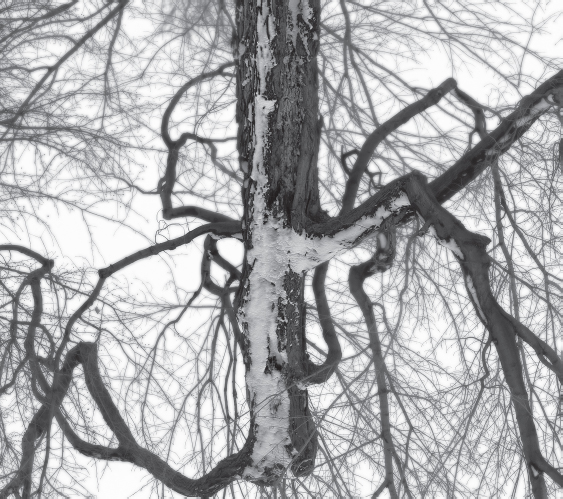
Figure 27. Nicolas Baier, Prehension (2006), inkjet print, 109 X 127 cm. An inverted digital photograph of a tree at the Mont Royal Cemetery, Montreal.

Figure 28. Nicolas Baier, Invitation Card, Traces Exhibition (2006). The tree reproduced and inverted in Prehension is visible on the left side of the photograph.
* * *
A cave painting, a meteorite, an opaque mirror, an unseeing eyeball: the subjects of Baier’s photography are primordial inscriptions, extraterrestrial objects, abyssal surfaces, canceled sensations. His work foregrounds the capacity of technical formalization to transform objects through the retentional exactitude of digital inscriptions, and thereby to render evident, though nowhere apparent, traces of their primary qualities. The constructive power of formalization (in this case, of digitization) renders the properties of an object irreducible to the correlate of a subject, through the complicity of technology with reason. Thinking this complicity of reason and technics (which is also to think the complicity of rationalism and empiricism) allows us to think the manner in which technics and formalization function as the filter not only of phenomenal immediacy but also of the categorical restrictions upon the constitution of objects for which Whitehead and Bachelard reproach Kant’s critical philosophy. We could say that technical formalization is the sieve of the transcendental subject: the means by which the forms of intuition and the categorial constitution of objects are filtered out of retentional traces. This, I think, is what Bachelard means by “the philosophy of no.”
The technics of prehension situates thought outside itself because, according to Stiegler, thinking already bears its own outside within the de-fault of its origin, due to its constitutive relation to technics. This technicity of thinking, which throws thought outside itself before it comes into its own, is one among the traces that Nicolas Baier photographs. Perhaps it is the real subject of his work, the non-site of his investigations. When we find ourselves surrounded by the remains of a vanished object, its traces mediated by technical retentions enabling the reproduction of its contours, we find ourselves forced to think beyond the simple location of objects, and beyond their constitution by our consciousness. The impetus to such thinking is what Bachelard calls “a coherent technique,” which holds the object together, in its vanished tracing, through the technics of prehension. To encounter such an absent object, at once nowhere and everywhere present, is to recognize it as both objective and constructed: as the mediation of a real existence irreducible to a subjective correlate.
For Whitehead, to split the real into two different realities, one of speculative physics and the other of intuition, is to construct “two natures,” where “one is conjecture and the other is dream.” Whitehead rejects this apparent schism, but he does not adequately theorize the manner in which technology mediates the divide between these two sides of the split real thought by modernity. With Stiegler, we can say that technics at once institutes and ungrounds speculative thinking in the first instance. With Bachelard, we can say that the technics of prehension mediates a dialectic of the rational and the empirical, which constitutes and constructs the object as in-itself rather than for-us. With and against White-head, we can say that the technics of prehension operates between speculative thinking and intuition, between conjecture and dream.
The technics of prehension, projecting thought outside itself from the somber mirror proto-stage of mineral inscription to the monochrome opacity of a black star, is the ek-stasis of thought and perception, the tracing of their différance by an inhuman mediation of rationalism and empiricism. To arrive at such a formulation is not only to think with Whitehead and Bachelard and Stiegler, but also to think through the photography of Nicolas Baier.