
AUTHOR: SAMUEL JOHNSON
DATE: 1755

In the summer of 1746, a group of booksellers, publishers and printers in London – among them, Thomas Longman, founder of the eponymous publishing house that continues to thrive today – reached the conclusion that they needed to commission a comprehensive dictionary of the English language. It resulted in one of the landmark publications in literary history – one that changed perceptions of what language is and how we think about it.
The world of reading changed much in eighteenth-century Britain. Literacy levels were on the rise and the costs of producing books, newspapers, pamphlets and the like led to a surge in demand for the written word. Ever larger numbers of people could now obtain reading materials at a reasonable price. But the more that was printed, the more it became obvious that the English language was an amalgam. A language that had evolved in many beautiful ways over many centuries, it lacked hard-and-fast rules.
That might have been OK when the written word was the concern of a relative few – the rich and the professionally religious – as had been the way until not long before. But now it was in the hands of the masses, there was a demand for greater clarity. How should words be spelled? Even more fundamentally, what meaning, or range of meanings, does each individual word possess? And how should they be used and understood in terms of a grammatical framework?
That group of publishing professionals who met in 1746 knew that the project of aggregating all the words in the language and bringing some order to them was vast. There were already dictionaries out there but they were of varying quality, frequently unreliable, often highly eccentric (several were arranged thematically rather than alphabetically, which did not help clarity) and none could claim to be definitive. Some were little more than word lists. What was needed was something authoritative.
Longman and his companions decide to approach Samuel Johnson, a much-respected writer – a journalist, poet, playwright, biographer and critic. They offered him 1,500 guineas (somewhere in the region of £250,000 today) to take on the job. He told them it would take him three years. In the event, it took him nearer nine, but even that seems swift given the scale of the challenge.
He undertook the work at his home at 17 Gough Square, London, spending the first year crafting a plan detailing his aspirations for the book and his proposed methodology. The project was his alone to an extraordinary extent. He employed a few staff to assist him, but this was almost exclusively restricted to administrative support. Almost single-handedly, he was charged with taking the language and shaking it into some sort of order. As his patron, the Earl of Chesterfield, put it: ‘We must have recourse to the old Roman expedient in times of confusion, and choose a dictator. Upon this principle, I give my vote for Mr Johnson to fill that great and arduous post.’
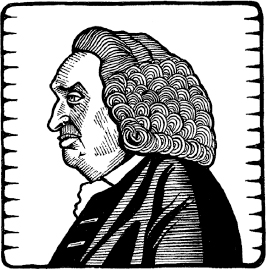
What made the Dictionary unique was Johnson’s decision to provide not only accurate definitions for every word, but also quotations to illustrate these definitions. In a remarkable feat of scholarliness, he sourced these quotes from writers across the ages. It is true that he favoured some more than others. William Shakespeare, John Milton, John Dryden, Alexander Pope and Edmund Spenser all feature heavily. But the breadth of his reading is almost unfathomable. (Johnson was infamous for marking his books with copious notes and comments.)
WHAT DO YOU MEAN?
Johnson was not above having some fun with his definitions. He could be variously wry, self-effacing and acerbic. A ‘lexicographer’ he defined as ‘a writer of dictionaries; a harmless drudge that busies himself in tracing the original and detailing the signification of words’. ‘Excise’, meanwhile, is ‘a hateful tax levied upon commodities and adjudged not by the common judges of property but wretches hired by those to whom excise is paid’. And there was a particularly pointed definition for Philip Stanhope, the Earl of Chesterfield – his patron, with whom he had a somewhat difficult relationship. Johnson defined a ‘patron’ as ‘one who countenances, supports, or protects. Commonly a wretch who supports with insolence, and is paid with flattery.’ Ouch!
In 1755, the complete first edition went on sale, with some 43,000 words defined and illustrated by 114,000 quotations. Self-described on its front page, here was A DICTIONARY of the ENGLISH LANGUAGE: in which The WORDS are deduced from their ORIGINALS, and ILLUSTRATED in their DIFFERENT SIGNIFICATIONS by EXAMPLES from the best WRITERS. To which are prefixed, A HISTORY of the LANGUAGE, and AN ENGLISH GRAMMAR. By SAMUEL JOHNSON, A.M. In TWO Volumes.
In the preface, Johnson talked of finding the language ‘copious without order, and energetick without rules’, with ‘perplexity to be disentangled, and confusion to be regulated’. Yet his years as a lexicographer had also taught him that language cannot be entirely tamed and nor should it. It changes and evolves and, he came to understand, it was not his job to make it ‘correct’ but rather to record it in its present state as best he could. The lexicographer as reporter, not embalmer.
The Dictionary itself was a beautiful artefact, printed on giant sheets of the finest paper. The cost was prohibitive for most. In its first thirty years of existence, sales did not exceed ten thousand copies. Yet its importance was recognized almost from the outset.
James Boswell, in his Life of Samuel Johnson, would write that ‘the world contemplated with wonder so stupendous a work achieved by one man, while other countries had thought such undertakings fit only for whole academies’. (The politician and writer Horace Walpole was rather more mealy-mouthed in declaring that Johnson’s reputation would not be ‘very lasting’ and that the task of compiling the dictionary had proven ‘too much for one man’.)
Johnson’s dictionary is not without its idiosyncrasies and even failings. The author’s personality and prejudices sometimes obtrude through – he gave short shrift to certain words rooted in French, one or two words were missed out altogether and he was adamant that no word in the English language began with ‘X’. Nonetheless, it set the standard for all other dictionaries, and had no rival in English until the appearance of the Oxford English Dictionary a century and a half later. Notably, the OED incorporated almost two thousand of his definitions without any substantial change.
The Dictionary quickly became a cultural treasure, not merely a guide to the English language but a celebration of the power of the word and an exploration of art and society. Its impact is measurable in practical terms too. For instance, the US Courts have routinely turned to Johnson’s dictionary over the centuries when it has come to examining the wording – the meaning – of founding documents such as the Constitution. It is also notable that Johnson produced several revised editions of the Dictionary over the remainder of his life but so complete was his first attempt that very few additional words were added.
It is not too much to say that in his defining of words, Johnson redefined our understanding of what it is to communicate as humans. According to Walter Jackson Bate, a twentieth-century biographer of Johnson, the Dictionary ‘easily ranks as one of the greatest single achievements of scholarship, and probably the greatest ever performed by one individual …’