

Imagine trying to live in a world dominated by dihydrogen oxide, a compound that has no taste or smell and is so variable in its properties that it is generally benign but at other times swiftly lethal. Depending on its state, it can scald you or freeze you. In the presence of certain organic molecules it can form carbonic acids so nasty that they can strip the leaves from trees and eat the faces off statuary. In bulk, when agitated, it can strike with a fury that no human edifice could withstand. Even for those who have learned to live with it, it is an often murderous substance. We call it water.
Water is everywhere. A potato is 80 per cent water, a cow 74 per cent, a bacterium 75 per cent. A tomato, at 95 per cent, is little but water. Even humans are 65 per cent water, making us more liquid than solid by a margin of almost two to one. Water is strange stuff. It is formless and transparent, and yet we long to be beside it. It has no taste and yet we love the taste of it. We will travel great distances and pay small fortunes to see it in sunshine. And even though we know it is dangerous and drowns tens of thousands of people every year, we can’t wait to frolic in it.
Because water is so ubiquitous we tend to overlook what an extraordinary substance it is. Almost nothing about it can be used to make reliable predictions about the properties of other liquids, and vice versa. If you knew nothing of water and based your assumptions on the behaviour of compounds most chemically akin to it—hydrogen selenide or hydrogen sulphide, notably—you would expect it to boil at minus 93 degrees Celsius and to be a gas at room temperature.
Most liquids when chilled contract by about 10 per cent. Water does too, but only down to a point. Once it is within whispering distance of freezing, it begins—perversely, beguilingly, extremely improbably—to expand. By the time it is solid, it is almost a tenth more voluminous than it was before. Because it expands, ice floats on water—“an utterly bizarre property,” according to John Gribbin. If it lacked this splendid waywardness, ice would sink, and lakes and oceans would freeze from the bottom up. Without surface ice to hold heat in, the water’s warmth would radiate away, leaving it even chillier and creating yet more ice. Soon even the oceans would freeze and almost certainly stay that way for a very long time, probably for ever—hardly the conditions to nurture life. Thankfully for us, water seems unaware of the rules of chemistry or laws of physics.
Everyone knows that water’s chemical formula is H2O, which means that it consists of one largish oxygen atom with two smaller hydrogen atoms attached to it. The hydrogen atoms cling fiercely to their oxygen host, but also make casual bonds with other water molecules. The nature of a water molecule means that it engages in a kind of dance with other water molecules, briefly pairing and then moving on, like the ever-changing partners in a quadrille, to use Robert Kunzig’s nice phrase. A glass of water may not appear terribly lively, but every molecule in it is changing partners billions of times a second. That’s why water molecules stick together to form bodies like puddles and lakes, but not so tightly that they can’t be easily separated as when, for instance, you dive into a pool of them. At any given moment only 15 per cent of them are actually touching.
In one sense the bond is very strong—it is why water molecules can flow uphill when siphoned and why water droplets on a car bonnet show such a singular determination to bead with their partners. It is also why water has surface tension. The molecules at the surface are attracted more powerfully to the like molecules beneath and beside them than to the air molecules above. This creates a sort of membrane strong enough to support insects and skipping stones. It is what gives the sting to a belly-flop.
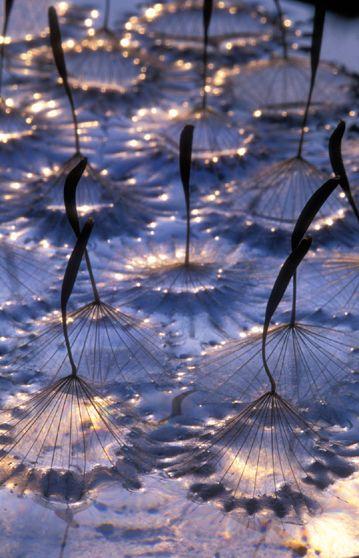
Surface tension of water, shown here by floating dandelion seeds, results because the molecules on the surface of water are more powerfully attracted to other water molecules than to the air above them. (credit 18.2)
I hardly need point out that we would be lost without it. Deprived of water, the human body rapidly falls apart. Within days, the lips vanish “as if amputated, the gums blacken, the nose withers to half its length, and the skin so contracts around the eyes as to prevent blinking,” according to one account. Water is so vital to us that it is easy to overlook that all but the smallest fraction of the water on Earth is poisonous to us—deadly poisonous—because of the salts within it.
We need salt to live, but only in very small amounts, and sea water contains way more—about seventy times more—salt than we can safely metabolize. A typical litre of sea water will contain only about 2.5 teaspoons of common salt—the kind we sprinkle on food—but much larger amounts of other elements, compounds and other dissolved solids, which are collectively known as salts. The proportions of these salts and minerals in our tissues are uncannily similar to those in sea water—we sweat and cry sea water, as Margulis and Sagan have put it—but curiously we cannot tolerate them as an input. Take a lot of salt into your body and your metabolism very quickly goes into crisis. From every cell, water molecules rush off like so many volunteer firemen to try to dilute and carry off the sudden intake of salt. This leaves the cells dangerously short of the water they need to carry out their normal functions. They become, in a word, dehydrated. In extreme situations, dehydration will lead to seizures, unconsciousness and brain damage. Meanwhile, the overworked blood cells carry the salt to the kidneys, which eventually become overwhelmed and shut down. Without functioning kidneys you die. That is why we don’t drink sea water.
There are 1.3 billion cubic kilometres of water on Earth and that is all we’re ever going to get. The system is closed: practically speaking, nothing can be added or subtracted. The water you drink has been around doing its job since the Earth was young. By 3.8 billion years ago, the oceans had (at least more or less) achieved their present volumes.
The water realm is known as the hydrosphere and it is overwhelmingly oceanic. Ninety-seven per cent of all the water on Earth is in the seas, the greater part of it in the Pacific, which is bigger than all the land masses put together. Altogether the Pacific holds just over half of all the ocean water (51.6 per cent); the Atlantic has 23.6 per cent and the Indian Ocean 21.2 per cent, leaving just 3.6 per cent to be accounted for by all the other seas. The average depth of the ocean is 3.86 kilometres, with the Pacific on average about 300 metres deeper than the Atlantic and Indian Oceans. Sixty per cent of the planet’s surface is ocean more than 1.6 kilometres deep. As Philip Ball notes, we would better call our planet not Earth but Water.
Of the 3 per cent of Earth’s water that is fresh, most exists as ice sheets. Only the tiniest amount—0.036 per cent—is found in lakes, rivers and reservoirs, and an even smaller part—just 0.001 per cent—exists in clouds or as vapour. Nearly 90 per cent of the planet’s ice is in Antarctica and most of the rest is in Greenland. Go to the South Pole and you will be standing on over 2 miles of ice, at the North Pole just 15 feet of it. Antarctica alone has 6 million cubic miles of ice—enough to raise the oceans by a height of 200 feet if it all melted. But if all the water in the atmosphere fell as rain, evenly everywhere, the oceans would deepen by only a couple of centimetres.
Sea level, incidentally, is an almost entirely notional concept. Seas are not level at all. Tides, winds, the Coriolis force and other effects alter water levels considerably from one ocean to another and even within oceans. The Pacific is about a foot and a half higher along its western edge—a consequence of the centrifugal force created by the Earth’s spin. Just as when you pull on a tub of water the water tends to flow towards the other end, as if reluctant to come with you, so the eastward spin of Earth piles water up against the ocean’s western margins.
Considering the age-old importance of the seas to us, it is striking how long it took the world to take a scientific interest in them. Until well into the nineteenth century most of what was known about the oceans was based on what washed ashore or came up in fishing nets, and nearly all that was written was based more on anecdote and supposition than on physical evidence. In the 1830s, the British naturalist Edward Forbes surveyed ocean beds throughout the Atlantic and Mediterranean and declared that there was no life at all in the seas below 600 metres. It seemed a reasonable assumption. There was no light at that depth, so no plant life, and the pressures of water at such depths were known to be extreme. So it came as something of a surprise when, in 1860, one of the first transatlantic telegraph cables was hauled up for repairs from more than 3 kilometres down and found to be thickly encrusted with corals, clams and other living detritus.
The first really organized investigation of the seas didn’t come until 1872, when a joint expedition set up by the British Museum, the Royal Society and the British government set forth from Portsmouth on a former warship called HMS Challenger. For three and a half years they sailed the world, sampling waters, netting fish and hauling a dredge through sediments. It was evidently dreary work. Out of a complement of 240 scientists and crew, one in four jumped ship and eight more died or went mad—“driven to distraction by the mind-numbing routine of years of dredging,” in the words of the historian Samantha Weinberg. But they sailed across almost 70,000 nautical miles of sea, collected over 4,700 new species of marine organisms, gathered enough information to create a fifty-volume report (which took nineteen years to put together), and gave the world the name of a new scientific discipline: oceanography. They also discovered, by means of depth measurements, that there appeared to be submerged mountains in mid-Atlantic, prompting some excited observers to speculate that they had found the lost continent of Atlantis.
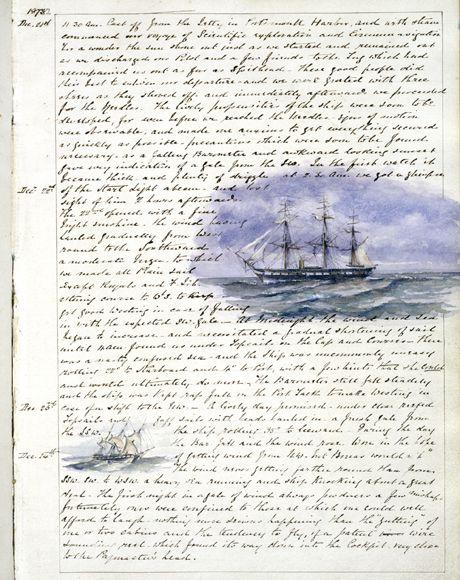
The first page of the journal of Pelham Aldrich, who set out on HMS Challenger in 1872 to scour the world’s oceans for new types of life. The expedition found 4,700 previously unknown species and gave birth to the new science of oceanography. (credit 18.3)
Because the institutional world mostly ignored the seas, it fell to devoted —and very occasional—amateurs to tell us what was down there. Modern deep-water exploration begins with Charles William Beebe and Otis Barton in 1930. Although they were equal partners, the more colourful Beebe has always received far more written attention. Born in 1877 into a well-to-do family in New York City, Beebe studied zoology at Columbia University, then took a job as a birdkeeper at the New York Zoological Society. Tiring of that, he decided to adopt the life of an adventurer and for the next quarter-century travelled extensively through Asia and South America with a succession of attractive female assistants whose jobs were inventively described as “historian and technicist” or “assistant in fish problems.” He supported these endeavours with a succession of popular books with titles like Edge of the Jungle and Jungle Days, though he also produced some respectable books on wildlife and ornithology.
In the mid-1920s, on a trip to the Galápagos Islands, he discovered “the delights of dangling,” as he described deep-sea diving. Soon afterwards he teamed up with Barton, who came from an even wealthier family, had also attended Columbia and also longed for adventure. Although Beebe nearly always gets the credit, it was in fact Barton who designed the first bathysphere (from the Greek word for “deep”) and funded the $12,000 cost of its construction. It was a tiny and necessarily robust chamber, made of cast iron 1.5 inches thick and with two small portholes containing quartz blocks 3 inches thick. It held two men, but only if they were prepared to become extremely well acquainted. Even by the standards of the age, the technology was unsophisticated. The sphere had no manoeuvrability—it simply hung on the end of a long cable—and only the most primitive breathing system: to neutralize their own carbon dioxide they set out open cans of soda lime, and to absorb moisture they opened a small tub of calcium chloride, over which they sometimes waved palm fronds to encourage chemical reactions.
But the nameless little bathysphere did the job it was intended to do. On the first dive, in June 1930 in the Bahamas, Barton and Beebe set a world record by descending to 183 metres. By 1934, they had pushed the record to over 900 metres, where it would stay until after the Second World War. Barton was confident the device was safe to a depth of about 1,400 metres, though the strain on every bolt and rivet was audibly evident with every fathom they descended. At any depth, it was brave and risky work. At 900 metres, their little porthole was subjected to 19 tons of pressure per square inch. Should they pass the structure’s limits of tolerance, death at such a depth would have been instantaneous, as Beebe never failed to observe in his many books, articles and radio broadcasts. Their main concern, however, was that the shipboard winch, straining to hold onto a metal ball and two tons of steel cable, would snap and send the two men plunging to the sea floor. In such an event, nothing could have saved them.
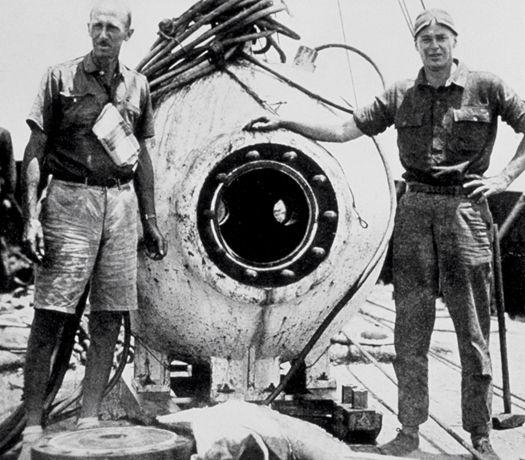
Charles William Beebe (left) and Otis Barton with the nameless and sometimes worryingly leaky bathysphere in which they made record-breaking descents throughout the 1930s. (credit 18.4)
The one thing their descents didn’t produce was a great deal of worthwhile science. Although they encountered many creatures that had not been seen before, the limits of visibility and the fact that neither of the intrepid aquanauts was a trained oceanographer meant they often weren’t able to describe their findings in the kind of detail that real scientists craved. The sphere didn’t carry an external light, merely a 250-watt bulb they could hold up to the window, but the water below 150 metres was practically impenetrable anyway, and they were peering into it through three inches of quartz, so anything they hoped to view would have to be nearly as interested in them as they were in it. About all they could report, in consequence, was that there were a lot of strange things down there. On one dive in 1934, Beebe was startled to spy a giant serpent “more than twenty feet long and very wide.” It passed too swiftly to be more than a shadow. Whatever it was, nothing like it has been seen by anyone since. Because of such vagueness, their reports were generally ignored by academics.
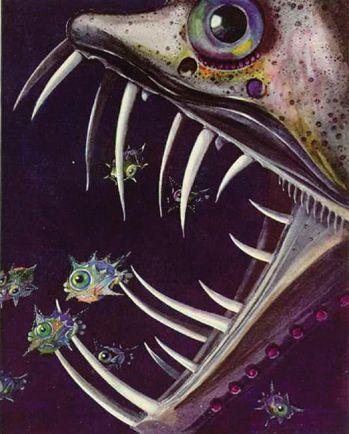
A painting of the minuscule but terrifying sabre-toothed viperfish, based on Barton and Beebe’s observations from their bathysphere. (credit 18.5)
After their record-breaking descent of 1934, Beebe lost interest in diving and moved on to other adventures, but Barton persevered. To his credit, Beebe always told anyone who asked that Barton was the real brains behind the enterprise, but Barton seemed unable to step from the shadows. He, too, wrote thrilling accounts of their underwater adventures and even starred in a Hollywood movie called Titans of the Deep, featuring a bathysphere and many exciting and largely fictionalized encounters with aggressive giant squid and the like. He even advertised Camel cigarettes (“They don’t give me jittery nerves”). In 1948 he increased the depth record by 50 per cent, with a dive to 1,370 metres in the Pacific Ocean near California, but the world seemed determined to overlook him. One newspaper reviewer of Titans of the Deep actually thought the star of the film was Beebe. Nowadays, Barton is lucky to get a mention.
At all events, he was about to be comprehensively eclipsed by a father and son team from Switzerland, Auguste and Jacques Piccard, who were designing a new type of probe called a bathyscaphe (meaning “deep boat”). Christened Trieste, after the Italian city in which it was built, the new device manoeuvred independently, though it did little more than just go up and down. On one of its early dives, in early 1954, it descended to below 4,000 metres, nearly three times Barton’s record-breaking dive of six years earlier. But deep-sea dives required a great deal of costly support and the Piccards were gradually going broke.
In 1958, they did a deal with the US Navy which gave the Navy ownership but left them in control. Now flush with funds, the Piccards rebuilt the vessel, giving it walls nearly 13 centimetres thick and shrinking the windows to just 5 centimetres in diameter—little more than peepholes. But it was now strong enough to withstand truly enormous pressures, and in January 1960 Jacques Piccard and Lt. Don Walsh of the US Navy sank slowly to the bottom of the ocean’s deepest canyon, the Mariana Trench, some 400 kilometres off Guam in the western Pacific (and discovered, not incidentally, by Harry Hess with his fathometer). It took just under four hours to fall 10,918 metres, or almost 7 miles. Although the pressure at that depth was nearly 17,000 pounds per square inch, they noticed with surprise that they disturbed a bottom-dwelling flatfish just as they touched down. They had no facilities for taking photographs, so there is no visual record of the event.
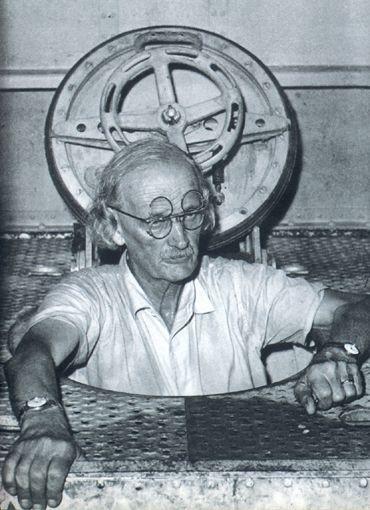
Auguste Piccard, whose bathyscaphe Trieste made the deepest descent ever undertaken in 1960. (credit 18.6)
After just twenty minutes at the world’s deepest point, they returned to the surface. It was the only occasion in which human beings have gone so deep.
Forty years later, the question that naturally occurs is: why has no-one gone back since? To begin with, further dives were vigorously opposed by Vice Admiral Hyman G. Rickover, a man with a lively temperament, forceful views and, most pertinently, control of the departmental chequebook. He thought underwater exploration a waste of resources and pointed out that the Navy was not a research institute. The nation, moreover, was about to become fully preoccupied with space travel and the quest to send a man to the Moon, which made deep sea investigations seem unimportant and rather old-fashioned. But the decisive consideration is that the Trieste descent didn’t actually achieve much. As a navy official explained years later: “We didn’t learn a hell of a lot from it, other than that we could do it. Why do it again?” It was, in short, a long way to go to find a flatfish, and expensive too. Repeating the exercise today, it has been estimated, would cost at least $100 million.
When underwater researchers realized that the Navy had no intention of pursuing a promised exploration programme, there was a pained outcry. Partly to placate its critics, the Navy provided funding for a more advanced submersible, to be operated by the Woods Hole Oceanographic Institution of Massachusetts. Called Alvin, in somewhat contracted honour of the oceanographer Allyn C. Vine, it would be a fully manoeuvrable mini-submarine, though it wouldn’t go anywhere near as deep as Trieste. There was just one problem: the designers couldn’t find anyone willing to build it. According to William J. Broad in The Universe Below: “No big company like General Dynamics, which made submarines for the Navy, wanted to take on a project disparaged by both the Bureau of Ships and Admiral Rickover, the gods of naval patronage.” Eventually, not to say improbably, Alvin was constructed by General Mills, the food company, at a factory where it made the machines to produce breakfast cereals.
As for what else was down there, people really had very little idea. Well into the 1950s, the best maps available to oceanographers were overwhelmingly based on a little detail from scattered surveys going back to 1929 grafted onto, essentially, an ocean of guesswork. The US Navy had excellent charts with which to guide submarines through canyons and around guyots, but it didn’t wish such information to fall into Soviet hands, so it kept its knowledge classified. Academics therefore had to make do with sketchy and antiquated surveys or rely on hopeful surmise. Even today our knowledge of the ocean floors remains remarkably low resolution. If you look at the Moon with a standard backyard telescope you will see substantial craters—Fracastorius, Blancanus, Zach, Planck and many others familiar to any lunar scientist—that would be unknown if they were on our own ocean floors. We have better maps of Mars than we do of our own seabeds.
At the surface level, investigative techniques have also been a trifle ad hoc. In 1994, 34,000 ice hockey gloves were swept overboard from a Korean cargo ship during a storm in the Pacific. The gloves washed up all over, from Vancouver to Vietnam, helping oceanographers to trace currents more accurately than they ever had before.
Today Alvin is forty years old, but it remains the world’s premier research vessel. There are still no submersibles that can go anywhere near the depth of the Mariana Trench and only five, including Alvin, that can reach the depths of the “abyssal plain”—the deep ocean floor—which covers more than half the planet’s surface. A typical submersible costs about $25,000 a day to operate, so they are hardly dropped into the water on a whim, still less put to sea in the hope that they will randomly stumble on something of interest. It’s rather as if our first-hand experience of the surface world were based on the work of five guys exploring on garden tractors after dark. According to Robert Kunzig, humans may have scrutinized “perhaps a millionth or a billionth of the sea’s darkness. Maybe less. Maybe much less.”
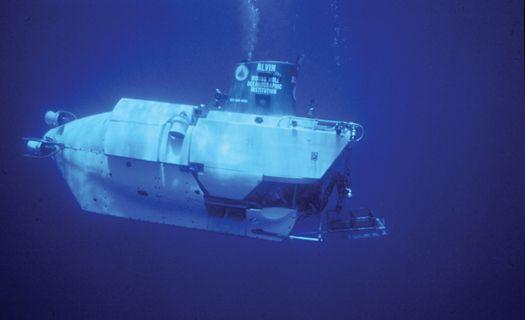
The venerable and productive mini-submarine Alvin, which was launched from Woods Hole, Massachusetts, in 1964 and has been making important discoveries ever since. (credit 18.7)
But oceanographers are nothing if not industrious and they have made several important discoveries with their limited resources—including, in 1977, one of the most important and startling biological discoveries of the twentieth century. In that year Alvin found teeming colonies of large organisms living on and around deep-sea vents off the Galápagos Islands—tube worms over 3 metres long, clams 30 centimetres wide, shrimps and mussels in profusion, wriggling spaghetti worms. They all owed their existence to vast colonies of bacteria that were deriving their energy and sustenance from hydrogen sulphides—compounds profoundly toxic to surface creatures—that were pouring steadily from the vents. It was a world independent of sunlight, oxygen or anything else normally associated with life. This was a living system based not on photosynthesis but onchemosynthesis, an arrangement that biologists would have dismissed as preposterous had anyone been imaginative enough to suggest it.
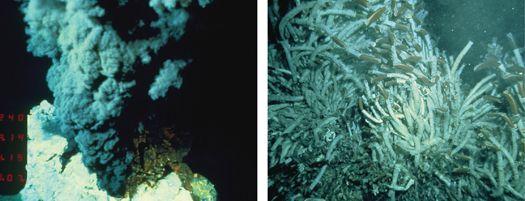
Left: An ocean vent known as the Spire disgorges a black sulphurous fluid from a depth of 3,080 metres on the mid-Atlantic Ridge. (credit 18.8a)
Right: Scientists originally assumed that no life could exist at the oceans’ deepest points because of a lack of sunlight. In fact, as a shoal of giant tube worms demonstrates, ocean vents harbour some of the most extraordinary life on the planet. (credit 18.8b)
Huge amounts of heat and energy are released by these vents. Two dozen of them together will produce as much energy as a large power station and the range of temperatures around them is enormous. The temperature at the point of outflow can be as much as 400 degrees Celsius, while a couple of metres away the water may be only two or three degrees above freezing. A type of worm called alvinellids were found living right on the margins, with the water temperature 78 degrees Celsius warmer at their heads than at their tails. Before this it had been thought that no complex organisms could survive in water warmer than about 54 degrees Celsius, and here was one that was surviving warmer temperatures than that and extreme cold to boot. The discovery transformed our understanding of the requirements for life.
It also answered one of the great puzzles of oceanography—something that many of us didn’t realize was a puzzle—namely, why the oceans don’t grow saltier with time. At the risk of stating the obvious, there is a lot of salt in the sea—enough to bury every bit of land on the planet to a depth of about 150 metres. It had been known for centuries that rivers carry minerals to the sea and that these minerals combine with ions in the ocean water to form salts. So far no problem. But what was puzzling was that the salinity levels of the sea were stable. Millions of gallons of fresh water evaporate from the ocean daily, leaving all their salts behind, so logically the seas ought to grow more salty with the passing years, but they don’t. Something takes an amount of salt out of the water equivalent to the amount being put in. For a very long time, no-one could figure out what could be responsible for this.
Alvin’s discovery of the deep-sea vents provided the answer. Geophysicists realized that the vents were acting much like the filters in a fish tank. As water is taken down into the Earth’s crust, salts are stripped from it, and eventually clean water is blown out again through the chimney stacks. The process is not swift—it can take up to ten million years to clean an ocean—but if you are not in a hurry it is marvellously efficient.
Perhaps nothing speaks more clearly of our psychological remoteness from the ocean depths than that the main expressed goal for oceanographers during International Geophysical Year, 1957/8, was to study “the use of ocean depths for the dumping of radioactive wastes.” This wasn’t a secret assignment, you understand, but a proud public boast. In fact, though it wasn’t much publicized, by 1957/8 the dumping of radioactive wastes had already been going on, with a certain appalling vigour, for over a decade. Since 1946, the United States had been ferrying 55-gallon drums of radioactive gunk out to the Fallarone Islands, some 50 kilometres off the California coast near San Francisco, where it simply threw them overboard.
It was all quite extraordinarily sloppy. Most of the drums were exactly the sort you see rusting behind petrol stations or standing outside factories, with no protective linings of any type. When they failed to sink, which was usually, navy gunners riddled them with bullets to let water in (and, of course, plutonium, uranium and strontium out). Before this dumping was halted in the 1990s, the United States had dumped many hundreds of thousands of drums into about fifty ocean sites—almost fifty thousand of them in the Fallarones alone. But the United States was by no means alone. Among the other enthusiastic dumpers were Russia, China, Japan and nearly all the nations of Europe.
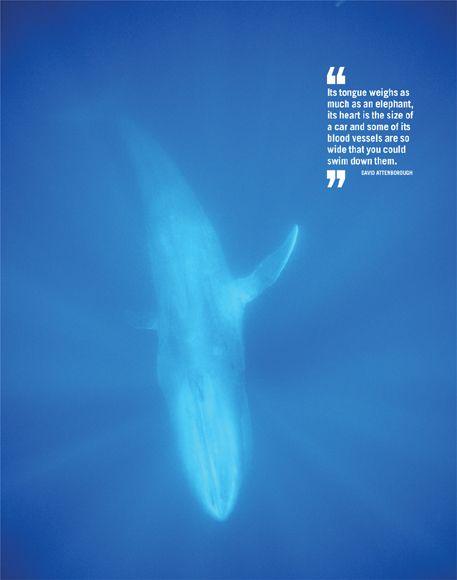
Blue whales are the largest animals on Earth—indeed, the largest that have ever lived—and yet much about them is unknown, including how they communicate and where they spend most of the year. (credit 18.9)
And what effect might all this have had on life beneath the seas? Well, little, we hope, but we actually have no idea. We are astoundingly, sumptuously, radiantly ignorant of life beneath the seas. Even the most substantial ocean creatures are often remarkably little known to us—including the most mighty of them all, the great blue whale, a creature of such leviathan proportions that (to quote David Attenborough) its “tongue weighs as much as an elephant, its heart is the size of a car and some of its blood vessels are so wide that you could swim down them.” It is the most gargantuan beast the Earth has yet produced, bigger even than the most cumbrous dinosaurs. Yet the lives of blue whales are largely a mystery to us. Much of the time we have no idea where they are—where they go to breed, for instance, or what routes they follow to get there. What little we know of them comes almost entirely from eavesdropping on their songs, but even these are a mystery. Blue whales will sometimes break off a song, then pick it up again at exactly the same spot six months later. Sometimes they strike up with a new song, which no member can have heard before but which each already knows. How they do this and why are not remotely understood. And these are animals that must routinely come to the surface to breathe.
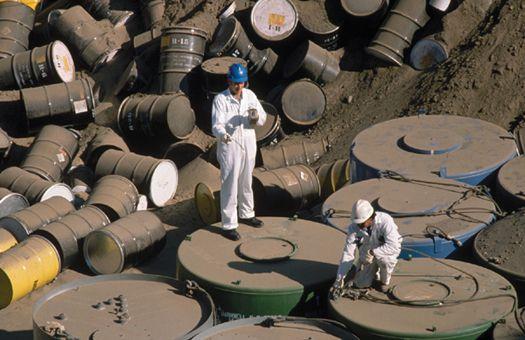
Safety officers check radioactive waste before consigning it to underground trenches. Between 1946 and the 1990s, much nuclear waste was dumped into the oceans, usually in unprotected 55-gallon drums. (credit 18.10)
For animals that need never surface, obscurity can be even more tantalizing. Consider our knowledge of the fabled giant squid. Though nothing on the scale of the blue whale, it is a decidedly substantial animal, with eyes the size of soccer balls and trailing tentacles that can reach lengths of 18 metres. It weighs nearly a tonne and is Earth’s largest invertebrate. If you dumped one in a small swimming pool, there wouldn’t be much room for anything else. Yet no scientist—no person, as far as we know—has ever seen a giant squid alive. Zoologists have devoted careers to trying to capture, or just glimpse, living giant squid and have always failed. They are known mostly from being washed up on beaches—particularly, for unknown reasons, the beaches of the South Island of New Zealand. They must exist in large numbers because they form a central part of the sperm whale’s diet, and sperm whales take a lot of feeding.1
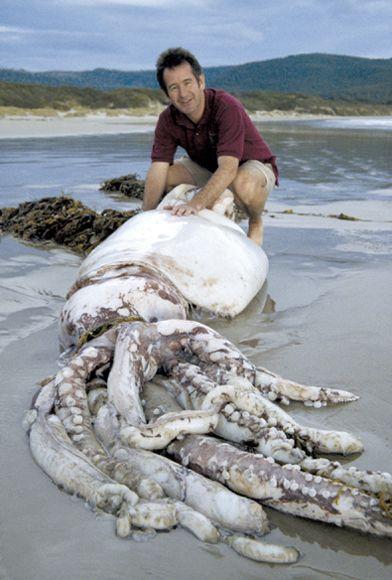
What little we know of giant squid comes almost exclusively from bodies washed up on beaches, as with this specimen in Tasmania. (credit 18.11)
According to one estimate, there could be as many as 30 million species of animals living in the sea, most still undiscovered. The first hint of how truly abundant life is in the deep seas didn’t come until as recently as the 1960s with the invention of the epibenthic sled—a dredging device that captures organisms not just on and near the sea floor but also buried in the sediments beneath. In a single one-hour trawl along the continental shelf, at a depth of about 1.5 kilometres, Woods Hole oceanographers Howard Sandler and Robert Hessler netted over twenty-five thousand creatures—worms, starfish, sea cucumbers and the like—representing 365 species. Even at a depth of nearly 5 kilometres, they found some 3,700 creatures representing almost two hundred species of organism. But the dredge could capture only those things that were too slow or stupid to get out of the way. In the late 1960s a marine biologist named John Isaacs had the idea of lowering a camera with bait attached to it, and found still more, in particular dense swarms of writhing hagfish, a primitive eel-like creature, as well as darting shoals of grenadier fish. Where a good food source is suddenly available—for instance, when a whale dies and sinks to the bottom—as many as 390 species of marine creature have been found dining off it. Intriguingly, many of these creatures were found to have come from vents up to 1,600 kilometres away. These included such types as mussels and clams, which are hardly known as great travellers. It is now thought that the larvae of certain organisms may drift through the water until, by some unknown chemical means, they detect that they have arrived at a food opportunity and fall onto it.
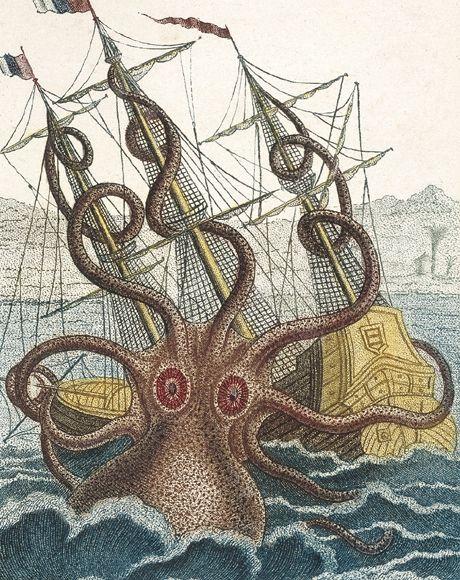
An exciting but decidedly overblown rendering of a giant octopus from an 1805 French work on marine life. (credit 18.12)
So why, if the seas are so vast, do we so easily overtax them? Well, to begin with, the world’s seas are not uniformly bounteous. Altogether less than a tenth of the ocean is considered naturally productive. Most aquatic species like to be in shallow waters, where there are warmth and light and an abundance of organic matter to prime the food chain. Coral reefs, for instance, constitute well under 1 per cent of the ocean’s space but are home to about 25 per cent of its fish.
Elsewhere, the oceans aren’t nearly so rich. Take Australia. With 36,735 kilometres of coastline and over 23 million square kilometres of territorial waters, it has more sea lapping its shores than any other country, yet, as Tim Flannery notes, it doesn’t even make it into the top fifty among fishing nations. Indeed, Australia is a large net importer of seafood. This is because much of Australia’s water is, like much of Australia itself, essentially desert. (A notable exception is the Great Barrier Reef off Queensland, which is sumptuously fecund.) Because the soil is poor, it produces practically no nutrients in its run-offs.
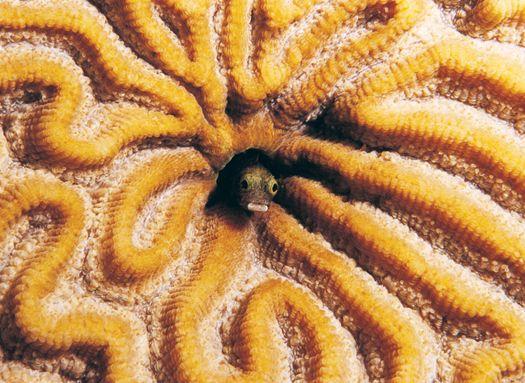
A type of fish known as a blenny cautiously peers out from a brain coral in the Dutch Antilles. Coral reefs take up less than 1 per cent of the oceans’ space, but provide homes for a quarter of their fish. (credit 18.13)
Even where life thrives, it is often extremely sensitive to disturbance. In the 1970s, fishermen from Australia and, to a lesser extent, New Zealand discovered shoals of a little-known fish living at a depth of about 800 metres on their continental shelves. They were known as orange roughy, they were delicious and they existed in huge numbers. In no time at all, fishing fleets were hauling in 40,000 tonnes of roughy a year. Then marine biologists made some alarming discoveries. Roughy are extremely long-lived and slow-maturing. Some may be 150 years old; any roughy you have eaten may well have been born when Victoria was Queen. Roughy have adopted this exceedingly unhurried lifestyle because the waters they live in are so resource-poor. In such waters, some fish spawn just once in a lifetime. Clearly these are populations that cannot stand a great deal of disturbance. Unfortunately, by the time this was realized the stocks had been severely depleted. Even with good management it will be decades before the populations recover, if they ever do.
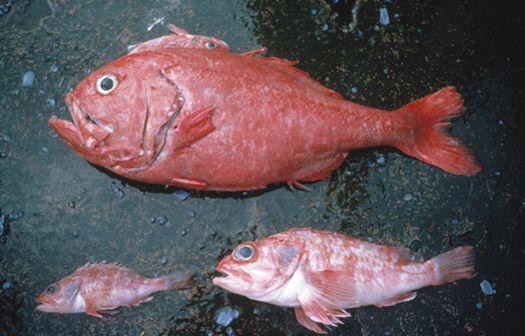
Orange roughy, a sluggish but delicious ocean fish, were caught in vast numbers before marine biologists realized how desperately susceptible to extinction they were. (credit 18.14)
Elsewhere, however, the misuse of the oceans has been more wanton than inadvertent. Many fishermen “fin” sharks—that is, slice their fins off, then dump them back into the water to die. In 1998, shark fins sold in the Far East for over $110 a kilo, and a bowl of shark-fin soup retailed in Tokyo for $100. The World Wildlife Fund estimated in 1994 that the number of sharks killed each year was between 40 million and 70 million.
As of 1995, some 37,000 industrial-sized fishing ships, plus about a million smaller boats, were between them taking twice as many fish from the sea as they had just twenty-five years earlier. Trawlers are sometimes now as big as cruise ships and haul behind them nets big enough to hold a dozen jumbo jets. Some even use spotter planes to locate shoals of fish from the air.

Shark fins bagged for sale in Hong Kong. The fins are sliced from the sharks by fishermen who then throw the fish back into the water to die. (credit 18.14a)
It is estimated that about a quarter of every fishing net hauled up contains “by-catch”—fish that can’t be landed because they are too small or of the wrong type or caught in the wrong season. As one observer told The Economist: “We’re still in the Dark Ages. We just drop a net down and see what comes up.” Perhaps as much as 22 million tonnes of such unwanted fish are dumped back in the sea each year, mostly in the form of corpses. For every kilogram of shrimp harvested, about four kilograms of fish and other marine creatures are destroyed.
Large areas of the North Sea floor are dragged clean by beam trawlers as many as seven times a year, a degree of disturbance that no ecosystem can withstand. At least two-thirds of species in the North Sea, by many estimates, are being overfished. Across the Atlantic things are no better. Halibut once abounded in such numbers off New England that individual boats could land 20,000 pounds of it in a day. Now halibut is all but extinct off the northeast coast of America.
Nothing, however, compares with the fate of cod. In the late fifteenth century, the explorer John Cabot found cod in incredible numbers on North America’s eastern banks—shallow areas of water popular with bottom-feeding fish like cod. The fish existed in such numbers, an astonished Cabot reported, that sailors scooped them up in baskets. Some of the banks were vast. Georges Banks off Massachusetts is bigger than the state it abuts. The Grand Banks off Newfoundland is bigger still, and for centuries was always dense with cod. They were thought to be inexhaustible. Of course they were anything but.
By 1960, the number of spawning cod in the north Atlantic had fallen to an estimated 1.6 million tonnes. By 1990 this had sunk to 22,000 tonnes. In commercial terms, the cod were extinct. “Fishermen,” wrote Mark Kurlansky in his fascinating history, Cod, “had caught them all.” The cod may have lost the western Atlantic for ever. In 1992, cod fishing was stopped altogether on the Grand Banks, but as of autumn 2002, according to a report in Nature, stocks had still not staged a comeback. Kurlansky notes that the fish of fish fillets or fish fingers was originally cod, but then was replaced by haddock, then by redfish and lately by Pacific pollock. These days, he notes drily, “fish” is “whatever is left.”
Much the same can be said of many other seafoods. In the New England fisheries off Rhode Island, it was once routine to haul in lobsters weighing 9 kilograms. Sometimes they reached over 13 kilos. Left unmolested, lobsters can live for decades—as much as 70 years, it is thought—and they never stop growing. Nowadays few lobsters weigh more than 1 kilogram on capture. “Biologists,” according to the New York Times, “estimate that 90 per cent of lobsters are caught within a year after they reach the legal minimum size at about age six.” Despite declining catches, New England fishermen continue to receive state and federal tax incentives that encourage them—in some cases all but compel them—to acquire bigger boats and to harvest the seas more intensively. Today the fishermen of Massachusetts are reduced to fishing the hideous hagfish, for which there is a slight market in the Far East, but even their numbers are now falling.
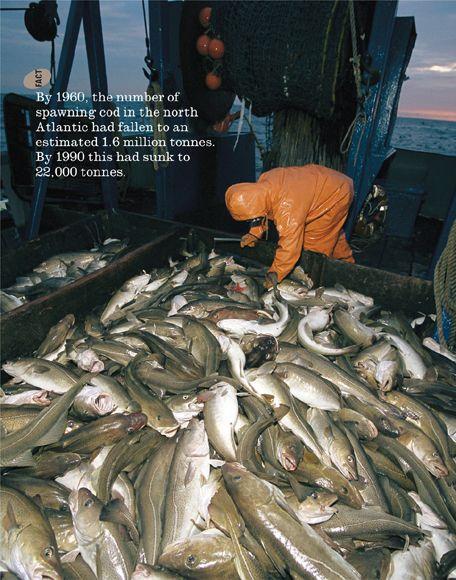
 By 1960, the number of spawning cod in the north Atlantic had fallen to an estimated 1.6 million tonnes. By 1990 this had sunk to 22,000 tonnes.
Cod, once so abundant that they could be scooped up in baskets lowered over the sides of ships, are now commercially extinct across much of the north Atlantic. (credit 18.15)
We are remarkably ignorant of the dynamics that rule life in the sea. While marine life is poorer than it ought to be in areas that have been overfished, in some naturally impoverished waters there is far more life than there ought to be. The southern oceans around Antarctica produce only about 3 per cent of the world’s phytoplankton—far too little, it would seem, to support a complex ecosystem, and yet they do. Crab-eater seals are not a species of animal that most of us have heard of, but they may actually be the second most numerous large species of animal on Earth, after humans. As many as 15 million of them may live on the pack ice around Antarctica. There are also perhaps 2 million Weddel seals, at least half a million Emperor penguins, and maybe as many as 4 million Adelie penguins. The food chain is thus hopelessly top-heavy, but somehow it works. Remarkably, no-one knows how.
All this is a very roundabout way of making the point that we know very little about Earth’s biggest system. But then, as we shall see in the pages remaining to us, once you start talking about life, there is a great deal we don’t know—not least, how it got going in the first place.
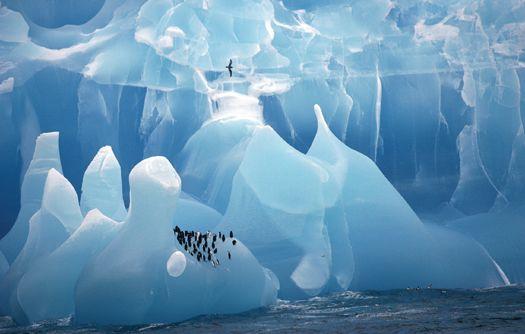
A flock of penguins cling to a precarious perch on the frigid edge of Antarctica, proof that life exists wherever it can. Surprisingly, the pack ice around Antarctica is home to some of the largest populations of animals on Earth. (credit c.16)

1 The indigestible parts of giant squid, in particular their beaks, accumulate in sperm whales’ stomachs into the substance known as ambergris, which is used as a fixative in perfumes. The next time you spray on Chanel Number 5 (assuming you do), you may wish to reflect that you are dousing yourself in distillate of unseen sea monster.
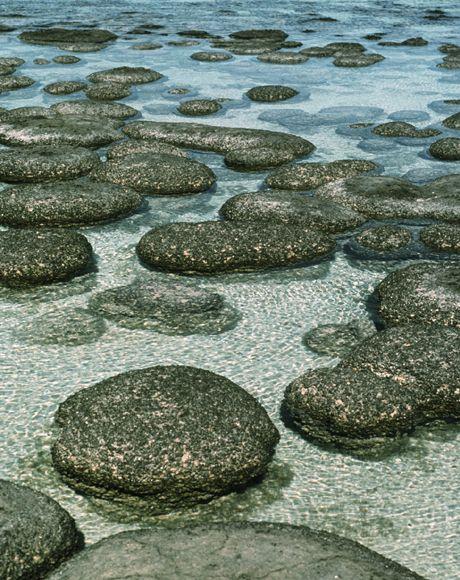
Perhaps the slowest evolving of all life forms, and now among the rarest, are stromatolites—a kind of living rock made by billions and billions of microscopic cyanobacteria. The tiny respirations of these organisms over millions of years largely created Earth’s oxygen-rich atmosphere, paving the way for more complex living things. These specimens are from Shark Bay in Australia. (credit 19.1)