
CHAPTER NINE
The term ‘waste silk’ is somewhat misleading, suggesting a material that has no value at all. Basically, it refers to any silk that isn’t suitable for reeling. This can be from a number of different reasons. The moth may already have started emerging from the cocoon. The thread that makes up the cocoon is uneven, with the outer part too thick and the inner part too thin. The cocoon may simply have been damaged or the raw silk might have needed re-reeling, during which process breakages had occurred – the latter was known in the trade as ‘gum-waste’ because the gummy substance that holds everything together in the cocoon has not been removed. As mentioned in Chapter One, even in the earliest days of silk manufacture, a use was found for waste silk for a filling for padded garments.
There must have been an abundance of waste silk from the earliest days of manufacturing in China, just as there was in later years when production was established in Europe. There is, however, very little evidence to show how it was used. There are references to its use as stuffing, when it was imported into Britain, as ‘soldiers’ bedding’ to be spun in mills. One of the earliest references comes from Jean-Baptiste du Halde, The General History of China (1736), ‘As the Chinese are very skilful in counterfeiting, they make a false sort of Kientcheou with the waste of the Tehi-Kiang silk, which without due inspection, might easily be taken for the right.’ As du Halde had never himself visited China, but based his book on reports sent back by Jesuit missionaries, the claim of counterfeiting might not be taken too seriously. Later references refer to carded silk being used to make ‘durable dresses for the peasantry’. Evidence of the spinning of short-fibred silk in Asia can be traced back for centuries. In India there was a long tradition of manufacturing Eri silk. This comes not from the Bombyx Mori but from Samia Ricini, a moth whose caterpillars feed on the leaves of the castor plant. Because the silk produced has short, quite coarse fibres it had to be carded and spun, like cotton – the system that would need to be applied to work waste silk. A. Yusuf Ali in a monograph of 1900 described the manufacture of Eri silk in detail, and then went on:
In the case of the mulberry feeding silkworm, after the glossy portion has been reeled off there is a small quantity of fluffy fibre which cannot be reeled and is called waste silk or chashm. This is mixed with some pea flour and boiled, while still moist and warm, thus dissolving any mucilaginous matter that there may be in it, and rendering the substance soft and pliable. After being dried this chashm of bombycide silk is spun and twisted in the same way as Eli silk.
As we know that Eri silk has been made for centuries, it seems reasonable to assume that as the technology was available, carding and spinning waste silk has a similarly long history in Asia. We just don’t know how long.
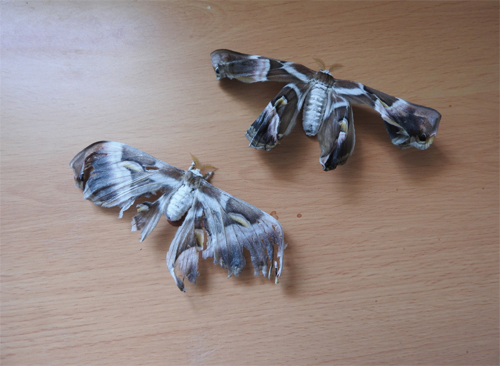
Eri silk moths from an Indian silk farm.
At first, as far as Europeans were concerned, the waste silk was considered to have only small value. It was imported as ‘nubs’ or ‘knubbs’, and an official document of 1593 shows that long raw silk was roughly ten times as valuable as nubs. Because the silk cannot be reeled it has to be carded and spun, just as other materials such as wool and cotton are treated. Carding gets its name from the earliest form in which it appeared. This used a pair of boards studded with wire, which were held in the hand, and the fibres were laid across one, while the other was pulled across. This disentangled and straightened the fibres. In the eighteenth century, hand cards were replaced by mechanical cards, using a wire studded drum, powered at first by water and later by steam. The good quality short fibres treated in this way are known as noil silk. In France and Piedmont, raw silk was also treated by carding. Silk that was slightly inferior, perhaps rather weak or coarse, was carded and spun to create what were called Floretta, described by Ephraim Chambers in the Cyclopedia of the Arts and Sciences (1728) as ‘a tolerable silk’. Chambers then goes on to describe the treatment of silk from damaged cocoons.
As to the balls, after opening them with scissors and taking out the insects (which are of some use for the feeding of poultry), they are steeped three or four days in troughs, the water whereof is changed every day to prevent their stinking. When they are well softened by this scouring and cleared of that gummy matter, the worms had lined the inside with, and which renders it impermeable to water, they boil them half an hour in a ley of ashes, very clear and well strained; and after washing them out in the river and drying them in the sun they card and spin them on the wheel, &c, and thus make another kind of Floretta, somewhat inferior to the former.
‘Floretta’ is just one version of the French ‘fleuret’ and the English ‘floret’, but it is the French version that came into general use when referring to silk. The spoiled cocoons were boiled, dried and beaten, and in the early days, the cocoons were then set onto a distaff, broken open and fibres pulled out to arm’s length at each side. The fibres were then carded and spun. Over the years, the English version of the word fleuret became the rather less romantic floss. The yarn that was produced was only rarely used for making cloth, but was generally sold on bobbins, and was ideal for use in embroidery. These yarns were being made in France as early as the sixteenth century.
The interest shown in utilising waste silk is hardly surprising, since between broken cocoons and damage during reeling and doubling, there was in any processing generally more waste than usable fine silk. Inventors soon began applying their ingenuity to finding new and improved ways of using this material. One of the earliest applications for a patent was made by Edmond Blood of London in 1671. His description of his invention was notably short of detail:
A NEW manufacture, being a Rich Silk Shagg commodious for Garments, made of a Silk Wast, hitherto of little or no use, and shagged by Tezell or Rowing Cards, like an English Bayes, Rowed Fustians or Dimatyes, a sort of Manufacture never before knowne or made in this our Kingdome.
Apart from the archaic spellings, it is fairly clear what he was making, even if it is far less obvious just how he was doing so. Teasel heads were regularly used in the woollen industry to raise the nap of the cloth, either in the form of hand held cards or in teasel gig mills. In the latter, the plant heads were set in batons fixed to the rim of a rotating drum, over which the cloth was passed. A rare survivor of this type of machine, powered by a water wheel, can be seen at Dunkirk Mill, Nailsworth, and is regularly demonstrated to the public. ‘Rowing’ refers to roving cards, which do the same job as the teasels. ‘Shagg’ is what is now known as shag, a material with a rough surface – most people come across the word in shag pile carpets. ‘Bayes’ is baize. In a further note, Blood indicated that his silk shag could either be used on its own or mixed with linen. He does not appear to have placed a very high estimate on the value of his invention, as all he was asking for its use was an annual rent of six shillings and eight pence, slightly over a hundred pounds at today’s prices.
The eighteenth century saw the appearance of more patents for treating waste, among which was one by Dr Edmund Cartwright, famous for his power loom. On this occasion, however, his machine for combing seems never to have actually gone into production. Even in the heart of the cotton industry of Lancashire, there was one manufacturer, Thomas Wood of Holcombe, who patented a machine for carding and roving silk – though it too never left the page to turn into physical reality. So, throughout a long period, lasting right up to the end of the eighteenth century, waste silk remained the poor relation.
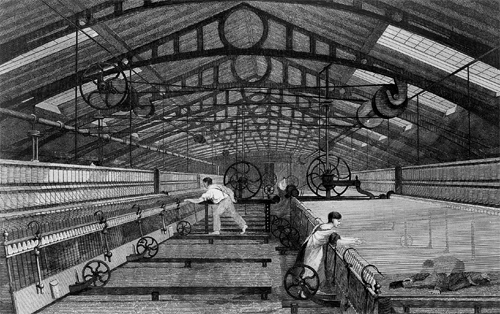
A nineteenth century engraving of mule spinning; a notable feature is the small boy crawling among the moving machinery.
One reason why waste silk did not become a really useful material was the method of manufacture. The process began with passing the waste through a breaker to disentangle the worst of the knotty connections, dressing it and then cutting it into lengths of about two inches. As one of the great virtues of silk is the length of the fibre, it seems perverse to cut it up, but one can see why. The rest of the processing was similar to that for other fibres, such as flax and cotton. The material was first scutched – a process used for flax – which involved using a wooden device called a knife, which removed any loose, unwanted material from the fibres. It was then carded and prepared for spinning. At the beginning of the nineteenth century, most spinning used mules. These are ingenious devices, originally developed for the cotton industry. To put it briefly, the mule consisted of a fixed section, with the unspun, but loosely wound, cotton on a row of bobbins. From these, the thread was taken to spindles, mounted on a wheeled carriage. The process starts with the carriage moving away from the main frame, drawing out the cotton, and then, at the end of the run, the spindles turn to impart twist, after which the carriage returns, and the twisted yarn is wound onto the spindles, ready for the next run. The alternative was the throstle, which was a development from the first successful cotton spinning machine, invented by Richard Arkwright, known as the water frame, because it was powered by a water wheel. In this machine, the threads were stretched by being passed through rollers, moving at different speeds. They then passed down to a rotating flyer to provide the twist. The throstle used the same basic idea but was designed for use with steam power. Because the machines were intended for use with the short staple cotton, it seemed sensible to reduce the silk waste fibres to a similar length for spinning by mule or throstle, but two Glaswegians, John Gibson and John Gordon Campbell, thought otherwise. In 1836, they applied for a patent for what was described as a new or improved process for manufacturing silk.
The patent of 1836 contained descriptions of eight different processes, of which the most important were the descriptions of spinning the long, uncut fibres on an improved throstle, together with spinning in combination with wool or flax. In a further elaboration, the patent described the process as ‘the same as that used by flax spinners’. The patent was granted and the yarn became known as ‘Patent Long Spin’. As soon as the patent was approved, complaints started to appear, challenging it on the grounds that spinning long waste was not new, but had been carried out for some time. A court case was brought, Gibson v Brand, in which Brand claimed that he had purchased waste silk and sent it away to be spun uncut on a flax spinning machine long before 1836. Eventually, it was agreed by the Court of Common Plea that although it was said that the earlier processes had been carried out in secret, which would not have invalidated the patent, there was sufficient evidence that spinning uncut fibres was a common practice, ‘although it had not been carried to such a state of perfection as under the present patent.’ As a result, some parts of the patent remained unchanged, and instead of being officially described in the wording as a ‘new or improved process’ it was now simply ‘improved’.
Silk spinners seem to have been a contentious lot. Towards the end of the century, Samuel Cunliffe Lister began manufacturing waste silk imported from India. He was awarded the Albert medal by the Royal Society of Arts for his role in importing waste silk from India and establishing long spinning. This led to his being challenged in a letter in the local paper, signed by ‘The Silk Club’, which pointed out that others had imported Indian silk and used it before Lister. Lister’s reply in March 1887 contains a great deal of fascinating information. He began by agreeing that waste silk had been spun long before he started in business, and that he had not made the claims himself and that the assertions were made by the RSA while he was ill in bed. But he pointed out that the spinning of Indian waste only became profitable due to improvements in machinery.
I remember well the first time that I saw anything of the kind was at Messrs. Holdforths’ mill at Leeds – I think in 1846. Having at that time gained some notoriety in wool-combing, Mr. Holdforth asked me to come over and see his silk-dressing machine, and to improve it if I could. I thought then, and still think, that it was one of the rudest and crudest of machines, but, as I know to my cost, very hard to beat. I had no idea when examining it carefully for the first time, of the long years of toil and trouble, and the ruinous sums it would cost me before I should be able to master it – and I am not sure that I have succeeded even now, after forty years (that is for all sorts) – but I can, at any rate, say that I have, as far as I know, invented and patented the first self-acting dressing machine, with plenty of room for improvement for those who come after me.
Among the other inventions, mentioned in the letter, was the intersecting gill, invented by his partner Mr. Warburton, a machine with two sets of teeth, one above the other, through which the silk was drawn for dressing. He went on to describe how he came to work with waste silk from India. He was shown a sample by a waste silk merchant called Spensley, who thought it worthless – ‘he said, laughing, that he had tried to use it as manure, but it would not rot.’ He bought a few bales, but once he had finally succeeded in developing the dressing machine, he was buying thousands of bales. When he began manufacturing, he also acquired a loom for weaving velvet, which is created by weaving two layers of fabric at the same time. His original mill burned down in 1871 and its replacement in the Manningham district of Bradford is a mark of just how successful he had become. It was the biggest silk mill in the country, with a floor area of around 27 acres. It was steam powered and the mill chimney still dominates this whole area, rising to an imposing 249 feet. The 32 boilers that supplied the power consumed 1,000 tons of coal a week. At its peak, it employed over 10,000 operatives, mainly women, and continued in operation right through to the end of the twentieth century. Its velvets were particularly sought after, and the company had some notable clients, including King George V and President George Bush, who ordered curtains for the White House. In the Second World War, the mill was kept busy turning out thousands of yards of parachute silk.

Manningham mill, Bradford, that specialised in waste silk spinning and was the biggest silk mill in the country. It has now been converted into apartments.
At the end of the letter, he complained about the fall in demand, because of the rise in price of the raw material and foreign competition. One particular problem was high tariffs raised against British silk by the American government to protect their own industry. Shortly after Lister wrote his letter to the Silk Club, on 9 December 1889 he posted a notice cutting the wages of large groups of workers which informed them that they could either accept the cuts or be locked out. The workers appealed to the Weavers Textile Association for help and one of their representatives made their case to Lister’s. He pointed out that the company had made profits of £138,000 and that the cut in wages would only bring in a modest £7,000 but the affected workers would see their pay cut by a massive 20 per cent. The company refused to accept the argument, and a bitter strike followed. Some 200 blackleg workers were brought in under police escort to carry out little more than essential maintenance work. Meanwhile, the Poor Law Commissioners decreed that strikers could not receive any benefits. The end was inevitable; poverty forced the workers to submit. The strike may have been over, but the dissatisfaction of the workforce had not gone away, and it was felt that they needed to organise themselves to make their voices heard. Shortly after that, the local workers got together to form the Bradford Labour Union. And it was in Bradford that that organisation formed the basis for a brand new political force in Britain – the Independent Labour Party, forerunner of the modern Labour Party. It is somewhat ironic that the country’s first socialist party should have had its roots in the country’s most luxurious industry.
Lister was not the only one aiming at improvements in the production and quality of waste silk. Because the threads were generally coarser than those from unbroken filaments, they were ‘gassed’ to remove any unevenness. The threads were passed through a gas flame, which removed any irregularities, which in theory left the silk more lustrous, but unfortunately was also inclined to leave a film of ash, which had exactly the opposite effect, dulling it again. Machine makers from Rochdale, W.H. Prince and James Tomlinson, patented a device for cleaning the silk after gassing, by running it round a number of caps to remove the ash. They sold the rights to Lister’s.
The growth of the waste silk industry was helped by a steady reduction in the government tax on the imported raw material, which in 1819 had been as high as £22 a hundredweight but which had reduced to a shilling a hundredweight just ten years later and then dropped altogether. This was reflected in the figures for imports, which in the three years 1815-17 had been 27,000 tons but had risen for 1839-41 to over a million tons. This gives some idea of the growing importance of the waste industry and does not even take account of the waste silk generated by silk throwing mills in Britain. The spun silk was used in a variety of different ways, often to produce comparatively cheap goods which, in the early years, went into bandanas for export, but it could also be used for more luxurious items. Paisley began to use spun silk for its famous shawls and tablecloths.
A very different type of spun silk began to gain popularity towards the end of the nineteenth century. Tussah silk is the product of the wild silk moth of India. This is a quite different species of the genus Antheraea and unlike the cultivated moth of China it is not a fussy eater, munching at a wide variety of plants, with a particular fondness for oak leaves. The filaments of the cocoon are lightly coloured and the oak eating worms produce an attractive honey coloured thread. It was not immediately accepted but, in 1872, Sir Thomas Wardle used Tussah, dyed black, to make a silk ‘sealskin’, which was exhibited at the Paris Exhibition of 1878. It became a very popular line. The machinery first developed in Britain made it possible, and waste spinning soon spread across the world, not just to Europe but also across the Atlantic. The development of the silk industry in America is the next subject and needs a chapter of its own.