
CHAPTER EIGHT
There were many reasons why masters might want to leave London, apart from the various riots that had darkened the scene. For some it was simply a chance to extend their business on their own terms, without the restrictions imposed by the Spitalfields Acts. Suffolk had been an important area for woollens since medieval times, but the introduction of water-powered machinery gave the north of England with its fast-flowing streams and rivers an overwhelming advantage. By the end of the eighteenth century, the industry was in terminal decline, but it did have a large population of skilled weavers. Sudbury was the town chosen for major developments; one advantage it had was that it lay at the head of the Stour Navigation, which made it ideal for importing raw material and exporting finished products. The Vanner brothers, of Huguenot stock, moved here in the late eighteenth century and their descendants are still here today. They began using Jacquard looms, but by 1900 they had power looms installed in a new factory but still in Sudbury, where they continue to manufacture silk and have their own dyeing and cloth finishing departments. They were to be followed by other London weavers and by 1844 there were approximately 600 looms in the town. Others followed.
Benjamin Walters was a weaver in Paternoster Row, London, in 1720 and his son Joseph followed him in the trade. Joseph’s son – Joseph Walters II – was also to become a weaver but, rather than teach the boy himself, his father sent him as an apprentice to John Dubois. It seems that, even in the early eighteenth century, the Huguenots still had a reputation as being the finest craftsmen in the region. Joseph and his brother George set up business and home in Wilkes Street, Spitalfields. Eventually, the family business grew too big for the house in Wilkes Street, and they established what might well have been the first silk weaving factory in London, though still using hand looms. Over the years, they moved further and further out of London and at Kettering they established a factory that was one of the pioneers in using power looms. By 1860, they had established a factory in Sudbury and the family business is still there today as Stephen Walters. Their reputation was so good that they received a number of high prestige commissions, including weaving the material for both Princess Anne and Princess Diana’s wedding dresses. They clearly benefitted from the experience that Joseph II gained from his Huguenot connection, though his old teacher would no doubt be astonished if he visited the modern factory to see the high-speed rapier looms controlled by computers.
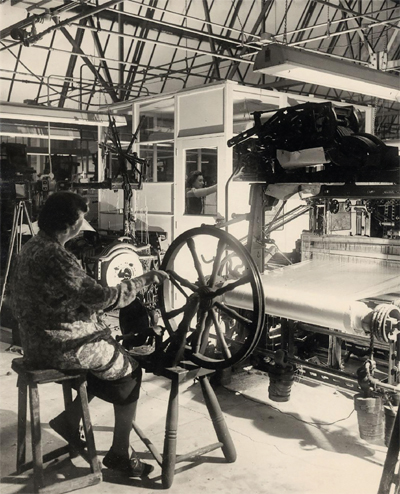
Gwen Curtis working at Walters factory on a fifty year old loom, weaving a silk lining for the coronation robe for Queen Elizabeth II.
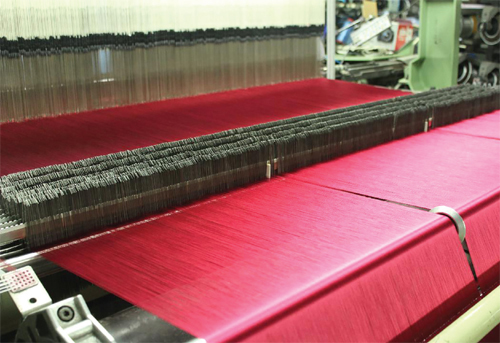
A modern rapier, shuttleless loom at the Walters silk factory.
Sudbury remains the major centre for silk weaving in Britain and there are still memories of the former handloom days in streets of old weavers’ cottages that survive in the town, easily recognised by the large windows that mark the position of workshops. A row in Cross Street, for example, had living quarters on the ground floor, well lit workshops on the floor above, and bedrooms above that. It was not the only place weaving silk in the early eighteenth century, and one notable mill in Hampshire went through several different owners, including for a short time, Stephen Walters. The Hayter family began building a water-powered mill at Whitchurch in Hampshire in 1813 on land owned by the Dean and Chapter of Winchester Cathedral. Unfortunately, the family went bankrupt in 1817 and the mill was sold to a silk merchant, William Maddick. He set about making improvements, adding a middle floor to the mill and creating the mill pond. The yarn was prepared in the main mill building, which was flanked by single-storey weaving sheds. It had a somewhat chequered history, changing hands several times. In 1845, it was taken over by the Chappell family but when Adelaide Chappell was widowed, she found it difficult to keep the business going. She sold off the northern weaving shed, which was converted into four cottages. By 1886, however, she was no longer able to cope, and once again the mill came on the market. This time it was bought by a local draper for his son, James Hyde. This marked the start of a long period of successful work, mainly weaving coloured silk linings for Burberry raincoats.
The new owners made improvements, including installing a new waterwheel with the latest developments, including a centrifugal governor that controlled the flow of water to the wheel. This is a device usually seen on steam engines. A pair of heavy metal balls are attached to a central spindle – as the flow of water increases and the wheel speeds up, so too does the spindle, so that the balls are forced further apart by centrifugal force. This action is geared to a system that raises and lowers boards between the mill stream and the wheel. The mill continued to struggle financially, and in 1956 Stephen Walters & Son stepped in to try and keep the historic site going. It was to have one other owner before it was taken over in 1985 in a fairly derelict condition by Hampshire Building Preservation Trust who restored it as a working industrial museum.
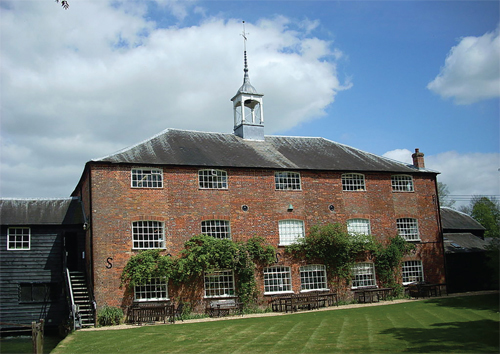
The eighteenth century silk mill at Whitchurch, Hampshire.
The main building is a reminder that the period we now refer to in Britain as the Industrial Revolution was also the Georgian age, which was notable for the elegant, classical simplicity of its architecture. Whitchurch Mill could easily be mistaken for a rather grand country house were it not for the little clock tower on the roof. The clock itself was installed to celebrate the victory at Waterloo and has been ticking away merrily ever since. Inside the main building, the ground floor is largely taken up with conventional power looms. Unfortunately, the low ceilings have never made it impossible to install the tall Jacquard mechanism. The winder on the upper floor is still geared in to the water wheel, and it is here that warping takes place. It is the last working silk mill in Britain that still uses any form of water-power in its processes and today produces specialist, high quality silk cloth. It is a reminder, too, that silk weaving has never had an easy passage in this country, as the many different owners testify. It is also, perhaps, somewhat surprising to find a thriving silk mill in this area. But the silk industry was never limited to one area. Even in the heart of the West of England, where the Gloucestershire mills were famous for producing woollen cloth, many silk mills thrived for a time. Blockley is now thought of as a quaint Cotswold village, yet silk throwing mills existed here as early as the start of the eighteenth century. The trade only died away completely in the 1880s, but for a time it was an important centre for silk throwing, mostly supplying yarn to the ribbon weavers of Coventry. Many other Gloucestershire mills were used for silk throwing for a time, mostly being converted from older woollen mills. In the latter part of the nineteenth century it was estimated that there were about 1,000 workers employed in the industry in the five valleys centred on Stroud. The other important centre in the county was Tewkesbury, where they specialised in manufacturing silk stockings. Many counties which we no longer associate with the industry had important centres for silk manufacture, several of which had their own specialities.
Coventry was one of the biggest customers for Gloucestershire throwing mills, where the silk ribbon industry was established early in the eighteenth century. It followed the usual pattern of masters sending the raw material to outworkers with their own looms. There are few reminders of the industry today in the city, but in its heyday, it was reckoned that almost half the population of Coventry were involved in the trade. I was actually totally unaware of the trade when I came to Coventry by canal in the 1970s, but I do remember being surprised to see a row of cottages on the canal side as we approached the city that had the unmistakable large windows that indicated hand working had once gone on inside.
Ribbon weaving seems to have first arrived, as did so many other branches of the industry, with Huguenot refugees. That it thrived and was a major employer can be gauged by the story of just one manufacturer, Thomas Bird, who died in 1756 and whose obituary stated that he daily employed over 2,000 weavers. This seems an extraordinarily large number, but at this time all the ribbons were hand woven on narrow looms, only able to weave a single ribbon. This was very delicate work, with the shuttle simply being passed using the fingers and it was possible to add decorative details, such as beading. When wider looms were introduced, capable of weaving several ribbons at once, this was no longer possible, so the hand-woven ribbons from the narrow looms were always special and enabled the craft to continue well into the machine age. The weavers at one time were paid one third of the price received when the goods were sold from the master’s warehouse.
The Cash family were prominent Quakers, who took an unusually benevolent interest in their workers’ welfare. Joseph Cash and sons Josiah and John began making ribbons in 1846, when they had offices and a warehouse in Hertford Street with a factory at West Orchard – a site now occupied by a shopping centre. They provided allotments for their workers and established a nursery school for the families in the grounds of their home. They were well aware that the days of the handloom were drawing to a close, but rather than simply build a weaving mill and hiring a workforce, they set up a system that was a sort of half-way house between home weaving and a factory. They built Cash’s Top Shops in 1857. These consisted of two rows of conventional two-storey cottages, built to a high standard and each one having its own little garden. But on the third floor was the loom workshop, with immense windows. Each weaver had his own access to the workshop from his home, and here the Cashes installed Jacquard looms, powered by a steam engine in the courtyard and with line shafting and belts driving the looms. The workers also had a number of benefits, including a canteen, sickness benefits and an annual trip to the seaside, paid for by the company. Things went well at first, but in 1860, the Free Trade Bill became law, and England was flooded with cheap French ribbons. It was the death knell for ribbon weaving in Coventry, but Cash’s adapted. Instead of ribbons they started a profitable business weaving name tags and labels. All over Britain in the first part of the twentieth century, mothers would be taking strips of name tags, cutting them into sections and sewing them into school uniforms. The family continued with the business right up to 1976. The Top Shops are still there, right alongside the Coventry Canal but no longer in use.

Ribbon loom manufactured by T. Wilkinson of Coventry circa. 1910 with Jacquard attachment that weaves four ribbons simultaneously, now in the Manchester Museum of Science and Industry.

Cash’s Top Shops in Coventry; the workers lived in the terraced houses, with the workshops above them on the top floor.
The crash of the 1860s saw mass unemployment among weavers and it has been estimated that some 9,000 people left the city in just two years, many of them emigrating. One man who, like the Cash family, found a solution to the problem by starting in a new line of business was Thomas Stevens. He was involved, like many others, in weaving plain and fancy ribbons and had premises in Queen Street, but he was also something of an innovator. He began using the Jacquards to weave coloured silk pictures. He could use the ribbon looms for the work – with the pattern repeating. He then used the designs not to create ribbons but bookmarks. One special bookmark that he created to mark the opening of the Coventry Market Hall in 1867 was 13 inches long and required a total of 5,500 Jacquard cards to complete the design. By 1862, he was selling a range of bookmarks, from quite simple ones costing just sixpence each to large elaborate ones for church Bibles costing fifteen shillings. He was always on the lookout for new openings and managed to obtain a contract from the Admiralty for sailors’ hat ribbons with the name of the ship woven in gold. The business kept expanding and new premises were built in West Orchard and when that proved inadequate, a third factory was established in Cox Street. At the same time, the pictorial ware was given a new trade name – Stevengraph – and was soon winning medals at trade fairs around the world. The works continued being run by the family but the Cox Street factory was bombed into oblivion, like so much else in Coventry, in the air raids of the Second World War.
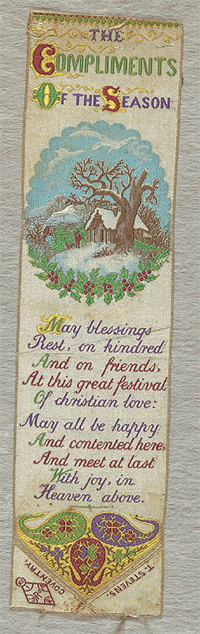
A silk bookmark by T. Stevens of Coventry, 1871.
Another town that began with a specialist trade was Macclesfield, which was known for manufacturing ornate buttons as early as the middle of the seventeenth century. Silk buttons in particular became a must have for the fashionable ladies and gentlemen of the time. They were embroidered by hand on wooden moulds. The work was almost entirely done by women and children and, in 1698, the Corporation issued an instruction that ‘poor children and the poor’ should be taught button making. Many of the buttons were sold wholesale and the rest were sold around the country by chapmen or pedlars. Many of them came from the settlement of Flash, which had been built up by individuals on the wasteland and led to them being known as ‘Flashmen’. The cost of imported silk from countries such as Turkey was more than balanced by the return export of woollens. But hand-made silk buttons were expensive, and cheaper versions that could be made to look quite gaudy found a ready market. The government saw the import of silk falling and with it the valuable exports, so they issued a law in 1709 forbidding ‘the making or selling Buttons made of Cloth Serge Drugget or other Stuffs’. Anyone found doing so was fined five pounds for every dozen buttons. Enforcing the Act proved difficult and it was, in any case, self-defeating at least according to Jon Aitken in his book A Description of the Country from Thirty to Forty Miles round Manchester (1795). ‘Hired informers were engaged in London and the country – an odious and very uncommercial mode of enforcing a manufacture! The result of which was to promote the use of metal and horn buttons.’

An eighteenth century English silk button on a wooden mould.
It was inevitable that, following the success of the Derby mill, a town with such a large number of people working with silk would want to follow Lombe’s example. The first small mill was built by Charles Roe at Park Green in the 1740s and was soon followed by others. Financing this new industry was not a problem for Roe, who had developed a new interest in copper mining and smelting, which was to turn more profitable than he could ever have imagined. His agent made a remarkable discovery that a modest hill on Anglesey called rather too grandly Parys Mountain was in fact one of the richest sources of copper ore ever found in Britain. Its exploitation was so successful that it brought the traditional copper mines of Cornwall and Devon close to bankruptcy for a time. For a while, Macclesfield was one of the leading manufacturers of silk in the country, and when Sir Frank Warner wrote his history of the silk industry in 1921, it was still thriving. The mills have now all closed, but the town is still home to two very fine museums to the industry, demonstrating both the machinery and the wares.
There were areas of silk production on various scales throughout much of Britain, but one more place deserves a special mention as it has given its name to an enduringly popular design: Paisley. The manufacture was started in about 1760 by Humphrey Fulton. He had begun his working life as a packman, a type of travelling salesman. He then began to manufacture linen before turning to silk gauzes in imitation of the work he had seen in Spitalfields in his packman days. The business was a success and he was soon said to have between 400 and 600 looms working in the town. His success soon brought imitators, including companies from London, attracted by the low wages being paid in Scotland. Later the manufacturers turned to muslin, which attracted the attention of Daniel Defoe as he made his great Tour through the Whole Island of Great Britain between 1724 and 1726:
Here is a manufacture of muslins, and perhaps the only manufacture of its kind in Britain, if not in Europe, and they make them so good and so fine, that great quantities of them are sent into England, and sold there at a good price; they are generally strip’d and are very much used for aprons by the ladies, and sometimes in head-clothes by the English women of a meaner sort, and many of them are sent to the English plantations.
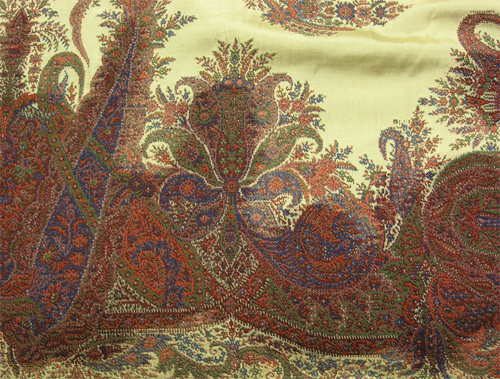
A nineteenth century paisley shawl now in the Auckland Museum, having been brought to New Zealand by the donor’s grandmother.
By 1781, there were reported to be 4,800 silk looms at work. As with other regions, Paisley silk weavers were badly hit by the introduction of factories producing cheap cotton yarn, which inevitably meant cheaper cloth. Having made fine muslins, the weavers began to think of making shawls with oriental patterns. One particular pattern, based on ornate teardrop shapes, had originated in Persia in the third century. The pattern was supposed to represent a cypress tree, a Zoroastrian symbol for eternal life. The design was used widely in Asia and the Middle East. One variety was made in Kashmir from the fine hair of local goats and an example turned up in France during the reign of Louis XIV, where Kashmir became ‘cachemire’ and later in Britain, cashmere. Guilllaume Louis Ternaux decided that he would make these shawls and a party was sent to Kashmir to buy a herd of goats. Of the 1,500 animals that started the journey, only 256 made it alive to France, but that proved enough to make a start. Soon, shawls were being made in a variety of materials, including silk. The fashion spread across the Channel, and they began making shawls in Paisley. It proved a highly lucrative trade and by 1834 was calculated to be worth a million pounds. The weavers stuck to the original design and it became so associated with the town that it soon became known simply as paisley – as it still is. But trade too often goes down as rapidly as it goes up. In 1838 an anonymous witness to a Parliamentary Enquiry of 1838 gave his views of the weavers’ plight in verse.
Hard is your fortune, nurslings of the loom,
Cradled in sorrow, reared in joyless toil;
Stumbling and lost in dull commercial gloom,
Uncheered by hope, your anguish to beguile.
The silk industry as a whole, however, received a major boost, when a new method was found for using the raw material.