
CHAPTER TWELVE
When we last looked at the industry in America, it was still dominated by the Cheney Brothers mills, the company was thriving – and it continued to grow and prosper. A whole new set of mill buildings was constructed between 1872 and 1917. By 1920, they were employing nearly 5,000 workers, a quarter of the population of Manchester, Connecticut. They dominated the town, supplying electricity and gas, building the local fire station and schools and were notably good employers, providing pensions and medical care. Other companies were doing equally well. This did not, however, mean that the mill workers were doing equally well. Between 1909 and 1919, there were a number of strikes in silk mills, of which the most famous took place at Paterson, New Jersey. They were encouraged by the success of a strike in Lawrence, Massachusetts, that had resulted in workers receiving a rise in wages. The Paterson workers had a long list of grievances: wages had been declining, working days were long and conditions poor. The mills were looking to improve productivity by modernisation and wanted to introduce a new system for weavers, where one operative could look after as many as four looms. The movement was led at first by the militant ribbon weavers who looked for help from the Socialist organisation, Industrial Workers of the World (IWW). When the demands of the workers were ignored, the strike began on 25 February.
From the start, it was clear that this was a strike about politics as much as industrial relations, at least as far as the authorities were concerned. On the first day, one of the IWW leaders, Elizabeth Gurley Flynn, gave a speech urging the workforce to unite, ignoring all differences of race and national origins. She was promptly arrested. Within a short time, all the IWW representatives who came to Paterson were also arrested. But it made no difference to the strike. The local workers had their own organisation, and the full force of the law was brought to bear; before it was over, almost 2,000 workers had been arrested. There was to be a final defiant gesture, when the workers organised and performed in a great pageant, but ultimately, they were simply unable to survive with no wages coming in. The strike ended on 28 July. In one sense, it was a battle that could never have been won as long as the strikers were opposing the introduction of the new regime for the looms. It was inevitable that Paterson would have to do as other mills were already doing or lose out to the competition. But the other demands for good working conditions, an 8-hour day and reasonable pay were all too justified but were never met. The defeat of the Paterson strike also saw a decline in the membership of the IWW, though it still exists. But in America the emphasis shifted to less militant labour unions.
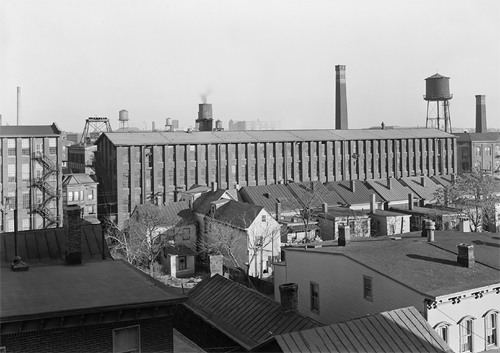
Part of the immense Barnett silk mill at Paterson, New Jersey, photographed in 1937. The industrial buildings tower over the workers’ houses.
The years of widespread strikes in the silk industry ended and the early 1920s were an especially good time thanks to a change in fashions. Hem lines were on the rise and ladies did not want to be seen with bare legs, and quite the most prestigious covering was the silk stocking. The one big difference between this period in the early days of the industry was that the manufacturers in America no longer looked to other Americans to provide the raw material, but turned back to the Far East, and in particular to Japan.
It is not certain when silk was first produced in Japan, but it seems to have arrived via Korea in the fourth century. Printed silk has survived from the eighth century palace at Nara, once the capital of Japan. Soon, it became common practice for Japanese women to rear silkworms in the attics of their houses. The importance of sericulture was emphasised by a custom, still preserved, that each spring the Empress of Japan feeds the silkworms in the palace gardens. In time, the Japanese perfected sericulture to the point where the quality of the silk they produced was the finest in the world, surpassing China, where it had all begun. The secret lay in the care and attention to detail.
In modern Japanese sericulture, the silkworms are raised in trays, in rooms kept at a steady temperature of 24 to 27°C, in a room where the lights are permanently kept on but never shine directly on the caterpillars. Cleanliness is vital and the women of Hangzhou who raise silkworms are forbidden to smoke, wear make up and, rather oddly, eat garlic. According to the web site factsanddetails.com the Japanese follow the rules laid down in China centuries ago.

Japanese workers at the Corticelli Co in America, removing newly hatched silkworms from the egg paper and feeding them.
First of all, the bark of a dog, even a foul smell can upset freshly hatched worms. Second, larvae should rest on dry mattresses, and they must sleep, eat and work in harmony. Third, a worm out of sync with the rhythm and transformation of the majority is buried or fed to fish to avoid any variation in the silk. Fourth, drowsy newly hatched worms are tickled with a chicken feather to prod development. And finally, the attendant, called silkworm mother, should have no bad smells, should wear clean, simple clothes so as not to stir the air and should not eat chicory or even touch it.
The production of these pampered little beasts was almost all carried out in people’s homes, and in the main silk production district of Gumma, there was in its peak period 25,000 of such homes. One of the main customers for Japanese silk was France in the nineteenth century, and it was from Japan that fresh silk worms were supplied after Pasteur had identified the parasite that had affected local stocks. In the 1920s, the American silk stocking manufacturers relied almost entirely on Japanese silk.
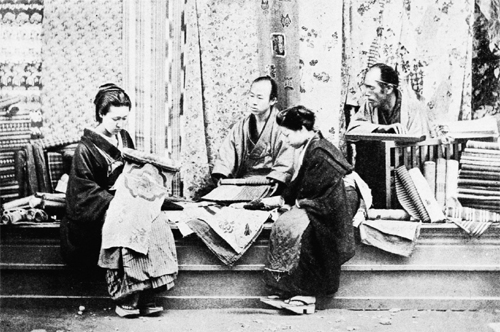
A Japanese silk merchant displaying his wares to potential customers in 1893.
In the latter part of the nineteenth century, the Meiji dynasty was restored in Japan, and it was decided that it was time for the country to try to catch up with the West by a process of industrialisation. Silk was already a major export, but was still based on domestic production, which made it difficult to keep to standards. The government decided that the answer would be the construction of a modern mill complex. The man in charge of the project was Shibusawa Eiichi from the Ministry of Finance, a bureaucrat but one who came from a family who were engaged in sericulture, so understood the problems. With no local experience of modern silk technology, a technical expert was needed, and the job of technical overseer went to Paul Brunat, a Frenchman involved in the silk trade in Yokohama. Working alongside him was Odaka Junchu, who was later to become manager of the mill. The site chosen was Tomioka, where there was an existing domestic silk industry and local coal mines for fuel. The actual construction was entrusted to another Frenchman, Edmond Auguste Bastien. Its appearance, not surprisingly, owed very little to Japanese traditional styles or construction methods. Bastien used timber framing with brick infill and glazed windows. Locals had to be taught how to produce the bricks in the first place, but it marked the beginning of brick manufacture on a large scale in the country. An indication of the degree of the change from Eastern to Western building ideas can be gauged from the fact that the windows had to be brought over from France, machinery was imported from Lyon, and experts came over from France to help set up the machinery and train operatives. They had their own special dormitory block in the complex.
Work began in March 1871 and when the mill opened in July 1872, it was an imposing array, with two big cocoon warehouses and the actual silk reeling mill contained 300 French machines of the latest design. Everything was in place but there was no work force. The idea had been to employ mainly women, but at first none came forward. There was no experience of factory work, and the insular Japanese were more than a little wary of the foreigners who had come to the site with Brunat. The French, not surprisingly, were often to be seen enjoying glasses of red wine with their meals and rumours spread that the foreign devils drank human blood. However, when Odaka Junchu’s daughter volunteered to work in the new factory, other women were persuaded that there was no real problem after all, and recruitment began in earnest. It was not only ordinary workers who were required, but also women who could be trained in the new technology and then go out to teach others. Teaching was an acceptable occupation, and young women from high ranking, including Samurai, families came to the mill. The locals called them ‘silk princesses’.
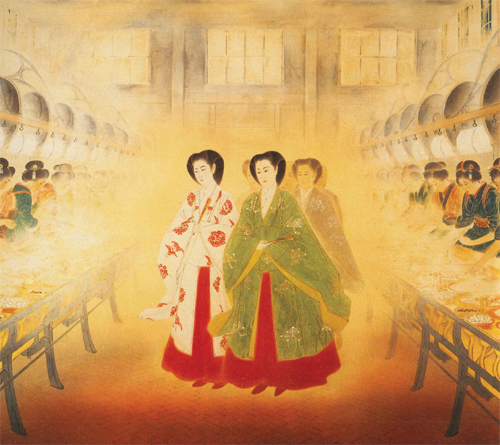
The Empress of Japan visiting the newly opened Tomioka silk mill.
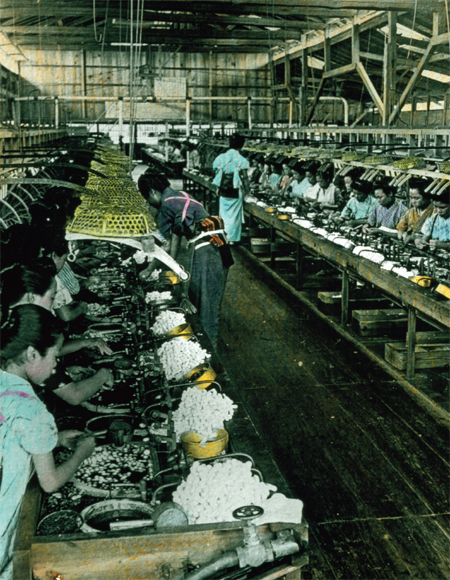
Inside a Japanese silk factory c. 1910, one of a series of tinted plates showing different aspects of Japanese life. The women are drawing the silk filaments from the cocoons.
The women who came to the mill lived in dormitories in groups of twenty, each group with its own supervisor. They worked six days a week, with long hours, but had Sundays off – though they were expected to use the day to do their laundry. Discipline was strict. It was rare for the women to be allowed out of the compound and during the working day, talking was strictly forbidden. When they first arrived, the women worked in the cocoon room, which was steamy and unpleasantly smelly. They were then moved into the factory for reeling, which was something they all looked forward to. When they were moved depended on the overseer. One worker, Yokota Ei, wrote a diary of her time at the mill, and she recalled her dismay when all the girls from her region were left in the cocoon room, while a group from another district who arrived later was moved on. It was the district from which the overseer himself had originated. The women protested and were moved on – the supervisor blaming the ‘mistake’ on the foreigners. As they learned the business, the women were eventually graded as first, second, third class or unclassified workers. The higher grades got better pay, ranging from 18 yen a month for first class to 6 yen for unclassified. Not surprisingly, Yokota Ei wrote that when she was classified as first class, ‘I was seized with such joy that the tears poured down’. On the whole, working conditions were tough, but the women were well treated, receiving a regular clothing allowance for summer and winter clothes, good food and medical care – with the prospects of a good career ahead of them. Many went back to their hometowns, where new mills were being built, and began the training processes there.
Once it had achieved its prime function of training staff who could help spread the new technology, the government sold the mill to the Misui family in 1893. After that, it passed to the Hara Company, which in turn was incorporated into the Katakura Silk Spinning Co., the biggest manufacturer of raw silk in the country. It finally closed in 1987 and was donated to the city in 2014 to be preserved and has now been recognised as a UNESCO World Heritage site.
Another important development in Japan was the work of Chogoro Takayaha, born in 1830. As a young man he became interested in sericulture and developed the Seion-Iku system, which relied on good ventilation and temperature control for the cocoons, together with cold storage for the eggs. He founded the Takayaha-Sha school of sericulture, which promulgated his ideas and became a major teaching institute not just for Japanese students but for many who came from abroad. It has now joined the silk mill as a World Heritage Site.
Apart from a vital export market, there was an equally important demand for silk for the upper classes. The traditional dress, the kimono, is ideally suited for extravagant decoration. The emperor and the court had initially relied heavily on imported silk, but that was no longer necessary. Although the garment has a long history, the name ‘kimono’ is comparatively modern, and though it seems exotic to the West, it simply means ‘thing to be worn’, simply because it was worn by both men and women, unlined in summer, lined in winter. One reason why it lends itself so well to decoration is that it is made from a single roll of cloth and held together by a sash or ‘obi’. Unlike western fashions, the actual shape scarcely changed through the ages – everything was in the design. The higher the social class, the more elaborate the decoration, whether embroidered or printed. The kimono carried elaborate messages, with motifs having symbolic significance – the crane for example signified longevity. There were also social messages. A woman might wear a kimono with references to literature, which told the world she was a lady with leisure for reading. In the 1930s, nationalistic Japan began producing extraordinary kimonos for young boys covered with militaristic motifs, from battleships to fighter planes. The finest kimonos, however, are true works of art.
The important export industry of raw silk to America began to suffer in the 1920s. The Japanese manufacturers responded initially by cutting wages to the point where they were half those earned by silk manufacturers in France and Italy. But the biggest blow came with the introduction of a new material developed in America.
Rayon had been introduced to the world as ‘artificial silk’, but the truth was that it was at best a poor relation. Several companies set to work to try and produce a better version. One of these was the grand E.L. du Pont de Nemours who in 1920 bought a 60 per cent share in a French rayon company for $4 million. The company name was changed to the more manageable, plain du Pont. They spent a great deal of money in research to improve the quality of rayon, in particular trying to make it softer – in one year alone the research budget was a massive million dollars. The initial results were not very reassuring. In 1926, the head of the Du Pont chemical division, Charles Stine, sent out a memo suggesting that the whole approach was wrong. They were trying to improve an existing material, when what they should be doing was finding a new, better one. And the way to do that was to open a laboratory devoted to ‘pure’ scientific research. The idea was approved, and Stine was authorised to hire twenty-five top chemists for a new facility with a budget of $25,000 a month, roughly $365,000 at today’s prices.
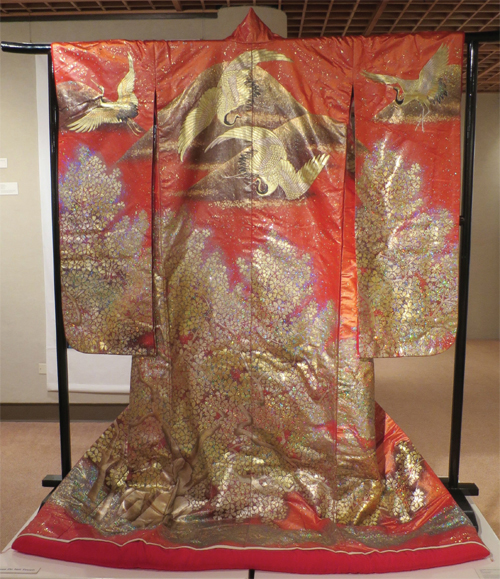
An elaborate Japanese silk kimono with a ‘tree of life’ motif.
There was some reluctance among top chemists, understandably suspicious that a very commercial company would not, in practice, tie their research to practical and profitable results. However, a young organic chemist, William H. Carothers, joined the company from Harvard University. He set about a programme of fundamental research into the nature of polymers. One current theory suggested they were colloids – very small particles distributed evenly through another medium. An alternative version proposed that they were composed of very long molecules, consisting of a chain of atoms. The latter was the view held by Carothers and he set out to prove it. He took a series of short organic molecules and began adding them together. In 1930, one of Carothers’ associates produced a long polymer by combining an alcohol with an acid – the first polyester. What at once attracted attention was the fact that the brittle fragments formed when the mixture cooled could be extended to four times their original length and became much more elastic. They had no immediate commercial value, as these polymers had a very low melting point – which, apart from being dangerous meant they were impossible to iron without disintegrating. But it showed that this was a fruitful area to investigate.
Four years of research produced nothing viable; new materials either had a low melting point, were soluble in water or both. Carothers was persuaded to take up the challenge, and this time instead of working with polyesters, he changed to working with polyamides. These are also long chain polymers, but they contain the amide group, consisting of one atom of nitrogen and two of hydrogen, derived from ammonia. In May 1934, a member of the team, Donald Coffman, produced a fibre with all the advantages of the polyesters but none of the problems. It was not quite the ideal product yet but by 1938, the new material was ready to go into manufacture. Du Pont decided to concentrate on limiting this material to a single use – making ladies’ stockings. This was a huge market, and America was already paying over $70 million a year for Japanese silk to meet the demand. The cheap end of the market was met by the less satisfactory rayon. All that was needed now was a catchy name. The first suggestion was ‘Nuron’, which was no run spelled backwards, which was obviously a good selling point, but there were copyright problems. The next suggestion was ‘Nilon’, but as there was ambiguity as to how the I would be pronounced – as in ‘mind’ or in ‘kiss’, the I was changed to a y. The new material became Nylon.
Nylon was a huge success, but production at first was limited. It was officially launched in October 1938, and the first 4,000 pairs of stockings were snapped up. It took time to go into full production and when the stockings eventually became widely available at a bargain price of $1.15 a pair, stores had sold out by noon on the first day. In 1940, Du Pont sold $9 million worth of nylon yarn and that shot up to $25 million the following year. This was excellent news for Du Pont, but disaster for the Japanese silk manufacturers. A rumour spread in Japan that it was all an American plot to attack their industrial growth, and the name was really an acronym; Now you laugh on Nippon.
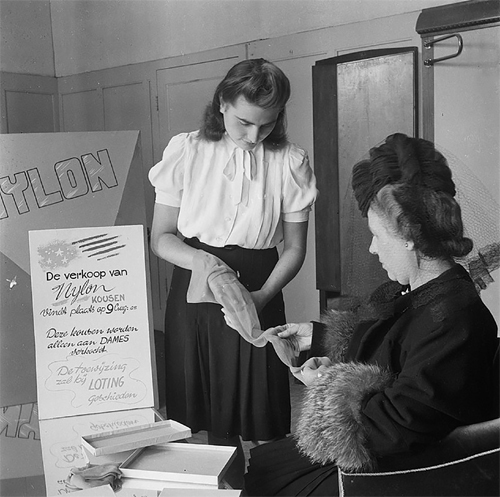
A sales assistant showing a pair of nylon stockings in 1946.
When war broke out between America and Japan, nylon was to find other uses – notably in making parachute silk and flak jackets. Stockings were scarce, particularly in Britain, where young women were often reduced to drawing the iconic and flattering dark seam up the backs of their legs, A visiting GI soon found that a pair of nylons was a far more welcome calling card than a bunch of roses. When the war ended, Du Pont went into full production to provide yarn for stockings, and when they came on the market there were ‘nylon riots’. In Pittsburgh in June 1946, an estimated crowd of 40,000 queued for a chance to buy just one of the 13,000 pairs of nylons on sale. Nylon became an acceptable material even for haute couture dressmakers. But it couldn’t last. The one thing that is certain in life is that women’s fashions will change – men’s are altogether more lethargic. There was a movement away from artificial fabrics in favour of more natural materials. Nylon and rayon were seen as rather cheap and slightly tawdry. Silk was back, but, of course, in some parts of the world it had never gone away.
When we last looked at the situation in India, there was a healthy industry centred on the great Moghul cities, such as Agra and the magnificent, but now abandoned Fatehpur Sitri. The East India Company had been formed in 1599, with the idea of getting a foothold in the lucrative spice trade. But the Dutch had established a monopoly in the Spice Islands, and so the British turned to India instead, with the hope of finding trade goods that would prove equally profitable. The early years were not a great success. The English merchants attached themselves to the court, but with no great success. Jahangir showed little interest when given the news of a great British naval victory over the Portuguese and was far more impressed by an English mastiff which had successfully fought and killed a leopard. His successor, Shah Jahan, showed an equal lack of interest. But Moghul power was on the wane, and gradually the East India Company’s influence grew until it became for a time the de facto ruler of the country. The days of the British Raj had begun. The Company’s main objective was not to help local industries prosper, but to make profits to be spent in Britain.
At first, merchants began buying elaborately decorated silk material for the British market, where it proved to be extremely popular – too popular as it turned out. The British weavers objected, and the Company changed tactics. Instead of sending finished cloth, they began sending out yarn instead. It was not a success. Indian raw silk was considered inferior to that from other sources, and the East India Company began losing money. By 1835, the Company had abandoned the silk trade altogether. All this had a devastating effect on the industry as a whole. There was a lack of investment which meant that Indian silk manufacturers were still relying on the handloom for cloth making, and the quality of raw silk declined. Instead of exporting good quality silk, India was mostly sending out waste silk, which fetched a far lower price. The locally reeled silk was described as ‘full of knots and loose ends and of unequal strength’. Local weavers preferred to use silk imported from China. G.B. Jathar and S.G. Beri in their book Indian Economicspublished in 1929 quote dramatic figures. The value of silk exported in 1845 was 3,560,000 rupees; in 1925 it was 295,800 rupees.
Jathar and Beri describe the efforts being made in the 1920s to improve the situation. The agricultural department of what was then the Province of Bengal, set up two schools of sericulture. As students graduated, they were given a small grant and ‘seed stock’ and encouraged to set up rearing houses for the silk moth. As an extra help, the government had also imposed a high tariff on imported silk. There was also at that time a movement to encourage what was in effect a cottage industry to become more efficient. In Bombay, now Mumbai, six weaving schools had already been established. But there was no rush towards industrialisation – quite the opposite. It was deliberate policy to encourage the handloom sector to produce ornate materials specifically aimed at the wealthiest purchaser. The idea of encouraging local handcrafts was also being espoused by a man who was becoming increasingly important in Indian political life, Mahatma Gandhi. He might have been thought to be an enthusiastic encourager of the local silk industry. In fact, he wanted it brought to an end. He was a vegetarian and utterly opposed to the killing of any animals for the benefit of humans. As the silk industry undoubtedly killed the pupae before they had a chance to emerge as moths, the process was inhumane. The argument has appeared again in recent years in the west, raised by animal rights activists with some success. The British fashion company ASOS announced in 2018 that it would no longer be selling any silk products.
Following independence, Indian governments adopted a unique approach to textile production. It was a vital part of the country’s economy and clearly needed nurturing. On the other hand, millions depended on it for their livelihood, and a wholesale move to modern factory technology would have resulted in mass unemployment. So, a limit was put on the number of mills that could be built and equipped with new machinery, with an emphasis on co-operative mills. Cloth production was divided between the power loom section, which might involve one man working a single loom or a small workshop, and the handloom section. Travelling around India, one can see this extraordinary diversity; on the one hand, one can visit a factory as modern as any in the world, and then you can go to a village where men are weaving on pit looms. These are just what the name suggests. A pit is dug in the floor and the weaver sits with his feet in the pit, operating the treadles. Most of these looms have at least been ‘modernised’ by including the flying shuttle, developed over two centuries ago. Some do not even have that degree of sophistication, but simply pass the shuttle by hand, using a smooth-bottomed ‘boat’ shuttle. One I brought back as a souvenir sits next to me on the windowsill, and it is indeed very boat-like, with pointed ends and smooth curves. Different regions have their own specialities. In Assam, silk from a local silk moth Antheraea Assamensis is used to produce Muga silk, which is notable for its golden lustre. It is so highly prized that once it was only used for royal garments. Today it is a valuable export.
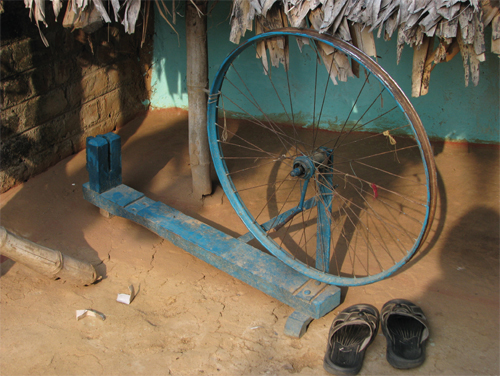
Improvisation in modern India; a bicycle wheel being used for silk winding.
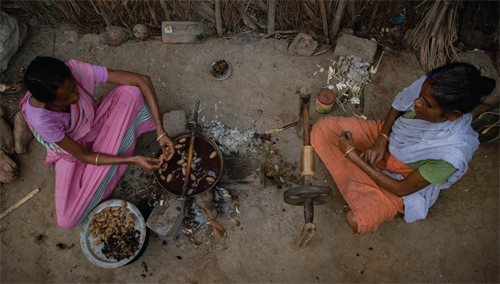
Extracting muga silk from the cocoons in Assam.
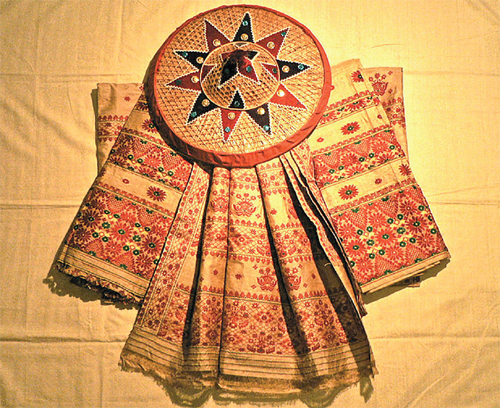
Clothing that displays the magnificent golden texture of muga silk.
A large part of the industry, however, is simply involved in producing yarn. Statistics for 2018-19 show that sericulture was spread across an astonishing 52,360 villages. Altogether, with sericulture and manufacture, the silk industry provides employment for nearly nine million workers. The country is the second most important producer of silk in the world, with annual exports worth over $250 million. The government is pushing for increased production, and one line of approach lies in improving the basic source of the silk – the silk moth itself. The familiar Bombyx Mori does not fare well in very hot climates – and Indian summers can be very hot indeed. To combat this, researchers have developed various bivoltine breeds – hybrids that are bred for heat resistance. The Sericulture Research Institute in Andhra Pradesh has recently produced a trans-genic silkworm that not only survives the high temperatures but is also resistant to various viruses that have troubled growers in the past. The new versions are being distributed widely. As in many aspects of Indian life, the silk industry is a mixture of the very traditional and the very modern. Much of the home market is for colourful saris as it has been for centuries, while other materials are being woven to meet the tastes of Western customers, especially in America. The tending of silkworms has scarcely altered, but the worms themselves have been modified by scientists. With such a varied scene, it is difficult to predict where Indian silk might be heading in the future.
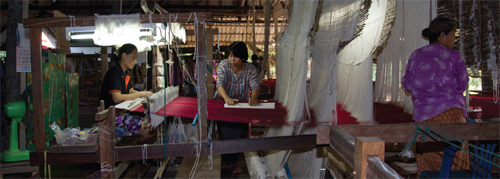
Silk weaving in Thailand.
Asia has never lost its place as the major centre for silk production, but the industry developed far faster in some parts than in others. Thailand lagged well behind other neighbouring countries; the rich preferred the imported materials from China in particular to anything produced in their own country. That everything changed in the twentieth century was mainly down to the efforts of a former American serviceman. Jim Thompson served in the Office of Strategic Services during the Second World War. He travelled widely during the war years and fell in love with Thailand. When he left the OSS in 1946, he made a permanent home in Thailand and, with a partner, set up the Thai Silk Company. He was not interested in modern manufacture but wanted to help revive the rapidly fading handloom industry. He specialised in producing shot silk, a material in which the warp thread is one colour and the weft another. My father worked for many years in Bangkok and I well remember him coming home and bringing Thai silk for my mother. Even as a boy I was impressed by the material, which miraculously, it seemed, constantly changed colour as it was moved about. The material received a huge publicity boost with the appearance of the movie version of The King and I in 1956. It won an Academy Award for the gorgeous costumes designed by Irene Sharaff. She used Thai silk, and Americans came to love the material. Paradoxically, the film was banned in Thailand itself because of its portrayal of the king. Jim Thompson was successful in his aim of revitalising the handloom industry as he had hoped, but the story has a curious end. On the wall of his house in Bangkok there is a horoscope predicting that 1967 would be an unlucky year. That year he was in Malaysia, went walking in the forest and was never seen again.
The development of the Asian silk rearing industry brought European developments to a halt. Italy, which had once had a thriving industry, succumbed to cheap Chinese imported yarn and one by one the mills closed until none was left. All that has changed in recent years. The revival owes a great deal to major fashion houses such as Gucci and Valentino, who announced plans to start 1,000 silkworm factories. The process is already under way and is thriving at Como, already well known as a manufacturing centre. There were several reasons for wanting to restart Italian sericulture after a forty years absence, not least economic. The price of Chinese silk has risen sharply to a point where locally produced silk can compete. Labour costs may be far higher in Italy than in China, but transport costs are low and there is no import duty to pay. Sericulture may have changed little, but production techniques have changed enormously. Como has established a reputation for using the latest digital printing technology to produce an exciting new range of designs. And the new designers favour the locally grown silk. None of this will make a huge difference to China, which accounts for over four fifths of world production.
China, however, has its own problem. In recent years, air pollution has risen alarmingly and mulberry trees have been among the victims. And as China develops its industries, the young are showing far less enthusiasm for staying in the country, working on silk farms. They want the city life. In other words, the world of silk is changing, but then it has been changing and developing for over 4,000 years, so there is no reason why it should not do so now and in the future. But one change would never have been anticipated. No one expected a garment to be made from silk that came from any creature apart from the silk moth. But now it has happened.
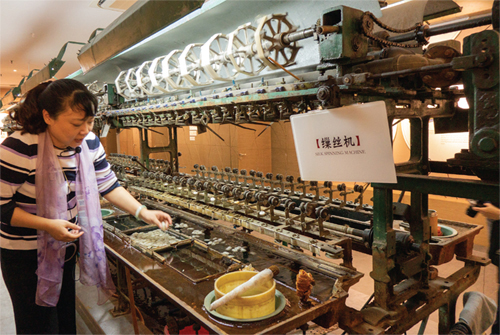
A silk spinning mill in China in 2018.