
CHAPTER THIRTEEN
We see natural silk all over the place and probably regard it as a nuisance, sweeping it away with a casual flick. We don’t think of it as silk – we call it a cobweb. But the spider is producing a silken thread and doing so in a very sophisticated manner. An article by David Robson in New Scientist in February 2020 described how researchers had discovered a surprising intelligence at work in the humble spider. We think of spiders as making silk purely to create a web to catch prey, but they have other more unusual uses as well. Some species use them for ‘ballooning’; they send up silken threads to catch the breeze and waft them off to new locations, sensing when the wind is right by hairs on their legs. Even in building their webs, different species use different techniques, and having built them they ‘fine tune’ them by testing the vibrations in the web and adjusting as necessary. When presented with prey in two locations in a laboratory experiment, the spiders were able in most cases to judge which was the nearer and head straight for it. These and other experiments suggest that, although they have tiny brains, they might have something we recognise as thought processes. So, in many ways, spiders are a lot more interesting than most of us thought. But what interests scientists and others is the nature of the silk.
The fact that is most often quoted about spider silk is that it is stronger than steel, with the suggestion that it is the strongest material known. That is not quite true, Kevlar is stronger. But as well as having great tensile strength, spider silk is also ductile – it can be stretched. This combination of tensile strength and ductility means it can absorb energy without breaking. It is the toughest material we know. With such remarkable properties this is obviously a very valuable material. But spiders are generally rather tiny and produce limited quantities of silk. But could it be used to make textiles?
One man who was convinced there was a future for spider silk was a French naturalist, Bon de Saint Helene, who collected spiders from cottages near his home and used the silk to make a pair of stockings and a pair of gloves in the early 1700s, which he presented to the French Academy. He then became more ambitious and made a garment for Louis XIV to wear but when the king put it on, the whole thing began to disintegrate, to the king’s embarrassment and annoyance, and the maker’s chagrin. The next attempt to weave with spider silk took place in the nineteenth century. Paul Camboué, a Jesuit missionary and teacher who arrived in Madagascar in 1882, made extensive studies of the local flora and fauna, identifying many species previously unrecorded. One species particularly intrigued him, the golden orb spider. Over 48,000 different species of spider have been identified so far, but this one is remarkable. It is large, about the size of an average hand, but it is the web that is distinctive for the golden colour that gives the creature its name.
Camboué decided to try and use this silk to create textiles. He built a device known as ‘the guillotine’, simply because the head was held on one side of the wooden contraption and the abdomen was on the other – unlike the lethal device, the spider guillotine left its victim intact and healthy. Once the spider was in place it was only necessary to touch the back of the abdomen with a finger to start the process of producing silk that could then be drawn out. He set up a special spider farm at Tananarive and employed local girls to reel the silk, spin and weave it. In 1900, he sent a bed canopy to the Paris Exposition, where it was put on display. There was, however, no commercial interest in developing the idea, and no more attempts at weaving from spider silk were made for 100 years.
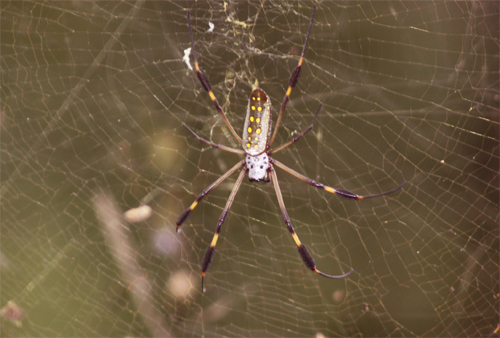
The female golden web spider.
In 2004, an Englishman, Simon Peers, and an American, Nicholas Godley, decided to resurrect Camboué’s idea. They too worked in Madagascar with the female golden orb spider and used a version of the guillotine. Every day, more spiders were collected and brought to the ‘spidery’ to provide the silk. They were used in batches of 24 to supply 24 strands that could be wound together. In making the garments, threads were doubled to 48 for the lining and doubled again to 96 for the main body of the garments. Many reports quote the fact that a million spiders were used, which is somewhat misleading. In fact, just over 20,000 spiders were brought to the spidery, each of them used several times to create the million threads. Two items were woven on hand looms, a shawl and a cape. The shawl had its pattern woven into the fabric, based on traditional Madagascan motifs. The cape was altogether more elaborate. With complex patterns added by appliqué and embroidery. The finished cape was exhibited at the Victoria and Albert Museum in London in 2012. It is a thing of great beauty and the natural gold colour is quite amazing. But the amount of work that had to go into producing it was immense and took years to complete. It was hardly a system that would seem to have any obvious commercial possibilities, simply because of the costs involved. But it did demonstrate that spider silk had special qualities, both of toughness and beauty that made it desirable. As with the silk of the moth, there was a real incentive to try and produce in the lab what the spider created in the wild.
One of the first to begin tackling this problem was Professor Randy Lewis of Utah State University, who set up a spider silk laboratory. Before you can make artificial silk, you need to know what the natural material consists of. In the 1990s, they cloned spider silk and sequenced the proteins. That was just a start. There were then years of experiments, working out exactly what gave the silk its strength and elasticity. Somewhat surprisingly, the protein found in the silk was also present in goat’s milk and experiments were made with modifying the goats genetically to produce fibres. An alternative involved a fermentation process involving genetically modified bacteria. That approach was followed up by a start up Company, Bolt Threads, established near San Francisco. They began using the fermentation commercially in a comparatively small way.
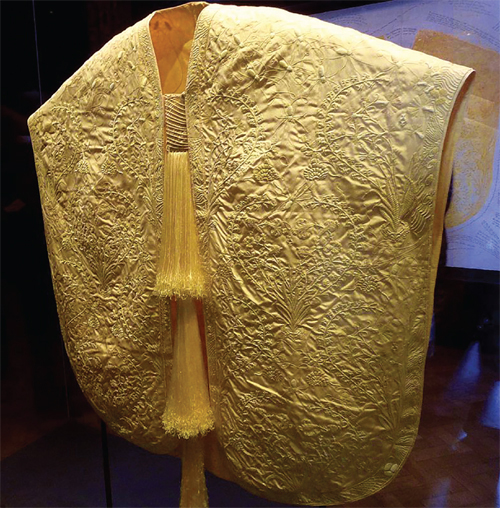
The golden cape made from Madagascan golden orb spider silk, displayed at the Victoria and Albert Museum in 2012.
A new approach was made at the University of Cambridge. In an article by Emily Matchar in the Smithsonian Magazine, July 2017, Darshil Shah of the University’s Centre for Natural Material Innovation spelled out the basic problem. ‘Spiders are interesting models because they are able to produce these superb silk fibres at room temperature using water as a solvent. This process spiders have evolved over hundreds of millions of years, but we have been unable to copy so far.’ The Cambridge team did, however, manage to produce a fibre that started with a mixture that was 98 per cent water. The other two per cent was made up of silica and cellulose, bound together by cucurbiturils – an imposing name, but with a simple origin; these large organic molecules look like Cucurbita – or, in plain English, pumpkins. First synthesised in 1905, these molecules have proved invaluable in holding other large molecules together. The silica and cellulose fibres can be pulled from the gel and within 30 seconds the water has evaporated, leaving strong, stretchy fibres behind. They are not quite as strong as natural spider silk but come very close. This system has huge advantages in that it works at room temperature with materials which are readily available and no chemical solvents are required. It is a remarkably green process, and if it can be scaled up offers all kinds of possibilities, including using different basic raw materials to create new fibres. The problem Shah and the team face is scaling up a process from laboratory to production. But with so many groups now working on developing artificial spider silk, there seems little doubt they will succeed. This is still early days; after all it took two decades of research and development to get nylon manufactured.
Silk has come a long way since the time thousands of years ago when, according to the legend, a cocoon fell into a princess’s tea. Its appeal has never waned. Its lustrous nature, its softness, durability and its adaptability have made silk fabrics the most desirable of all textiles, not just in the land where the humble moth first gave up its secrets, but around the globe. And, in travelling, silk has taken with it knowledge and ideas, inventions and discoveries. Silk seems to turn up everywhere, from the first tentative attempts at flight to the development of the computer. The book you are reading was made possible because the technology of paper making came to the west down the Silk Road. That useful little number that tells you which page you were on is the result of an Indian system of numerals that travelled the same route and the words you are reading were produced on a system that developed from an idea first devised to automate the weaving of complex patterns in silk. There is also a continuity; techniques passed down through the generations sit beside the latest technology. This was brought home to me at the heart of the European industry in Lyon. In the morning, I visited a craftsman working at a handloom, producing ornate fabrics, while in the afternoon I went just a short distance to a modern factory where the shuttleless looms were turning out equally ornate fabrics at an astonishing rate, guided only by a computer programme. Over the years, scientists have attempted to produce a material that has all the qualities of silk; they have come close but have yet to reach their goal. Silk has been called the ‘Queen of fabrics’; the queen it seems will reign for many years to come.
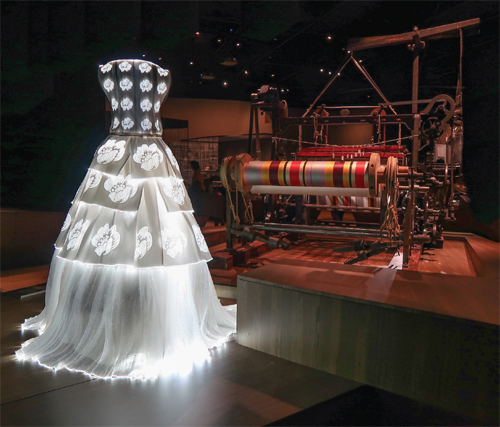
Modern technology can produce beautiful and elaborate clothes to match those of the past; adiaphanous silk dress produced on an electrically powered loom.