
CHAPTER FIVE
It was inevitable that such a profitable industry as silk production would move into Europe. By the ninth century, Arabic and Jewish silk artisans had started to move into Italy, but the emphasis was still very much on importing silk fabrics from the East. The city of Lucca was trading in silk, making use of its large Jewish population. One family, in particular, the Kalonymos, had kept extensive trading links with Byzantium and the Middle East. By the middle of the twelfth century, they had established an agreement with Genoa, to take goods through their territory to join the city to the port. As part of the deal, Lucca arranged for Genoese merchants to bring in materials such as raw silk from the Levant, providing the opportunity to start manufacturing for themselves, instead of simply acting as merchants. It soon became clear that manufacturing could be at least as profitable as trading and could even offer greater rewards.
By the thirteenth century, the Italian industry was beginning to thrive, though to describe it as an Italian industry is slightly misleading, since Italy did not exist as a sovereign country, but was made up of a whole series of city states; Venice at this period was not, for example, just the famous city but the Venetian Republic, and rivalry between the different regions was to be a feature of the developing industry for centuries. The first major centres to develop were in Genoa, Venice, Bologna and Lucca. Each area had its own specialities. Lucca, for example, was noted for its luxurious cloths, embellished with gold and silver threads, which were sold all over Europe and was probably by far the most successful of the silk manufacturing centres. But the industry there was greatly affected by political discord. For years, the region had been run by a ‘Captain of the People’, but in 1314 there was a coup and Uguccione della Faggiuoia of Pisa declared himself Lord of Lucca. He only lasted for two years before he was expelled, but in that time many Jewish silk artisans left the area to take their skills elsewhere. Some, it seems, made their way to Venice, and became an important part of the developing industry there. Initially welcomed, they were later to be treated with suspicion. In 1516, the Republic declared that all Jews must be housed in a special area that had originally been used as a waste area for dumping material from local foundries. The Italian word for ‘throw away’ is ‘gettare’ and that is the likely origin of the name given to the area in which the Jews were compelled to live – the Ghetto. Access to the rest of the city was by two bridges which were locked each night, and fines were imposed on any Jews found in the city after the gates were shut. It was the first of Europe’s ghettos that were to acquire a sinister significance in the twentieth century. It was an ungrateful response to a group of people who had done a great deal to add to Venetian prosperity. Lucca itself soon returned to more profitable times and by 1371, 89 silk firms were recorded as operating and by the end of the fourteenth century, the city had an estimated 3,000 looms at work.
Venice was not the only region where Jews suffered discrimination. Sicily had an early silk industry, but it dwindled away until it was briefly revived in the fifteenth century. In 1485, Messina employed a Jewish artisan to set up a velvet manufacturing enterprise. His services were considered so valuable that some of the petty restrictions imposed on Jews were waived for the benefit of him and his family. Jewish women were required under the law to wear distinctive clothes, but his wife and family were allowed to dress as they liked. For a time, the business prospered, but then everything changed. At that time, the country was under Spanish rule and in 1492, Spain decreed that all Jews should be expelled from all their territories. Silk and politics were, it seems, closely intertwined.
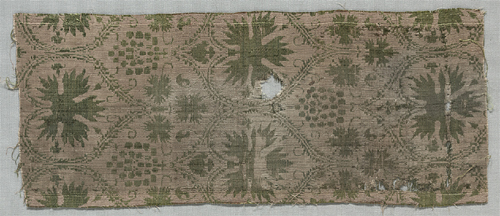
A fragment of Italian silk cloth from the late fourteenth century.
Local rulers were anxious to recruit skilled workers from wherever they could be obtained. In 1449, the Duke of Milan reached an agreement with a Florentine Pietro di Bartoli who was to try and recruit artisans from Lucca. In 1467, the Duke issued a decree that guaranteed the immigrants that their pay would be at least the equal of weavers in any of the major centres. It was successful and by 1467 there were 300 foreign workers in Milan. Other areas followed similar paths, and it was not just the workers who appeared, as they often brought their equipment with them. In his excellent book The Silk Industry of Renaissance Venice (2000), from which much of the information quoted in the early part of this chapter is drawn, Luca Molà quotes an entrepreneur from Modena, who explained that thanks to the immigrants, the city had ‘all the necessary implements, be they water-powered spinning machines or cloth dyeing shops, while masters born in the city have learned the craft.’
The reference to water-powered spinning machines is intriguing for this is centuries before the Industrial Revolution of the eighteenth century introduced water-powered machinery for cotton spinning in Britain. Frustratingly, we know very little about the earliest of these machines, simply because the details of how they were worked were closely guarded secrets. The earliest documentary evidence comes from a Lucca document of the fourteenth century and a rough sketch from a Florentine manuscript of 1487. A much more detailed drawing was published in 1607, and it is generally assumed that the earlier throwing mill machinery must always have been similar to the seventeenth-century version. The mill machinery consists of two tall, concentric wooden frames about five metres in diameter. The outer, fixed, ring contains two rows of vertical spindles with a row of horizontal reels above them. The inner rotates about a vertical axle, turned by gearing from a waterwheel. As it moves, the laths on the inner frame rub against the spindles and reels to rotate them. Each spindle carries a fixed spool above which is an S-shaped wire. The untwisted silk passes through eyelets at both ends of the S, and as that turns, the threads are twisted together and wound onto the rotating spool. The fourteenth century document from Lucca describes the mill as having two rows of twelve reels, each reel having twelve spindles. Later mills were larger, with more spindles and reels. It seems that the mills were first developed in Lucca and were then brought to Venice and Florence. The throwing mills were the greatest Italian contribution to the silk industry, and machines of similar design remained in use from the fourteenth century right through to the nineteenth.
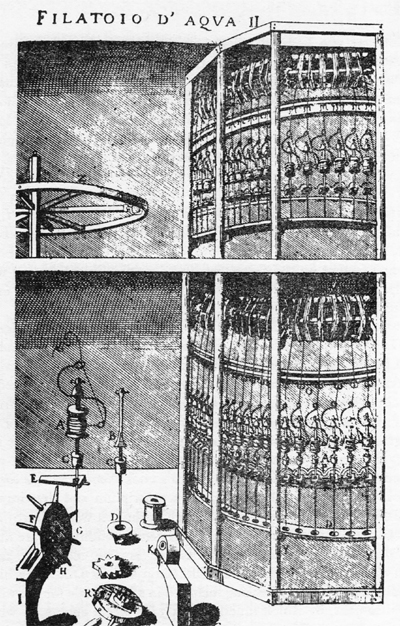
An Italian silk throwing machine, the first of its kind to be powered by a water wheel, from Nova Teatro di Edifici et Machine 1607.
Different areas went to great lengths to attract good workers. Many offered to cancel any debts they might have had, but the most bizarre offer was undoubtedly that made by Pope Sixtus V, who not only offered to cancel earthly debts but divine ones as well, through remission of various sins. In some cases, the foreign weavers had to be provided with suitable living accommodation. In Pisa, the authorities decided that they could enjoy a double benefit. They turfed all the prostitutes out of the city’s brothels and adapted the houses for use by weavers. With so many incentives being offered to skilled workers, the industry burgeoned and as time went on, locals learned the skills imparted by the immigrants. As a result, according to a document of 1461, Florence was estimated to have one third of the population involved in silk manufacture and by the sixteenth century, there were 12,000 at work in Lucca. These figures did not necessarily include women who worked part time at doubling, warping and winding. A very good indicator of just how the industry had grown can be gauged by a report from the Venetian ambassador to Florence, who noted that the region was importing 400 bales of silk, roughly 70,000kg a year.
A report from Verona to the Venetian authorities, pointed out just how useful bringing in workers for the industry was for the whole development of an area:
‘Since the art of black velvet has many crafts in it; some of them are suitable for women and children, such as raising silkworms, reeling and winding silk; some are for more mature men, such as sorting silk, dressing it, dyeing it. Some are for merchants, such as running shops, trafficking in currency, bartering and selling; some are for citizens, such as planting, making working shops with merchants and producing cloths.’
The writer then went on to produce what must have been the clinching argument in favour of starting the industry; it would increase tax revenue.
Velvets were an important and valuable commodity. They were made by adding an extra warp over a series of small rods, forming small loops which could then be cut or left as loops before the rods were removed. Velvet is still made on handlooms using this technique in Lyon, where I watched a weaver at work in his atelier at the back of a specialist silk shop. There are many variations, with mixtures of cut and uncut pile. Piles can be placed one on top of the other to create patterns, and supplementary threads can also be added to make brocades. These were luxury cloths, commanding a high price, and could only be afforded by the wealthiest and most important members of society. In Venice, for example, most noblemen dressed in black, but officials of the Senate had to wear coloured garments, each official having his position specified by a particular colour. Needless to say, they were not content with wearing a plain coloured cloth but favoured elaborate brocaded velvets.
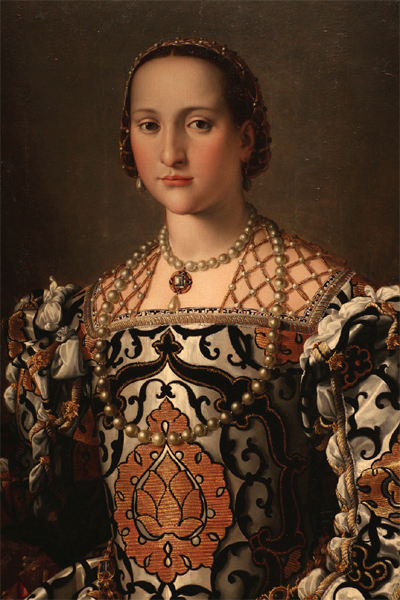
A portrait of Eleanor of Toledo (1503-72), the wife of Cosimo de Medici, wearing an Italian silk velvet dress.
Entrepreneurs who wanted to make a fortune by setting up businesses in other parts did not always have an easy time. In 1537, Antonio Guidotti went to England and settled in Southampton as a merchant but had to beat a hasty retreat to avoid being gaoled for bankruptcy. Then he saw an opportunity to return to Britain to set up a silk business that would repay his debts and still produce a handsome profit. He corresponded with Thomas Cromwell, a Privy Councillor and holder of many official offices. He received encouragement, and no doubt also hoped for a subsidy, as he stressed how much the enterprise was costing him. He employed a Florentine weaver, who recruited a workforce of twenty-four skilled men, together with their equipment. They duly set sail for Southampton, but there is no record of them ever arriving in Britain. Some entrepreneurs fared even worse.
Two brothers, Luca and Nicolo, surnames unknown, arrived in Italy from Ragusa, a republic in Dalmatia, the area around Dubrovnik. Luca persuaded a young velvet weaver in Venice to join him in the enterprise. He in turn found recruits among his friends – two more weavers, a dyer and a spinner. They then paid for the construction of machinery for spinning and throwing and bought looms and dyed silk. Under Venetian law, it was strictly forbidden to take these workers and their machinery out of the Republic, but they hoped to get away with it, by hiring a vessel to take them only as far as the island of Curzola in the Adriatic, which regularly traded with Venice. Then they planned to move on to Ragusa on a second ship. Unfortunately, with so many people involved, news of what they planned was leaked to the authorities. They were preparing to leave when the harbour authorities swooped, confiscating all the equipment.
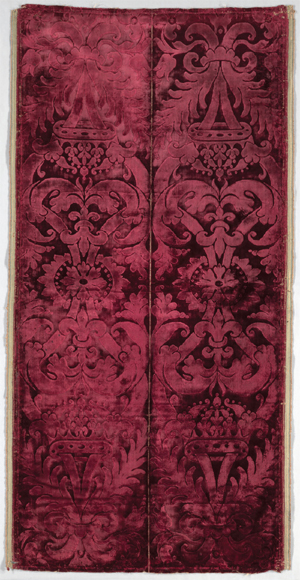
Venetian Procurator’s stole of the sixteenth century, which was worn over the shoulder as a badge of office. The cloth was woven to create two stoles, hence the seam down the middle.
Having poached workers from other areas, each region introduced punitive laws to try to prevent the same thing happening to their newly acquired work force. Most laws simply prohibited movement of workers and specialist machinery, offences usually accompanied by large fines, but which might include imprisonment for a short time. Others were altogether more draconian; an edict of 1314 offered a bounty to anyone who murdered an émigré worker. The lengths to which authorities would go was exemplified by a major row that developed between Florence and Siena. The latter decided it needed to join the silk bonanza and did as everyone else had done, bribed workers from nearby Florence to come to their city. The Florentines responded by sending agents to bribe them to come back again, adding they would be especially welcomed if they burned down the workshops and looms before they left. Then Siena responded by passing a law that stated that any agent attempting to bribe workers to leave Siena would be publicly flogged, branded on the face with a red hot iron and on top of all that pay a fine as well. One can safely assume that agents were suitably deterred.
The laws were never really effective, and in time silk workers moved freely throughout Italy. In the middle of the sixteenth century, a merchant gave evidence to the Council of Verona:
In the past I organised the production of velvets in the city of Mantua and master artisans came to work there from Genoa, Milan, Bologna, Ferrare and all the other cities of Italy, and they worked for me, three, four, six months more or less depending on their wish.
It was clear that movement was no longer controlled, as silk manufacture spread out from Italy to other parts of Europe.
France was among the first beneficiaries of Italian expertise, and an industry was soon developed in Tours. The city had been, for a time, capital of France and still had a royal palace, used by the court. Royalty, aristocracy and the church were the main customers for the most expensive silks, so Tours was an ideal centre and enjoyed royal patronage under Louis XI. Having established workshops in Tours, the king decided to set up another in Lyon, which he expected the locals to pay for. The merchants of Lyon were less than enthralled by the idea, as they were doing very nicely indeed importing expensive silks from Italy and the last thing they needed was home grown competition. So, for a time, Tours was the main centre for silk manufacture in France. In 1546, the Venetian ambassador, Marino Cavalli, reported that several master craftsmen had settled in Tours with their families, and were teaching the intricacies of fine silk weaving to French workers.
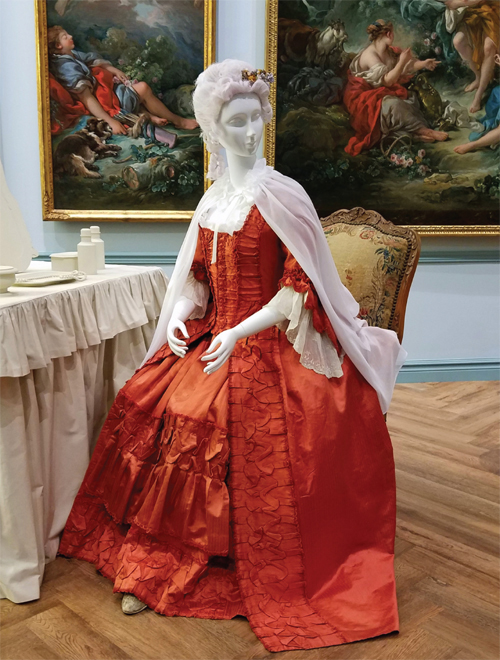
French silk dress and petticoat c. 1760, on display at the Museum of Fine Arts, Boston.
In 1536, a Piedmontese entrepreneur, Stefano Torchetto, was granted letters patent by Francis I to set up silk industries in ‘Avignon, Genoa and other places’ but the biggest change came during the reign of Louis XIV who gave orders to Jean-Baptiste Colbert, the Minister of Finance, to reorganise the French industry. By this time, Lyon, having originally rejected the whole idea of manufacture, had already had a change of heart. And it was Lyon that Colbert chose to be the main centre of development, and by the late eighteenth century there were estimated to be 15,000 working in the industry. Lyon became the most important manufacturer of silk in the whole country, a position it holds to this day. The Silk Museum in the city shows some of the magnificent cloths produced for the court at that time, including an elaborate dress created for Marie Antoinette, though given that lady’s ultimate fate, it seems a little tactless to display it on a headless model.
Other centres produced a variety of different silks. Tours became known for ribbed silk – ‘gros de Tours’. Paris, Nimes and Avignon produced plain silks that could be bought by the wealthier middle classes. Lesley Miller, in her article on French silks (1650-1800) in Jennifer Harris (ed) 5,000 Years of Textiles (1993), quotes prices for different types of silk in the middle of the eighteenth century, which illustrate the vast difference in prices, ranging from retail process of 180 to 350l- per ell for very rich brocaded silks, decorated in gold and silver, to 2 to 14l- for plain silks. The advantage to the merchants of opting for the richest materials becomes clear when one looks at the prices paid to the weavers. The maximum paid to a weaver of the richest and most elaborate brocades – the ones that could be sold for as much as 360l- was only 36l- per ell, but the profit margins dropped sharply for the plain cloths. The rates paid to weavers were not very different from those for the artisans making brocades, but the price the cloth could be sold for was only a fraction of that for the elaborate varieties. It obviously paid to specialise in the most expensive silks, but that depended on having a large enough demand – and enough customers who could afford the high prices. Fortunately, it seems that throughout Europe, silk was the must-have material for royalty and aristocracy. In Britain, William Lee invented the stocking frame for knitting stockings in the 1580s. He hoped to receive royal patronage and Elizabeth I was said to have been initially enthusiastic. Then she was told it could not be used for silk stockings and her interest evaporated on the instant.
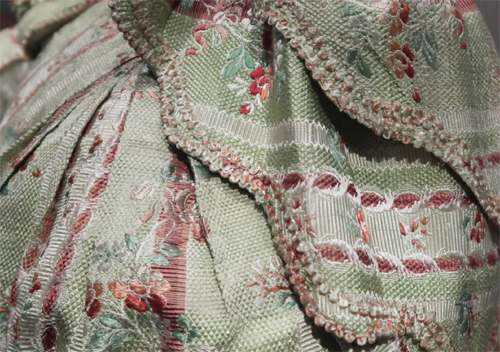
The exquisite detailing of a French court dress from Lyon, c. 1750, decorated with silver wrapped yarn, on the Musée de Tissus, Lyon.
Various patterns were adopted at different periods as fashions changed. Basically, there were two types of design – point repeats and comber repeats. The former were symmetrical along the length of the cloth, and were mostly preferred for furnishings. The combers were not symmetrical at all, which gave the designers freedom to produce ever more extravagant dress fabrics. These were designs that came to be known as bizarre, which does not in this context mean odd so much as very elaborate without obvious repeating motifs. By the middle of the eighteenth century, there was a trend towards painted and printed silks, rather than purely woven. But whatever the motifs and styles that came into vogue, the silk masters had no option other than to follow the trend. One valuable customer, however, continued to demand rich vestments – the Catholic Church. But towards the end of the century, all this huge extravagance and show became too much for the population as a whole. The French Revolution brought it all to a sudden and dramatic end, and the demand for beautiful silks died alongside its aristocratic patrons.
One textile that was of huge importance throughout the Middle Ages and the Renaissance was tapestry. The houses and castles of the nobility may have looked grandly imposing, but they were also likely to be cold and draughty, so wall hangings had a very practical purpose. But they also became works of art in their own right, and nobles often took their own tapestries with them when they travelled, for they were marks of prestige. The English king Henry VIII had a vast number of tapestries and one set of ten that he commissioned were valued a century after his death at around £5,000 – over £500,000 in today’s currency. This was an expensive business. One of the early and most famous centres was Arras in northern France, a city with an extensive woollen trade. Its tapestries were so famous, that the name of the city became synonymous with the product – which is why, when Hamlet stabbed the unfortunate Polonius, Shakespeare called the wall hanging behind which he was hiding an arras. The earliest tapestries were made exclusively of wool, but as time went on, the more beautiful designs began to call for the richness of silk.
In France, Jean-Baptiste Colbert, who had helped establish Lyon as a silk centre, now set about reorganising the tapestry ateliers of Paris into one great site at the Gobelins workshops in the city beside the River Bièvre. The name would become synonymous with some of the finest tapestries ever produced. Under the direction of Charles le Brun, it produced masterpieces for the royal court, many of them featuring stories aggrandising the king, Louis XIV.
Strictly speaking, tapestry can be defined as any woven pictorial fabric and dates back to ancient times – tapestries were most famously found in the tomb of Tutankhamun. But in this chapter, we are looking at how they were made in Europe from the Middle Ages. The starting point is the cartoon – not a funny drawing, but the painted design that would be copied by the weavers. Among the famous artists who produced these cartoons was Raphael. In 1515, he was commissioned by Pope Leo X to produce full-scale designs for sixteen tapestries showing the lives of St. Peter and St. Paul which were to hang in the Sistine Chapel in Rome. Seven of the original cartoons are now part of the British royal collection and are displayed in the Victoria and Albert Museum in London. One of the greatest of French cartoonists was Francois Boucher, who worked at Beauvais originally, but was made director at Gobelins in 1755. His speciality was the romantic, pastoral idyll, in which lovesick swains seldom seem to have anything much to do apart from serenading swooning milkmaids in the shade of a tree. The Royal Court loved them and they fitted perfectly with the taste of the time – this was the age when Marie Antoinette could spend a fortune setting up an idealised ‘farm’ where she and her companions could dress as milkmaids and shepherdesses – though it is highly unlikely that any cow was milked or any sheep shorn by them. They were Boucher figures in a Boucher farm. It is no wonder that the famous encyclopaedist Diderot wrote of Boucher – ‘That man can do anything – except tell the truth.’ But they make lovely pictures and beautiful tapestries.
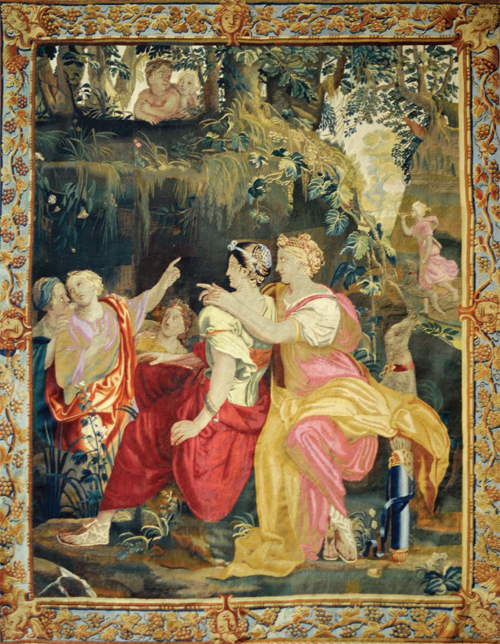
A sixteenth century French tapestry showing Daphne choosing Diana as her ideal in the Virginia Museum of Fine Arts.
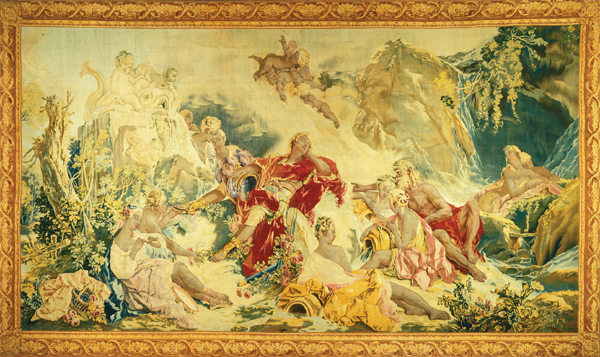
A tapestry based on a design by François Boucher made at the Beauvais factory c. 1750. Woven with a wool warp and silk weft it depicts the Dream of Ronaldo.
Two types of loom were used, the vertical and the horizontal. In both cases, the weaver worked at the back of the warp. With the vertical warp loom, the annotated cartoon hangs on the wall, behind the weavings alongside a mirror that allows the weaver to check that the front of the tapestry is proceeding as it should by direct comparison with the cartoon. With extremely large cartoons, they might be cut into pieces, and a number of weavers would be employed, each copying his own section. Examples of this type of working can be seen in the Victoria and Albert Museum in London, where seven Raphael cartoons were cut up in this way but have now been reassembled and put on display. With the horizontal loom, the arrangement is similar, except that the cartoon and mirror are on the floor. Large numbers of weft threads are used, and many weavers can work at the same time on the same tapestry, which was just as well as with a complex design a single weaver could only produce about one square metre a month. To put that in perspective, the Raphael cartoons mentioned above are roughly fifteen square metres – each one would have taken well over a year for a single weaver.
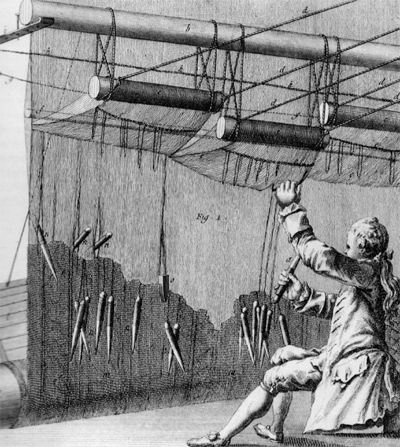
Tapestry weaving at the Gobelin works in France in the eighteenth century.
Tapestry weaving was not perhaps the most important use of silk in terms of quantity of thread used, but the end products stand among the most beautiful creations that used the material. But by the end of the eighteenth century, the demand for tapestries had all but disappeared while the market for material for clothing and furnishings continued to grow – everywhere that is except in Revolutionary France, where such fripperies were well and truly out of favour. When the French industry revived in the early years of the nineteenth century, it brought with it a major change in production technology that would have profound implications and began a process which has changed our world forever. But before turning to that subject, there is one other contribution to the modern world in which silk played a part from the start, and it is a rather surprising one: aviation.
At the end of the eighteenth century, Joseph Montgolfier became obsessed with the idea that it would be possible to move armies by air using balloons. In particular, he thought the siege of the British garrison at Gibraltar by the French and Spanish could be brought to a swift end if the French could land on the Rock from the air. According to legend, he got the idea when a chemise that was drying before an open fire was caught by the updraft of warm air and rose to the ceiling. The story has probably as much truth as most such legends have; very little. He did, however, realise that a balloon could be lifted into the sky, by burning material underneath it, though he seems to have thought there was something in the nature of the materials used in the fire that caused the effect; he favoured a mixture of chopped wood and sheep’s wool as the fuel. In 1782, he made his first hot air balloon, an envelope of silk with a hole at the bottom, which he demonstrated to his brother Étienne, who was greatly impressed and proposed making a far larger balloon. The Montgolfiers went on to build far more balloons and in September 1783 the first aeronauts took to the skies from the Palace of Versailles, watched by Louis XVI and Marie Antoinette; not daring humans, but a sheep, a duck and a cockerel who landed safely after a flight of three kilometres.
The Montgolfier brothers were not the only early experimenters. They inspired another Frenchman, Jacques Charles, with his brothers Ainé and Cadet, to try an alternative to hot air as a lifting agent. They used the lightest gas, hydrogen. Their biggest problem was how to prevent the hydrogen escaping through the fabric. It needed to be light but impermeable, and like Joseph Montgolfier they turned to the fine material, silk, but coated it with rubber solution. The hot air and the hydrogen balloon, the latter later developed into the airship, were to be the only means available for flight until the Wright brothers’ heavier than air craft made its first appearance over a century later. Silk had been the first material to be used, and the fabric was to appear again in another major advance. In October 1797, an enthusiastic French balloonist, André-Jacques Garderin, went up in a balloon with a new device above the gondola, what looked like a huge umbrella. It was, in fact, a silk parachute. When he had reached a good height, he cut the rope attaching the gondola to the balloon, unfurled his parachute and descended safely, if somewhat erratically, to land. Once again, silk had proved its versatility, but now it is time to turn away from aviation and back to the world of high fashion.
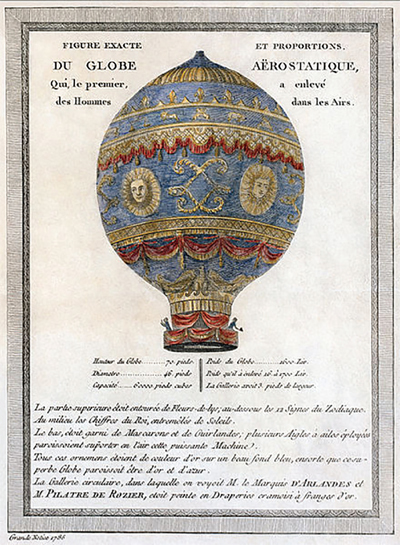
The Montgolfier brothers were pioneers who created the first hot air balloons; their first balloon was made of silk. This later version was silk and paper.