
CHAPTER SIX
The draw loom was a great success in its time but suffered from one serious disadvantage. It required the vigilance of the draw boy – and it usually was a boy who could fit himself on to the top of the loom – to pull up the appropriate warp threads for each pass of the shuttle. It required a great deal of concentration to follow the correct sequence that would produce the pattern, which would normally be indicated in diagrammatic form. It was a system that could be improved by some form of automation. The first to attempt the job was a Lyon worker in the silk industry, Basile Bouchon. His father was an organ maker, so Bouchon could see a form of automation in the barrel organs he produced. In these organs, a tune is produced by means of pins and staples arranged on the barrel – pins for short notes, staples for long. As the barrel is turned, the pins engage with the valves that allow the air into a particular pipe. Each barrel contains just one tune, the unique arrangement of the barrel corresponding with the notes required. For an organ to work well, the pins had to be positioned with extreme accuracy, and the normal practice was to punch holes in paper for the correct design, then wrap that round the barrel – holes would then be drilled into the barrel corresponding with those of the paper. This was the inspiration for Bouchon’s semi-automated loom of 1725.
In the Bouchon loom, as in the barrel organ, a pattern of punched holes was created in a paper that was wrapped around a perforated cylinder. A series of hooks attached to needles were arranged in a box at the side of the loom so that each hook could snag a string that would lift a warp thread. When the cylinder was pushed towards the box, if the needle met an unperforated section of paper, it would be raised, lifting the thread. If the hook met a hole, then it simply passed inside the cylinder. The cylinder had to be rotated by hand for each throw of the shuttle, and was partially successful, but not widely adopted. There were two problems. Firstly, it still required a boy to operate the device, so there was no saving in labour costs. Secondly, paper is fragile and easily torn. Any tear would mean that it would have to be taken away for repair or even used as a template to create a new punched roll. There was also a limit to the number of threads that could be handled, making it useless for the most complex problems. In 1728, one of Bouchon’s assistants, Falcon, made a major improvement. He replaced paper with punched cards and increased the number of warp threads that could be lifted by arranging the holes in rows. It got over one of the problems – a fault on one card just meant that just that card had to be replaced, not the whole roll. It is thought that around forty looms of this type were sold altogether, which is a minute proportion of the thousands then in use.
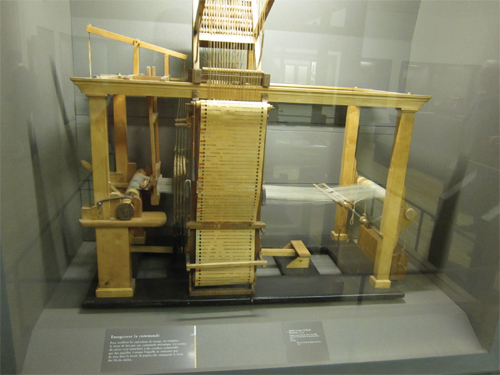
The Bouchon loom that used perforated paper to control the movement of the headless. This version is in the Musée des Arts et Metiers, Paris.
In 1741, Louis XV’s Chief Minister Cardinal Fleury was given the task of looking for ways of improving productivity and creativity in the French silk industry that was now showing signs of falling behind other European countries. One might have expected him to appoint someone with a detailed knowledge of textile technology as an inspector, but instead he chose Jacques Vaucanson, who had been born at Grenoble, the son of a glover. Although he had no experience in textiles, Vaucanson had acquired a reputation as a remarkably ingenious designer of automata. One suspects that the cardinal might have been an acute man who recognised that the future lay with automation and the fresh eye of a genius mechanical inventor might be more useful than an expert steeped in tradition. At the age of just 18, Vaucanson created his first machines, androids which could clear the table and serve guests at a dinner. That was just the start. His next ambitious project was a full-sized figure of a flute-playing shepherd with a repertoire of twelve songs. But his most celebrated creation was the Digesting Duck. The automaton had hundreds of moving parts – the life-sized duck could flap its wings, quack and ‘drink’ water. The feature that gave it the odd name was totally bizarre. The duck could be fed pellets of food and after a short time, a little squirt of all too realistic green slimy poo would appear from its backside. After that, automating a loom might have seemed quite a minor problem.
Vaucanson took the ideas developed by Bouchon and Falcon and improved on them by making the loom self-acting. He moved the mechanism to the top of the loom, so that it could act directly on lifting the appropriate threads by the same system of needles, hooks and punched cards. The mechanism however depended on a complicated sliding cylinder. There is no evidence that the loom was ever adopted – and some experts have suggested that it might well have been unworkable. It did, however, pave the way for the real breakthrough.
The next inventor to tackle the problem was Joseph Marie Jacquard. There is a certain amount of confusion about his early life, beginning with his name. He was, in fact, called Joseph Marie Charles, but there were several related Charles families all living in the same district, so to distinguish them from one another they all had nicknames – this branch was Jacquard and the name stuck. He was born in 1752, the son of a master weaver, and one of nine children, only two of whom survived. He never received any formal schooling and remained illiterate until the age of thirteen, when he was helped out by his brother-in-law, a printer and bookseller. He also introduced Joseph to a circle of intellectuals, and it seems that although intellectually astute, he was physically quite delicate. Inevitably, he started his working life with his father at the loom, but when that proved too much for him, he too moved into bookbinding and printing. When his father died in 1772, he inherited the estate which, as well as the textile workshop, included a vineyard and a quarry. By 1778, he was referring to himself as a master weaver and silk merchant, which suggests that the family inheritance gave him a degree of independence rare among weavers. The family income increased when he married a widow, Claudine Bouchon, who brought with her property and a substantial dowry and they had a son in 1779. The prospects must have looked good, but he fell into debt and had to sell off his father’s inheritance. However, he continued in business and began attempts to automate the draw loom, with limited success.
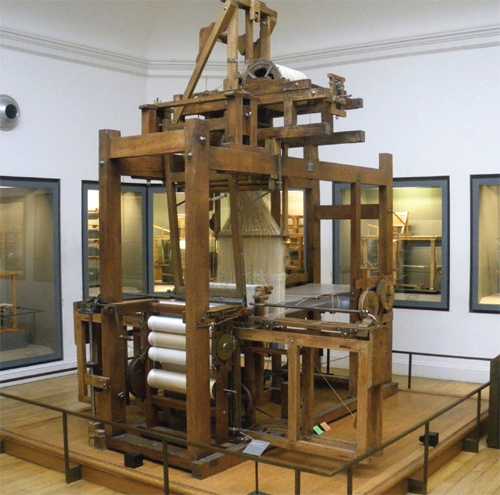
The Vaucanson loom improved on the Bouchon by using punched cards instead of perforated paper.
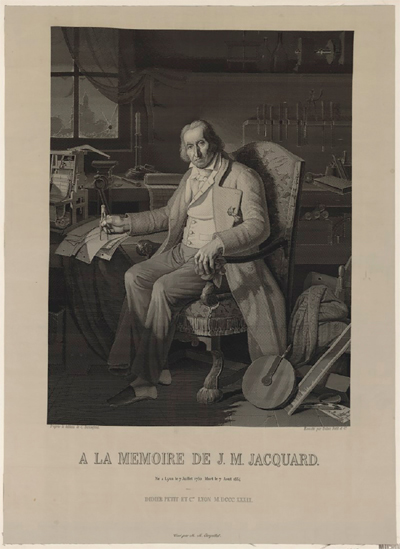
A portrait of Jacques Marie Jacquard woven in silk on a Jacquard loom.
The French Revolution had, of course, a profound effect on the silk industry and, in 1793, there was an uprising against the extremists of the Convention. Jacquard and his son sided with the rebels. But when it became obvious the cause was lost, they fled the city. Their position could have been serious, but they took pseudonyms and went for the one place they knew they should be safe; they both joined the Revolutionary army, fighting in the Rhine campaign, during which, tragically, Jacquard’s son was killed. When he returned to Lyon, he seems to have taken a whole variety of different jobs, from repairing looms to bleaching straw hats. Then, somewhere around 1799, he turned again to invention. The results were a treadle loom that he patented in 1800 and a loom for making fishing nets. He was again working on automating the draw loom, which he developed in 1801. He showed the loom at the exhibition of French industrial products in Paris in 1801, where he was awarded the bronze medal. In 1803, he was called back to Paris and while there had a chance to see a Vaucanson loom at the Conservatoire des Arts et Metiers. By 1804, he had his own device perfected. He now showed the device in Lyon, where it received a very different reception.
The story of the Industrial Revolution in Europe is one of violent reaction to labour-saving devices. In Britain, when Sir Richard Arkwright attempted to open one of his water powered cotton mills in Lancashire, it was burned to the ground. The introduction of machines for dressing cloth in Yorkshire were smashed by Luddites. It is not difficult to see why. Merchants and manufacturers saw their costs cut and profits increase, but skilled craftsmen saw their livelihoods threatened as the machines took over their crafts. In Lyon, there was the same fear. If machinery could be used to create complex patterns, their specialist skills might no longer be needed. On top of that, many families relied on the income from the draw boys, whom the Jacquard machinery would make superfluous. His new machinery was smashed. But ideas are not as easily destroyed as machinery.
1804 was not just the year that Jacquard unveiled his invention, it was also the year Napoleon was declared Emperor. The austerity of the Revolution was rapidly abandoned and the new court was to prove as avid for silk as the old had been. The new administration was also keen to promote inventions – the old enemy across the Channel had been making huge strides in industrial progress, and Napoleon had no intention of seeing France lag behind. Jacquard was summoned to Paris, where he had a two-hour interview with the emperor, in which he explained the principles of his machine. Napoleon was impressed and Jacquard was given an apartment and workshop at the Conservatoire des Arts et Metiers in Paris, together with a handsome allowance that left him free to concentrate on perfecting the machine.
The Jacquard mechanism used a continuous chain of punched cards, wrapped round a square box. As each card was put in place, a simple treadle was used to raise rods attached to hooks. Rods coinciding with holes, remained unmoved, while those meeting solid card were displaced. A beam then rose up and connected with the rods that had been left in place. Threads from the hooks were attached to one or more headles, which would then be raised to make the shed. The great advantage of the system was that it did not require a second person to work at the loom and it offered a way to reproduce even the most intricate patterns. Although the device is usually known as a Jacquard loom, it is really a Jacquard machine that could, in theory, be used with any loom. The only disadvantage is that it added greatly to the height of the whole system, and some workshops were unable to fit them in – and, of course, there were always those weavers who could not afford the expense.
An essential part of the operation was the creation of the cards. The design had first to be drawn out on squared paper and the pattern transferred to the cards. An early version in La Maison des Canuts in Lyon starts with the warp threads to be used in the design arranged in the correct order on a vertical frame. The operative takes each row of the design at a time and pulls on the appropriate threads to create a template. This then goes to a more elaborate machine that punches the holes, and finally a third machine is used to sew the cards together in the correct order, in a continuous loop. Once a pattern has been completed, and the loop has come full circle, the next pattern can begin to be formed. An alternative can be seen in Macclesfield, which uses a machine not unlike a typewriter keyboard to punch the holes manually.
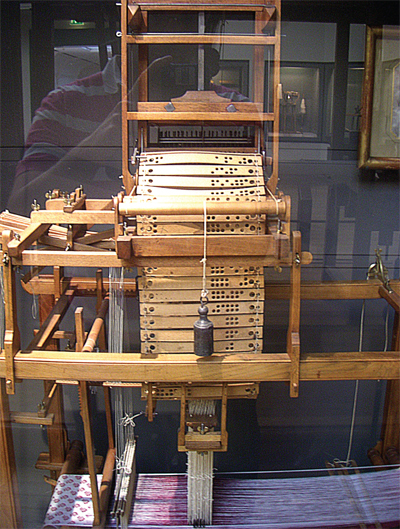
A Jacquard loom of 1810 in the Musée des Arts et Metiers, Paris.
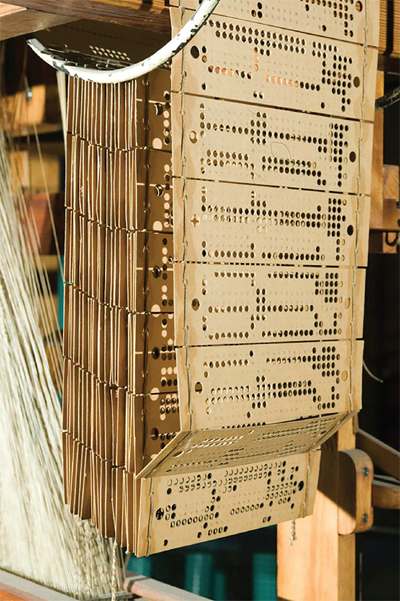
A close up view of the punched cards of a Jacquard loom; the changing pattern of holes indicate which headless are to be lifted and which will remain in place.
In spite of the opposition of the Lyon weavers, the Jacquards spread rapidly throughout France, and Napoleon himself was one of the beneficiaries. Some of the exotic fabrics he acquired can be seen in the Musée des Tissus, also in Lyon. It was estimated that a skilled weaver working on an unadapted draw loom could produce one inch of highly decorated silk a day; with the addition of a Jacquard he could weave two feet. There are not many machines that can instantly produce a 1,200 per cent increase in productivity, so it was inevitable that news of such a device soon spread outside France. Stephen Wilson of Lee Wilson & Co. of Spitalfields sent an industrial spy to France who reported back in a letter of 1820 that he had seen the whole operation and was sneaking a card, rod and hook out of the country.
One huge advantage of the Jacquard mechanism was that it could be applied to almost any loom, and by the start of the nineteenth century, power looms were starting to come into use. The story of the development of the first successful power loom did not come directly from the silk industry, but it is worth telling simply because it is so bizarre. The Reverend Edmund Cartwright was the rector of Melton Mowbray, a town better known for pork pies than textiles. Indeed, Cartwright had never even seen a weaver at work when he was told by a Manchester manufacturer that it would never be possible to mechanise the handlooms. He decided to prove the expert wrong and set about designing a power loom, eventually producing a model that he patented in 1786. It was not a huge success. The warp threads were vertical and, in the inventor’s own words, ‘the reed fell with the weight of at least half a hundredweight, and the springs which threw the shuttle were strong enough to have thrown a Congreve rocket’. The Congreve rocket was a military rocket, which could carry an explosive load of several hundred pounds, which gives some idea of the force needed for Cartwright’s shuttle mechanism. Originally, the power source was two strong men – who were exhausted after about an hour. He went on to make further improvements and took out more patents. In its final version, the shuttle was thrown using a combination of levers and cams, powered not by exhausted helpers but by waterwheel or steam engine. Later improvements were devices that automatically stopped the machine when a weft broke, or the shuttle got jammed. With these improvements in place, a weaver no longer had to concentrate on just the one machine to instantly deal with any problem but could tend two or three looms. Not only did handloom weavers find themselves increasingly displaced as the work moved from home and workshop to factory, but the new looms were now often worked by women instead of men. The textile world was changing, and the changes affected all branches including silk.
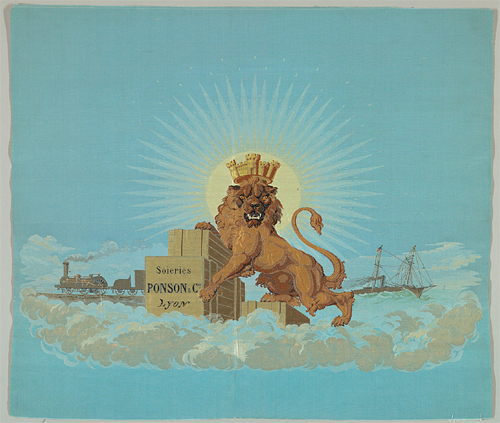
A promotional silk panel showing the heraldic lion of Lyon and a train taking goods all over Europe while the ship sails off to America.
The Jacquard revolutionised silk production, but the basic idea of controlling complex actions through punched cards was to have far reaching consequences. At the heart of the whole machine was the card with punched holes. It is rather satisfying to think that one use goes right back to Bouchon’s original inspiration, the barrel organ. The rotating barrel was quite a crude arrangement, and each barrel could only play one tune. In the nineteenth century, the magnificent fairground organ was produced. The traditional church organ is supplied with a continuous supply of air, and when the organist depresses a key on the console or pulls out a stop, it opens a valve allowing the air into one specific pipe producing a particular note. It is not difficult to see that a Jacquard type of card could be used – where holes in the card permit air to go to the appropriate pipe. It is necessarily complex, as the fairground organ was designed to produce a sound like a band – so some pipes would produce a trumpet like effect, while others would be fitted with reeds to imitate, for example, a clarinet. And, of course, for each ‘instrument’ a whole range of notes would have to be provided. I recently visited the Dean family workshop near Bristol, where they make and repair fairground organs, and discovered that one part of the manufacturing process has still not been automated; the cards are still cut by hand. The holes, unlike those of a Jacquard, are rectangular, and the length of the slit determines the length of time the air enters that particular pipe and thus the length of the note. Like the Jacquard cards, these are fastened together to form a ‘book’. It is wonderful to think that people still enjoy these colourful machines, but they represent only a side-line in the main story of how the Jacquard card system brought in a technological revolution.
The nineteenth century saw great advances in communication, starting with the electric telegraph, developed by Cooke and Wheatstone, which used electro-magnetism to move needles to indicate letters. The greatest improvement in the system was made by Samuel Morse, who instead of needle indicators, used his famous system of dots and dashes, the Morse code. There were disadvantages to the system in that the time it took to send a message depended on the speed of the operator and errors could easily be made – as I discovered many years ago when taking a Morse course. The answer was to develop a system where the message could be corrected if necessary, stored and then sent on at a later time and the only limiting factor on speed was the system itself. The answer was the punched tape. Émile Baudot developed a system that used five piano-like keys to punch holes that were used as a code. So, for example, for A the operative simply pressed key 1, for B keys 3 and 4, for C 1,3 and 4 and so on. The code, of course, had to be learned, but was no more difficult to master than the Morse code. The tape was then inserted in the telegraph machine and run through to send the message. Improvements were made by Donald Murray, who still used a version of the Baudot code, but now instead of five keys, used a system very like that of a standard typewriter keyboard to punch the tape. This was the teleprinter and it remained the standard method of communication right up to the modern computer age.
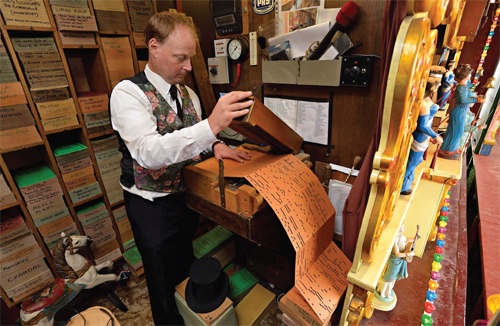
Richard Dean with the punched card book that controls his fairground organ.
Print remained the main source of providing information to large numbers through newspapers. A German immigrant to America, Ottmar Mergenthaler, developed a revolutionary method of printing. Previously it had relied on type setters, picking individual pieces of type and placing them in the correct order in a case. In the new method, a matrix of type was created. The operator worked at a keyboard to produce punched tape, which was fed to the matrix case, a metal plate with moulds for individual characters. This was placed in the caster, where it could be fed with molten lead. The punched tape determined which mould was to be cast, and the character then appeared in the correct place. It is said that when a visitor first saw the machine in use, he exclaimed in wonder – ‘You’ve just produced a line of type!’ And that is how the machine got its name – Linotype. It was first installed at the offices of the New York Tribune in 1886 and soon became the standard method of printing newspapers throughout the world and, like the teleprinter, remained in use until the onset of the computer age, which leads us on to the next major use of the punched tape.
We count using a base of ten, probably because that’s how many fingers we have – which makes them useful for calculations. But numbers do not have to be based on 10 – many mathematicians would have preferred a base of 12. The simplest system of all uses 2 as its base. It works just like our familiar system. After 9 we move back to 1 and add a 0. Binary is the same. So, a binary code running up to our number 7 would be - 1, 10, 11, 100, 101, 110, 111. We have already seen a binary system in operation in the Jacquard loom. There the code was for lift, don’t lift. It is obvious that it can be adapted to other systems, like the blow, don’t blow of the fairground organ. But it could also code for 1 or 0. And that is exactly what was used in the early computers. When in the sixties I worked on X-ray crystallographic data, I had to book a time on the department computer, perhaps getting an hour at infrequent intervals. It was then a case of transferring the data to punched tape. The computer itself was gigantic, occupying the whole of a large room, and yet all it could do was crunch numbers. It had only the fraction of the power of even the cheapest smartphone of today. The idea that it could be used to manipulate words was then unthinkable. But the modern computers still all rely on the same system based on the binary code.
It is, of course, nonsense to think that computer programmers and developers in the twentieth century took their inspiration from a Jacquard card, but it is nevertheless the case that the ideas first worked out two centuries ago were the start of a long period of development. But the punched card, together with the binary code, provided the basis for everything that followed. Perhaps, and indeed probably, someone would have come up with a similar system, but its very first use was in the manufacture of ornate silk fabrics.
We have jumped onwards in time to the modern age, and it is now time to turn the clock back to see what was happening in silk manufacturing in other parts of the world, starting in Britain.