
Chapter Ten
“Metette ben la voce
Respirate bene
Pronunciate chiaramente
Ed il canto sarà perfetto.”
This statement is most often attributed to Gasparo Pacchierotti. Philip A. Duey translates it as, “Project the voice well, breathe correctly, pronounce clearly, and your song will be perfect.”1 Pronunciation is not only about diction; it is also about control of the vocal registers through the tuning of the vowel space. We have studied the manner of breathing, the onset of the tone, and the concept of registration as practiced by the historical Italian masters of the voice. Now we turn our attention to the resonators and their relation to the primary vibration of the vocal cords. Nothing is as controversial and confusing as this, because most of us are not accustomed to thinking of ourselves as musical instruments, subject to the same acoustical laws as all other instruments.
Only when the vibrations of the vocal cords reach the resonators—the throat, mouth, and nose—do we hear the characteristic sound of our voices. Nothing can be done to change this basic quality because it is governed by the physical and mental makeup of the singer. However, as G.B. Lamperti wrote, we can “individualize the voice”—find its natural resonance and eliminate faults. In short, we can develop skill to add to whatever talent we already possess, in order to come as near as possible to our ultimate potential. This means that we must come to understand the basic concept of registration and learn to control these diverse “families” of sounds possessed by every voice. In this way, we can increase the range, power and flexibility and control the color, dynamics, and expressiveness of our voices.
Some of this may sound like too much trouble to you. After all, almost everyone can sing in some degree, so why should we bother with complications? The answer, of course, is relative. How proficient do you want to be? Almost everyone can walk or run, but only a few can hope to become an Olympic athlete. However, millions exercise for health and enjoyment. Training helps them to achieve their individual goals, whether running a marathon or just taking a walk in the park. This is the true meaning of the word amateur—one who loves what he does. To sing better technically makes it possible to reach goals of expression hitherto denied because of a lack of skill. It should be remembered that technique is our servant and never our master. After a time, the satisfaction of moving toward our potential becomes a real pleasure, and sometimes, working out a technical problem becomes almost as gratifying as applause.
THE WORK OF BERTON COFFIN
With the passing of Dr. Berton Coffin (1910–1987), the contemporary world of singing lost one of its most important influences, and his stature will only increase as time goes by. Dr. Coffin was an authority on historical vocal pedagogy and was trained by teachers who could trace their vocal lineage back to the Grand Tradition of Garcia, Lamperti, Marchesi, and Battistini. He was also, by all accounts, a generous, warm-hearted personality with a good sense of humor who always was ready to share his vast knowledge with others, singers, and teachers alike. Since Coffin was equally proficient in both the artistic and acoustical aspects of the vocal art, he was able to interpret his life-long reverence for the teachings of the of the Bel Canto masters into a practical and coherent system for the teaching of great singing. He summed up, clarified, and organized many of the precepts of the historical schools of singing that had previously seemed vague and mysterious to many. Coffin was at great pains to point out that he was not a vocal scientist per se, but a voice teacher and singer first and foremost, who used scientific data to enhance the traditional methods of teaching voice.
Dr. Berton Coffin was a distinguished professor emeritus and former chairman of voice at the College of Music of the University of Colorado, Boulder. Although most of his academic and professional background was in music and vocal performance, Coffin felt that his first major of physics enhanced his interest in and perception of the acoustical aspects of vowel formation. Dr. Coffin was a keen observer who traveled extensively, attending over 400 performances in more than 70 opera houses all over Europe.
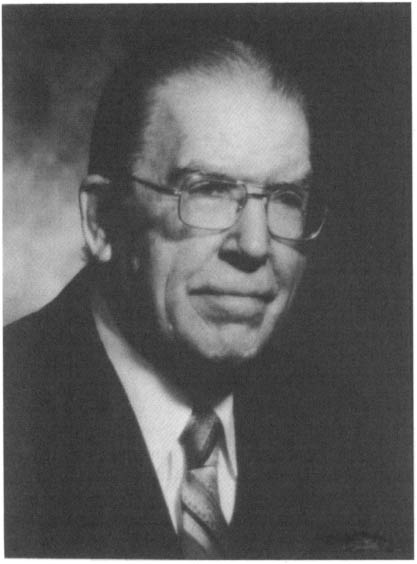
Figure 10.1. Dr. Berton Coffin.
Berton Coffin was a charter member of the National Association of Teachers of Singing (NATS) and served as president in 1968 and 1969. He was very active in the organization, serving as a clinician and editorial board chairman for the NATS Bulletin (now the NATS Journal). Private studies had included work with Graham Reed (assistant to Herbert Witherspoon), Mack Harrell, and Werner Singer, but the greatest influence on the young Coffin was that of Paola Novikova, who had been a student of Mattia Battistini, one of the greatest exemplars of the Italian Bel Canto tradition. Over a ten-year period of time, Dr. Coffin worked individually with Novikova and observed lessons of her famous pupils, such as George London, Nicolai Gedda, Irmgard Seefried, Hilde Güden, Ferruccio Tagliavini, and many others too numerous to mention. In 1986, Dr. Coffin stated, “Novikova’s belief that the voice is a musical instrument was the basis of the extensive study which led to the first edition of The Sounds of Singing, my book Overtones of Bel Canto, the Chromatic Vowel Chart and this edition [the second] of The Sounds of Singing.”2
As Berton Coffin’s knowledge of great singing technique grew, both through the Italianate intuitive oral tradition of Novikova and through his own intense study of the Bel Canto masters, such as the Garcia family, the Lampertis, Delle Sedie, Lilli Lehmann, and others, he began to realize that this great tradition was in danger of becoming lost, even in the midst of a great explosion of scientific knowledge. The empirical school of Bel Canto, which was based in part on the mastery of the vocal registers, was born of a need to meet the challenge of the increasing range and complexity of the music of the Renaissance and Baroque eras. When Coffin began his work, he was interested in understanding the acoustical basis of the historical Bel Canto school. He was especially influenced by the work of Manuel Garcia II. What was missing, he came to believe, was a reliable method of controlling the registers, which had previously been left up to the instincts of the singer and the intuition of the teacher.
ACOUSTICAL PHONETICS
Dr. Coffin’s physics background, as well as his knowledge of the Bel Canto tradition, helped him to understand the acoustical nature of the vocal tract as it relates to the control of the singing voice. He wrote:
I began to sense that what was believed to be fact was either incomplete fact or not necessarily fact. This indicated that there was a body of knowledge yet to be explored. I wanted to know more about the nature of sound in the physiognomy of the singing voice. My course of investigation was uncharted and my final conclusions were not anticipated, rather in many instances they were avoided. I had no intention of counting the visual lines of a spectrogram. In avoiding them I came upon an aural procedure of sensing the harmonic structure of singing. What we perceive from what happens acoustically in the voice is the psychological part of this observer’s statement of the foundations of singing.3
What the Bel Canto masters were not able to explain clearly was how the resonators control the vibration of the vocal cords once the tone is instituted, although Garcia did discuss the vocal timbres and the necessity of vowel modification. Just as the acoustics of a brass instrument control the lip vibration of the player, so also the movements of the resonators in the formation of vowels have an effect on the vibrations of the vocal cords. Good singers have always “tuned” the resonators instinctively by feel and by what they were hearing. The great contribution of Dr. Berton Coffin to the vocal art was a method of notating register events, pitch, and vowel color in the same exercise. Dr. Coffin called this tool The Chromatic Vowel Chart, and its use, with understanding and hard work, can help even an ordinary singer begin to approach the skill level of great singers.4 Of course, the distribution of vocal and musical talent is dependent on the mercy of God, but anyone who desires to understand the acoustical “rules of the road” of his voice can bring real improvement to it by the application of these principles.
Coffin developed his chart using two types of equipment. The first was a small external speaker, which he called an Echophone (later called Vowel Mirror and Vowel Resonator). When the pitch of the lowest formant of the vowel is played into the front of the mouth on a small portable organ, the resonance of the vocal tract (with stopped vocal cords) feeds back the appropriate vowel sound and can be literally focused or placed. The second was called the Radioear Bone Vibrator, a small hearing aid device which is held against the throat just above the larynx and used as an artificial larynx to generate vowel sounds. Coffin used these devices in his teaching early on, but Overtones of Bel Canto makes little mention of their use. The most important point is that the chart was developed by the use of these devices so that no contractions or distortions of the vocal tract would mar the accuracy of the vowel pitches notated.
Coffin began his investigation of the mysteries of the singing voice by collaborating with Dr. Pierre Delattre starting in 1958. Delattre was a world-renowned leader in the field of acoustical phonetics, who brought a musician’s ear to his researches in languages and acoustics. The emerging science of acoustical phonetics was being studied at the Bell Laboratories and at other sites around the world in the interest of achieving synthetic speech. This research can be experienced first-hand by dialing information on your telephone and listening to the synthesized voice intoning your number. At the time of this writing, AT&T has used this technology to develop software which is said to be capable of copying any human voice. It is purported to be so good at reproducing the sounds, inflections, and intonations of a human voice that it can recreate voices and even bring the voices of long dead celebrities back to life.
THE INTERNATIONAL PHONETIC ALPHABET (IPA)
The following quadrilateral contains the vowel symbols of the International Phonetic Alphabet along with the approximate position of the vocal organs used in producing them.
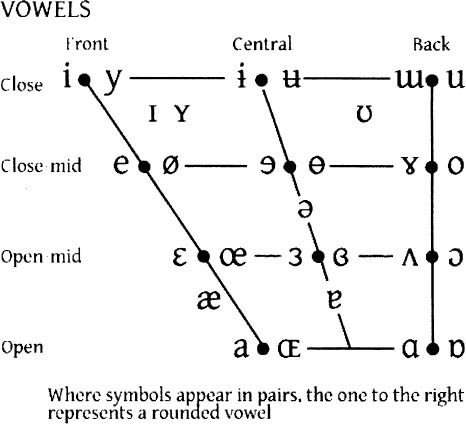
Figure 10.2. The International Phonetic Alphabet (Vowels).
COFFIN’S FIRST STATEMENT ON
ACOUSTICAL PHONETICS
In Phonetic Readings of Songs and Arias (1964), Coffin addressed the issue of singing technique for the first time. In this work, Dr. Coffin began to focus upon the effect that language (vowels and consonants) have upon the physical production of tone. This was not new—G.B. Lamperti had remarked on the mysterious fact that the acoustics of the head, through word, vibration, and resonance, control the throat. The 1964 edition of Coffin’s Phonetic Readings of Songs and Arias contains a long statement defining the necessity for vowel modification. In 1982, after he had written Sounds of Singing and Overtones of Bel Canto, Coffin felt compelled to revise this statement in important ways: The revised statement is as follows:
1. Spoken vowels are caused by two cavities, the cavity behind the tongue hump and the cavity in front of the tongue hump. In good singing the tongue hump is reduced in height in order that the vocal tract can act more as one resonator which allows an instrumental standing wave between the vocal cords and the front of the mouth.
2. The resonant frequencies of these cavities are approximately 15% higher (1½ steps) for women than for men.
3. The high resonance of vowels, in front of the tongue hump, R2, can be heard by whispering the vowels.
4. The low resonance of vowels, R1, can be heard by forming the vowel and thumping the side of the throat just above the larynx. This resonance frequency can only be heard when the glottis is closed (as before the explosion of a cough). The vowels i-e-a-o-u will give a rising and falling pattern of pitches. R1 can also be heard by stopping the ears and whispering the different vowels.
5. R1 frequencies for the various vowels in male and female voices are as high as
æ a α (750 cps) roughly g2 [Above middle C]
ε œ  (600 cps) roughly d2
e ø o (456 cps) roughly a1
i y u (350 cps) roughly f1
I II III Series (Modified from Howie and Delattre.)
6. Three vowel series are shown, I—Front vowels, II—Umlaut vowels, and III—Back vowels. In “Sounds of Singing” and “Overtones of Bel Canto” I have introduced a Neutral vowel series for use in vocalization and the singing of songs and arias.
7. There is a loss of understandability of a given vowel when it is sung on a pitch above its R1 frequency and it will tend to sound like the vowel in its series on that particular note.
8. Vowels sung on pitches higher than the pitches indicated in No. 5 will tend to be distuned, harsh, unfocused, and unstable in vibrato when an unmodified form is forced upon the voice, and conversely, the voice becomes musical and the vibrato even when correct resonance is used. The crux of the matter is—the vocal tract becomes a resonator for sung pitch in singing—vowels must be modified for the resonator to work efficiently, and vice-versa, when the resonator adjusts to amplify the sung pitch, vowels are automatically modified.
9. Basically, language study and the pronunciation of texts should precede the modifications of vowels in singing. The Yersin sisters, the famous teachers of French diction said (1924, p.13), “One ought to be able to read a song at first sight in a foreign language prior to singing it so that the whole attention may be concentrated upon the singing itself.”
10. There is no rule of thumb on the modification of vowels except that in an ascending scale they will tend to open until the voice is spread, and in a descending scale the voice will close until it is muted (when in the same register). If vowel positions are kept in a steady state the voice will run into and out of resonance points (change registers). A study of videotapes in repetition, slow motion, and stop frames will reveal what good singers do to stay in resonance. Again, learn the pronunciation of songs and arias first and then use the Vowel Charts in singing to find the modification nearest to good linguistic pronunciation.
11. Again, if the resonance is disregarded (without intuitive change) there may be difficulty with timbre, pitch, agility, and flexibility in dynamics. When things are right the vibrato will spin. Good critics will point out vocal deficiencies sooner than they will mention slight modifications of language values—in fact, they will usually not notice the latter.
12. It has been found that the extremes of the vowel triangle /i/, /a/, and /u/ must be modified in singing in order for a standing wave to be formed in the throat. Albert Bach in “Musical Education and Vocal Culture” quotes Anna Maria Celoni as saying “le vocali l’i ed l’u si devono evitare a lasciarle a coloro che avessero al mania al’imitare i cavalli ed i lupi.” (The vowel /i/ and /u/ should be left for those who desire to imitate horses or the howling of wolves.) The younger Garcia says of /a/ that in the tenor voice the “/a/ in clear timbre on the notes g’ to b’ will always appear shrill . . . and resembling a boy chorister’s voice; therefore they should never be used except in closed timbre.” The closed timbre is a change into another register. My continued observations have indicated that where teaching is done entirely on /a/ breaks occur at certain points, so in general, pure forms of /i/, /u/ and /a/ should not be used except in recitative and soft passages. This means that the Italian pure vowel concept should be replaced by the Italian pure tone concept—watch while listening to the Italian singers on video tapes.
13. Since female voices sing nearer to the resonance frequency of vowels, they must have a great deal of modification in their singing. Also for acoustical reasons there will be greater visual evidence of it.
14. Since male voices are playing the pitch of vowel by overtones most of the time, there tends to be less need of vowel modification, especially below c1. However, there is a basic modification in male voices utilized by Caruso. The vowels should be modified towards the open on the low notes and rounded towards the closed on the top (Coffin 1980, p.97).
15. The exact meaning of each word should be known for expression and word emphasis before singing. These meanings may be found for the most usual songs and arias in “Word-for-Word Translations” (1966 and 1972).
16. Vowels vary their modification with emotional coloring—when notes are fast there is less need to be concerned with vowel modification. In slower passages when joy is to be depicted the vowels become brighter (higher overtones used). When sadness is to be depicted the face drops and the highest overtones are reduced so that the vowels tend toward the Back and Umlaut vowels.
For application of vowel modifications in singing see “Overtones of Bel Canto”—but precede that study by reading your songs and arias phonetically, and knowing the meaning of the words. Thus, there is a high art with which the wedding of language and cantilena (vocal line) must be accomplished. Traditionally this has occurred quite late in study and is the mark of an artist. Why can it not occur earlier if the above phenomena are understood and observed in the study of languages through phonetics?5
Why not indeed? The above statement by Dr. Berton Coffin includes the facts necessary to build a comprehensive system for mastery of the vocal art. In my opinion, Coffin’s Sounds of Singing and Overtones of Bel Canto are the most important books about the craft of singing since Garcia. The sticking point is the part above about the “above phenomena being understood.” Most singers and even teachers are not accustomed to thinking of the voice as a musical instrument, subject to the same laws as any other instrument, even if these laws are understood. Musical acoustics are not taught in most schools and there is reluctance on the part of many to tackle a complex subject that is perceived to be irrelevant. The fact is that it is of cardinal importance to utilize the results of this research in learning how to sing.
It is not my intention to “improve” upon Coffin in writing down these thoughts about his work, nor am I offering anything new. In over nineteen years of using this material, I have learned to think about the voice in a different way. Acoustical phonetics requires us to perceive the voice as more of an acoustical instrument and less as a bundle of muscles. The muscles react to the acoustics of the vocal tract, not the other way around. Coffin has done the hard work and it up to us to simply use the results in a skillful way.
Being an American, I often use the analogy of the automobile to explain vocal matters. It is not necessary to understand the process of building a fine car to be able to enjoy driving. You must obey traffic laws, of course, and you should know how to maintain the machine, such as having regular tune-ups (voice lessons) with a knowledgeable mechanic (voice teacher). Let us see if we can learn enough about the machine to get it on the road and enhance our driving skill.
COFFIN’S MODEL OF THE VOICE (1980)
The place to start is the statement that vowels have pitch. Vowels will act as resonators to sung pitch and will literally amplify the sung tone if they are “tuned” to allow for greatest resonance. In my experience, most singers generally do not understand this. We are not talking about the musical pitch of either singing or speaking. What we are discussing is the fixed pattern of reinforced overtones generated by a tone (musical or even non-musical) by which the ear distinguishes one sound from another. For example, we are able to perceive the difference between a dog barking and a car horn blowing on the same pitch, by registering the pattern of reinforced overtones we hear. Those who work with acoustics call these overtones formants. The same process is at work when we are able to hear the difference between one vowel and another, as in everyday speech. The ear is so acute that we can even hear the minute overtone shifts that distinguish one singer from another in the same vocal category. “Name the Singer” is one of the most popular features on the Metropolitan Opera Quiz. Each sound that we hear is really a complex chord made up of these overtones. The formants or resonances of the vowels are called, in order of pitch from lowest to highest, R1, R2, R3, and R4. They are also called F1, F2, etc. by speech researchers. R1 is the lower resonance of vowels due to harmonic reinforcement of the complete vocal tract. It is essentially the resonance behind the tongue hump. The resonance in front of the tongue hump is R2. R3 and R4 are very high up, beyond the pitch of the human voice. Coffin stated that these formants (R3 and R4) are not necessary for the intelligibility of vowels, but are basically timbre or voice resonances that allow us to recognize the individuality of voices.
Please refer to number 5 in the above statement by Berton Coffin to find the approximate frequency of the lowest formant (R1) for the various vowels. This is very important because it is the basis for Coffin’s construction of what he called the Vowel Register Scale, which, as we shall see, is the central acoustical register in the human voice. Statements numbers 3 and 4 give us the place in the vocal tract where R1 and R2 are vibrating.
As noted in number 6 above, Dr. Coffin used four vowel series upon which to construct his Vowel Register Scale. This vocabulary of vowels accommodates all of the languages encountered in Western classical music. The symbols of the International Phonetic Alphabet used by Coffin are as follows.
Front Vowels
[a] Italian A, corners back, mine.
[æ] as in American last.
[ε] as in American let.
[e] first vowel sound in may.
[I] American, fit.
[i] as in American, feet.
Neutral Vowels
[Λ] lateral (open) schwa, fun. Sheltered Ah.
[(Λ)] schwa with rounded lips. Truck.
[Y] half rounded (half closed) schwa, pull.
[ə] rounded (close) schwa, French le.
Back Vowels
[ ] lateral Ah, corners back and jaw down, shout.
[ ] dark ah, father.
[ ] Coffin’s coinage of the lateral [] rotated 90 degrees. (Bright awe) joy.
[] as in American, awe (dark aw).
[ ] O with lips drawn back or neutral. (Bright O) jovial.
[ ] [u] with lips drawn back or neutral. (Bright U).
[u] as in English pool. (Dark U).
Umlaut Vowels
[Œ] Rounded front open vowel. French [a].6
[œ] lips rounded [e], German, Götter, French, coeur.
[ø] lips rounded [e], German schön, French peu.
[Y] lips rounded [I], German, Hütte.
[y] lips rounded [i], German, fühl, French du.
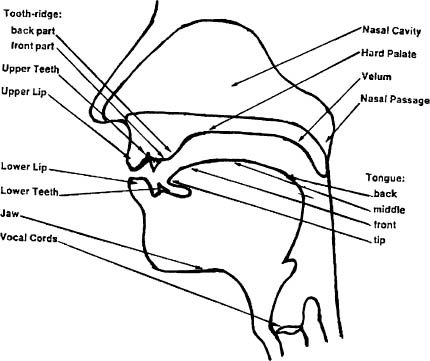
Figure 10.3. The Organs of Speech.
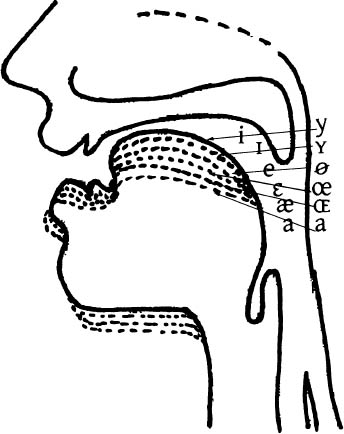
Figure 10.4. Tongue Positions for Front and Umlaut Vowels.
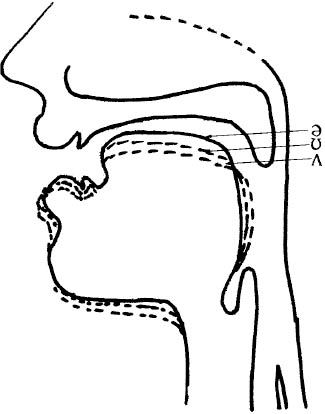
Figure 10.5. Tongue Positions for Neutral Vowels.
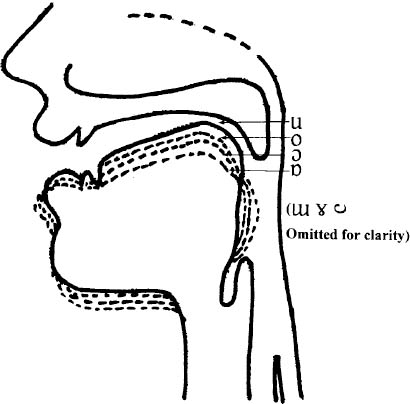
10.6. Tongue Positions for Back Vowels.
NOTES ON PRONUNCIATION
1. The preceding vowels should be practiced in the speaking voice before attempting singing. Reduced to basics, it can be argued that there are only three vowels, [i], [u], and [ə]; that is, the front vowel series is based upon [i], the back vowels are based upon [u], and the neutral vowels upon [ə]. The umlaut series is a combination of the front and back series. In the above table, each of these vowels is in the bottom position of its respective group. Opening the jaw slightly, thereby raising the formant pitch, generates the next vowel of the same group. Practice intoning each subsequent vowel in the position of the preceding one: [i] to [I], [I] to [e], [e] to [ε], and so on. You will observe that only a small movement is needed to pass from one vowel to the other. If you pronounce the word “YIKES!,” you will begin the word with the [i] vowel and rapidly pass through all the other vowels of the front vowel series ending in [a]. You will also observe that the pitch of the word rises from the beginning to the end. Similarly, exclaim “WOW!” for the back vowel series ([u]—[]) and “WAS!” ([ə]—[Λ]) for the neutral series. When we make crossovers (moving from vowel group to vowel group), it is often necessary to make larger movements, like [i] to [o]. This is the situation we meet when we are pronouncing words, as in a song. Part of the skill in mastering this approach to Bel Canto is in getting from one vowel to the other as economically as possible.
Opening and closing movements of the vocal organs to tune the resonators are as follows:
2. The jaw opens and closes. This movement is the most obvious and the one that many singers use almost exclusively. Garcia recommends that the mouth is to be opened by the natural fall of the jaw. Over-opening the jaw is an acoustical disaster. If the jaw is dropped too much, the tongue is forced to move up out of its position of rest to resonate the more closed vowels. This results in the constriction of the tongue and jaw. More worrisome is the fact that, if the resonators are opened too wide, they will come out of harmonic relationship with the vocal cords and will generate harmonics that will actually interfere with the vibration of the vocal cords. The result of this is heavy forced singing. Loudness depends on the vocal cords being allowed to vibrate freely in a harmonic relationship with the resonators so as to produce a tone of wide amplitude. The wider arc of vibration means that each pulse will contain more energy. This, in turn, disturbs the molecules of air lined up between the vocal cords of the singer and the ear of the listener. The more these molecules move, the more the eardrum moves, and the louder the tone is perceived to be. Excessive subglottal pressure does not help; it only increases the stiffness of the vocal cords. Let the tongue rest on the lower jaw and “carry” the tongue from position to position by small movements of the jaw, as much as possible.
3. The tongue hump moves back and forth altering the volume of the forward or rearward resonators. Note that—the vowels are named and grouped according to the position of the tongue hump. Front vowels have the hump well forward, resulting in a larger rear vowel space. These vowels feel more forward, but the major resonator is the throat! Umlaut vowels are combination vowels with front vowel tongue positions and back vowel lip positions. The back vowels have the dominant resonance space in the mouth because the tongue hump is in the throat. These vowels feel deeper, but do not be misled. Caruso was unable to believe an X-ray picture of himself singing an [] vowel because he saw the tongue hump back in the throat. He believed that his throat was very large in these vowels. I am told that the sumptuous golden tone that was characteristic of Caruso’s singing was really the result of his oral pharynx being so broad and high that he could place an egg in his mouth and close his teeth without breaking it! This, of course, is a gift of nature and cannot be developed. We must make the best of what we have. In neutral vowels there is very little tongue hump, the tongue being almost flat. Remember that in good singing, the tongue hump is reduced in height in order for the vocal tract to behave like an organ pipe to produce the standing wave. Therefore, it is useful to think of the neutral vowel [Λ] as the central vowel around which the other vowels revolve, like the planets around the sun. My experience is that most people press the tongue down too low when pronouncing the [Λ] vowel, producing the “dull” sound. This is probably why Vennard cautioned against its use. I like to rhyme (alternate on the same pitch) this vowel with [ε] to develop brilliance; it is not necessary to move the tongue much. This vowel [Λ] is indispensable as a modification of the [a] on high notes, and great singers invariably use the neutral vowel in florid passages. Coffin’s Vowel Chart shows that the [Λ] can vary as much as seven degrees of opening without changing its character.
4. Lip rounding or smiling movements alternately affect the length of the vocal tube, as well as its bore.
5. The larynx moves up and down, also varying the length of the vocal tube. Laryngeal position responds to changes in pitch and vowel. Attempts to artificially lower the position of the larynx result in heavy, forced singing and a stiff tongue moving backwards down the throat. This condition is also affected by faulty breathing.
6. The soft palate position moves up and down (really an oblique movement) and is very critical to freedom in singing. I am opposed to attempts to lift the soft palate, as seems to be the current trend. This often results in constriction of the upper swallowing muscles, closing off access to the nose. With the addition of nasality, R2, R3, and R4 become somewhat further apart and R1 becomes slightly weakened. This is what happens in the top of the voice and what is meant by “singing forward” or “in the mask.” The shift toward the higher harmonics is one of the things that happen in the passaggio and should be cultivated by all singers. The passaggio must be kept narrow in all voices. It may seem that you are giving up resonance by the use of the narrow passaggio, but really, all you lose is excessive fatigue and trouble with your high notes.
Many masters of the past such as Lilli Lehmann, Garcia, Jean de Reszke, and Mattia Battistini emphasized the importance of nasal resonance in singing high notes. This is not to be understood as nasal singing, but nasalized singing. The soft palate should have a soft action. Lilli Lehmann makes this quite clear:
When the peak of the softest part of the palate is placed forward toward the nose, instead of being drawn up high behind the nose, as in head voice, it forms a kind of nasal production which, as I have already said, cannot be studied enough, because it produces very noble tonal effects and extraordinary connections. It ought always to be employed. By it is effected the connection of tones with each other, from the front to the back to a point under the nose; from the lower middle tones to the head tones. In truth, all the benefit of tonal connection depends upon this portion of the soft palate; that is, upon its conscious employment.
This is all that singers mean when they speak about “nasal singing”—really only singing toward the nose. The soft palate placed toward the nose offers a resonating surface for the tone.
The reason why teachers tell their pupils so little of this is that many singers are quite ignorant of what nasal singing means, and are tormented by the idea of “singing toward the nose,” when by chance they hear something about it. They generally regard the voice as one complete organ acting by itself, which is once for all what it is. What can be made of all the cooperating organs they know nothing of.
Blind voices are often caused by the exaggerated practice of closing off the throat too tightly from the head cavities; that is, drawing the pillars of the fauces too far toward the wall of the throat. The large resonating chamber thus formed yields tones that are powerful close at hand, but they do not carry, because they are poor in overtones.7
If nasal resonance is always employed (in Lehmann’s words), then it stands to reason that since the nose is a fixed-space, non-tunable cavity, all tuning takes place in the mouth and throat. Therefore, nasal resonance is the constant, and oral and throat resonance is added and subtracted depending upon the open or closed quality of the vowel. The percentage of nasal resonance is therefore higher in the closed vowels. That is why [i] and [u] feel more forward and [a] or [] feel deeper.
G. B. Lamperti had the following to say about nasal resonance: “Singing is humming with the mouth open.”8 This statement can be realized by the use of the [n] hum, which has several advantages. I am referring to the Italian dental [n]:
The second set of consonants—the Linguals, N, L, R—call for special attention in the use of the tongue for their formation. In English these consonants differ radically from the Italian, being produced by raising the tongue against the palate with a stiff movement, while in Italian the tongue is in complete relaxation, its tip moving very gently toward the front teeth. Their pronunciation is En, El, Er, the tongue relaxed touching the base of the front teeth.9
In using the [n] hum, one can close off the oral cavity with the tongue without disturbing the vowel space. In the [m] hum one sings into the closed mouth until the tone is forced through the nose. I am opposed to the use of the velar sound [ŋ] (as in hung) to teach nasal resonance. In my opinion, this requires the tongue to be pressed backward against the velum and leads to constriction.
Coffin used the device of the hand placed over the mouth while intoning the vowel to produce a hum, but I prefer the [n] hum. The tone just seems to seek the proper placement. I like the unattributed statement from the Internet: “Placement is a sensation but not an action.”
This aria from Gluck’s masterpiece illustrates how useful the [n] consonant is to provide the correct amount of nasal resonance without disturbing the vowel space. Of course the French language incorporates nasal vowels as part of the language, but we can learn to utilize a bit of this technique in other languages without becoming nasal. Mattia Battistini was said to be “the greatest singer I ever heard” by Albert Spalding, the celebrated violinist. Battistini sang unimpaired to the age of 75 and was said to possess “a splendid snarl.” He was the teacher of Paola Novikova, Coffin’s teacher.
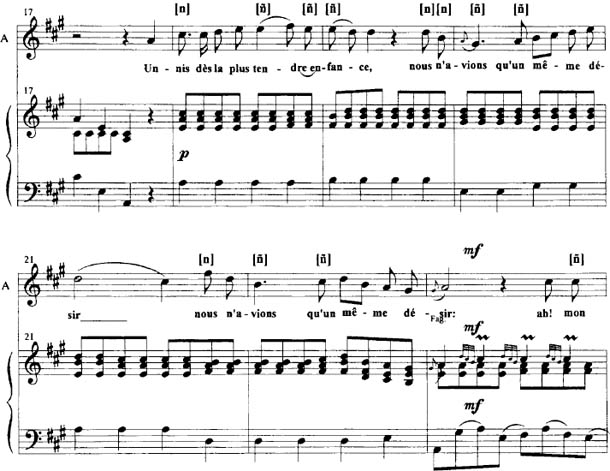
Example 10.1. “Unis dès la plus tendre enfance,” from Iphigénie en Tauride (1774) by Christoph Willibald Gluck.
7. The position of the head is also important. Great singers sing high notes on open vowels with the head well back. Singers who force will often drop the head, in an instinctive attempt to close the resonators and shift to a higher register. Also, very often the head will pitch forward when the chest is allowed to drop, causing the larynx to become cramped. The head must lift up and away from the body—the so-called “noble posture.”
8. Never sing [a] above the staff! You will have reason to regret it because you will run into acoustical interference. It is best to emulate the example of great singers of all nations and substitute [Λ] instead.
9. The sound of the umlaut vowel on openings 12–14 is the French [a], a slightly rounded (with the lips) version of the Italian [a]. I have notated it as [(Œ)]. Coffin made no such distinction on the vowel chart, but it is clearly not the same as the Italian [a] and will not tune properly on the 12th–14th positions of the scale unless rounded. It also proceeds from [œ] on the 11th degree of opening.
10. The opening of the vowel space is not arbitrary. It must be established by speaking the vowel in the most natural way possible, breathing through the nose and mouth simultaneously, if possible, and then singing the pitch indicated. If any further tuning is needed, small movements of the lips, jaw, and/or tongue should establish the maximum resonance for that vowel on that pitch.
11. In vocalizing, all of the vowel groups should be used to ensure a balanced pronunciation. All the articulatory muscles should remain engaged. For example, when moving from a front vowel to a back vowel, the cheeks should not collapse, but should remain firm. Constant vocalization on front vowels tends to cause the larynx to rise and the tone to become shrill. Overuse of the back vowels causes fatigue and can encourage the blade of the tongue to slide backwards, obstructing the tone. The front and neutral vowels should be used almost exclusively for high notes.
DELINEATING THE ACOUSTICAL REGISTERS
I hope that you will remember Garcia’s statement from the previous chapter:
By the word register, is to be understood a series of consecutive and homogeneous sounds produced by the same mechanical means and differing essentially from other sounds originating in mechanical means of a different kind; hence it follows, that all the sounds belonging to the same register are of the same quality and nature, however great the modifications of quality and power they may undergo.10
Garcia viewed the human voice as one wide-ranging instrument. The various categories of voice fall somewhere upon this gigantic scale and are characterized by the dominant register of each voice. For example, the bass voice is “chesty” and the soprano “heady.” Coffin postulated that the voice is a ten-track system, some of which share the names of the traditional Bel Canto registers. The lowest three registers, based on the 8th, 7th, and 6th harmonics, are not named and can be lumped together under the name of the 5th harmonic—Strohbass or “straw-bass,” also called Growl Register by some. Women can sing a few notes in this register, but it is not really a viable register for the higher women’s voices. Coffin named this register Keller (Cellar) Register in women’s voices. Chest Register follows next, then the register called Upper in men’s voices and Middle in women’s voices. Mixed Register is next, named the same in both voices. Vowel Register, a scale based on the actual pitches of the lowest formants of the vowels, follows. Head Register, not used by male voices except for some countertenors, is next. Whistle Voice follows, also called Bell, Flageolet, or Alt Register. Coffin called the highest register “Super Whistle.” So we have from the top down:
Super Whistle
Whistle (Alt, Bell, Flageolet)
Head
Vowel
Mixed
Middle (Upper)
Chest
Keller (Strohbass, Growl, 6th, 7th, and 8th Harmonics)
The movements between the acoustical registers are much subtler than those of the mechanical registers. The changes in the vocal cords are less pronounced than the difference between the Chest and Falsetto. Each note in the acoustical register is based upon the same harmonic and sounds like a member of the same family of tones, regardless of its pitch or dynamic level.
If we wish to retain the traditional nomenclature of the Bel Canto registers, the acoustical registers could be thought of as segments of the three familiar Chest, Middle, and Head plus Whistle Voices:
Whistle / Super Whistle
Vowel / Head
Middle / Mixed
Strohbass / Chest
THE ACOUSTICAL REGISTERS OF
THEINDIVIDUAL VOICES
In order to make the concept of the acoustical registers more clear, we will now lay out the register positions for each voice, with range notation from Garcia’s Classification of Cultivated Voices, example 10.2.11
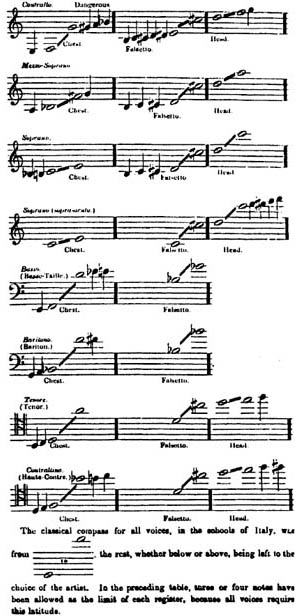
Example 10.2. Garcia’s Table of Range for the Different Voices.
Concentrated study of this “map of the voice” now places us in a position to make some further observations about Coffin’s model of the voice. We can also perform practical demonstrations illustrating common maneuvers encountered in singing and, perhaps, offer explanations for puzzling vocal behavior.
Some pitches only have two registers available, such as E above middle C in the mezzo example. The [a] or [] vowels can be used with impunity in the Chest Register and lower because of the large number of overtones available. In the higher registers, however, these vowels must be modified to avoid spreading into harmonic interference. This modification entails moving into another (higher) register. Harmonic interference occurs in openings of 15—18 and is notated as dangerous!
The lyric soprano voice is the most prevalent category in classical vocal music. Often these voices are deficient in the middle and the bottom of their range. Some of this may stem from the teaching philosophy of some German singers such as Elizabeth Schumann. A pamphlet by her daughter-in-law stated, “Although she allowed [the] deeper and bigger voices to mix chest with head resonance in the lower notes, from approximately B flat downwards, she made an iron rule that the higher type of soprano, lyrical, soubrette, and coloratura, should on no occasion make use of chest notes, even in a mixed form.”12
Garcia states that all voice proceeds from the Chest Register and the lyric soprano is no exception. All lyric sopranos should take care to build the strength of the Middle and Chest registers.
As shown, Garcia’s mezzo-soprano range was only down to low A. We have shown this range down to low F. Garcia’s top note in chest was up to G, while Coffin’s chart shows the chest only up to C. Many early recordings from around the turn of the century reveal marked register divergence among the lower female voices, which may have been caused by constantly taking the Chest Register up too high (belting). On the other hand, a transition into Middle Register at C is too low for most voices to carry over an orchestra. E above middle C seems to me to be a good compromise and, as stated prerviously, any slight spreading is manageable.
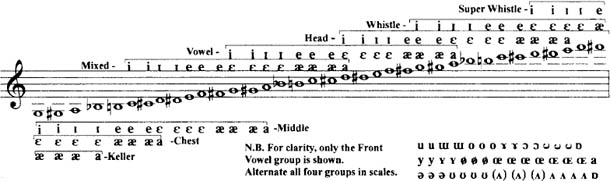
Example 10.3. Coffin’s Acoustical Model of Female Voices (1980), Lyric Soprano.
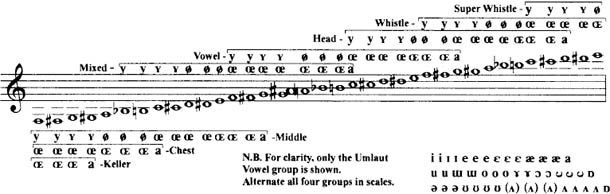
Example 10.4. Coffin’s Acoustical Model of Female Voices (1980), Mezzo-Soprano.
The coloratura soprano (sopra acuto) is the highest female voice. It is doubtful that this voice would ever avail itself of the Keller Register, but we show it nevertheless. The Whistle Register, however, is an important component in the coloratura soprano’s bag of tricks. The high Fs in the Queen of the Night’s arias are never secure unless the Whistle Voice is used. Mariah Carey, the pop diva, uses the Whistle Voice to astound her fans while making millions.
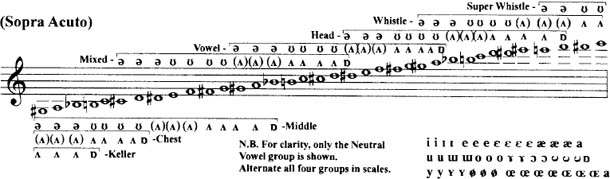
Example 10.5. Coffin’s Acoustical Model of Female Voices (1980), Coloratura Soprano.
The rare coloratura who sings even higher, like Lily Pons or Mado Robin, makes occasional use of the voce di capelli or Super Whistle to reach stratospheric heights. Mozart’s sister-in-law, Aloysia Weber (1750–1839), and Teresa Aguari (La Bastardella) (1743–1783) were also renowned for voices that ranged freely over the high F.
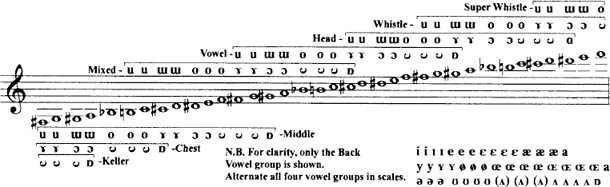
Example 10.6. Coffin’s Acoustical Model of Female Voices (1980), Lirico-Spinto Soprano.
Garcia does not list the lirico-spinto soprano because the roles that are most congenial for this voice, such as Aida, were not written until after 1850. This type of voice is a little higher than the mezzo-soprano (the Vowel Register begins on F#). I believe that this voice is sometimes called a Falcon soprano after Marie Cornelie Falcon (1814–1897), who created the part of Valentine in Les Huguenots and Rachel in La Juive. Some mezzo-sopranos, such as Grace Bumbry, Shirley Verrett, and Christa Ludwig, have attempted to ascend to this category with varying degrees of success. Usually the heavier mezzo voice finds the tessitura to be onerous.
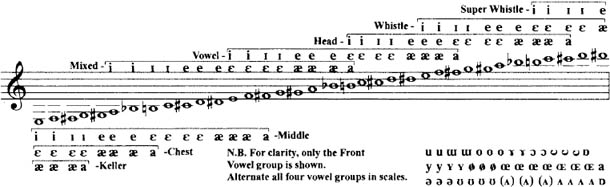
Example 10.7. Coffin’s Acoustical Model of Female Voices (1980), Contralto.
Garcia’s range for the contralto voice only extended up to G5. This masculine sounding voice is out of fashion today, but at one time artists like Victoria Tesi and Ernestine Schumann-Heink (1861–1936) were very famous. Dame Clara Butt’s (1873–1936) mighty contralto can be heard on records as an example of the dramatic contralto.
Note the curious fact that Garcia shows the end of the Chest Register for contraltos and mezzos as G, while the soprano is only allowed to take this register up to E. Coffin’s system shows the end of the Chest Register as B for the contralto.
The lyric baritone is probably the most prevalent male voice. Less common is the Verdi baritone which has the same range. In his middle and late works, Verdi wrote for a large orchestra. This requires a big resonant sound in the middle and bottom of the voice along with a brilliant top. Baritones of this rare type are Titta Ruffo and Leonard Warren (1911–1960). The technical challenge for the Verdi baritone is the careful choice between the Upper Register and the Mixed Register on climactic notes in the passaggio.
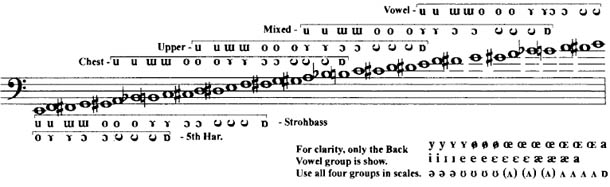
Example 10.8. Coffin’s Acoustical Model of Male Voices (1980), Lyric Baritone.
The high baritone has sometimes become the dramatic tenor by utilizing the Mixed Voice and the Vowel Register. Enrico Caruso, Lauritz Melchior, and Jean de Reszke were all singers of this type. The successful helden and dramatic tenors have all been very careful to avoid carrying too much weight up into the passaggio. Melchior and Giovanni Martinelli (1885–1969) were criticized for closing the passaggio excessively, but both had long careers. De Reszke, on the other hand, probably had the passaggio forced open by the difficult Helden roles such as Siegfried and Tristan, which ultimately ended his career within five years after singing his first Siegfried.
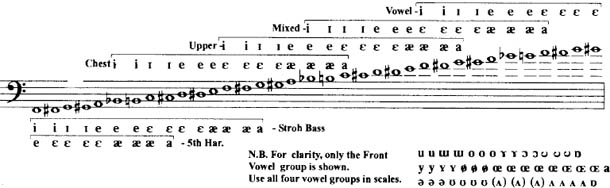
Example 10.9. Coffin’s Acoustical Model of Male Voices (1980), High Baritone or Dramatic Tenor.
The high baritone has been associated with Mozart, operetta, and, in the United States, musical theater. Some opera roles such as Pelleas and Eisenstein have been sung by baritones as well as by tenors. As previously mentioned, some of the Handel tenor roles were given to what Rodolfo Celetti calls Barytenors. Garcia did not designate this kind of voice in his treatise.
With the decline of the castrati, the lyric tenor voice began to emerge as the romantic lead in Italian opera. Such voices, in the phrase of John Ardoin, “suggest the alacrity of youth.” Because of the necessity of constantly singing in the passaggio, technical mastery is probably harder for the tenor than for other voices. Tessitura is another problem, especially in choral music. The tenor mostly “fills in the harmony” and, while not often singing the really high notes in choral music, must maintain a high average pitch. Very often, the lyric tenor suffers from constriction if he does not control the breath adequately.
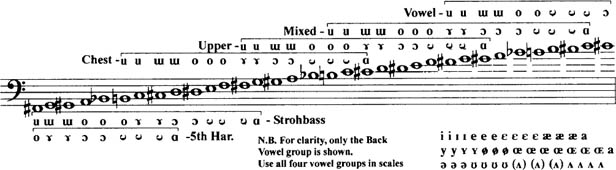
Example 10.10. Coffin’s Acoustical Model of Male Voices (1980), Lyric Tenor.
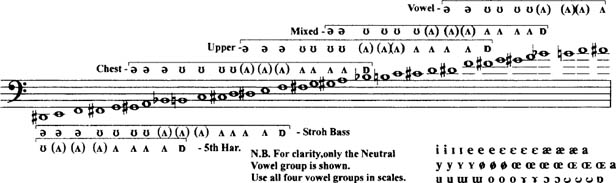
Example 10.11. Coffin’s Acoustical Model of Male Voices (1980), Bass-Baritone.
This category is a relatively modern invention that came into being with the rise of declamatory music. It was found that the bass could not reach the high notes and the normal baritone did not have the vocal weight for such roles as Wotan, The Flying Dutchman, and Boito’s Mefistofele.
The high E was considered to be the top of the bass voice for most of its history. My guess as to the reason for this is that the historic basses were “one-register” types of singers and were unable or unwilling to access the Mixed Register.
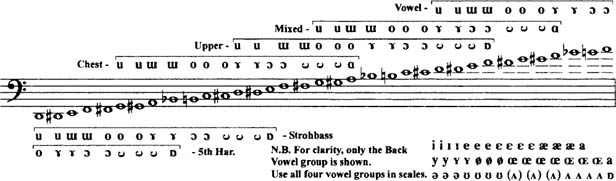
Example 10.12. Coffin’s Acoustical Model of Male Voices (1980), Bass.
Modern basses like Ezio Pinza (1892–1957) and Cesare Siepi (b.1923) began to sing higher roles such as Don Giovanni, which had formerly been the province of baritones. As a result, the distinction between the bass and bass-baritone has become blurred.
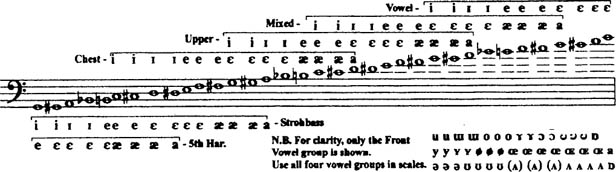
Example 10.13. Coffin’s Acoustical Model of Male Voices (1980), High Lyric Tenor.
This voice is sometimes called the tenorino. Such a voice is rare and is useful for Early Music, Rossini operas, and the Bach oratorios. There is a propensity for constriction in this type of voice because of the common deadly combination of a high tessitura and faulty breathing.
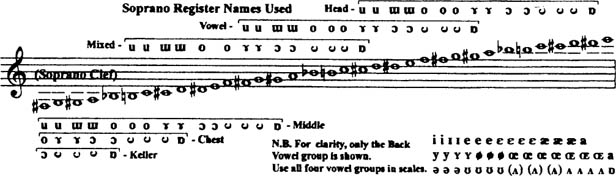
Example 10.14. Coffin’s Acoustical Model of Male Voices (1980), Countertenor (Tenor Falsettist).
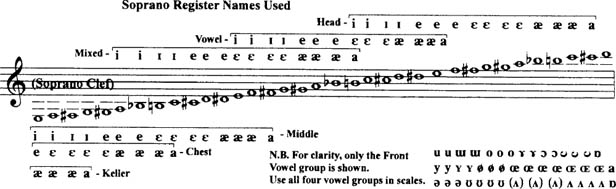
Example 10.15. Coffin’s Acoustical Model of Male Voices (1980), Countertenor (Baritone Falsettist).
The reappearance of the countertenor voice is an event that is worthy of special notice. Our last encounter with this voice was in the Middle Ages when the falsettists were struggling with the increased demands for power and range of Renaissance music in the church. This problem was solved, albeit drastically, by the appearance of the castrati in 1599. The Spanish falsettists were supposed to have discovered a special method to increase range and power, but some speculate that they were really covert castrati. The art of the falsettist faded into obscurity for 200 years as the castrati held sway in the Italian opera. However, in the churches in Germany, England, and other European countries, the falsetto tradition continued. The music of Bach, the Elizabethan composers, and Purcell are examples of music written for this special kind of voice. When the castrati died out in the beginning of the nineteenth century, the mantle of the protagonist in Italian opera fell naturally upon the shoulders of the highest natural male voice, the haute contre tenor. Audiences that were used to the sound of the castrati’s anguished cries in tragic roles did not consider the reinforced falsetto quality of the haute contre tenor to be strange. As orchestras in the nineteenth century got larger, and the interest in earlier music waned, the number of haute contre tenors declined.
In the 1950s, an English countertenor, Alfred Deller (1912–1979), began to perform hitherto neglected repertoire, such as Purcell and the Elizabethan and Restoration composers. Deller’s voice was more resonant than the typical falsettist and his musical gifts did much to popularize early vocal music. There is a story that a dowager rushed up to Deller after a concert and breathlessly asked him if he was a eunuch. Deller replied, “No madam, I am unique!”
Since Alfred Deller’s time there have been many countertenors before the public, and we have seen them accepted by audiences who have become accustomed to the disembodied sounds of male sopranos and altos, especially in Baroque music. However, because falsettists must sing with only the ligamentous portion of the vocal cords, the problem of the lack of power and range still remains. This is admitted by modern countertenors, but some progress has been made in making this voice more viable. Weakness in the Middle Register (female terminology) can be alleviated somewhat by developing a firmer closure of the cords, a remedy utilized by Antonio Bernacchi so many centuries ago. The range extension can be attained by the use of the Head Register. Women singers, although singing with the entire vocal cord, often experience the same problems and apply the same remedies.
Of special interest is the fact that the term countertenor includes both natural tenors (example 10.14) and baritones (example 10.15) who sing in approximately the same range. This calls for some difference in technique. Since the tenor voice is one step higher on our vowel register chart than the baritone, in the lower reaches of the voice, the tenor falsettist will use the Chest Register and will be forced to learn how to make a smooth transition into it. The natural baritone falsettist, on the other hand, will often sing his low notes only in the Middle Register. At the time of this writing, we are seeing the revival of many Baroque operas, with countertenors singing parts that were originally created by the castrati.
Other branches of the vocal art make use of the coordinated falsetto. Some pop styles such as Doo-Wop and Rhythm and Blues were only made possible by the invention of the microphone. On the other hand, years of rigorous training are necessary to develop the loud unamplified falsetto sound of singers in the thousand-year-old tradition of Chinese Opera.
ACOUSTICAL CHARACTERISTICS OF A SINGLE REGISTER
We will now turn our attention to the study of the characteristics of a single register. The Vowel Register (example 10.16F) is a chromatic scale that is constructed upon the actual pitch of the lowest formant (R1) of the vowels. This is the central harmonic register for all voices and will be used as our example for women. The first note of the Vowel Register, as designated by Coffin, begins on the following pitches for the various classifications of the female voice:
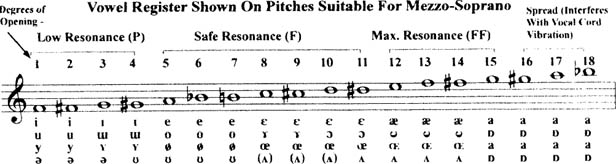
Example 10.16F. A Single Acoustical Register (Female Vowel Register).
Contralto—E above middle C
Mezzo Soprano—F
Lirico-Spinto Soprano—F-Sharp
Lyric Soprano—G
Coloratura Soprano—A-Flat
Learn the beginning pitch of the Vowel Register for your vocal category because it will be the basis for transposing pitches of subsequent exercises. Our example will be for the mezzo-soprano voice (Vowel Register begins on F).
The Male Upper Register or Female Middle Register (example 10.17M) sounds the characteristic resonance of vowels by their first harmonic (at the octave) below the Vowel Register. We will use this register as our illustration for the male voice. Our example will be for the high baritone (Vowel Register begins on F). In the male voice, Vowel Register begins on the following pitches:
Bass—D above middle C
Bass-Baritone—E Flat
Baritone—E
High Baritone or Heldentenor—F
Lyric Tenor—Sharp
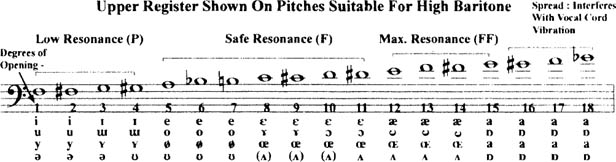
Example 10.17M. A Single Acoustical Register (Male Upper Register).
OBSERVATIONS ON THE ACOUSTICAL REGISTERS.
1. The Vowel Register lies in the upper middle part of the female voice and the highest part of the male voice. As previously stated, much of the time the musical pitch that women are singing is the actual pitch of the lowest formant of the vowel. The resonators, being small in the female, are able to sound the actual fundamental pitch (the musical pitch of the song) as well as the harmonics of the higher overtones. This explains the extraordinary carrying power of many treble voices. The fundamental pitch and the first formant of the vowel are the same.
It is possible that the castrati trained on the Vowel Register, although they did not call it by that name. This would help account for the legendary squillo (ring) of their voices. They would also have learned to utilize the harmonics of the Head Register for their very highest notes.
2. Only the lower portion of the Vowel Register is available to the majority of male singers. The exception to this statement is the so-called countertenor (falsettist), who sings in approximately the same range as the female mezzo-soprano or, in some rare cases, the soprano. Males, especially baritones and basses, must resonate the vowels by overtones most of the time. This is because the lower notes of the male voice would require a tube of two or three feet in length and a foot wide in order to sound the actual fundamental pitches of their lower notes! This strange phenomenon is called the “difference tone.” If three or four upper harmonics are sounded, the human ear “fills in the blanks” and the fundamental is clearly heard, although it doesn’t really exist! For a thorough explanation of this phenomenon, see Coffin’s Sounds of Singing, appendix J. One of the most important points of this is that young singers should not attempt to “make resonance” or imitate the sound of older singers. Singers’ perception of their own sound is illusory so they must listen to the vowel carefully and tune the resonance accordingly.
3. In Coffin’s system there are four vowels (corresponding to the four vowel groups) available on each pitch of each register. For instance, on the first note in Vowel Register (F natural in this case), we have [i], [ə], [u], and [y]. Being very closed, these vowels are low in resonance. Coffin postulated that each register encompasses about 15 semitones (a major ninth), before it spreads out of resonance (or out of a harmonic relationship with the musical pitch). The lowest note of the register is the most closed;—hence it is the least resonant. As we move up the scale chromatically, we find that it is necessary to open the vowel space a small amount (six-and-one-half percent for each semitone) in order to match the resonance of the vowel to the musical pitch. This causes the vowel to begin sounding like the next vowel in its series and also to sound a bit more resonant. Therefore we progress from [i] to [I] to [e], and so on, using the front vowel series as an example. This must be done with the ear. Feeling is much too treacherous as a control.
4. As each vowel is matched (tuned) to its corresponding musical pitch, the resonators vibrate sympathetically with the vocal cords and literally amplify the vocal tone. This is the secret of the big resonant voice that is produced with apparent ease. However, if the resonators are out of phase with the vocal cords, the resultant interference batters the cords with non-harmonic vibration that causes many vocal troubles. For instance, the singer is compelled to force the vibrator (vocal folds) to obtain adequate loudness for operatic singing. You may believe that you are plagued by phlegm because of allergies, but your throat may be trying to protect itself against this nonharmonic battering by manufacturing more mucus as a lubricant. Many singers are not aware of the difference between loudness and resonance. Loudness is amplitude (the swing up and down of the vocal cords) and is the resultant of breath force. Resonance is the increase of sound by the sympathetic vibration of other bodies (resonators):
From the standpoint of classical mechanics, vibrations are represented as periodic displacements of particles recurring at a certain frequency and attaining in each period of vibration a certain maximum displacement known as the amplitude. Greater amplitude is tantamount to greater vibration energy. Each mechanical system is capable of vibrating at some characteristic frequency or group of frequencies. Thus the G string of a violin vibrates at a frequency corresponding to the pitch identified in music as the G below middle C, and also (less readily) at certain higher frequencies which are called harmonics. If a mechanical system is acted upon by an external periodic force of frequency very nearly equal to that of one of the principal natural vibrations of the system, energy will be picked up bit by bit, increasing the amplitude of the natural vibration, which can become on occasion very much larger than the amplitude of the external periodic force. This is the phenomenon called resonance.13
Do not be seduced into singing heavy fat tones in the passaggio or top using only open vowels. This practice is very fatiguing and wearing to the voice. Such disparate singers as Lauritz Melchior and Alfredo Kraus (1927–1999) had very long careers by studious avoidance of the spread passaggio. When I listen to the auditions of many young singers, I hear much out-of-pitch singing. This is rarely because the singer is just unmusical. More often, this is a reflection of faulty breathing and a resonance system that is fighting itself.
5. Frequently, operatic sopranos will attempt to drive the Vowel Register up to pitches higher than its natural limit (A natural) and experience extreme difficulty in the top of the voice. For the highest notes, up to E-flat6, they will need the register traditionally called Head Voice, which lies a fifth higher than the vowel pitch (R1). This register, like its male counterpart Mixed Register, is unstable and, more importantly, it suffers from an incomplete pattern of vowel resonance (R1 is missing). This means that sopranos operating above the vowel pitches have fewer available overtones and must become skilled in vowel modification so as to convey the illusion of good diction. This explains why sopranos suffer from a reputation of being unintelligible. There are some pure vowels that are not available to them on high pitches. We will study the remedies for these problems presently.
6. Like sopranos attempting to force Vowel Register up to higher pitches, we also have the phenomenon of the “A” tenor. I believe that these voices can find their higher voices by learning to access the Mixed Voice and the Vowel Register. A careful examination of the male vowel chart (Vowel Register beginning on F-sharp) will reveal that the highest extent of the Upper Register for the tenor is G-sharp. If we take Mathilde Marchesi’s advice to abandon any register two semi-steps before its highest note, we will find that we will make a register transition into Mixed Voice at F or F Sharp. This, of course, is the upper extent of the famous passaggio, which can be entered on a lower pitch at lesser dynamic levels.
7. The top of the male voice is usually sung in Mixed Register, an unstable register that lies a fifth below the Vowel Register. It is a real misnomer and a source of confusion to call this register Head Voice in the male singer. If one is thinking of the classical Garcia three-register model of the voice, the Mixed Register forms the upper part of the Middle Register of the female voice. Modern tenors, like the great Jussi Björling, use this register, which extends to high C-sharp for their high notes. The very highest tenors can access the Vowel Register to reach stratospheric notes in full voice. We have the example of the early haute contre tenors such as Giacomo David and Giovanni-Battista Rubini. The castrati, who were known for a ringing clear tone and who frowned upon the use of the uncoordinated falsetto, trained these men.
In my opinion, the forcing upward of the Upper Register is the explanation of the technique of Gilbert-Louis Duprez, called sombre timbre by Garcia. Henry Pleasants states that Duprez was the first to sing the High C “from the chest” in a performance of William Tell in Paris in 1837.14 This technique is dependent on lowering the larynx and rounding the lips, effectively lowering the pitch of the resonators to the next lower vocal category. Tenors who use this technique have a distinctively baritonal quality. Heavy breath pressure is necessary to sustain this sound, and practitioners frequently have short careers. Duprez was known for his dramatic ability but was never able to sing with nuance, tonal color, or flexibility. Rossini remarked that Duprez’s voice sounded like a capon with its throat cut. Berlioz was also quite critical of Duprez’s singing. Duprez’s career was over by 1849, and nothing remained of his voice but its strength.
8. Vowel Register sung softly is falsetto in male voices. The uncoordinated falsetto is unproductive and should not be used. When a tone tends toward the uncoordinated falsetto in the male or female voice we say that one is singing “off the voice.” I do not think of falsetto as a separate register, although it certainly qualifies as a register by Garcia’s definition. I consider it to be a discoordination of the voice. There is, however, a coordinated falsetto (Feigned Voice or voce finta) that can be joined to the normal voice. This is very useful for singing pianissimo notes in the top of the voice and for developing the Mixed Voice in the male singer. The Mixed Voice is a mixture of Upper Register and Vowel Register. One of the prime concerns of Bel Canto training was the elimination of the uncoordinated sound and the blending of the registers. Each acoustical register, allowing for individual differences in singers, can be sung either in falsetto or in full voice. Even the coordinated falsetto is not a viable resource for the operatic singer, except for piano singing. It can, however, be used profitably for training purposes and for the development of the countertenor voice.
9. There are two more registers that lie above the Head Voice, which are available to the coloratura soprano. A falsetto or whistle-like vibration of the vocal cords produces the Whistle Register (also called the Alt, Bell, or Flageolet Register).
Emma Calvé was a leading dramatic soprano of the French School of singing. Indeed, for many, she was the embodiment of French style and taste. Calvé was a pupil of Mathilde Marchesi and a superb vocalist with a range of A below middle C to the E above high C. She was comfortable in both soprano and mezzo-soprano roles and was one of the greatest Carmens of all time, although not with the gutsy, dark sound that we have become accustomed to. She sang with the customary three registers of the Marchesi school but also spoke of having a “fourth voice,” which she learned from the next to last castrato in the Sistine Chapel choir, Mustafà. Mustafà had told her that, if she practiced with her mouth shut tight for two hours daily for ten years, she may be able to master it. Calvé, according to her autobiography, accomplished the feat in three years. This ethereal unearthly sound was none other than the Whistle Register.
The practical applications of the Whistle Voice for the female singer are not readily apparent, but very valuable none the less. The Whistle Voice can be used as a resource for extending the female Head Voice. It is to be hoped that we can get at this unique sound in less that the decade prescribed by Mustafà. The Whistle Voice has a distinctive “blown” quality. One of the problems for this register is that the lowest four notes, being too closed and colorless, are useless for artistic singing. However, like the tiny door in Alice in Wonderland, they are the entry into a whole world of high pianissimo effects. They become the register of choice for the coloratura soprano who must cope with The Queen of the Night and such high-flying repertoire. Also, elisions from the Whistle to the Head Voice help to bring more overtone energy into the Head Register.
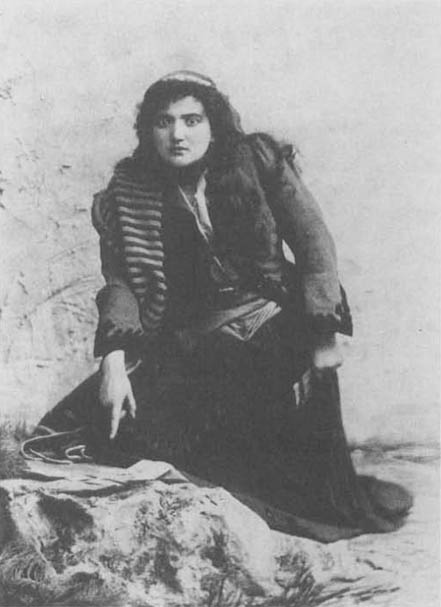
Figure 10.7. Emma Calvé as Carmen in the Card Scene from Bizet’s Carmen.
Three things are necessary for the successful execution of the Whistle Voice. First, the lower vowels must be quite closed for the vocal cords to vibrate in this mode. Second, the soft palate must be relaxed so that a double stream of vibrating air is emitted and the useful resonance of the nasal cavity is incorporated. This is not to say that the tone is to be nasal, but nasalized. The attempt to raise the soft palate as in yawning causes the velum to move up and back, causing the kind of tone Lilli Lehmann described as “blind.” The French contributed the nasal vowels to art of singing, but often overdo it. Third, as described more thoroughly in the section on breathing, the attack must definitely be of the “flute” variety. It is possible that, at lower dynamic levels in the Whistle Register, the vocal cords actually may not touch and that this otherworldly quality is produced solely by the air flowing over the edges of the cords.
The Whistle Register is useful for developing the flute-like, floating quality in soprano Head Voices and is, of course, indispensable to the top of the high coloratura voice. Beverly Sills had this ethereal quality in her very highest notes. Her teacher was Estelle Liebling, who studied with Marchesi.
10. Rossini, who did not like its quality, named the highest register, called the Super Whistle by Coffin, voce di capelli (voice of the hair). The use of this register is extremely limited, and few voices can take advantage of it. Lilli Pons made use of the Super Whistle as well as the Whistle Register by closing her teeth.
The other registers are formed by an inversion of the standard harmonic series of Helmholtz and are really “undertones of a resonator.” They corroborate the classical Bel Canto register pitches outlined by Garcia. The Chest Register (both sexes) sounds the vowel resonances by their third harmonic (at the fifteenth). The fourth harmonic is called straw-bass (Strohbaxs) or Growl Register in the male voice and Keller (Cellar) in the female, and so on down to the deepest reaches of the basso profondo, who will be working the fifth and sixth harmonics.
11. It is evident that those who try to sing with a fixed position of the vocal organs will have great difficulty in tuning for the various registers and vowel colors encountered in a vocal composition. This philosophy is analogous to trying to play a pipe organ where all the pipes are of one size. We cannot repeal the laws of nature. A smooth and supple pronunciation is what is called for to ensure the maximum resonance, flexibility, and control of the voice.
12. Dynamics can be partially controlled by a judicious choice of registers. Within each vowel on each pitch, we also have control of loudness by the addition or subtraction of breath pressure. The subtle interplay of these two forces, resonance and loudness, under the control of excellent breath technique, makes possible the most exquisite shadings of that most famous of Bel Canto effects—the messa di voce.
VOCAL MANEUVERS IN ONE REGISTER
Tuning
Tuning is the movement of the resonators to bring them into a harmonic relationship with the vocal cords. When tuning takes place, an instrumental standing wave is formed in the vocal tract. This produces a tone of maximum resonance and loudness for any favorable vowel sung on a given pitch. Let us choose a comfortable note in the middle of the voice. Count up nine semitones from F above middle C. (Males start one octave lower.) This is the ninth degree of opening. Adjust up or down for your voice classification (one half step higher for the F-sharp tenor; one step higher for the G soprano, and so on). I like to begin this maneuver on the front vowels, so we will use [ε]. Speak the vowel, breathe in through the vowel space formed, and sing out on the [ε] at a comfortable forte. The spoken space and the sung space should be approximately the same. “Canta come si parla!” (“Sing as you speak!”) was the Bel Canto adage. Leaving the organs in position, begin to open the jaw slowly. You will observe that as you slowly open the mouth, the vowel will begin to sound like the next vowel on the harmonic series, [æ]. Closing the jaw will have the opposite effect. Our vowel will now begin to sound like [e] or [I]. Take a breath, return to your original [ε], again on a comfortable forte, and begin to move the other organs such as the lips and tongue, carefully observing the effects. You will hear, for example, an umlaut sound as the lips are pursed and an []-like sound as the tongue is backed.. These are all fairly large movements. Finally, return to the [ε] and begin to make tiny movements of the jaw and lips as if tuning in a faraway radio station. When the vowel sounds to your ear (one of your major assets) like the clearest [ε] you can sing, you will feel a buzz in the mouth at the hard palate (the standing wave) and the tone will be at its maximum resonance for that register on that pitch. Any vowel can be tuned in this manner, but the more open vowels have greater latitude of movement. Do not worry if this sound is not the maximum loudness that you can sing. As we shall see, there are other adjacent registers that can be utilized for more or less resonance and loudness on the same pitch.
Vowel Rhyming or Resonance Matching
“Vowel Rhyming” is a term used by Berton Coffin to equalize the resonance of two or more vowels of the same resonance space. This is a quick way to analyze the deficiency of any vowel and to repair the problem. For instance, many people will sing the [Λ] vowel with the tongue too low and backed, resulting in a dull hollow sound. Rhyming this vowel with [ε] will produce a bright ringing quality, which makes the [Λ] an excellent substitute for [a], especially on top. Listen to Italian singers—this is the vowel of choice for high notes and [Λ] isn’t even in their language! Coffin included two rhyming strips in the middle of his chart that assist in tuning unruly vowels on any pitch.
In examples 10.16F and 10.17M, observe that each pitch has four vowels in each register, one from each group. Intone any vowel on a pitch, tune it, and then sing the other three, taking care to keep the same resonance on each vowel. Move whatever is necessary to get from vowel to vowel. Usually the jaw doesn’t need to be moved on the same degree of resonance from vowel to vowel, but the lips and tongue do. You will begin to appreciate that vowels with the same degree of opening will have the same resonance when well tuned, but will have different shapes, much as a cube and a sphere can have the same volume but have vastly different forms.
Legato is not only a smooth tying of the notes together; it also entails matching resonance of the vowels of a phrase. The Bel Canto teachers described this as being like “pearls on a string.” This means that all the vowels of a phrase should be as close to the same resonance as possible. Adjacent closed vowels like [u] or [i] should be opened slightly and [a] or [] closed slightly. The vowel chart helps enormously in the elimination of guesswork in modifying vowels.
Piping or Resonance Tracking
When we sing up or down a vowel scale without changing registers, we are said to be tracking resonance. Each register in the voice feels as if it fits in a groove or upon a track. Coffin called this maneuver “Piping.” Indeed, a register can be visualized as a pipe, smaller at the bottom end and flaring out as we ascend. If we stay in the pipe, all the tones will have the same texture. The illustration of the familiar Heralds’s Horn (figure 10.8) helps us to visualize this principle. Piping is probably the most natural maneuver in singing. Both Garcia and Bassini spoke of singing in a tube—as in the upper tube and the lower tube. Most untrained singers will stay in the same register when asked to sing a scale. Piping or resonance tracking is executed by beginning the scale down low in a register, where the vowel space is small, and ascending to the more open vowels at the top of the scale. A natural crescendo will be produced as the vowel space becomes larger in ascending, and the reverse will happen as we descend. This is very useful as certain climactic phrases are negotiated. The typical phrase will be scale-like and rarely exceed a fifth. Any phrase wider than this will usually entail a register transition. The most important vowels are the first and the last. The intermediate vowels are passed through so quickly that their presence is implied rather than clearly articulated. Many singers will tend to stay frozen in the first vowel position and must be reminded to allow the resonance adjustment to “float” from bottom to top. Remember that the smaller the vowel space is—the less resonant; the more the space—the more resonant (but subject to spreading and acoustical interference, if opened excessively).
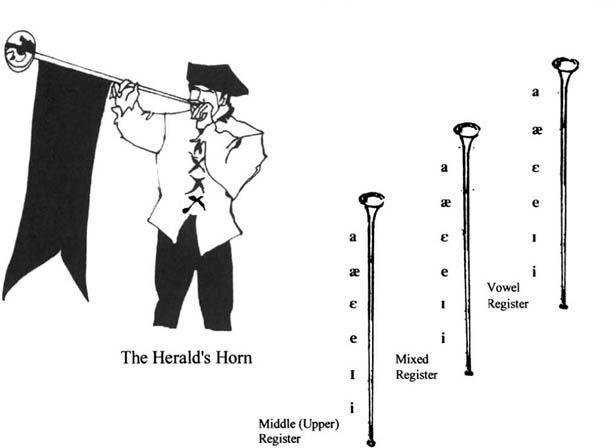
Figure 10.8. The Herald’s Horn Illustration of Parallel Registers.
Musical Examples from the Literature: Piping
After having observed the behavior of the voice in maneuvers involving only one register, we shall now add another acoustical register to our examples, male and female (examples 10.20F and 10.21M). We do this to increase our understanding of the interplay between the registers. For this purpose we will add the Head Voice for the female and the Mixed Voice for the male. Both of these are based upon the second harmonic (the fifth) of the Vowel Register. The female Head Register begins on the fifth above and the male Mixed Voice on the fifth below. To simplify, we will use only one vowel group per example, although any of the other three, singly or in combination, could be used. Please remember to adjust the pitches up or down for your individual voice.
Observation of the interplay between two adjacent registers leads to the following conclusions. First, the profile of each acoustical register is the same as all the others—there are fifteen ascending semi-steps in each before spreading out of resonance. As previously noted, each semi-step corresponds to one degree of opening. Each register gradually gets more resonant ascending and less resonant descending. Coffin uses four vowel groups for each.
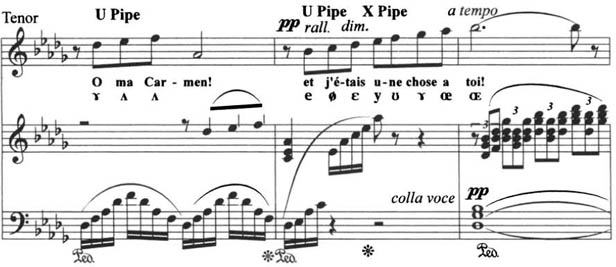
Example 10.18. “La fleur que tu m’avais jetée,” from Carmen (1875) by Georges Bizet.
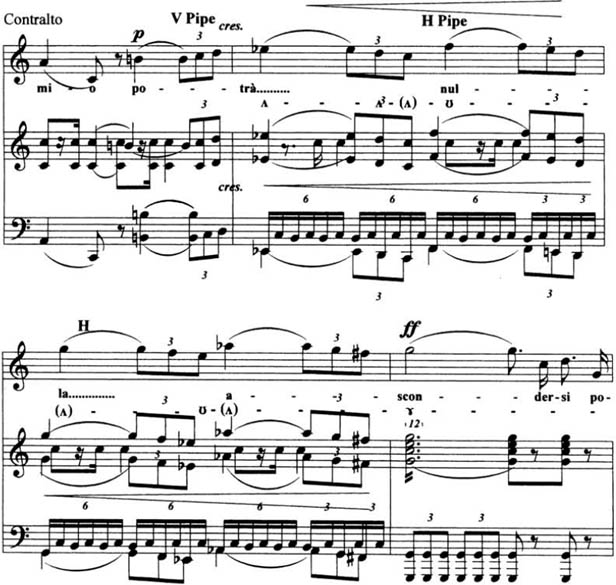
Example 10.19. “È lui! è lui!” from Un ballo in maschera (1859) by Giuseppe Verdi.
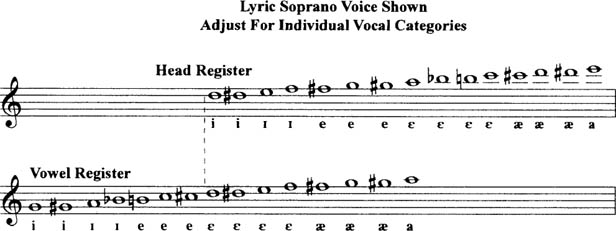
Example 10.20F. Adjacent Registers (Female Voices).
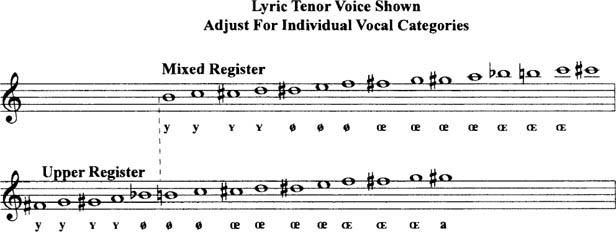
Example 10.21M. Adjacent Registers (Male Voices).
Second, there are several notes in common to both registers; therefore, one can choose which register to sing by simply singing the appropriate vowel on the given pitch. This is not so important for the middle and bottom of the voice, but becomes crucial in the passaggii and the top of the voice.
Yodeling or Bugling
All octaves, all fifths up, and all fourths down have the same degree of opening; therefore, all these tones have equal resonance. As we move to the same vowel positions on adjacent registers by means of these leaps, we pass through barely perceptible null areas called register transitions (or mini-yodels). The singer experiences the passage between them as a slight click. I am sure that you have noticed this phenomenon countless times while singing repertoire. Only the most knowledgeable listeners will notice this and, if they are like me, they will get the greatest pleasure out of the shifting resonances and vowel colors of the skilled singer. Mozart, Handel, and many of the Bel Canto composers used these leaps (di slancio) of sometimes as much as a twelfth for breathtaking effects.
It is extremely important to keep the same space at all times in this maneuver. If the vowel is allowed to spread, we will stay in the beginning register when we move to the higher note (piping). As we move higher and higher, the vocal muscles will contract, tempting us to push into a crescendo. Resist the impulse. The control of the vowel space will overcome any tendency of the throat to spread or constrict. Moving to the next register will relieve the pressure, like shifting gears, and the higher notes can be accessed with much less effort.
Register transitions are shown as mini-yodels. This does not mean a perceptible break or crack in the voice. A register transition can be made on any interval with the appropriate vowel to control the registers. Suggestions for vowel modifications are shown beneath the text and are not always the only solution. Mozart must have loved the play of the registers in the female voice. His music is full of all kinds of skips and leaps and descents into the chest register.
Musical Examples from the Literature: Yodeling
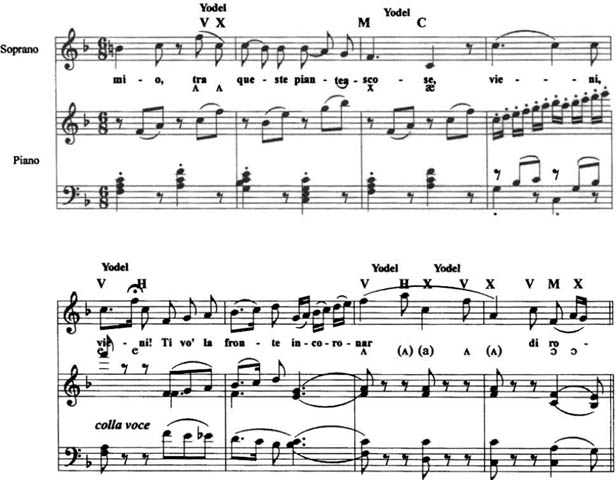
Example 10.22. “Deh vieni non tardar,” from Le nozze di Figaro (1786) by Wolfgang Amadeus Mozart.
Sometimes register choices are a little tricky. This example is scored for a bass-baritone. A basso-profondo might want to consider using mixed register for the top notes to avoid the danger of spreading out of resonance. Register transitions are more difficult to detect when there is more than one vowel involved or when syllables begin with consonants. They are there nonetheless. Also, this excerpt is unusual because of the speed and the number of register transitions involved. It should be practiced slowly until one can execute it up to speed by “feel” and muscle memory. This is what great singers do by instinct and trial and error. The passaggii, male and female, are very real. There is much confusion as to their nature, and many seek to find the one true way to negotiate them. A careful study of the register map will reveal that there are several paths across these chasms; choose the one appropriate for your song.
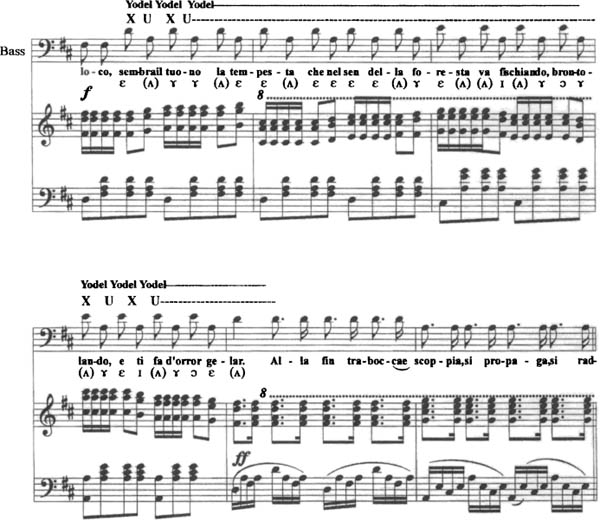
Example 10.23. “La calunnia,” from Il barbieri di Siviglia (1816) by Gioacchino Rossini.
Dvořák’s beautiful Gypsy Song utilizes the skip to the Vowel Register in the third and sixth measures.
Register Switching
It is quite evident by an examination of this chart that the registers overlap. There is no question of register “breaks” or “changing notes.” Transitions can be made imperceptibly wherever the singer wishes. Good singers have always done this. When a scale is run without changing the vowel space, we will be running in and out of resonance and, therefore, making register transitions at every fifth or so. Thus an octave scale will have two register transitions, an octave and a half will have three, and so on. A register event is a passing from one resonant series of notes through a slightly less resonant area back into resonance. This is not apparent to the casual listener. Most places in the voice have two choices of registers for scales and some few have three. This will be seen when viewing the entire “map” of the voice.
It takes great discipline to keep the vowel space from spreading when ascending, thereby becoming enmeshed in one of the lower registers. Garcia advises a gentle rounding upon ascending and opening when descending. Register switching is a primary skill when singing coloratura passages and best executed with a flexible “floating” resonance adjustment.
Reverse Piping
Beautiful pianissimo effects for high notes can be obtained by the maneuver I call “Reverse Piping.”15 In this maneuver, we can close the pipe rather than open it, moving across two registers in our ascent. This is usually done by a leap, but it can also be done on a step-wise progression. This maneuver is difficult to learn because of the natural tendency of the voice to follow one register sound up an ascending line (piping), but it is a skill essential for great singing. All notable singers exhibit outstanding control of the high pianissimo voice.
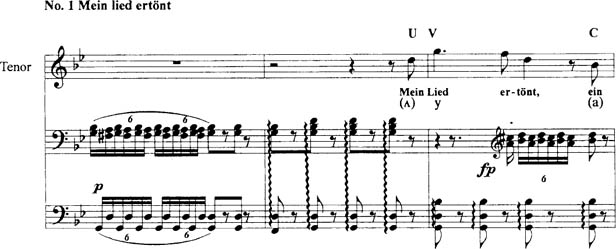
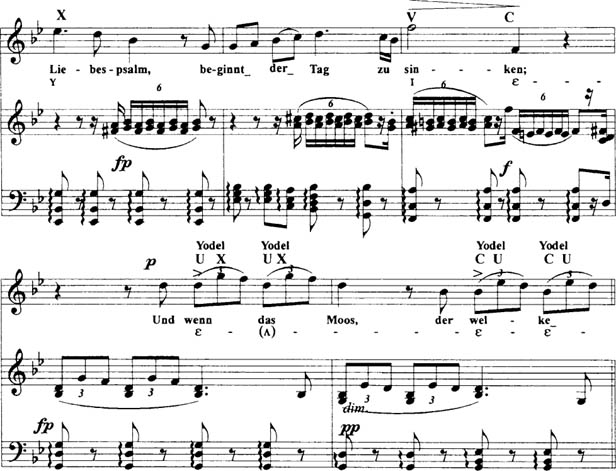
Example 10.24. “Mein Lied ertönt,” from Zigeunerlieder, Op. 55 (1880) by Antonín Dvořák.
Musical Examples from the Literature: Reverse Piping
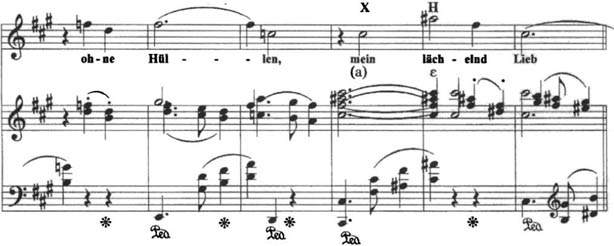
Example 10.25. “Ich schwebe,” Opus 48, No. 2 (1900) by Richard Strauss.
Richard Strauss was an unsurpassed master of music written for the high lyric soprano. Strauss composed many songs for his own wife Pauline and many other great artists of his day, such as Maria Ivogün (1891–1987), Margareta Siems (1879–1952), and Elizabeth Schumann (1888–1952). This excerpt is from the song aptly named “Ich schwebe” (“I float”). It is an example of the control of dynamics by the reduction of both resonance and loudness. It is amazing how often the great composers instinctively understood acoustical phonetics, for it is not necessary to modify the vowels in this example. Resist the impulse to open the resonators in moving up—“bite” the top vowel.
In the Aida example, the soprano is required to sing her high B-flat pianissimo and therefore closes the resonators to access the Head Register. Radames, on the other hand, has an accent on his high F natural and a crescendo to the G-flat. This is best done by piping on the Upper Register line.
Spelling
There may be as many as three different registers available on any one pitch. Spelling is the movement from register to register on the same pitch by singing vowels appropriate to each. For instance, on the mezzo-soprano vowel chart (example 10.4), singing the [i] vowel on F4 would give us Vowel Register, [ε]—Mixed Register, and [ae]—Middle Register. Small movements of the lips, jaw, and tongue assist in finding the resonance center of each vowel. As we pass from closed to open, and back to closed again, we can sense movement from register to register on the same pitch. In learning this maneuver, along with the control of loudness by good breathing technique, the foundation is laid for the execution of the messa di voce. Garcia says, “During pianissimo practice, the pharynx will be reduced to its smallest dimensions, and will dilate in proportion to the increasing intensity of sound; returning afterwards by degrees to its original shape, as the sound becomes weaker.”16
To control the dynamics of our singing perfectly, we need control of both loudness and resonance. Within any vowel space it is possible to sing more or less loudly by the addition or subtraction of breath pressure. The simple crescendo was already in use in 1601, and its difficulties were commented upon by Caccini. Referring to the above quote from Garcia, it is apparent that the vowel space must vary with dynamics and as many as three registers need to be negotiated on the same pitch. Therefore, both loudness and resonance will be used to control the dynamic effects called crescendo, esclamazione (diminuendo), and the famous specialty of Bel Canto, the messa di voce. The vowels must be disguised to sound as if they are all the same during the swelling and diminishing of the tone. This is a truly amazing feat, which can be learned. It is small wonder that this skill, along with that of the trill, is practically extinct in this age of instant gratification.
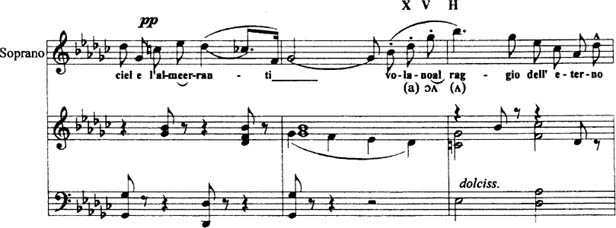
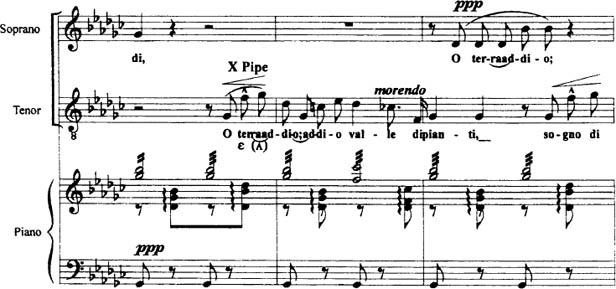
Example 10.26. “O terra addio!” from Aida (1871) by Giuseppe Verdi.
Musical Examples From The Literature: Spelling
The first four notes of Whistle Register are useless for the female voice (except for training purposes) because of their lack of resonance. However, from the fifth degree of opening on up, the space is sufficient to produce a beautiful flutelike quality, which can be used to good effect in this excerpt. Begin with a light aspirate, then crescendo until the limit of loudness is reached for the Whistle Register. As the vowel is then opened slightly, the voice will pass into Head Voice, where the maximum loudness and resonance will be reached for this pitch. Of course, the final effect of any singing also depends upon the quality of the initial vibration. That is governed by good breathing technique and attention to attacks. For a study of the effective use of the Whistle Register, one can listen to early recordings of Beverly Sills.
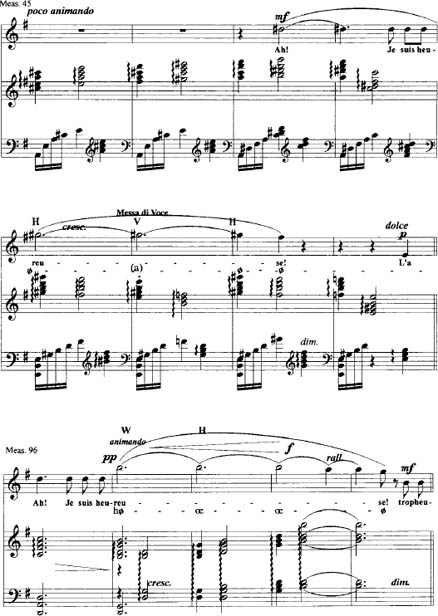
Example 10.27. “Depuis le jour,” from Louise (1900) by Gustave Charpentier.
Scoring
When it becomes necessary to modify vowels in order to locate more favorable resonance and help the vibrator, we are scoring. This is what we have done in the previous musical examples from the literature. It is not necessary to score all the tones in a composition—just the questionable spots. Of course, this will usually be in the passaggii and above, but will also sometimes be needed on the bottom, when the text calls for a vowel that is too closed to resonate well. Scoring is where the vowel chart can be of greatest benefit. It is no longer necessary to just guess at a vowel modification. Now we have a tool that allows us to precisely choose a modification that sounds most like the original vowel for maximum resonance and control over the vocal instrument.
I will leave the last words of this chapter to Berton Coffin:
I am of the opinion that the vocal masters of the past were listening to the play of overtones in the voices which they were training—it is they who developed the term, “registers.” And, I know that better and faster results are obtained when a somnambulistic approach is taken in this acoustical type of singing rather than a rational, analytical, or intellectual one. To some singers vocalizing in this manner is their form of daily meditation. It sensitizes the thresholds of perception. Teaching by overtones leads more toward the art than the science of singing. It is the intuitive which inspires, not the mechanistic.17
NOTES
1. Philip A. Duey, Bel Canto In Its Golden Age (New York: King’s Crown, 1951) 174.
2. Berton Coffin, Coffin’s Sounds of Singing, 2nd ed. (Metuchen, NJ: Scarecrow, 1986) 2.
3. Coffin, Coffin’s Sounds of Singing 5.
4. I recommend the purchase of Coffin’s Chromatic Vowel Chart to everyone who wants to understand the acoustical nature of the voice. At the time of this writing (2004), it can be purchased from Scarecrow Press or Amazon.com for $10. Overtones of Bel Canto is also very desirable to have.
5. Berton Coffin, Phonetic Readings of Songs and Arias, 2nd ed. (Metuchen, NJ: Scarecrow, 1982) viii–xi.
6. Jeannette D. Bragger and Donald B. Rice, Allons-Y! (Boston: Heinle & Heinle, 1988) 117. Allons-Y! states that “the (French) a is pronounced with the lips rounded.” Coffin did not distinguish the rounded [a] from the normal [a].
7. Lilli Lehmann, How to Sing, translated by Richard Aldrich (Northbrook, IL: Whitehall, 1972) 78–79.
8. William Earl Brown, Vocal Wisdom: Maxims of Giovanni Battista Lamperti (New York: Arno, 1931) 104.
9. P. Mario Marafioti, Caruso’s Method of Vocal Production (New York: Dover, 1981) 254.
10. Manuel Garcia II, The Art of Singing, Part I (Boston: Ditson, c.1855) 6.
11. Garcia, The Art of Singing, Part I 8–9.
12. Michael Scott, The Record of Singing, vol. 2 (London: Duckworth, 1979) 201.
13. Encyclopedia Americana, Vol. 23, (New York: Grolier, 1973) 14b.
14. Henry Pleasants, The Great Singers: From the Dawn of Opera to Our Own Time (New York: Simon & Schuster, 1966) 167.
15. This term was coined by the author and not used by Coffin.
16. Garcia, The Art of Singing, Part I 33.
17. Coffin, Overtones of Bel Canto 45.