
Chapter Nine
VOCAL CATEGORIES IN THE MIDDLE AGES
It is helpful to understand that the vocal categories of the Middle Ages and the Renaissance were different than they are now. The lowest voice in a polyphonic composition was called the tenor (from the Latin tenere: to hold) because it was assigned to hold or sustain the principal melody (cantus firmus) in a two- or three-part work. Therefore, the term was meant to name the function of the voice on the tenor line and not to describe the range or quality of the voice. Indeed, sometimes the tenor was played on an instrument. The range of the tenor during the Middle Ages was typically from about A3 to F4 (approximately the same as today’s baritone). The term barytonus means base or foundation and is included among singers in the Papal choir in 1547. Sometimes the barytonus would also sing the tenor part of the polyphonic composition. In the seventeenth century the extent of this kind of low tenor voice had expanded to approximately A4. From the earliest times, the high voice was considered to be the best:
Expressive singing presumes a series of vocal qualities which in their totality give an ideal picture, contemporary to be sure, of the fine voice; and, at the same time, present a goal for voice training. Attempts have been made repeatedly to describe in brief all the esthetically necessary qualities. One such definition of voice probably enjoyed great popularity in the Middle Ages. It is found, for example, in St. Isidore of Seville around the year 600, in Aurelianus Remensis in the ninth century, and in Hieronymus de Moravia around 1250. As Rossetus pronounced it in 1529:
“The perfect voice must be high, musical, strong (firm) and clear; high, so that it satisfies the ear, strong (firm) so that it does not waver or lose its strength (or go off pitch), musical so that it will not grate on the ears, rather caress them and lure the hearts of the listeners and capture them. If one of these qualities is missing, then it is not a fine voice.”1
One of the famous early tenors was Annibale Pio Fabri (1697–1760), who created many of the tenor parts for Handel during the London seasons of 1729–1731. Rodolfo Celletti calls this voice type barytenor and says that it was used extensively in the serious operas of Rossini. Perhaps the heldentenor category had much earlier antecedents than has been supposed previously.
The use of the term tenor for the highest male voice may have come about as a contraction of the term contratenor, which was synonymous with alto or contralto, the name for the highest adult male voice at that time. This meant, of course, the line in a two- or three-part composition that was composed in counterpoint against the tenor (principal melody). In recent years we have seen the return of the falsettist contra or countertenor that now routinely sings the alto parts in early music concerts.
The treble parts in sacred polyphonic compositions were sung mostly by boy sopranos (from the Italian sopra: over). These parts were also called the cantus (melody), discantus (descant), or superius (higher). In secular settings, women and girls also sang the descant parts. As previously mentioned, the court of Ferrara was renowned for its women singers.
In the fifteenth century, a new conception of music demanded that the lowest voice be freed from its circumscribed function of giving a fixed melodic line and be allowed to function as a foundation for the newly conceived harmonic progressions, especially at cadences. This necessitated adding another line under the tenor, called, at first, contratenor bassus (low contratenor). Later, it was called simply bassus. These designations—soprano, alto, tenor, and bass (SATB), with the addition of specialist sub-headings (such as coloratura soprano)—have remained to the present time as the traditional categories of the voice.
THE TWO-REGISTER CONCEPT
For centuries, singers had observed the tendency of the voice to divide itself into two parts. These sounds were called Chest Register (voce di petto) and Head Register (voce di testa). Other terms for the upper register were Falsetto, voce finta (Feigned Voice), and, in certain cases, Mixed Voice (voce misto or voix mixte). As previously stated, Bassini said that “all are falsetto tones which are not produced from the chest.” The word “register” was coined during the Middle Ages when it was noticed that the different textures of the human voice bore a distinct resemblance to the various registers of the organ. The skillful use of these registers, when well integrated and blended, enabled the singer to extend the range and to have a greater control of the dynamics of the song than the mere variation of breath pressure.
Manuel Garcia defined the word register in 1840:
By the word register, is to be understood a series of consecutive and homogeneous sounds produced by the same mechanical means and differing from other sounds originating in mechanical means of a different kind; hence it follows, that all the sounds belonging to the same register are of the same quality and nature, however great the modifications of quality and power they may undergo.2
The highest of these registers was called Head Voice from the earliest times, because the vibrations seemed to be emanating from the region of the face. As mentioned, the descant lines of part songs in the church were assigned to boys. Since the pitch of these parts was about an octave above the high notes of the modern tenor, it is a real misnomer to call the high portion of the modern male voice the Head Register. Garcia said, “With men, the head sounds exist only as a mere remnant of the boy’s voice and are at best a poor resource. The Italian public attach no value whatever to them; nor can they be employed, unless in exceptional cases by very high tenor voices and what are called buffi caricati. All other male singers do wrong to use them.”3
THE SOLUTION TO THE PROBLEM OF THE PURE FALSETTO
The use of the pure (uncoordinated) falsetto was universally condemned by the teachers of the Middle Ages and Renaissance as being a poor resource, suitable, in the words of Doni, only for the characterization of lying, fickleness, and flattery!4 However, falsetto males were used to reinforce the boy’s Head Register singing until the end of the sixteenth century. Basses and baritones seemed eager to extend their ranges by the use of the falsetto during the Renaissance. This kind of falsetto was probably the coordinated type. The Spanish seem to have used a special method for developing the falsetto, because the papal choir imported most of its sopranos from Spain in the sixteenth century. Later, as liturgical music increased in range and complexity, boys and falsettists were found inadequate in power and reliability. In 1562 the first castrato, Francisco Soto, a Spanish soprano, was admitted to the Papal Choir, and the evirati held sway, first in churches and later in the opera houses, for the next 300 years. Some say that it is possible that the Spanish falsettists were covert castrati. Whatever the case, “the advent of the castrati is an energetic renunciation of the falsetto.”5
THE CHEST VOICE
Then, as now, most people prefer the sound of the voce naturale or Chest Voice. Lodovico Zacconi wrote:
Chest voices are, according to the cognomen view, the best. Chest voices are such voices which, upon starting the tone by forcing the air out of the throat, appear to do this by the power of the chest. These voices tend to produce considerably more pleasure than head voices, so that one never tires of hearing them. The chest voice is the most characteristic and natural voice, not only because it is produced by the chest, the proper instrument, but also, because it is most purely produced.6
It should be noted that the lowest register of the male voice—the “throat bass,” also called the “Growl Register,” or Strohbass (Straw Bass) was known at this time. Marin Mersenne called it “a rattle in the throat, which basses sometimes use in order to supplement the natural voice when it is not low enough.”7
THE MIDDLE OR MIXED VOICE
The higher tones of the male voice and the middle of the female voice were sometimes called Voix Mixte, Voce Misto, or Mixed Voice. Ulrich says that:
These high tenors, counter-tenors, must have been more numerous then than now; also, they must have understood better how to train the chest voice and expand its range upward than we do today. The ability to use the register, which seems to be a mixture of head and chest voice was considered if it was there naturally; if not, it had to be developed. All of the voice types from baritone to the highest tenor have the ability to produce tones in this register. However, Garcia says that it is a natural and splendid source of help for the chest voice. Beyond this, if one considers the range of contemporary tenor parts, it is absolutely necessary and far more important for tenors than baritones.
This register was known in the A Capella period. Zacconi and Cerone, who depended upon it, describe its effects. Possibly it was consciously used in the Middle Ages, as one may conclude from John of Moravia. If considerable care was given to the training of this register, as one must assume, then the fact that the alto parts were sung by high tenors is explained. One might almost use today the nomenclature which Cerone used for this register, “middle voice,” or “mixed voice.”8
REGISTRATION IN THE BEL CANTO ERA
During the so-called Bel Canto era of the seventeenth and eighteenth centuries, there were other authorities that wrote about the vocal registers, including Pier Francesco Tosi and Giambattista Mancini.9 These writings and others were concerned with what might be called the physiological or mechanical registers, as opposed to the acoustical registers, which were not clearly understood at that time. Tosi and Mancini were male sopranos and their books were written about the training of the boy soprano voice. Their major concern was the union of the two registers and the buildup of the weaker one (voce di testa) so as to facilitate the production of an even scale. Mancini made the following statement about the registers:
The voice in its natural state is ordinarily divided into two registers, one of which is called the chest, the other the head or falsetto. I say ordinarily, because there are rare examples in which one has received from nature the most unusual gift of being able to execute everything in the chest voice. I am speaking only of the voice in general divided into two registers, as commonly happens.10
This second sentence in this passage is given considerable importance by Edward Foreman, the editor of Mancini’s book, and by James Stark. I believe that it refers to the middle register, which was utilized by Antonio Bernacchi, Mancini’s teacher, and the secret of which was passed to Farinelli after his celebrated encounter with Bernacchi in 1727. Henry Pleasants and others state that Bernacchi sang his divisions with a full Chest Voice, but this seems unlikely to me, given the difficulty of executing the extremely florid music of the time in a “belt” quality of voice. If one is accustomed to thinking about only two registers, as contemporaries of Bernacchi were, then a well-developed middle register would certainly sound like Chest Voice to them. If we were able to listen to Bernacchi today, I think that his technique would sound more like the singing of Marilyn Horne, than that of Allesandro Moreschi.11
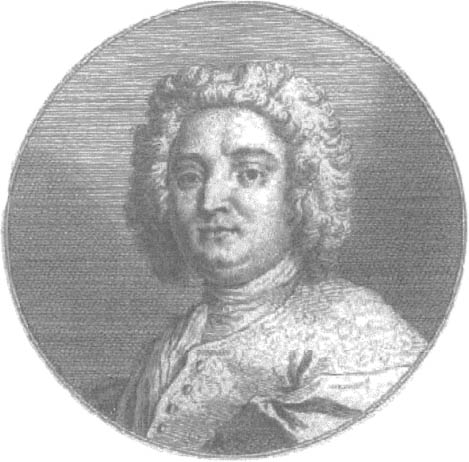
Figure 9.1. Antonio Bernacchi.
There is another passage from Mancini’s book, as translated by Pietro Buzzi, which seems to imply the existence of the middle register, at least in some singers:
In our time [1774] teachers wish to enlarge the range, and by forcing Nature, they bring out from the throat even a larger number of tones. Thus, today, the tendency is to judge a singer’s merits by the range of his voice. In my opinion, however, the worth of a voice will always depend upon its evenness of quality throughout the whole register, and perfect intonation. The strength of the medium and chest tones must also be equivalent to those of the head, in order to form an even register. The medium and low tones are naturally more homogeneous, sonorous, and pleasing, because they come from the chest, while the head tones are more difficult to perfect because they are more shrill.12
Tosi and Mancini both state that the change from Chest to Head Register occurs at D4. These models of the voice seem to suggest that the transitions between the registers, whether two or three in number, occur at fixed places, and that the “breaks” between them must be eliminated by building up the weaker register and holding back the stronger.
THE COLORFUL VOICE
Before we leave Mancini, we should consider another important element of the singer’s art—the concept of vocal color. Little was said about tone coloring in the early treatises, but the term chiaroscuro is to be found in several:
Once the scholar has arrived at the level of sustaining and passing the notes as above [blending the registers] without taking breath, he should continue his study, singing solfeggios of agility with the two vowels A and E, and this exercise will make him master of coloring at will any passage with that true expression which forms the cantilena colored with chiaroscuro, so necessary in every style for singing.13
Giovanni Battista Lamperti’s concept of chiaroscuro is very interesting. His interpretation of it is a wonderful description of the “standing wave” that occurs when the resonators are perfectly in tune with the vocal cords:
There is a vocal resonance like unto a composite vowel-sound containing all of them. The reverberation of the voice is felt as an elastic solid filling head, throat and (in low tones) chest. When this composite sound is focused in the middle of the skull, it can be moulded by the lips into any form or shaded to any color, changed from one vowel to another and made to open or close at will. It is the “dark-light” tone, which unites all registers, that can be sung with mouth open or shut.14
The instrumental standing wave is a constant vibration that extends from the vocal cords to the front of the mouth when the voice is “tuned”: “In the standing wave, air pressures move from the source [vocal cords] to the mouth of the instrument and a portion of the pressures is reflected back upon the vibrating sound source assisting it in its vibration.”15
Chiaroscuro is usually translated as bright-dark, but brilliant-dark would be more descriptive. The ideal tone is said to be round (orotund) with a brilliant ring. We are accustomed to listen for this type of tone in modern operatic singing, but before 1835, most singing would have sounded much brighter (dominated by front vowels), as opposed to darker (dominated by back vowels). The concept of chiaroscuro underwent a change in the first quarter of the nineteenth century when the darker element of the term began to dominate operatic singing.
In the previously mentioned work by Manuel Garcia II, the register above the Chest Voice was called Falsetto and formed the top of the male voice and the middle of the female voice. He stated that its range extended from G3 to C-sharp4 or D4. In Hints on Singing, published in 1894, with the collaboration with Herman Klein, Garcia changed the name of the Falsetto Register to the Medium Register. Klein adds, “The term falsetto is no longer in use as a name for the medium register in the female voice. It was so employed by the author and his contemporaries, because its mechanism corresponds to the acute falsetto sounds which the male voice is capable of producing.”16
Garcia’s 1841 model of the voice shows the register transition points and the ranges of the various categories of voice.17 Garcia, and other masters of the previous two centuries of the Bel Canto school, began the course of training by exercises designed to unite the registers. All this Garcia learned from his father, Ansani, and other masters, but he had to contend with a new development that came about in the first quarter of the nineteenth century.
GILBERT-LOUIS DUPREZ AND THE VOIX SOMBRÉE
In the seventeenth and eighteenth centuries, the art of singing was at its zenith. Vocal virtuosity and expressiveness were developed to their utmost. Besides the nobility, the singers were the most famous people in Europe. In the nineteenth century, however, new challenges to the singer’s art emerged with the advent of Grand Opera. There was new emphasis on dramatic values and, in the works of Wagner and Verdi, larger orchestras came into use. Great opera houses were built to accommodate these tremendous works. For example, The San Carlo Theater in Naples and La Scala in Milan seated over 3,500 people. It was no longer enough to just stand and sing beautifully. The public began to demand dramatic voices, and singers were pressed to develop strategies to deal with the new demands.
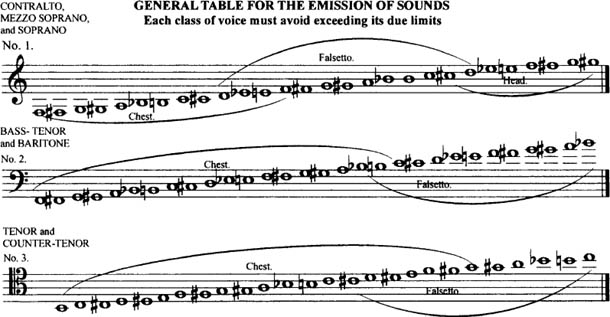
Example 9.1. Garcia’s Model of the Voice (1841).
Gilbert-Louis Duprez developed the concept of voix sombrée (singing with the lowered larynx). This was (and remains) essentially a more efficient way to force by lowering the pitch of the vocal tract and operating higher up in each register. The effect is to create a thick baritonal sound for tenors and a contralto-like quality for sopranos. Some people call this technique the do di petto or “chest” high C, but I think that this is another misnomer. It should be called the mezzo petto, or Upper Register, in Berton Coffin’s terminology. I will explain more about this later.
Manuel Garcia accommodated this new development (voix sombrée) by explaining the “formation of timbres”:
Many different causes may tend to modify the timbres of the voice. First—accordingly as the glottis closes or half-opens the sounds produced will be either bright or dull. Secondly—the folds or upper tendons surrounding it may either, by retiring, add volume to the sounds, or, by closing, produce a stifled tone. Thirdly—the pharynx may give the tones that pass through it, the varied qualities of timbre. The moment that a sound is emitted, it becomes subject to the influence of the vocal tube through which it passes; which tube, having the power of lengthening or shortening, contracting or expanding, and of changing its curvilinear form to that of a right angle, most perfectly fulfils the function of a reflector to the voice. Hence the varieties of timbre will correspond to the multitudinous mechanical changes of which the vocal tube is susceptible. We shall understand these movements of the pharynx, if we consider it as a deep and highly elastic pipe, beginning below the larynx, forming a curve at the arch of the palate, and ending above at the mouth; a tube, which, when at its shortest dimensions, forms only a slight curve, and at its longest, nearly a right angle; the larynx, in the first case, rising towards the soft palate, and the latter dropping to meet it; whereas, in the second case, the larynx drops and the soft palate rises; thus making the distance between them greater.
The short and gently curved shape produces the bright timbre; while the sombre is caused by the lengthened and strongly-curved form. There is also a close relation between the different vowel sounds and the various forms assumed by the pharynx. This subject will be especially considered when we speak of the fourth set of organs—those of the mouth.
In conclusion, our observations on timbres may all be comprised in the following brief precept or aphorism:—“Every change of method in producing vibrations, gives rise to a different timbre; and every modification that a sound undergoes during its passage through the vocal tube alters its character or quality.”18
Manuel Garcia was cognizant of the incompleteness of the previous (two-register) model of the voice. He made several very general statements that opened the door for further research by Berton Coffin and others on finer control of the vocal registers. Garcia remarked that male voices often had difficulty in keeping the notes F3 to A3 for basses and G3 to A-sharp3 for tenors in bright timbre in the chest voice. They were to combat this tendency by practicing in clear timbre on the A and E vowels with more and more openness, but were to gently round the voice—basses at A-flat3 and tenors at B3 or C3. He recommended that the bright timbre should be used to make the voice light and penetrating, but that basses should abandon it at D3 and tenors at F-sharp3 since any higher use of this timbre was disagreeable.
In Hints on Singing, Garcia engaged in the following dialog about the female voice:
Q. What of the head register?
A. This register forms the purest and brightest portion of the soprano voice; but frequently the charming softness, so pleasing in the high notes, is perversely turned into tormenting yells that almost injure the ear of the listener.
Q. When singing a long scale, say a twelfth, do you keep the same tint throughout?
A. If the exact timbre-shade were retained from top to bottom of a long scale the effect would be discordant. To satisfy the ear with the impression of equality, the singer by skilful gradation must increase the roundness of the high notes, and reverse the process in descending.
Q. But does not this method introduce a real inequality in the vowel sound?
A. It does; and the apparent inequality of the notes in the scale will be the result of actual but well graded inequality of the vowel sound. Without this manoeuvre, the round vowels, which are suitable to the higher notes, would extinguish the ringing of the middle and lower notes and the open vowels, which give éclat to the lower would make the higher notes harsh and shrill. The neglect of this proceeding causes many voices to appear unequal; but, I repeat, it must be used with moderation and taste.19
There is another text that deserves to be mentioned at this point: Esthetics of the Art of Singing (1885) by Enrico Delle Sedie, an early Italian Verdi baritone. Elizabeth Mannion gave me a copy of a very interesting vowel chart a number of years ago, which, I believe, was given to her by Gerhard Hüsch, the great German baritone and a student of Delle Sedie. This is from the earliest known text that takes into account the acoustical discoveries of Helmholtz, and it anticipates Berton Coffin by almost a hundred years. It is essentially a guide to vowel modification and is based on the French [a]. Delle Sedie observed that sympathetic vibration of the vocal tract (tuning) always improves the quality of the voice. He was also emphatic about the importance of the attack of the tone in ensuring the quality of the primary vibration.
QUESTIONS
It is clear from these statements that there is more to be considered here than just the problem of which register to sing in. There are other questions to be answered:
1. How many registers are there anyway?
2. Does one register begin where the other one leaves off or do they overlap?
3. If they overlap, how many registers can there be on one note?
4. How are the registers controlled?
5. How do the acoustics of the voice affect the vibrations of the vocal cords?
6. Why is it necessary to alter the vowel in a scale in order for the voice to appear even?
7. Why does it seem impossible to sing certain vowels on certain pitches in a song while other vowels seem to be very comfortable on the same pitch?
8. Why are certain vowels, such as [i] or [u], not resonant, while others like [a] are extremely resonant, but seem to be difficult to keep in the register?
9. If we sing in bright or sombre timbre, should we hold any set position of the vocal organs?
10. How are we to negotiate the passaggi (or transitions) between registers?
11. Many singers with robust voices notice that there is difficulty, on certain vowels, rising above the B flat5 for sopranos, A flat5 for mezzos, A4 for tenors, and F-sharp4 for baritones. What is the reason for this?
These questions have plagued even great singers over the years, and most have solved these difficulties with varying degrees of success, by a process of trial and error, without grasping the underlying causes. One is forced to conclude that there is something missing in the traditional two- or three-register concept that would supply some of the answers to our questions. G. B. Lamperti, known as the younger Lamperti, had this to say:
The singing voice is born from the overtones of regular vibration of the vocal cords.20
It is a strange fact that the throat is controlled by what happens above it, in the acoustics of the head, through word, vibration, and resonance.21
As I study the works of the master teachers and observe the behavior of my own voice and the voices of my students, I can readily accept the truth of Lamperti’s statement. However, these general statements are difficult to put into practice, because they are, like the inner workings of the voice, hard to visualize and organize.
Between Garcia’s era and ours, there have been countless books on singing published, a myriad of “new” theories, and many “experts” who promised “quick and easy” methods of singing. None, in my estimation, were any improvement on the traditional Italian methods of vocal pedagogy, although authorities like William Vennard, Johann Sundberg, and Richard Miller have added much to our knowledge of the way the voice actually functions. In 1980, with the publication of Overtones of Bel Canto, Dr. Berton Coffin laid out a practical and coherent system for the teaching of great singing, based on the precepts of the Bel Canto masters, organized in a twentieth-century way. In the next chapter we will consider the acoustical registers and the application of these studies to the classical concepts of Italian Bel Canto.
CONCLUSIONS
The vocal categories in the Middle Ages and the Renaissance were different than they are now. From the earliest times, vocal authorities had recognized the tendency of the voice to divide itself into two parts, usually called the voce di petto and the voce di testa. However, by the end of the sixteenth century, there were several registers clearly defined: the “throat bass,” used to extend the bass voice downward; the Chest Register, which encompasses most of the range of the male voice; the Mixed or Middle Register, used for the high notes in the male voice and the middle part of the female and boy soprano voices; and the Head Register, used for the high notes in the treble voices. It is also possible that the castrati used the Whistle Voice during this period. As we have learned, the elderly Sistine Chapel castrato Mustafá possessed the secret of this unique vibration early in the twentieth century. It is probable that the whistle voice was in use hundreds of years before this time. Several of the castrati, such as Gaetano Guadagni (c.1725–1792) and Girolamo Crescentini were renowned for their ethereal and supernaturally beautiful voices.
Pier Francesco Tosi and Giambattista Mancini wrote about the vocal registers in the eighteenth century. Mancini implies the existence of a middle register. The term chiaroscuro was coined to describe the vocal timbres. In 1837, Gilbert-Louis Duprez developed the technique of the voix sombrée, and Manuel Garcia II published his book The Art of Singing in 1841, which included his chart of the ranges of the individual voices and the location of the range of the registers. In 1885, Enrico Delle Sedie published a book that included a vowel chart, which utilized the discoveries of Helmholtz in the field of acoustics.
NOTES
1. Bernhard Ulrich, Concerning The Principles of Vocal Training during the A Capella Period and until the Beginning of Opera (1474–1640) (Minneapolis, Pro Musica, 1973) 20.
2. Manuel Garcia II, The Art of Singing, Part I (Boston: Ditson, c.1855) 6.
3. Garcia, The Art of Singing, Part I 6.
4. Giovanni Battista Doni wrote several treatises, including studies on ancient Greek music. He also invented, or reconstructed, a double lyre that he called “Amphichord.”
5. Ulrich, Concerning The Principals of Vocal Training 100.
6. Ulrich, Concerning The Principals of Vocal Training 103. Zacconi was one of the most important theorists of the early Italian school. His most important work was Prattica di musica utile et necessaria si al compositore . . . si anco al cantore (Musical Practice Useful and Necessary for One to Compose and also to Sing), published in 1592.
7. Mersenne (Mersennus) was a French priest who taught philosophy and who studied deeply both music and mathematics. His most important work was Harmonie universelle of 1636. Mersenne was the codiscoverer of the overtones because he was the first to recognize the real significance of the position of the back of the tongue in forming vowels.
8. Ulrich, Concerning The Principles of Vocal Training 106.
9. Pier Francesco Tosi (1714–1800) was a concert singer and composer. His treatise, Observations on the Florid Song of 1723, has been a primary source of information about the performance practice for singers of the seventeenth and early eighteenth centuries. Tosi wrote but little about vocal technique, but his advice to singers and teachers about the art of singing is still pertinent today. He was a staunch advocate of high standards for the profession, and, in the era where there was so much empty virtuosic display, he demanded that the heart rule the throat. Giambattista Mancini (1716–1800) was a student of Antonio Bernacchi and was appointed singing master to the Royal Court in Vienna in 1760. In 1774, Mancini published Practical Reflections on Figured Singing that contained more technical information than Tosi’s book had. It also includes an extensive listing of some of the great singers of that storied age.
10. Giambattista Mancini, Practical Reflections on Figured Singing (Champaign, IL: Pro Musica, 1967) 20.
11. Allesandro Moreschi (1858–1922) was the last castrato. He was employed by the Sistine Chapel until 1913 and made several records around the turn of the century. Moreschi’s voice is that of the only castrato on record and he was certainly no Farinelli! Particularly egregious are the register breaks, and I would not draw any conclusions as to where they were located in the seventeenth and eighteenth centuries from Moreschi’s singing. As historical documents, however, Moreschi’s records are fascinating.
12. Phillip A. Duey, Bel Canto in its Golden Age (New York: King’s Crown, 1951) 115. Edward V. Foreman tells me that this quote is a fabrication of Buzzi. Even so, the truth is still valid, regardless of who its father is.
13. Mancini, Practical Reflections on Figured Singing 42.
14. William Earl Brown, Vocal Wisdom: Maxims of Giovanni Battista Lamperti (New York: Arno, 1931) 61.
15. Berton Coffin, Overtones of Bel Canto (Metuchen, NJ: Scarecrow, 1980) 171.
16. Manuel Garcia II, Hints on Singing (London: Ascherberg; New York: Schuberth, 1894) 8.
17. Garcia, The Art of Singing, Part I 9, 15.
18. Garcia, The Art of Singing, Part I 7–8.
19. Garcia, Manuel, Hints on Singing 16–17
20. Brown, Vocal Wisdom 19.
21. Brown, Vocal Wisdom 66.